Introduction
India is experiencing a double burden of malnutrition (Drèze and Sen, Reference Drèze and Sen2013; Ramachandran, Reference Ramachandran2006; Subramanian et al., Reference Subramanian, Kawachi and Smith2007). One-third (31%) of under-nourished children worldwide live in India (Development Initiatives, 2018). In 2015, 38.4% of Indian children under age 5 were stunted, and 58.6% of pre-school aged children suffered from anaemia (IIPS, 2017). Over 820 million people globally experience food insecurity (FAO et al., 2019), with 1 in 9 of these living in India (FAO, 2014). Recent estimates suggest less than 10% of Indian children aged 6-23 months receive an adequate diet, and India is in the bottom 20 countries globally ranked by Global Hunger Index score (von Grebmer et al., Reference von Grebmer, Bernstein, Mukerji, Patterson, Wiemers and Ni Cheilleanchair2019). Previous research has linked undernutrition and food insecurityFootnote 1 to diminished cognition (Crookston et al., Reference Crookston, Dearden, Alder, Porucznik, Stanford, Merrill, Dickerson and Penny2011; Sandjaja et al., Reference Sandjaja, Poh, Rojroonwasinkul, Nyugen, Budiman and Ng2013), poorer learning outcomes (Aurino et al., Reference Aurino, Fledderjohann and Vellakkal2019; Crookston et al., Reference Crookston, Dearden, Alder, Porucznik, Stanford, Merrill, Dickerson and Penny2011), limited social skills (Jyoti et al., Reference Jyoti, Frongillo and Jones2005), and mortality (Black et al., Reference Black, Allen, Bhutta, Caulfield, De Onis, Ezzati, Mathers and Rivera2008; Christian, Reference Christian2010; Fledderjohann et al., Reference Fledderjohann, Agrawal, Vellakkal, Basu, Campbell, Doyle, Ebrahim and Stuckler2014, Reference Fledderjohann, Vellakkal, Khan, Ebrahim and Stuckler2016).
Meanwhile, the prevalence of insulin resistance is escalating due to overweight and obesity (Ramachandran, Reference Ramachandran2006), initially concentrated in urban areas and among children from higher socioeconomic backgrounds (Wang et al., Reference Wang, Chen, Shaikh and Mathur2009), but increasingly incident in low- and middle-income groups (Vellakkal et al., Reference Vellakkal, Subramanian, Millett, Basu, Stuckler and Ebrahim2013). Overweight and obesity have likewise been linked to negative outcomes such as stigma (Pont et al., Reference Pont, Puhl, Cook and Slusser2017) and poorer physical health (Davidson et al., Reference Davidson, Mackenzie-Rife, Witmans, Montgomery, Ball, Egbogah and Eves2014) in a variety of contexts.
In addition to the considerable impacts on well-being, malnutrition has long-term implications for economic development. Taken together, the economic burden of malnutrition in India is estimated to be between 0.8 and 2.5% of the GDP (Crosby et al., Reference Crosby, Jayasinghe and McNair2013), with long-term implications for the intergenerational transmission of poverty. Notably, however, extant research demonstrates that malnutrition and food insecurity are not exclusively problems of poverty, neither in India (Aurino et al., Reference Aurino, Fledderjohann and Vellakkal2019) nor elsewhere (Garratt, Reference Garratt2019).
Ensuring the right to food
In response to high rates of undernutrition, the Government of India passed the landmark National Food Security Act in 2013 (Pillay and Kumar, Reference Pillay and Kumar2019). While several governmental programmes targeting malnutrition have been in place in India for decades, the Act establishes the schemes as legal entitlements. This action is in contrast to the recent, much-criticized approach in many high-income countries (e.g. Great Britain), where food insecurity is framed as an individual problem rather than a structural issue, and charitable organizations are left to fill the gap (Garratt, Reference Garratt2019; Lambie-Mumford, Reference Lambie-Mumford2013; Loopstra et al., Reference Loopstra, Fledderjohann, Reeves and Stuckler2018). India’s framing of food security as an entitlement is in principle consistent with the right to food established in Article 25 of the UN Declaration of Human Rights (United Nations, 1948) and the International Covenant on Economic, Social and Cultural Rights (OHCHR, n.d.). Within this framework, states have an obligation to prevent hunger, provide food where citizens are unable to do so for themselves due to structural constraints, and facilitate citizens’ access to/utilization of resources.
One potential means by which states can meet the right to food is through food aid programmes. From a theoretical perspective, the effect of in-kind food aid is ambiguous. It is plausible that subsidies for staples such as rice could improve nutrition outcomes by increasing caloric intake and/or by freeing scarce household resources to spend on more diverse, nutrient-dense foods, e.g. vegetables, legumes. Some evidence shows a strong association between expanding food subsidy programmes, improved living conditions, and lower health inequalities (Drèze and Sen, Reference Drèze and Sen1991; Wilkinson and Marmot, Reference Wilkinson and Marmot2003). If the amount of in-kind food aid is inframarginal, i.e. does not exceed the amount a household would normally consume, the food aid should have the same effect as a cash transfer (Krishnamurthy et al., Reference Krishnamurthy, Pathania and Tandon2017).
On the other hand, food subsidies are often criticized for not reflecting the complex real-life experiences and perceptions of the food-insecure people they intend to serve (Pottier, Reference Pottier1999). Nutrition-related policies often rely on people to access health knowledge and make healthy dietary choices on an individual level (Wilson, Reference Wilson1989). Wilson contends that this compounds socioeconomic inequalities in nutrition, invoking Sen’s (Reference Sen2001) capability approach to argue that structural factors severely impair freedom to function in the context of diet and nutrition. Indeed, several studies (Jensen and Miller, Reference Jensen and Miller2008a; Pottier, Reference Pottier1999) demonstrate food consumption is far more complex than a simple economic transaction, occasionally defying basic economic principles. Evidence from China suggests where households receive subsidies for staple food items, they make substitutions that do not improve the nutritional content of diets, and may spend more on non-food items (Jensen and Miller, Reference Jensen and Miller2011). Using subsidies to make certain commodities more accessible might incentivize eligible households to consume more of these commodities.
Public Distribution System (PDS)
The PDS is India’s main governmental food and nutrition security (FNS) programme to combat malnutrition. It provides subsidised staple foods – primarily rice, sugar, wheat, and cooking oil (Government of India, 2005). Eligibility varies between states, but in general is means-tested based on income and household assets, with more provisions – larger quantity and highly subsidised price – for Below Poverty Line households (Central Vigilance Committee, 2009). In 2010, about half of rural and two-fifths of urban households in the lowest wealth tertile accessed rice through the PDS (authors’ calculations, Consumer Expenditure Survey National Sample Survey Organization, 2010). In the state where our study focuses (Andhra PradeshFootnote 2, hereafter AP), the PDS functions well: up to 100% of households accessing the PDS indeed receive the full food quantity they are entitled to with very low variation. However, the programme has also been criticized for alleged corruption (Jha et al., Reference Jha, Gaiha, Pandey and Kaicker2013; NDTV, 2010; Pandey, Reference Pandey2011; Pillay and Kumar, Reference Pillay and Kumar2019). The PDS provides rice, sugar, wheat flour, and red gram (dahl/pulses), but by quantity, rice and sugar are by far the most common provisions in AP.
Compared to other cereals, rice has a very low content of iron, protein and fibre (WHO, 2014). Much of rice’s nutritional value is lost during processing and preparation. Some studies of rice and wheat consumption find adverse associations with nutritional outcomes (Gangopadhyay et al., Reference Gangopadhyay, Lensink and Yadav2013; Jensen and Miller, Reference Jensen and Miller2011; Tarozzi, Reference Tarozzi2005), while others find no such link (Ecker and Qaim, Reference Ecker and Qaim2011; Kochar, Reference Kochar2005). Recent studies underline that the consumption of highly polished white rice significantly increases blood glucose levels compared to the consumption of brown rice (Mohan et al., Reference Mohan, Spiegelman, Sudha, Gayathri, Hong and Praseena2014; Shobana et al., Reference Shobana, Kokila, Lakshmipriya, Subhashini, Ramya Bai and Mohan2012). WHO’s guidelines recommend reducing the sugar intake to <5% of the total energy intake per day, i.e. 25g for an average adult (World Health Organization, 2015). This corresponds to growing evidence and a broad recognition that sugar has strong, negative impacts on health (Basu et al., Reference Basu, Yoffe, Hills and Lustig2013; Lustig et al., Reference Lustig, Schmidt and Brindis2012; Taubes, Reference Taubes2017; World Health Organization, 2015). Sugar consumption is associated with overweight, diabetes, and cardiovascular diseases (Johnson et al., Reference Johnson, Segal, Sautin, Nakagawa, Feig, Kang, Gersch, Benner and Sánchez-Lozada2007; Malik et al., Reference Malik, Schulze and Hu2006). Increased consumption of rice and sugar would be unlikely to improve nutrition outcomes and could even worsen some outcomes.
Evidence on whether food subsidies through the PDS improve dietary intake and reduce nutritional risks is mixed, tends to be cross-sectional, and is limited to certain food items. Several studies found a link between accessing PDS subsidies and improved dietary diversity and caloric intake (Chakrabarti et al., Reference Chakrabarti, Kishore and Roy2018; Kaul, Reference Kaul2014; Kishore and Chakrabarti, Reference Kishore and Chakrabarti2015; Rahman, Reference Rahman2016), though sometimes operating through consumption of items not directly provided by the PDS (Kaul, Reference Kaul2014). Others found an increase in the consumption of the subsidised staple food at the expense of more nutrient-dense non-staple foods (Desai and Vanneman, Reference Desai and Vanneman2015; Kaushal and Muchomba, Reference Kaushal and Muchomba2015; Khera, Reference Khera2011a; Shankar Shaw and Telidevara, Reference Shankar Shaw and Telidevara2014). For instance, families receiving rice through the PDS may not increase expenditure on cereals, but instead spend saved money on pulses, oil, vegetables, and sugar (Kishore and Chakrabarti, Reference Kishore and Chakrabarti2015). Kaushal and Muchomba (Reference Kaushal and Muchomba2015) found that price reductions arising from rice (and wheat) subsidies are associated not with increased caloric and protein intake, but with increased consumption of rice and sugar. Desai and Vanneman (Reference Desai and Vanneman2015) also found that PDS users consume more cereals, and further showed spending on other items such as fruit and milk is reduced in favour of items that can be purchased cheaply through the PDS.
Work in China and India has also found a link between food prices and nutrition outcomes (Chakrabarti et al., Reference Chakrabarti, Kishore and Roy2018; Jensen and Miller, Reference Jensen and Miller2008b). This work, however, lacks a specific focus on nutritionally vulnerable groups whom the PDS aims to support, particularly young children. While longitudinal work on food prices and child nutrition is limited, some recent work has shown that an increase in food prices during the Global Recession was associated with an increase in wasting in India (Vellakkal et al., Reference Vellakkal, Fledderjohann, Basu, Agrawal, Ebrahim, Campbell, Doyle and Stuckler2015).
Food aid has the potential to reduce hunger and malnutrition, mitigating the effects of poverty and economic shocks (e.g. rising prices) by providing for dietary needs and/or freeing up monetary resources. However, the effectiveness of food aid may depend on the nutritional quality of the items on offer. We hypothesize that PDS subsidies increase rice and sugar consumption, crowding out nutritionally rich food sources and thereby failing to reduce the risk of stunting.
The remainder of the paper will (1) provide an overview of the methods used to test this hypothesis, including a description of the data and statistical modelling techniques; (2) present the results of the analysis and robustness checks; and (3) discuss the results in light of existing literature, strengths and limitations of the study and the implications of the findings for social policy.
Methods
Data
Data on children’s nutrition came from the longitudinal Young Lives (YL) Survey, conducted in APFootnote 3. These secondary data are anonymized, and publicly available with user registration (Oxford Department of International Development, n.d.); no ethics approval was required for analysis. The survey is described elsewhere (Galab et al., Reference Galab, Reddy, Antony, McCoy, Ravi, Raju, Mayuri and Reddy2003). Briefly, it tracks two cohorts of children from infancy through childhood and adolescence. The cohorts were aged 6-12 months (n = 2,011) and 8 years (n = 1,008) at recruitment in 2002. Five waves of data have been collected. We used data for waves 2 (2006) and 3 (2009) since food consumption data were not collected for the younger cohort due to their age in the first wave, and subsequent waves are not matchable to our second data source (below). Mothers or primary caregivers reported for young children and the household. In 2009, the older cohort self-reported food consumption in the last 24 hours. Overall attrition was low – 4.0% and 3.2% respectively for the young and old cohort between 2002-2009 (Barnett et al., Reference Barnett, Ariana, Petrou, Penny, Duc and Galab2013).
Measures
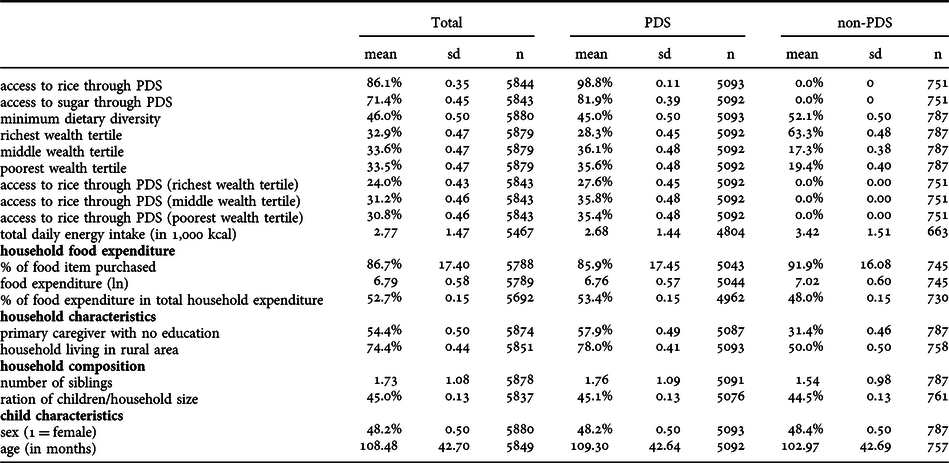
Access to the PDS was measured based on primary caregivers’ responses to the question, “If you are accessing PDS, which of the following items are you receiving” (Young Lives Study, 2006). Respondents answered yes/no for whether their household received each of the following from the PDS: rice, dahlFootnote 4, sugar, kerosene, and others. We created a dichotomous indicator for each food item (1 = accessed item). We measured household wealth as a categorical measure in tertiles based on a composite index of housing quality, consumer durables, and housing services. Although the PDS is a means-tested program, not all poor households access the PDS, and many wealthier households still receive subsidized food (Jha et al., Reference Jha, Gaiha, Pandey and Kaicker2013; Khera, Reference Khera2011a); PDS receipt is therefore not a proxy for poverty, nor for food insecurity. We therefore compare households which did and did not access the PDS in Table 1 to identify whether/how these households differ on key indicators.
Descriptive statistics for PDS households, non-PDS households, and all households, young and old cohort, Young Lives Waves 2-3, 5,879 observations

Food consumption was based on mothers’ reports on household expenditures in Indian rupees during the last two weeks (15 days in wave 3) for 20 food items. Taken together with price data from local market hubs for AP from NSSO’s Consumer Expenditure Surveys in the associated years, we calculated consumption quantity. NSSO data are available for purchase from the Indian Ministry of Statistics and Programme Implementation (National Sample Survey Organization, 2014). Following Vellakkal et al. (Reference Vellakkal, Fledderjohann, Basu, Agrawal, Ebrahim, Campbell, Doyle and Stuckler2015), we calculated food consumption in kcal for nine different food groups (rice, sugar, pulses, meat, fish, milk, eggs, fruit and vegetables), with household weights applied for PDS access, wealth tertile, and child’s age (see Web Appendix). Caloric intake by food group was then used to calculate for each child: (1) total daily calorie intake as sum of calorie intake from food items from all nine food groups; (2) share of total food energy from sugar (kcal from sugar/total kcal); and (3) share of total food energy from rice (kcal from rice/total kcal).
Notably, NSSO CES data collection is slightly mismatched to the YL data. While the YL data were collected in 2006 and 2009, the NSSO CES were collected in 2005 and 2010. However, it is reasonable to assume that price variations between 2005-2006 (and 2009-2010) were uniform across villages within districts. In other words, although the absolute amount of rice, sugar, and calorie consumption might be under or overestimated, the differences between households remain constant. Concerns regarding the mismatch of data sets used in this paper therefore do not impose serious concerns for the analyses. However, measurement error introduced by our data limitations would make it more difficult to detect a significant association between the PDS and signs of malnutrition, resulting in a conservative bias.
Our dietary diversity score is based on a 24h recall of the child’s consumption across seven food groups (grains, roots, tubers; legumes, nuts; dairy; flesh foods; eggs; vitamin-A-rich fruits and vegetables; other fruits and vegetables). According to WHO, a minimum dietary diversity requirement is met if the child consumed food items from at least four different food groups in the 24 hours prior to the interview (World Health Organization, UNICEF, 2010). Following standard methods, stunting was based on two standard deviations below the mean internationally standardized height-for-age score (HAZ). Children with an age-standardized BMI two standard deviations below the mean were coded as having low BMI. Observations with missing values in at least one of the relevant variables were excluded listwise from the analysis (n = 631), leaving a final analytical sample of 5,279 observations.
Statistical modelling
We used two-stage linear probability models to test sequentially the associations between access to subsidised food and food consumption and, subsequently, the association between this subsidised food consumption and nutritional outcomes, as follows:
 $$\displaylines{
Rice{\mkern 1mu} consumptio{n_i} = {b_0} + {\beta _1}{\mkern 1mu} {\rm{*}}{\mkern 1mu} PD{S_i} + {\beta _2}{\mkern 1mu} {\rm{*}}{\mkern 1mu} wealt{h_i} + {\beta _3}{\mkern 1mu} {\rm{*}}{\mkern 1mu} (PD{S_i}{\mkern 1mu} {\rm{*}}{\mkern 1mu} wealt{h_i}) \cr
+ {\beta _4}{\mkern 1mu} {\rm{*}}{\mkern 1mu} {\rm{Sociodemographi}}{{\rm{c}}_i} + {\beta _5}{\mkern 1mu} {\rm{*}}{\mkern 1mu} {\rm{Household}}{\mkern 1mu} {\rm{Tota}}{{\rm{l}}_i} \cr
+ {\beta _6}{\mkern 1mu} {\rm{*}}{\mkern 1mu} {\rm{Period}}{\mkern 1mu} {\rm{and}}{\mkern 1mu} {\rm{Cohort}}{\mkern 1mu} {\rm{Effec}}{{\rm{t}}_i} + {\varepsilon _i} \cr} $$
 $$\displaylines{
Undernutritio{n_i} = {b_0} + {\beta _1}{\rm{*}}{\mkern 1mu} Rice{\mkern 1mu} consumption_i^* \cr
+ {\beta _2}{\mkern 1mu} {\rm{*}}{\mkern 1mu} wealt{h_i} + {\beta _3}{\mkern 1mu} {\rm{*}}{\mkern 1mu} (PD{S_i}{\mkern 1mu} {\rm{*}}{\mkern 1mu} wealt{h_i}) + {\beta _4}{\mkern 1mu} {\rm{*}}{\mkern 1mu} {\rm{Sociodemographi}}{{\rm{c}}_i} \cr
+ {\beta _5}{\mkern 1mu} {\rm{*}}{\mkern 1mu} {\rm{Household}}{\mkern 1mu} {\rm{Tota}}{{\rm{l}}_i} \cr
+ {\beta _6}{\mkern 1mu} {\rm{*}}{\mkern 1mu} {\rm{Period}}{\mkern 1mu} \,{\rm{and}}{\mkern 1mu} \,{\rm{Cohort}}{\mkern 1mu} {\rm{Effec}}{{\rm{t}}_i} + {\varepsilon _i} \cr} $$
Here, i is indicator for the index child. PDS is the dichotomous indicator of access. Wealth is our control for household wealth. Sociodemographic captures individual level controls, which include a dichotomous measure of whether the primary caregiver had any formal education, number of siblings, ratio of dependent children under the age of 16 to the total household size, child’s daily caloric intake averaged over 15 days, child’s age in months, and a dichotomous indicator of whether the child was female. Household includes the total logged household food expenditure for bought food items, the share of bought food items among all food expenditure, and the share of food expenditure among the total household expenditure for food and non-food items, as well as whether the household is part of a rural community. Since the sample followed two cohorts over time, we also controlled for period and cohort, and an interaction between access to the PDS and wave 3. Our choice of two-stage linear probability models captures the indirect association between PDS access and undernutrition, operating through children’s food item consumption. All analyses were conducted using Stata 12.1. For a full description of variable calculations, see the Web Appendix.
Results
The pooled analytic sample comprises 5,279 observations from 2,944 children, with 66.3% of the sample (n = 1,950) drawn from the young cohort and 33.7% (n = 994) from the old cohort. The sample is fairly evenly split by gender (48% female). Children’s ages range between 55-191 months (4-15 years) pooled across waves. On average, children have 1.73 siblings. Over half (54.4%) of primary caregivers have no formal education, and around three quarters (74.4%) of the sample live in rural areas. Approximately 87% of households accessed at least one item through the PDS, with 86.1% accessing rice and 71.4% accessing sugar. In general, rice consumption is very high, equivalent to 55% to 65% of total caloric intake. Around 34% of children are stunted, and 26% have low BMI.
Comparing sociodemographics split by PDS access (Table 1), nearly all (98.8%) households that accessed at least one item through the PDS received rice, and most (81.9%) received sugar. Dietary diversity among this group was somewhat lower than for children in non-PDS households (45.0% vs. 52.1% respectively). Although the PDS is means-tested, nearly one-fifth (19.4%) of households in the poorest wealth tertile did not access any items through the PDS, while more than one-quarter (27.6%) of those in the wealthiest tertile did so. Caloric intake differed by PDS receipt, with non-PDS households consuming an average of 3,420 calories daily, compared to 2,680 in PDS households. PDS households also tended to spend somewhat less on food, but this comprised a higher share of the total household expenditure. A higher proportion of caregivers in PDS vs. non-PDS households had no formal education (57.9% vs 31.4% respectively), and PDS households were more likely to be located in rural areas (78.0%) compared to non-PDS households (50.0%). Household composition and children’s age and sex were not markedly different between PDS and non-PDS households.
PDS access to sugar and consumption
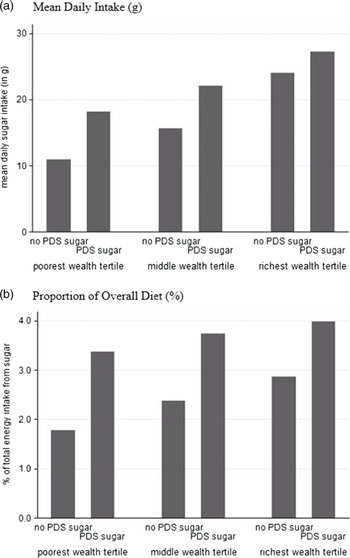
Figure 1 shows the mean quantity of daily sugar consumption in grams (a) and the dietary proportion of energy intake from sugar (b) by household wealth and access to sugar through the PDS. Children living in wealthier households tend to consume greater quantities of sugar, both in relative terms, as seen by the increase in mean consumption across wealth tertiles, and absolute terms (top), as seen by the increase by wealth tertile in the proportion of energy intake comprised by sugar (bottom). PDS access also corresponds to greater sugar consumption across wealth tertiles. As shown in Figure 1, children in households with access to subsidised sugar through the PDS consume between 3 and 7g (or 1.4 to 1.9 times) more sugar than children without access to the PDS with similar household wealth.
Sugar consumption in total kcal and share of food energy intake, by access to sugar through the PDS, young and old cohort, Young Lives

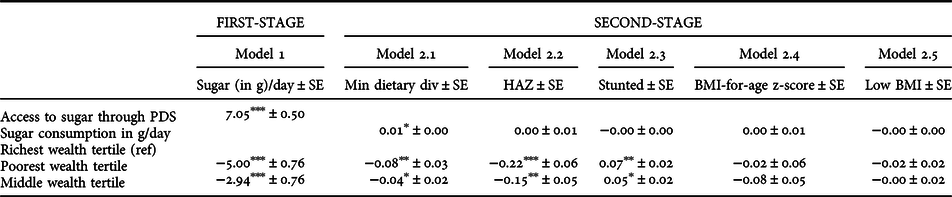
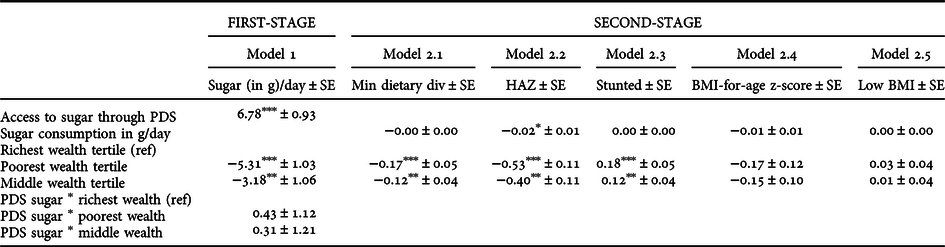
Model 1 in Table 2 provides the results of the first-stage linear probability models assessing the association of PDS sugar access with sugar consumption. Access to subsidised sugar is associated with 7.05g higher sugar consumption per day (b = 7.05; p < 0.001). Notwithstanding this association, children in the poorest wealth tertile consume 5.00 fewer grams (p < 0.001) and those in the middle wealth tertile consume 2.94 fewer grams (p < 0.001) of sugar compared to children in the wealthiest households. Introducing an interaction term (Model 1, Table 3), we do not observe a significant interaction effect between household wealth and access to PDS sugar on sugar consumption.
Linear probability of malnutrition, sugar consumption, and access to sugar through the PDS, young and old cohort, Young Lives Waves 2-3, 5,279 observations

Notes Estimates of 2nd stage of 2SLS difference model. 1st and 2nd stage models are adjusted for household food expenditure, household composition, other household characteristics, child characteristics, period effect, and duration dependency. Robust standard errors reported; * p < 0.05, ** p < 0.01, *** p < 0.001.
Linear probability of malnutrition, sugar consumption, and access to sugar through the PDS interacted with household wealth, young and old cohort, Young Lives Waves 2-3, 5,279 observations

Notes Estimates of 2nd stage of 2SLS difference model. 1st and 2nd stage models are adjusted for household food expenditure, household composition, other household characteristics, child characteristics, period effect, and duration dependency. Robust standard errors reported; * p < 0.05, ** p < 0.01, *** p < 0.001.
PDS access to rice and consumption
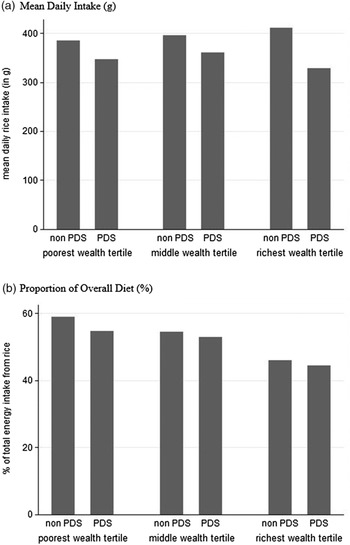
Figure 2 shows the mean quantity of daily rice consumption (top) and the dietary proportion of rice (bottom) by household wealth and access to rice through the PDS. Although children in households with access to PDS rice consume less rice in absolute terms, their share of rice in the total caloric intake is similar to that of those children without PDS rice access.
Rice consumption in total kcal and share of food energy intake, by access to rice through the PDS, young and old cohort, Young Lives

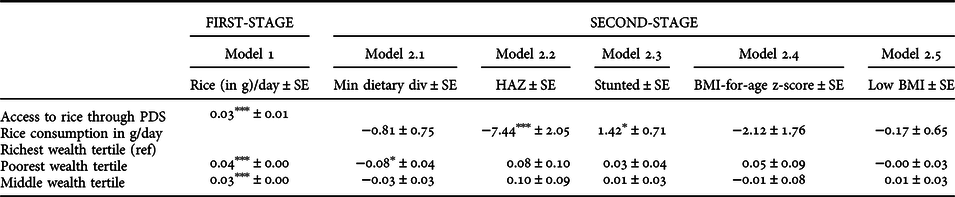
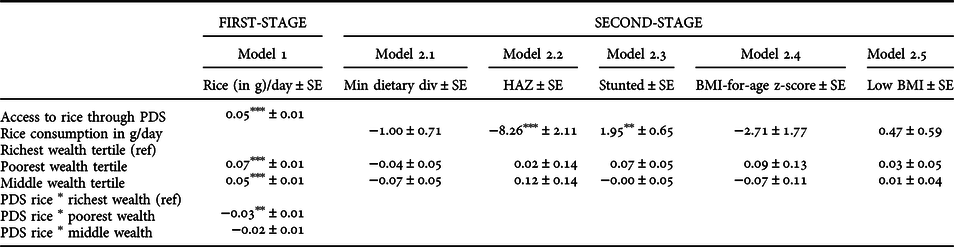
Model 1 in Table 4 provides the results of the first-stage linear probability models of PDS rice access and rice consumption. Children with access to rice through the PDS consume on average 30g (b = 0.03; p<0.001) more rice daily. Compared to children in wealthier households, children in the middle-wealth and low-wealth tertiles consume 40g and 30g more rice daily (b = 0.04; p<0.001 and b = 0.03; p < 0.001) respectively. However, the association between access to rice through the PDS and rice consumption varies by wealth. When we introduce an interaction term (Model 1 in Table 5), access to PDS rice adds an additional 50g of rice to the daily intake of children in wealthiest households, while it only adds 30g and 20g of rice respectively to the diets of children in middle and low-wealth tertiles. In short, access to PDS rice is associated with an increased consumption of rice, especially among children from wealthier households, who consume less rice overall than those in poorer households.
Linear probability of malnutrition, rice consumption, and access to rice through the PDS, young and old cohort, Young Lives Waves 2-3, 5,279 observations

Notes Estimates of 2nd stage of 2SLS difference model. 1st and 2nd stage models are adjusted for household food expenditure, household composition, other household characteristics, child characteristics, period effect, and duration dependency. Robust standard errors reported; * p < 0.05, ** p < 0.01, *** p < 0.001.
Linear probability models of malnutrition, rice consumption, and access to rice through the PDS interacted with household wealth, young and old cohort, Young Lives Waves 2-3, 5,279 observations

Notes Estimates of 2nd stage of 2SLS difference model. 1st and 2nd stage models are adjusted for household food expenditure, household composition, other household characteristics, child characteristics, period effect, and duration dependency. Robust standard errors reported; * p < 0.05, ** p < 0.01, *** p < 0.001.
PDS-access, stunted growth, and BMI
By combining estimates from our first-stage models of the association of PDS access with food consumption with the second-stage models of the association of food consumption with nutrition outcomes, we quantified the potential reduction in nutritional risks linked to the PDS. Turning first to sugar, Models 2.1-2.5 in Table 2 show the results of the second-stage models. A 1 gram increase in sugar consumption is associated with a marginally significant increase in the likelihood of receiving an adequately diverse diet by 1% (b = 0.01; p<0.05), but there is no association between sugar consumption and stunting, HAZ, nor BMI. Multiplying the coefficient for access to PDS sugar on consumption in the first-stage by the coefficient for sugar consumption in the second-stage, children with access to PDS sugar have a 0.1% (95% CI:-0.00; 0. 14) higher chance of receiving an adequately diversified diet compared to those with no PDS access to rice. We did not find a significant interaction between wealth and access to PDS sugar in the first-stage, and so observe no considerable change in the coefficients with the inclusion of the interaction (Table 3, Models 2.1-2.5).
Turning next to rice, the second-stage models (excluding the first-stage wealth interaction) are provided in Models 2.1-2.5 of Table 4. Each 1kg increase in rice consumption is associated with a lower HAZ (b = −7.44; p < 0.001) and increased probability of stunting (b = 1.42; p < 0.05), but not with the likelihood of receiving an adequately diversified diet nor BMI.
Combining the first-stage effect of access to PDS rice on consumption with the second-stage coefficient for rice consumption, access to PDS rice is associated with a lower HAZ by −0.22 (95% CI:0.13; 0.33) and an increased risk of being stunted by 4% (95% CI:0.02; 0.07). We observed a significant interaction between wealth and PDS rice in the first-stage model, suggesting that the association between access to PDS rice and consumption varies by wealth (Models 2.1-2.5 in Table 5). PDS rice is associated with a lower HAZ by −0.41 (95% CI:0.27; 0.55) and −0.17 (95% CI:0.07; 0.26) and an increased risk of stunting by 10% (95% CI:0.06; 0.14) and 4% (95% CI:0.02; 0.06) respectively for children in high and middle-wealth households. For children in the poorest households, access to PDS rice is associated with a −0.25 (95% CI:0.14; 0.35) decrease in HAZ and an elevated risk of stunting by 6% (95% CI:0.03; 0.09). Access to rice through the PDS appears to be negatively associated with children’s long-term growth trajectory, especially for children in wealthier households. Wealth appears to act on nutrition outcomes through the level of rice consumption.
Robustness checks
We performed several tests of our model’s specification. First, we ran a Propensity Score Matching Model (PSMM)Footnote 5, allowing us to estimate the effect of receipt of PDS-subsidised rice and sugar as a treatment effect. However, since access to the PDS is very high, especially among poorer households, this did not yield reliable results. Analyses were only possible when the sample was split by wealth tertiles. Nevertheless, the split sample yielded very similar results as the models described above, particularly in reference to the association between PDS access, wealth, and nutrition. Access to subsidised sugar is associated with a non-significant increase in the likelihood to receive an adequately diverse diet by 4% across all wealth tertiles, but is not associated with negative nutrition outcomes. Furthermore, while access to subsidised rice yields better nutrition outcomes for children in the lowest wealth tertile, for the middle and wealthiest tertile it is associated with lower HAZ (TE = −0.23; SE = 0.14 and TE = −0.38; SE = 0.14 respectively) and a higher risk of stunting (TE = 0.09; SE = 0.06 and TE = 0.11; SE = 0.05 respectively).
Second, considering that dietary guidelines normally include recommendations regarding the share of caloric intake from given foods (U.S. Department of Agriculture and U.S. Department of Health and Human Services, 2010), we replicated our models using share of food energy from sugar and rice instead of the absolute sugar and rice consumption. Access to PDS sugar and rice is associated with an increase in the share of sugar and rice in the total caloric intake by 1.04 and 3.39 percent points respectively. For easier interpretation of the estimates, the models using the absolute consumption was chosen.
Third, we disaggregated the models by child sex. Consistent with evidence of son-preference (Aurino, Reference Aurino2017; Pal, Reference Pal1999; Sen and Sengupta, Reference Sen and Sengupta1983), we found that boys received greater rice and sugar quantities in association with PDS access. This contrasts, however, with evidence that finds son preference in breastfeeding (Fledderjohann et al., Reference Fledderjohann, Agrawal, Vellakkal, Basu, Campbell, Doyle, Ebrahim and Stuckler2014; Jayachandran and Kuziemko, Reference Jayachandran and Kuziemko2011), but not in other food items (Fledderjohann et al., Reference Fledderjohann, Agrawal, Vellakkal, Basu, Campbell, Doyle, Ebrahim and Stuckler2014; Griffiths et al., Reference Griffiths, Matthews and Hinde2002; Maitra et al., Reference Maitra, Rammohan and Dancer2006). However, much of the literature that finds no gender difference in food distribution focuses on which food items girls and boys consume rather than how much. Here, in examining quantities of food consumed, we show that, through the PDS, consumption and nutrition outcomes are slightly stronger for boys than for girls in all models, but estimates do not differ substantially in their direction. Girls may be disadvantaged not in the content but in the quantity of food they receive, and that this may be compounded by limits on household food resources.
Fourth, some evidence suggests that factors associated with undernutrition differ in rural and urban communities (Fotso, Reference Fotso2007; Smith et al., Reference Smith, Ruel and Ndiaye2005). All analyses were run separately for households in urban and in rural communities. Associations for access to rice through the PDS and nutrition outcomes are slightly stronger in urban areas, but estimates do not differ substantially in their direction from those reported above. However, the association between access to sugar through the PDS and nutrition outcomes is much stronger in urban areas compared to rural areas.
Fifth, approximately 20% of all households reported consumption of at least one food item 2 SD above the respective mean. Considering each person has multiple measures, this observation is not surprising. Because over-reporting is not strictly random, single and multiple imputation would impose serious threats to introduce bias (Rubin, Reference Rubin2004). However, we ran all analyses with outliers excluded, and compared the results. Though the analyses which exclude outliers produce smaller standard errors, the estimates do not differ substantially.
Finally, to account for the possibility that eating patterns and household context vary systematically between the younger and older cohorts, we disaggregated the results by cohort. There was some minor variation in results, but they remained substantively unchanged. Results for these models are presented in the Web Appendix, with the full set of coefficients for all covariates presented.
Discussion
In this paper, we show that (1) accessing subsidised rice and sugar through the PDS is associated with an increase in both absolute and relative intake of rice and sugar, (2) access to subsidised sugar is associated with a very slight greater likelihood of an adequately diverse diet, and (3) additional proportions of rice did not reduce the risk of adverse long-term growth trajectories of children aged to 5 to 16. We also found evidence that the benefits from programmatic improvements to the PDS may be stratified by household wealth. Compared to poorer households, in wealthier households access to subsidised rice is related to greater additional rice consumption. The results of this study provide further evidence that, in their current form, India’s food subsidies may not yield nutritional benefits (Jensen and Miller, Reference Jensen and Miller2011; Kochar, Reference Kochar2005; Tarozzi, Reference Tarozzi2005) and may incentivise consumption of nutritionally inferior food items (Ecker and Qaim, Reference Ecker and Qaim2011; Gangopadhyay et al., Reference Gangopadhyay, Lensink and Yadav2013), especially in wealthier households.
Our study constitutes an important contribution to the evidence on food subsidy schemes and nutrition outcomes in several ways. First, it outlines a mechanism for how three important elements of household and child well-being might be associated: access to food, dietary intake, and nutritional risks. Second, the study uses high quality longitudinal data to track changes in children over time, thus contributing to emerging scientific evidence regarding factors associated with recovering from stunting (Crookston et al., Reference Crookston, Penny, Alder, Dickerson, Merrill, Stanford, Porucznik and Dearden2010; Himaz, Reference Himaz2009). Third, it provides much-needed empirical evidence on the association between accessing a key governmental program (the PDS) for targeting food security and child nutrition. In extant literature, the complexity of the challenges of ensuring adequate nutrition has been recognized. However, our results provide some evidence that current policies may not fully take this complexity into account.
Two related factors may drive the association between PDS sugar consumption and dietary diversity we observed. First, sugar consumption may serve as a proxy for dietary diversity – sugar is not nutritionally necessary, representing a frivolous addition to the diet. While food-insecure households may not prioritize sugar consumption, those with greater FNS and a more diverse basket of foods available may also consume sugar as a luxury once basic needs are met. Second, given its association with meal frequency, sugar consumption may reflect snacking on sugary treats among children in households with adequate FNS to support snacking.
Strengths and limitations
One strength of our paper is that it offers robust evidence from a unique combination of data sources, building on a mixed literature by linking the oft-used NSSO data with rich longitudinal data to examine the associations between subsidy receipt, quantities of specific foods consumed, and nutritional outcomes. We look specifically at outcomes for children during a global economic recession – a period characterized by rising food prices and worsening outcomes for children (Christian, Reference Christian2010; Fledderjohann et al., Reference Fledderjohann, Vellakkal, Khan, Ebrahim and Stuckler2016; Vellakkal et al., Reference Vellakkal, Fledderjohann, Basu, Agrawal, Ebrahim, Campbell, Doyle and Stuckler2015), during which PDS subsidies may have been a particularly important source of resilience for households. We carefully identified potential confounding factors and conducted a number of robustness checks, including using propensity score matching to account for observed confounders.
Nonetheless, our study has several limitations. First, it focuses on one state in Southern India, and cannot be generalized to the whole of India. Dietary content, nutritional challenges, and the efficiency and content of the PDS vary substantially from state to state (Chakrabarti et al., Reference Chakrabarti, Kishore and Roy2018; Jha et al., Reference Jha, Gaiha, Pandey and Kaicker2013; Krishnamurthy et al., Reference Krishnamurthy, Pathania and Tandon2017), and AP is one of five states to have implemented a unique ‘new-style’ PDS provision that includes extremely low rice prices and near-universal coverage (Drèze and Sen, Reference Drèze and Sen2013; Kishore and Chakrabarti, Reference Kishore and Chakrabarti2015). This statewise variation may to some extent help to explain why our findings differ from some previous evidence that has found no effects or positive effects of the PDS on nutritional outcomes.
Second, the PDS provides subsidised food to households over a sustained period of time, and not as part of an emergency plan to address short-term fluctuations in the availability of nutrients. Thus, we decided to focus on long-term nutritional outcomes (HAZ, stunting) in this study rather than short-term nutritional benefits (wasting). Children may benefit in the short run from access to subsidised food through the PDS, while such subsidies are detrimental if sustained over time. In a similar vein, given the sampling frame of the YL data, a test for the association of access to subsidised sugar with overnutrition and long-term health consequences of sugar consumption, such as cardiovascular diseases and diabetes, could not be explored in this study. Finally, we were not able to consider the consumption patterns of PDS pulses and the possible associations with child malnutrition. This is because pulses were not included in the PDS rations in AP during the time period examined here. It is possible that the availability of subsidised pulses would have a positive association with children’s nutritional outcomes.
Conclusions
Considering the large costs associated with the PDS and its contribution to government budget deficit (Sharma, Reference Sharma2012), our findings highlight the need to carefully monitor the impact of the scheme on children’s dietary diversity and nutritional outcomes. This does not suggest the need for a drastic overhaul of the PDS is needed per se. However, there is a need to further understand how access to different entitlement packages through the PDS might impact on the items and quantities of food consumed, and on the nutritional sequelae of dietary choices.
This study provides some initial evidence that several adjustments to the PDS may improve its performance. First, better targeting of the rice subsidy to those households with deficits in daily energy requirements could potentially improve gains. As we found no evidence of improvements in child HAZ, sugar could potentially be dropped from the PDS. Second, alternative incentive structures to consume an adequate, well-composed diet could be put into place. These might include social and behaviour change campaigns addressing the importance of an adequate nutrient intake and a balanced diet. However, such campaigns will be ineffective without structural support to empower families to make dietary changes (Wilson, Reference Wilson1989). Third, nutrient intake could be improved without changing existing consumption patterns through fortification of the food items provided as part of the PDS and the incorporation of more nutritious food items in the entitlement package.
Acknowledgements
No authors have any conflicts of interest to declare. Support for this project was provided by a grant from the Economic and Social Research Council, NWO-WOTRO, Population Reference Bureau, and Population, Reproductive Health, and Economic Development, and the RCN foundation joint research scheme. JB was partially funded by the Evangelisches Studienwerk e.V. Villigst through a basic scholarship. DS was funded by a Wellcome Trust Investigator Award. The funders had no role in the study design, data analysis, decision to publish, or preparation of the manuscript.
Supplementary material
To view supplementary material for this article, please visit https://doi.org/10.1017/S0047279420000380