INTRODUCTION
Relatives of palliative care (PC) patients are highly burdened during caregiving and bereavement (Kissane et al., Reference Kissane, McKenzie and McKenzie2003). Studies indicate that 30–50% suffer from depression, anxiety, or adjustment disorders, especially during the first months after the loss of the patient (Chentsova-Dutton et al., Reference Chentsova-Dutton, Shucter and Hutchin2002).
Mindfulness, a concept of growing impact in psychotherapy, has been shown to be effective for stress reduction and to help in coping with painful emotions (Kabat-Zinn, Reference Kabat-Zinn2003). Originally, it is a Buddhist concept and has been described as “the awareness that emerges through paying attention on purpose, in the present moment, and non-judgmentally to the unfolding of experience moment by moment” (Kabat-Zinn, Reference Kabat-Zinn2003). However, there is no consensus on a definition yet. A common distinction is between formal practice, particularly meditation, and informal mindful activity, i.e., present-centered awareness in daily routine. Dispositional mindfulness, a general tendency to be mindful in daily life, has been reported to correlate with mental health and well-being (Brown & Ryan, Reference Brown and Ryan2003; Feldman et al., Reference Feldman, Hayes and Kumar2007).
Several mindfulness-based interventions have been designed to use “the benefits of being present” (Brown & Ryan, Reference Brown and Ryan2003): Mindfulness Based Stress Reduction (MBSR) (Kabat-Zinn, Reference Kabat-Zinn2003) has been applied to several conditions and settings (e.g., chronic pain, cancer patients, health care professionals). Mindfulness Based Cognitive Therapy was designed to prevent relapse in recurrent depression (Teasdale et al., Reference Teasdale, Segal and Williams2000). Mindfulness techniques are also taught in combination with behavioral training (Hayes et al., Reference Hayes, Luoma and Bond2006; Robins & Chapman, Reference Robins and Chapman2004).
Meta-analyses and systematic reviews report significant effects of these interventions (Baer, Reference Baer2003; Grossman et al., Reference Grossman, Niemann and Schmidt2004; Nyklicek et al., Reference Nyklicek, van Son and Pouwer2010). However, the small number of randomized controlled studies and methodological problems have been criticized (Toneatto & Nguyen, Reference Toneatto and Nguyen2007). Currently, the research focuses on the necessary format and intensity of mindfulness training (Carmody & Baer, Reference Carmody and Baer2009).
Decentering, the ability to step back from thoughts and feelings and observe them non-judgmentally without identification, has been discussed as a potential mediator of the benefits of mindfulness-based interventions (Shapiro et al., Reference Shapiro, Carlson and Astin2006). It has been described as particularly helpful during the grieving process because it helps to “ride the waves of grief” (Kumar, Reference Kumar2005), while not being overwhelmed by them. So far, only theoretical papers and exploratory studies deal with mindfulness in caregivers (Waelde et al., Reference Waelde, Thompson and Gallagher-Thompson2004) or during bereavement (Kang & Yoo, Reference Kang and Yoo2007).
Existential Behavioural Therapy (EBT) has been developed to support informal caregivers facing the imminent or recent loss of a family member in a PC setting. Short- and long-term effects of this intervention on quality of life (QoL) and psychological distress have been found up to 12 months after treatment (Fegg et al., Reference Fegg, Brandstätter and Kögler2013). Mindfulness training was a core element of the intervention.
AIMS
The aims of this study were (1) to assess if dispositional mindfulness is related to mental distress and psychological well-being in informal caregivers of PC patients, (2) to evaluate whether the effect of the EBT intervention in this population was mediated by mindfulness, and (3) to explore the impact of formal and informal practice on interventional effects.
METHODS
The effects of mindfulness were studied in a randomized controlled trial (with equal randomization 1:1) evaluating EBT in comparison to a treatment-as-usual control group in informal caregivers of PC patients (Fegg et al., Reference Fegg, Brandstätter and Kögler2013). Inclusion criteria were: (1) relative of a PC patient (life expectancy ≤ 6 months), (2) at least 21 years old, (3) without severe psychiatric disease or significant cognitive impairment, and (4) sufficient knowledge of German. Informed consent was obtained from all participants. The study was approved by the Research Ethics Committee of the Munich University Hospital.
The EBT groups (six sessions, maximum of 10 participants/group, 22 hours in total) were led by trained psychotherapists (Fegg et al., Reference Fegg, Brandstätter and Kögler2013). Information on mindfulness was given during the first meetings. Every session included formal mindfulness practice (e.g., following one's breath while noticing and letting go of all thoughts, feelings and sensations) for at least 15 minutes. Participants received CD recordings with mindfulness exercises and were encouraged to practice at home at least twice a day for a minimum of 10 minutes. Furthermore, informal mindfulness (i.e., performing daily activities mindfully, e.g., brushing teeth, preparing meals) was practiced.
MEASURES
Self-report questionnaires were completed before (T1) and after intervention (T2, approx. 6 weeks after T1), and at follow-ups three (T3) and 12 (T4) months after the end of the intervention.
Mindfulness was assessed with the Cognitive and Affective Mindfulness Scale-Revised (CAMS-R) consisting of 12 items in the categories “Attention,” “Present-focus,” “Awareness,” and “Acceptance” (Feldman et al., Reference Feldman, Hayes and Kumar2007). Furthermore, items were taken from the Five Facets of Mindfulness (Baer et al., Reference Baer, Smith and Hopkins2006): the three items with the highest loadings on each of the five factors (“Non-reactivity to inner experience,” “Observing,” “Acting with awareness,” “Describing,” “Non-judging experience”) were included. Psychological distress was assessed with the Brief Symptom Inventory (BSI, subscales depression, anxiety, somatization; and the global severity index, GSI) (Franke, Reference Franke2000). Raw scores were converted into gender-adjusted T-values. QoL was assessed with the WHOQOL-Bref (26 Items, total score range 0–100) (Angermeyer et al., Reference Angermeyer, Kilian and Matschinger2000). A numerical rating scale on overall QoL (QoL-NRS, range 0–10) as well as the Satisfaction with Life Scale (SWLS, five items, range 1 to 7) have been included (Diener et al., Reference Diener, Emmons and Larsen1985). Meaning in life was assessed with the Schedule for Meaning in Life Evaluation (SMiLE) (Fegg et al., Reference Fegg, Kramer and L'hoste2008).
STATISTICAL ANALYSES
The analyses were carried out using SPSS (v19). The (two-sided) significance level was p = 0.05. Due to the exploratory character of the study, no Bonferroni correction was performed.
Partial, age- and gender-adjusted Pearson correlations were calculated between mindfulness, psychological distress and QoL. To examine the impact of dispositional mindfulness (measured at T1) on psychological distress, QoL and meaning in life (measured at T2, T3, and T4) regression analyses (adjusted for the respective pre-treatment values) were performed (Vickers & Altman, Reference Vickers and Altman2001). We controlled for age (metric), gender, relation to the patient (partner/child vs. parent/other), time of death (≥ 6 weeks before vs. <6 weeks before/during vs. after intervention), use of other psychosocial support (yes/no), and group participation (yes/no). To test the mediation effect, Δ mindfulness (difference between T1 and T2/T3/T4) was additionally included. Only for the EBT group, the effect of mindfulness training was investigated by including frequencies of formal/informal practice (dichotomous, split at 75%-quartile; adjusted for the respective pre-treatment values of the outcomes) as co-variables into the linear models. Conditional normality of the outcome variables was checked using the respective model residuals. The regression coefficient (B-value) and its 95% confidence interval (CI) are reported.
RESULTS
Sample
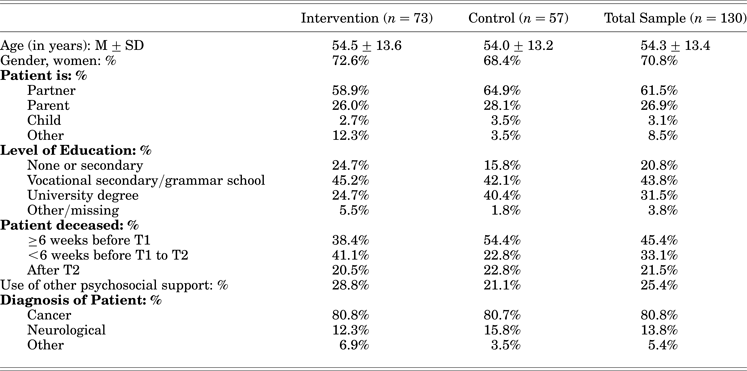
One-hundred-and-sixty informal caregivers took part in the trial; mindfulness data were available for 130 participants. Missing data were due to early dropouts (n = 19) and questionnaires with missing mindfulness scales (n = 11). Ten EBT groups consisting of averagely 7.3 ± 1.1 participants were successfully carried out between 06/2008–06/2010. Table 1 shows socio-demographic characteristics of the study participants.
Sample characteristics

Effects of Dispositional Mindfulness
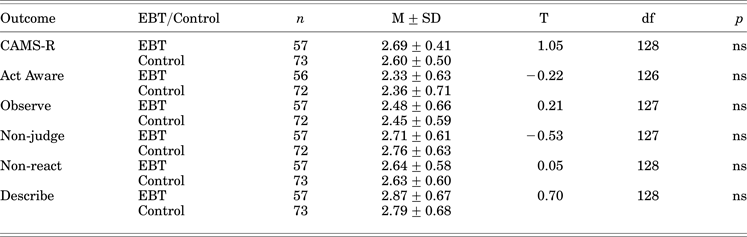
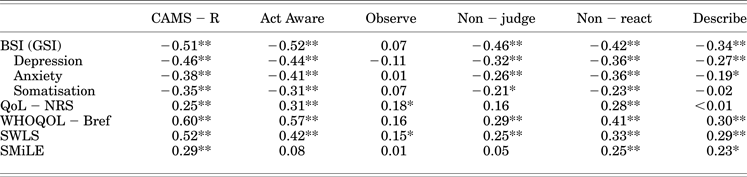
Table 2 shows mindfulness scores at T1. Table 3 summarizes correlations between mindfulness, mental health, and psychological well-being at T1. We controlled for age and gender, because these variables influenced mindfulness: the older the participants, the higher was their mindfulness (CAMS-R, r = 0.32, p < 0.02). Men (2.8 ± 0.5) had higher scores in comparison to women (2.6 ± 0.4; t = −3.23, p = 0.002).
Mindfulness at T1
Act Aware = Acting with awareness, Observe = Observing, Non-judge = Non-judging of inner experience, Non-react = Non-reactivity of inner experience, Describe = Describing
Correlations between mindfulness, mental health and psychological well-being at T1 (n=130)
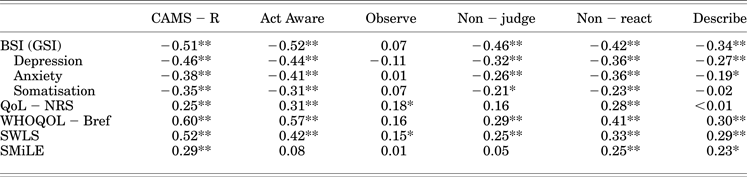
Annotations: * p < 0.05, **p < 0.01. Partial correlations adjusted for age and gender.
Act Aware = Acting with awareness, Observe = Observing, Non-judge = Non-judging of inner experience, Non-react = Non-reactivity of inner experience, Describe = Describing
Except for “Observing,” correlations were moderate to large. In exploratory analyses, similar correlations for the subgroup of bereaved relatives (n = 93) were found.
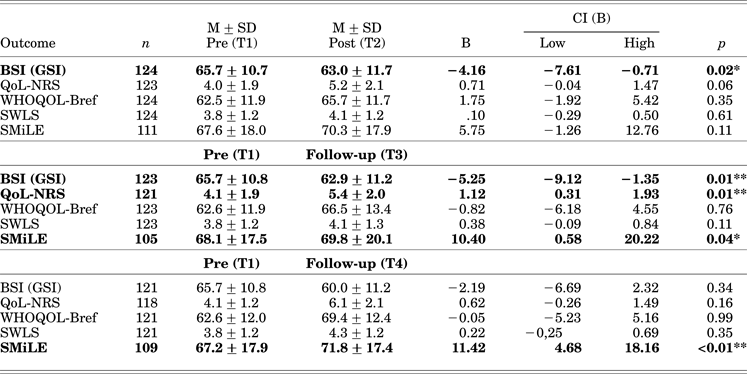
As expected, there was no difference in mindfulness between the intervention and the control group (T1, Table 2). However, mindfulness was a predictor of adaptation and well-being in all relatives (Table 4).
Dispositional mindfulness (T1) as a predictor of adaptation and well-being (T2, T3, and T4)
Annotations: *p < 0.05; **p < 0.01, B = regression coefficient, CI(B) = confidence interval for B. Adjusted for participation in the intervention (yes/no), T1 values of the outcomes, age, gender, relation to the patient, time since death and use of other support.
The effects (B-values) in Table 4 show that, e.g., psychological distress (BSI-GSI, range 21–80) at T2 is 4.16 T-points lower, if mindfulness at T1 is one point (range, 1–4) higher. Similarly, QoL-NRS at T3 is 1.12 (of 10) units higher, if mindfulness at T1 is one point (range, 1–4) higher.
Is the Treatment Effect Mediated By Mindfulness?
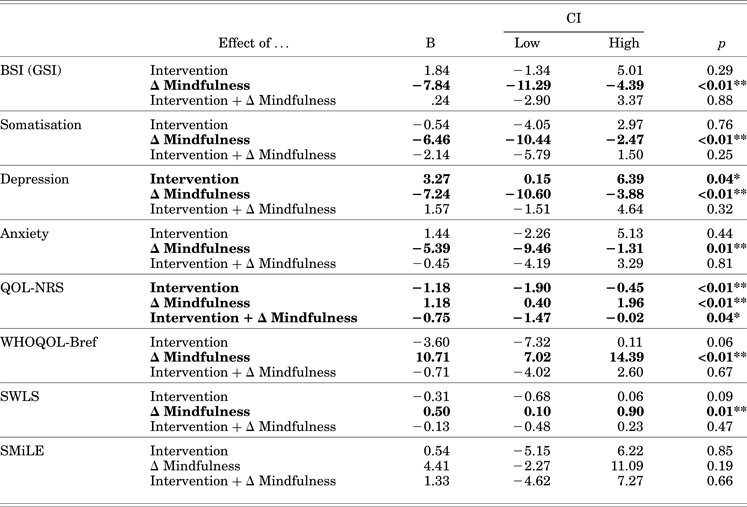
A significant, long-term increase of mindfulness (CAMS-R, adjusted for age, gender, relationship to the patient, time since death, and use of other support) in EBT participants (T1: 2.6 ± 0.5, T4: 2.8 ± 0.5) in comparison to controls (T1: 2.7 ± 0.4, T4: 2.7 ± 0.5) was found (T1/T4, B = −0.19 (−0.34 to −0.03), p = 0.02). A tendency was found in the T1/T2-comparision (p = 0.07), no effect in T1/T3. Being another prerequisite for mediation, the effect of the mediator on the outcomes was tested. Regarding T1/T4, a significant effect of Delta mindfulness has been found for all outcome parameters except SMiLE (Δ mindfulness, all p ≤ 0.01, Table 5). If Δ mindfulness is added into the model for analyzing the impact of the intervention (intervention + Δ mindfulness), the effects of EBT on depression, QoL-NRS and (by trend) SWLS are diminished which is indicative of a mediation effect.
Mediation of long-term (T1-T4) intervention effect by mindfulness (N = 118)
Annotations: *p < 0.05, **p < 0.01, B = regression coefficient, CI = confidence interval for B, Δ Mindfulness = CAMS-R (T4) – CAMS-R (T1). Adjusted for T1 values of the outcomes, age, gender, relation to the patient, time since death and use of other support
Impact of Formal and Informal Mindfulness
Group participants were asked how many times per week they had practiced mindfulness for at least 5 minutes. At T2, participants reported to practice formal mindfulness 3.4 ± 3.8 times/week and informal mindfulness 5.7 ± 9.2 times/week. There was a significant decline of formal mindfulness practice from T2 to T3 (2.0 ± 2.8; t = 3.7, p < 0.01) and from T2 to T4 (1.0 ± 1.6; t = 4.2, p < 0.01, n = 49) but not in informal practice from T2 to T3 (4.8 ± 9.0) or to T4 (5.6 ± 10.5, ns, n = 45).
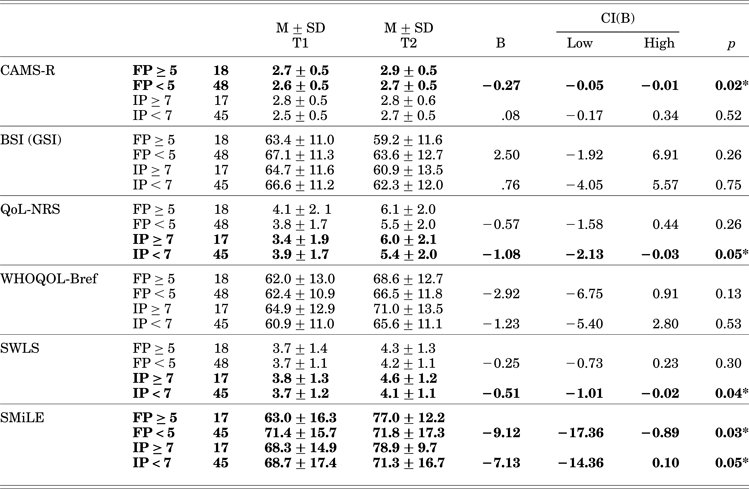
In the intervention group, the quartile of participants who practiced mindfulness most frequently (formal: ≥5 times/week, informal: ≥7 times/week) were compared to the low practitioners (Table 6). Frequent formal (but not informal) practice had a significant impact on change of mindfulness, frequent informal (but not formal) practice was followed by an increase in QoL and life satisfaction; MiL was positively and significantly affected both by formal and informal practice.
Impact of mindfulness practice
Annotations: *p < 0.05, **p < 0.01, FP = Formal practice; IP = Informal practice; B = regression coefficient, CI = confidence interval for B, Adjusted for T1 values of the outcomes, age, gender, relation to the patient, time since death and use of other support.
DISCUSSION
Mindfulness in informal caregivers of PC patients was significantly correlated with higher QoL, life satisfaction, the experience of meaning, and lower psychological distress. This parallels findings from other studies reporting correlations with increased well-being and decreased neuroticism and maladaptive coping (Brown & Ryan, Reference Brown and Ryan2003; Feldman et al., Reference Feldman, Hayes and Kumar2007).
Regarding the facets of mindfulness, a negative correlation between psychological distress and “Describing/labeling with words,” “Acting with awareness,” “Non-reactivity to inner experience,” and “Non-judging of experience” was found. These attitudes may help relatives to cope with their experiences. No correlations were found with “Observing”: this might be explained by the assumption that observation of internal experiences alone is not adaptive without the accepting attitude cultivated in meditation (Baer et al., Reference Baer, Smith and Allen2004; Reference Baer, Smith and Hopkins2006).
Mindfulness has both been described as state and trait. With regard to trait, dispositional mindfulness (T1) was a significant predictor of adjustment for all relatives in both groups. The effect was most significant at the 3-months follow-up (T1/T3).
Regarding changes of mindfulness (as a state) following the EBT intervention, small but significant effects were found. There are two possible explanations why state mindfulness did not show a larger increase: First, the CAMS-R might not be sufficiently sensitive to change (Brown & Ryan, Reference Brown and Ryan2003; Chiesa & Malinowski, Reference Chiesa and Malinowski2011). Multimodal methods might be needed, e.g., real-time sampling assisted by handheld computers or detailed practice logbooks. However, during intense caregiving and in acute bereavement, these methods might be ethically questionable (Baer, Reference Baer2003). Second, to achieve an increase in mindfulness, more extensive trainings might be necessary (Orzech et al., Reference Orzech, Shapiro and Brown2009). MBSR recommends 45–60 min/day over 8 weeks.
Long-term effects of the EBT intervention on depression and QoL appeared to be partly mediated by mindfulness. Although this interaction has to be interpreted cautiously, other studies report similar results (Nyklicek & Kuijpers, Reference Nyklicek and Kuijpers2008). Group participants evaluated mindfulness as highly positive and transferred both the concept and the practice into their daily life, as has been shown in qualitative interviews (Kögler et al., submitted). Mindfulness seems to be well accepted by relatives during caregiving (Waelde et al., Reference Waelde, Thompson and Gallagher-Thompson2004) but establishing regular practice might be difficult in this situation (Oken et al., Reference Oken, Fonareva and Haas2010).
Participants who indicated the highest levels of formal practice had a stronger increase in mindfulness and meaning in life; those with the highest levels of informal practice showed stronger improvements in QoL, life satisfaction, and meaning in life. Formal practice may enhance the ability to focus on the present moment, as measured by the CAMS-R, while doing daily activities with full awareness might positively impact on QoL and life satisfaction (Shapiro et al., Reference Shapiro, Bootzin and Figueredo2003).
There are some limitations of our study. The sample was heterogeneous and consisted of bereaved and caregiving relatives in varying relationships to the patient with partners being predominant. All subjects agreed to take part in a randomized controlled trial evaluating a group intervention. These issues may affect the generalizability of the results. However, we wanted to conduct a study that is close to clinical practice and therefore strived to introduce an intervention for informal caregivers at the transition from caring to grieving.
To summarize, the concept of mindfulness was well accepted by relatives of PC patients, both active caregivers as well as bereaved ones. Further research on underlying mechanisms is needed, concerning the format, intensity and type of practice which are most effective in improving well-being und reduce psychological distress. Mindfulness training may be a promising concept for psychosocial support in palliative care.
ACKNOWLEDGMENT
This research was supported by Deutsche Krebshilfe e.V. (No. 107433). The authors declare no conflict of interest.