

The emperor in my title is psychological altruism, which has been defined as a motivational state with the ultimate goal of increasing another's welfare (Batson Reference Batson1991; Sober and Wilson Reference Sober and Wilson1998). ‘Ultimate’ in this definition refers to means-end relations in the current (proximal) situation, not to either a metaphysical first or final cause – as it does for some philosophers – or to evolutionary function – as it does for biologists who substitute ultimate for distal when contrasting proximal and distal causes (e.g. Mayr Reference Mayr1961). An ultimate goal is an end in itself, what the motivated individual is seeking to attain. In contrast, an instrumental goal is sought only as a means to reach an ultimate goal. If increasing another's welfare is an instrumental means to reach the ultimate goal of increasing one's own welfare, we have psychological egoism rather than altruism.
Psychological altruism should be distinguished from evolutionary altruism – acting in a way that increases the reproductive fitness of one or more others and decreases the reproductive fitness of the actor (Sober and Wilson Reference Sober and Wilson1998: 17). My psychological colleagues often claim to see evidence of a genetic basis for altruism. They point to ideas of (a) inclusive fitness or kin selection (a genetic predisposition to help others in proportion to shared genes or kinship – Hamilton Reference Hamilton1964), (b) reciprocal altruism (a genetic predisposition to help those who are predisposed to reciprocate in the future – Trivers Reference Trivers1971; Axelrod and Hamilton Reference Axelrod and Hamilton1981), (c) some combination of these two (e.g. Selective Investment Theory – Brown and Brown Reference Brown and Brown2006), (d) sociality (a genetic predisposition to maintain close and positive social relations – Caporeal et al. Reference Caporeal, Dawes, Orbell and van de Kragt1989) and/or (e) group selection (a genetic predisposition to act in ways that promote the survival of one's group relative to other groups – e.g. multilevel selection theory – Sober and Wilson Reference Sober and Wilson1998; Wilson and Wilson Reference Wilson and Wilson2007).
Each of these ideas was designed to explain how, under certain circumstances, an organism might enhance the survival of at least some genes it is carrying by acting in a way that reduces its own immediate personal reproductive fitness. That is, each was designed to explain how what may appear to be evolutionary altruism is actually evolutionary egoism. But my colleagues think these ideas cover far more. From the most popular textbooks to the most prestigious handbooks, the implicit and often explicit claim is that one or more of the evolutionary ideas listed provides a plausible genetic explanation for psychological altruism.
However, if one looks with an open and critical eye, one quickly sees that there is no substance to these claims. They are like the emperor's new clothes in Hans Christian Andersen's fairy tale. In spite of exclamations to the contrary, the emperor is quite naked. Problems exist both with the evidence cited as supporting the claims and with the relevance of the claims to what is being explained.
1. DOUBTFUL EVIDENCE
Let me illustrate the evidence problem with the most frequently cited research, at least in the psychological literature. It is a series of six studies reported by Burnstein et al. (Reference Burnstein, Crandall and Kitayama1994). In line with predictions based on Hamilton's model of inclusive fitness, Burnstein et al. found that when presented with a series of forced-choices in hypothetical scenarios, research participants said they would be more likely to help someone who was closely related (e.g. a sibling or parent) than someone more distantly related (e.g. an uncle or grandmother). Hypothetical persons in need who were related .50 to participants were more likely to be helped than those related .25, who were in turn more likely to be helped than those related .125, who were more likely to be helped than unrelated persons. (These proportions apply to the less than 1% of the human genome not shared with all other humans – Essock-Vitale and McGuire Reference Essock-Vitale and McGuire1980.) This trend was slightly (but significantly) stronger in situations in which the other would die (e.g. choosing whom to rescue from a burning building) than in more mundane helping situations (e.g. doing a favour).
Burnstein et al. (Reference Burnstein, Crandall and Kitayama1994) also found a linear effect of the needy person's age, but only in the life-or-death situations. One-year-olds were more likely to be helped than 10-year-olds, who were more likely to be helped than 18-year-olds, who were more likely to be helped than 45-year-olds, who were more likely to be helped than 75-year-olds. They interpreted this linear trend to reflect the remaining fitness value of the recipient; younger people have more opportunity to place their genes in the next generation than do older people. Less consistent with inclusive-fitness predictions, the age effect was not qualified by relatedness.
I quite agree that at least some of these results – as well as some other results (e.g. Essock-Vitale and McGuire Reference Essock-Vitale and McGuire1980) – can be interpreted in terms of inclusive fitness. But I do not think they provide the kind of empirical support we would normally expect. There certainly is no claim to have evidence linking these responses to a genetic basis. The evidence is consistent with this possibility, but the weight that should be placed on evidence consistent with a given explanation depends on whether other plausible explanations also exist. If the evidence is consistent with one or more equally plausible alternative explanations, then to claim clear support for one's favoured explanation is premature.
In the present case, plausible alternatives abound. We humans have a complex set of social norms and sanctions that specify to whose needs we should give priority. These norms and sanctions can, I think, easily account for the results reported by Burnstein et al. (Reference Burnstein, Crandall and Kitayama1994). Indeed, the Burnstein et al. procedure of having participants respond to a number of systematically varied hypothetical scenarios involving forced-choice decisions seems especially likely to make these norms and sanctions salient.
It could, of course, be said that social norms are simply the proximal mechanism through which a genetic predisposition to help in proportion to kinship expresses itself. Indeed, many say just this (e.g. Kruger Reference Kruger2003). But, although possible, there is again no clear support for this claim. These norms could at least as plausibly be a product of socialization and cultural evolution (Campbell Reference Campbell1975; Richerson and Boyd Reference Richerson and Boyd2005), which rest on broad genetic capacities to learn rules, etc., without being based on a genetic predisposition to make helping decisions based on kinship.
Alternatively, it could be said that there is a genetic tendency to respond to some phenotypic marker for kinship (Dawkins's Reference Dawkins1976 ‘Green Beard’ effect), such as perceived similarity (Essock-Vitale and McGuire Reference Essock-Vitale and McGuire1980; Rushton et al. Reference Rushton, Russell and Wells1984). Once again, however, one need not claim a genetic basis to explain the effect of similarity on helping. There are simpler and more parsimonious explanations.
2. DOUBTFUL RELEVANCE
Some years ago, Campbell (Reference Campbell1975) warned against applying an inclusive fitness analysis to human helping behaviour. Campbell readily agreed that one can build a strong case, as did Hamilton (Reference Hamilton1964), for a genetically hard-wired impulse to self-sacrifice in the worker caste of social insects (however, for some recent doubts, see Wilson Reference Wilson2005; Wilson and Wilson Reference Wilson and Wilson2007). Campbell also noted that these insects are different from humans in three conspicuous ways (other than body size, number of legs, and type of skeleton). First, they are unusually highly genetically related to at least some others in the hive, sharing three-quarters of their genes with them. Second, they are sterile and can produce no direct offspring. Third, their behaviour is limited to hard-wired stimulus-response patterns little modified by learning and experience.
Humans have several characteristics that make them far less susceptible to natural selection based on inclusive fitness. In contrast to social insects, humans have (a) a lower level of genetic relatedness to those whom their behaviour affects (except for identical twins, a case too rare to provide a basis for natural selection) and (b) most humans have the ability to produce children and so to place their genes directly in the next generation. In addition, (c) the exceptional flexibility of human behaviour and (d) the sensitivity to social training and social rewards and punishments render culturally evolved social-learning (normative) explanations of kinship patterns in human helping behaviour highly plausible. In light of the conspicuous differences between humans and social insects, to generalize from the insect data to claim that human altruism is based on an allele to help conditional on degree of kinship seems not only unfounded but also implausible.
A similar response can be given to the extensive evidence that humans and perhaps some of our primate relatives (Brosnan and de Waal Reference Brosnan and de Waal2003) are highly attuned to reciprocity and fairness and will act to enforce a norm of reciprocity even when they receive no direct benefit and incur personal cost (Fehr and Gächter Reference Fehr and Gächter2002). Unless we can think of no other way to account for these phenomena, the robustness of reciprocity tells us nothing about its genetic basis. But of course we can think of other ways. Attention to reciprocity and fairness can be explained at least as plausibly in terms of reinforcement, socialized norms, expectations and enlightened (i.e. long term) self-interest. These are all processes known to powerfully affect behaviour of species that live in groups, have the cognitive capacity to keep score, and keep track of their reinforcement history.
A similar response can also be given to the extensive evidence that species that live in groups act cooperatively and in ways that promote the survival of the group. In each of these cases, it does not take a very close look to see that the evidence cannot be counted on to provide our emperor with genetic clothes of any substance. Cultural evolution offers an extremely plausible alternative account (Campbell Reference Campbell1975; Richerson and Boyd Reference Richerson and Boyd2005).
3. SEEKING A MORE PLAUSIBLE GENETIC BASIS
Must we, then, simply admit that psychological altruism has no genetic basis – that if it exists at all, it is a socio-cultural creation? Or can we find a more plausible genetic account than those fashioned over the last 50 years? I think we can find a more plausible account. To do so, we need to start by working backwards.
3.1 Empathic concern produces altruistic motivation
If psychological altruism is a motivational state with the ultimate goal of increasing another's welfare, then what produces altruistic motivation? The most likely proximal source is, I would suggest, an other-oriented emotional response evoked by and congruent with the perceived welfare of another – what I have called empathic concern and others have called sympathy, compassion, pity, etc. (This emotional response is not the only possible source of altruistic motivation, but, as the most likely, it is the only one I shall consider.) Empathic concern does not involve feeling as the other feels; it involves feeling for the other. Over the last several decades, other social psychologists and I have conducted more than 30 experiments to test the empathy-altruism hypothesis – the hypothesis that empathic concern produces altruistic motivation – against plausible egoistic alternatives. With remarkable consistency, results have been strongly supportive of this hypothesis (see Batson Reference Batson1991 for a partial review and Batson in press for a complete review).
3.2 An illustrative experiment
I shall not attempt to review those experiments here. Instead, to illustrate the power of empathy-induced altruistic motivation, I shall describe only one (Batson and Ahmad Reference Batson and Ahmad2001). Sixty undergraduate women each individually faced a one-trial Prisoner's Dilemma, which was presented to them as a ‘Social Exchange’. These women were informed at the outset that they would never meet the other participant in the exchange (who was actually fictitious). Payoffs were made concrete and real in the form of raffle tickets for a $30 gift certificate at a store of the winner's choice.
To experimentally manipulate empathic concern, all participants were told that we were studying the effect of different types of interaction, and in their session, interaction would be indirect rather than face-to-face. The description of indirect interaction differed across experimental conditions. Twenty participants were told that indirect interaction meant no communication would occur between themselves and the other participant. Forty participants were told that it meant there would be one-way written communication and, further, that they had been randomly assigned to be the Receiver and so would read a note that the other participant (the Sender) had written before knowing anything about the study. The note would describe something interesting that happened to the Sender recently.
Perspective-taking instructions were used to manipulate empathy among the 40 participants who read the note. The 20 participants in the low-empathy condition were instructed: ‘While you are reading the note, try to take an objective perspective toward what is described. Try not to get caught up in how the other person feels; just remain objective and detached.’ The 20 participants in the high-empathy condition were instructed: ‘While you are reading the note, try to imagine how the other person feels about what is described. Try to imagine how it has affected his or her life and how he or she feels as a result.’
In the note, the other participant told of suffering a break-up with her boyfriend. She ended the note saying, ‘I've been kind of upset. It's all I think about. My friends all tell me that I'll meet other guys and all I need is for something good to happen to cheer me up. I guess they're right, but so far that hasn't happened.’ We assumed participants would think that giving the other participant a better chance at the raffle by cooperating might cheer her up, whereas reducing her chances by defecting would not. (Behavioural effects of perspective-taking instructions like those used in this experiment have been found to be due to effects on empathic concern, not due to experimental demand or cognitive/perceptual processes – see Coke et al. Reference Coke, Batson and McDavis1978.)
After reading the note from the randomly assigned perspective (or reading no note), participants made their choice whether to defect or cooperate. But, rather than the standard one-trial Prisoner's Dilemma in which participants choose simultaneously without knowing what the other has done, choices in the exchange were made sequentially. Ostensibly by chance, the other participant always went first – and defected. So when each of the 60 undergraduate women made her choice, she knew that the other participant had already defected. Given the payoff matrix used, possible outcomes for the participant were now either to (a) receive 5 tickets if she defected (the other participant would then also receive 5 tickets, which was the number each had prior to their decisions) or (b) receive 0 tickets if she cooperated (the other participant would then receive 25 tickets).
In such a situation, predictions are clear from game theory, reciprocal altruism, and rational choice – as well as from social-psychological theories of justice and social norms. All agree that there is no longer a dilemma; the only thing to do is to defect. Not only will defecting maximize one's own outcome, but it will also satisfy the norms of reciprocity, fairness, and distributive justice. Moreover, there is no longer any need to worry about feeling guilty should one defect and find that the other has cooperated, as can happen in a simultaneous-decision dilemma. The other has already defected. Not surprisingly, in the very few previous studies that have looked at responses in a sequential-decision situation like this, the rate of cooperation has been extremely low – around 5% (Shafir and Tversky Reference Shafir and Tversky1992; Van Lange Reference Van Lange1999).
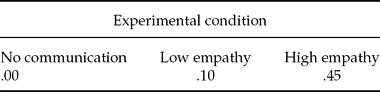
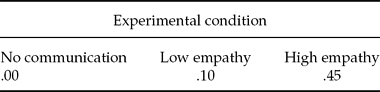
The empathy-altruism hypothesis predicts, however, that if in such a situation the participant has been led to feel empathy for the defecting other, a dilemma remains. Self-interest, reciprocity, and fairness counsel defection, but empathy-induced altruism counsels cooperation. As shown in Table 1, results of this experiment patterned as predicted by the empathy-altruism hypothesis. In the absence of empathy (i.e. in the no-communication and low-empathy conditions), cooperation was extremely low (0% and 10%, respectively). But when empathy was induced, cooperation rose to 45%. Empathy-induced altruism was not strong enough to override other motives (self-interest, retribution, justice) for all participants led to feel empathy, but it was strong enough to do so for almost half.
Proportion cooperating in each experimental condition of Batson and Ahmad (Reference Batson and Ahmad2001).
Note: There were 20 women in each experimental condition.
Given the apparent power of empathic concern to produce altruistic motivation, we can move one step back in the search for a plausible genetic basis for psychological altruism. We can ask: Is there a plausible genetic basis for empathic concern? I think there is a promising candidate – parental nurturance.
4. PARENTAL NURTURANCE
Parental nurturance has only rarely been linked to empathy-induced altruism in recent psychological discussions, but the two were frequently linked a century ago. At that time, psychologists were strongly influenced by Darwin (Reference Darwin1871), who spoke of instinctive love based on parental and filial affections and ‘the all important emotion of sympathy’ (308).
William McDougall (Reference McDougall1908) provided what is perhaps the most systematic argument for parental nurturance as a basis for empathy-induced altruism. He described the ‘parental instinct’, which he considered to be the most powerful of all instincts, and the associated ‘tender emotion’. McDougall did not think of instincts as automatic, reflexive responses. He believed that all instincts include a cognitive, an affective, and a motivational component. The cognitive and motivational components are modifiable by experience and learning, but the affective component is not; it defines the character of the instinct. Thus, the tender emotion defines the character of the parental instinct. According to McDougall (Reference McDougall1908), this instinct
is primarily to afford physical protection to the child, especially by throwing the arms about it; and that fundamental impulse persists in spite of the immense extension of the range of application of the impulse. . . . Tender emotion and the protective impulse are, no doubt, evoked more readily and intensely by one's own offspring, because about them a strongly organized and complex sentiment grows up. But the distress of any child will evoke this response in a very intense degree in those in whom the instinct is strong. . . . By a further extension of the same kind the emotion may be evoked by the sight of any very young animal, especially if in distress. . . . In a similar direct fashion the distress of any adult (towards whom we harbour no hostile sentiment) evokes the emotion. (61, 63)
McDougall (Reference McDougall1908) believed that the motivation to help evoked by the tender emotion was altruistic: ‘From this emotion and its impulse to cherish and protect spring generosity, gratitude, love, pity, true benevolence, and altruistic conduct of every kind; in it they have their main and absolutely essential root without which they would not be’ (61).
5. THREE PROPOSITIONS OF A NURTURANCE EXPLANATION
McDougall's nurturance explanation of the genetic basis of empathy-induced altruism rests on three propositions.
5.1 Humans have a need-oriented, emotion-based, and goal-directed parental instinct
First is McDougall's (Reference McDougall1908) basic proposition that the tender emotion – what I am calling empathic concern – is an integral part of the instinctual impulse of humans to care for and protect their young. If this proposition is true, the human parental instinct goes well beyond nursing, providing other kinds of food, protecting, and keeping the young close – the activities that characterize parental care in most other mammalian species. It includes feeling for the child based on inferences about the desires and feelings of the child (‘Is that a hungry cry or a wet cry?’ ‘She won't like the fireworks; they'll be too loud.’). It also involves a clear recognition of the distinctiveness, even possible dissimilarity, of self and other. Parents must recognize that a child's needs may be quite different from their needs. They must also recognize that the child's capacity to deal with needs may be quite different from their own. Humans have doubtless inherited key aspects of their parental instinct from ancestors they share with other higher mammalian species, but in humans this instinct has become considerably less automatic and more flexible (also see MacLean Reference MacLean1990; Zahn-Waxler and Radke-Yarrow Reference Zahn-Waxler and Radke-Yarrow1990; Bell Reference Bell2001; Taylor Reference Taylor2002).
We should not accept this first proposition too quickly. Many mammalian species lack the prefrontal cortical structures and cognitive abilities necessary to experience tender, empathic feelings; yet these species display parental care. Clearly, much mammalian parental care is not based on empathic concern. No doubt, much human parental care also is not based on empathic concern. It is more automatic. McDougall would not, I think, have disputed this. Rather, his argument implies that once cortical development enabled humans to experience tender, empathic emotions in response to perceptions of need, a need-sensitive, flexible, and adaptive form of parental care emerged based on the tender emotion and directed toward the goal of maintaining the welfare of the child. Parental care based on the tender emotion did not replace the more primitive hard-wired stimulus-response circuits. It supplemented them, increasing the flexibility with which they are employed.
Antonio Damasio (Reference Damasio1994, Reference Damasio1999, Reference Damasio2003) has repeatedly pointed out that one of the virtues of relying on emotions and goal-directed motives to guide action – rather than relying on more automatic stimulus-response patterns (his ‘regulatory mechanisms’) – is that emotions and their associated goal-directed motives can be adaptive under a wide range of circumstances. Such flexibility seems highly desirable when caring for human offspring. To illustrate the flexibility that emotions introduce with an emotion quite different from empathic concern, consider anger. Aggressive responses occur in many species that do not experience anything like the emotion we would call anger. Among humans, however, aggressive responses are stimulated, tempered, and generalized by feelings of anger that are a product of complex cognitive assessment of the situation, including assessment of the intentions of others. Similarly, tender, empathic feelings permit more flexible and adaptive parental care, care that is not simply reflexive or reactive to distress cues but is directed toward the goal of enhancing the child's welfare as needed in the particular situation. This flexibility includes anticipation and prevention of needs, even evolutionarily quite novel ones – e.g. the need to avoid sticking a pin in an electrical outlet.
5.2 The human parental instinct generalizes beyond progeny
Second is the proposition that we humans are capable of generalization whereby non-kin – even strangers – can be responded to in something like the way we respond to our own offspring. If McDougall is right, we must be capable of caring about the welfare of strangers and of wanting to protect them in the same way, if not to the same degree, that we do our own children. Through cognitive generalization, we must be able to ‘adopt’ non-progeny, making it possible to evoke empathic concern and altruistic motivation when they are in need (Hoffman Reference Hoffman1981; Batson Reference Batson and Berkowitz1987). The prospect of such generalization may seem implausible and at odds with the theory of natural selection, as has been argued by Boehm (Reference Boehm1999).
A genetically hard-wired impulse that produces parental care for offspring in mammals need not, however, be progeny specific to be effective. Insel (Reference Insel, Post, Underwood, Schloss and Hurlbut2002) noted that ‘rat mothers will show intense devotion and defense of their young, but they are not selective in their maternal behavior, offering the same level of care to unrelated young in the nest’ (255). Presumably, occurrence of unrelated young in a rat's nest is sufficiently rare that there has not been strong selection pressure for a more discriminating maternal response.
Some have proposed that parental nurturance may even play a role in adult attachments. Reflecting on research over the past decade concerning the role of oxytocin in pair bonding in monogamous prairie voles (in contrast to non-monogamous meadow voles), Curtis and Wang (Reference Curtis and Wang2003) suggested:
One possibility for the origin of pair bonding is that pair-bonding species have co-opted the mechanism (or mechanisms) by which maternal bonds are formed. This possibility is further supported by observations that even sexually naïve male prairie voles display maternal-type behaviours when exposed to pups, and that prairie vole mothers display considerably more maternal care than do meadow vole mothers. (51)
In a highly interdependent and cooperative species like our own, generalized parental nurturance may have been more than tolerated; there may have been a selective advantage to extending the genetically hard-wired nurturant impulse beyond one's own offspring – what is currently discussed as alloparenting and cooperative breeding (Hrdy Reference Hrdy2009). Due to selection pressure on the small, closely knit hunter-gatherer bands in which our genetic predispositions for social behaviour are thought to have evolved (Caporeal et al. Reference Caporeal, Dawes, Orbell and van de Kragt1989; Kelly Reference Kelly1995; Hrdy Reference Hrdy1999, Reference Hrdy2009), generalization of the impulse to provide nurturant care for our own offspring – whether generalization (a) to one's younger siblings (Dunn and Kendrick Reference Dunn and Kendrick1982; Hrdy Reference Hrdy2009), (b) to the offspring of other band members, and even (c) to other adults in the band – may have increased the likelihood of one's genes surviving (Sober and Wilson Reference Sober and Wilson1998). And, to the extent that the human nurturant impulse relies not on hard-wired stimulus-response patterns but on cognitively based emotions such as tender, empathic concern, it would be relatively easy to generalize. In contemporary society, the prospect of such generalization appears more plausible when one thinks of the tender care typically provided by nannies and workers in day care centres, by adoptive parents, and by pet owners. Also consistent with such generalization, Lishner et al. (Reference Lishner, Oceja, Stocks and Zaspel2008) found that empathic concern for adults in need is enhanced when the adult has a more infant-like face or voice. One can even see tender, nurturant care provided by young children to people, pets, stuffed animals, and dolls – and by pets to family members (Hoffman Reference Hoffman1981; Zahn-Waxler and Radke-Yarrow Reference Zahn-Waxler and Radke-Yarrow1990). Clearly, tender, nurturant feelings are not limited to those who are mothers or even to those who are parents. The instinct is deep and pervasive, although receipt of nurturant care when young seems necessary for its normal expression (Harlow et al. Reference Harlow, Harlow, Dodsworth and Arling1966; Hrdy Reference Hrdy2009).
5.3 Intensity of tender feelings varies with perceived similarity to progeny, not to self
Third is the proposition that the strength of a generalized impulse to care for and protect can vary in intensity. If nurturant tendencies are to account for variation in empathic concern even for strangers, then they must be stronger in response to the plight of some strangers than others. The claim is that nurturant tendencies will be stronger toward those who are more child-like, who seem more vulnerable, or who seem to need protection. This claim is in contrast to the common claim that strength of tender, empathic feelings for another depend on the similarity of the other to oneself.
6. ANY SUBSTANCE TO THESE NEW (ACTUALLY OLD) GENETIC CLOTHES?
Is there any evidence – other than anecdotes and examples such as those just mentioned – to support the idea that nurturance might underlie empathic concern even for strangers? Knowing of no prior research that had tested this idea, colleagues and I sought to provide an admittedly somewhat bizarre test (Batson et al. Reference Batson, Lishner, Cook and Sawyer2005). Ostensibly to evaluate a new feature called ‘Helping Hands’ for the student-run university newspaper, female introductory psychology students at the University of Kansas (KU) read a brief article in which a student described helping ‘Kayla’ with rehabilitative exercises after a severely broken leg. There were four experimental conditions. Participants in the Student condition read the following article:
I was a bit nervous, not knowing what might lie ahead. As it turned out, what I encountered that first day was a badly hurt and struggling 20-year old junior at KU, Kayla. Kayla was recovering from a severely broken leg. The leg had been splintered in one place and broken in two others.
Kayla had had reconstructive surgery on the leg 2 days before. The surgeon put in four pins to secure the bone, and then the leg was put in a plaster cast from the hip down. Kayla could not move without experiencing considerable discomfort, and often, sharp pain. Still, it was important that she try to walk with the cast in order to get used to it and to build up strength in her muscles.
Kayla's rehabilitation exercises sounded like a real ordeal, but when I went to get her she was more than ready. Soon she was hobbling around the therapy room as best she could with that bulky cast. She would try to walk without assistance, but the pain was so great that she could only take 3 or 4 steps. Yet she kept trying. Once she slipped and fell, and let out a cry of pain. Still, she got up and tried again. Kayla just wouldn't quit.
Participants in the Child condition read exactly the same article, except that Kayla was described as ‘a badly hurt and struggling 3-year-old child’. Participants in the Dog condition read exactly the same article, except that Kayla was described as ‘a badly hurt and struggling 5-year-old adult dog’. Participants in the Puppy condition read exactly the same article, except that Kayla was described as ‘a badly hurt and struggling 4-month-old puppy’. In the Student and Child conditions, the article was entitled, ‘Lawrence Memorial Hospital’. In the Dog and Puppy conditions, it was entitled, ‘Lawrence Veterinary Hospital’.
After reading the article, participants completed an emotional response questionnaire, indicating how much they experienced each of a number of emotions while reading. Included among the emotions were six used in previous research to measure empathic concern: sympathetic, compassionate, softhearted, tender, warm, and moved (see Batson Reference Batson1991). Ratings of these six emotions were averaged to provide an index of empathic concern felt for Kayla.
We reasoned that nurturant tendencies would be less for the student Kayla (who although more similar to self, was a young adult and not in need of special protection) than for the other three Kaylas. Following McDougall (Reference McDougall1908), we assumed that an unrelated child would evoke relatively strong nurturant tendencies. We assumed that both the 5-year-old dog and the 4-month-old puppy would also evoke relatively strong nurturant tendencies. Regardless of age, dogs are typically in the role of pet, and so dependent on humans for nurturant care. Using targets from a different species was admittedly unusual (but not without precedence – see Shelton and Rogers Reference Shelton and Rogers1981; Odendaal and Meintjes Reference Odendaal and Meintjes2003), yet it had the important virtue of providing a stringent test of the generalization and similarity-to-progeny-not-self claims of the nurturance explanation. Note that the nurturance predictions are quite different from predictions that might be derived from inclusive fitness, reciprocal altruism, and group selection.
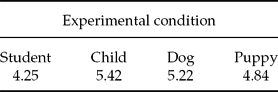
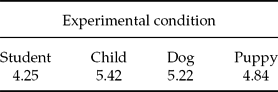
Across conditions, did the means on the empathic concern index pattern as predicted by the nurturance explanation? As can be seen in Table 2, they did. Reported empathy for Kayla in the student condition (M = 4.25) was lower than in the other three conditions (M = 5.13). There was a significant difference across experimental conditions, F(3, 60) = 2.80, p < 0.05. A planned comparison revealed that the difference between the student condition and the other three was statistically reliable, F(1, 60) = 6.61, p < 0.02, and the residual variance across the child, dog, and puppy conditions did not approach significance, F(2, 60) = 0.90. These results were quite consistent with the nurturance predictions.
Empathic concern in each experimental condition of Batson et al. (Reference Batson, Lishner, Cook and Sawyer2005).
Note: There were 15 women in each experimental condition. Empathic concern was measured on a 1–7 scale (1 = not at all, 7 = extremely).
Of course, a university student and a child, dog, and puppy differ in many ways. I have not been able to think of a difference other than the difference in nurturant concern that would produce less empathy for the fellow university student. However, the possibility of such a difference remains. Moreover, we have no evidence the empathic responses in this experiment were genetically based. For these reasons, I consider the support we found for the nurturance explanation to be only suggestive. At the same time, I would point out that these results are very difficult to explain from the perspectives of inclusive fitness, reciprocal altruism, selective investment theory, sociality, or group selection.
7. SUMMARY AND CONCLUSION
I propose that four evolutionary developments combine to provide a genetic basis for psychological altruism. First is the evolution in mammals of parental nurturance. Second is the evolution in humans (and possibly a few other species) of the ability to see others as sentient, intentional agents and, thereby, to recognize other's needs, even subtle ones. Third is the evolution in humans of tender, empathic emotions as an important component of parental nurturance. Fourth is the evolution in humans of cognitive capacities that make it possible to generalize tender, empathic feelings and, thereby, altruism beyond offspring.
Clearly, many scholars today wish to speculate about genetic bases for psychological altruism. One hears frequent claims of evidence for genetically hard-wired impulses to help based on degree of kinship (Hamilton Reference Hamilton1964), reciprocity (Trivers Reference Trivers1971), sociality (Caporeal et al. Reference Caporeal, Dawes, Orbell and van de Kragt1989), cooperation (Sober and Wilson Reference Sober and Wilson1998), trust (Frank Reference Frank, Davidson, Scherer and Goldsmith2003), or coalition formation (de Waal Reference de Waal1996). Yet, insofar as I know, none of these claims is empirically justified. If we wish to speculate about a genetic basis, then I think we shall find more substance – both logical and empirical – if we focus on cognitive generalization of tender, empathic feelings that emerged to add flexibility to a genetically hard-wired parental instinct (McDougall Reference McDougall1908). Because recent thought has been so strongly influenced by the ideas of inclusive fitness, reciprocal altruism, and group selection, the possibility that parental nurturance might serve as the genetic basis for psychological altruism has been largely ignored. So has the fact that these other ideas leave the emperor quite naked.