1. Introduction
The Cenozoic fossil record of the Antilles in general, and Jamaica in particular, has been described in considerable detail in recent years (e.g. Wright & Robinson, Reference Wright and Robinson1993; Donovan, Reference Donovan1998, Reference Donovan2004), but asteroids have not been well treated. The skeleton of living asteroids consists of a large number of proportionately small skeletal elements. Scavengers and predators, together with the typical, active physical and chemical depositional conditions of the Antillean Cenozoic, served to limit available fossils almost entirely to discrete so-called marginal ossicles, which are the comparatively robust elements that fringe asteroids (Donovan, Reference Donovan2001, table 5); a solitary complete specimen was described from Middle Miocene deposits of Carriacou, the Grenadines, by Jagt et al. (Reference Jagt, Thuy, Donovan, Stöhr, Portell, Pickerill, Harper, Lindsay and Jackson2014). The bulk of the Jamaican marginals are of a comparatively simple morphology with limited superficial differentiation for the attachment of accessory spines, pedicellariae or granules. Marginals provide only a very incomplete picture of the living animal; nevertheless, their occurrence alone provides an important addition to the fossil fauna of Jamaica. Following a review of geological occurrences, taxonomic concerns and study approaches, the ossicles from the Upper Oligocene of Antigua and Jamaica are briefly described here, followed by an evaluation of (limited) faunal implications from perspectives of asteroid evolution and biogeography. Finally, implications of the fauna for Antillean palaeontology and geology are summarized.
2. Terminology and repository
Terminology of the asteroid endoskeleton follows Spencer & Wright (Reference Spencer, Wright and Moore1966) and Blake & Portell (Reference Blake and Portell2011). Jamaican stratigraphic nomenclature is adapted from Mitchell (Reference Mitchell and Donovan2004); that of Antigua follows Weiss (Reference Weiss1994) and references therein. Specimens documented here form part of the collections of the Naturalis Biodiversity Center (formerly Rijksmuseum van Geologie en Mineralogie; prefix RGM), Leiden, the Netherlands, RGM 791 837 – 791 861.
3. Geological occurrence
The greatest number and diversity of asteroid marginal ossicles known from a single site in the Cenozoic of Jamaica is at Seven Rivers, parish of St James, western Jamaica (Portell and Donovan, in press). This site is in the upper lower or lower middle Eocene deposits of the Guys Hill Formation, Yellow Limestone Group, and is best known for its vertebrate remains (Donovan, Portell & Domning, Reference Donovan, Portell, Domning and Renema2007). The many tens of asteroid remains from this site show a bewildering array of forms that have defied classification beyond recognizing a taphonomic admixture made up almost entirely of goniasterid marginal ossicles, a few astropectinid marginals and a few ossicles of other series. If disarticulated ossicles are to be investigated effectively, the ideal is to have large monospecific assemblages which enable description of many specimens. In the present example, specimens are available from about the same stratigraphic level (= upper Oligocene) in two principal sites (Jamaica, Antigua) separated by c. 1700 km; other minor sites in these areas are mentioned in the text.
3.a. Jamaica: Lee's Marl Crushing Plant (LMCP)
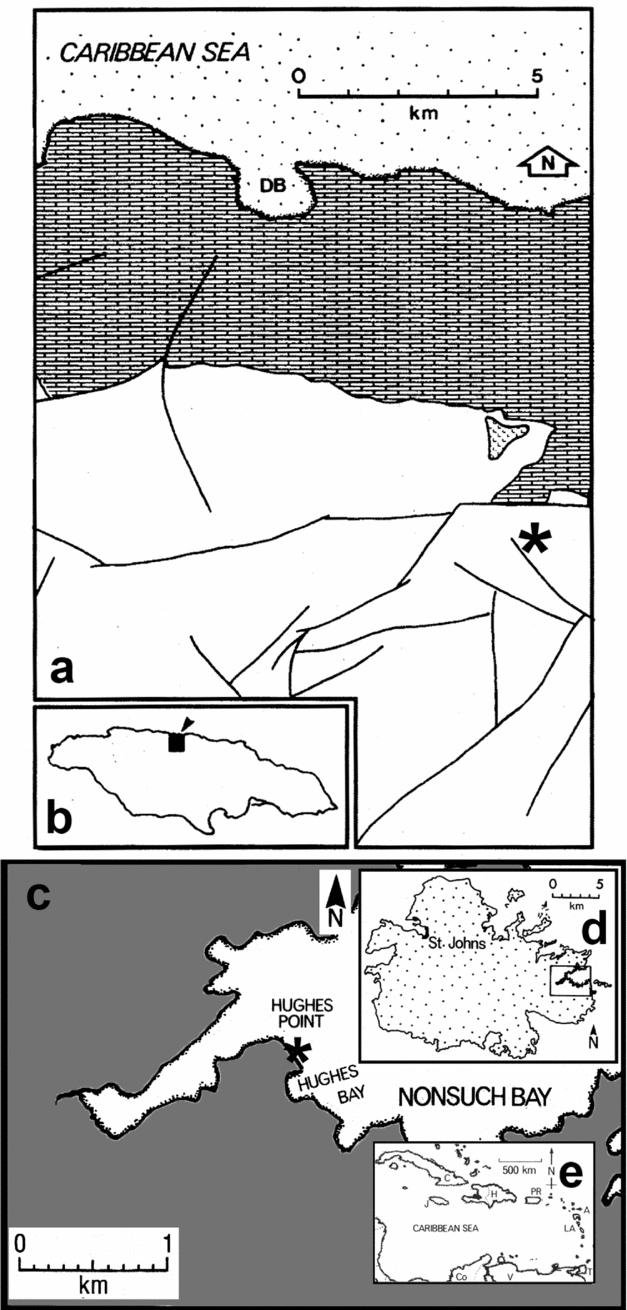
Dixon and Donovan collected echinoderms from LMCP (Fig. 1a), parish of St Ann, north-central Jamaica, between 1991 and 1994, following the discovery of a horizon rich in the echinoid Clypeaster oxybaphon Jackson, 1922. It has been the most productive site for fossil echinoderms in Oligocene deposits of Jamaica, yielding echinoids (Dixon & Donovan, Reference Dixon and Donovan1994, Reference Dixon and Donovan1998), ophiuroid vertebral ossicles and a comatulid brachial (Dixon, Donovan & Veltkamp, Reference Dixon, Donovan and Veltkamp1994), and asteroid marginal ossicles (described here). Other components of the fauna include larger benthic foraminifera, colonial scleractinian corals, benthic molluscs and dugong ribs (Dixon et al. Reference Dixon, Donovan, Domning and Taylor1999), and trace fossils (mainly borings; Donovan, Blissett & Pickerill, Reference Donovan, Blissett and Pickerill2015).
Locality maps for principal upper Oligocene asteroid-bearing sites at Lee's Marl Crushing Plant, Jamaica (a, b; modified after Dixon & Donovan, Reference Dixon and Donovan1998, fig. 2) and Hughes Bay, Antigua (c–e; modified after Donovan et al. Reference Donovan, Harper, Portell and Renema2014a , fig. 1). (a) Simplified geological map, with main faults, of the region south of Discovery Bay (DB), north central Jamaica. Key: * – Lee's Marl Crushing Plant; white – Brown's Town Limestone of Moneague Formation (upper Oligocene); L-pattern – Eocene limestones; brick pattern – Neogene limestones; stipple – Caribbean Sea. Roads not shown. (b) Outline map of Jamaica showing area of (a) (box) within the island. (c) Outline map of the Nonsuch Bay area, eastern Antigua, showing the position of Hughes Point and the area where the asteroid ossicles described here were collected (*). Roads not shown. (d) Inset map of Antigua shows the position of map (c) (box). (e) Inset map showing the position of Jamaica and Antigua in the Caribbean. Key (clockwise from Jamaica): J – Jamaica; C – Cuba; H – Hispaniola (that is, Haiti and the Dominican Republic); PR – Puerto Rico; A – Antigua (arrowed); LA – Lesser Antilles; T – Trinidad; V – Venezuela; Co – Colombia.

The pure limestones of the LMCP are not marlstones, despite the name of the site (Donovan & Pickerill, Reference Donovan and Pickerill2013). Following the revision of the lithostratigraphy of the White Limestone Group by Mitchell (Reference Mitchell and Donovan2004), this locality is included in the Brown's Town Limestones of the Oligo-Miocene Moneague Formation. The pit is at NGR 125 936, Jamaica 1:50,000 metric edition, sheet 3, ‘Falmouth-Browns Town’.
3.b. Antigua: Hughes Point
Antigua lies towards the northern end of the Lesser Antilles volcanic arc. It is an island of volcanic origin and, with the exception of some minor Late Quaternary sediments, the island's entire rock record is late Oligocene in age (Weiss, Reference Weiss1994; Donovan et al. Reference Donovan, Jackson, Harper, Portell and Renema2014b ). The regional dip is towards the northeast with the oldest rocks, the Basal Volcanic Suite, cropping out in the west and south. The rock record of the island is divided into three conformable units: the Basal Volcanic Suite; the overlying Central Plain Group; and the Antigua Formation. The Antigua Formation is a succession of varied limestones with minor tuffaceous/sandy horizons that are exposed in the north and east of the island.
The specimens described here originate from the upper Oligocene Antigua Formation at Hughes Point, Nonsuch Bay, eastern Antigua (Fig. 1c). Hughes Point has good exposures and many large, fallen blocks from high in the cliff; the upper and lower parts of the section represent different biofacies (Donovan et al. Reference Donovan, Jackson, Harper, Portell and Renema2014b ). Most of the marginal ossicles from Antigua described here were collected from float around Hughes Point, that is, from the upper biofacies. Beds are well lithified and bedding is well defined, although horizons may have irregular bases and tops. Common fossils include larger benthic foraminifera such as Nummulites antiguensis Vaughan & Cole, Reference Vaughan and Cole1936 and flat Lepidocyclina canellei Lemoine & Douvillé, Reference Lemoine and Douvillé1904, benthic molluscs such as pectinoids and the oyster Hyotissa (Donovan et al. Reference Donovan, Harper, Portell and Renema2014a ), decapod crustaceans (Collins & Donovan, Reference Collins and Donovan1995), bryozoans, branching corals, echinoids and trace fossils (Donovan, Harper & Portell, in press).
4. Taxonomy of fossil asteroids
4.a. Background
Post-Palaeozoic fossil asteroids, and especially Cretaceous and younger representatives, are generally similar to living exemplars; as a result, researchers have assigned many fossils to extant genera. Although both well-preserved and fragmentary specimens are known and widely illustrated, these are rare; isolated ossicles are far more commonly encountered. A number of authors have published careful generic diagnoses focused on fossils, including those of Sladen (Reference Sladen1891), Spencer (Reference Spencer1905, Reference Spencer1907, Reference Spencer1913), Wienberg Rasmussen (Reference Wienberg Rasmussen1950), Spencer & Wright (Reference Spencer, Wright and Moore1966), Gale (Reference Gale1986, Reference Gale1987b ) and Breton (Reference Breton1992). However, because of the fragmentary nature of the fossil record clearly circumscribed diagnoses have been difficult to develop and taxon concepts tend to be generalized, leading to unstable taxon interpretations and assignments in the literature.
In spite of these limitations, and in association with more complete fossils, important observations on the phylogenetic (Spencer, Reference Spencer1913), stratigraphic (Breton, Reference Breton1992) and biogeographical (Gale, Reference Gale1989; Jagt, Reference Jagt1999, Reference Jagt2000b ) significance of taxa have been published. Among the many references, the monograph of Breton (Reference Breton1992), together with related papers, are invaluable in that a single author has provided careful, comprehensive summation that includes diagnoses, commentaries, a taxonomic key, literature survey and many illustrations of Mesozoic goniasterids from a single geographical region.
4.b. The study of more complete fossil asteroids
More complete fossil asteroid specimens range from sequences of a few marginals, in some occurrences together with a few ossicles of other series, to suites of relatively intact specimens. There are no simple guidelines to sufficiency for taxonomic interpretation; important morphology is usually unavailable even for superficially relatively well-preserved specimens. Asterozoans are complex organisms, and adequate understanding requires both dorsal and ventral surfaces as well as the lateral expression of the arms. Interior morphology, especially that of the jaw frame and ambulacral series but also of body wall ossicles, is important, but almost invariably partially obscured by specimen collapse associated with burial. Development of accessory spines and granules is important, as well as the form of denuded primary ossicles; however, in many specimens the former commonly obscure the latter. Understanding of ossicles of all types calls for partial specimen disarticulation so that interior surfaces can be viewed, yet displacement can also obscure the original configuration. A classic example of such difficulties is whether or not podial pores to the arm interior were developed among Palaeozoic asteroids; Spencer (1914–1940) equivocated through his monograph, although at one point the presence of podial pores, expressed as ‘endothecal ampullae’, was considered to be relatively unimportant (Spencer, Reference Spencer1914–1940, see 1919, p. 184).
4.c. Consideration of isolates
Difficulties encountered in the study of isolates are more serious than the problems which accompany the study of more complete specimens. Asteroid construction favours the occurrence of isolates in the fossil record; individual skeletal elements are articulated rather than fused and they typically dissociate quickly following death. Ossicular construction further biases the fossil record. Asteroid ossicles are sponge-like and the comparatively dense stereom of the marginal ossicles, together with their comparatively robust and approximately equidimensional form, favours their preservation over other ossicular types. Students of fossil asteroids have based species and generic terminology on robust marginal ossicles common in valvatidan and paxillosidan families. Nevertheless, difficulties accompany a taxonomy of marginal ossicles (or those built around any single ossicle type) because, depending on count, the asteroid skeleton consists of 10–15 types, all of systematic and functional significance. Unfortunately, few clusters of isolates have been discovered grouped tightly enough as to arguably represent derivation from a single individual; for the most part, ossicles are collected more or less widely dispersed through geological exposures and subsequently combined and assigned to taxa, thus demanding subjective decisions as to allowed ranges of variation. Treatment becomes increasingly subjective with inclusion of ossicles of more than one system (for example, marginals plus abactinals) under a single name, yet all ossicular types are necessary for adequate understanding of the parent specimen.
There are biological as well as preservational concerns. In addition to variation among individuals of any natural population (or populations through time as represented at most outcrops), asteroid ontogeny encompasses variables of growth. Marginal morphology of most species changes significantly between the interbrachial midline of the disc and the tip of the arm (e.g. Figs 2, 3); variation can be particularly marked in taxa with sharply angled interbrachia (such as the paxillosidan astropectinid Astropecten Gray, Reference Gray1840), although changes can also be important in taxa in which interbrachia are more gradually curved (e.g. the valvatidan goniasterid Mediaster Stimpson, Reference Stimpson1857). Secondly, proportions change during growth; proximal ossicles of a small individual can look quite different from more distal ossicles of similar external dimensions from a larger individual, the more distal ossicles typically being the more delicate. Thirdly, and less commonly, form itself can differ; only distal marginals of certain robust goniasterids are enlarged (such as extant Pentagonaster Gray, Reference Gray1840 and fossil Metopaster Sladen, Reference Sladen1893). In other taxa, extended spine-like processes are found on only some ossicles (e.g. the arthrodiscidid valvatidan Kionaster Blake & Portell, Reference Blake and Portell2011). Further, marginal ossicles are only one of a number of ossicular types in asteroids, all showing their own ranges of variation. Taxa based on isolates must depend on viewpoints of ossicular association that vary among authors and through time. For example, one of us (DBB) was told by a reviewer that current researchers agree that the species concepts of Brünnich Nielsen (Reference Brünnich Nielsen1943) were too finely subdivided; however, another generation might return to earlier views. Because association of scattered isolates under a single taxon name requires subjective decisions, such taxa ultimately reduce to the holotype and become constructs of dubious validity under the code of nomenclature.
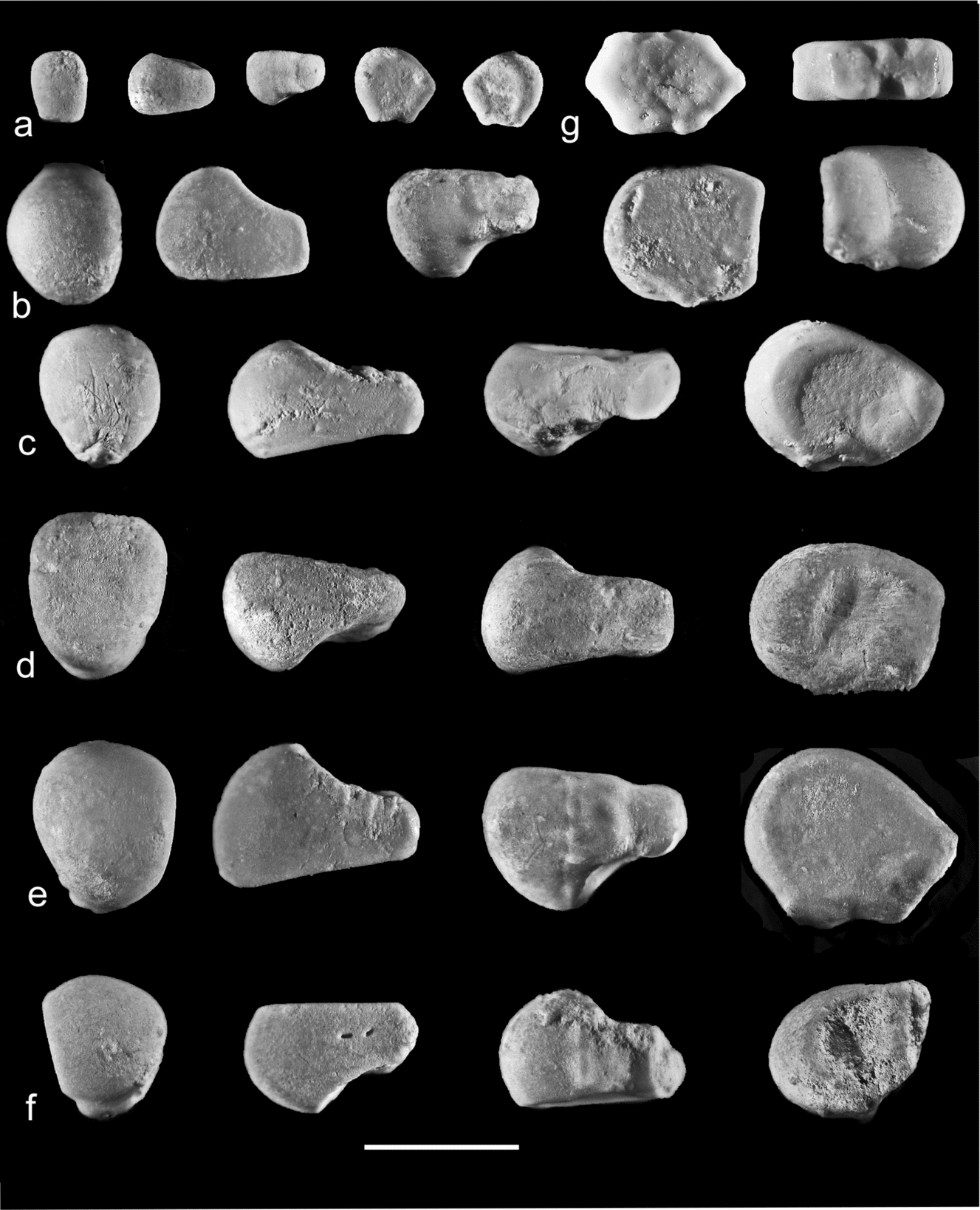
(a–f) Superomarginal ossicles of Pycinaster sp., left to right, in abradial, dorsal, ventral, and lateral views. (a, b) Both sides included, the abradial face to the left in the first lateral views, to the right in the fifth image. Two alveolar pedicellarial pits are present in the dorsal aspect of (f) and prominences abutting the inferomarginal are visible in ventral view, especially of ossicles (e) and (f). Although fine textures are seen on many surfaces exposed during life, ossicles show surface abrasion. (g) An abactinal in dorsal and lateral views, affinities of the abactinal are uncertain, see text. (a) RGM 791 837; (b) RGM 791 838; (c) RGM 791 839; (d) RGM 791 840; (e) RGM 791 841; (f) RGM 791 842; (g) RGM 791 843. Scale bar represents 10 mm for (a–f), 5 mm for (g).

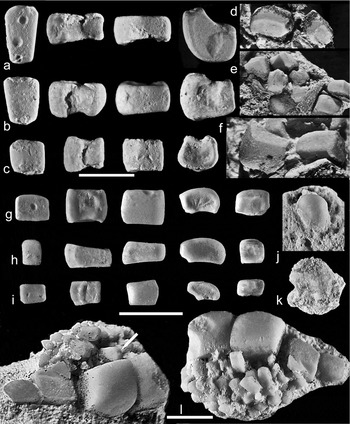
(a–c) Inferomarginal ossicles of Pycinaster sp., left to right, in abradial, dorsal, ventral, and lateral views; (a) abradial shows large spine-base facets. (d–i, k) Nymphaster? sp. a. (d–f) Ossicles in varied orientations and associated sedimentary rock. (g–i) All oriented as superomarginals, left to right as (a–c), and with adradial view at far right; faceting on these faces suggests smaller body wall ossicles. (g) Abradial view, positioning of central depression suggests a spine, but simple expression might indicate a secondary origin. (j) Unassigned abactinal. (k) Marginal in oblique ventral view, outer face bearing fine granules. (l) Nymphaster? sp. b, two views of the only-known, partially articulated specimen. Four marginals are retained, two displaced and partially preserved; at arrow, overall ossicular shape together with a longitudinal groove that appears to mark the separation between furrow and subadambulacral spines indicates an adambulacral ossicle. Ossicular height is more oreasterid-like than goniasterid-like; adjacent ossicles appear to be another adambulacral and actinal ossicles across the ambulacral furrow, the missing series displaced and lost during preservation. (a) RGM 791 844; (b) RGM 791 845; (c) RGM 791 846; (d) RGM 791 847; (e) RGM 791 848; (f) RGM 791 849; (g) RGM 791 850; (h) RGM 791 851; (i) RGM 791 852; (j) RGM 791 853; (k) RGM 791 854; (l) RGM 791 855. Upper scale applies to (a–f), middle scale refers to (g–k), both represent 10 mm; the lower scale refers to (l) only and represents 5 mm.

Discrete ossicles will encourage careful researchers to caution; taxonomic inferences will be based on modern analogues and fossils are therefore seen within the framework of modern exemplars. Unfortunately, this perspective encourages inadvertent minimizing of change through geological time. Alternatively, insufficient caution can encourage the researcher to exaggerate diversity, the cited criticism of Brünnich Nielsen (Reference Brünnich Nielsen1943). Finally, isolates have been much more intensively studied in Europe than in North America and other regions. This may engender potentially misleading assignment of isolates from other areas to European taxa, with associated implications for biogeographical history.
4.d. Approaches
Advances in computer and analytical technology can significantly augment more traditional taxonomic studies. Asteroid isolates can be imaged and ranges of variation evaluated using statistical, multivariate techniques. A testing framework can be based on extant taxa that are also reported from the fossil record. For example, the goniasterid Nymphaster Sladen, Reference Sladen1889 has been widely recognized in both living and fossil faunas; marginal isolates (and potentially those of other ossicular systems) can be taken from the disc and arms for quantitative evaluation. Individuals of different sizes and populations as well as different species can be tested against species belonging to other genera. Blind sampling can aid objectivity. With results in hand, the researcher is ready to return to fossil material known only from isolates.
The scientific value of research programmes must be considered against time and resource commitment. Given variation among ossicular systems, and the complexity of generic and species diagnoses of modern exemplars, a taxonomy based on isolates cannot duplicate that treating complete or relatively complete fossil material. The potential difficulty of basing taxa on isolates can be exemplified by the history of Buterminaster Blake and Zinsmeister, Reference Blake, Zinsmeister, Feldmann and Woodburne1988 from the Eocene of Antarctica. The putative genus, a small goniasterid with a large disc and robust ossicles, was based on fairly complete specimens; its most striking feature is the presence of a much-enlarged terminal ossicle. In a subsequent phylogenetic analysis, Mah (Reference Mah2007) demonstrated that Buterminaster nested within the extant genus Pentagonaster; he was therefore able to synonymize the fossil genus with the latter. If Buterminaster were to have been based on distal arm fragments, the generic concept would likely still stand. Further, because proportionately enlarged terminals occur in families with elongate, tapering arms, such as the paxillosidan Astropectinidae, even familial affinities of an isolated terminal or arm fragment would remain unproven. The known Eocene Seymour Island asteroid fauna, with the exception of Buterminaster, consisted entirely of surviving genera, although the modern fauna is distinct; synonymizing Buterminaster was a useful contribution to the understanding of Antarctic faunal history. Taxa based exclusively or nearly exclusively on isolates can only be more problematic than the whole-specimen issues surrounding Buterminaster.
5. Assessment of the new fossils
The Jamaican and Antiguan asteroid fossils from upper Oligocene deposits consist almost entirely of dissociated marginals (Figs 2, 3). In addition, a single small arm fragment (Fig. 3l) and very few ossicles other than marginals (e.g. Fig. 3j) have been recovered. On other sediment fragments, ossicles are closely situated but not in life orientations (e.g. Fig. 3e–g) and whether or not such accumulations represent life associations is unclear; the conservative interpretation is followed, treating the clusters as current-induced concentrates (but see Donovan, Harper & Portell, in press). Two marginal types are present: those distinctive enough to be assigned to Pycinaster Spencer, Reference Spencer1907 (here assigned to the Goniasteridae), and the remainder considered to be of uncertain goniasterid affinities but potentially representing one or two species of surviving Nymphaster.
Marginals of Pycinaster are comparatively distinctive, allowing their generic recognition. The genus has previously been recognized to comprise eleven species, including two in open nomenclature (see Appendix). The new Jamaican occurrence is the youngest known to date and also the first to be reported from beyond European deposits. Six recognized species are Late Cretaceous in age and the remaining four are Paleogene in age. The Goniasteridae is one of largest of surviving families and its fossil record is comparatively good (for the Asteroidea); many species have been recognized from Jurassic and younger rocks. Unfortunately, much of the fossil record consists of isolates and incomplete discs and arms; taxonomic assignments therefore become problematic, as is true of the Jamaican specimens.
Arguably, in large isolate suites such as the Jamaican material, intergrading morphological expression allows greater confidence in association as single taxa. However, because of the limitations of the existing terminology, the Jamaican Pycinaster ossicles are not assigned at the species level and assignment of ossicles to Nymphaster is tentative.
6. Systematic palaeontology
Class ASTEROIDEA de Blainville, Reference Blainville and Levrault1830
Subclass NEOASTEROIDEA Gale, Reference Gale1987a
Order VALVATIDA Perrier, Reference Perrier1884
Family GONIASTERIDAE Forbes, Reference Forbes1841
Remarks. A large portion of the Jamaican collection consists of dissociated marginals consistent with traditional interpretations of the genus Pycinaster (see Appendix). An extended and accessible source of excellent illustrations of specimens assigned to Pycinaster (rather than isolated ossicles) was provided by R. Randell (unpub. data, 2012: http://www.chalk.discoveringfossils.co.uk).
A subfamily Pycinasterinae was recognized by Spencer & Wright (Reference Spencer, Wright and Moore1966) and raised to family level by Gale in Smith et al. (1988, p. 195). Only two generic names have been included in the (sub)family – Pycinaster itself and Phocidaster – the latter ‘known from a total of 9 interradial marginals, all dissociated’ (Gale in Smith et al. Reference Smith, Paul, Gale and Donovan1988, p.195). The following diagnosis of the Pycinasterinae was provided by Spencer & Wright (Reference Spencer, Wright and Moore1966, p. U59): ‘Very robust forms with rather small disc and long arms; superomarginals high, swollen, with rounded profile, and with large hollows for intermarginal muscles; spines almost absent; marginals and aboral ossicles may have feeble rugosities. Alveolar pedicellariae.’ Gale's diagnosis of the family Pycinasteridae (in Smith et al. Reference Smith, Paul, Gale and Donovan1988, p. 195) is: ‘The marginal ossicles are stout and tall. Only the first-formed pairs of marginals (SM1, IM1) oppose; more distally, supero- and inferomarginals alternate. The marginal ossicles are notched at the intermarginal junction. A large, orally directed dagger-shaped or spatulate spine is present in each interradial area immediately adjacent to the mouth frame.’ These diagnoses are focused on the morphology of the superomarginal ossicles. In viewing the specimens at the Randell website, relatively complete specimens appear robust but not all have proportionately long arms and pedicellariae are not obvious in all specimens. Marginals of most specimens seem to alternate, but a lateral view of one specimen (R. Randell, unpub. data, 2012: http://www.chalk.discoveringfossils.co.uk, fig. 6) shows alternating ossicles on one side, the marginals paired on the other. The meaning of the notching noted by Gale is not fully clear, but if it refers to the overhand of the superomarginals (R. Randell, unpub. data, 2012, fig. 1B), most of the illustrated ossicles do not show this expression. No example of a spatulate near-oral spine was provided by Gale and none appears to occur in the illustrations of Randell.
Many specimens illustrated by Randell are among those included in Pycinaster by Sladen (Reference Sladen1891) and Spencer (Reference Spencer1905, Reference Spencer1907, among others). These specimens show significant variation in outline, in the expression of abactinal ossicles and in the shape of the superomarginals, as is true of the Jamaican material (Fig. 2). Robust spine bases and many pedicellarial alveolae mark the marginals of one specimen (R. Randell, unpub. data, 2012, fig. 7B), but not of others. Many extant genera document ranges of variation at least superficially comparable to that of Pycinaster (e.g. Fisher, Reference Fisher1919). Significant variation within extant species and genera has been recognized (such as Foltz et al. Reference Foltz, Fatland, Eléaume, Markello, Howell, Neill and Mah2013); as yet, little effort has been made to interpret ancient occurrences relative to the variation recognized among modern species.
Potentially useful aspects of variation have not yet been incorporated into interpretation of pycinasterids. For example, the arrangement of the ventral or actinal ossicles of the Natural History Museum, London (BMNH), specimen E20293, a specimen assigned to P. angustatus, are complex with ossicles along the adambulacrals well-aligned with that series. Other ossicles near the marginals are aligned with that series; ossicles near the mouth frame are irregular in distribution (R. Randell, unpub. data, 2012, figs 2B, 9). Blake & Hotchkiss (Reference Blake and Hotchkiss2004, p. 361) reviewed actinal ossicular arrangements among Palaeozoic and post-Palaeozoic taxa noting, for example, the irregularity of arrangement of actinals in the Triassic forcipulatacean Trichasteropsis. They argued that regularity might be apomorphic, having evolved through time. In contrast with the specimen of Pycinaster, a specimen of the goniasterid Calliderma smithae (see R. Randell, unpub. data, 2012, fig. 1, BMNH 75997) approaches the regularity of alignment parallel to the adambulacral series that is typical of later members of the Goniasteridae. If alignment is an apomorphy of that family and actinals of other specimens of Pycinaster also prove to be irregularly distributed, then the valvatidan lineage leading to Pycinaster might have separated prior to the appearance of true goniasterids, thereby supporting (sub)familial status. At present, the Pycinasterinae, or Pycinasteridae, lacks a comprehensive diagnosis that encompasses all assigned specimens and serves to clearly differentiate it from the Goniasteridae; the concept is therefore not recognized here.
Genus Pycinaster Spencer, Reference Spencer1907
Remarks. The Jamaican and Antiguan isolates are consistent with the complete subfamilial diagnosis of Spencer & Wright (Reference Spencer, Wright and Moore1966, p. U59; see remarks above); Pycinaster itself was described only as showing the ‘Characters of subfamily.’ Spencer & Wright (Reference Spencer, Wright and Moore1966) tentatively included a second genus, ?Phocidaster Spencer, Reference Spencer1913, which is known only from interbrachial superomarginals; these are large, clavate and with a distinctive surface texture. The Jamaican ossicles appear unlike those of only poorly known Phocidaster. Marginal ossicles from the goniasterid/oreasterid Nidorellia Gray, Reference Gray1840 display features that resemble those present in several Pycinaster spp., including a very swollen, convex dorsal surface; some Nymphaster of late Campanian age are also superficially comparable (J. W. M. Jagt, pers. comm., November 2014). The swollen dorsal surface also forms an acute edge to the very convex ossicular margin. Although similar, several differences of the more elongate ossicle and more curved lateral surfaces in Pycinaster spp. differentiate it from Nidorellia.
Pycinaster sp.
Figures 2, 3a–c
Occurrence. Lee's Marl Crushing Plant, road to Bamboo, about 1.1 km east of Brown's Town, parish of St Ann. Brown's Town Limestones of Moneague Formation, upper Oligocene (Chattian), Jamaica (see Section 3.a), RGM 791 837 – 791 846. Many marginal ossicles, together with a single abactinal and a small number of spines and possible spines. Given the presence of spine bases on inferomarginals (Fig. 3a), the spines are likely derived from Pycinaster.
Other material. In addition to the Brown's Town locality material, many asteroid ossicles were recovered from coeval localities in Jamaica and Antigua; these are dominated by marginal isolates and at least the better-preserved of these are apparently goniasterids, including tens of specimens in samples RGM 791 859 – 791 861. A single goniasterid adambulacral is also included. Echinoid fragments are associated with some of the asteroid ossicles.
Antiguan specimens are from the upper Oligocene (Chattian) Antigua Formation, RGM 791 859, mainly of Hughes Point (Fig. 1c), including material both from the bedded sequences and, particularly, from float blocks fallen from the top of the cliff. Rarer specimens came from a road-cutting south of Parham, and from Hodges Point and Hodges Bay.
Description, larger superomarginals (medial and interbrachial). Dorsal surface of ossicles strongly convex, wider dorsally than ventrally in lateral view. Ossicles mushroom-shaped in cross-section. Ossicular lengths and widths greatest at dorsal side of ossicle; convex dorsal side of ossicle thicker than ventral side. Ossicle asymmetrical in lateral view, one side relatively straight, the other ossicle forming a continuation of the curvature of the dorsal side of the marginal ossicle creating an overhang with a strong concavity. A relatively shallow, rounded-square or quadrate inset is present on the side with the re-entrant; the opposite or ‘straight’ side is bare. Ventral surfaces with raised processes that abut corresponding structures on the inferomarginals. Ossicular surface largely lacking well-defined accessory attachment sites, although surface textures can suggest presence in life of fine, granular accessories; pedicellarial alveolae rare, but occurring (Fig. 2f, dorsal).
Discussion of larger superomarginals. Marginal ossicular edges differ in appearance; one side is straight, suggesting a relatively flush contact with the abactinal surface; the other side bends gradually to form a more rounded contact with the inferomarginal ossicle. Departure from bilateral at least suggests the abrupt shape change between the disc and arms (for example, Spencer & Wright, Reference Spencer, Wright and Moore1966, fig. 54.2a). Forty-five ossicles were examined. Height ranges from 4.97 mm to 13.65 mm. Ossicular shape is correlated with its size; shorter, more squat ossicles appear more rounded or more nearly hemispherical, whereas larger, more elongate ossicles are more mushroom-like. Approximately 15 ossicles are rounded and lack any discrete sides.
Surface textures are quite varied and their interpretation is problematic, but only one ossicle shows apparently definite pedicellarial alveolae (Fig. 2f). Several ossicles show distinct, narrow notches or pits on their ventrolateral sides; these are unpaired and do not appear to represent pedicellariae because they are restricted to the ventrolateral side of the ossicle. Gnawing or biting during life such as that recognized by Neumann (Reference Neumann2000) is possible and ossicles are certainly likely to have been damaged in the depositional setting following death, but prior to final burial.
Description, smaller superomarginals (distal, possibly also from smaller individuals). Rounded portion of the ossicle proportionately larger, lacking angularity of larger ossicles. Ossicles are polygonal–rounded on one side, but smooth, rounded on the external(?) surface. Dimensions of available examples: 4.97 mm in length by 4.70 mm on dorsal surface by 2.08 mm on ventral surface by 3.41 mm on dorsal surface.
Description, larger inferomarginals (medial and interbrachial). Ossicles approximately reniform, lateral to actinal curve gradual, outline differing among ossicles. Width in lateral view greatest ventrally, narrowing dorsally; this outline corresponding to thickness of the superomarginal ossicle, which is thicker dorsally and narrower/thinner ventrally. The dorsal surfaces bear low articular prominences near the abradial edges that abutted the superomarginals. The dorsal ossicular length tends to be slightly greater than the length of the edge of the inferomarginal ossicle articulating with the actinal ossicle. Inferomarginal outlines apparently shifting around the curvature of the arm; internal curvature angle of larger ossicles consistently greater than that of smaller ossicles. Ossicular surfaces finely textured suggesting possible presence of accessories; a very few apparent spine facets recognized (Fig. 3a, lateral), but no pedicellarial alveolae recognized. Interior surfaces of many inferomarginals with a quadrate inset and a raised perimeter that is confluent with the plane of the remaining surface of the ossicle.
Remarks on larger inferomarginals. The greatest inferomarginal height and thickness is interpreted as belonging to those ossicles located medially on the disc and decreasing distally towards the arm tips. Smaller inferomarginal ossicles tend to be more rounded/polygonal, similar to their superomarginal counterparts.
Description, smaller inferomarginals (distal ossicles, but perhaps also from smaller individuals?). Smaller inferomarginals lack the developed curvature of the dorsal surface that identifies them as superomarginals; ossicles interpreted as inferomarginals are based on size–shape relationships. Small inferomarginals are also rounded on one side, presumably one of the externally facing sides.
Abactinal and smaller ossicles, and debris. A single abactinal ossicle has been recovered from the Pycinaster suite (Fig. 1g) and, therefore, it is potentially derived from the species of the marginal. However, most illustrated Pycinaster abactinals appear to be fairly irregular in outline and perhaps arched (e.g. R. Randell, unpub. data, 2012: http://www.chalk.discoveringfossils.co.uk/), whereas the single available ossicle from the Antilles is more typical of the Goniasteridae. Ossicular type of a number of other smaller marginals cannot be determined. The diagnostic properties of shape are not clearly determinable because differences between superomarginals and inferomarginals of more distal ossicles were less clearly expressed, and also because of taphonomic disruption.
Discussion. The available Pycinaster ossicles appear to represent a single species because they document a broad, but intergrading, range of ossicular sizes and form; there are no discontinuities that might suggest the presence of more than a single species. The larger ossicles are inferred to represent interbrachial and proximal arm ossicles, these distinctive enough to allow differentiation into superomarginal and inferomarginal series. The more proximal ossicles grade in form to the smaller, much less distinctive distal ossicles, which are not readily separated into ossicular series (that is, superomarginals and inferomarginals). Because the isolates were scattered at the outcrop, there is no reason to believe only a single individual was represented; it is also therefore possible that individuals of different sizes were present. However, smaller ossicles do not exhibit the distinctive forms shown by the larger; clear differentiation of supero- and inferomarginals might therefore only have taken place during later ontogeny.
In addition to overall superomarginal form, marginal surficial textures are suggestive of specimens included under the concept of Pycinaster of earlier authors (for example, Spencer, Reference Spencer1913, pl. 11) and illustrated by Randell (unpub. data, 2012: http://www.chalk.discoveringfossils.co.uk/). The somewhat irregular surfaces at least suggest the possible presence of granular accessories. Pedicellariae and spines (or spine attachment sites) are comparatively few among illustrated taxa, and both occur only rarely on the Jamaican specimens.
The marginal ossicles are highly varied, yet there is no clear discontinuity of form that would suggest presence of more than a single species; significant variation within potentially a single population challenges efforts to recognize biological species based on isolates.
Genus Nymphaster Sladen, Reference Sladen1889
Nymphaster? sp. a
Figure 3d–i, k
Material. RGM 791 847 – 791 854, all upper Oligocene (Chattian) Browns Town Limestones of the Moneague Formation, White Limestone Group, Jamaica (see Section 3.a). Many of the isolates are partially embedded in matrix and surfaces of all are at least partially obscured. Further, many ossicles were abraded and chipped or broken before final burial, as is indicated by partial rounding of surfaces. In the laboratory, some ossicles were partially cleaned mechanically, although there is some danger of ossicular breakage, and preparation was incomplete. Others form part of samples RGM 791 860 and 791 861.
Description. A suite of approximately 150 ossicles consisting entirely of marginals that are approximately rectangular in plan-view outline and comparatively wide (such as the dimension from the body interior to the body edge). Ossicles of simple overall form, outer face evenly curved, not expanded or bulbous. Outer face more steeply rounded abradially, lateral shoulders rounded. Outer face uniformly, very finely punctate; differentiated edge zone lacking. Very few, if any, spine bases present; pedicellarial alveolae lacking. Lateral faces weakly indented (for connective tissues), adradial face faceted (suggesting small abactial, or actinal, ossicles). Intermarginal face ridged, intermarginal edge straight (suggesting marginals of two series were paired rather than offset along the length of the arm). Marginal size intergrading, ranging from small fragments of uncertain identity up to approximately 6 mm; ossicles broadly similar; no markedly enlarged or otherwise obviously differentiated ossicles present (distal and disc marginals of certain genera are enlarged and of morphology unlike that of adjacent marginals). Ossicles exhibiting no compelling characters allowing separation of inferomarginals from superomarginals (hence illustrated ossicles are oriented uniformly, as if superomarginals). No wedge-shaped marginals present. (In genera such as Astropecten and Luidia Forbes, Reference Forbes1839, interbrachia are angular and interbrachial marginals are wedge-shaped, enabling the angular interbrachial configuration. Absence of wedge-shaped ossicles from the Jamaican suite favours the presence of a broadly rounded interbrachium in the parent species, assuming wedge-shaped ossicles are not absent because of sampling or biostratinomic sorting.)
Discussion. Familial assignment of the marginal suite is based on overall ossicular form. Uniformity of expression of many ossicles favours derivation from a single species (although multiple species from limited geographical areas, but assigned to single genera, are recognized in some extant faunas). The putative presence of a rounded interbrachium supports assignment to the Goniasteridae, although a few members of certain other families, such as the Oreasteridae, Ophidiasteridae and Ganeriidae, approximate goniasterid interbrachial curvature.
Marginal ossicles of many European Mesozoic taxa have distinctive, complex shapes, and both differentiated edge zones and enlarged distal marginals are widespread. Accessories of many taxa are differentiated in size and form, and accessory spacing varies; pedicellarial alveolae are common. The simple Jamaican isolates contrast with the more typical European expressions. Assignment of the ossicles to the extant genus Nymphaster is suggested by the key of Spencer (Reference Spencer1905) as well as by illustrations of Sladen (Reference Sladen1891) of N. coombii (Forbes, Reference Forbes1848) and, at least, some of the illustrations of Schulz and Weitschat (Reference Schulz and Weitschat1971), Gale (Reference Gale1987b ), Jagt (Reference Jagt1999, Reference Jagt2000a ) (accepting reassignments of Gale, Reference Gale1987b , of certain species interpretations of Schulz and Weitschat), Randell (unpub. data, 2012: http://www.chalk.discoveringfossils.co.uk/) and, perhaps most particularly, illustrations and discussions of Breton (Reference Breton1992, see pl. 31.5–7).
However, Spencer (Reference Spencer1905, p. 123) sounded a cautionary note, suggesting that Cretaceous species assigned to Nymphaster are consistent with the earlier concept of Sladen (Reference Sladen1891), but that Spencer recognized uncertainties in distinguishing among fossil Nymphaster, Calliderma and Pentagonaster, going so far as to suggest that a future observer might place the three taxa in one genus. Breton (Reference Breton1992, p. 399) stressed the ambiguity surrounding assignment of species to Nymphaster. He noted that among the many nominal species are those taxa based on very sketchy material and, further, that ossicular shape changes from arm to disc can be significant. Simple Jamaican ossicles provide few potential indicators of separate species, perhaps consistent with the contention of Schopf et al. (Reference Schopf, Raup, Gould and Simberloff1975) that taxon recognition reflects morphological complexity rather than, necessarily, clade evolution; uniformity of the Jamaican suite could be misleading.
Marginal ossicles of living Nymphaster are similar to the Jamaican isolates and together they illustrate difficulties of taxonomic assessment. The monograph of Clark & Downey (Reference Clark and Downey1992) is the best comprehensive source on extant Atlantic Ocean asteroids. These authors recognized 24 Atlantic goniasterid genera, their tabular key (their table 33) including nine characters, none addressing marginal form, although two treat superomarginal arrangement on arms. The Jamaican isolates are broadly consistent with the single Atlantic species of Nymphaster, N. arenatus (Perrier, Reference Perrier1881), recognized by Clark & Downey (Reference Clark and Downey1992). Approximately 17 species of Nymphaster are recognized worldwide however (Clark, Reference Clark, Jangoux and Lawrence1993), and all would need to be compared in any comprehensive evaluation. Complexities are further illustrated through reference to Fisher (Reference Fisher1919), who treated many goniasterid genera – at least five (Rosaster Perrier, Reference Perrier1894; Paragonaster Sladen, Reference Sladen1889; Ateloris Fisher, Reference Fisher1911; Lithosoma Fisher, Reference Fisher1911; and Iconaster Sladen, Reference Sladen1889) – including species with simple marginal ossicle morphology superficially similar to that of the Antillean specimens. Many uncertainties of scope surround taxon concepts that make heavy reference to isolates, and the many extant genera bearing relatively simple marginals illustrate the difficulties of taxon assignment and the need for rigorous comparative approaches.
Nymphaster? sp. b
Figure 3l
Material, locality and horizon. RGM 791 855, upper Oligocene (Chattian) Antigua Formation of Hughes point, Antigua, collected from a fallen block from the top of the cliff (see Section 3.b).
Discussion. An arm fragment, the only known partially articulated specimen in the Antiguan material, is assigned to Nymphaster? sp. b. Four marginal ossicles present, two displaced and altered, the better-preserved two closely appressed in apparent life position. Marginal form is similar to that of Nymphaster? sp. a, although ossicles are comparatively bulbous and more nearly square in outline; surface texture again is of very fine pustules with no enlarged accessory bases or pedicellarial alveolae. The Philippine species Nymphaster arthrocnemis Fisher, Reference Fisher1913 was differentiated from congeners in part based on the presence of relatively tumid marginals (Fisher, Reference Fisher1919, p. 277), a difference that applies to Nymphaster? sp. b, leading to its recognition here as a potential second species of Nymphaster. Potentially problematic for assignment to Nymphaster is the presence of relatively high adambulacral ossicles, the ossicular type recognized based on overall shape together with presence of a longitudinal groove (Fig. 3l, arrow) that suggests separation between furrow and subadambulacral spines; ossicular height is more oreasterid-like than goniasterid-like. Adjacent ossicles appear to consist of another adambulacral and actinal ossicles across the ambulacral furrow, the missing series lost during preservation.
Acknowledgements
SKD gratefully acknowledges the support for his fieldwork in Antigua provided by the First Shell Distinguished Research Fellowship in Science at the University of the West Indies, Mona (1993) and National Geographic Society grant #GEFNE55–12 (2013, 2014). The detailed reviews of Dr John W.M. Jagt (Natuurhistorisch Museum, Maastricht) and an anonymous referee are gratefully acknowledged.
Appendix 1. Literature survey of ‘Pycinasteridae’ (Pycinaster, Phocidaster)
Pycinaster angustatus (Forbes, Reference Forbes1848)
(as Goniaster (Astrogonium) angustatus) Forbes, Reference Forbes1848: 474.
(as Pentaceros punctatus) Spencer, Reference Spencer1905: 88, pl. 26, fig. 1.
(as Pycinaster angustatus) Sladen, Reference Sladen1891: 21, pl. 9, fig. 1; 122; Spencer, Reference Spencer1905: 95, pl. 21, fig. 2, pl. 25, fig. 7, pl. 26, fig. 4; Spencer, Reference Spencer1913: 124, pl. 11, figs 12, 13; Valette, Reference Valette1915: 40, fig. 13; Mercier, Reference Mercier1935: 12, pl. 1, fig. 5a–c; Mercier, Reference Mercier1936: 24; Spencer & Wright, Reference Spencer, Wright and Moore1966: U59, fig. 54.2; Schulz & Weitschat, Reference Schulz and Weitschat1971: 122, pl. 26, figs 1–7.
Stratigraphical range: Upper Cretaceous; Santonian.
Pycinaster corbaricus Breton & Vizcaïno, Reference Breton and Vizcaïno1997
Breton & Vizcaïno, Reference Breton and Vizcaïno1997: 13.
Stratigraphical range: Eocene; Ypresian.
Pycinaster cornutus Wienberg Rasmussen, Reference Wienberg Rasmussen1945
Wienberg Rasmussen, Reference Wienberg Rasmussen1945: 423, pl. 9, figs 12–14; Wienberg Rasmussen, Reference Wienberg Rasmussen1950: 76, pl. 10, fig. 9.
(as Pycinaster aff. cornutus) Jagt, Reference Jagt2000a : 433, pl. 22, figs 15, 16.
Stratigraphical range: Paleocene; upper Danian.
Pycinaster crassus Spencer, Reference Spencer1907
Spencer, Reference Spencer1907: 96, fig. 24, pl. 29, figs 1–5; Spencer, Reference Spencer1913: 125, pl. 15, fig. 4; Valette, Reference Valette1915: 38, fig. 12; Mercier, Reference Mercier1935: 12, pl. 1, fig. 4a–b; Mercier, Reference Mercier1936: 24; Brünnich Nielsen, Reference Brünnich Nielsen1943: 56, pl. 3, figs 20, 21; Wienberg Rasmussen, Reference Wienberg Rasmussen1950: 73, pl. 10, figs 6, 7.
(as Pycinaster cf. crassus) Helm & Frerichs, Reference Helm, Frerichs and Schneider2013: 199, fig. 20.
Stratigraphical range: Upper Cretaceous.
Pycinaster danicus Brünnich Nielsen, Reference Brünnich Nielsen1943
Brünnich Nielsen, Reference Brünnich Nielsen1943: 57, fig. 11, pl. 4, figs 1–5; Wienberg Rasmussen, Reference Wienberg Rasmussen1950: 75, pl.10, fig. 8.
Stratigraphical range: Paleocene; upper Danian.
Pycinaster humilis Spencer, Reference Spencer1913
Spencer, Reference Spencer1913: 124, pl. 11, fig. 11.
(as Pycinaster cf. humilis) Néraudeau & Breton, Reference Néraudeau and Breton1993: 117.
Stratigraphical range: Upper Cretaceous: Cenomanian and Turonian.
Pycinaster magnificus Spencer, Reference Spencer1913
(as Pentagonaster dutemplei) d’Orbigny, Reference Orbigny1850: 124.
(as Arthraster senonensis) Valette, Reference Valette1902: 211.
(as Pycinaster senonensis) Spencer, Reference Spencer1907: 95, fig. 23.
Spencer, Reference Spencer1913: 125, pl. 11, figs 14, 15; Valette, Reference Valette1915: 41, fig. 14; Schulz & Weitschat, Reference Schulz and Weitschat1971: 123, pl. 26, figs 8–19; Wright & Smith, Reference Wright, Smith, Owen and Smith1987: 216, pl. 47, figs 1, 2; Breton, Reference Breton1988a : 125; Breton, Reference Breton1988b : 125; Neumann, Reference Neumann2000: 433, pl. 22, figs 13, 14, 17–21, pl. 23, fig. 3; Jagt, Reference Jagt2000a : 433, pl. 22, figs 13?,14?,17–21, pl. 23, fig. 3; Villier, Reference Villier and Odin2001: 604, fig. 9/9–11; Smith & Wright, Reference Smith, Wright, Smith and Batten2002: 268, pl. 52, fig. 5.
Stratigraphical range: Upper Cretaceous: lower Campanian – lower Maastrichtian.
Pycinaster rasmusseni Müller, Reference Müller1953
(as Pycinaster aff. cornutus) Wienberg Rasmussen, Reference Wienberg Rasmussen1950: 76, pl. 10, fig. 10.
Müller, Reference Müller1953: 49, pl. 1, fig. A, pl. 2, fig. G, pl. 3, fig. L, pl. 4, fig. U, pl. 6, fig. DD0HH, pl. 9, figs EA–GA, pl. 10, figs ZA–BC.
Stratigraphic range: Upper Cretaceous; lower Maastrichtian.
Pycinaster rosenkrantzii Brünnich Nielsen, Reference Brünnich Nielsen1943
Brünnich Nielsen, Reference Brünnich Nielsen1943: 58, pl. 4, figs 6–9; Wienberg Rasmussen, Reference Wienberg Rasmussen1950: 77, text-fig. 6f, pl. 10, fig. 11.
(as Pycinaster? aff. rosenkrantzi) Jagt, Reference Jagt2000a : 434, pl. 23, figs 1, 2.
Stratigraphical range: Paleocene; upper Danian.
Pycinaster sp. 1
Jagt, Reference Jagt2000a : 435, pl. 21, figs 14, 15, pl. 22, fig. 7.
Stratigraphical range: Upper Cretaceous; lower Maastrichtian.
Pycinaster sp. 2
Jagt, Reference Jagt2000a : 435, pl. 22, fig. 11.
Stratigraphical range: Paleocene; lower Danian.
Genus Phocidaster
Phocidaster grandis Spencer, Reference Spencer1913
Spencer, Reference Spencer1913: 140, pl. 13, figs 28, 29.
Stratigraphical range: Upper Cretaceous; Cenomanian.