Introduction
It has been recognised for many years that patients with severe mental illness are at dramatically increased risk of premature death (Harris & Barraclough, Reference Harris and Barraclough1998; Fazel et al. Reference Fazel, Wolf, Palm and Lichtenstein2014). This tragedy of increased mortality in an already vulnerable patient group has variously been explained by increased risk factors in this population, including higher rates of smoking, a greater risk of developing diabetes and poor nutrition (Holt et al. Reference Holt, Bushe and Citrome2005; Lester Reference Lester2005; Windfuhr et al. Reference Windfuhr, Turnbull, While, Swinson, Mehta, Hadfield and Appleby2011). Patients with severe mental illness are less likely to access primary or secondary healthcare and their symptoms are more likely to be ignored (Kendrick et al. Reference Kendrick, Burns, Freeling and Sibbald1994; Björkenstam et al. Reference Björkenstam, Ljung, Burström, Mittendorfer-Rutz, Hallqvist and Weitoft2012). Psychotropic medications have been shown to cause an increase in metabolic syndrome and diabetes, which in turn leads to a greater risk of early morbidity and mortality (Newcomer Reference Newcomer2007; Hasnain et al. Reference Hasnain, Vieweg, Fredrickson, Beatty-Brooks, Fernandez and Pandurangi2009; Beck et al. Reference Beck, Stephenson, Brayford, Wilford, Potter and Suleman2013).
This article describes a service enhancement initiative, which aimed to improve the monitoring of the physical health of patients attending a psychiatric clinic. A preliminary audit carried out by the authors indicated that the physical health monitoring of these patients was falling significantly short of that recommended by the current international best practice guidelines. This project focussed on monitoring physical health in a clearly identifiable subgroup of patients, namely those prescribed antipsychotics in depot formulation, to ensure that the aims of the initiative were achievable.
Background
A search of the literature was conducted in order to establish the rationale for the project, inform the development of a local monitoring protocol and examine the successes and failures of similar projects undertaken in other hospitals and jurisdictions.
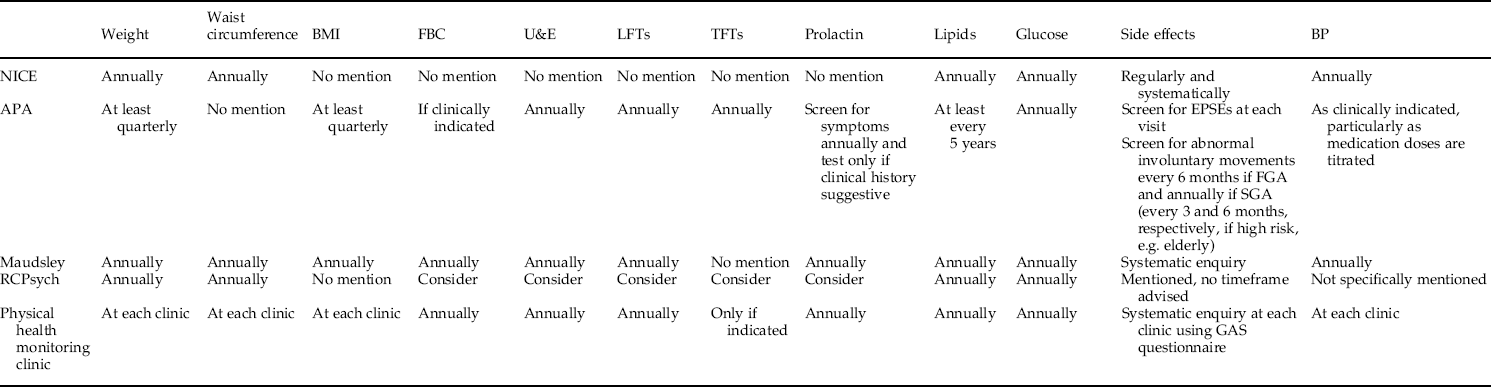
The major influential bodies within psychiatric practice were scrutinised for evidence of published guidelines on what should be monitored and how often. Table 1 shows a summary of the parameters and frequencies recommended, as well as those adopted by our physical health monitoring clinic. It is apparent that there is no definitive international consensus specifying exactly what should be measured, and how often. A clinical decision was made therefore to include measures of body weight, BMI, waist circumference and blood pressure, and side effects of prescribed antipsychotic medication at each clinic, so as ensure capture of all patients in case of failure to attend at the next monitoring clinic.
Summary of monitoring frequencies with parameters adopted for local protocol

BMI, body mass index; FBC, full blood count; U&E, urea and electrolytes; LFTs, liver function tests; TFTs, thyroid function tests; BP, blood pressure; NICE, National Institute for Health and Care Excellence; APA, American Psychiatric Association; EPSE, extrapyramidal side effects; FGA, first generation antipsychotic; SGA, second generation antipsychotic; RCPsych, Royal College of Psychiatrists; GAS, Glasgow antipsychotic side effect scale.
Debate continues as to where health monitoring of psychiatric patients should be conducted, and by whom. It has been noted that many psychiatrists reject the role of physical health monitoring and prefer to remain solely responsible for the psychiatric illness of their patients (De Hert et al. Reference De Hert, Cohen, Bobes, Cetkovich-Bakmas, Leucht, Ndetei and Correll2011). Marder et al. (Reference Marder, Essock, Miller, Buchanan, Casey, Davis and Shon2004) however previously made the point that psychiatrists have frequently more contact with their patients than primary healthcare providers as this group is less likely to seek help from GPs. As such, psychiatrists are often in a better position to pick up on early changes such as weight gain or elevated blood pressure. The Royal College of Psychiatrists (2004) assert that psychiatrists should initiate investigations if indicated and act on their outcomes, in addition to working collaboratively with GPs to refer to specialists where necessary. A recent addition to the NICE guidelines (2014), states that the psychiatric team is responsible for monitoring the physical health of patients for at least the 1st year of treatment. Only then should responsibility for monitoring be passed on to primary care services, with reference made to shared care between the two services (National Institute for Health and Care Excellence, 2014). The concept of responsibility also extends to patients, of course. Although this patient group is recognised as vulnerable, they should be educated and encouraged to monitor their own weight and report changes to their psychiatrist as part of a broader empowerment approach (Marder et al. Reference Marder, Essock, Miller, Buchanan, Casey, Davis and Shon2004).
In one Irish study, the majority of GPs believed that management of the metabolic consequences of antipsychotic medications was the responsibility of primary healthcare providers. Those GPs who disagree and asserted that psychiatrists should manage these complications cannot be ignored, however (Bainbridge et al. Reference Bainbridge, Gallagher, McDonald, McDonald and Ahmed2011). The general consensus in the literature seems to suggest that monitoring of physical health should be within the capabilities of psychiatrists, but that follow-up and treatment is the responsibility of primary care (Cohn & Sernyak, Reference Cohn and Sernyak2006). This emphasises the need for effective communication between service providers to ensure that abnormal results are followed up in a timely and appropriate manner (Bainbridge et al. Reference Bainbridge, Gallagher, McDonald, McDonald and Ahmed2011).
Few suggestions have been made in the literature as to how to go about monitoring physical health on a practical level. Some attempts to regulate and control monitoring have been described with varying success rates. Cohn and Sernyak (Reference Cohn and Sernyak2006) proposed that structured monitoring should involve a protocol, an organised method of documenting results and shared care between relevant primary and secondary care professionals as necessary. De Hert et al. (Reference De Hert, Cohen, Bobes, Cetkovich-Bakmas, Leucht, Ndetei and Correll2011) make no specific recommendations about how screening should take place, but recommend using an algorithm, proforma or chart to monitor physical health. Wildin and Najim (Reference Wildin and Najim2013) report on an initiative called a Depot and Well-Being Clinic established in a UK trust. The goal was to improve the physical health of a specific cohort of stable patients on depot antipsychotic medications attending an outpatient clinic. The initiative involved patients attending twice annually, with the monitored parameters having been derived from NICE and Maudsley Guidelines, and GPs informed following every appointment. A high non-attendance rate led to implementation of a reminder service involving written reminders and encouragement from community mental health nurses.
Rather than establish a clinic, Gonzalez et al. (Reference Gonzalez, Ahammed and Fisher2010) took a more educational route to improve monitoring. They presented data on physical health monitoring within their local service, met with consultants on a number of occasions and gave two brief didactic talks to non-consultant hospital doctors. A single monitoring sheet was incorporated into the chart. A significant improvement in most monitored parameters resulted. A question mark remains over the likelihood of long-term success of such a method, however. In the Irish mental health services, the feasibility and success of such an educational programme is doubtful in the context of the rapid turnover of non-consultant medical staff. An established clinic that can be repeated within a specific and well-identified timeframe is likely to have more enduring success.
Objectives
Following the review of the literature, the objectives of the quality initiative were decided on as follows:
-
∙ All patients currently receiving depot antipsychotics would have had blood monitoring annually, to include full blood count, renal and liver profiles, prolactin, fasting glucose and lipids.
-
∙ All patients currently receiving depot antipsychotics would have had their weight, BMI, waist circumference and blood pressure checked annually by the community mental health nurse.
-
∙ There would be annual documentation of a systematic enquiry by the reviewing psychiatrist, through the use of a validated questionnaire, into side effects experienced by each patient.
Methods
The catchment area in question services a population of ~36 000. This encompasses rural and urban areas, both affluent and deprived. Following an engagement process with multidisciplinary staff, a physical health monitoring clinic was established, to be run on a twice-yearly basis, staffed by a consultant psychiatrist, a senior registrar, an senior house officer (SHO), three community mental health nurses and a secretary. A letter was sent to all patients receiving depot antipsychotics explaining the purpose of the clinic and inviting them to attend. The mail invitation was followed up by a text message reminder, and verbal reminders from nursing staff when administering depots. Ethical approval was deemed unnecessary by the local Ethics Committee as it was considered a service improvement project.
A clinical assessment proforma was drawn up and printed on brightly coloured paper so as to be easily identifiable within the chart. The proforma acted as an aide-mémoire to standardise and structure the clinic process. A self-report questionnaire, the Glasgow Antipsychotic Side Effect Scale (Waddell & Taylor, Reference Waddell and Taylor2008) was utilised to detect medication side effects, and community mental health nurses assisted patients with this if necessary. Monitoring standards were audited at baseline and after each clinic.
Results
Attendance at both the first and second clinics was encouraging, with 21 of the 23 invited patients attending on the first occasion and 22 of the 23 invited patients attending on the second. All patients were given blood forms and asked to attend the local phlebotomy clinic within the following 2 weeks. Any abnormal bloods returned were acted on in the usual manner, by writing to the relevant GP. Apart from the high attendance rate, patients’ compliance with all requested tests and anecdotal reports from the clinical team suggest that the initiative was well received by patients. Feedback from medical staff indicated satisfaction with the proforma used.
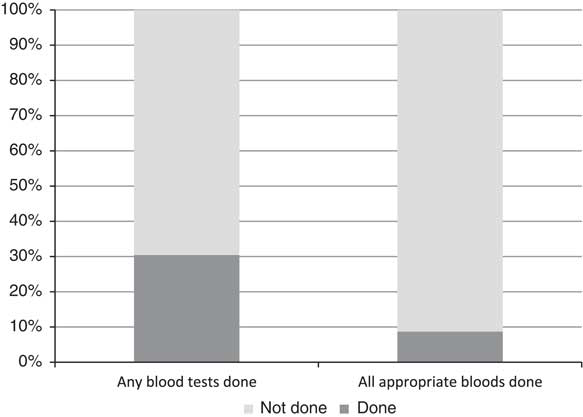
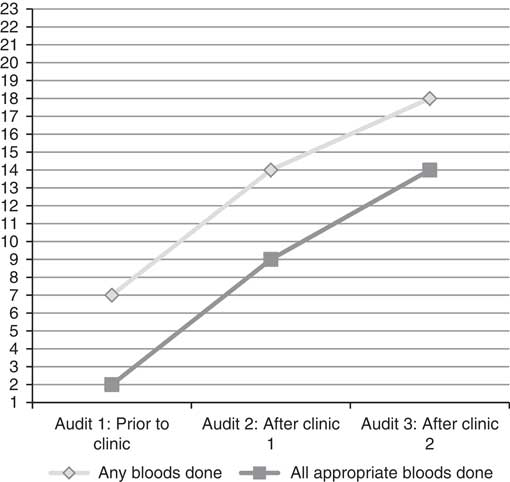
An audit, examining 23 medical records in total, was conducted 2 months after each clinic to allow for return and filing of results. Before the first clinic, only seven of the 23 medical records (30%) indicated that any blood monitoring had been conducted, and only two of the 23 medical records (9%) indicated that full blood monitoring according to the protocol adapted for the project had been completed within the preceding year (Fig. 1).
Results of audit 1 – blood test monitoring.

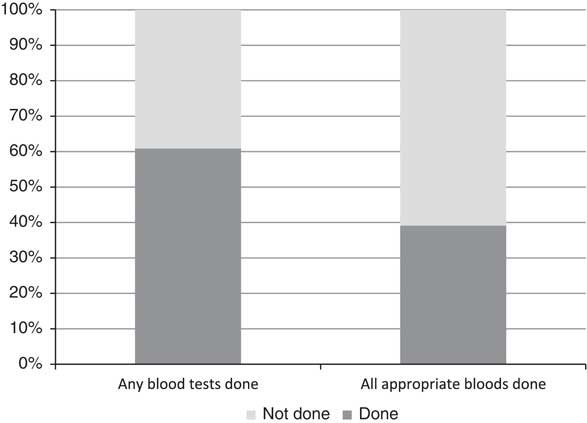
The second audit measurement, conducted 2 months after the first clinic, showed that 14 of the 23 medical records (61%) indicated that some blood monitoring had been completed, and that nine of the 23 medical records (39%) indicated that full blood monitoring according to the protocol adapted had been completed (Fig. 2). Notably, four of the five patients who did not have records of complete blood tests were solely missing prolactin results from their charts. This may have been a result of prolactin being sent to an external laboratory for testing, leading to problems in the returning of the results to the doctor requesting the test, rather than the patient’s GP.
Results of audit 2 – blood test monitoring.

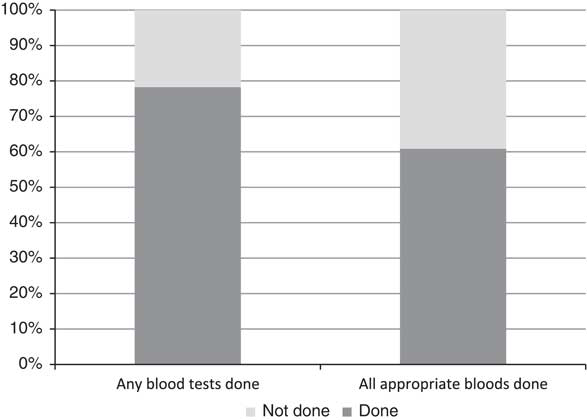
The third, and final audit measurement, conducted 2 months after the second clinic, found evidence in 18 of the 23 medical records (78%) which indicated that some blood monitoring had been completed, and in 14 of the 23 medical records (61%) indicating that full blood monitoring according to the protocol adapted had been completed (Fig. 3).
Results of audit 3 – blood test monitoring.

Figure 4 shows the improvement in blood test monitoring following the running of the two clinics.
Blood monitoring improvements over time.

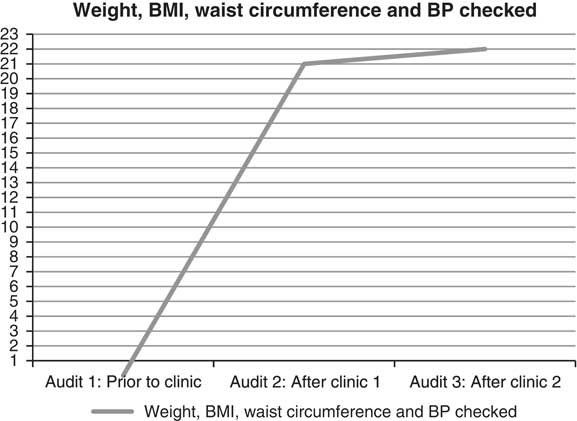
Before the establishment of the physical health monitoring clinic, physical parameters were not routinely measured or recorded. The initial audit conducted before the first clinic revealed evidence of the monitoring of physical parameters within the preceding year in only one medical record. Discussions with staff revealed a number of possible explanations for this, including lack of availability of necessary equipment and a prevailing local practice of community mental health nurses often administering depot injections while visiting the patient at home.
The second audit measurement, conducted 2 months after the first clinic, revealed that physical parameters had been recorded in the medical records of all 21 patients who had attended the clinic. Similarly, the third and final measurement conducted 2 months after the second clinic revealed that physical parameters had been recorded in the medical records of all 22 patients who had attended the clinic (Fig. 5).
Improvement in physical parameter monitoring after each clinic.

Summary
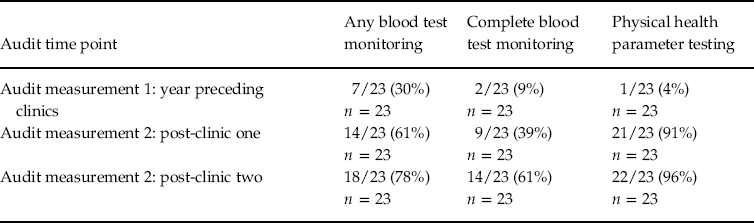
An audit examined 23 medical records on three occasions, before commencement of the health monitoring clinic, and 2 months after each of the initial two clinics. Audit measurements revealed that the proportions of the medical records with evidence of blood profile and physical health parameter monitoring increased progressively across the three audit measurement points (Table 2).
Summary of results

Discussion
This service enhancement was driven by the acknowledgement that the practice of monitoring important physical health markers in those prescribed depot antipsychotic medications was below that recommended in professional guidance. An explorative exercise with the multidisciplinary team revealed a number of possible explanations for this deficit. The first was that due to time pressure in a busy routine review clinic, other clinical issues were perceived as priorities. The second was that inexperienced doctors (SHOs) were frequently assigned to review such patients, due to the relative stability of their clinical condition, their compliance with depot medication, and their regular contact with community mental health nurses. Less experienced physicians are less likely to be familiar with monitoring guidelines, or may be less efficient in other aspects of clinical assessment, leaving little time to address physical health. Lastly, this patient group tends to seek healthcare less enthusiastically and their physical health can be neglected (Kendrick et al. Reference Kendrick, Burns, Freeling and Sibbald1994; Björkenstam et al. Reference Björkenstam, Ljung, Burström, Mittendorfer-Rutz, Hallqvist and Weitoft2012). This physical health monitoring clinic was implemented in order to improve this situation and act, in some senses, in an advocacy role for a group that is often marginalised and stigmatised (Patel & David, Reference Patel and David2005).
The health monitoring clinic project had a number of strengths. Most notable among these was the positive response from the patients involved, with all but two attending the first clinic and all but one attending the second. All patients were agreeable to the measurements of physical health markers. Furthermore, patients were required to attend a separate phlebotomy clinic in order to have the necessary blood tests completed and the fact that most complied with this extra burden was encouraging.
A further strength of the initiative was that the implementation was incorporated into the existing organisation of the outpatient clinic with minimal or no disruption, and was achieved on a budget neutral basis. The ultimate strength of the initiative was the outcome, with an increase in the proportion of patients attending the clinic who had physical health monitoring completed, as demonstrated by repeated audit of medical records.
An unanticipated consequence of the initiative was the reduction in the number of patients on the outpatient clinic list assigned to the SHO, who, before the project, tended to see the more settled, stable patients on depot. These newly vacated appointment slots were reassigned to the assessment of patients who required emergency review. As a function of the reassignment of the newly available clinic appointments, the service achieved a reduction in the waiting list for initial assessments from 4 months to 5 weeks over the duration of the project. Apart from the obvious clinical benefits, this achievement met one of the service’s key performance indicators.
A number of limitations were noted. Not all patients attended the clinics, and not all medical records of those who did attend had evidence of blood monitoring recorded. A number of explanations for this were proposed. The first explanation is that not all patients attended the local phlebotomy clinic to have bloods samples taken, either as a function of having mislaid the blood form, or having forgotten to have the tests done. Negative symptoms or cognitive deficits associated with schizophrenia may also have contributed to their failure to attend the phlebotomy clinic. Another explanation relates to the local lack of electronic access to hospital laboratory results, with an arguably dated system of blood results being posted back to the community clinic, which is not co-located with the hospital. This demonstrates the potential utility of electronic records in the future. A further limitation was that the project was limited to just one catchment area of the service, limiting its potential benefit to patients on depot medication within that area. Obviously, future initiatives should aim to broaden the monitoring to all patients on antipsychotic medications, not just those on depots.
Although not every patient prescribed depot antipsychotic medication has now had gold standard health monitoring, the implementation of this project has yielded encouraging results. The health monitoring clinic will now continue on a twice-yearly basis with the ultimate goal of ensuring that all patients have health monitoring in line with best practice and professional guidance. Certain logistical changes could help achieve this goal. One way to ensure blood monitoring was more comprehensive would be to organise the clinic in such a way that bloods could be taken on site, at the time of the clinic.
In terms of future planning, the spotlight on physical health created in this initiative has been noticed by other sector areas within the local mental health service and has led to expression of interest from other sectors in adopting the same monitoring system. We hope that outlining the establishment of this twice-yearly physical health monitoring clinic may assist others in planning such a project, with the goal of reducing the ‘scandal of premature mortality’ befalling those with major mental illness (Thornicroft, Reference Thornicroft2011).
Acknowledgements
The authors would like to acknowledge the contribution to the project by the community mental health nurses and NCHDs involved.
Financial Support
This research received no specific grant from any funding agency or from commercial or not-for-profit sectors.
Conflicts of Interest
None.
Ethical Standards
The authors assert that all procedures contributing to this work comply with the ethical standards of the relevant national and institutional committee on human experimentation with the Helsinki Declaration of 1975, as revised in 2008. The authors assert that ethical approval for publication of this audit was not required by their local REC.