Introduction
The Coronavirus Disease-2019 (COVID-19) outbreak (caused by SARS-CoV-2) emerged as a cluster of reported cases in China on December 31, 2019 after which it was classified as a global pandemic on March 11, 2020. 1 Till date, the COVID-19 pandemic has affected the health of more than 165 million people, and caused the death of over 3.42 million people across the world. 2
As at June 7, 2021, when this manuscript was written, there are 727612 confirmed cases reported by Jordan, of which 739947 have recovered, and 9530 deaths reported so far in hospitals. 3 Furthermore, this study was carried out during the second peak of the COVID-19 outbreak, which lasted from January 28 to April 25, 2021. During the COVID-19 pandemic, Healthcare workers (HCWs) are at higher risk of infection than the general population. Due to the close proximity and contact of HCWs with Covid-19 patients they are highly susceptible to getting infected and are more prone to the risk of exposure. Reference Verbeek, Rajamaki and Ijaz4–Reference Smereka and Szarpak6
Recognizing the high-risk status of HCWs, many health organizations around the world have published infection control interventions to guide them on how to reduce transmission of COVID-19 including: universal source control (by covering the nose and mouth to contain respiratory secretions), the use of appropriate personal protective equipment (PPE) when caring for patients with COVID-19, and environmental disinfection. Reference Lynch, Davitkov and Anderson7 The Jordanian government has followed the WHO’s guidelines and updates since the beginning of the COVID-19 outbreak.
Health experts strongly urge the use of proper personal protective equipment (PPE) for the HCWs’ and patients’ safety and emphasize that compliance and adherence to infection prevention and control (IPC) guidelines is a cornerstone in the practice of HCW during this pandemic. Reference Chang, Xu, Rebaza, Sharma and Dela Cruz8 The recent COVID-19 pandemic has prompted concern about healthcare workers’ adherence and compliance to IPC practices. Despite the importance of PPE in reducing transmission of COVID-19, prolonged use of masks, respirators, and face shields, can be difficult to comply with since PPE can be burdensome, and uncomfortable to use. Therefore, the level of HCWs compliance varies. Reference Rebmann, Carrico and Wang9
By understanding compliance levels, and by identifying perceived barriers to HCWs adherence to the implementation of proper infection protection and control protocols, we can more easily identify strategies that will support healthcare workers to undertake the IPC measures needed at such a critical time in this pandemic. In this study the researchers aimed at evaluating knowledge and compliance of health care workers regarding infection protection and control protocols and studying the barriers affecting their practice and perception.
Materials and methods
Study design
The study was implemented as a cross sectional correlational design. This design attained the aims of the study in assessing compliance and perceived barriers of HCW towards PPEs and examining factors affecting their compliance and perceived barriers.
Population, setting, sampling and sample size
Populations of this study were all healthcare workers from the 3 major geographical areas of Jordan (i.e., North, Middle, and South of Jordan). The healthcare system in Jordan has 4 sectors: public sector, private sector, teaching sector, and royal medical services (RMS) sector. This study involved all health sectors except RMS. Health institutions included in our study are the Ministry of health, University Hospitals, and Private Hospitals. These hospitals were selected because they have sufficient exposure to patients infected with COVID-19. A non-random convenience sample method was used to recruit healthcare workers who met the following inclusion criteria and were included in the study: aged at least 18 years old, able to read, write, and understand English, have online access to the material of the study, and gave consent. The sample size was calculated using Gpower software (Heinrich Heine University, Düsseldorf). Assuming a power of 80%, α level of 0.05, and medium effect size, a total of 270 healthcare workers was deemed sufficient to detect any statistically significant difference. In this study, 285 completed and returned the questionnaires.
Data collection procedure
Data was collected during the period between January 28, 2021 and February 28, 2021. After gaining the required ethical approval, participants were recruited using personal communication, social media, emails, flyers, and posters with Quick Response code (QR code) as matrix barcode for filling the online survey.
Instruments
The instruments used in this study were adapted from the WHO risk assessment tool for healthcare workers in the context of COVID-19, 10 and further questions were added to it to do a secondary analysis. Face-to-face validity was used by 5 experts to revalidate the tool to account for local conditions. The tool launched and intended as a self-administered online survey in English. The Socio-demographics characteristics part included: information about age, gender, training experience, institutional work characteristics, exposure to COVID patients, previous diagnosis with COVID-19, vaccination, and source of information. This information was developed based on the reviewed studies.
Degree of compliance and perceived barriers part included: Participants were asked about compliance and barriers to the use of PPEs. Degree of compliance assessment included 8 compliance items with a scale of 0 to 4 points (0 = never, 1 = rarely, 2 = sometimes, 3 = usually, and 4 = always). A value > 2 was considered good compliance. Degree of barriers to compliance assessment included 20 barrier items with a scale of 0 to 4 points (0 = never, 1 = rarely, 2 = sometimes, 3 = usually, and 4 = always). A value above 2 was considered moderate barriers.
Data analysis
The data were imported to Statistical Package for the Social Sciences SPSS version 22 (IBM Corp., Armonk, New York). The data set was reviewed for input accuracy and checked for out-of-range values. Description of the participants was done using frequencies and percentages for categorical variables, mean, and standard deviation for scale variables. Independent samples t-test was done to examine the difference in compliance/barriers according to sociodemographic characteristics’ dichotomous variables of the participants. Pearson r product moment correlation coefficient was used to examine the relationship between variables. All significance values were set at P < 0.05 and included 2-sided analysis.
Results
Description of the participating healthcare workers
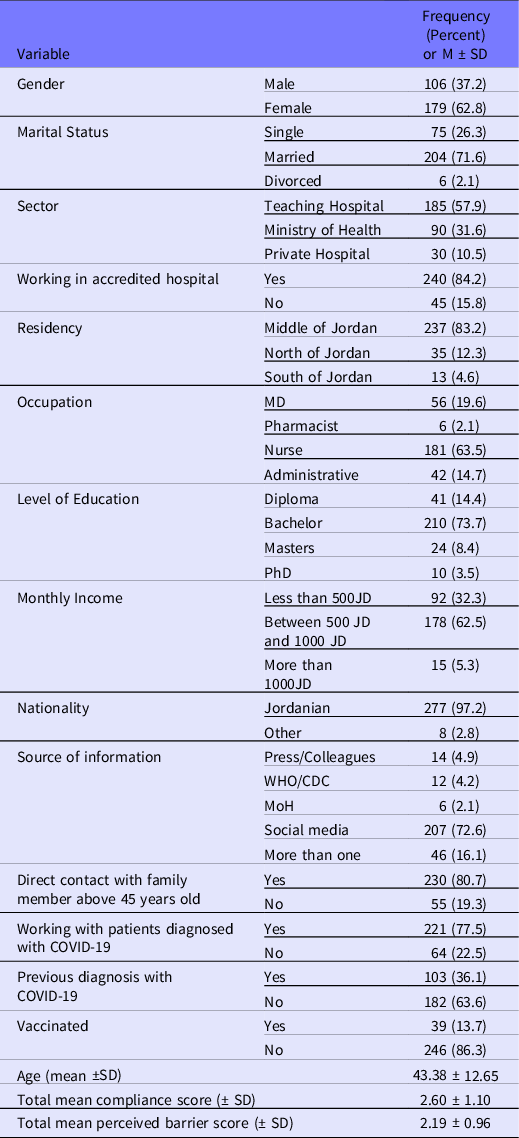
The sociodemographic characteristics of the participating healthcare workers are reported in Table 1. A total of 285 were included in this study. Most of the sample were females (62.8%), married (71.6%), Jordanian (97.2%), and living in the middle of Jordan (83.2%). Healthcare workers working in a teaching hospital represented most of the sample (57.9%), followed by the Ministry of Health (31.6%), and the private sector represented (30%). Of those, nurses, medical physicians, administrative, and pharmacists were 63.5%, 19.6%, 14.7%, and 2.1%, respectively. Almost 84.2% of the healthcare workers worked in accredited hospitals.
Description of characteristics of healthcare workers

Healthcare workers were asked about their source of information about COVID-19. Almost 72.6% used social media, only 4.2% of them used the World Health Organization (WHO) and CDC websites, and 16.1% of them used more than 1 source. A total of 80.7% of the healthcare workers had direct contact with a family member older than 45 years and almost (77.5%) were working directly with patients diagnosed with COVID-19. Previous diagnosis with COVID-19 was reported by 36.1% of healthcare workers and only 13.7% have taken the vaccine.
Research question 1: What is the relationship between compliance, perceived barriers of using PPEs and age of healthcare workers?
The relationship between compliance, perceived barriers, and age was investigated using product moment correlation coefficient. Preliminary analyses were performed to ensure no violation of the assumptions of normality, linearity, and homoscedasticity. Results showed that there was a small statistically significant positive correlation between compliance and age (r = 0.16, n = 285, P < 0.01); and a strong statistically significant positive correlation between compliance and perceived barriers (r = 0.57, n = 285, P < 0.01). Increased age and perceived barriers were correlated with increased compliance. However, there was no statistically significant correlation between barriers and age.
Research question 2: What are the differences in compliance and perceived barriers according to socio-demographic characteristics of the healthcare workers?
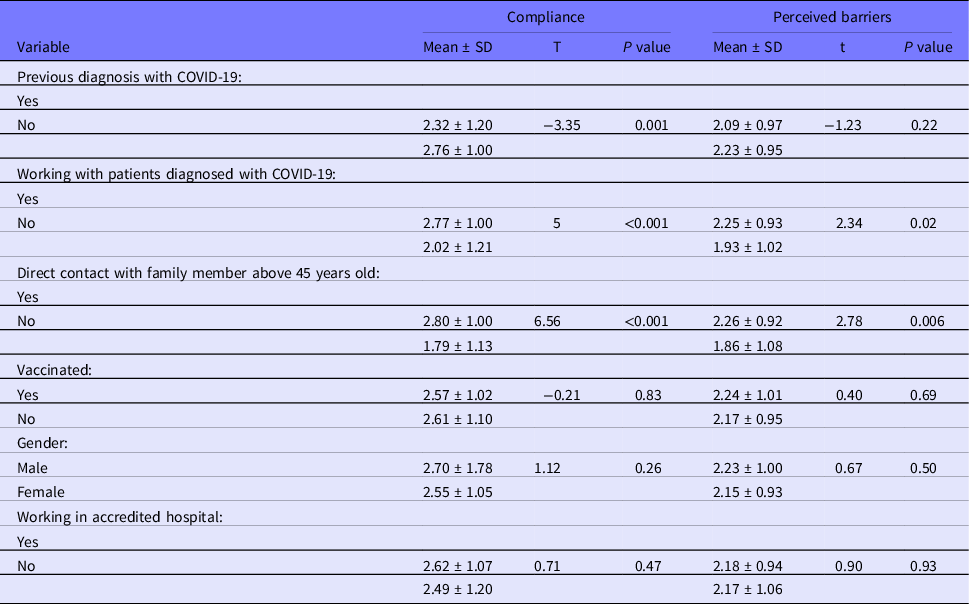
As demonstrated in Table 1, depending on the level of measurement of the variables, independent samples t-tests and a 1-way analysis of variance (ANOVA) were conducted to examine the difference in compliance and perceived barriers according to characteristics of the healthcare workers. First, independent samples t-test showed a statistically significant difference in compliance of healthcare workers according to their previous diagnosis with COVID-19. Those who do not have a previous diagnosis with COVID-19 (M = 2.76, SD = 1.00) showed significantly higher compliance level than those with previous diagnosis of COVID-19 (M = 2.32, SD =1.20, t (283) = 3.35, P < 0.01). The magnitude of the differences in the means was small (eta squared = 0.04). Second, an independent samples t-test was conducted to examine the difference in compliance according to working with patients diagnosed with COVID-19. Those working with patients diagnosed with COVID-19 showed significantly higher compliance levels (M = 2.77, SD = 1.00) compared to those who were not working with patients diagnosed with COVID-19 (M = 2.02, SD =1.21, t (283) = 5, P < 0.001). The magnitude of the differences in the means was moderate (eta squared = 0.08). Third, those who reported having direct contact with a family member older than 45 years old (M = 2.80, SD = 1.00), showed significantly higher compliance level compared to those having no direct contact with family member above 45 (M = 1.79, SD = 1.13, t (283) = 6.56, P < 0.001). The magnitude of the differences in the means was moderate (eta squared = 0.11). However, there was no statistically significant difference in compliance according to vaccination against COVID-19, gender, and accreditation status (External evaluation of healthcare facility by an independent body against pre-determined standards).
As shown in Table 2 regarding the perceived barriers, first, an independent samples t-test showed that those working with patients diagnosed with COVID-19 reported significantly higher levels of barriers (M = 2.25, SD = 0.93) compared to those who were not working with patients diagnosed with COVID-19 (M = 1.93, SD = 1.02, t (283) = 2.34, P < 0.05). The magnitude of the differences in the means was small (eta squared = 0.01). Second, those who reported having direct contact with a family member older than 45 years old (M = 2.26, SD = 0.92) showed significantly higher level of barriers compared to those having no direct contact with family member above 45 (M = 1.86, SD = 1.08, t (283) = 2.78, P < 0.01). The magnitude of the differences in the means was small (eta squared = 0.01). However, there were no statistically significant differences in perceived barriers according to the previous diagnosis of the participants with COVID-19, vaccination, gender, and accreditation status.
Differences in compliance and perceived barriers according to characteristics of healthcare workers

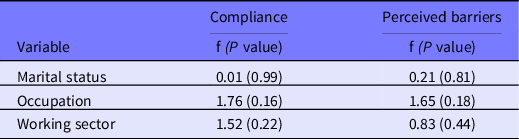
In Table 3 a 1-way analysis of variance (ANOVA) was conducted to examine any differences in compliance and perceived barriers according to the marital status, occupation, and working sector of healthcare workers. Results showed no significant differences in both compliance and barriers according to marital status, occupation, and working sector of healthcare workers.
Differences in compliance and perceived barrier according to characteristics of healthcare workers

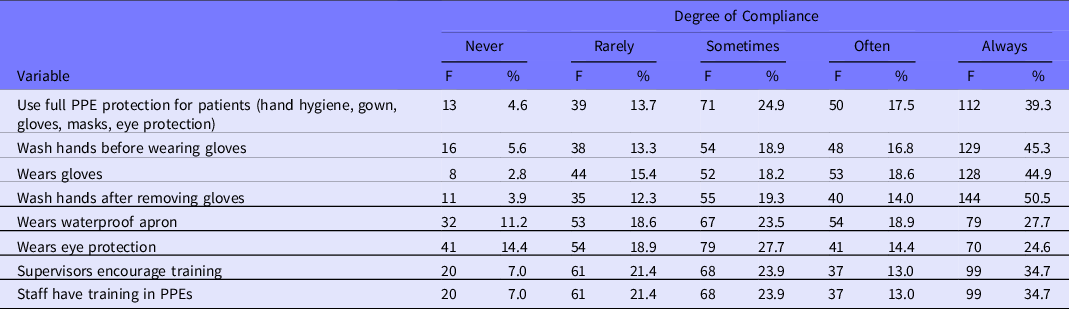
Table 4 reports respondents’ degree of compliance with different PPEs. More than a third of the respondents always used full PPEs for patients (39.3%). About 14.4% of the respondents do not wear eye protection. Surprisingly, only 44.9% of the respondents reported wearing gloves, which are considered basic protective equipment. A total of 19.3% of respondents sometimes wash hands after removing gloves while 50.5% of respondents always wash hands after removing gloves. As regards to training, 21.4% of respondents mentioned that supervisors rarely encourage training in PPE and only 34.7% of HCW staff have training in PPEs.
Compliance with PPEs

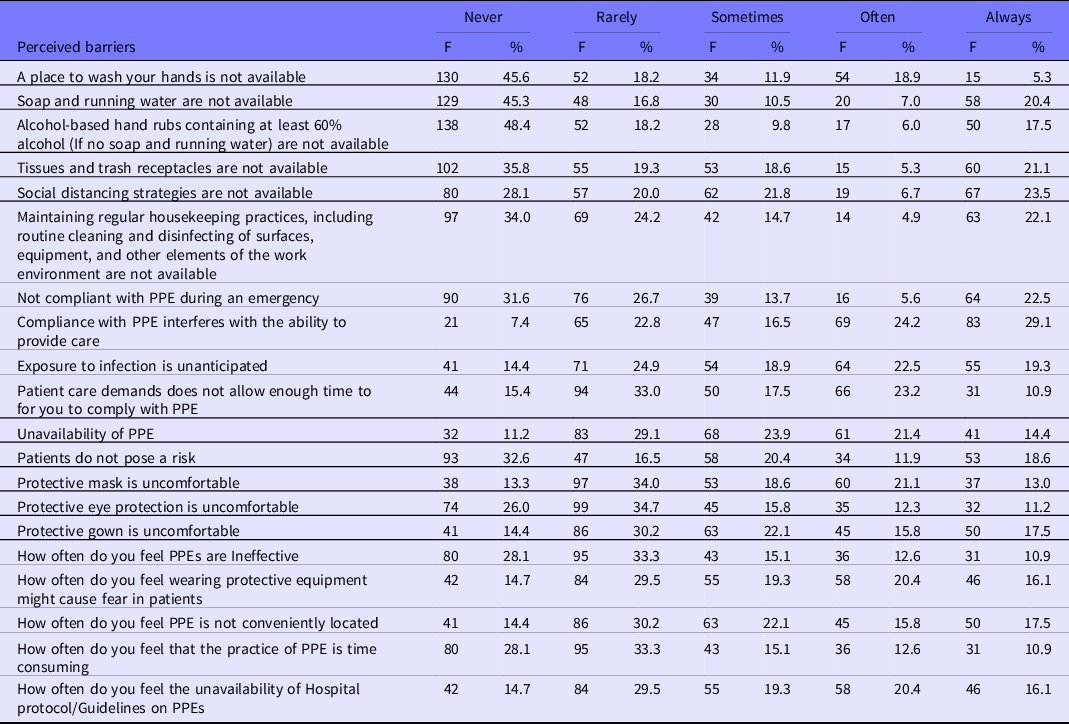
Table 5 reports perceived barriers to use of PPEs. Only few HCWs mentioned that PPEs are always not available (14.4%). Often, because of the demands of patient care, HCWs do not have enough time to comply with the rigors of PPEs (23.2%). HCWs felt that wearing PPEs, such as gloves, aprons, gowns, and goggles, might cause fear in patients (20.4%). Almost 29% of respondents mentioned that complying with PPEs always interferes with the ability to provide care. As a result of the unanticipated exposure to infection, 18.9% of respondents sometimes fail to comply with PPEs. Shockingly, 15.1% of the HCWs feel that sometimes PPEs are ineffective. More than a fifth of respondents (22.5%) said that they are not compliant with PPEs during an emergency. As for the availability of soap and running water, 45.3% declared that they are never unavailable, and if not available, 48.4% mentioned that alcohol-based hand rubs containing at least 60% alcohol, were there instead.
Perceived barriers to use of PPEs

Discussion
The global spread of the emerging infectious disease COVID-19 has proven difficult for health-care system. In the absence of proven treatments, vaccine shortages, and with the number of new infections continuing to rise at an alarming pace across the world, preventative measures are necessary to break the virus’s chain of transmission and control infection rates. HCWs remain at risk of contracting coronavirus disease. Several cases of infected health-care employees, in Jordan, have already been reported. In order to slow the spread of the COVID-19 pandemic and reduce morbidity and mortality, preventing communicable disease transmission inside hospitals is a top priority. The World Health Organization (WHO) has issued guidelines for ensuring occupational health and safety, as well as recommendations for key COVID-19 prevention measures that apply to all workplaces and for all employees. 11 These include routine hand-washing or disinfection with alcohol-based hand sanitizer, respiratory hygiene such as covering cuffs, and other measures that apply to all workplaces and all employees. Proper use and compliance to PPEs protocol is particularly important when caring with patients during pandemic situation. Therefore, the present study investigates the perceived barriers and compliance of the Jordanian HCWs in relation to transmission of COVID-19 during the ongoing COVID-19 outbreak. It will estimate the recommended preventative protection measures on a day-to-day basis and when working at hospital.
Participants contributing to the study appeared to have a relatively good compliance (x = 2.6, SD = 1.10); a possible explanation is that 84% of the participants worked in accredited hospitals. As the compliance with full PPE is around 80%, wearing gloves (82%), washing hands before (80%), and after wearing gloves (84%) were reported as the highest compliance levels. On the other hand, the least complied with PPE were waterproof apron (70%) and eye protection (65%).
Healthcare worker characteristics (HCW)
Results produced in the current study indicate a possible link between the increase compliance levels with increase age. This result is in line with similar studies noting that, the compliance level is increased with age. Reference Okello, Kansime, Odora, Apio and Pecorella12
Evidence suggests mixed findings regarding the association of HCWs compliance with gender, nationality, and socioeconomic status. In 2 studies highlighting that, Nour et al reported that female staff were significantly more likely to comply with infection prevention and control practices. Reference Nour, Babilghith, Natto, Al-Amin and Alawneh13 In addition, females with high income were reported to better comply. Reference Hassan14,Reference Bazaid, Aldarhami, Binsaleh, Sherwani and Althomali15 On the contrary the current study found no significant association between compliance with infection prevention control practices, gender, or other socio-demographic factors.
According to the findings of the present study, there was no significant association between compliance and the occupation and working sector of the healthcare provider. Other studies showed that doctors and nurses were reported to more likely adhere to use PPEs compared to other staff. Reference Okello, Kansime, Odora, Apio and Pecorella12 Moreover, governmental hospitals were reported significantly less likely to have all appropriate PPE. Reference Alser, Alghoul, Alkhateeb, Hamdan, Albarqouni and Saini16
Therefore, additional attention should be on providing more awareness and training for HCW who works with non-COVID-19 patients.
Healthcare worker (HCW) risk perception
This study revealed that compliance levels were significantly higher among HCWs working directly with COVID-19 cases, and among those living with elderly family members. Additionally, HCWs who do not have a previous diagnosis of COVID-19 showed significantly higher compliance level than those with previous diagnosis of COVID-19.
These findings can all be tied together and linked to the level of risk perception that the healthcare providers experience. Several studies reported that high levels of distress were associated with higher compliance, Reference Chia, Koh and Fones17 as results showed that a highly anxious staff was more likely to comply with recommended protective practices. Research evidence shows that higher levels of risk perception were associated with higher compliance. Reference Kim and Choi18,Reference Goulia, Mantas, Dimitroula, Mantis and Hyphantis19 This indicates that, whilst it is important not to create unhealthy anxiety, desensitization to risk may contribute to reduction in PPE use. Particular attention may be needed in order to maintain PPE use as risk changes, or is perceived to change, over the course of an outbreak.
Perceived barriers
Availability and location of PPE
While addressing the main perceived barriers that negatively impacted the level of compliance, the participant perceived moderate level of barrier to adhere to preventive measures (x-2.19, SD = 0.96). In this study, 35% of participants said that they often do not have PPE available every time they need it and almost 18% reported that they often feel that PPEs are not conveniently located.
These results were incongruent to the reported findings of previous studies conducted in other variable income countries such as Palestine, Ghana, Uganda, and Italy. 10,Reference Okello, Kansime, Odora, Apio and Pecorella12,Reference Alser, Alghoul, Alkhateeb, Hamdan, Albarqouni and Saini16,Reference Savoia, Argentini, Gori, Neri, Piltch-Loeb and Fantini20 This lower level of compliance can be explained by findings from other studies. These studies reported that the availability of PPE was significantly associated with higher compliance and the use of PPE when eyewear and gloves were readily available at the point of care. Reference Hu, Zhang and Li21,Reference Mitchell, Ogunremi and Astrakianakis22
Convenience of PPE
As reflected by our study results, 13% of HCWs stated that wearing protective masks is uncomfortable, while 17% stated that wearing protective gowns is uncomfortable. This is in line with many qualitative studies where participants reported not using PPE due to perceived inconvenience and its effect on their ability to do their job. Reference de Perio, Brueck and Mueller23,Reference Kang, Kim and Choi24
Availability of protocols and knowledge sources with compliance
According to the findings of the present study, 36% of the participants were previously diagnosed with COVID-19. Meanwhile, 71% reported having received training on the use of PPE equipment. Moreover, hospital protocol/guidelines on PPEs use were available for most of the participants (84%). This corresponds to others’ findings that HCWs need guidance on the protocols for protecting themselves against the risk of infection. Reference Alsahafi and Cheng25–Reference Nhan, Laprise, Douville-Fradet, Macdonald and Quach27 In context, note that these frequent protocols change for staff to keep up, and there is delay in communicating protocols updates. The use of in situ simulation as a proactive risk mitigation strategy to prepare healthcare organizations for pandemic planning is well supported in the literature. Reference Brazil, Purdy and Bajaj28,Reference Dubé, Kaba, Cronin, Barnes, Fuselli and Grant29
Across different studies, results showed that staff received conflicting messages from different sources, recommended protocols changed too frequently for staff to keep up, and communication about changes to protocols was too slow. Reference Goulia, Mantas, Dimitroula, Mantis and Hyphantis19,Reference Gesser-Edelsburg, Stolero, Mordini, Billingsley, James and Green30
In line with previous Jordanian research, Reference Suleiman, Bsisu and Guzu31 almost 66.7% of HCWs stated that they used social media as the main source of information about COVID-19. In this context, social media was the second source of information used by the HCWs, according to Gan et al., Reference Gan, Lim and Koh32 while official government websites were the primary source. Bazaid, et al., in Saudi Arabia reported that public rely on social media as a primary source of information. Reference Bazaid, Aldarhami, Binsaleh, Sherwani and Althomali15 This might be related to the pandemic nature of COVID-19, which created a global concern where most of the information is widely available and easily circulated on the internet and social media platforms.
Based on the results of this study, it is recommended that healthcare organizations provide ongoing frequent training and discussion, using simulation to check for competency, and updating the protocols within the healthcare setting, to ensure adequate resources for infection control, and timely provision of practical evidence-based infection control guidelines.
Limitations
We acknowledge several limitations to our data, including the following: (1) our assessment of compliance relied upon self-report, (2) potential selection bias arises due to sampling method, (3) the participants were recruited conveniently and invited via e-mail, social media, or poster, and then they chose whether to participate or not, and (4) The small sample size may have an impact on generalizability to the larger population.
Conclusion
The results of this study indicated that it is necessary to ensure the proper use of PPE by having clear instructions and strengthening the training of healthcare workers. Healthcare organizations must give priority to the procurement and distribution of PPE, and provide adequate, extensive, and frequent training to healthcare providers regarding adherence to Infection Prevention Protocols (IPPs). The Ministry of Health and policy makers need to maximize the vaccination program to accelerate vaccination of 100% of all health care workers in the country.
Supplementary material
To view supplementary material for this article, please visit https://doi.org/10.1017/dmp.2021.289
Data availability statement
The datasets used, and /or analyzed during the current study are available from the corresponding author on reasonable request.
Acknowledgments
We would also like to thank and express our appreciation to all participating Health care workers.
Author contributions
Eman F Badran conceived the idea and supervised the project; Samiha Jarrah and Rami Masadeh participated in planning, designing, and collecting the data, participated in the project’s implementation, and reviewed the research tools and final manuscript; Thaira Madi and Samar Hassan participated in collecting the data and implementation of the project; Rana AlShimi, Samar Salhout, Nada Alwahabi, Mira AlJaberi, Abdallah Rayyan, and Alhanoof Alhammad carried out the project and participated in planning, designing and collecting the data; Rami Masadeh, Mira AlJaberi, and Abdallah Rayyan contributed to the statistical analysis and interpretation of the results. All authors provided critical feedback, participated in the research and analysis, and contributed to the final manuscript.
Conflicts of interest
All authors have declared that they have no potential conflicts of interest related to the research, authorship, and/or publication of this article.
Ethical standards
The study protocol was approved by the collaborative institution’s institutional review board and Jordan University Hospital (Ref: 220000110) and deanship of scientific research (Ref: 19/2020/137). The design was also reviewed and approved by the Protection of Human Subjects Committee (IRB) and access was gained to all participating hospitals. The relevant procedures were carried in accordance with the ethical standards of the responsible committee on human experimentation (institutional and national) as well as with the principles of Good Clinical Practice issued by the Declaration of Helsinki (2004; Tokyo), and its later amendments. Informed consent was obtained from all the participants before inclusion in the study.