On 7 September 1974, Pastor W. T. H. Richards, universally known as ‘Billy’, was taken ill after a normal day's work at his church, the Gospel Tabernacle in Slough, Berkshire, and died later that evening from a massive heart attack. Previously a miner in Wales, Richards was fifty-seven years old, and had spent the previous thirty years founding and building the church, establishing a flourishing and growing ministry not only in the town but in many countries worldwide.
At his funeral, attended by over a thousand people, the great Nonconformist leader Dr Martyn Lloyd-Jones said: ‘This man was a spiritual statesman. I have rarely known a man who had a larger and clearer world view of the present situation of the Christian Church and of what we all should be doing.’Footnote 1 Lloyd-Jones later hosted a thanksgiving service at Westminster Chapel, attended by 1,600 people.Footnote 2 A commemorative magazine contained thirty-eight pages of testimonials from Christian leaders across the world, many from Richards's own Pentecostal denomination, but also from the wider Christian community.Footnote 3
One might question whether an objective view of Richards's work can be found in sentiments expressed so soon after his untimely death. However, the well-known Baptist pastor and author David Pawson rated Richards even more highly, comparing his work to that of the apostle Paul.Footnote 4 Commenting on the opening verses of 1 Thessalonians 2, in which the apostle defends his track record in establishing the church in Thessalonica, Pawson wrote:
There was a man of God called Billy Richards, a Pentecostal pastor in Slough. Many years ago he started a work of God in a chicken hut with a leaking roof. They had six buckets on the floor to catch the rain that first service. Six or seven men gathered in that little hut. But by the time he was taken to glory, in that church in Slough, you would find seven or eight hundred people there worshipping God. They had sixteen daughter groups scattered around Slough and its environment. They had a correspondence course for some enquirers, and some 2000 people learning how to be Christians. They had 40 missionaries working overseas. This is not the work of a bungler, it is the work of a man who knows what he is doing, a man who is effective.Footnote 5
Longevity, outliving the initial work of an inspiring leader, was the key test. The apostle Paul could say ‘I've left behind me a strong church full of faith, hope and love’ in Thessalonica: and in Slough, the same test showed the enduring value, or institutionalization, of Richards’ work forty years after his death.Footnote 6
By the time of his death, then, Billy Richards was widely accepted by the Nonconformist Christian ‘establishment’. His influence extended beyond Slough, both nationally and internationally; and it continues, as can be seen in Pawson's commendation, in the lives of thousands reached by his correspondence courses, radio broadcasts, publications, conferences and speaking tours, and in the ongoing work of the church he founded. This was achieved in what was widely acknowledged as a demanding mission context. This article examines the role of inspiration in establishing, building and maintaining this work, and how that work was institutionalized so that it outgrew and outlasted an individual charismatic personality. It also considers what lessons can be drawn for assessing church ministry in late twentieth-century urban Britain, and the agency of religious institutions in twentieth-century secularization.
The historiography of secularization and urban church ministry in the late twentieth century is a relatively neglected area. Two articles by Jeremy Morris, in part responding to Callum Brown's influential The Death of Christian Britain, provide a good overview of the historiography and its perceived weaknesses.Footnote 7 Morris characterized secularization under three headings – institutional marginalization, institutional attenuation and cultural attenuation – and identified a tendency by historians to focus on external factors. He commented that ‘a refreshingly different reading of British religious history might come into view’ through a focus on ‘the adaptive strategies of churches in the modern period, as they sought to ‘modernize’ their ministries, liturgies, missionary, and educational methods and bureaucracies to cope with the challenges of rapid social change’.Footnote 8 This article presents one such example of how the actions of religious organizations could affect their own fortunes, and shows how such an analysis might lead to a wider understanding of secularization.
The prevalence of local studies reflects the reality that most people's experience of organized religion was through local contact, with a minister, a congregation or individual church members. However, most local studies have focused on established urban centres in the nineteenth and early twentieth centuries, and coverage of the later twentieth century is notably lacking.Footnote 9 Recent exceptions are Ian Jones's study of post-war Birmingham, and a collection of essays on late twentieth-century London.Footnote 10 Jones identified the challenges churches faced in dealing with multiple generations, particularly within declining congregations, and this theme is also important to understanding Billy Richards's ministry. The compilation edited by Goodhew and Cooper raises many themes which are pertinent to this article. This study complements that volume by covering the post-war period and considering urban church ministry outside London.
A major theme in the literature is the trajectory of secularization, and whether this is best seen as a steady decline in adherence to organized religion from the late nineteenth century onwards, or whether the progress of decline has been disrupted by the cultural upheavals of the 1960s.Footnote 11 Written from a statistical perspective, Peter Brierley's work offers general support for a gradualist explanation, but identifies a fragmentation in adherence after the Second World War, whereby losses in the historic mainstream denominations were offset to an extent by growth in smaller and newer groupings, including Pentecostal and charismatic churches.Footnote 12 The historiography is notably weak in considering these movements.
Billy Richards was a member of one such movement, the Assemblies of God denomination. He grew up in a Welsh assembly, attended Bible college in north London, and later spent five years working with the denomination's Evangelistic Society and three London assemblies.Footnote 13 At the time of his death, he was playing a key role in planning the Pentecostal World Conference.Footnote 14 While Stephen Hunt's history of the world-wide charismatic movement is too general to focus on more than a few individuals, William Kay's study of the British Assemblies of God contains more local and individual detail, and identifies Richards's Gospel Tabernacle as one of two key ministries in the post-1945 period which acted as institutional ‘bridges’ between an older group of inspirational ‘Pentecostal veterans’ and a newer generation of young leaders.Footnote 15 Kay does not, however, explore any longer-term influence that Richards had, either within the denomination or more widely.
This article therefore offers local study support to the analysis of secularization in the latter half of the twentieth century, focusing on the agency of religious institutions in secularization, and extending the analysis into the newer urban areas arising from industrialization and suburbanization in south-east England.
Context: The Challenges of Urban Mission
Build my Church, which appeared in 1964, is one of many books and pamphlets published by Richards on matters of belief and ministry. It serves both as a history of the foundation of the church, and a summary of his views on church planting. In it, he recounted how he came to Slough in 1943 in response to ‘a call’, heard during an air-raid while ministering in London, to ‘a town I had heard about only a few times, and in which I had not the slightest interest … [and where] I did not know one single person’.Footnote 16 He had a total of £12 in his pocket. On arrival, he found:
Here was a respectable, materialistic, and self-satisfied cosmopolitan group of people who needed a change of heart as much as the heathen in the farthest corners of the uncivilised world. It is sometimes more difficult to be a missionary to civilised people than to those who have never known or heard about the Christian faith … Even some Christians were quick to tell me that I would do no good, the place was ‘too hard’ … ministers of other denominations had also agreed that the town was the hardest they had ever ministered in.Footnote 17
In a book which describes Richards's success in establishing a thriving ministry in unpromising circumstances, this might seem self-serving. But there is much evidence to substantiate the challenging environment which Slough, and towns like it, presented to church leaders. Famously singled out by John Betjeman to characterize all that he disliked about mid-twentieth-century industrial life, Slough was prosperous, and had grown rapidly as new industries relocated around the periphery of London, providing thousands of jobs for workers migrating from depressed areas in the north and west of the British Isles.Footnote 18 But this had come at a cost; one local survey noted ‘the characteristic that strikes the outsider almost at once … here is a town with very little civic consciousness, with no centre to the life of the people and with no long tradition in which all have shared’. Too many arriving too quickly had resulted in a lack of cohesion: ‘the people themselves have come from all over the country … large groups of Welsh, Irish and Northcountrymen … have almost submerged the original inhabitants’.Footnote 19
Slough was not unusual in these respects. Rapid industrialization in the south-east and accompanying economic migration and urban development (particularly in and around London) posed significant challenges for all institutions.Footnote 20 The churches were no exception. Speaking to the Church of England Assembly in 1935, Archbishop Lang warned:
This problem of making spiritual provision for the populations of the new districts which were being formed in many parts of the country was the greatest that had been presented to the Church in our generation. It might almost be said to be one of the greatest ever presented to the Church of England in the course of its long history. … Some dioceses, notably London and Chelmsford, were almost breaking down under the magnitude of the problem.Footnote 21
His words could have applied to any of the major established Protestant denominations.
Table 1 shows the membership of the major non-Catholic Christian groupings in Slough in the period 1940–70, covering the period of Billy Richards's ministry at the Gospel Tabernacle, and Table 2 presents these figures relative to population.Footnote 22 The electoral rolls of all six Anglican parishes within which Slough was located suffered both an absolute and a proportional decline. The combined membership of the four major Nonconformist denominations (Baptist, Congregational, Methodist and Presbyterian) remained constant, albeit at low levels relative to the population, before declining in the 1960s. The combined membership of some smaller Nonconformist congregations (two Brethren assemblies, a Quaker meeting and the Salvation Army) was smaller still, but constant relative to population. Only two groups showed strong growth both in absolute and relative terms: the Gospel Tabernacle and groups generally considered to be outside mainstream Christianity, such as Jehovah's Witnesses, Latter-Day Saints and Seventh-Day Adventists.Footnote 23
Membership of major Christian groupings, excluding Roman Catholic: Slough 1940–70

Sources: Anglican electoral rolls from the Oxford Diocesan Handbook; Baptist, Congregational, Methodist membership from a variety of published sources; Presbyterian and smaller Free Churches (including Brethren, Quakers and the Salvation Army) and other groups (including Jehovah's Witnesses, Latter-Day Saints and Seventh-Day Adventists) from SO sources: see Masom, Local Churches, 74–9.
Church Membership relative to Adult Population, Slough 1940–70

Table 1 shows that the Anglicans – the largest group – suffered an absolute decline of 20 per cent over the thirty-year period. However, relative to the adult population in a growing town, the decline was far more significant: a 60 per cent decrease, from 7.5 to 3 per cent. For the United Kingdom as a whole over the same period, Brierley has calculated that Anglican electoral rolls reduced from 11 to 7 per cent of the adult population.Footnote 24 The significant difference in levels of adherence between the country as a whole and a new urban area such as Slough was evidence both of the challenges highlighted by Archbishop Lang and of the Church of England's failure to address them. The parish system was chronically slow to adapt to the new urban landscape, and this was compounded by increasing pressures on the Church of England's central funding, which limited the scope for building and staffing (or ‘planting’) churches in new areas. In Slough, for example, the population of one parish expanded from 1,500 to 30,000 residents in twenty years, but it was served only by two small church buildings, one incumbent and a curate.Footnote 25
While the Church of England was hampered by institutional factors in its ministry to the new urban areas, mainstream Nonconformist denominations perhaps had greater freedom to respond. With varying levels of success, Baptists, Congregationalists and Methodists all sought to establish congregations in the new areas of the town after the First World War. During the Second World War, a Presbyterian church was formed, catering primarily to the growing Scottish community. These initiatives meant that, as Tables 1 and 2 show, absolute membership across the four denominations grew after the Second World War in line with population growth, before falling by over 25 per cent in the 1960s. However, for the United Kingdom over the same period, Brierley calculated that membership of these denominations declined from 10 per cent to 7 per cent of the adult population. Like the Anglicans, then, these denominations struggled to achieve the levels of adherence in newer urban areas which were seen in more established communities.Footnote 26
There were various reasons for this, some of which also affected the Anglicans. Church planting was expensive and Nonconformist churches had to fund such initiatives largely with money raised locally. Moreover, to a greater or lesser extent, all Nonconformist denominations suffered increasingly from an inability to recruit new members, either from within, through transferring their children into adult membership, or from without, through attracting incomers to the town, to replace those moving away or simply lost through death.Footnote 27 While this failure to recruit was partly due to a lack of church extension (now known as church planting), as Richards outlined in Build my Church, the environment seemed particularly difficult for church work.Footnote 28 In the mid-1950s, one departing Methodist minister, who had previously worked in the north of England and in Wales, declared: ‘of all the places I have worked … I believe Slough is one of the worst for lack of spiritual life. I have found the further south I go people are less enthusiastic about spiritual living’.Footnote 29 This, however, seems an unlikely explanation, since many Slough residents were migrants from the north and Wales. More plausibly, he felt that ‘Slough was difficult because it was such a new town’. Addressing Slough Baptist Church in 1941, the president of the Baptist Union spoke of attendances declining because new housing estates were too far away for children to walk to church, and of wireless services giving the less committed an alternative to Sunday worship.Footnote 30 Such dynamics could also affect the internal vitality of congregations. Some years later, Slough's Baptist minister wrote:
When our church was built, it was in the middle of a neighbourhood area – all walked to church, time was plentiful, everyone knew everyone else intimately and after worship opportunity was taken for conversation in which friendship in the Lord was deepened and strengthened. Now all has changed. Traffic and commerce is all about us, worshippers travel by bus and are more concerned about the bus queue after the service. Attendance in the week is rare, and they scarcely know each other.Footnote 31
Methodist leaders struggled with similar issues. As membership declined (albeit slowly) in the post war period, it became more elderly; commitment declined, reflected in lower attendances; and congregations became scattered across the town and less committed to fellowship meetings outside Sundays. This had a double effect on newcomers: existing congregation members used Sundays as their opportunity for fellowship with friends, and so were less likely to look out for, or even recognize, newcomers; and there were fewer fellowship opportunities for those newcomers in any case.Footnote 32
The minister at the well-funded Methodist Central Hall, the Revd Francis Burns, challenged his congregation regularly about what he saw as their lack of commitment: ‘if all of us regarded our Church membership as lightly as some people do, there would be no Church left for us to go to on those few occasions when we decide to be present’.Footnote 33 Indifference to Christianity in wider society was directly related: ‘I believe that the answer to the apathy of this generation is to be found in the missionary enterprise of all Christian people, and not simply in the zeal of ministers of religion, though that does count enormously’.Footnote 34 And in this church at least, he felt it was seriously lacking:
… why is it that in these latter days we leave such personal evangelism to cranks and fanatics, to people whose Gospel, we are convinced, is a perversion of the genuine thing. We may laugh at their beliefs, but … are we Methodists showing one tenth of the zeal of the Jehovah's Witnesses who go from door to door?Footnote 35
Moreover, as noted above, all the main denominations also suffered from an increasing inability to recruit from within by educating children in the faith and transferring them into adult membership. This trend has been commented on widely, others noting the significant role played by Sunday schools and tracing their proportional decline during the twentieth century.Footnote 36 Two factors can be noted here: firstly, churches needed to be attractive to families, whether all attending together or parents simply sending their children to Sunday school; secondly, Sunday schools were labour intensive, requiring a committed body of teachers and other helpers. This latter factor could be related to the commitment of church members; at least one previously healthy and growing Sunday school in Slough closed because of lack of helpers.Footnote 37
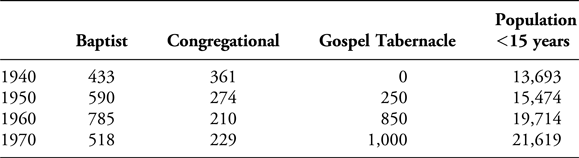
Table 3 shows the total number of Sunday School scholars across the Baptist and Congregational churches in the town, with the Gospel Tabernacle for comparison. Reliable figures for the Methodists and Anglicans are not available. Baptist numbers grew in line with growth in the population of under-fifteen-year-olds, mainly due to new church plants, before falling back in the 1960s. Numbers at Congregational Sunday schools not only failed to keep pace with population growth, but fell steadily in absolute terms.
Major Nonconformist Sunday Schools, Slough 1940–70

Source: Masom, Local Churches, 229–37.
This, then, was the context in which Billy Richards sought to establish his new church. Immediately after the Second World War, the mainstream denominations maintained their existing memberships, but eventually these declined gradually in absolute terms through death or by people moving from the district. There was some success in establishing new congregations on the expanding housing estates, but overall church adherence lagged well behind the UK averages. The town was seen by experienced church leaders as spiritually apathetic and therefore a hard place in which to work. The congregations of existing churches became less tightly knit as members lived further from the church, and there was some perceived loss of commitment. Sunday schools began to decline relative to population, with the consequence that churches increasingly struggled to replenish their memberships ‘from below’, and congregations became more elderly.
The Gospel Tabernacle
Beginning from no established base in 1943, over the next thirty years Billy Richards would show that while church planting was certainly challenging, it was not impossible. By the time of his death in 1974, the Gospel Tabernacle had grown to over 600 members, meeting in a 450-seat building that had been extended several times over the years, with all funding raised from the congregation. Over a thousand children per week attended the twenty-eight children's and youth clubs across the town; and several thousand people subscribed to correspondence courses on evangelism, in a ministry that extended well beyond Slough.Footnote 38 As Tables 1–3 show, within twenty-five years of its establishment, the Tabernacle had become the largest Free Church group in the town, with the largest children's and young people's work. The remainder of this article will explore the inspirational and institutional roots behind this growth story.
Richards was clear as to the reasons why other churches had struggled. In 1954, he wrote:
The church is to be blamed for this shocking state of affairs. For more than a generation the church has been self-centred. She has been ‘neither cold nor hot’ and her ‘couldn't care less’ attitude toward the masses outside the fold has produced a situation that is almost irremediable. The leaders of the church have lacked passion and vision, they have pandered to the ‘elite’ … The gospel they have preached has lacked conviction and has only served to tickle the ears of the listeners. They have not preached Heaven and Hell-Fire, sin and holiness, judgement and reward – the result, there has been a falling away from the church, many have lost faith, the world is unconvinced … The church must repent … throw off the false dignity, needless ceremony and cold ritualism and humble herself to the level of boy and girl, youth and maiden and man in the street and in all sincerity offer the help that alone can be given [by] the living God.Footnote 39
While this did have implications for the content of the church's message, as further discussed below, what this meant was that to appeal to the unchurched, or even to maintain the commitment of those currently within their congregations, churches needed to be spiritually authentic, offer a message relevant to everyday life and build a sense of community. In the same year, the church began to regularly advertise ‘12 reasons why you should attend the Gospel Tabernacle’:
1 You will find real friendship
2 You will find that the Services will appeal to both old and young
3 You will be uplifted and strengthened to do your week's task
4 You will meet hundreds of happy people whose lives and homes have been transformed
5 You will find healing for body as well as soul
6 You will find a Church that gives priority to your children
7 You will find a Minister and Members whose chief concern is to help you
8 You will find the burdens and cares of life can be lifted
9 You will find Services arranged for all age groups
10 You will find a Gospel that works
11 You will find the Services are ‘alive’ and enjoyable
12 You will find out the secret that brings over 650 adults, young people and children to the Services, Club and Schools of the Gospel Tabernacle each week.Footnote 40
This formula certainly appealed to some members of the mainstream denominations, who ‘wanted something more’ than was being offered there, and consequently some of the Tabernacle's growth was through membership transference. For example, one eighty-four-year-old ex-Baptist and Congregationalist, who had at various times been a deacon, Sunday School teacher and lay preacher, moved to the Tabernacle in 1950 because the mainstream churches ‘lacked real life and gusto’.Footnote 41 However, for other recruits, there was no sign of any pre-existing church connection, and the appeal could be to the young as well as the old. One fourteen-year-old girl was taken to the church by a friend, and six years later was involved in several children's and youth activities and the choir. It appears that, consistent with its ‘12 reasons’, the church created the strong sense of community and commitment that other Nonconformist churches were struggling to maintain. A twenty-year-old reported being in church on four weekday evenings and both Saturday and Sunday, alongside her full-time job as a typist at a local engineering firm.Footnote 42 In describing the ‘Success Story of a Church’ in 1963, the local newspaper referred to it as ‘Religion with a Smile’.Footnote 43
The Tabernacle sought not only to be relevant and friendly but to take advantage of contemporary means of communication. Richards broadcast regularly on Radio Caroline, and the BBC's Morning Service came from the church in May 1965.Footnote 44 The two local newspapers were generally empathetic and gave helpful publicity. At various times, the Slough Observer printed a monthly ‘sermonette’ from Richards, and its letter pages often contained his views on contemporary culture and morals.Footnote 45 In what now looks like a throw-forward to a later age, Richards introduced modern music into services, and was comfortable with a high media profile that made him a local ‘celebrity’.Footnote 46 It was, as the Slough Observer was to put it later, ‘that old-fashioned religion in a new-fashioned way’.Footnote 47
But the claim was that this was not just a matter of slick marketing and a friendly congregation, for the Tabernacle was a place where supernatural things happened. A Slough Observer reporter attended a healing service in 1952 and published five profiles of named Slough residents who claimed to have been healed of deafness, blindness, diabetes, a stiff neck and severe back pain respectively.Footnote 48 Richards said: ‘we do believe that God can heal [people] today as he did in the past’. More widely, testimonies of personal spiritual encounter given by ordinary congregation members were a regular feature of services. After one service with testimonies by a butler, a manager, a salesman and a plumber, Richards explained: ‘the idea is to show people Christ can satisfy people whatever their occupation’.Footnote 49
The mainstream denominations’ recruitment struggles have been noted. Two major foci for the Gospel Tabernacle from its establishment were the young and evangelism. As the general secretary of the Assemblies of God said of Richards later: ‘Early in his ministry he discovered the secret of inspiring others to win the lost for Christ. He realised the importance of children's and youth work and forged ahead with this until his work gained almost universal recognition and admiration.’Footnote 50 By 1962, the focus on young people had resulted in seventeen Sunday Schools and youth clubs being established around Slough, with 850 children a week attending, while, as shown in Table 3, Sunday schools in other churches were declining. Many of these schools were on new estates where the traditional churches had struggled to attract unchurched incomers.Footnote 51 The groups employed a contemporary and appealing approach to attract children: as Richards said in 1969, ‘we believe in a lively and picturesque presentation of the gospel which will appeal to young people’.Footnote 52 This ‘lively’ approach included the use of conjurors, puppet shows and child-friendly songs, in addition to the long-standing highlights of any Sunday school, the family outings and the annual trip to the seaside.Footnote 53 While some put the lack of commitment in other churches down to boredom, there was ‘no room for gloom at this Sunday School’.Footnote 54 But the lively approach was not to devalue the message: ‘[Richards] set his face against merely entertaining youth … his object was always to challenge them with the demands of discipleship’.Footnote 55 He led from the front (‘gospel salesman packs in the kiddies’), but also mustered a large team of teachers and helpers: ‘the church relies for its momentum on the fervour of its members’.Footnote 56 In 1962, there were sixty teachers in the seventeen Sunday Schools; and the helpers included young people themselves; the worship services were supported by a twenty-two piece ‘swing band’, and the puppeteers were two sixteen-year-olds.Footnote 57
The focus on the need for personal evangelism was equally explicit; the subtitle of Build my Church was A Fascinating Story about the Pioneering & Establishing of a Church through Personal Evangelism.Footnote 58 Despite the Tabernacle's growth, this focus continued to the end. In the last edition of Dedication to which he contributed before his death, Richards devoted two pages to ‘The Importance of Door-to-Door Work’, declaring ‘it is the most productive kind of evangelism and more important by far than any form of mass evangelism’.Footnote 59 Elsewhere he quoted C. H. Spurgeon, D. L. Moody and Billy Graham (amongst others) in support of this approach.Footnote 60 While ‘personal evangelism’ involved inviting friends to church, as with the twenty-year-old typist mentioned above, it could also involve ‘door-bell evangelism’. In one early visitation project, the door of every home in Slough was knocked on over a seven-year period by a group of thirty church members, mostly young people.Footnote 61 The normally ebullient Richards conceded that its impact in ‘getting people to church’ might have been limited, as ‘not everyone is interested, but everyone knows we are here’. Later, the only other churches that seemed able to marshal the resources for such work were the so-called sects (Jehovah's Witnesses, Latter-Day Saints and Seventh-Day Adventists), whose enthusiasm relative to his own congregation had so concerned the Methodist Francis Burns.Footnote 62 It is noticeable from Tables 1 and 2 that alongside from the Tabernacle it was these groups that saw absolute and relative growth in the post-war period.
The Gospel Tabernacle demonstrated that strong leadership, a contemporary message, a focus on families and the young and an activist gospel directly relevant to everyday life could stimulate a high level of commitment. But this was based on a traditional theological understanding of the Christian message. As some ministerial colleagues sought to ‘modernize’ the content of the Christian message to make it more appealing to modern sensibilities, for Richards the ‘old fashioned messages’ were as valid as ever, it was simply that they had not been delivered effectively. In his Slough Observer ‘sermonettes’, he expounded an unapologetically evangelical message, defending traditional Christian positions on theology, behaviour and morals.Footnote 63 During the 1960s, through the letters pages of the Slough Observer, Richards debated regularly with the liberal vicar of Colnbrook, on the east side of Slough, issues such as miracles, divorce and remarriage, evangelism, contraception and the virgin birth.Footnote 64
Richards's methods were not to everyone's taste, and he did not always defend them in language that endeared him to clerical colleagues, as seen in his condemnation of the mainstream churches quoted above.Footnote 65 The debates with the vicar of Colnbrook revealed deep-seated differences, and when another Anglican priest described some clergymen as ‘theatre-managers’, one of his targets was clear: ‘with an anxious eye on the empty seats, may God forgive us [if] we have often found ourselves ordering not public worship but public entertainment’.Footnote 66 In 1963, Richards conceded: ‘some people may find our methods unorthodox but I think they are justified because we get the message over’, and in 1969 he pointed to the results:
I have been preaching the same message in Slough for 25 years as the preachers of the early Church, and have found that it works. There has been constant growth for a quarter of a century and still hundreds of folk from various walks of life pack the Gospel Tabernacle each week to listen to the Gospel of the New Testament. It is obvious that it has lost none of its attractiveness. I see no reason to abandon it now for empty speculations or a sophisticated religion that is devoid of spiritual life.Footnote 67
Locally, then, within thirty years Richards had established through his inspirational leadership a substantial institution, the largest Nonconformist church in the town, with premises to match a committed congregation of all ages, and a high local profile. But the institution had influence well beyond Slough.
From early on in his Slough ministry, Richards had looked beyond the UK for his own inspiration, while at the same time his own ministry provided inspiration for others. In 1953, he spent three months in the United States, combining a preaching tour with studying the methods of Christian youth movements.Footnote 68 Later, he set up ‘Christian Witness’, a training and publishing venture based in Slough, with the declared purpose ‘to help build the Church of Christ by endeavouring to promote evangelism in the local church by seeking to train Christians in personal work at home and abroad’.Footnote 69 Dedication was a monthly (later bi-monthly) magazine for church leaders and ministers, with a circulation of up to six thousand.Footnote 70 Other materials included a correspondence course in evangelism, and a regular flow of written publications and cassette tapes of instructional material. One issue of Dedication listed around one hundred individual items that could be ordered.Footnote 71 From the early 1960s, an annual week-long Christian Witness convention was arranged, usually at a holiday camp. The 1970 convention in Paignton attracted over seven hundred residential delegates, including over one hundred ministers and their wives.Footnote 72 The twelfth convention took place shortly after Richards's death and attracted ‘the largest company ever to attend’.Footnote 73 Early camps included young people, but as the work grew separate youth camps were organized. For example, in 1974, whilst the main convention took place in late September, a separate youth camp was held in North Wales with ‘several hundred’ attending.Footnote 74 It was claimed that over ten thousand students had been enrolled in the ten-lesson correspondence course, which was supported through ten international centres across Europe, Africa, Australia and North America.Footnote 75
There had been inspirational preachers in Slough before; for example, a young Methodist minister had drawn large congregations to the Central Hall in the years before the Second World War.Footnote 76 However, that inspiration did not translate into widespread institutional renewal. Central Hall congregations fell following this minister's departure and, as noted above, the following years saw the church's leaders struggling with decline and perceived apathy. The Tabernacle's ‘12 reasons’ perhaps read like a ‘to do’ list for many a church but were hardly revelatory. The question is: why did Richards succeed locally where other able and experienced ministers struggled, and why did ministers both nationally and internationally look to his organization for support, guidance and inspiration?
Inspiration and institution
During his lifetime, the Gospel Tabernacle and Christian Witness ministries had been driven by the force of Richards's personality and, he would have claimed, the inspiration of the Holy Spirit.Footnote 77 However, growing and scaling the work required many people to be inspired to support the work practically and financially. The first step in institutionalization was therefore to mobilize a growing team of volunteer workers. Significantly, the principal of London Bible College, Gilbert Kirby, described Richards as ‘a man with a vision who inspired others to follow where the Lord was leading him’ with ‘a wonderful capacity for enthusing others’.Footnote 78 David Powell, principal of the Assemblies of God Bible College, said:
Brother Richards was wise in allocating responsibility. This was one of the main reasons for his God-given success … He believed God would raise up people to help him and He certainly did so. Those who are fully acquainted with the Gospel Tabernacle system and its outreach will know what wonderful people God has raised up … so that the work of the Gospel Tabernacle and its outreach ministries could go on without let or hindrance.Footnote 79
Children and young people's work, as well as door-to-door visitation, required armies of volunteers, which many churches and secular youth groups struggled to attract during this period. The periodic expansion of the church building cost at least £26,000; in addition, funds were raised for the regular work of the church. All these are marks of a committed church congregation. Moreover, this army of workers was not just in support of a programme; they were key agents of the work itself, as the Methodist Burns had realized. Richards sought to inspire others to be in themselves inspirational. In 1970, he wrote of the greatest need of the local church being ‘Attractive Members’:
The masses are on the search for a people possessing a steadfast serenity, a glowing faith, a transcendent joy, who can speak with conviction ‘this is the way, walk ye in it’ … but oftentimes are only seeing the leaves of a cold, lifeless religion. The result is they turn a deaf ear to our message. … In other words, live attractive lives for Christ, so that the unbelievers will be compelled to listen and consider the Gospel.Footnote 80
Those thereby recruited would add to the base of support and growth of the local institution. But inspiring others in this way went beyond Slough. Dedication magazine regularly included contributions from other ministers, many from Richards's own denomination, but also including Lloyd-Jones, Kirby and the chairman of the Keswick Convention.Footnote 81 The Christian Witness camps were similarly addressed by speakers from the wider church. The 1974 conference advertised six main speakers, of whom Richards was one, the other five being from churches other than the Gospel Tabernacle.Footnote 82
Further steps in securing the growing institution were in building a facility for Sunday worship and the addition of various meeting rooms, offices for the full-time staff and, later, the Christian Witness ministry, which represented at least four phases of expansion in thirty years.Footnote 83 Leadership began to be shared, with the establishment of a team of elders and deacons and another team of leaders for the children and young people's work. In January 1974, Richards took a further significant step in strengthening the core of the ministry by appointing three new assistant ministers.Footnote 84
As noted above, Richards was a member of the Assemblies of God denomination, and was playing an active part in denominational matters at the time of his death.Footnote 85 More widely, he sought to set the Tabernacle and its ministries within the institutional context of the evangelical movement. Kirby described him as ‘a convinced Pentecostal and a thoroughgoing evangelical [who] opened his pulpit to men who shared his basic beliefs and yet were not necessarily of his own denomination’.Footnote 86 Contemporary influences included Westminster Chapel, London Bible College, the Keswick Convention and Billy Graham, of whose various ‘crusades’ Richards was the most committed local supporter from as early as 1954.Footnote 87 Issues of Dedication regularly reprinted works by evangelical ‘greats’ such as Spurgeon, Moody, A. W. Tozer and Bishop J. C. Ryle.Footnote 88
Perhaps one of the most significant tests of whether this work had taken an institutional form greater than the personality of one man, however inspirational, would come after his death, especially since that death came so suddenly. That the 1974 Christian Witness conference could be a success, only two weeks after Richards's death, was a first sign that his work was underpinned by a wider institutional base. Another was the way his local church responded to his loss. Under the leadership that Richards had appointed early in 1974, within three years the Gospel Tabernacle had outgrown its premises and began meeting in a local theatre with an expanded congregation.Footnote 89 In following years, the church spawned new congregations in Langley and Windsor, and through partnerships created a network of churches along the Thames Valley. Over forty years on, the church, now known as Kings Church International, continues. The church's website proclaims its historical roots and provides six podcasts of sermons preached by Richards in 1973.Footnote 90
In conclusion, without the story of the Gospel Tabernacle, the experience of organized religion in Slough after the Second World War, or at least that of mainstream Protestantism, could be characterized within Morris's framework of institutional marginalization and attenuation.Footnote 91 However, the ministry of Billy Richards offers both a case study in how inspiration and institution can work together and a formula for successful urban mission in the third quarter of the twentieth century. Again using Morris's words, as one example of ‘the adaptive strategies of churches’ employed to counteract apathy, marginalization and secularization, it may contribute to ‘a different reading of British religious history’.Footnote 92 Inspirational leadership was needed, focusing on the relevance of Christianity to everyday life and concerns and building a community of mutually supportive like-minded people. This became both the institutional core and an inspiration to others to investigate, and perhaps join, that community. Appealing to the young and families was crucial, both in building a congregation for all ages and in securing the future. While the Tabernacle's focus on ‘miraculous’ divine intervention might have appealed to a minority, the ‘12 reasons why you should attend the Gospel Tabernacle’ could have been a manifesto for any church. The Tabernacle presented an unapologetically traditional understanding of Christian doctrine and morals, but sought to adapt the presentation to modern expectations and means of communication while retaining its core values.Footnote 93 Through this, Billy Richards demonstrated to evangelical ministers one example of (as Martyn Lloyd-Jones put it) ‘what we all should be doing’ in the changing urban landscape of late twentieth century Britain.Footnote 94