Introduction
Poultry is one of the leading sectors in Turkish agricultural sector. Annual turnover of the poultry sector is around US$3-3.5 billions, employing approximately 500,000 people in the immediate and related sectors. In the early 1970s, the sector was dominated by backyard producers. However, since the 1980s the sector has rapidly developed with the establishment of modern layer farms and integrated broiler firms.
Poultry meat production has increased five-fold since 1990, from 216,759 tons a year in 1990 to 1,062,000 tons a year in 2005. Turkey ranked 14th in the world in poultry meat production in 2005. The integrated broiler and turkey enterprises produce 93% of the total production. While most of the villagers in rural areas (35% of the total population) keep backyard poultry - around 20 millions birds or 3% of the total poultry population (Alav, Reference ALAV2006) - they are primarily produced for family consumption, and their products are very narrowly marketed (Yalcin, Reference YALCIN2006).
There were 1,530 table egg producing enterprises in Turkey in 2005. The flock size of layers generally averaged between 20,000 to 100,000 layer hens with the percentage of layer farms greater than 50,000 layer hens being 65%. Table egg production has fluctuated between 7-12 billion over the years. It reached its peak level (12 billion) in 1998, and declined to 9 billions in 2005. Turkey ranks 10th in the world egg production. Turkey exported 124 million table eggs and 52 million breeding eggs, and imported 16.8 millions of breeding eggs in 2005.
The Avian Influenza (AI) outbreak was firstly observed in Turkey in October 2005, and was rapidly eradicated. However, a second wave of the disease was observed at the end of December 2005 and was accompanied by human deaths. This resulted into a nationwide economic crisis. Due to the panic, the poultry meat market collapsed, and sales dropped 1-4% below pre-AI level, with prices dropping to a level much lower than the cost of production in the early days of January 2006. All these developments are believed to have negatively affected the table egg producers as well. However, there has been no scientific estimate of these impacts so far. Therefore, this study was carried out to estimate the financial impacts of the HPAI outbreaks in Turkish table egg producers.
Surveying the Turkish industry
A face to face survey was carried out in randomly selected 124 table egg producers in 7 most important egg producing cities in Turkey (Afyon, Ankara, Balıkesir, Çorum, Karaman, Kayseri and Konya provinces) between September 2006 and May 2007. The cities include in the survey accounted for 40% of the total national layer hen population and 50% of the table egg production.
Before visiting the producers, several meetings were hold with participants from several sectors such as the Ministry of Agriculture, egg producer unions, associations and cooperatives) to discuss on suitability of the questions include in the questionnaire during face to face survey.
The financial analyses were divided into 3 periods, namely ‘before the disease’ (October 2004-January 2005), ‘during the disease’ (October 2005-January 2006) and ‘after the disease’ (February-May 2006).
The effect of AI outbreak on technical parameters
The actual capacity of 65,469 hens per enterprise before the outbreak declined by 40% to 39,463 hens per enterprise during the outbreak. Thus, the rate of capacity utilisation, which had been 84% before the crisis, fell by nearly 50%. Producers shortened egg production periods by 10 weeks. The companies were forced to dismiss approximately 25% of their employed workers. Nevertheless, no significant change was observed during the crisis in parameters such as egg productivity, daily feed consumption, and mortality rate.
On the other hand, after the outbreak period, the fact that the poultry enterprises almost reached pre-AI levels in terms of their actual capacity and the number of employed workers indicates that producers rapidly recovered from the crisis.
The effect of AI outbreak on economic parameters
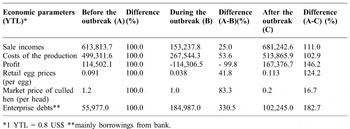
Table 1 shows some economic parameters calculated for the periods before, during, and after the AI pandemic.
The impacts of AI to some economic parameters.

*1 YTL = 0.8 US$ **mainly borrowings from bank.
As seen in Table 1, sales income dramatically declined during the crisis. As the decline in the cost of production did not compensate for economic losses, it negatively affected the cash flow of the producers. Consequently, company debts increased by 3-4 times when compared to the pre-crisis period. During the crisis, 14.5% of the producers had to suspend production for 5.3 months.
Pre-outbreak figures were considerably exceeded by those ‘after the outbreak’ in terms of other parameters studied, to the exclusion of market price of culled hens. Compared to the ‘before the outbreak’ period, egg prices, sales income and enterprise profits increased by 24%, 11% and 46% respectively for the ‘after the outbreak’ period. On the other hand, the average debts per enterprise increased by about 83% in this period.
Further to the findings shown in Table 1, it was noted that 65% of the enterprises applied additional bio-security measures and thus, average bio-security expenditures per enterprise rose to an amount of 6,648 YTL during the crisis. On the other hand, 87% of the producers stated that they had to on average 153,426 YTL from their personal savings during the crisis.
Due to avian influenza-related reasons, the government granted egg producers a subsidy of 1,1 YTL per culled hen over 60 weeks old. On average each enterprise surveyed culled 25,100 heads for this purpose. Furthermore, 26.6% of the producers delayed their insurance premium payments for an average duration of 7 months; 5.6% delayed their bank credit payments for an average duration of 11 months; 18.5% delayed their tax payments for an average duration of 6.5 months; and 43% delayed their payments of electricity bills for an average duration of 9 months.
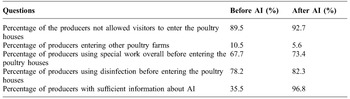
Table 2 shows the answer rates to the questions concerning observance of sanitary and hygienic rules and the amount of information on avian influenza on the part of producers before and after the outbreak.
Observance of sanitary and hygienic rules by the producers before and after the outbreak.

Table 2 shows that, after the outbreak period, producers’ sensitivity to bio-security and hygienic issues were increased, when compared to the period before the outbreak, and there were attempts to remove existing hygienic deficiencies, such as not allowing visitors access to poultry houses, use of special work overalls, boots, and outing in place disinfection procedures. According to producers, the main reason for the AI outbreaks turning into crisis was the ‘sensational news’ that had appeared in both printed and visual media. Other factors they mentioned, in order of importance, included;
• Wide-spread production of backyard poultry in Turkey,
• Lack of education related to human health in Turkey,
• The EUs import ban on poultry products from Turkey due to the AI outbreaks, lack of government efforts on combating the outbreaks,
• Pessimistic scenarios of the World Health Organization (WHO) about the likely pandemic of the disease outbreaks,
• Unpreparedness of integrated poultry plants to AI.
Discussion
The government granted considerable subsidies to the poultry sector during the crisis (15.4 million YTL for 14 million culled hens, accounting for 25% of total layer population). However, a quite significant number of producers preferred not to apply for the other subsidies due to too much bureaucracy during the applications.
Nevertheless, some producers who had to decrease the scale of enterprise, or stop the production for about 5 months, failed to benefit from significant market advantage in the post-crisis period owing to future uncertainties relating to the disease and its market implications ahead of them. Similar farmer behaviours have been reported by Obayelu (Reference OBAYELU2007) from the AI crisis in Nigeria.
On the other hand, along with the increased demand after the outbreak period, export opportunities also increased and there arose a considerable demand for eggs from Iraq, which created significant advantages for the enterprises continuing their production. Rapidly increased demand along with scarcity of supply gave the producers an opportunity to increase their profitability to a considerable extent after the outbreak period.
Similar to those reported in this study, Rushton et al. (Reference RUSHTON, VISCARRA, GUERNE-BLEICH and MCLEOD2005) stated a dramatic decline in the employment the poultry sector during the AI crises in five South East Asian countries.
Sariozkan and Sakarya, (Reference SARIOZKAN and SAKARYA2006) reported that the proportion of income from culled hens accounted for 3-4% in the total income. However, such income disappeared due to the government's ban of live hen sales, which resulted in a dramatic decrease in the live hen prices (the price was almost gratis) after the AI crisis in Turkey.
The timeliness and amount of government compensation is important (McLeod et. al., 2006; FAO, Reference FAO2008). Compensation for culled birds is essential to encourage the owner to report disease outbreaks promptly. It must be paid at or near to the actual market value of the birds and must be paid to the actual owner rapidly and in full, because it has been observed that the producers urgently needed funds due to the collapse of the poultry market. Those having personnel funds used them, and those did not have sufficient savings had to borrow money or capital at a higher interest rate as reported in other developing countries (McLeod et. al., 2005; Rushton et. al., 2005). ‘Right time’ compensation would encourage producers to report the disease and prevent the sale of culled hens.
Farmers have learnt the importance of controlling contagious disease and have improved their hygiene and sanitary standards accordingly. This will be beneficial both for producers and consumers in the future.
In conclusion, the Turkish AI crisis, which lasted for one and a half months, clearly showed how consumer panic can threaten the poultry sector. This points to the fact that it is most important that the industry and government find ways to secure the confidence of consumers in case of a pandemic.
Acknowledgements
The authors would like to thank The Scientific and Technological Research Council of Turkey (TUBITAK-106O457) for the financial support of this study.