Introduction
There is persuasive evidence that the assessment of both creative works and collaborative learning can be difficult and complex, even controversial (van Aalst, Reference VAN AALST, Hmelo–Silver, Chinn, Chan and O'Donnell2013; Eisner, Reference EISNER and Bresler2007), particularly the assessment of contemporary music in styles where multiple and diverse forms of authorship are the norm (Burnard, Reference BURNARD and Odena2012). Perceiving what people are doing as individuals when they work with others is not always possible because creativity, cognition and their resulting activities may be (Cole & Engeström, Reference COLE, ENGESTRÖM and Salomon1993; Fautley, Reference FAUTLEY2010; Glăveanu, Reference GLĂVEANU2011). In New Zealand, the assessment of group composing provides a case in point.
New Zealand schools are to a large degree self-managing institutions where major curriculum and assessment changes have fostered an environment in which teachers and students have a great deal of autonomy in making their curriculum choices (McPhail, Reference McPHAIL2012a). The National Certificate of Educational Achievement (NCEA) is the national secondary school qualification in New Zealand and ‘one of the most complicated school qualification systems in the world’ (Hipkins, Johnston & Sheehan, Reference HIPKINS, JOHNSTON and SHEEHAN2016, p. 6). The NCEA is compromised of three modular, standards-based certificates, generally corresponding to the last three years of secondary schooling. Knowledge and skills are assessed through assessment units called achievement standards. NCEA Music achievement standards assess performing, composing and arranging, aural perception, research and analysis, and music technology. None are compulsory. Teachers (and sometimes) students select a series of standards through which course content will be assessed. Some achievement standards, including those for composing are internally assessed (by the teacher) and some are externally assessed as national, written examinations. For more detail about how this complex assessment system interacts with the New Zealand Music curriculum see McPhail (Reference McPHAIL2012a, Reference McPHAIL2012b).
The NCEA is one of the very few secondary school qualifications in the world where individual students may opt to compose in a group. The challenge for teachers is that each group-composing student must receive an individual grade of Not Achieved, Achieved, Merit or Excellence (NZQA, 2010). Group composers communicate musically and gesturally as well as verbally and often an outside observer such as a classroom teacher may not be able to perceive what is happening (Thorpe, Reference THORPE2009). Group composers may not know what they are achieving nor have the appropriate vocabulary to explain to their teacher what they are doing, or plan to do (Thorpe, Reference THORPE2015). Groups of students may work together in ways that are more creative and productive than when working alone (Engeström, Reference ENGESTRÖM2015; Wenger, Reference WENGER1998). Finally, as legitimate members of a group-composing community of practice, novices may claim shared ownership of the group's compositions, even if their contributions have been minimal (Lave & Wenger, Reference LAVE and WENGER1991). If NCEA assessment judgements for group composing are to be fair and valid then teachers require professional knowledge of both the interactions of group members and the styles in which they compose (Thorpe, Reference THORPE2012). The main purpose of the present study was to investigate how this might be done.
The study: Assessing complexity (Thorpe, Reference THORPE2015)
The year before the achievement standard was to be registered I carried out a pilot case study in one secondary school where my stance was that of non-intervenionist observer (Stake, Reference STAKE1995). I asked a teacher to trial the (then) draft achievement standard. The study generated scant data about the summative assessment of group composing. In a busy classroom, working with multiple groups, the teacher did not seem to know very much about the collaborative compositional processes in which the students were engaged, nor did the student participants have many ideas about how these might be assessed. By asking her to trial the standard I had intervened and so, as an educator, I was uncomfortable silently observing her struggle with complexities when I had knowledge and experience that might have supported her. At the same time literature analysis was indicating that the assessment of group composing would require new pedagogical and assessment practices. Clearly, case study was an inappropriate method because. I needed to be closer to the action, working with teachers and students, and sharing what knowledge and experience I had about group composing and its assessment. I revised my ethics procedures, had these approved by the university, and shifted my research ‘self’ (Reinharz, Reference REINHARZ2011) from non-interventionist observer to practitioner (teacher and researcher), where my stance was interventionist, and the research method practical action research (Zuber-Skerrit, Reference ZUBER-SKERRIT1996)
Four roles emerged through the ethical and reflexive processes of action research which the teachers and I moved in and out of: researcher, music teacher and musician. I was also the lead researcher, and occasionally a critical friend and teacher educator. These ‘research selves’ were related to the requirements of the project: brought selves as social, historical and professional identities; and situational selves, created in response to the context (Reinharz, Reference REINHARZ2011). This placed me squarely in the socio-cultural frame of the action and socio-cultural theory therefore underpinned the main study.
When practice is viewed as situated (Lave & Wenger, Reference LAVE and WENGER1991), a much broader perspective is required because in this study ‘assessment’ did not involve only the actions of the teacher because it was clear that the students needed to be involved in some way too. Kemmis (Reference KEMMIS2009) conceptualises practice as densely woven patterns of ‘sayings’, ‘doings’ and ‘relatings’ and characterises these as ‘practice architectures’. The practice architecture of this study, framed by socio-cultural theory, was therefore constructed of three practices: teaching, assessing and composing.
I negotiated partnerships with two teachers, ‘Alice’ and ‘David’Footnote 1, team-teaching their respective classes of 20 Year 11 Music students over a period of one school year in each schoolFootnote 2. Both had responded enthusiastically to my invitation on musicnet (the New Zealand Ministry of Education secondary music teachers’ on-line forum) and were keen to be involved. Alice's school, ‘Kotare College’, is a state school in a low socio-economic suburb with minimal resources available. Alice wanted to start work late in Term 1. The class consisted of 15 boys (11 Pākehā, two Māori, one Tongan, one Tuvaluan) and five girls (two Pākehā, two Tongan, one Māori). There were fewer girls and Māori students in the class than in the Kotare College population as a whole. We subsequently worked with 11 boys in three bands composing in reggae, blues rock, heavy rock styles. All the girls chose to solo compose.
David's school, ‘St Bathan's Collegiate’, is a private boys'school with a lavishly equipped music department. There were 20 boys in a class that largely reflected the ethnicities of the school population. In the year following the research at Kotare College, David and I worked with ten composers in four groups. One student was Māori and nine were Pākehā (non-Māori), composing in indie rock, pop, and heavy rock styles.
Through successive cycles of practical action research we taught group composing and assessed it using the new NCEA achievement standard. In both teaching partnerships our stated aim was to support the students to reach their potential as composers, to gain a deep understanding of what they were doing, and thus reach valid assessment judgements for each student. Throughout the study a number of complex ethical issues arose related to the knowledge and expertise of both teachers, our respective roles and the wide socio-economic disparity between the two school communities. The highly reflexive and ethical turn of action research proved to be a very effective research method, resulting in rich data, but most importantly, ensured that for the teachers and students, involvement in the project led to positive outcomes for all (See Thorpe, Reference THORPE2015, pp. 81–103 for a detailed examination of these issues).
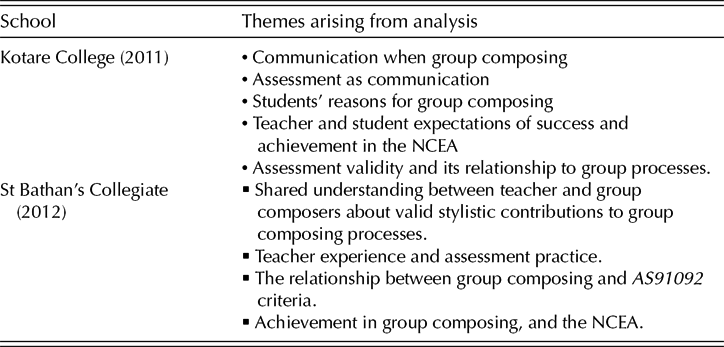
I carried out two cycles of data analysis, on-going throughout the action research, and developed underlying themes, resulting in detailed pictures of what had occurred in each school (see Table 1).
Themes arising from data analysis (Thorpe, Reference THORPE2015, pp. 121, 157)

Following data collection I struggled to take the analysis deeper in ways that accounted for multiple pedagogical, cultural, and social complexities. I am not the first music education researcher to encounter this problem. When investigating the impact of gamelan projects on groups of offenders in prison Henley needed to ‘untangle the complexities’ and used activity theory (AT) as an analytical tool (Reference HENLEY2015, p. 128).) Like Henley, it was a memorable moment when I saw potential of (AT) to ‘untangle’ the complexities of group composing and its assessment. The rest of this article discusses my procedures and findings in relation to this analysis.
Developing a framework for analysis: Activity Theory
While activity theory has not been used extensively in music education research to date, Odena (Reference ODENA and Odena2012) and Fautley (Reference FAUTLEY2010) observe that it is emerging in the literature as a powerful analytical tool to examine and explain such complexities (Burnard & Younker, Reference BURNARD and YOUNKER2008; Soares, Reference SOARES and Odena2012; Welch, Reference WELCH2007). Recently Kinsella and Fautley (Reference KINSELLA, FAUTLEY and Bugos2017) have explained the origin and development of AT in relation to music education. Therefore, rather than repeating this work, I begin with Engeström's triangle – the structure of human activity system (see Figure 1).
An activity system (adapted from Engeström, Reference ENGESTRÖM1987)

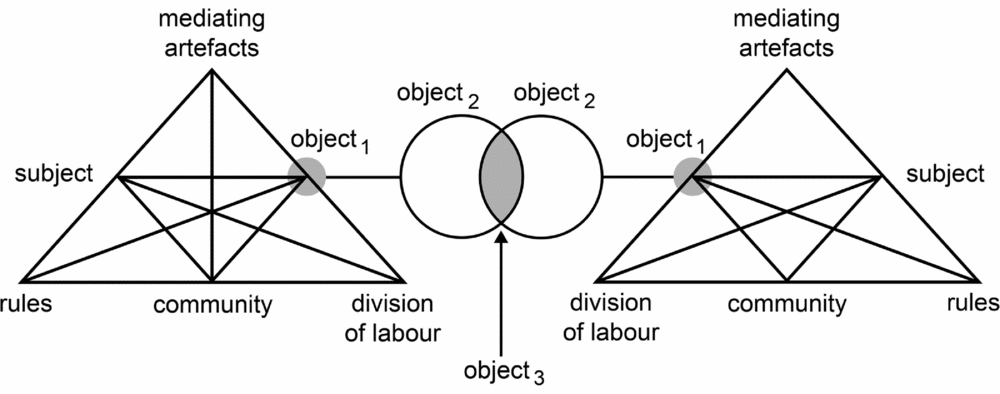
Engeström (Reference ENGESTRÖM1987) observed that activity takes place within communities, generating culturally and historically derived rules and divisions of labour. The object of the activity is the goal of the subjects (those taking part in the activity), mediated by culturally and historically derived artefacts, leading to an outcome. Engeström's ontological assumption is that activity is dynamic in nature and that change within a system is inevitable. He expanded the triangle to represent the third generation of activity theory where the interactions between adjacent systems lead to a third object and its associated outcome (see Figure 2).
Two interacting activity systems (Engeström, Reference ENGESTRÖM2001, p. 136)

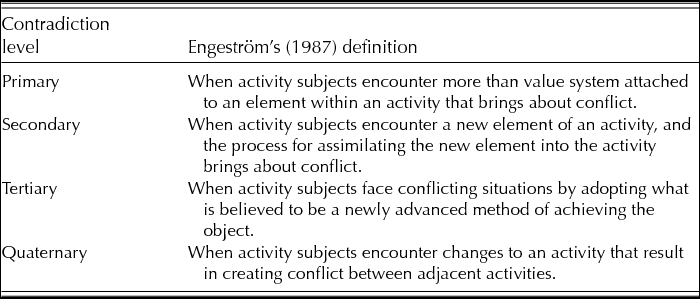
Engeström (Reference ENGESTRÖM1987) also identified four levels of inner contradiction within and between activities systems (see Table 2).
Engeström's four levels of inner contradiction (Yamagata-Lynch & Haudenschild, Reference YAMAGATA-LYNCH and HAUDENSCHILD2009, p. 510)

I used all of the above to construct a framework for the next stage in the analysis of my data.
Three activity systems
AT analysis revealed a significant number of tensions and contradictions within and between multiple, interacting activities associated with group composing, teaching and assessment. The complexities and multiplicities of human activity are mediated through physical, social, psychological and cognitive domains (Hakkarainen et al., Reference HAKKARAINEN, PAAVOLA, KANAGA, SEITMAA–HAKKARAINEN, Hmelo–Silver, Chinn, Chan and O'Donnell2013) and AT was a means by which these complexities could be interpreted (Engeström, Reference ENGESTRÖM, Chaiklin and Lave1993). Like Henley (Reference HENLEY2015) I grappled with the limitations of second generation activity theory where analysing single activities such as group-composing, learning, teaching or assessing, could not account for the complexities of identity transformation or cultural context (Engeström, Reference ENGESTRÖM2015; Henley, Reference HENLEY2015). By identity transformation I mean the way in which the subject of the activity, closely related to divisions of labour, tools, rules, and communities, shifted everything when the participant's identity changed, or was modified in some way.
I went on to third and fourth generation analyses of the interplay between social jamming, group composing, student identity and student achievement. In this context I define social jamming as a recreational activity, the musical equivalent of shooting hoops or kicking a ball around. Group composing often begins with social jamming, but I viewed the activity of group composing as the equivalent of playing an actual game of basketball or football.
During the first cycle of action research at Kotare College I developed a conceptual model of composing (Thorpe, Reference THORPE2017). I shared this with the students in both schools. The teachers, students and I used this model as a framework to facilitate informed, cordial and motivational discussions about the students’ creative processes. These interactions resulted in a great deal of valid data upon which the teachers could base their assessment judgements. The model is derived from earlier research into group composing in garage bands (Thorpe, Reference THORPE2008) and informed by the work of Fautley (Reference FAUTLEY2005, Reference FAUTLEY2010), Webster (Reference WEBSTER1990, Reference WEBSTER, Sullivan and Willingham2002), Guildford, (Reference GUILFORD1950), and Wallas (Reference WALLAS1926). Consistent with other research into group music making in contemporary styles (for example Biasutti, Reference BIASUTTI2012; Campbell, Reference CAMPBELL1995; Green, Reference GREEN2002, Reference GREEN2008; Jaffurs, Reference JAFFURS2004), group composing usually begins with a ‘messy’ phase when group composers jam together, looking for ideas upon which to base their composition (Thorpe, Reference THORPE2015). While this may look to an outside observer like the same activity as social jamming, the object is quite different. A key finding is that students who seemed to view jamming as a mainly recreational, social activity were those who did not successfully complete group compositions. What follows is a discussion of how AT was used to analyse three interrelated but distinct activities: social jamming, group composing and achieving in the NCEA.
Social jamming
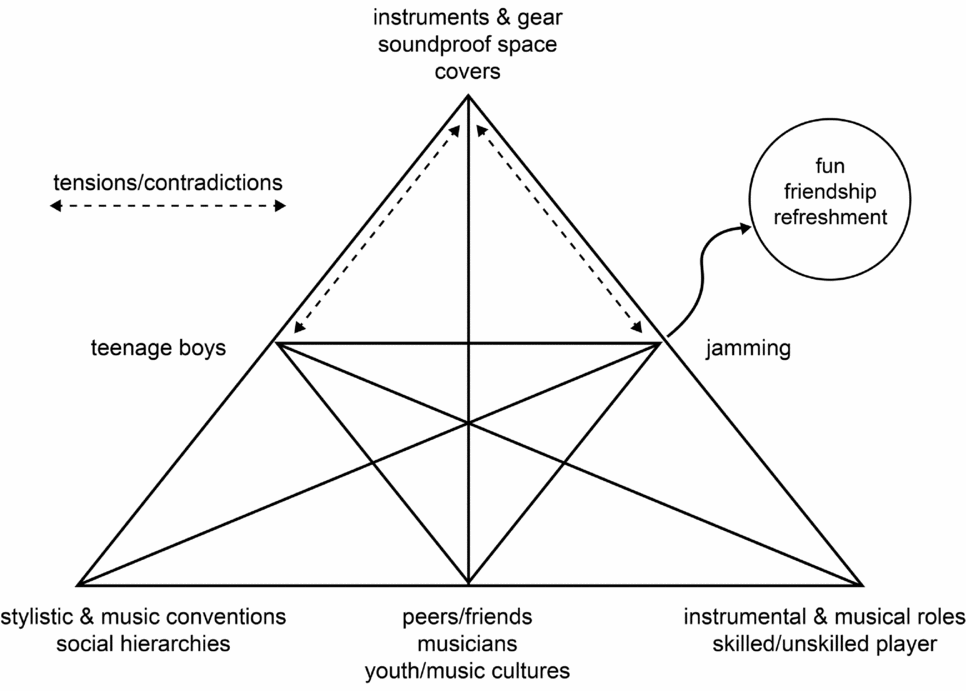
Social jamming is an activity that may or may not happen at school. Therefore, the subjects of this activity are teenagers engaged in a socially enjoyable activity, rather than Year 11 students. In line with the research of Green (Reference GREEN2008, Reference GREEN2002) and others into young people's informal music making, the student participants in both schools reported that the object of jamming was feeling good. It was fun, they enjoyed being with their friends, they liked being independent, and they enjoyed helping each other. Some found it a refreshing change from sitting still and engaging in academic learning. The tools needed were instruments and gear appropriate to the musical style, as well as the skills to use them. Language, the primary tool, was gestural, verbal and musical and informed by stylistic knowledge of the music. Players also needed a soundproof space when working in high-volume styles.
The musical style and its associated instrumental roles defined the divisions of labour (for example playing electric guitar, drums or bass in a heavy metal piece). These were also mediated by the skill-level of the players. For example, in some groups a beginner electric bassist played a different role in the group to that of a more skilled lead guitarist. Musical and cultural conventions acted as rules, but no doubt there are rules related to social hierarchies that were not perceivable by an outsider, such as their teacher or me.
Jamming was situated within peer/friendship communities associated with cultures related to musical tastes, social milieu, youth cultures, as well as cultures related to their communities, families and ethnicities (Dillon, Reference DILLON2007; Tarrant, North & Hargreaves, Reference TARRANT, NORTH and HARGREAVES2001). For example, two boys of Pacific Island descent jammed in an island reggae style not studied in their music class, but seemingly related to their own culture and, by association, their homes, families and communities. Therefore, while social jamming happened at school, school may have been merely the community location, not the community itself.
In the present study, the main tension the students reported was a lack of access to the appropriate tools, mainly soundproof rooms and gear such as amplifiers and drum kit. Social jamming is represented in Figure 3 as an activity, and a dotted arrow represents the tension.
Social jamming as an activity

NCEA group composing

Group composing
Group composing usually began with jamming, and so some of the same elements of social jamming are also part of a group composing activity system. However, when the object of one activity develops over time to become a tool in a related activity then it is nested within the system (Barab et al., Reference BARAB, BARNETT, YAMAGATA-LYNCH, SQUIRE and KEATING2002; Engeström, Reference ENGESTRÖM2001). Thus, when considering group composing as a school-based activity, jamming is no longer a recreational activity but is nested within the activity of group composing as a tool.
While composing may involve the same musical styles as social jamming, when it occurs at school the subjects are not only social jammers but also Year 11 students, embedded in the communities of the classroom and the school. Rather than a recreational pursuit, jamming is integrated into a school-based activity connected to a qualification system, the NCEA. Cognitive as well as affective aspects are involved, where the object of the activity is group composing, and the outcome a composition, chord chart, recording and the associated NCEA grades. While some group composers reported that, like social jamming, group composing was refreshing and fun, and that they really enjoyed helping less experienced group members, there were different rules. These were associated with the classroom teacher, school managers and the qualifications authority that administrates and moderates the assessment. The same musical divisions of labour as jamming were evident, but the NCEA assessment also requires a chord chart or other form of written representation, meaning that both music and English literacy skills were required on the part of at least one of the students. Successful group composing also requires that members shape, organise and critique their work (Thorpe, in press). Therefore, group composers took a number of other musical roles within the activity.
When considering jamming as a tool in the activity of group composing several contradictions and tensions emerged from the analysis. These are represented in Figure 5 as numbered, dotted lines.
NCEA group composing as an activity system

Contradictions ① and ② are primary, that is, more than one value system is attached to an element of the activity (Engeström, Reference ENGESTRÖM1987). These relate to values associated with jamming and NCEA achievement. Group composing usually starts with jamming in popular music styles that are embedded within communities of peers and their associated cultures (Davis, Reference DAVIS2005; Jaffurs, Reference JAFFURS2004; Campbell, Reference CAMPBELL1995). For group composing, the rules are to some extent the composition task set by the teacher who must in turn abide by the rules of the assessment. Therefore, to achieve the standard the students must compose structured music, make a recording and submit a written representation. To achieve a Merit or Excellence grade they must also compose music that is stylistically ‘controlled’ or ‘assured’ (NZQA, 2010, p. 2).
If some students valued playing in the group because they saw it as an opportunity for social jamming, or if they valued music that did not comply with the requirements of the teacher's composition task and/or NCEA rules, then there was a potential tension for both teacher and students. In the present study, some students seemed very reluctant to stop jamming and progress to shaping the composition. Perhaps for them the music classroom was ‘simply a bigger place in which to play’ (McPhail, Reference McPHAIL2012a, p. 206). Although it looked the same as group composing and achieving in NCEA Music, these students may have been engaged in the activity of social jamming.
Contradictions ③, ④ and ⑤ pertain to the inclusion of NCEA requirements into an activity that was, for some students, a social and recreational one. Contradiction ③ relates to tools. The study found that while the students all jammed from time to time in class, Kotare College students did not have access to sufficient resources to group-compose over sustained periods. Unlike St Bathan's Collegiate, there were not enough practice rooms at Kotare College and the only band room was not soundproofed. Group composers at Kotare College had to wait their turn to access a productive composing space and seemed to lose interest while they waited.
There were some contradictions (④) related to roles and divisions of labour for group composing. Less skilled and/or knowledgeable students generally lacked a broad prior knowledge of diverse musical styles and so struggled to fulfil the musical and stylistic roles that group composing required of them. This meant that they also struggled to critique and organise their music because they were not able to communicate effectively with one another about what they were doing. Similarly, beginner players at Kotare College did not have access to digital media that might have helped them to fulfil their required instrumental and stylistic roles (Tobias, Reference TOBIAS2013).
Contradiction ⑤ relates to a tension between social jamming as a pleasurable, open-ended social activity, and the more school-oriented activity of group composing. While for some students social jamming was seen as an opportunity for socio-musical fun, it is also the precursor to the generation of valuable musical ideas, and therefore part of group composing. There was evidence that some students did not connect jamming with the activity of group composing, and by association, achieving in NCEA Music. Why this might be so is examined in the next section.
Identity: Social jammer, composer, or NCEA achiever?
Adolescents use popular music and its associated cultures as social identifiers in order to construct identities for themselves (Tarrant et al., Reference TARRANT, NORTH and HARGREAVES2001). MacDonald, Miell and Wilson (Reference MacDONALD, MIELL, WILSON, Miell, MacDonald and Hargreaves2005) differentiate between ‘listeners’ and ‘players’, although the two are by no means mutually exclusive (p. 323). While listeners identify with the music, accessing the implicit body of knowledge they acquire through listening, players can actually embody that knowledge. Group composers have the opportunity not only to identify with a musical culture and community, but also to participate in it as an activity (Thorpe, Reference THORPE2009). In this way they are linked both to structures that form and maintain peer and friendships, and possible or imagined futures (Tarrant et al., Reference TARRANT, NORTH and HARGREAVES2001; Wenger, Reference WENGER1998; Zillman & Gan, Reference ZILLMANN, GAN, Hargreaves and North1997).
Analysis revealed that some students might have regarded themselves as legitimate peripheral participants in an adult musical community of practice (Lave & Wenger, Reference LAVE and WENGER1991). A community of practice is a group of people, such as a group-composing band, or group of friends jamming socially together, who ‘share a concern, a set of problems, or a passion about a topic’ (Wenger, Reference WENGER1998, p. 133), Learning occurs within the community of practice, regardless of its purpose (Lave & Wenger, Reference LAVE and WENGER1991). From a socio-cultural perspective, this implies that group composing or social jamming might have provided some students with opportunities to negotiate meaning and thus construct identities through their engagement in an activity associated with authentic work in the adult world (Wenger, Reference WENGER1998).
Although it is not possible to gain a complete understanding of the students’ motivations to jam and group-compose, some inferences may be drawn from the findings. All student participants completed a questionnaire asking them about the importance, to them, of group composing, achievement in NCEA Music and achievement in the NCEA across all school subjects. Most students in both schools reported that they valued playing together as much as, or even more highly than NCEA achievement. However, the St Bathan's Collegiate students all indicated that NCEA achievement across all subjects at Merit or Excellence level was either ‘important’ or ‘very important’ to them. This was in sharp contrast to the Kotare College data where only three students indicated that NCEA achievement of any kind, in any subject was important to them. Crucially these were the only Kotare College students who successfully completed and submitted two group compositions. Furthermore, there is little evidence that any Kotare College student participant constructed an identity such as ‘NCEA high-achiever in Music’, even though some were skilled musicians. This is in contrast to the St Bathan's students who all indicated that they were aware of the connection between the activities of jamming, composing, and NCEA achievement in music.
During the AT analysis I was conscious that ‘the way in which subjects are positioned with respect to one another within an activity carries with it implications for engagement with tools and objects’ (Daniels & Warmington, Reference DANIELS and WARMINGTON2007, p. 382). All student participants reported that jamming was a ‘feel good’ activity, but some said that group composing felt good too. For these students NCEA Music achievement was associated with positive feelings. When I considered social jamming and group composing as adjacent activities, 3rd generation analysis revealed a number of contradictions. These are represented on Figure 6 as ⑥.
Interacting activity systems

While Figure 6 presents a rosy educational picture when the object is ‘positive psycho-social outcomes’ and ‘achievement at school’, this was not so for all students. For some, particularly at Kotare College where, overall, students had much lower expectation of NCEA achievement, there were not two activities but one: social jamming. Further data analysis suggested to me that this was related to these students’ motivation to achieve at school. I turned to theories of motivation to deepen the analysis.
Social jamming, group composing and student motivation to achieve in the NCEA
In his examination of students’ motivation in relation to their achievement and engagement at school, Brophy (Reference BROPHY2008) asserted that ‘if a curriculum strand has significant value for learners, it will be because its content network is structured around big ideas that provide a basis for authentic applications to life outside school’ (p. 135). When viewed as nested activity systems, social jamming and NCEA group composing can be seen to have considerable potential to foster the kinds of authentic learning, learner connection and meaningful achievement Brophy called for in school curriculum design. Furthermore, the community of practice of a productively composing band provides considerable opportunities for learning autonomy, identity construction, and meaning-making for its members (Wenger, Reference WENGER1998).
The previous analysis has identified contradictions and tensions within the activity of NCEA group composing that have the potential to militate against engagement and achievement for some students. Then again, student achievement has been shown to be optimal when students are self-regulated and autonomously motivated (Brophy, Reference BROPHY2008), and motivation determines the relation between the subject and the object in an activity (Engeström, Reference ENGESTRÖM2001). While all students jammed together and many student participants seemed self-regulated and intrinsically motivated in one or both of the activity systems, some did not move from social jamming to composing, and thus to NCEA achievement.
Educational theories related to students’ motivations to achieve generally focus upon three psychological aspects: social milieu, value, and expectancy (Wigfield, Tonks & Eccles, Reference WIGFIELD, TONKS, ECCLES, McInerney and Van Etten2004). Social milieu has been substantially examined in music education research and is a key variable in the students’ motivations to play, jam and compose together (Allsup, Reference ALLSUP2003; Davis, Reference DAVIS2005; Green, Reference GREEN2008; Jaffurs, Reference JAFFURS2004). Therefore the notions of value and expectancy have particular relevance in relation to the activities presently identified. Wigfield et al. (Reference WIGFIELD, TONKS, ECCLES, McInerney and Van Etten2004) focus on four aspects of value in relation to student motivation to achieve: intrinsic, attainment, utility, and cost.
Intrinsic value is related to enjoyment, such as the level of satisfaction in completing a composition, as well as enjoyment and aesthetic appreciation during the creative process. Such activity is autotelic, in that the subjects engage in an activity such as jamming or composing for its own sake (Csikszentmihalyi, Reference CSIKSZENTMIHALYI1996). Enjoyable activity frequently results in the state of flow where:
There is no worry of failure, there are clear goals every step of the way, there is immediate feedback, distractions are excluded from consciousness, there is a balance between challenge and skill, self-consciousness disappears, sense of time becomes distorted and action and awareness are merged. (Sheridan & Byrne, Reference SHERIDAN and BYRNE2002, p. 140)
Intrinsic motivation in a creative endeavour such as composing is also linked to enjoyment, the discovery of unorthodox solutions, and sustained and persistent effort (Ruscio, Whitney & Amabile, Reference RUSCIO, WHITNEY and AMABILE1998). Intrinsically motivated people also demonstrate deeper levels of creative problem solving than those who are not (Barrett, Reference BARRETT and Elliot2005).
When considering this kind of motivation in relation to the activity systems of social jamming and group composing, it is helpful to consider Waterman's (Reference WATERMAN2005) delineation of enjoyment into hedonic, which can be experienced through simple participation (such as social jamming) and eudemonic, associated with sustained, goal-oriented effort (such as group composing).
Attainment value is the value the learner places upon attainment of the object (Wigfield & Eccles, Reference WIGFIELD and ECCLES2000). When considering the hedonic activity of social jamming, it is clear that all of the student participants valued the object of the activity, but that it was only tenuously related to the more eudemonic group composing activity, in which not all are meaningfully engaged. Only students who associated group composing with NCEA achievement were those who completed their compositions.
The same can be said for utility value, that is, the perceived value of group composing and the NCEA to their future lives. All student participants associated NCEA achievement with extrinsic goals and many reported that they intrinsically valued group composing and the music they created for its own sake. When asked about the purpose and function of the NCEA, all of the Kotare College students associated NCEA achievement with immediate employment in the adult workforce or with admission to the local technical college. Some Kotare students reported that group composing was something that might be useful to them in the workplace, but achievement in NCEA Music did not seem to be highly valued in itself.
In contrast, all St Bathan's Collegiate student participants reported that they associated NCEA achievement with gaining access to university courses. While they seemed intrinsically engaged in group composing as an aesthetic and social pursuit, all reported that high NCEA achievement at Level 3 (the final year of high school) was an important goal for their future lives. If, as has been suggested earlier, group composing presents students with opportunities to negotiate meaning and thus construct identities, it seems that while St Bathan's and Kotare students’ musician identities may have been similar (when jamming socially for example), for some, their student identities may have been different.
When we consider cost in relation to social jamming and NCEA group composing, it is in relation to how much engaging in one activity might limit another (Wigfield & Eccles, Reference WIGFIELD and ECCLES2000). To create a structured and coherent piece of music, composers must to move out of divergent creative processes into a more convergent, focused activities related to the final product (Thorpe, Reference THORPE2015). There is a social cost to doing this if hedonic enjoyment in social jamming is the only motivation. It may be that for some of the Kotare students, the value of social jamming enjoyment outweighed the extrinsic goal of achieving NCEA credits, particularly if NCEA Music achievement was not highly valued.
Expectancy of achievement, and the achievement itself, are mitigated by the level of difficulty experienced by the learner - not too easy, not too difficult (Brophy, Reference BROPHY2008). Overall, the St Bathan's Collegiate students brought higher levels of musical skill and knowledge to the activity of group composing than the Kotare College students. Group composing was probably easier for them to do. Furthermore, unlike Alice, David made links between the music curriculum and the students’ lives outside of school. For example, his second composition task was based upon musical styles from familiar movie genres. The students also worked in a very well resourced environment. Under those circumstances, the activity of NCEA group composing was probably easier to do than for the Kotare College students.
Novice students at Kotare College struggled to compose with minimal skills and knowledge, and woefully inadequate resources. Even one highly skilled Kotare student believed that composing was difficult, and, despite composing two valid, stylistically controlled pieces (a Merit grade), said that he did not know very much about composing, and did not believe that he could compose on his own. Although some achieved in NCEA composing, all of the Kotare College student participants either left school, or returned to the hedonic pleasures of social jamming in the months following the project. None went on to achieve in composing in NCEA Music the following year. It seems that low expectations of achievement on the part of both teacher and students, along with low value placed upon it by the students, resulted in no subsequent NCEA achievement in composing. Inadequate resourcing of group composing was another significant factor in the low achievement of these students. This is in marked contrast to the St Bathan's Collegiate students who had access to multiple spaces and well-equipped facilities. In contrast, all St Bathan's Collegiate students who chose Music the next year went on to achieve Merit or Excellence in composing.
Conclusion
Activity theory analysis helped me to understand that, in the context of the present study, a student's identity as ‘a member of a collaboratively composing band’ may not necessarily be the same as ‘a successful NCEA candidate’. The relationships between this enjoyable social activity and the requirements of NCEA music are complex and contain a number of tensions and contradictions. AT analysis revealed that for some students, particularly those in an under-resourced school in a low socio-economic area, the motivation to group-compose may not necessarily have been be driven by the extrinsic rewards of a school qualification, but rather the enjoyment of social music making.
These findings align closely with New Zealand research into student expectancy of achievement at secondary school. Low student aspirations of NCEA achievement both predict and reinforce low achievement (Walkey et al., Reference WALKEY, MCCLURE, MEYER and WEIR2013). Furthermore, students in low-socioeconomic communities are more likely to have low expectations of academic success than those for high socio-economic backgrounds (Bishop & Glynn, Reference BISHOP and GLYNN1999; Tavani & Losh, Reference TAVANI and LOSH2003). There is significant evidence to suggest that low or even moderate teacher expectations of achievement in the NCEA reinforce low academic achievement (Savage et al., Reference SAVAGE, HINDLE, MEYER, HYNDS, PENETITO and SLEETER2011).
Socio-economic disparity has been identified as a significant challenge to achieving equitable educational outcomes for New Zealand secondary school students, particularly for Māori students and those from ethnic minorities (Hynds et al., Reference HYNDS, SLEETER, HINDLE, SAVAGE, PENETITO and MEYER2011) In the present study AT analysis enabled me to gain a greater understanding of the impacts low expectation and under-resourcing may have upon student achievement in music. Nevertheless, when the activities of jamming and group composing are successfully linked to achieving in NCEA Music, the intrinsic rewards of social jamming and group music-making have the potential to support significant achievement for young people and perhaps lessen current disparities. For future research, AT has considerable potential as an analytical tool to further interpret the complexities of music teaching and learning.