1. Introduction
On 17 January 1966, at the height of General Franco's dictatorship (1939–1975), two US Air Force planes crashed in the sky over the Spanish town of Palomares (Almería), and four nuclear bombs containing 4–5 kg. of plutonium fell to earth; three fell on land near the coast and leaked their contents, and the fourth fell into the sea. The event came to the attention of the official media, but it was soon counterbalanced by the appearance on national television of Manuel Fraga Iribarne, the Minister of “Information and Tourism,” together with the US Ambassador Angier Bilde Duke, who were bathing at a beach near Palomares, thereby disseminating an image of control and an absence of any risk of nuclear contamination (La Vanguardia, 09–03–1966). In addition, the president of the Spanish Nuclear Energy Board (Junta de Energía Nuclear- JEN), Dr. José María Otero Navascués (1907–1983), was interviewed by newspapers in a move designed to reinforce his scientific authority. His words left no room for any kind of speculation: “There is no danger of radioactivity in the Palomares area, nor could there have been.”Footnote 1 Nevertheless, the Palomares bombs became a controversial episode which remained in the Spanish public consciousness for decades, even during the democratic period that followed the dictatorship. In 2011, 45 years after the accident, there are still areas near the town with plutonium radioactivity, and the risk for the local population still remains.Footnote 2
This was obviously a single episode in a broader context. During the Cold War, assessment of the dangers of nuclear power as well as its potential benefits were burning issues in the media, while at the same time a very serious affair on a state level. Its political impact, in terms of national pride, international prestige, and technological development was inevitable, and it therefore adopted different forms in different countries, under different political regimes and foreign alliances. Together with the space race and cybernetics, it became one of the crucial subjects that those seeking to popularize science were unlikely to omit. The impact of Hiroshima and Nagasaki, and the new military-industrial research projects of big science, jeopardized the image of the “neutrality” of science, but political authorities were keen to convince their societies that nuclear power could also be used for peaceful purposes. In particular, President Eisenhower's “atoms for peace” campaign became a powerful tool of propaganda for nuclear energy (Bensaude Vincent Reference Bensaude-Vincent, Krige and Pestre1997, 331; Krige Reference Krige2006b).Footnote 3
From the Manhattan project to the Nazi quest for the atomic bomb, a great deal of research has been carried out on the political engagement of professional scientists in the application of nuclear energy for war and peace.Footnote 4 Other studies have conducted in-depth analyses of the way in which state policies, propaganda campaigns, and publicity strategies attempted to shape Western public opinion regarding the need to develop nuclear power (Forgan Reference Forgan2003; Hughes Reference Hughes2003b; Smith Reference Smith2010). More broadly, in recent years, great effort has been devoted to reconstructing the history of different science popularization practices as a whole in the twentieth century (Lafollette Reference Lafollette2008; Bowler Reference Bowler2009; Schirrmacher Reference Schirrmacher2009), but less work has been dedicated to the role of individual science popularizers (Gregory Reference Gregory2005), especially in peripheral European countries (Papanelopoulou et al. Reference Papanelopoulou, Nieto-Galan and Perdriguero2009), often seen as playing a minor role in the escalation of nuclear weapons during the Cold War.
As argued in this paper, a detailed reconstruction of new case studies will shed new light on the subtle mechanisms that, alongside police and military repression, supported authoritarian regimes in the period following the Second World War. Science popularization became a fundamental part of the culture of the twentieth century, but also one which cannot be separated from important issues regarding scientific authority and their influence on social and political control.Footnote 5 Of course, links between the spread of scientific knowledge and the mechanisms of social control can also be analyzed in other historical and political contexts, even in formal democracies (Aronowitz Reference Aronowitz1988). In their expository practices, professional scientists, but also science popularizers, played and continue to play a role in the public arena in different political and cultural contexts for the sake of their scientific authority, academic hegemony, and social recognition (Hilgartner Reference Hilgartner1990). Their aims and motives, in co-evolution with the aims and motives of a specific political regime and its elites, help us to analyze the ethical status of experts and professionals as potential intellectuals at large in our contemporary societies (Nieto-Galan Reference Nieto-Galan2011). Their subtle role in dictatorial regimes, which are obviously associated with crude repression and state violence, makes the whole analysis even more rewarding.
Through details of Miguel Masriera's life and work, the paper describes subtle mechanisms of appropriation of the international “atoms for peace” program in the context of the Franco dictatorship. It also shows how science popularization acted as a “neutral” subject, whose foreign great luminaries – from Einstein to Eddington – were presented to local lay audiences as intrinsic, non-problematic names, inserted in the scientific culture of the Spanish fascist elites. At the same time, though, that kind of erudite, cosmopolitan science popularization provided an open window for the regime abroad, in a time of intellectual isolation of Spain from Western Europe. The paper also helps us to describe, through particular science popularization practices, specific mechanisms of individual survival and adaptation in that kind of regime.
In the case of Spain, important research has been undertaken over the last decade into the history of nuclear power during the Franco era (Ordóñez and Sánchez Ron Reference Ordóñez, Sánchez Ron, Forman and Sánchez Ron1996; Romero de Pablos and Sánchez Ron Reference Romero de Pablos and Sánchez Ron2001; Barca Reference Barca2000; Romero de Pablos and Santesmases Reference Romero de Pablos and Santesmases2008; Roqué and Herrán Reference Roqué and Herrán2012), but not much has been carried out on the analysis of the role of science popularization, and nuclear power popularization in particular. Rosa Medina and Alfredo Menéndez have shown how NoDo, the Spanish official newsreel, included science and technology content aimed at reinforcing the military, authoritarian character and at emphasizing the rupture with the country's democratic past (Medina-Domènech and Menéndez Navarro Reference Medina-Domènech and Navarro2005; Tabernero et al. Reference Tabernero, Jiménez-Lucena and Molero-Mesa2012). However, a lot remains to be revealed on the role that science popularization in general, and individual science popularizers in particular, played during the dictatorship. In the case of Masriera, it is regrettable that, up to now, he has only been mentioned as a marginal actor, as a journalist who played a minor role when compared with the “real” local figures.Footnote 6 He seldom appears in general histories and prosopographies of the dictatorship's elite,Footnote 7 and his full biography is still to be done, with this paper being a first attempt at a broader research project on the alliance between knowledge and power in a group of relevant professional chemists during the Franco regime.
2. From Academic Prestige to Popular Science
Miguel Masriera, the son of Arturo Masriera (1860–1929), a well-known Catalan writer and humanist, was born in Barcelona in 1901. After completing secondary school, he entered the Science Faculty to begin his training at the research school run by Antonio García Banús (1888–1955), an organic chemist who worked on free radicals and obtained notable international recognition (Nieto-Galan Reference Nieto-Galan2004). After graduating in 1922, Masriera benefited from Banús’ contacts at the Swiss Federal Institute of Technology (ETH) in Zurich, and was awarded a fellowship to work with Hermann Staudinger (1881–1965), the luminary of the chemistry of macromolecules. In Zurich, Masriera took courses with prestigious professors such as Leopold Ruzicka and Paul Scherrer, and graduated as a chemical engineer, later submitting his Ph.D. in Madrid in 1924. In 1926, he began to lecture in theoretical chemistry and later physical chemistry courses at the Science Faculty in Barcelona, which he combined with new research into spectroscopy and photochemistry (Roqué Reference Roqué2012).Footnote 8
In the 1920s, Masriera had already begun to publish some popular science articles in the general press. Perhaps his most famous public appearance was linked to controversies concerning Albert Einstein's theory of relativity following the latter's visit to Spain in 1924 (Glick Reference Glick1987; Roca-Rosell Reference Roca Rosell1988; Canales 2009).Footnote 9 Masriera had met Einstein personally in Zurich and corresponded later with him, as stated in his articles published in the newspaper La Vanguardia in 1925.Footnote 10 His early contributions published in the general press nonetheless were not restricted to specialized subjects such as Einstein's relativity. Masriera also tackled philosophically and politically-orientated issues in several Spanish newspapers, in which he expressed for instance his anti-communist views and his aim to overcome the cultural gap between hard sciences and humanities by popularizing the former.Footnote 11
During the Spanish Civil War (1936–1939), he held several posts in the Catalan autonomous government, Generalitat de Catalunya,Footnote 12 and replaced Banús as head of the Institut de Química at the University of Barcelona. As a result, when the war ended in 1939 with the victory of General Franco's forces, Masriera went into exile in France, following the path of many other university professors who lost their positions and suffered the depuration policies of the new regime (Giral Reference Giral1994; Otero Carvajal et al. Reference Carvajal and Enrique2006; Claret Reference Claret2006; Barona Reference Barona2010). Under the protection of Frédéric and Irene Joliot-Curie, he managed to work on spectroscopy and IR photography for the French Government at the Astrophysics Institute (Institut d'Astrophysique) with Professor Daniel Chalonge,Footnote 13 and later at the École Normale and the Sorbonne.Footnote 14
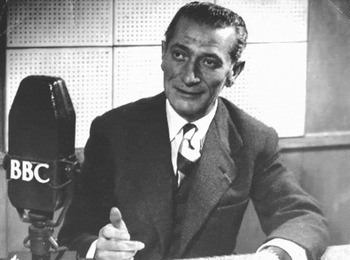
Masriera at the BBC, in 1956. Private collection of the author.

In Spain, Franco's victory had dismantled a prominent generation of scientists who had been very well positioned in the international arena in the early decades of the twentieth century. However, during the first decades of the dictatorship, science played an important role in the construction of a new fascist nation, but seeking a radical break with the recent past (Malet Reference Malet, Romero and Santesmases2008). In order to emphasize the rupture with the country's democratic past, especially with the years of the Second Spanish Republic (1931–1936), scientific achievements were often presented in public as reinforcing the military and authoritarian character of the regime (Medina-Domènech and Menéndez Navarro Reference Medina-Domènech and Navarro2005).
In the early 1940s the new regime authorities spread a false idea of reconciliation abroad to encourage exiled Spaniards to return. However, in practice, internal political repression was fierce. A good number of Spanish scientists felt comfortable with the supposed “neutrality” of their profession, but they finally were arrested for different degrees of collaboration of the Second Spanish Republic. It was in this context that Masriera decided to return to his homeland.Footnote 15 In fact, Masriera's name was recorded in the archives of Franco's police under the category of “rojo” (red), for his services to the democratic regime before and during the Civil War,Footnote 16 and he was not allowed to take back his position at the university. In his correspondence with some of the former colleagues who had managed to accommodate themselves in the new regime,Footnote 17 he lamented his marginalization from the new academic order, and insisted on having at least a research position in the Spanish National Research Council (Consejo Superior de Investigaciones Científicas, CSIC), founded by Franco in 1939 and led in practice by José María Albareda (1902–1966), a reputed chemist and member of the right wing Catholic organization, Opus Dei (Malet Reference Malet2009). In reality, despite a number of promises and false expectations, Masriera never again obtained an academic post.Footnote 18
Once back in Spain, he soon began to conduct independent scholarly work on theoretical aspects of quantum physics and cosmology. He established his own laboratory at home with some instruments he was able to bring with him from Paris,Footnote 19 and also acted as a private consultant for several industrial companies.Footnote 20 Yet above all, he became a very active science popularizer: he published successful popular science books and articles in newspapers, and translated foreign texts on nuclear physics, the space race, and computer science.Footnote 21 Under the patronage of the Count of Godó, the owner of La Vanguardia and an upper class Catalan aristocrat enjoying a comfortable position in the Franco regime, Masriera was appointed the newspaper's science popularizer. Although his collaboration with La Vanguardia had begun in the 1920s, his presence in the daily press became particularly relevant from 1948 onwards.Footnote 22
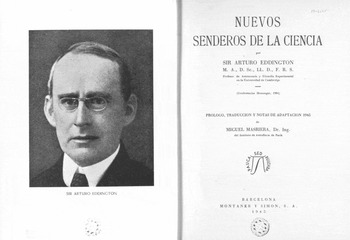
Masriera's work drew inspiration from the enormous task undertaken by the British astrophysicist Arthur Eddington (1882–1944) in disseminating Einstein's ideas in the UK (Stanley Reference Stanley2007). In 1945, Masriera translated Eddington's book, New Pathways of Science (Eddington Reference Eddington1945). In a long preface to the Spanish version, in which he proclaimed himself the “Spanish Eddington,” Masriera made important observations of his own perception of science popularization at the end of WWII. He was in favor of disseminating theoretical science, including philosophical reflections, which in his view complemented the scientific method well. Eddington's anti-materialism, and his mystical attempts to reconcile science and religion, fitted very well with Masriera's political ideology and world view, and reinforced the strong religion-laden scientific culture of Francoism.
Masriera's translation of Arthur Eddington's New pathways of science (Spanish version of 1945). Reproduced with permission of the Biblioteca de Catalunya (BC), Barcelona.

Masriera kept on writing popular science articles in La Vanguardia until the end of his life. In the 1960s, a period of the dictatorship in which the country benefited from substantial economic growth and further international legitimization, he lectured at the Escuela Oficial de Periodismo (Official School of Journalism)Footnote 23 and played an important role in organizing seminars on scientific journalism, which attracted figures of authority in science and politics, and created the atmosphere for legitimizing the profession.Footnote 24 Masriera was awarded several prizes,Footnote 25 and became a reference model for the younger generation, especially after the creation of the Asociación Española de Periodismo Científico (Spanish Society of Scientific Journalism, AEPC) in 1971, which attempted to legitimize science popularization by conferring a more consistent professional status on its practitioners.Footnote 26
Masriera addressed his popular science articles to an educated middle class audience with intellectual interests in scientific and humanistic subjects. He also depicted three different kinds of audiences: 1. Lay users of ‘black boxes’ (the great majority); 2. Informed readers, with a scientific background, but seeking a pragmatic, anti-philosophical approach; 3. “Philosophers,” with a high degree of intellectual ambition and metaphysical mentality (Eddington Reference Eddington1945, xviii-xix). He rejected any thrill-seeking popularization aimed solely at increasing the audience. As a strategy for defining his own professional authority in public, Masriera strongly criticized popularizers with a poor scientific background.Footnote 27 Throughout his work he presented the twentieth century as the era when three new scientific disciplines emerged: “atomistics” (a peculiar way of defining nuclear physics and the development of nuclear power after the Second World War), “cybernetics” (the new world of computer science, electronics, robotics, and information theories), and “astronautics” (which combined several aspects of modern engineering, astronomy, and astrophysics).Footnote 28
Masriera emphasized the need to take “theoretical science” seriously, even in its popular form, as a way of discovering links with philosophy and the humanistic culture. In the same way, popularizing relativity was in his view a basic step towards the lay understanding of the macroscopic world, while disseminating quantum physics was crucial for lay explanations of the microscopic world (Eddington Reference Eddington1945, xxv). He even saved some of his intellectual energies for metaphysics and speculation (applying his peculiar philosophy “with neither time nor space”), and also for literary fiction (Masriera Reference Masriera1969a, vi).Footnote 29 As discussed in the next section, he never gave up tackling daring, theoretical issues, keeping regular contact with prestigious scientists abroad, or establishing fruitful industrial collaborations from his own laboratory at home. Until his death in 1981, in the early years of the new democratic Spain, Masriera “travelled” through the fringes of academic authority, but managed to build a broad, multifaceted scientific culture for his own adaptation to the constraints of the regime.
2. Atoms in the Public SphereFootnote 30
Masriera's early background in physical chemistry, and his intellectual commitment to the new physical atom emerging in the early twentieth century, placed him close to academic theoretical physics. His international education, first in Zurich and later in Paris, acquainted him with prestigious names such as Einstein, Dirac, Eddington, Scherrer, Joliot, Perrin, and Pauli, among many others. Since he had already taken an active part in the popularization of Einstein's theory of relativity in Spain in the 1920s, he felt comfortable appropriating and spreading the new physics in books, journals, and newspapers.
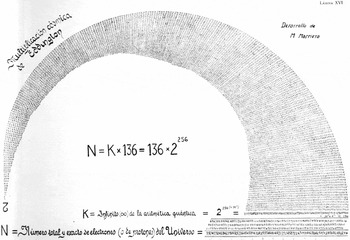
In 1945, once transuranium elements (those beyond Uranium, number 92, in the periodic table) had been identified, in a critical moment for his reintegration into the Spanish academic system, Masriera attempted to find a theoretical explanation that would enable him to define the “exact” number of chemical elements. Following Paul Dirac, and in particular, Eddington, Masriera published a hypothesis of a finite number of chemical elements in the universe, which he reckoned to be 96. By considering nuclear charges as elemental particles, he reasoned that the possible charges and the number of elements ought to be equal to the number of possible single wave equations. In 1938, in the Turner Lecture at Trinity College, Cambridge, Eddington had employed aesthetic and numerological considerations to define the “exact” number of protons in the universe and the same number of electrons.Footnote 31 This controversial hypothesis became one of Masriera's constant topics, not only in academic research but also in popular publications that attracted the interest of a general reader who, in his view, was thirsty for “atomic culture” (Eddington Reference Eddington1945). In Masriera's own words:
I had the satisfaction of translating A. Eddington's work, New Pathways of Science, into Spanish. My aim was to adapt it to the present state of the art with notes and a preface, while scrupulously respecting the original text. This led me to study in depth the other works of this prominent English astrophysicist and to familiarise myself with his cosmological generalisation of Dirac's quantum mechanics, for the systematisation of nature's constants. It was then – about 1943 – when I realised that such theories could have an application which these authors had not thought of . . . a limit to the number of possible nuclear charges, that is to say, the number of places for elements in the periodic system in nature. For that purpose, I established an analogy between atomic nucleus and elementary particles. . . . Based on my hypothesis, it was easy to conclude that there were as many nuclear charges as there were simple wave equations. The number of the latter was easy to demonstrate, and it was 96. (Masriera Reference Masriera1946, 211)Footnote 32
The 96 elements hypothesis as appeared in Masriera's translation of Arthur Eddington (Reference Eddington1945) Nuevos senderos de la ciencia (lámina XVI). Reproduced with permission of the Biblioteca de Catalunya (BC), Barcelona.

The 96 elements issue became a useful tool for maintaining correspondence with prominent experts and a way of combating his intellectual isolation. In 1946 Masriera had already written to Dirac for advice on his bold theory. In 1949 he sent his paper on the 96 elements to Hans Bethe (1906–2005), a figure who would go on to win the Nobel Prize for Physics in 1967,Footnote 33 and then to the philosopher and historian of science G. Burniston Brown, in London.Footnote 34 In the same year the Physical review rejected his paper.Footnote 35 In 1948, the 96 elements article had also reached the Joliot-Curie and Perrin in Paris, and, in spite of Dirac's mediation, it was also rejected by Nature.Footnote 36 In 1949, in a letter to De Broglie, who was also critical of the hypothesis, Masriera acknowledged his isolation in the following terms: “I work now in Spain, totally isolated from nuclear physicists.”Footnote 37 Marginalized in national and international academic circles and inspired by Eddington's intellectual agenda, Masriera did not hesitate to publish this controversial theory in popular form,Footnote 38 as he had done in the 1920s for Einstein's relativity. As occurred in other cases – for instance, when the British astronomer and popularizer Fred Hoyle failed to publish academic papers (Gregory Reference Gregory2005) – this stimulated his more “popular” writings to gain scientific authority in the public sphere.
Throughout the 1950s, the progressive legitimization of the Franco regime by the United States made it easier to disseminate the “atoms for peace” program, giving it a particular shape in the domestic public sphere. The year 1953 became the “annus mirabilis,” the year of the first official agreement with the United States, the Vatican (Concordato), and Eisenhower's kick-off of the “atoms for peace” campaign. In this context, various exchange programs between Spain and the US were set up (Romero de Pablos and Sánchez Ron Reference Romero de Pablos and Sánchez Ron2001, 208–220). In 1949 the Comisario de Extensión cultural (Commissioner of cultural dissemination) of the Spanish Ministry of National Education had asked Masriera to write popular articles and give talks on the radio on atomic energy and its applications in war and peace.Footnote 39 In 1950, he was invited to the “Nuclear Week” held in the city of Santander together with prominent members of the future JEN, and foreign luminaries. Werner Heisenberg (1901–1976), at the time director of the Max-Planck Society, and Samuel K. Allinson (1900–1965), director of the Institute for Nuclear Studies in Chicago, were among those taking an active part in the event.Footnote 40 In a crowded hall, Otero Navascués, the future director of the JEN, gave three introductory lectures. The audience included a large number of university students, with a good number of women and priests, as Masriera himself reported.Footnote 41
After Santander, it was clear that Masriera's gifted skills as a popularizer ought to be further exploited by the owners of La Vanguardia, the Godó family, yet all his texts also needed to pass official censorship.Footnote 42 In fact, his correspondence with Otero reveals Masriera's process of coevolution with the regime. Otero employed Masriera's skills to transmit the atomic culture efficiently to the general population – the Palomares affair and other episodes highlighted the need to communicate scientific ideas to the wider public in the “right way,” – whereas Masriera accepted a secondary position in relation to the head of JEN, with the hope of obtaining Otero's support in his long-standing struggle to acquire an academic post.Footnote 43 However, as we know, Masriera never actually attained the position and remained a kind of mediator for Otero's purposes in terms of the public image of nuclear power policies.Footnote 44
Masriera regularly lectured on atomism and nuclear power. In 1950 he took charge of producing a new series of books, known as Orbe,Footnote 45 and later became the editor of the science fiction series “Nebulae.”Footnote 46 In 1955, he published Ideas básicas sobre el átomo y la energía nuclear (Main ideas on the atom and nuclear power). In practice the book brought together his published papers on the 96 elements hypothesis and ideas from his numerous public lectures and popular articles. The book combined textbook-like theoretical explanations on the constitution of atoms with detailed discussions on the applications of nuclear energy in war and peace. Although he did not minimize the risks of the uses of that new source of energy, the book as a whole provided a technophile and optimistic view of nuclear power quite in tune with the “atoms for peace” program (Masriera Reference Masriera1955).
In addition, Masriera became a very frequent traveler to international meetings on nuclear energy – with the green light from the Franco authorities and the JEN in particular, but also sponsored by his own newspaper, La Vanguardia, which sought press coverage of the latest innovations. In 1953 he visited an isotope laboratory in Amsterdam, and later the Harwell nuclear plant in the UK.Footnote 47 In 1958 he attended the Second UN International Conference on the peaceful uses of atomic energy in Geneva, and presented himself as a translator of texts from French, English, and German into Spanish for the International Atomic Energy Agency (Masriera Reference Masriera1958). He reported on the relevant details of the Geneva conference, which had 6,000 participants and involved 2,000 papers, including a number of exhibitions.Footnote 48 The Spanish delegation was led by Otero, and other members of the JEN, and again Masriera acted as a science journalist.Footnote 49
In 1958, a series of eight public lectures on the atom and its peaceful applications took place in Madrid. Other exhibitions in the same vein were also held in Madrid, Bilbao, and other cities in Spain.Footnote 50 Some years later, in 1965, the US Exhibition “Atoms in Action” was invited to Madrid with the support of the government and attracted around 80,000 visitors, and thousands of students and school children followed the courses and lectures (Ordóñez and Sánchez Ron Reference Ordóñez, Sánchez Ron, Forman and Sánchez Ron1996; Romero de Pablos and Sánchez Ron Reference Romero de Pablos and Sánchez Ron2001). In 1966, Masriera was invited by EURATOM, a European project for the development of nuclear power, to visit several nuclear plants in Italy, West Germany, Belgium, and France (Masriera Reference Masriera1968).Footnote 51
These are just examples of the broader public campaign for the legitimization of nuclear power, which even reached school textbooks and films. For the regime, nuclear power was a very promising new avenue of science, and a useful tool for national pride and internal social cohesion. For that purpose, a technophilic, non-problematic image of atoms and power had to be spread to lay audiences, whereas, from the periphery, international luminaries such as Einstein, Heisenberg, Eddington, and many others, were easily presented uncritically. Without a doubt, Masriera became a crucial actor in that program.
4. A Scientific Culture for the Dictatorship
As Paul Lewis discussed in depth some years ago, in terms of political stability, authoritarian regimes rely on certain elites, which often combine loyalty to the founding ideals of the new political system with their capacity of adaptation to new problems and challenges. These elites are frequently made up of administrators or “technocrats” who contribute decisively to the modernization of the economic system along capitalist lines, while adhering to a quite fixed framework of authoritarian ideas and supporting a lack of civil rights in political terms (Lewis Reference Lewis2002). Lewis devoted a good part of his research to studying Franco's elite, particularly the social and ideological roots of his cabinet ministers. Nevertheless, intellectual and economic circles also played an important role in the internal stability of the dictatorship and its international legitimization. Here, the scientific culture of the nation obviously played a very important role (de Riquer Reference Riquer2010, 297–346), and Masriera soon became a relevant actor.
On the one hand, we know he was marginalized from the academic system, yet was able to earn his living and develop a professional career by means of subtle alliances with specific factions of the pro-Franco cultural elite. He made contact with distinguished figures such as Eugenio d'Ors (1881–1954), a prominent Catalan intellectual who sided enthusiastically with Franco during the Civil War (Terricabras Reference Terricabras2010).Footnote 52 Old links with some university colleagues, together with new projects with emergent industrialists and publishers completed a subtle network of sociability, in which Masriera's scientific background and his popularizing skills played a crucial role.
Masriera was the founder and first president of the Academia del Faro de San Cristobal (AFSC), a cultural society in which scientists and humanists would gather regularly and organize public debates and academic celebrations to honor d'Ors’ life and work (Delgado Reference Delgado1968).Footnote 53 The role the AFSC played was that of a provincial academy of an elitist group, aiming to establish a fruitful dialogue between the two cultures, but in tune with the main values of the dictatorship. There is evidence that d'Ors’ thinking played an important role in the way in which Masriera conceived his scientific popularization. Inspired by figures like Goethe, d'Ors sought integration between “the sciences, the letters, and the arts.” With a conservative perspective and totalitarian overtones, d'Ors was fully convinced of the importance of high level culture for the politics of all regimes and the progress of any nation. He published regular articles in the general press, and in the widely read section, “Glossari,” as a guide to help ordinary people fight moral disorientation. It was no coincidence that Masriera's section in La Vanguardia was named “Glosario científico” (scientific glossary), a clear homage to d'Ors’ intellectual bridges between science and humanities.
After the agreements signed between the US and Franco's regime in 1953, a fraction of the Spanish elite began to work in collaboration with the American authorities. Scientific, technological and industrial collaboration was fundamental in the new stage of the alliance against Soviet communism, but culture also played a very important role. In 1956, John Reid, the cultural attaché of the US Embassy was in charge of organizing regular meetings aimed at disseminating US values in Spanish society. Topics ranged from theater and poetry in the US, to American foreign policies and the modern use of nuclear power; the latter being an ideal subject for Masriera's engagement in the project. A year earlier, in 1955, the “Coloquios íntimos de Estudios Norteamericanos” (Intimate workshops of North American studies) had already taken place in Barcelona. The event had brought together an important group of local scientists.Footnote 54 In the same year, the Instituto de Estudios Norteamericanos (IEN) (Institute of North American Studies) organized another series of lectures in Barcelona entitled “Los EE.UU vistos desde España y por los españoles” (The US seen from Spain and by Spaniards), where Masriera talked about “El esfuerzo atómico de los EE.UU” (The US atomic effort).Footnote 55 Masriera's science popularization fitted very well with the US interest in attracting anti-communist intellectual elites and exchanging ideas, values, and sound information on the two countries. As John Krige has shown, the US Government's main targets were the local scientific elites that could be trusted for their conservative and anti-red ideology within the logic of the Cold War (Krige Reference Krige2006a). Masriera's science popularization can be easily framed in this context.
Masriera's attempts to gain the support of the local elites, which in a way reinforced his position in the local context, was not however in contradiction with his obsession to keep an international network. He regularly attended international chemistry meetings, at which he used some of the old personal contacts he maintained from his times in Zurich, for interviews and articles to the press.Footnote 56 In 1956 we have evidence of Masriera's plan to travel to the Soviet Union.Footnote 57 Unfortunately there is not enough evidence to show whether this journey actually took place. However, other details of the preparations are of great interest. In October 1956, just a few months later, Luis de Galinsoga, the director of La Vanguardia, contacted Juan Aparicio, the General Press Director in Madrid, asking for permission for Masriera to travel to Moscow, with the support of the Count of Godó, and with the necessary condition of subsequently producing popular articles in the newspaper. Galinsoga's emphasis on the neutrality of science and science popularization is worth noting. In his own words: “Of course [the trip] covers scientific stuff, though I do not know if . . . among technical speculations there might be indirect political propaganda.”Footnote 58
Other popularizing practices contributed to the regime's international projection. In 1955, the year that Spain was finally admitted to the UN, after a long period of foreign reluctance after the end of World War II, a conference on science popularization was sponsored by the UNESCO in Madrid.Footnote 59 In 1957, the same year that the Soviet satellite Sputnik had made such an impact, an international conference on Astronautics was organized in Barcelona. It was part of a series of meetings in Amsterdam, London, and Stockholm aimed at updating and discussing the latest achievements in space technology.Footnote 60 In autumn 1957, Barcelona welcomed experts on artificial satellites from the US, the USSR, France, Britain, and other European countries, while local politicians and members of the military regularly appeared in the local press. Franco himself was the honorary president of the Conference, and the working sessions took place in the premises of the CSIC's Catalan office.Footnote 61
Further to its international dimension for the regime, Masriera adopted astronautics as one of the mainstays of his popularizing programme in the local context. In the late 1940s he had already lectured on “cosmo-chemistry.”Footnote 62 In 1950 he became an honorary member of the Astronomical Society, Aster.Footnote 63 In 1958 he contributed to a series of public lectures on satellites: moral, scientific, medical, and political aspects.Footnote 64 Taking advantage of the public success of the 1957 Conference in Barcelona, Masriera produced a series of science fiction books, “Nebulae,” which were regularly advertised in newspapers in the following terms: “Sputnik has opened the way. Scientists say that we will be on the Moon by 1965.”Footnote 65 The series disseminated the work of prominent science fiction authors such as Arthur C. Clarke, the president of the “Science Fiction Book Club,” who visited Barcelona for the meeting.Footnote 66 In 1960 Masriera edited a book, La astronáutica, written by his friend and colleague Mateu Sancho, a member of the American Rocket Society (Sancho Reference Sancho1960). Both men took the opportunity to address this hot topic to a potential audience of readers who had been captivated by the launching of the first artificial satellites that followed the mythical events of 1957, in a technophilic, but foreign, atmosphere of rivalry between Washington and Moscow.
5. Conclusion: The Political Dimension of Science Popularization
From what we already know, Masriera's case study serves as an interesting example when attempting to analyze the role of science popularization in authoritarian regimes. Nuclear power became a burning issue that needed to be disseminated to society at large, but other topics such as the space race and cybernetics also had an important international dimension, which fitted very well with Spain's desire to overcome the initial period of autarky and to find legitimization abroad. At the same time, atomic culture reinforced Masriera's expertise and early foreign contacts from his time at the ETH, and acted as a legitimizing strategy within the regime.
Masriera's academic marginalization can be seen as a tragic result of the Spanish Civil War, which surely it was. However, being at the fringes of any kind of professional science placed him in a privileged position to bridge the gap between the two cultures, to assess from a very personal perspective the complex landscape of the scientific culture in Spain and abroad. His aim was to have an impact on research on theoretical physics, yet his hypothesis of the 96 elements was never accepted. After his years in Paris, he was seen as an expert on spectroscopy and infrared photography, yet he ended up with his own laboratory at home as a private consultant. He never became a proper industrial chemist, but kept regular contact with entrepreneurs and numerous firms. Following the pattern set by d'Ors, he attempted to become a philosopher, even a science fiction writer, and inspired by Eddington, he opened up the twilight zone between theoretical physics, cosmology, and philosophy. All these efforts can be perceived as failures, yet it was precisely in this combination of knowledge and expertise that Masriera built his career, in a context in which science popularization had to pass the control of official censorship and obtain the approval of the Franco authorities.
Masriera's case helps us to adopt a more critical view of science popularization in peripheral authoritarian contexts. As described in the paper, Masriera subtly built up a safe environment in tune with the aims of the regime, in the fringes of professionalization and scientific authority: he spread the achievements of foreign great luminaries, published details of foreign material culture of the big science, and placed science in the core of the local fascist elite. His articles in newspapers, his books and public lectures spread cosmopolitanism and a certain sense of modernity in a regime which, at least until the late 1960s, suffered from severe cultural isolation from democratic Western Europe.
As in other contemporary authoritarian contexts, above and beyond the over-simple dichotomy between internal adepts and external dissidents in exile, survival strategies were plural and complex. As expert historians of the Franco dictatorship have recently shown, there were at least five different patterns of strategies to follow for accommodating to the new regime: 1. a soft cultural resistance; 2. a conversion to the new fascist values; 3. a critical collaboration; 4. a relatively tolerated dissidence; 5. an ideologically coherent, courageous internal exile (de Riquer Reference Riquer2010, 298). In my view, the pattern of Masriera's strategy was probably between 1 and 3: he was for a soft cultural resistance, and a critical collaboration, but in practice assumed a moderate conversion to the values of the regime. He then became a collaborator with a certain degree of independence (Macrakis Reference Macrakis1993; Gómez Rodríguez Reference Gómez Rodríguez2009).
As historians, it is our duty to find enough evidence to critically describe the “good” or “bad” behavior of scientists working under authoritarian regimes. To do so, we can adapt other historiographical frameworks which have already been developed in contexts such as Nazi Germany.Footnote 67 In this case, historian Mark Walker coined the term “citizen-scientists” in order to find a useful category of analysis for this problem. In Walker's view:
The roles of citizen and scientist are inseparable. The “citizen-scientists” enjoy access to knowledge that is denied to most of their fellow citizens. Moreover, citizen-scientists often enjoy enhanced status within this society; precisely because of their expertise . . . they bear the responsibility of discharging the duties of a citizen in the process of prosecuting their profession. This argument applies not only to Germany, but to other countries as well. (Walker Reference Walker1989, 5)
In any event, Masriera became a peculiar citizen-scientist. His science popularization helped him to survive under a regime which regarded his liberal, democratic past with suspicion, but at the same time saw that he served the interest of the political, economic, and cultural elite of the Franco era. It brought to the average reader a flavor of “neutral” cosmopolitism, a fascination for the new paths of science and technology, providing an erudite discourse which, as part of the “atoms for peace” agenda, helped to reinforce anti-communist values in the Cold War period, and reinforced cultural policies of the dictatorship.
Again by comparison to Nazi Germany, Mark Walker pointed out the crucial role of the “very many scientists who neither resisted nor joined Hitler's movement, rather who went along with the ride” (Walker Reference Walker1995, 4). In spite of his early collaboration with the democratic Spanish Republic and his exile, once back in Francoist Spain in the 1940s, Masriera was not far from this profile. Not by chance, on March 8, 1966, he published an article in La Vanguardia referring to the Palomares bombs. The text was full of “technical” details about the radioactivity of plutonium and uranium, but his conclusions were clear enough:
the report of the president of our Spanish Nuclear Energy Board, José María Otero, was reassuring . . . although it fell into the sea [plutonium] is not soluble in water and its corrosion would take a very long period of time. To sum up, I would live peacefully in Palomares.Footnote 68
Acknowledgments
Some sections of this research were presented in the following meetings: “Science, Scientists and Totalitarian Systems: Spanish Science during Francoism.” Universitat Pompeu Fabra, Barcelona, November 20th–22nd, 2008; “Communicating Science: National Approaches in 20th Century Europe,” MPI for History of Science (Berlin), (8–10 May, 2010); ESHS meeting, Barcelona, November 18th–20th 2010; and Història de la física a Espanya (segle XX): balanç i perspectives, Barcelona, 1–2 December 2011. On these occasions I was able to discuss parts of this paper with several colleagues. I would like to especially thank Nestor Herrán, Xavier Roqué, Antoni Roca-Rosell, Albert Presas, Antoni Malet, Maria Jesús Santesmases, Mitchell Ash, Mark Walker, Bernadette Bensaude-Vincent, and Arne Schirrmacher for their help and critical comments. I am also grateful for the very useful comments of two anonymous referees. Alexandre Métraux's advice as Science in Context editor regarding the improvement of an earlier version of this manuscript was also of great help. The staff at the Arxiu Històric (Record Office) of the Institut d'Estudis Catalans (IEC) was also extremely helpful. Thanks to Masriera's family donation, the “Fons Masriera” (FM) is now being catalogued at the IEC. In the paper, for Masriera's personal letters, I refer to FM. 3.2 (correspondence). This research has been funded by the Spanish Ministry of Science and Innovation (HAR2009-12918-C03-02/HAR2012-36204-C02-01), and by the Autonomous Government of Catalonia (Generalitat de Catalunya), “Science, Technology and Medicine in modern Catalonia (18th–20th centuries)” (2009 SGR887). I am also indebted to ICREA-Acadèmia for the five-year research prize I was awarded in 2009. I thank Science in Context for giving permission to reproduce a shorter version of this paper in Spanish (Nieto-Galan Reference Nieto-Galan, Roqué and Herrán2012).