Introduction
Most marriages in the past, as in the present, were formed between individuals who not only shared similar levels of education, socioeconomic status and religious beliefs, but also belonged to the same, or a nearby, community. Geographical proximity undoubtedly had a large bearing on choosing a marriage partner. Assuming that this choice was usually confined to the local residential area, it follows that marriages with an ‘outsider’ were often the result of having been unsuccessful within the community. The general population undoubtedly considered exogamic marriages as second-best to endogamous ones, although for the more privileged members of society, who were generally less bound by tradition, there was no such social disapproval or stigma attached, and in certain circumstances exogamic marriage would even have been encouraged. In terms of marriage possibilities the territorial horizon was much wider for the wealthier than for the poorer classes.
Territorial exogamy and its determinants
Numerous studies have shown that residential propinquity has a large role in the marriage selection process (from the first study by Bossard (Reference Bossard1932), to the more recent one of Pullum & Peri (Reference Pullum and Peri1999)). Most of this research examined small or geographically isolated contexts as well as town environments and arrived at similar conclusions on the high levels of endogamy (Brändström et al., Reference Brändström, Sundin and Tedebrand2000; Gueresi et al., Reference Gueresi, Pettener and Martuzzi Veronesi2001; Van de Putte, Reference Van de Putte2003; Prost & Boëtsch, Reference Prost and Boëtsch2005; Riegler et al., Reference Riegler, Marroni, Pattaro, Gueresi and Pramstaller2008).
Although the importance of the relation between geographical distance and marriage is explicitly accepted, researchers have not always attempted to identify the causes of exogamy. Although levels of endogamy are prevailingly high, investigation on a regional level reveal that certain areas have a higher inclination than others (Haandrickman et al., Reference Haandrikman, Harmsen, van Wissen and Hutter2008; Fornasin & Marzona, Reference Fornasin and Marzona2009).
Marriage patterns result from factors related to both preference and opportunity (Kalmijn, Reference Kalmijn1998). From a historical perspective, the most important of the many factors relating to the preference and opportunity of marrying outside one's own community are given below.
(1) Marriage market. Given that the choice of marriage partner was largely restricted to within one's own community in the past (Bozon & Heran, Reference Bozon and Heran1989), many people living in particularly isolated locations were forced to ask for marriage dispensation from the Church to marry a cousin (Merzario, Reference Merzario1981). While many small communities' endogamy levels were caused by their isolation, it is interesting that even in situations where movement was unhindered certain groups still had a greater propensity towards exogamic marriage than others. Anyone considered socially atypical was more likely to seek a partner further afield than people with more commonly shared attributes (McFarland, Reference McFarland1970). This was true of the upper classes, who formed more exogamous marriages when they were a small minority group, and thus short of potential marriage partners, than when their presence was more substantial (Küchemann et al., Reference Küchemann, Harrison, Hiorns and Carrivick1974).
(2) Social norms of the time. Marriage practices are governed by the social norms of the time (Katz & Hill, Reference Katz and Hill1958; Derosas et al., in press). In the past these choices were most often imposed by the immediate and extended family (Mitterauer & Sieder, Reference Mitterauer and Sieder1982; Heady, Reference Heady1999; Bull, Reference Bull2005; Manfredini & Breschi, Reference Manfredini, Breschi, Bengtsson and Mineau2008; Hanaki & Kurosu, Reference Hanaki and Kurosu2010). In addition, a number of conditions were imposed by the State and the Church (Goody, Reference Goody1983) regarding factors such as marriage age (Hollingshead, Reference Hollingshead1950; Van Poppel & Nelissen, Reference Van Poppel and Nelissen1999), or the second marriages of widows/widowers (Corsini, Reference Corsini, Dupaquier, Hélin, Laslett, Livi Bacci and Segner1981; Le Goff & Schmitt, Reference Merzario1981; Klapisch-Zuber, Reference Klapisch-Zuber and Klapisch-Zuber1985).
(3) Land-ownership and succession practices. These would have limited marriage choices to within a narrow, parental, and thus often also spatially limited arena (Levi, Reference Levi1985; Delille, Reference Delille1985). Endogamous marriages would have been encouraged to ensure that the wider community or blood-relations were not deprived of brides' dowries (Nicolosio Ciceri, Reference Nicolosio Ciceri2002; Bras et al., Reference Bras, Van Poppel and Mandemakers2009). Property ownership (house, land or shop) presupposes ‘sedentariness’ associated with low levels of exogamy.
(4) Occupation. Occupation would also have had a predetermining role in the formation of an exogamic marriage. People in occupations strongly rooted to the local area naturally travelled less than those who worked in more than one location and had to move around on a regular basis. In fact, employment in commerce or transport, associated with high mobility, results in more exogamic marriages, and correspondingly those most likely to wed within their parents' community are the children of farmers and smallholders (Wall, Reference Wall1996; Rabino-Massa et al., Reference Rabino-Massa, Prost and Boëtsch2005).
The combination of these economic, social and cultural factors has important consequences of a biodemographical nature (Fuster & Colantonio, Reference Fuster and Colantonio2004). High levels of endogamy are associated with high consanguinity, which is peculiar to closed and reproductively isolated populations such as mountain villages (Pettener, Reference Pettener1985; Boëtsch et al., Reference Boëtsch, Prost and Rabino-Massa2002), local level elite populations (Dribe & Lundh, Reference Dribe and Lundh2005; Manfredini, Reference Manfredini2009) or groups with a particularly strong cultural identity (Danubio & Pettener, Reference Danubio and Pettener1997).
The territory
This study examines Friuli, a region in north-east Italy, including nearly all the municipalities within the province of Udine, the only town in the area during the 19th century. The main activity in the plains was agriculture, which diminished in importance with altitude. The secondary economic sector (handicrafts) was particularly strong in the small towns and most notably in Udine.
An additional feature of the regional economy was the seasonal migration of men to Central and Eastern Europe, mostly for building and construction work. These migratory flows were particularly important in the hills and mountain areas. The 1871 census puts the regional population at 334,928 inhabitants, and that of 1901 at 408,765. Over this period the average growth rate per 1000 individuals was 6.6, with the rates for birth, death and marriage being 35, 25 and 7, respectively (Serio, Reference Serio, Del Panta, Pozzi, Rettaroli and Sonnino2002). The period under analysis coincides with a particularly evident fall in mortality levels in Friuli, marking the beginning of demographic transition (Breschi et al., Reference Breschi, Pozzi and Rettaroli1994).
This research is largely based on examination of 80,000 marriage certificates issued between 1872 and 1900 by the Italian Registry Office, now held in the Udine State Archives Office. Whilst this study only examined information most relevant to the analysis, a more detailed account of this source is available (Marzona & Fornasin, 2009). Irrespective of place of marriage, these certificates provide useful data on spouses, including name, surname, age, often profession and in about 50% of cases previous marital status and also place of residence (Moretto, Reference Moretto1991).
Over this 30-year period the mean age at marriage across all social classes remained at 25.3 for women and 30.1 for men. However, in the case of exogamic matrimony, whereas the brides' age does not alter, that of bridegrooms increases by one year, with the overall proportion of marriages falling from 34.4% to 30.4%.
Methods and variables
In this paper, territorial exogamy was calculated on a municipality level. To examine the determinants of exogamy three groups of variables were used: those related to (a) context, (b) socioeconomic factors and (c) socio-cultural factors.
Context-related variables
Variables related to context were included in the analysis so as to subsequently filter the results for the influence of economic and socio-demographic determinants.
The first context-related variable is population number of the bride and bridegrooms' area of residence, taken as an indirect indicator of the marriage market size, which in turn influences the number of exogamic marriages, based on the hypothesis that the bigger the marriage market, the lower the levels of exogamy.
The second context-related variable is time, allowing the pattern of exogamy levels recorded in Friuli to be monitored over the last three decades of the 19th century.
The third context-related variable in this group is spouse age, allowing examination of the gains in life expectancy recorded in Friuli at the end of the century and the effect this could have had on marriage markets. Lower death rates imply later dissolution of marriages and therefore fewer young widows/widowers on the marriage market. However, age is not just a context variable since it can have a determining role in other ways too. In youth, travelling around, at least locally, tends to be more common than in later life, suggesting that young people are generally more inclined towards exogamic marriage. However, young individuals were also more subject to the control of their parents, who were likely to still be alive and probably steer them towards an endogamous marriage. However, while the tendency towards travel may decrease with age, an older person is likely to have accumulated more life-experience and give more importance to emotional bonds, resulting in greater chances of forming an exogamic marriage.
The fourth context-related variable is regional setting. The geographical setting implies a combination of cultural, social and economic elements that come to be reflected in the local practices, customs and traditions, after a long historical process of sedimentation. Unfortunately no documentary evidence is available to trace the influence of all these factors, but they can, at least partly, be considered. Here four distinct geographical settings are examined: the plains, hills, mountains and towns (Udine; the only main town in Friuli).
Socioeconomic factors
The socioeconomic variables are mainly based on occupation. This paper adopts a six-way (plus one residual) occupational classification, partly taken from those of the Historical International Standard Classification of Occupations (HISCO; van Leeuwen et al., Reference Van Leeuwen, Maas and Miles2002), based on individual's relationship with spatial ‘mobility’ and the contemporary social class structure.
The occupational categories were examined for men and women separately. The male categories were: (1) peasants; (2) builders; (3) artisans and industry workers; (4) traders and travelling traders; (5) upper class; (6) domestic staff and non-agricultural unskilled labourers; (7) other and unknown. The female categories were: (1) agricultural workers; (2) housewives; (3) artisans and shopkeepers; (4) traders and travelling traders; (5) upper class; (6) domestic staff; (7) other and unknown. Separate consideration was given to men in the building trade because they were strongly linked to emigration (Cosattini, Reference Cosattini1983).
An additional socioeconomic variable included in the analysis was the ability of newlyweds to sign their marriage certificate, based on the hypothesis that literate individuals would have been more desirable than the illiterate within the marriage market, with an effect on levels of exogamy.
Socio-cultural factors
Concerning socio-cultural factors, the first variable is the age gap between spouses. Marriage between people of the same age is an indicator of a romantically oriented partner choice. If a young person's choice is left ‘open’ they most often opt for a spouse from their own age group (Shorter, Reference Shorter1975), meaning that marriages between couples with a considerable age difference are more likely to result from family or social pressures. Following this line of reasoning, romantically oriented partner choices promote endogamous marriages. Van de Putte et al. (Reference Van de Putte, Neven and Oris2007) puts the close circle of age as two years' difference.
The second socio-cultural variable is civil status, on which there are relatively few data available. It can be presumed that marrying a widower or widow was considered less attractive than marrying a previously unmarried partner, and so it can be supposed that second marriages were more likely to be exogamic than first.
A third socio-cultural variable concerns whether the spouses' parents were still alive to check for the presence of family influence on marriage type. There are four possible variations: both parents alive; father only alive; mother only alive; and both parents dead. The hypothesis here is that marriage candidates with living parents would have been more heavily influenced by the family and thus more likely to choose a partner from within the local community than those without parental restraints, who had more freedom to look further afield, meaning a rise in exogamic marriages.
The fourth socio-cultural variable concerns whether spouses are illegitimate, which in social terms was considered a negative characteristic and should therefore give rise to a larger number of exogamic marriages.
Logistic regression models were devised and applied to the data in order to identify and measure the influence of the determinants of exogamic marriage. The outcome variable is exogamous versus endogamous marriage as recorded on the municipality level. Two corresponding but individual models were created for men and women that calculate the influence of the variables related to geographical, socioeconomic and socio-cultural factors in Friuli. To measure the influence of geographical context on exogamy, four models, each referring to one of the four types of territory, were used for each sex. The hypothesis here is that the other variables, particularly occupation, have different levels of significance depending on their geographical setting.
Results
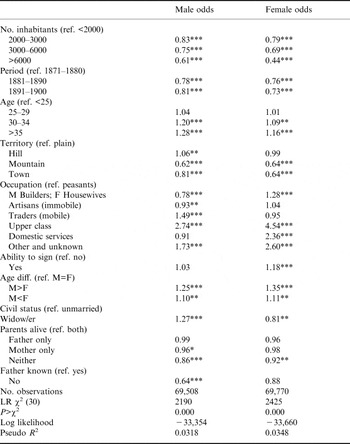
Table 1 shows the results of the logistic regression models applied to the whole of Friuli. While the male and female models both are statistically significant, they do not fully explain the dependent variable. This is not surprising given the sheer scale of the territory in question; the municipal area proves too large to trace and measure all matrimonial movements.
Logistic regression: determinants of exogamic marriage

*** p<0.01;
** p<0.05;
* p<0.1.
The odds resulting from the population number variable are all below 1, with statistical significance, confirming the hypothesis that the bigger the marriage market the lower the levels of exogamy.
The time variable also produces odds below 1, with statistical significance, supporting the idea that exogamic marriages progressively decreased over this period. This variable had been purposely included in order to identify and take account of this factor, making it possible to cleanse the overall results of purely temporal trends. Results from the population and time variables suggest that decreases in exogamy are possibly connected to population increases. The average population size of council communities rose over time, which meant that marriage markets expanded, causing a decrease in exogamy.
Results from the age variable provide a number of additional insights. The number of exogamic marriages increases with spouse age, with statistical significance after the age of 30. The impact of this determinant is greater on men than on women. This suggests that life-experience favoured exogamic marriage more than simply moving around.
The impact of the regional setting variable on the odds ratios of exogamic marriages is clearly evident. In all but one of the areas these are below 1 (in relation to the plain), with the probability of exogamic marriages dropping with increases in altitude. The deviations are statistically significant in nearly all cases, but particularly in the mountain and town areas. These results demonstrate the presence of a relationship between exogamy and differences in population behaviour detectable on a geographical basis. It also confirms the mountain areas as having the highest levels of endogamy, which, it should be noted, does not depend on the community size alone. The tendency towards endogamy in this setting is in line with the high levels of consanguinity that can be observed in other geographically and culturally isolation contexts (Danubio & Amicone, Reference Danubio and Amicone2001). These results suggest that the determinants of exogamous marriage vary according to geographical context (discussed below).
The occupational categories used for the variables regarding spouses' socioeconomic characteristics were based on the estimated levels of mobility of fields of employment. The most sedentary group was that with the closest links with the land: farmers and smallholders. Occupation has a significant impact overall, but some odds ratios are unexpected. Given that men and women have different categories, each sex is commented on separately.
For men, builders and artisans formed the least number of exogamic marriages (fewer than the reference category), and those involved in trade and the upper classes formed by far the most. The scarcity of exogamic marriage among builders, who mostly worked away from home on a regular basis, means that the most mobile category is also that least inclined towards exogamic marriage, which concurs with previous observations made in situations where an emigration-based economy prevails (Lorenzetti, Reference Lorenzetti2003). The higher number of exogamic marriages in the case of artisans and traders is in accordance with their propensity towards travel, and that of the male upper class is probably determined by the often limited dimensions of their marriage markets.
The situation differs considerably for women, and not simply because the occupational classifications differ. All the female occupational categories, or at least those that significantly differ from the reference category, demonstrate a greater tendency towards exogamic marriage. While the high ratio of exogamic marriages among the upper class can again be attributed to the restricted dimensions of this marriage market, that among housewives and domestic workers can be linked to their low social and economic desirability. Unlike peasants, housewives usually came from families of labourers or builders, who were unlikely to own any real estate. Domestic workers not only often came from the same kind of family, but also habitually worked outside their residential area, further increasing their chances of forming exogamic marriages.
Whereas the ability to sign the marriage certificate appears to have little effect on the odds of men forming an exogamic marriage, this does have a clear impact on women. Literate women are more likely to marry an ‘outsider’, suggesting that men who opted for a bride from another community tended to invest in human capital, choosing an educated woman.
The reference group used in measuring the influence of age gap between spouses was that of marriages between people of the same age. The levels of exogamy increase with difference in spouse age, irrespective of whether the husband or wife was the older of the two, confirming the hypothesis that romantically oriented partner choices are more likely to lead to endogamous marriage.
The results related to civil status indicate that widowers were more likely to form an exogamic marriage than unmarried men. Widowers, but also men in general, tended to pursue previously unmarried woman, confirming that widows were considered as undesirable within the marriage market. In addition, the interests of the defunct husband's family to preserve the widow's dowry could also have had an influence on the low quota of widows who formed an exogamic marriage (Breschi et al., Reference Breschi, Fornasin, Manfredini and Zacchigna2009).
Parental presence has a much larger impact on men than on women. For men, whereas the absence of the mother alone does not notably affect the number of exogamic marriages compared with the reference condition (both parents alive), the father's absence does result in significantly fewer cases, and the absence of both parents reduces these odds even further. This suggests that orphaned men were considered as highly desirable within the marriage market for socioeconomic reasons, expressed by the fact that the father's absence alone is decisive in increasing endogamy levels. These bachelors would not have needed to look far for a wife because they were often household heads and property owners and therefore considered a ‘good catch’. The additional absence of the husband's mother would also have further advanced the status of the new bride within the family, avoiding potential competition with the mother-in-law and subordination in the domestic sphere. In the case of women, however, only the absence of both parents has a significant impact on exogamy levels.
Illegitimacy significantly increased the odds of endogamous marriage in the case of men alone. It therefore appears that the son of an unknown father was considered as desirable within the marriage markets. It is possible that an illegitimate male youth received greater consideration from his maternal grandparents than a legitimate son who was brought up by both biological parents.
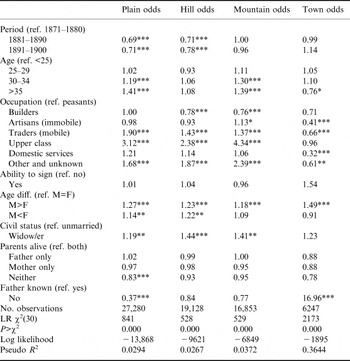
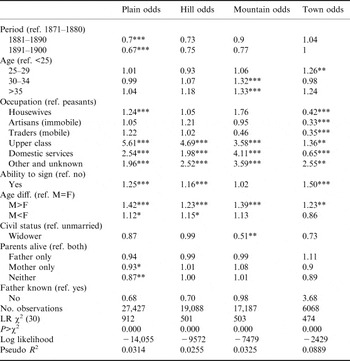
The model demonstrates significant differences in the incidence of exogamous marriage on a geographical basis. However, it is not clear if these variations relate to the frequency alone but also to a different role of the determinant causes. Tables 2 and 3 show the results of the logistic regressions applied to each individual geographical area.
Logistic regression: determinants of exogamic marriage and territory for males

*** p<0.01;
** p<0.05;
* p<0.1.
Logistic regression: determinants of exogamic marriage and territory for females

*** p<0.01;
** p<0.05;
* p<0.1.
The results from these territorial models are statistically significant, and the data adaptation values are in line with the more general models presented in Table 1, but certain differences do emerge that can provide further insight. Firstly, the importance of the time variable is not the same in all the geographical contexts. In the town there are no significant variations of exogamy levels over time for either sex, and the same is true in the mountains for men only. The demographical trends in Udine and the mountain areas were like those of the other settings during this period, so this variation cannot be attributed to a slower rate of expansion of the marriage market. It is possible that although this was a phase of population growth, the sheer size of Udine meant that expansion of the marriage market had little impact on exogamy levels. In the mountains, this uniformity is likely to be largely determined by the local emigration-centred economy.
Results from the occupation variables also differ greatly according to geographical context. The levels of exogamy for builders are near those for the peasants in the plain and town areas, but lower in the hills and mountains, which is possibly due to the different roles that builders played in these settings. Whereas in the plains and town resident bricklayers and kiln-men were a small minority group and often employed in local markets, in the mountains and hills they formed the most important contingent of the emigration-centred local economy. Artisans and labourers moved around very little in all contexts, but this is most pronounced in the town, where exogamic marriages among artisans are as much as 40% rarer than among agricultural workers. This is probably due to the much bigger scale of the marriage market for these categories in Udine compared with the other areas.
Among traders, the levels of exogamic marriage are also low in the town, while they are significantly higher than the reference category in all other areas. This could again be related to the dimensions of the marriage markets for this category. A similar situation is seen for the upper classes, whose numbers ensured a sufficiently ample marriage market in the town alone, where their low levels of exogamy are close to those of agricultural workers. Exogamic marriages are also very rare among domestic workers from the urban area, which is a reflection of the particularly strong presence of outside workers in this employment sector in the town of Udine.
For women, the occupational category ‘housewife’ has exogamy levels lower than the reference category in the town, but higher elsewhere, particularly in the mountains. The female upper class, domestic staff and women connected to craft and trade were all less likely to form exogamic marriages in the town than in the other contexts. In all these cases, with the exception of the upper class, the levels in the town are far below those of the reference category. The explanations given above for the men are similarly valid for these female categories. Udine's high demand for female servants attracted women in this sector from all over the province. This is reflected in the low levels of exogamy for domestic staff who were original town dwellers and the high levels for those with residence elsewhere.
For men, literacy skills have a statistically significant influence on exogamy levels in the town alone, increasing them by 54%. A similar picture emerges for the women of the town, but moreover it can also be noted that a literate woman is a good four times more likely to form an exogamous marriage than an illiterate one in the mountain area. This is a reflection of the numerical disparity between the number of literate men and women in the mountain context, where literate men by far outnumber literate women (Ferigo, Reference Ferigo2002). Women with literacy skills would have been particularly sought after in contexts with a disproportionate number of literate men.
Another of the town's peculiarities is in being the only place where the probability of a widower forming an exogamic marriage does not differ significantly from that of a bachelor. The reduced number of exogamic marriages for widows compared with previously unmarried women is well documented in all areas, but is significant in the mountains alone. In this context people tended to get married later in life and the higher levels of spinsterhood would have expanded the marriage market in favour of men, meaning they very rarely resorted to choosing a previously married woman from outside their community.
Illegitimacy in males had the effect of suppressing exogamic marriages in the plain and noticeably increasing them in the town. In an urban setting these men were likely to be foundlings abandoned at birth, with no family and a surname that made this instantly recognizable, which probably represented a socioeconomic disadvantage (Kertzer & Sigle, Reference Kertzer and Sigle1998). In out-of-town communities, however, these individuals would have at least had a mother, the maternal side of the family and, however modest, an inheritance of some kind. As previously mentioned, in situations such as this, being illegitimate could even have been an advantage within the marriage market.
Conclusions
Determinants of territorial exogamy in the Friuli region in the 19th century differed for men and women, and there were also variations in relation to residential area. Exogamic spouses tended to fall into two distinct groups: either older individuals and, in the case of men, often with a previous marriage behind them; or those in the upper social classes who were less tied to the local area for economic reasons.
A clear discrepancy emerges between the urban and non-urban contexts, largely corresponding to the influence of socioeconomic factors brought about by the chief town's function within the province. Udine was not only the centre for the whole of Friuli for all professions connected to management, administration, craftsmanship and trade, but also had the highest concentration of resident upper classes. This meant there was an ample marriage market for a number of segments of society that was limited elsewhere. The movement of people to the town induced by these employment opportunities caused decisively low levels of exogamy for certain occupational categories, such as domestic staff, compared with the rest of the province. The findings reveal a general fall in exogamy during the second half of the 19th century, for which there are four possible explanations.
The first explanation depends on the internal mobility of the region. During this period the social fabric of Friuli underwent a number of important changes. In the first half of the 19th century, Friuli was characterized by high levels of internal emigration, primarily consisting of seasonal flows of textile workers from the mountains to the plains. While the percentage of jobs linked to the textile industry was around 50% at the start of the century, this was reduced to little more than 5% at the end, meaning that this type of emigration practically disappeared (Fornasin, Reference Fornasin1998). Although some such traditional skills did survive in a few communities, they were no longer the main economic activity in any location, having been ousted by the building and construction sector. These changes are likely to have decreased exogamic marriages in general, but particularly those formed in later life.
The second explanation is related to mean age at marriage, which in this period dropped a year for men (from 30.6 to 29.6) and almost 10 months for women (from 25.7 to 24.9). The reduced number of travel opportunities for younger compared with older individuals meant less chance of finding a partner from another community, which partly explains these results. In fact, some studies demonstrate that the older the spouses the greater the geographical distance between their individual residences (Coleman & Haskey, Reference Coleman and Haskey1986).
The third explanation is related to international emigration. Although these male emigrants obviously travelled, the vast majority married a woman from their own, or at least a nearby, community. Their absence for many months of the year meant not only little time in their home surroundings, but even less for coming into contact with individuals outside their close circle of acquaintances, which is reflected in the low levels of exogamic marriages. To a certain extent, it is precisely because travel was becoming easier and more frequent in this period that partner choices became ever more limited to within the confines of home communities.
Lastly, the fourth interpretation is based on the fall in mortality during this period, which signalled the first phase of demographic transition in Friuli. This meant not only fewer widows and widowers but also implicated a lower number of re-marriages. The fact that widowers were more likely to form second or third marriages than their female counterparts, as well as find a wife from another community, meant that their reduction in numbers, together with the fall in the mean age at marriage, would have caused a drop in exogamic marriages.
Acknowledgment
This research was undertaken as part of ‘Friuli/in prin’, a joint project between the Udine State Archives Office (Archivio di Stato di Udine) and the Department of Statistics of the University of Udine.