Introduction
Tea is an important cash crop, with a total planted area of 4.10 million ha in 48 countries in 2016 (FAOSTAT 2018). Weed management is one of the biggest challenges for tea cultivation because of the strict constraints on chemical control and tillage in tea gardens. For example, in China, the total tea-planting area was 2.85 million ha in 2018, but there were only six herbicides registered for tea-garden use (CPIN 2019), including three PRE herbicides (prometryn, atrazine, and simazine) and three POST herbicides (glyphosate, glufosinate, and bentazon). Chemical weed control may directly influence the quality and safety of tea products. Moreover, tea plants are perennial broadleaved shrubs with relatively shallow root systems that may be injured by herbicides or tillage practices. Hence, tea growers frequently rely on hand weeding in gardens, which is increasingly unaffordable owing to increasing labor prices.
Many weed species occurring in tea gardens are useful plants (Srithi et al. Reference Srithi, Balslev, Tanming and Trisonthi2017). Thus, tea growers may find use for some weeds in tea gardens to ease the high costs of weed management. For example, we conducted field surveys of 13 tea gardens in Guizhou Province in 2017 and observed 134 weed species. Although none of them was on the list of protected plants in China, 81 were medicinal plant species, 14 were wild vegetables, and 17 were forage species (Zhang et al. Reference Zhang, Chen, Yu, Xu, Gen, Dong and Tan2018).
Training farmers is an effective way to improve growers’ weed management knowledge (Damalas and Koutroubas Reference Damalas and Koutroubas2017; Laforge and Levkoe Reference Laforge and Levkoe2018; Schreinemachers et al. Reference Schreinemachers, Wu, Uddin, Ahmad and Hanson2016; Wang et al. Reference Wang, Wang, Zhang and Yang2014), especially training on the use of information technologies and mobile phone networks. For example, after being trained, growers could have better knowledge of the species composition of weed communities of tea gardens. Correctly identifying the species is the basis of integrated weed management. Some mobile phone applications enable growers to identify many plant species by scanning plant individuals or photos (e.g., the application named “Xingse”). We may introduce such applications to tea growers and thus be able to contact growers about weeds in tea gardens. Network communication between groups composed of growers, scientists and administrators could be formed from farmer trainings, and members of such groups may discuss all aspects of tea-garden weed management practice and training plans. Farmer trainings could be an important forum to test, compare, and popularize weed management strategies formally and intensively.
Unfortunately, our years of observation have indicated farmer trainings in many tea-planting areas are insufficiently effectives in improving tea growers’ knowledge about weed management. One important reason for the low effectiveness could be the insufficient pertinence of the information targeted to the tea growers. Customizing the contents and methods of farmer trainings about tea-garden weed management according to group characteristics of tea growers could be important. However, little is known about group characteristics of tea growers with regard to weed management behaviors.
Tea growers in Guizhou Province, China, could be a typical group to use to study farmer training about tea-garden weed management systems. The total tea-planting area in Guizhou Province encompassed approximately 11% of the world’s total tea-planting area, approximately 0.46 million ha, with an integrated output value of approximately $8.5 billion in 2016 (Li and Hu Reference Li and Hu2017; National Bureau of Statistics of China, 2017). Thus, tea production has been the largest agricultural pillar industry in Guizhou Province. Tea gardens in Guizhou are very diverse in environmental factors, size, and management systems (Li and Hu Reference Li and Hu2017). More than 800 varieties of tea are collected in Guizhou Province (Tian et al. Reference Tian, Liang, Long, Luo, Yan and Zhou2007); Chen et al. (Reference Chen, Gong, Chen, Li, Wang and Zhou2014) surveyed 48 tea varieties planted in Guizhou Province, of which 11 varieties accounted for an area greater than 1% of the total surveyed area. Tea gardens are distributed among all counties in Guizhou Province. High-quality tea products are mainly from areas at altitudes of 800 m to 1,500 m.
Training tea growers has been listed as routine work for many counties in Guizhou Province since 2007 (Li and Hu Reference Li and Hu2017). Many counties train 1,000 to 1,500 tea growers (one person may be trained multiple times) every year; however, only a small part of these trainings focus on weed management (Plant Protection and Quarantine Station of Guizhou Province, unpublished data).
We interviewed 354 tea growers from 142 villages in Guizhou Province and collected information on grower’s age, training experience, weed control methods and costs, property attributes and sizes, and the most serious weed species in interviewees’ tea gardens. The purpose of this study was to explore group characteristics of tea growers in terms of (1) grower age, property attributes, and size of tea gardens managed; (2) customs of weed control behavior; (3) anticipation of cost trends for tea-garden weed management; and (4) interest in farmer trainings for tea-garden weed management.
Materials and Methods
Survey Design and Administration
Guizhou Province (24°37′ to 29°13′ N, 103°36′ to 109°35′ E) is located on the Yunnan-Guizhou Plateau of southeastern China. Guizhou has a subtropical, humid, monsoon climate, with an average annual temperature of approximately 15 C and an average altitude of approximately 1,100 m (Wu et al. Reference Wu, Zhao, Liao, Zhang and Qu2013). Before the survey, we contacted the Plant Protection Stations (government organizations) of 25 counties in Guizhou Province. Tea cultivation in these 25 counties was representative of the whole province, and officers from the Plant Protection Stations in these counties were willing to provide support. Among the 25 counties, the tea-planting areas ranged from 2,467 ha (Xinren County) to 40,500 ha (Meitang County). The total tea-planting area of these 25 counties in 2017 was approximately 367,890 ha, accounting for 78.8% of the tea-planting area in Guizhou Province (Li and Hu Reference Li and Hu2017).
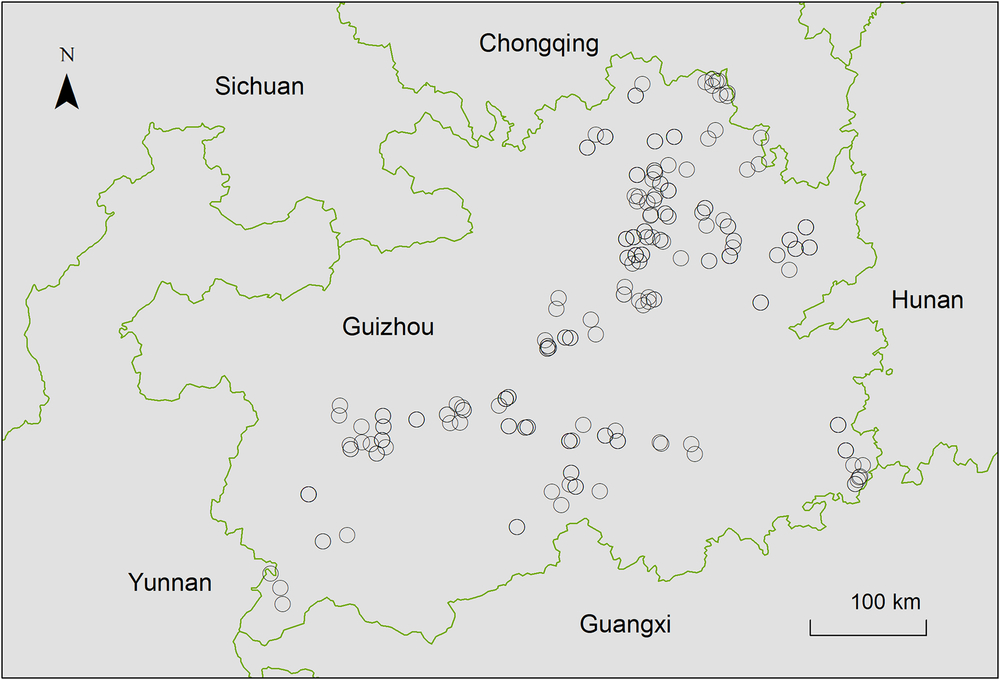
Under the assistance of the local Plant Protection Stations, we used questionnaires to conduct surveys of 142 tea-planting villages (Figure 1) from February to September 2018. In each county, the Plant Protection Station committed officers to assist or conduct the questionnaire-based investigation. A total of 354 tea growers were interviewed face to face. Each of the respondents was selected at random from those who had more than 5 yr of experience managing a tea garden.
The 142 tea-planting villages surveyed in this study.

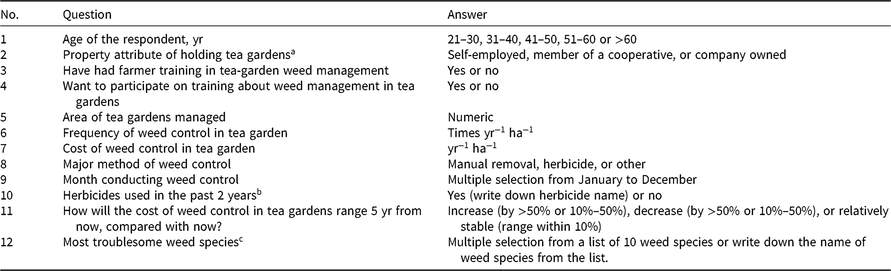
The questionnaire (Table 1) comprised 12 questions about the respondents and the tea gardens under their management. To assist the growers with the question about most troublesome weed species (question 12), we printed a set of color photos for each weed species listed to accompany the questionnaire. The list of troublesome weed species consisted of 10 weed species, which were selected on the basis of our field surveys conducted in seven counties of Guizhou Province in 2017 (Zhang et al. Reference Zhang, Chen, Yu, Xu, Gen, Dong and Tan2018). Also, we recommended a free mobile phone application named “Xingse” to each respondent. Xingse can identify weed species with photos and automatically provide additional photos and description of the species identified. Also, users may check photos and descriptions of the weed species with Xingse by searching by the weeds’ names. In their responses to the questionnaire, the 354 respondents listed 28 weed species (including the 10 attached to the questionnaire) as the most troublesome.
Questionnaire for the survey conducted in Guizhou Province, China.

a Cooperative tea gardens were owned by growers, with tea-garden management and selling of the tea was unified within the cooperative.
b Among the total 354 respondents, 57 reported using chemical weed control on their tea gardens, including 40 respondents who applied glyphosate, 15 who applied glufosinate, and two who did not remember the exact herbicide used.
c The 10 weed species included horseweed, tall fleabane, brackenfern, common pokeweed, Japanese stiltgrass, ragleaf, vestita starwort, Asiatic dayflower, shaggy soldier, and creeping woodsorrel.
Statistical Analysis
To explore the relationships among different variables, answers were transformed into two data sets including a factor matrix (questions 1 through 11 in Table 1) and a weed matrix (question 12 in Table 1). Specifically, the longitude, latitude, and altitude of the place in which the survey questionnaire was conducted were used as the location of the village. Growers’ ages in question 1 were coded as 1 (21 to 30 yr old), 2 (31 to 40 yr), 3 (41 to 50 yr), 4 (51 to 60 yr), and 5 (older than 60 yr). Data from question 2 were divided into three factors—self-employed, cooperative, or company—and each of the three factors was coded as 1 (yes) or 0 (no). Data from questions with binary answers (questions 3, 4, and 10) were transformed into binary data (i.e., 0 or 1), as well. Data from question 12 were split into 29 columns, one each for the 28 weed species mentioned by the respondents plus a column referring to the respondents; and binary data (i.e., 0 or 1) were used for each species in the column in the weed matrix for each respondent.
To explore relationships among respondents and their weed management practices (questions 1 to 11, except question 4, because 99% of respondents answered “yes” to question 4), we conducted Pearson correlation analyses with SPSS, version 16.0 (IBM Corp., Armonk, NY). Moreover, we used canonical correspondence analysis (CCA) using the “vegan” add-on package in R, version 3.5.1 (Borcard et al. Reference Borcard, Gillet and Legendre2011) to explore the relationships among the list of most troublesome weed species and factors of respondents and their weed management practices. Four respondents did not provide information about their costs of tea-garden weed management and thus were not included in the CCA. In the CCA, 16 weed species with a frequency of greater than 1% among the 350 valid questionnaires were included. In the CCA, the factor matrix was composed of 12 variables. Binary data were used for five factors: being self-employed, a member of a cooperative, employed by a company, having experience of tea-garden weed management training, and having applied herbicides in tea gardens in the past 2 yr. Seven other factors were not pretreated by centering or standardization. Moreover, canonical axes in the biplot of CCA ordination were magnified twofold to better show relationships among factors and species.
Results and Discussion
Growers’ Age, Property Attributes, and Size of Tea Gardens
Among the 354 respondents, 51% were 41 to 50 yr old, 24% from 51 to 60 yr, 19% from 31 to 40 yr, 3% from 21 to 30 yr, and 3% were older than 60 yr (Table 2). Among these respondents, 42% managed tea gardens for a company, 39% were self-employed, and 19% were members of a cooperative. The 354 respondents managed a total of 14,075 ha, accounting for 3% of the total tea-planting areas in Guizhou Province. Among these 354 respondents, 21% managed tea gardens smaller than 1 ha, 23% managed tea gardens of 1 to 10 ha, 35% managed tea gardens with areas of 11 to 50 ha, and 21% managed tea gardens larger than 50 ha (Table 2).
Group characteristics of the 354 respondents, based on the first five questions of the questionnaire surveyed in Guizhou Province, China.

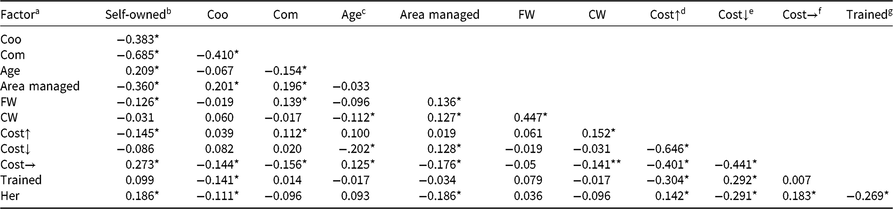
Pearson correlation analyses suggested close relationships among all factors studied (Table 3). Self-employed tea growers tended to be older, manage smaller tea gardens, and conduct weed control practice with lower frequency and with chemical herbicides (P < 0.05); whereas tea growers employed by companies tended to be younger, manage larger tea gardens, and conduct weed control practice with greater frequency (P < 0.05). Tea growers from cooperatives tended to manage larger tea gardens and to not have applied herbicides on their tea gardens in the past 2 yr (P < 0.05). Older respondents tended to have lower-cost weed control (P < 0.05). Respondents managing larger areas of tea gardens tended to control weeds with greater frequency and at higher costs (P < 0.05), and tended to not have applied herbicides in the past 2 yr.
Pearson correlations among factors.

a Abbreviations: Com, company; Coo, cooperative; CW, cost of weed control ha−1 yr−1; FW, frequency of weed control yr−1; Her, applied herbicide(s) in the past 2 years.
b *indicates P < 0.05.
c Of respondent.
d Estimated weed control costs 5 yr later would increase >10%.
e Estimated weed control costs 5 yr later would decrease >10%.
f Estimated weed control costs 5 yr later would range within 10% of current cost.
g Had farmer training on weed management of tea gardens.
Tea cultivation in Guizhou Province showed a situation of consolidation: More than 60% of the respondents were from tea-growing cooperatives or companies, and more than 55% of the respondents managed tea gardens with areas larger than 10 ha. Self-employed growers were usually smallholders, usually managed tea gardens with their families, and frequently controlled weeds with glyphosate or glufosinate. Growers from cooperatives primarily managed tea gardens with their families, although they have to comply with the agreements of the cooperative (e.g., not to use chemical herbicides). Growers from companies managed tea gardens as a team, and they commonly hired labor for weed management.
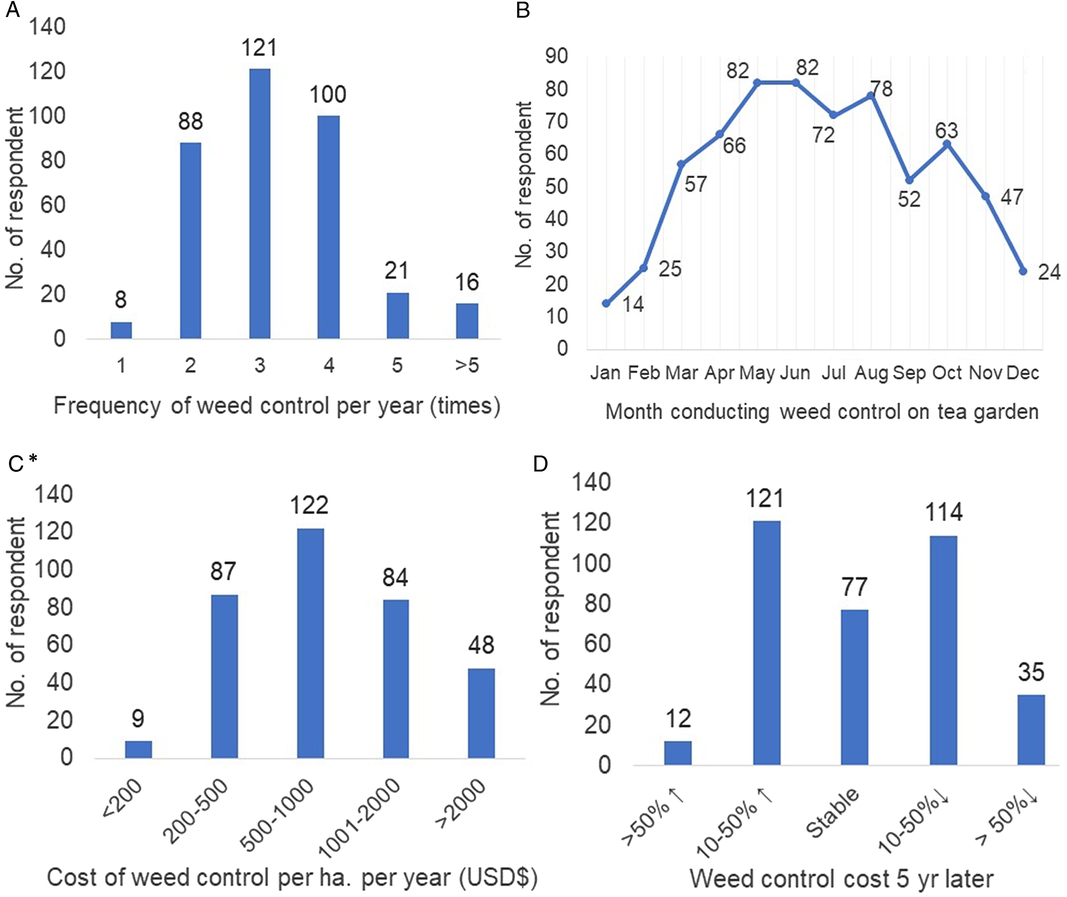
Currently, there are 1.35 million families enrolled in tea planting or producing in Guizhou Province, among which 4,149 cooperatives and companies have been registered (Li and Hu Reference Li and Hu2017). In crop cultivation, smallholders are vulnerable to a number of economic uncertainties (Caviglia-Harris Reference Caviglia-Harris2018; Chen et al. Reference Chen, Wichmann, Luckert, Winowiecki, Forch and Laderach2018). The cost of weed management in tea gardens ranged from USD $200 to $2,000 ha−1 yr−1 for 81% of the respondents (Figure 2C). Generally speaking, the value of tea leaves ranged from USD $6,700 to $18,000 ha−1 yr−1 (unpublished data). By taking part in cooperatives or working for companies, tea growers not only can communicate market information more easily but also may save input for large-scale effects. On the other hand, consolidation of tea planting is also efficient for administrating and providing services for local governments, for their higher investments, and more intensive management. Compared with self-employed tea growers, cooperatives or companies are more sensitive to policies published by governments, and more frequently get financial incentives from governments (Li and Hu Reference Li and Hu2017).
Frequency, month, cost, and estimated cost of weed control in tea gardens managed by respondents surveyed in Guizhou Province.

Weed Management Behaviors of Tea Growers
Most respondents (87%) conducted weed control two to four times yr−1, with the most common frequency being three times yr−1 (Figure 2A). The 354 respondents most frequently conducted weed control in tea gardens in the relatively hot season, May to August (Figure 2B), and a few respondents also controlled weeds in winter. Cost of weed control in tea gardens in Guizhou Province ranged greatly, with 14% of the 354 respondents indicating their cost was more than $2,000 ha−1 yr−1; 3% indicating a cost of less than $200 ha−1 yr−1; 25%, $201 to $500 ha−1 yr−1; 34%, $501 to $1,000 ha−1 yr−1; and 14%, $1,001 to $2,000 ha−1 yr−1 (Figure 2C). Moreover, 16% of the 354 respondents used herbicide to control weeds in their tea gardens in the past 2 years; of these, 40 respondents applied glyphosate and 15 applied glufosinate.
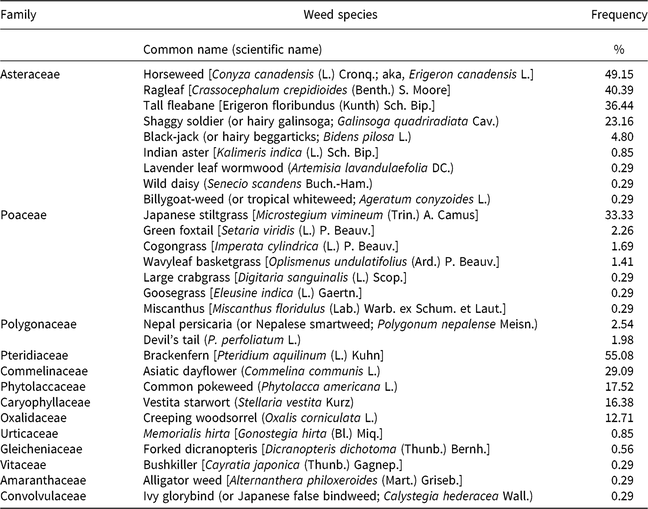
The respondents listed 28 weed species from 13 taxonomic families as the most troublesome (Table 4), including nine species from Asteraceae, seven species from Poaceae, and two from Polygonaceae. Brackenfern [Pteridium aquilinum (L.) Kuhn] was the most frequently listed by respondents (n = 195 of 354), followed by horseweed [Conyza canadensis (L.) Cronq.; aka, Erigeron canadensis L.], ragleaf [Crassocephalum crepidioides (Benth.) S. Moore], tall fleabane [E. floribundus (Kunth) Sch. Bip.], Japanese stiltgrass [Microstegium vimineum (Trin.) A. Camus], and Asiatic dayflower (Commelina communis L.).
Frequency of the 28 species listed as the most serious weeds in tea gardens by 354 respondents survey in Guizhou Province, China.

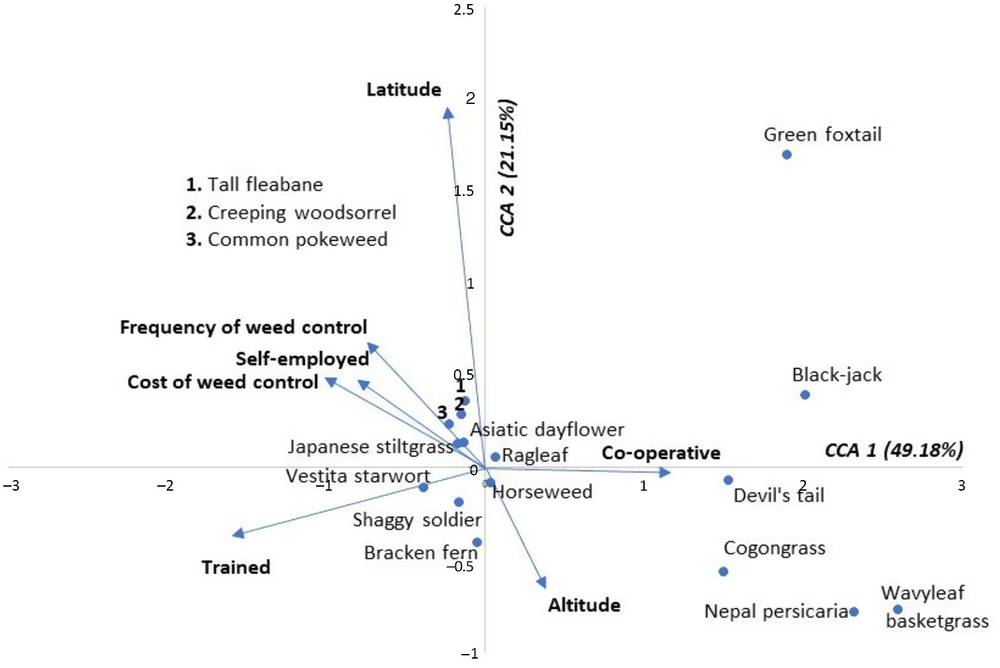
According to the CCA results, latitude, altitude, being self-employed, being a member of a cooperative, having training experience in tea garden weed management, and frequency and cost of weed control in tea gardens had significant (P < 0.05) influences on the list of most troublesome weed species in surveyed areas (Figure 3). The CCA ordination indicated that the 16 weed species with listed frequencies of greater than 1% among the 354 respondents could be distributed into two groups. Specifically, group 1 comprised ragleaf, horseweed, tall fleabane, creeping woodsorrel (Oxalis corniculata L.), common pokeweed (Phytolacca americana L.), Asiatic dayflower, Japanese stiltgrass, vestita starwort (Stellaria vestita Kurz), shaggy soldier (or hairy galinsoga; Galinsoga quadriradiata Cav.) and brackenfern distributed around the point of origin, which implied that they tended to be treated as most troublesome weed species by various respondents. Group 2 comprised wavyleaf basketgrass [Oplismenus undulatifolius (Ard.) Roem. & Schult.], Nepal persicaria (or Nepalese smartweed; Polygonum nepalense Meisn.), cogongrass [Imperata cylindrica (L.) P. Beauv.], black-jack (or hairy beggarticks; Bidens pilosa L.), green foxtail [Setaria viridis (L.) P. Beauv.], and devil’s tail (or Asiatic tearthumb; P. perfoliatum L.) distributed on the right side of the CCA ordination, which implied they tended to be treated as the most troublesome weeds by respondents who had not had farmer’s training on tea garden weed management (e.g., growers from cooperatives,) with lower frequency and cost of weed control. Overall, group 1 species are highly adapted to tea garden environments and frequently infest tea gardens across the province. Nevertheless, group 2 species may also infest tea gardens in which proper weed control practices likely are not followed and tea gardens managed by growers likely to be from cooperatives and growers who lack tea-garden weed management training.
Canonical correspondence analysis (CCA) showing seven factors of respondent group characteristics and most troublesome weed species in tea gardens listed in 350 valid questionnaires from growers in Guizhou Province, China. Longitude, company employed, age, area, and herbicide application (glyphosate or glufosinate) were not significantly associated with the list of most troublesome weeds, according to in respondents’ answers, and thus were not shown. For description of factors, see Table 1.

Weed infestation is one of the biggest challenges for intensification of tea cultivation. Growers frequently control weeds from April to October in Guizhou Province, two to four times yr−1, at a cost of USD $200 to $2,000 ha-1 yr−1. This is high compared with weed control costs for other crops. For example, the cost of weed control in local rice fields commonly ranges from approximately $40 to $120 ha−1 yr−1 (Plant Protection and Quarantine Station of Guizhou Province, unpublished data). The high cost of weed control in tea gardens is mainly due to the constraint of applying herbicides and relying on manual removal of weeds. Weed communities may quickly regrow or emerge from soil seedbanks, and labor used for weed control is limited by availability and cost. Another important reason is the lack of tillage. Tea plants are a perennial crop with relatively shallow root systems; thus, tillage is difficult to conduct and may injure tea plants. Hence, many perennial weeds, such as brackenfern (Guo et al. Reference Guo, Li, Busta and Jetter2018) and Asiatic dayflower (Yang et al. Reference Yang, Yu, Li and Dong2018), become serious pests because of their robust stems and ability to regrow. Also, highly fertile weeds and weeds that readily distribute could be serious pests in tea gardens; these include horseweed, tall fleabane (Bajwa et al. Reference Bajwa, Sadia, Ali, Jabran, Peerzada and Chauhan2016), ragleaf (Chen et al. Reference Chen, Guo and Huang2009), and shaggy soldier (Li et al. Reference Li, Qi, Yao and Yang2015). Common pokeweed also is a serious weed in tea gardens; it grows quickly, adapts easily to various environments, and its seeds are readily spread by birds (Li et al. Reference Li, Yang, Fang, Li, Liu, Leng and An2017). Moreover, shade tolerant and/or climbing weeds, such as Japanese stiltgrass (Warren et al. Reference Warren, Wright and Bradford2011), creeping woodsorrel, and vestita starwort (eFloras.org), could also be serious problems in tea gardens. Generally speaking, weeds with the aforementioned characteristics are frequently treated as troublesome for tea growers and should be highlighted in farmer training, according to local weed communities. Furthermore, locations (latitude and altitude) significantly influenced the composition of most troublesome weed species listed by tea growers. Hence, knowing the composition of weed communities in local tea gardens should be also highlighted when preparing farmer trainings.
To save costs, a small proportion of respondents used glyphosate or glufosinate for weed control in tea gardens in the past 2 years; these respondents significantly tended to be smallholders (Table 3). Nevertheless, applying chemical herbicides is not encouraged by the government of Guizhou Province. To create and enhance the brand image of Guizhou tea, the government of this province published official policies to guarantee the quality of tea products and limit the application of chemical pesticides. For example, there are policies about the standard monopolized stores for tea-garden pesticides, and growers are asked to buy pesticides only from such certified stores. The government of Guizhou Province also encourages tea-planting cooperatives and villages to formulate agreements on constraining the use of chemical pesticides in tea gardens. Therefore, farmer training on tea-garden weed management for smallholders should emphasize content on herbicide application and the related policies.
Anticipation of Tea Growers’ Weed Management Cost Trends
Anticipation of cost trends for weed management may influence growers’ thoughts about attending trainings and shifting weed management strategies. Among the 354 respondents interviewed, 37% thought the cost of weed management in tea gardens would increase more than 10% after 5 yr, whereas 42% thought it would decrease more than 10% (Figure 2D). Pearson correlation analyses (Table 3) suggested that respondents anticipating increased costs tended to be from companies, to have spent more money for weed management, and to have applied chemical herbicides. Respondents expecting decreased costs tended to be younger, managed smaller areas of tea gardens, and did not apply chemical herbicides. Moreover, respondents who thought the cost of tea-garden weed management would remain stable tended to be self-employed, older, to have managed smaller tea gardens, spent less for weed control, and applied chemical herbicides on tea gardens.
Companies and growers who paid most for weed management in tea gardens frequently relied on manual control of weeds; thus, they tended to think the cost of weed management would increase (there is a clear trend of increasing labor prices in the whole of China). Growers who applied chemical herbicides on tea gardens also tended to think the cost of weed management would increase, which was possibly stimulated by the policies for strictly limiting the use of chemical pesticides on tea gardens in Guizhou. Smallholder tea growers (i.e., self-employed and those managing small tea gardens) commonly managed tea gardens maintained entirely by family members and tended to apply herbicides. Thus, smallholders were not influenced as much by the increasing labor price and limits of chemical herbicides on tea gardens. Younger respondents were more optimistic about the cost trend. Growers managing larger tea gardens also tended to think the cost would decrease, which possibly may be because of the confidence they had in advantages of large-scale effects. For example, large-area garden managers may hire fixed-contract employees in lieu of temporary workers for weed control practices and they may ask employees to take responsibility for a fixed garden area. Thus, this could be an effective method to save costs on weed management. Therefore, different growers groups have different perspectives of cost trends for weed management, and thus farmer trainings should also shift the contents of the training curriculum accordingly. For example, growers from companies might be more interested than smallholders in effective, although expensive and complicated, weed control technologies.
Growers’ Interest in Farmer Trainings on Tea-Garden Weed Management
Among the 354 respondents, 60% had the experience of farmer trainings in weed management of tea gardens and 99% of them did want to participate in such trainings (Table 2). Respondents having had training in tea-garden weed management (n = 212 of 354) tended not to be from cooperatives, to think weed control cost will decrease, and not to use chemical herbicides (P < 0.05) (Table 3).
Farmer training could be an important way to improve growers’ weed management practices (Damalas and Koutroubas Reference Damalas and Koutroubas2017; Laforge and Levkoe Reference Laforge and Levkoe2018; Schreinemachers et al. Reference Schreinemachers, Wu, Uddin, Ahmad and Hanson2016; Wang et al. Reference Wang, Wang, Zhang and Yang2014); thus, it is an important part of agricultural administration of local governments in China (Wang et al. Reference Wang, Wang, Zhang and Yang2014). Currently, farmer training on tea-garden weed management held in Guizhou Province frequently includes contents such as common weed species, harmfulness of weeds, and mechanical weeding methods. The training had positive effects among tea growers in the surveyed area; growers who had farmer training tended to be significantly more optimistic about the cost of weed management and slightly, but not significantly, tended to conduct weed control more frequency and at lower cost (Table 3). Most tea growers (99% of the respondents) would like to attend farmer training on tea-garden weed management, yet current training programs in Guizhou Province do not strongly support growers in improving their weed management practices.
Acknowledgements
We thank the Plant Protection Station of the following 25 counties for providing great help on the questionnaire investigation: Fenggang, Jiangkou, Huaxi, Yuqing, Guiding, Zheng’an, Liping, Kaiyang, Meitang, Wuchuan, Sinan, Puding, Shiqian, Yanhe, Liuzhi, Pu’an, Duyun, Pingtang, Dejiang, Pingba, Daozhen, Danzhai, Weng’an, Xingren, and Xingyi counties in Guizhou Province. We thank Prof. Zhongyang Huo from Yangzhou University for his help on preparing the manuscript. This study was funded by the Science and Technology Cooperation Support Project of Guizhou Province ([2018] 2359); 2016 Plant Protection New Technology Demonstration Project of Guizhou Provincial Agriculture Committee (Qiannongcai [2016] 109); Guizhou Province Guidance Fund for Science and Technology Achievements Transformation “Integration and Demonstration of Green Prevention and Control Technology for Diseases and Pests in Guizhou Tea Garden” (2015); and a project funded by the Priority Academic Program Development of Jiangsu Higher Education Institutions. No conflicts of interest have been declared.
Supplementary material
To view supplementary material for this article, please visit https://doi.org/10.1017/wet.2019.67