1. THE CONCEPT OF NOISE IN WESTERN MUSIC
In physics, noise is a sound of vibration with irregular frequencies, cycles and amplitudes, while musical sounds are the result of regular and cyclic vibrations of sound generators. In the context of music, the definition of noise seems ambiguous and subjective. Luigi Russolo proposed that the physical standard was not the key to distinguish the two sounds, but the subjective auditory factors of human beings were indispensable and critical. Edgard Varèse holds a similar view:
Indeed, to stubbornly conditioned ears, anything new in music has always been called noise. But after all, what is music but organized noises? And a composer, like all artists, is an organizer of disparate elements. Subjectively, noise is any sound one doesn’t like. (Varèse Reference Varèse, Cox and Warner1962: 20)
Before the twentieth century, Western music under the tonal system was dominated by musical sound with clear pitches, and composers rejected sounds of noise nature and no clear pitches. Later in the twentieth century, the futurism trend set off in the West has profoundly influenced the development of Western contemporary art. The futurism trend emerged from the field of literature and rapidly penetrated into various categories of art. With core ideas of anti-tradition and anti-harmony, it advocates machine-based manufacturing and urban life, and pursues the liberation of speed and violence. The influence of futurism on the field of music is marked by Russolo’s (Reference Russolo, Cox and Warner1913) The Art of Noises: Futurist Manifesto. Russolo argued that futurist musicians must continually enlarge and enrich the field of sounds, and should substitute for the limited variety of timbres that the orchestra possesses today the infinite variety of timbres in noises. Russolo’s concept of noise led the liberation of sound art, and greatly expanded the scope of sound in music creation, to turn music creation into the ‘organization of sound’. In his book, Russolo elaborated on his concept of noise music. By explaining the physical principle of noise and the aesthetic significance of noise as the basic sound material of musical compositions, and by analysing timbre differences, rhythms and irregular scale forms unique to the sound in nature and human life from the perspective of art music, Russolo developed a complete theory of noise music.
The discussion around the noise in Western music goes on and on. Among them, the view of noise from Mary Russo and Daniel Warner are worth paying attention to. They proposed that noise in Western music is virtual acoustical noise and that this concept of noises seemed completely different from other music:
Western music’s ‘noise’ is virtual acoustical noise (the non-periodic vibrations of ambient or concrete sounds) and its ‘signals’ are the tones (periodic vibrations of strings, air, vocal chords, etc.) of the tempered scale. This structural distinction with its clear bias toward the discrete, measurable pitch, and clean, clear production value (i.e., an absolute minimum of breath sounds, string ‘noise,’ etc.), along with its pretense of highly developed pitch systems (e.g., tonality, dodecaphony, and other serial techniques), is often the strategy with which Western music holds at arms length its ‘others’—jazz, world musics, rock, and folk musics. (Russo and Warner Reference Russo, Warner, Cox and Warner2004: 49)
At the same time, they also talked about the questions of noise and musical sound.
Nonetheless, noise is, and always has been, inscribed in all sound and music. In fact, noise plays a primary role in the perception of virtually every musical sound. Noise components at the beginning of musical instrument tones (usually no longer than a few milliseconds in duration), referred to as attack transients, very often provide the primary perceptual cues for aural identification. Without these noise components it is virtually impossible for a listener to differentiate between, for instance, a clarinet and piano tone sounding at the same frequency, because their pitched or ‘steady-state’ portions (comprising most of all instrumental tone’s duration) happen to be timbrally similar. In fact, no acoustic instrument or concrete sound is actually a ‘pure tone’. It is possible to electronically produce pure pitch (sine wave) or pure noise (white noise). But aside from these two esoteric exceptions, the entire sound world is one in which periodic and non-periodic vibrations intermingle in an endless variety of ways (Russo and Warner Reference Russo, Warner, Cox and Warner2004: 49).
Russo and Warner proposed that noise is present in every musical signal. This shows, on the other hand, that noise and musical tone are one in sound. The point is similar to the understanding of noise in traditional Chinese music.
2. NOISE IN CHINESE MUSIC
Noise has been acceptable to the Chinese ears since time immemorial, so much so that it is often not distinguished from music deliberately:
In addition to the musical sound of regular vibration in the general rhythmic sense, as recognized by the international community, noted in frequency ratios and mathematical expressions and openly recorded in historical documents, or the sonorous, stunning and harmonious sound or those at least pleasing to the ear in the general sense, the sound, in the ears or the mind of Chinese, also includes the noise sound for the purpose of deterring evil spirits and exorcising ghosts, playing a powerful role in the construction of social orders, which is often not very agreeable or even rather unpleasant to the ear. (Zhang Reference Zhang2011: 3)
From daily life to ritual activities and to music, the Chinese do not reject noise, and sometimes even eagerly seek after it. In Chinese folk activities, such as festivals, weddings, funerals and religious ceremonies, you can always hear music such as gongs and drums and sound such as firecrackers. Their fervent and noisy sound, though deafening, arouses the excitement of the people and adds to the atmosphere of those folk activities. Noise is indispensable for Chinese music. A great variety of percussion instruments and repertoires reflect the Chinese people’s pursuit of noise. In Chinese opera music, percussion is more a pillar accompaniment instrument, without which the rhythm of the performance would be out of control. For the elegant music played by the literati, it is also very common to introduce noise to the music to create better diversity through different playing methods. It is demonstrated that noise has always been a part of the Chinese aesthetics of sound in music. More importantly, the Chinese regard both musical sounds and noises in music without differentiation, which constitutes one of the most important sound concepts in the Chinese music. For example, you can find both descriptions of ‘sound’ with a fixed pitch and discussions on ‘sound’ without a fixed pitch in some ancient Chinese classics. Yue Ji, (乐记) (The Record of Music), for instance, parallels ‘the sonorous sound of bells and chimes, the solid sound of stone, the grieving sound of stringed instruments, and the hollow sound of woodwind instruments’ (‘Zhongsheng qiang, shisheng qing, sisheng ai, zhusheng lan’, ‘钟声锵、石声磬、丝声哀、竹声滥’) with ‘the joyous sound of drums’ (‘Gupi zhi huansheng’, ‘鼓鼙之欢声’), which demonstrates the equal treatment of Chinese to noise and music sound, and the different attitudes of the Chinese music and the Western music before the twentieth century towards noise.
A review of the history of European music tells us that no nation has ever produced a percussion instrument other than the timpani. The question that follows is, of course, why is Chinese people’s acoustic experience or tolerance completely different from that of Westerners. That’s because they have completely different cultural spaces. By comparing Chinese and Western music histories, we felt to the most extent that the Chinese people’s concept of how to deal with noises seemed completely different from that of Westerners. (Zhang Reference Zhang2011: 16)
In Chinese music that attaches great importance to timbre varieties, the unique timbre language composed of noise widely exists in traditional Chinese music. Among the stringed instruments, erhu, for example, can be played by throwing and hitting the bow to simulate the sound of hoof beat and neigh, or by rubbing the bow hair and the rod with the strings, accompanied by a quick trembling movement of the left hand, to simulate neighs of a herd of horses. The timbre of Chinese plucked string instruments also implies a clear mindset of noise, as is shown by the sudden ending sound called shayin (煞音), a common playing method for plucked stringed instruments such as pipa. To play shayin with pipa, for example, we need to play with the right hand while pressing the strings lightly with the fingernails of the left hand, to make a sound like ‘cha-cha’ by controlling the collision between the fingernails and the swaying strings. Compared with shayin, the sounds made by twisting (jiaoxian, 绞弦) and combining (bingxian, 并弦) the strings of pipa are more of the nature of noise. These two playing methods can make sounds similar to the percussion music of snare drums, gongs and cymbals through pushing and pulling strings in different ways, combined with other fingerings such as sweeping and rotating. Yinnao (吟猱), one of the main playing techniques of guqin, a Chinese plucked string instrument with a history of more than 3,000 years, is to make wandering sounds by swaying the strings from side to side with fingers of the left hand. When playing with this technique, in addition to gaining a ‘bendable’ expression of the sound, a ‘hoarse’ noise will be produced by swaying and rubbing the fingers on the strings. The noise represents the form of sound swinging and wandering in the space after the sound is uttered. The beauty of curves created by the loop swinging of sound this way embodies the emphasis of Chinese music on the ‘bendability’ of sound trends. The noise unavoidably brought by the playing method is not originally a part of the music content. But in fact, it has been naturally integrated into the expression of the melody, forming the charm of noise unique to the lingering sound of guqin.
The broad musical sound that captures a great number of noises, the rich and varied instrumental noise languages, the subtle timbre characteristics that exist in the mutual transformation between musical sounds and noises, and other superficial musical expressions and meanings are all related to the aesthetic concept of Chinese art called yun (韵, meaning lingering charm). Yun is considered as the core of the aesthetic content of Chinese culture. Yun is used to indicate the stagnation of time-progressive expressions such as music, calligraphy and dance, the coagulation of spatial exhibits such as architecture, clothing and utensils, as well as aesthetic sentiments such as the demeanour of human posture. This Chinese character is therefore combined with many other Chinese characters to become part of hundreds of Chinese words containing this meaning. The meaning derived from yun reflects the essence of the aesthetic spirit of Chinese traditional art and culture. In the category of sound and hearing, yun is not equal to any musical or sound element, but a musical demeanour beyond any specific sound image. Therefore, this Chinese character is also used to express the structural harmony and echo between the core and the margin, the centre and the accessory.
From the perspective of Chinese sound aesthetics, the application of noise not only gives a vivid description to things in nature but, more importantly, can also endow music with a special charm. With yun as the core of Chinese music aesthetics, all techniques that can cause changes in the charm of music are regarded as important means of musical expression. The noise used in Chinese plucked string instruments is also an important element reflecting changes in the charm of sound. Chinese phrases such as ‘one sound with multiple tones’,‘supplementing sound with charm’, and ‘combination of sound and charm’ are often used in some works to describe the timbre variation caused by the transformation and contrast between musical sound and noise.
For traditional Chinese music, the broad sound forms and rich timbre varieties brought by noise are one of the important elements that help complete its style. When the noise in traditional Chinese music meets the concept of noise in Western electronic music, the former is activated to be with new acoustic features.
3. CREATION OF CONTEMPORARY CHINESE MUSICAL INSTRUMENTS
From the 1920s, Chinese folk musicians represented by Liu Tianhua (刘天华) began to improve Chinese musical instruments by widely accepting Western music and learning the playing techniques of Western musical instruments. This improvement has been continued to this day, that is, Chinese musical instruments has never stopped their assimilation of foreign cultures. Guo Wenjing (郭文景), a contemporary Chinese composer, proposes that:
Chinese contemporary music and Chinese symphony may not develop without an open mind and the study of foreign cultures. Among the elements of traditional Chinese music, that is, folk songs, folk art forms, operas and musical instruments, the first three all need to be saved and protected, and only Chinese musical instruments does not, for they are full of vigor and live in the present, and can be found in all scopes of music. (Guo Reference Guo2021)
Meanwhile, Chinese musical instruments widely integrated with Western musical instruments, symphony orchestras and electronic music to give birth to a great number of excellent works. In the 1970s and 1980s, a group of composers who exerted the most important influence on the development of Chinese contemporary music, including Chen Yi (陈怡), Zhou Long (周龙), Tan Dun (谭盾), Ye Xiaogang (叶小纲), Chen Qigang (陈其钢), Guo Wenjing, Qu Xiaosong (瞿小松) and Zhang Xiaofu (张小夫), began to acquaint themselves with Western contemporary music language, and developed a strong interest therein. Thus they have made attempts in their works to integrate Western contemporary composition techniques with traditional Chinese music language. Almost at the same time, these composers began to learn Western electronic music, and in the following ten years, they have been trying to apply Chinese musical language in creating electronic music. Le Chant Intérieur (吟) (Zhang Xiaofu, 1988), Taiyi II (太一II) (Xu Shuya, 许舒亚, 1991), and Ornamentation (纹饰) (Liu Jian, 刘健, 1989) are the representative works of early Chinese electroacoustic music. The Chinese music style highlighted in these early works played an important role in the subsequent creation and development of Chinese electronic music.
In Chinese electronic music, it is common form to combine electronic music with Chinese musical instruments. In the process of integration with electronic music, some sound features of Chinese musical instruments have been endowed with a broader expressive force, including the use of electronic music sound technology to expand and develop the noise elements of Chinese musical instruments. Plucked string instruments are a representative class of Chinese musical instruments, including guzheng, guqin, pipa, ruan and liuqin. In the next section, I will explain and discuss the changes and characteristics of noise sound adopted in electronic music presented by three representative plucked instruments, guqin, guzheng and pipa, based on three electronic music works, namely Blooming (梅花五弄) (Liu Peixin, 刘佩鑫, Reference Liu2019), Danqing (丹青) (Wang Hefei, 王鹤霏, 2015), and Scoring Strings (灼弦) (Yu Lu, 郁璐, 2013).
4. THE EXPRESSION OF SPECIFIC NOISE
4.1. Analysis of Blooming
Blooming is an electroacoustic music work composed by the Chinese contemporary composer Liu Peixin, released in 2019. The inspiration for this work came from the Chinese guqin solo meihua sannong (梅花三弄) (Triplicate Plum Blossom Melody). The reason why it is called ‘Triplicate’ is that the motive is repeated three times in the work. In Blooming, the composer borrowed this idea and changed the sound theme of the work five times (Figure 1).
The structure of Blooming and the development of the sound motive.

The sound materials in this work are quite consistent, and all of them were collected from samples of guzheng, including the glissando, tremolo, slapping the guzheng’s body, rubbing strings and hitting the strings with the palm. All the sounds in these three sections of the work fall into two broad categories: A – guzheng’s original sounds recorded by the performer; and B – guzheng’s sound transformation processed by various digital techniques. Sounds in category B have been developed into four sound forms:
-
Sound a: a high-frequency whisper like a poem sound.
-
Sound b: a piano-like metallic sound.
-
Sound c: a sound blend with original guzheng and electronic guzheng.
-
Sound d: other ornamental sounds.
I will focus on sounds a and b of category B in the following paragraphs because these samples have distinct effects and show a specific noise-like sound characteristic due to different types of sound-processing software. I will take three playing methods of rubbing strings, glissando and tremolo as examples to illustrate the noise-like sound characteristics.
4.1.1. Rubbing strings – a high-frequency whisper-like poem sound
The sound, a high-frequency whisper-like poem sound, is developed by the rubbing string playing method. The original sound of rubbing the strings is close to noise, such as ‘si-si’ or ‘sha-sha’. In Section 18″–1′28″, the composer employed a great deal of rubbing of the strings, leading to a pianissimo stridulation with a slow increase. The samples of rubbed strings are processed by reverberation, filtering and GRM Tools shuffling, creating a metallic noise. The composer called it ‘the first shape of the sound’. By blending ‘hitting on the strings with the palm’ and overtone, the sound texture becomes more complex and diversified. The small, high frequency and the metallic noise constitute the opposing dimensions of the sounds of musical tones of guzheng and noise-like sound making, opening up a world with a sense of mystery.
4.1.2. Tremolo and glissando – piano-like metallic sound
Tremolo and glissando are both important techniques in guzheng, and the composer used these two techniques extensively in this work. In addition to expanding the musical tone characteristics and sound layer, the composer also paid attention to the creation and excavation of the noise of tremolo and glissando to augment timbre richness. There is a specific type of noise contained in tremolo and glissando, which comes from striking with the strings with the fingernails.
The composer mainly used techniques such as timber stretching, flanger and filter to augment and shape the noise and contribute to the piano-like metallic sound. Timber stretching is an extremely powerful technique to expand the microscopic sound time structure. Flanger and filter add a ‘metallic’ timber to the noise. The frequency of the piano-like metallic sound is approximately 2,000 Hz to 10,000 Hz, which is very bright and gorgeous. In Section B, sound sometimes emerges as a phrase. However, it is applied in Section C as a sustained sound and contributes to a high frequency layer.
4.1.3. Comparison of rubbing strings, tremolo and glissando
These three samples are blended in this music in different ways, showing that the composer shaped the acoustics into different forms of concepts of electroacoustic music. I will take the example of Section 18″–1′28″ for analysis in the following text.
There are two sound forms in Section 18″–1′28″. Sound form A comes from the tremolo sample, which is processed by modulator techniques and leads to metallic-like noise. By augmenting the loudness of the sound of the rubbing of the strings, the composer obtained a clear noise B. These sounds from A and B constitute a motive. The motive is repeated for three times with a crescendo at 18″–48″ and a phrase augmented. At 48″, the metallic-like noise disappears, but the rubbing of the string material is sustained with a long crescendo. The rubbing strings material provides a background, against which the other sound materials, such as musical tones, glissando with the flanger and glissando with reverse technique, emerge alternately and contribute to the tense texture of electroacoustic sound. At 18″–48″, the connection between two sound forms is similar to dialogue. At 48″–1′28″, compared to 18″–48″, the composer employed rubbed strings, glissando and other sound materials, leading to various noise-like layers.
4.2. Analysis of Danqing
Danqing was composed by Wang Hefei in 2015 for guqin and electroacoustic music. The music creates a poetic space. Guqin’s sound is marked by a highly important characteristic – the after-sound, which has exerted an influence upon almost all this music creation – and noise-like acoustics have been involved. In Danqing, the electroacoustic music parts are collected from samples of guqin, including the melodic sequence, glissando, arpeggio, overtone and noise-like sounds, such as yinnao mentioned earlier. The majority of original sounds show clear musical tones. However, some of the original sounds that show noise characteristics in specific aspects are processed by different digital techniques, such as modulation, reverberation and delay. These noise-like sounds greatly enhance the expressive power of the music. I will mainly discuss these noise-like sounds in the following paragraphs.
4.2.1. The noise-like sounds based on yinnao
The structure of Danqing is shown in Figure 2.
The structure of Danqing.

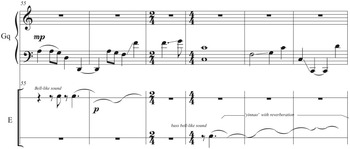
The noise-like sounds based on yinnao are mainly reflected in the second Part B of the work and show remarkable changes in space, tone and frequency. The reverberation gives the sound a broad virtual space. By increasing the wet signals of reverberation and setting a longer reverberation time for yinnao, the composer attempts to create virtual spaces which are larger or different from natural room acoustics. It epitomises the connection of the electroacoustic part and the instrument layer: an integration of virtual and real spaces based on noise-like sound. Considering 3′40″–3′56″, bars 55–60 (Figure 3), for example, the guqin performer used yinnao to play the short phrase, which is constituted by a conjunct interval with a disjunct interval. For the creation of the electroacoustic part, the composer used a recording of yinnao and expanded the noise characteristic by reverberation. The yinnao noise produced in this manner sounds far more intangible and arcane.
Bars 55–60.

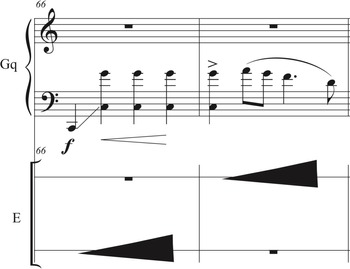
The composer used a modulator to control the change in frequency and pitch of yinnao in the electroacoustic part. The rate in the modulator can cause a pitch change, and its parameter plays a decisive role in determination of the amplitude of pitch variation. The feedback in the modulator creates a sound that is round in the virtual space and contributes the sound of exaggerated glissando. For example, at 4′15″–4′20″, bars 66–7, guqin is played for four intervals with forte and then crescendo. The score notes the sounds of electroacoustics with two symbols, showing that this layer also has a crescendo with the guqin together (Figure 4). These two symbols describe the electroacoustic sound, which is yinnao, transformed by the modulator technique. It epitomises the thinking pattern underlying electroacoustic music: an integration of musical tone and noise.
Bars 66–7.

4.2.2. Noise of striking with the strings with fingernails
There are some playing techniques in guqin, and the sounds can create a pianissimo noise by striking the strings with the fingernails, such as ti (剔), tiao (挑), li (历), pi (劈), pola (泼剌) and gun (滚). These playing techniques are different from the noise of yinnao. They are used to express certain powerful or intense emotions. For example, po (泼) in the fingering pola means that the index finger, middle finger and ring finger of the right hand enter the strings obliquely inward, and la (剌) indicates sweeping out from three directions, which is the opposite of the path of po. The ‘swimming fish swinging its tail’, formed by one po and one la, can create one tone and multiple timbres. For example, the fingering of ti and gun are both methods by which the right hand is used. The difference is that ti is a monophonic fingering, while gun is the continuous application of ti, that is, ti from seven strings to two strings or from six strings to one string. The playing techniques illustrated in the preceding examples are all mixed with the sound of striking with the fingernails on the strings, which can be forte or piano.
In Danqing, the noises of striking the strings with the fingernails were augmented by the preceding playing methods for electroacoustic music. Most of these timbres are used in the second section of the work, that is, the climax, which has noisy, complex sound layers. At 05′23″–05′29″, that is, bars 88–90, the electroacoustic sound evolves from striking the strings of the guqin with the fingernails. The frequency, pitch and noise loudness of the original sounds have been changed and developed into two forms of sound: one starts with a musical tone and turns into noise with glissando, and the other has a dynamic curve from pianissimo to fortissimo and fades out. Specifically, the noise-like sound in the electroacoustic part is recorded by glissando with the tremolo playing method of guzheng. From the high register to the low register, the noise gradually increases with a crescendo and becomes more audible and swells. Its effect is full of tension, anxiety, and perhaps passion. The composer gave the sound a long reverberation time, causing the noise to fade out very slowly.
4.3. Analysis of Scoring Strings
Scorching Strings is a mixed electroacoustic musical work for pipa and electroacoustic music by Yu Lu. The electroacoustic layer was sampled from pipa. By multiple transformations and synthesis of the original sounds through digital techniques, the composer was able to transform the sounds into various textures. At the same time, the work is highly characterised by the rationality of Western noise music and the thinking of Chinese music’s noise, blended with traditional musical tone techniques to set the complex texture of the sound layers.
The pipa is an instrument with a great variety in timbre, allowing performers to easily and subtly control the timbre to make noise-like sounds by changing the playing methods, such as shayin and jiaoxian mentioned earlier. These noise-like sounds contribute to a noisy and jagged sound texture. I will mainly discuss how the composer shapes the noise-like sounds of the electroacoustic part in the following paragraphs.
4.3.1. Musical Tone to Noise-like Sound
A number of samples of pipa musical tones used in the electroacoustic parts of the work are blurred in their pitch characteristics to varying degrees. The musical tone motive is abstracted into sound material, implying some specific noise language.
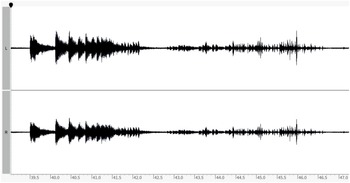
For example, at 39″–47″ (Figure 5), there are short phrases that combine with the pipa layer and the electroacoustic part. The pipa plays a sostenuto chord with a crescendo, and it becomes D1 at 43″, where the electroacoustic layer emerges. The electroacoustic layer has a dramatic glissando, which is developed by the modulator. It sounds metallic and contributes to a comparison with the quite sostenuto musical tone by pipa, and at the same time, it shows the thinking pattern of this work: the non-integration of noise and musical tone.
Waveform of 39″–47″.

The gradual transformation of the musical tones of the electroacoustic parts into noise-like sounds is reflected in every section of the work, which is an important manifestation of the composer’s idea of sound development. Based on the collection of noise textures in original sound materials or the transformation of musical tones into noise sounds, the composer realised the multilayered decomposition and development of various sounds of pipa.
4.3.2. Noise Application of Jiaoxian and Shayin
Both jiaoxian and shayin are important performance techniques for pipa. The main expansion of jiaoxian and shayin noise sounds occurs in the climax, which attaches a certain sense of noise form to the work, serving as the primary embodiment of the integration of original noise samples and noise-like sounds by various processing devices, such as GRM Tools. I focus here on the diversity of noise-like sounds in the electroacoustic part and the relationship between the pipa layer and the electroacoustic part.
There are two sound forms, or musical images, in the phrase climax in the electroacoustic layer. The first sound form is collected from the strumming and tremolo technique, forming a continuous tone cluster with an accelerando developed by digital techniques. The composer highlighted the sound expressively at approximately 50–200 Hz by bass boosting, sounding like a bass drum. This finding lays a foundation for the low frequency of the climactic section. A sound sampled from jiaoxian and shayin and developed by the modulation technique is the second sound form.
The second sound form is largely concentrated at 5,000–10,000 Hz. While increasing in loudness, extending in the sound layer, and employing an automation technique, its texture becomes noisier and fiery. The noise-like sounds in the electroacoustic part enrich the texture of the music and provide various and complex sound layers for the pipa layer. At 6′23″–6′43″, the real pipa and noise-like sounds around high frequencies in the electroacoustic part are rolled into one. Significantly, the composer employed GRM Tools Doppler, Shuffling and PitchAccum to control its texture. For instance, at 6′23″–6′30″, the composer set the amplitude variation, Doppler variation, following time, circle amplitude and circle frequency in GRM Tools Doppler and set fragment, delay, feedback and so on in GRM Tools Shuffling to compose the electroacoustic sound layers, which are composed of jiaoxian, shayin, tremolo and strumming. At 6′32″–6′38″, there is a clear characteristic curve of electroacoustic sound that contributes multiple cycles between low frequencies and high frequencies to control the automation of transpose in PitchAccum. These electroacoustic sound layers have more variations and are more expressive of spaciousness, dynamic pitch and frequency than the real pipa layer.
5. EPILOGUE – COMMON CHARACTERISTICS OF NOISE EXPRESSION
Through the analysis and observation of the preceding three works, we may gain a glimpse of the following three common characteristics of Chinese plucked string instruments in electronic music: presentation of noise in musical sound, extraction of atypical noise language and expansion of typical noise language.
5.1. Noise as musical sound
The musical sound of noise nature is also often taken into account by composers when creating electroacoustic music parts. In the process of variation of sound material, composers tend to use technical means to completely alter the external form of the sound. But meanwhile, they tend to create the logical relationship between the sound variety and the original sound by retaining the main characteristics of the musical sound, such as rhythm, pitch or phrase form.
5.2. Extraction of atypical noise language
The extraction of atypical noise language is mainly reflected in the noise inevitably brought about by the playing methods and techniques in the performance of musical instruments. Take the noise produced by the fingernail touching the strings for example. This noise is very common in the performance of plucked string instruments. Its volume is not very loud in the case of normal playing. But in electroacoustic music, composers endow this faint sound with a special musical expression. The noise produced by the fingernail touching the strings is often reflected in the control of the sound frequency for electroacoustic music, mainly highlighting the presentation of the sound at high frequencies. The noise is discontinuous and granular in form, so the details of its sound in the granular form will be regarded by the creator as the main sound feature and will be highlighted and modified. By expanding the high-frequency zone of the sound and raising the loudness, the preceding sound form will be highly specifically presented.
5.3. Expansion of typical noise language
The above-mentioned jiaoxian and shayin, as well as yinnao of guqin are typical noise sounds in Chinese traditional musical instruments. Among them, jiaoxian and shayin are the playing methods used in pipa works to imitate the intense noise of percussion instruments such as gongs and cymbals. In the work Scoring Strings the composer used sound modulation technology to amplify the metallic characteristics of the timbre of jiaoxian and shayin, adding to it the sound texture of metal percussion instruments. What is more, the composer created rich sound parts and thus obtain complex sound levels by adopting jiaoxian and shayin sounds at different frequency bands and tones after being processed by the frequency domain sound effector. This is also the enhancement and exaggeration of the noise characteristics of jiaoxian and shayin.
The sound of yinnao is a symbol of space in Chinese traditional music. The Chinese regard this noise as a ‘feeble sound’ in music, or the continuation of a strong sound, and the change of the vibration amplitude along the continuation features some spatial interest indicating the wandering and disappearing of sound. Therefore, based on the presentation of this sound in electronic music, the spatial attribute will be an important aspect to extend to. Meanwhile, the vibration change of the sound of the noise is often expanded into a sound with exaggerated convolution by the composer using sound modulation technology. This technique is to emphasise the ‘bendability’ of sound in the sound production process, as is valued in Chinese music. The exaggeration of ‘bendability’ lies in the expression of the charm of sound and the changing development trend of the sound during its existence.
The use and expression of noise in the preceding three works show the emphasis on noise in Western electroacoustic music, and also fully reflects the aesthetic awareness of noise based on the Chinese traditional music language. In addition to the application of the representative noises of pipa, guzheng and guqin, respectively, the three works use electroacoustic music technology to continuously extend and develop the sound characteristics and musical expressions of the noises. These sounds with rich classical charm are given new colours of sound under the effect of different sound technologies.