Introduction
Physic nut, also known as Jatropha (Jatropha curcas L.), is a promising crop for producing biodiesel as an alternative renewable energy source (King et al., Reference King, He, Cuevas, Freudenberger, Ramiaramanana and Graham2009). It belongs to the family Euphorbiaceae and is a perennial deciduous shrub. Jatropha is a monoecious plant with male and female flowers in the same inflorescence (Heller, Reference Heller1996; Liu et al., Reference Liu, Deng and Liao2008). It is known for its drought-resistant properties, easy propagation and ability to grow in marginal soil conditions. Jatropha can continue to produce seeds for up to 50 years after being planted in the field (Hikwa, Reference Hikwa1995; Makkar et al., Reference Makkar, Becker and Schmook1998). A critical problem for jatropha production is the low seed yield, and commercial cultivars are not available. Jatropha improvement through jatropha mating has been attempted without success in seed yield and plant type with similar genetic backgrounds. (Tar et al., Reference Tar, Tanya and Srinives2011; Rafii et al., Reference Rafii, Saleh, Shabanimofrad and Latif2012; Wijaya et al., Reference Wijaya, Surahman, Susantidiana and Lakitan2014). The interspecific hybridization with J. integerrima has been considered as a way to generate new phenotypes. Basha and Sujatha (Reference Basha and Sujatha2007) and Tanya et al. (Reference Tanya, Taeprayoon, Hadkam and Srinives2011) used ISSR markers to study the relationships between jatropha and peregrina. They found that these species were expected to breed and produce diverse traits. The F1 hybrid between jatropha and peregrina, as well as backcross to jatropha, has shown variation in corolla colour, according to the report by Sujatha and Prabakaran (Reference Sujatha and Prabakaran2003). However, the selfing of the only F1 hybrid with white flower of a cross between J. curcas and J. integerrima, produced only three seeds. Basha and Sujatha (Reference Basha and Sujatha2009) also attempted to self-jatropha × peregrina but found that the resulting fruit was small and poorly filled. Male sterile characters were interesting to consider, as mentioned by Heller (Reference Heller1996), who reported that Nicaragua male-sterile jatropha gave high fruit production. Male sterility can be classified into three types: pollen sterility (no pollen), structural or staminal sterility (abnormal pollen) and functional sterility (closed flowers) (Briggs and Knowles, Reference Briggs and Knowles1967). Sujatha and Prabakaran (Reference Sujatha and Prabakaran2003) found male sterility in the F1 of a cross between J. curcas × J. integerrima, while Sahai et al. (Reference Sahai, Kumar and Rawat2009) detected male sterility in the F1 of a cross between J. curcas × J. gossypifolia. This study aimed to investigate the number of male sterile lines in the F2 population resulting from a cross between jatropha and peregrina. The pistil ability of male sterile lines was evaluated in the form of a fruit set with developing seeds for expected seed production using four pollination sources.
Materials and methods
Plant material and male sterile selection
Four hundred and forty-five F2 plants were obtained from the self-pollination of only one F1 plant number 4 (F1 #4). This F1 plant crossed two local Thai cultivars: J. curcas ‘CV Chai Nat’ (CN) and J. integerrima, a local dwarf ornamental type (Jid) (Fig. 1). The F2 plants were grown in the Jatropha research field of the Department of Agronomy at Kasetsart University, Kamphaeng Saen Campus in Thailand, with a spacing of 1 m × 1 m. We monitored the flowering stage of the plants and counted the number of male sterile lines by observing the floral structure of the closed stamen with poor fruit set after 1 year of planting in the field. The percentage of male sterility was calculated from the proportion of male sterility and the number of F2 populations. The floral features of CN, Jid, F1 (#4) and F2 (#371) (one of the male fertile lines from the F2 population) were described, and the flowering period from bud formation to the flowering stage was counted to support the male sterile characteristics and monitor all the inflorescences throughout the year.
The scheme of a cross between jatropha (CN) × peregrina (Jid), F1 (#4), F2 (#371) and ms-1 to ms-5.

Male sterile validation
A one-way analysis was conducted with three replicates to measure the amount of fertile pollen grains. The samples used were the male parent (Jid) and female parent (CN) of the F2 population, F1 hybrid plant number 4 (F1 #4), fertile F2 plant number 371 (F2 #371) and selected male sterile lines. Four previous fertile samples were used as control samples to compare with the male sterile lines. Inflorescence samples were collected from each replicate at 8.00–10.00 Am and moved to a fixing solution consisting of a ratio of 1 glacial acetic acid to 3 absolute ethanol for 48 h. The fixing solution was removed, washed twice with water and then stored in 70% alcohol at 4 °C. Five male flowers per inflorescence were randomly mounted on separated microscopic slides, stained with a 1% (w/v) acetocarmine solution for 2 min and covered with a cover slide (Stanley and Linskens, Reference Stanley and Linskens1974). Ten positions on each slide were considered, and the red pollen grains were counted under a light microscope (Olympus version BX 51 with X400). The data were analysed using the accumulation of 10 positions in each slide, and then the percentage of stained pollen grains detected as red pollen grains was calculated.
The variance and mean comparison analysis was conducted using Duncan's New Multiple Range Test in the R programme (R Core Team, 2012).
Seed set under different methods of fertilization
The male fertile lines (CN, Jid, F1 (#4) and F2 (#371) and male sterile line groups (ms-1 to ms-5) employed three different hybridization techniques: hand-pollination, self-pollination and cross-pollination. Hand-pollination, there are three steps involved: firstly, remove the male flower, then rub the anther of the male plant onto the jatropha and finally, use F2 representative to pollinate the female stigma, then cover the stigma with polythene bags and wait until the fruit matures. Cover the inflorescence with a polythene bag for 7 days for self-pollination and then remove the bag, allowing the plant to mature. Open-pollination does not require bag covering or artificial pollination. To calculate the number of fruits, measure it as a percentage of the fruit set.
Male sterile performance testing
The seed and stem cutting propagation of ms-5 did not successfully germinate. As a result, grafting was used to propagate using the shoot tip of ms-5, with jatropha as the rootstock. After transplantation into the field, only eight grafted plants were obtained, accounting for ~0.05%. Observations on the inflorescences of each grafted jatropha were recorded: which include the number of female flowers per inflorescence (NFFI), number of fruits per inflorescence (NFI), percentage of fruit set per inflorescence (FSIP), dry fruit weight per inflorescence (DFWI), seed weight per inflorescence (SWI), number of seeds per fruit (NSF), percentage of seed germination (SGP), seed length (SL), seed width (SW), seed thickness (ST) and 100-seed weight (100-SW). The R programme (R Core Team, 2012) performed one-way analysis and mean comparisons.
Results
Jatropha plants typically have separate male and female flowers on the same inflorescence. The flowers have five petals and five sepals, with the male flowers containing 10 stamens. The female flower site is located in the centre between two branches of the inflorescence and is known as the female flower site (Luo et al., Reference Luo, Li, Chen and Sun2007). Our research found that some jatropha plants exhibit male sterile characteristics due to differences in stamen features compared to jatropha plants peregrina, F1 (#4), and F2 (#371), which showed long filaments and opening-anthers at the flowering stage. Five of 445 (1%) in F2 population were male sterile and coded as ms-1 to ms-5, as shown in Fig. 2. The jatropha (CN) male flowers had greenish sepals and petals, while peregrina (Jid) had greenish sepals at the flower bud stage and red sepals at the flowering stage with red petals. Male flowers of F1 (#4) had light green sepals and pale purple petals, while those of F2 (#371) had light green sepals and coral petals. Ten stamens were observed in CN, Jid, F1 (#4) and F2 (#371).
The inflorescence, female flower, male flower and stamen features of jatropha, peregrina, F1 (#4), F2 (#371), ms-1, ms-2, ms-3, ms-4 and ms-5.

The time from bud formation to flowering in jatropha, peregrina, F1 (#4), F2 (#371), ms-2 and ms-3 was 17, 16, 17, 15, 15 and 17 days, respectively, while the male flowers of the ms-1, ms-4 and ms-5 lines did not develop, only the flower shape developed over time, which is in contrast to the ms-2 and ms-3 lines. The sepals of ms-3, ms-4 and ms-5 were green, ms-2 was red-green and ms-1 had both red colour sepals and petals. The petal colour of ms-3 was light pink, while that of ms-4 and ms-5 was green. All stamens of male sterile lines had no filaments or pollen inside the anthers. The filaments of the male sterile feature were not stretched, and the anthers were closed, as shown in Fig. 2. Fertile pollen grains were used to investigate stamen activity for pollination and fertilization. During the flowering stage, the viability of pollen grains can be checked under a microscope. Among the male fertile groups, including jatropha (CN), peregrina (Jid), F1 (#4) and F2 (#371), had visible red pollen grains. However, the anther sac of the male sterile group was not open. The anther sacs of the male sterile group were examined to monitor the pollen grains. It was discovered that some of the grains were stained and aborted (Fig. 3). The percentage of viable (stained) pollen grains in the four male fertile lines was significantly different, and red pollen grains were detected. The maximum percentage of viable pollen grains was found in peregrina, which was not different from jatropha, followed by F1 (#4) and F2 (#371) with 96.21%, 91.57%, 81.31% and 75.54%, respectively, with a coefficient of variation percentage of 7.6.
The viability of pollen grains was examined by microscopic staining (40×). Normal pollen grains of male fertile plants showed a circular shape and red colour (a–d) from (a) J. curcas, (b) J. integerrima, (c) F1 (#4) and (d) F2 (#371), whereas male sterile plants showed aborted stained grains (empty) because of the absence of pollen (e) ms-1, (f) ms-2, (g) ms-3, (h) ms-4 and (i) ms-5.

The results of pollen-pistil compatibility of male fertile and male sterile lines using hand-pollination with pollen from jatropha and representative of F2, self-pollination and open-pollination are shown in Table 1. The average success rates of the fruit sets of CN, Jid, F1 (#4) and F2 (#371) were 84.17%, 0.83%, 16.67% and 36.67%, respectively. All fruit in the male fertile line group had seeds inside. The maximum fruit set achieved through self-pollination and hand-pollination in CN was 90%. However, Jid's fruit set was only successful through open-pollination due to self-incompatibility.
Number of fruits set (NFS) and fruiting percentage (%) of male sterile and male fertile groups with different pollination methods

SP self-pollination, HP hand-pollination, OP open-pollination.
The F1 (#4) with pale purple petals produced a highly successful F2 population through self-pollination of 15 fruits, along with two fruits from hand-pollination and three fruits from open pollination. While working on a cross between jatropha and peregrina with white flowers, Sujatha and Prabakaran (Reference Sujatha and Prabakaran2003) only obtained three F2 seeds with good fruit sets but without normal seed development. The F2 (#371) plant produced the highest number of fruits set through hand pollination, followed by open and self-pollination. The male sterile lines (ms-1 to ms-5) produced fruit through hand pollination with jatropha pollen. Fruit set by open pollination resulted in ms-2 to ms-5, while only ms-5 produced viable seeds (Fig. 4).
Fruit and seed characteristics of male fertile (a–d) and male sterile (e–i) plants were observed after being fertilized through open and hand pollination. Male fertile plants showed normal fruit and seed development viz. (a) J. curcas, (b) J. integerrima, (c) F1 and (d) F2. On the other hand, male sterile plants exhibited abnormalities in their fruit and seed development including, (e) ms-1 had small, distorted seeds with no endosperm, (f) ms-2 had abnormal fruits, seeds, small size, endosperm withered until fall, (g) ms-3 did not produce any seeds until the fruit fell, (h) ms-4 had fruits that withered early and could not develop into a seed and (h) ms-5 produced normal fruits and seeds.

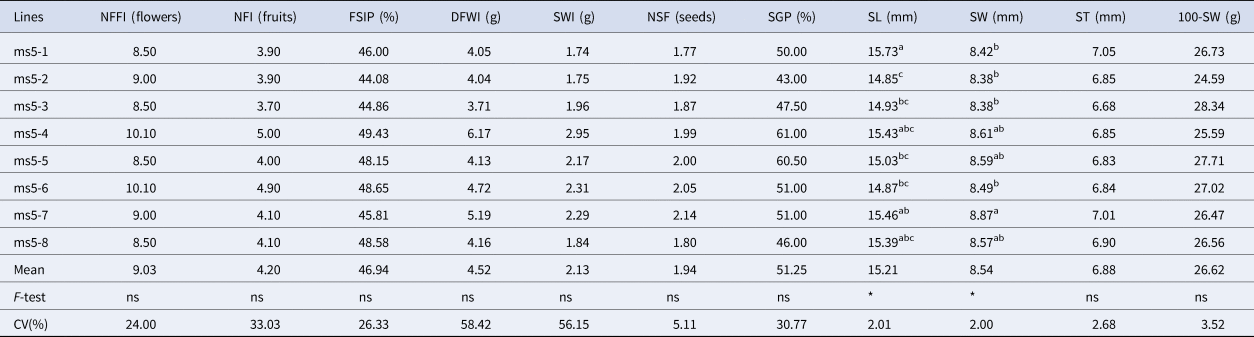
The study observed eight grafted jatrophas and found no significant differences in NFFI, NFI, FSIP, DFWI, SWI, NSF, SGP, ST and 100-SW, but significant differences in SL and SW. The average of eight ms-5 grafted jatrophas of NFFI (9.03), NFI (4.20), FSIP (46.94), DFWI (4.52), SWI (2.13), NSF (1.94), SGP (51.25), ST (6.88) and 100-SW (26.62), whereas SL (15.21) and SW (8.54) (Table 2).
Eleven traits of eight ms-5 grafted jatrophas after growing in the field

Number of female flowers per inflorescence (NFFI), number of fruits per inflorescence (NFI), fruit set per inflorescence percentage (FSIP), dry fruit weight per inflorescence (DFWI), seed weight per inflorescence (SWI), number of seeds per fruit (NSF), seed germination percentage (SGP), seed length (SL), seed width (SW), seed thickness (ST) and 100-seed weight (100-SW).
CV, coefficient of variation; ns, not significant (P ≥ 0.05); * = significant (P < 0.05).
Mean values in the same column superscripted with different uppercase letters denote significant (P < 0.05) differences between grafted jatrophas.
Discussion
Various methods were used to improve jatropha breeding, such as introducing plants, creating polyploids, inducing male sterility, and creating hybrids between different species. The main goal was to increase the genetic diversity of jatropha by crossing plants of the same species. However, despite being the primary approach, intraspecific crossing did not create new hybrid varieties (Tar et al., Reference Tar, Tanya and Srinives2011). Crossbreed Jatropha curcas with J. integerrima was to achieve phenotypic variation as previous studies conducted by Sujatha and Prabakaran (Reference Sujatha and Prabakaran2003), Basha and Sujatha (Reference Basha and Sujatha2009), and One et al. (Reference One, Tanya, Muakrong, Laosatit and Srinives2014) discovered that this particular species had a significant effect on the number of inflorescences, but did not examine male sterility. Only five of the 445 F2 jatropha plants we studied showed male sterility. In contrast, One et al. (Reference One, Tanya, Muakrong, Laosatit and Srinives2014) did not find male sterile jatropha in the 227 F2 population of jatropha and peregrina.
This study revealed that the chance of developing male sterile jatropha is the lowest, approximately 1% in the F2 population, compared to the rate found in properly cloned cassava (5%) (Jos et al., Reference Jos, Nair and Sreekumari1990). In contrast, the F2 population of sorghum demonstrated a 33.75% chance of male sterility (Xin et al., Reference Xin, Huang, Smith, Chen, Burke, Sattler and Zhao2017), while pigeon pea showed a 29.13% chance (Saxena et al., Reference Saxena, Wallis and Byth1983) and soybean had a 32.28% chance (Zhao et al., Reference Zhao, Tong, Yang, Yang and Zhang2019).
Marques et al. (Reference Marques, Siqueira, Colombo, Ferrari, Bahadur, Sujatha and Carels2013) reported that the hybrid of J. curcas × J. curcas exhibited various traits, such as being free of phorbol ester, having male sterile plants and dwarf plants resulting from inbreeding. However, our study discovered male sterility in the F2 generation of J. curcas × J. integerrima: ms-1 to ms-5. During the self-pollination test, the male sterility of ms-1 to ms-5 led to a failure in the fruit set. However, open-pollination observed fruit sets, particularly in ms-5, with the highest fruit set. When using jatropha pollen by hand, the fruit set was better compared to hand-pollinating with jatropha from line F2 (#371) of the F2 population, expectation on the effect of pollen incompatibility. Pollen fertility of F1 (#4) value was 81.31%, different from that of Basha and Sujatha (Reference Basha and Sujatha2009) and Sujatha and Prabakaran (Reference Sujatha and Prabakaran2003), who worked on pollen fertility in interspecific derivatives of J. curcas × J. integerrima crosses ranged from 64% to 6.6–52.0%, respectively, influenced to get high opportunity on fruit and seed sets.
This research found that the 100-seed weight (100-SW) of ms-5 was 26.62 g, which the value was a range in the period reported by Basha and Sujatha (Reference Basha and Sujatha2009) about 100-SW in interspecific hybrids of J. curcas × J. integerrima were advanced to F2, BC1F1, BC1F2 and BC2F2 generations were 28–78 g with mean 39 g. For seed characters, the ms-5 found seed size with seed length (15.21), seed width (8.54) and seed thickness (6.88) was smaller than the seed size of One et al. (Reference One, Tanya, Muakrong, Laosatit and Srinives2014) reported in 18.65 mm, 11.23 mm and 9.27 mm, respectively. Future research on improving jatropha after getting a male sterile line should focus on crossbreeding a male sterile line with jatropha pollen to produce a hybrid with high seed yield and desired traits with high heterosis.
Conclusions
This study demonstrated a new characteristic of male sterility, which was a part of the jatropha germplasm resource. ms-5 showed high pollen-pistil compatibility for seed production, whereas ms-1 to ms-4 displayed only fruit enlargement but aborted seeds. Thus, ms-5 is a new target for consistency in jatropha-breeding programmes.
Acknowledgements
The authors thank the Center of Advanced Study on Agriculture and Food of Kasetsart University, Bangkok, Thailand (project no. CASAF 157), and the Project on Breeding to Accelerate the Domestication of Novel Jatropha for Fuel and Feeds (Grant No. P-11-00599) from the National Science and Technology Development Agency, Ministry of Science and Technology, Thailand.