Introduction
At the present time, the population numbers of Spix's yellow-toothed cavies (Galea spixii Wagler, 1831) in nature are considered to be stable (Catzeflis et al., Reference Catzeflis, Patton, Percequillo and Weksler2016), and its captive breeding has been stimulated for meat production (Oliveira et al., Reference Oliveira, Rodrigues, Sousa, Albuquerque, Moura, Ambrósio, Miglino and Oliveira2010). In addition, this animal presents a potential to be used as an experimental model for the development of techniques for the conservation of other hystricomorphic rodents, such as the rare Galea monasteriensis (Dunnum & Vargas, Reference Dunnum and Vargas2008).
Studies on the reproductive aspects of male cavies are limited to the morphological and physiological description of its reproductive system (Rodrigues et al., Reference Rodrigues, Oliveira, Albuquerque, Menezes, Assis Neto, Miglino and Oliveira2013) and spermatogenesis (Santos et al., Reference Santos, Oliveira, Arroyo, Silva, Rici, Miglino and Assis Neto2013b). Due to the absence of electroejaculation protocols in cavies, the recovery of spermatozoa directly from the epididymis tail could be considered as a feasible alternative to obtain viable gametes (Martins, Reference Martins2007).
Among the variables that can affect the quality of epididymal sperm, the solution used for sperm recovery is of fundamental importance and must be compatible with the species spermatic particularities. In this sense, it is known that the cavies’ sperm (Santos et al., Reference Santos, Oliveira, Arroyo, Silva, Rici, Miglino and Assis Neto2013b) present marked morphological differences compared with laboratory rodents (Varisli et al., Reference Varisli, Scott, Agca and Agca2013). Thus, methodologies designed for rats or mice would not be directly applicable for cavies.
When processing epididymal sperm from other rodents, solutions based in TES (Ponce et al., Reference Ponce, Aires, Carrascosa, Fiol De Cuneo, Ruiz and Lacuara1998; Varisli et al., Reference Varisli, Scott, Agca and Agca2013) or TRIS (Silva et al., Reference Silva, Peixoto, Santos, Castelo, Oliveira and Silva2011) have been used for recovery and different conservative proposals. It is important to highlight that the evaluation of these solutions represents the initial step in the development of a cryopreservation protocol. Thus, the present study aimed to evaluate the performance of solutions based in TES or TRIS for epididymal sperm recovery from G. spixii, and to conduct a thermal resistance test (TRT) associated with fluorescence analysis as complementary methods to predict the viability of these gametes during short-time conservation.
Material and methods
The study was conducted at the Center for Multiplication of Wild Animals from UFERSA (IBAMA register no. 14.492.004), located in Mossoró, RN, Brazil (5°10′S, 37°10′W). Nine healthy, mature, male Spix's yellow-toothed cavies, with an average age of 2 years, were used. They were maintained under a natural photoperiod (approximately 12 h), and sheltered in covered paddocks (3 × 3 m). The animals were fed with fruits and tubers. Fresh drink water was available ad libitum.
The animals were pre-medicated with an intramuscular administration of ketamine hydrochloride (15 mg.kg–1) (Ketalar®; Pfizer, São Paulo, Brazil) and xylazine hydrochloride (1 mg.kg–1) (Rompun®; Bayer, São Paulo, Brazil). After 15 min, anesthesia was induced with intravenous administration of sodium thiopental (50 mg.kg–1) (Thiopentax®; Cristalia, São Paulo, Brazil), and the animals were subsequently euthanized with intravenous potassium chloride (2.56 mEq.kg–1) (Revitec®; Halexlstar, São Paulo, Brazil) (Vale et al., Reference Vale, Oliveira, Favaron, Miglino, Paula, Silva and Oliveira2013). Immediately thereafter, the abdomen was opened and the testicles–epididymis–vas deferens complexes were recovered. These were covered with gauze humidified with physiological saline solution (NaCl 0.9%), stored in an isothermal box, and transported to the laboratory at room temperature. Sperm recovery was performed by the flotation method (Ponce et al., Reference Ponce, Aires, Carrascosa, Fiol De Cuneo, Ruiz and Lacuara1998), in which the epididymis was sliced and immersed in 2.5 ml of one of the extenders tested. For each animal, the epididymis tail was randomly submitted to sperm recovery using solutions based in TES [4.9 g tris-hydroxymethyl-aminomethane, 1.06 g N-[tris(hydroxymethyl)methyl]-2-aminoethanesulfonic acid and 0.2 g d-fructose dissolved in 100 ml of ultrapure water (TES; 327 mOsm/l and pH 7.2)] or TRIS [3.028 g tris-hydroxymethyl-aminomethane, 1.78-g monohydrated citric acid, and 1.25 g d-fructose dissolved in 100 ml of ultrapure water (TRIS; 295 mOsm/l and pH 6.8)] (Silva et al., Reference Silva, Peixoto, Santos, Castelo, Oliveira and Silva2011). After 5 min in a static position, the sperm suspension was separated from the epididymis fragments using a micropipette (Silva et al., Reference Silva, Peixoto, Santos, Castelo, Oliveira and Silva2011).
The number of recovered sperm was calculated by multiplying sperm concentration, obtained through the Neubauer counting chamber, and the recovered volume. The motility (percentage of motile sperm) and vigour (strength of sperm flagellum beating on a 0 to 5 scale) were assessed using a light microscopy (Eclipse E200, Nikon, Melville, NY, USA) at ×100 or ×400 magnification. Bengal rose smears were prepared to evaluate sperm morphology, counting 200 cells/slide, under light microscopy (×1000 magnification) (Silva et al., Reference Silva, Peixoto, Santos, Castelo, Oliveira and Silva2011). A hypo-osmotic swelling test was performed to assess sperm membrane functionality, using a fructose solution at 100 mOsm/l (Ponce et al., Reference Ponce, Aires, Carrascosa, Fiol De Cuneo, Ruiz and Lacuara1998).
To evaluate plasma membrane integrity and mitochondrial activity of sperm, an aliquot (10 μl) containing sperm was incubated at 37°C for 10 min in a solution composed by the association of 2 μl of propidium iodide (PI; Sigma-Aldrich, Co., St Louis, MO, USA), 5 μl of CMXRos (Mito Tracker red®, Molecular Probes, M-7512) and 3 μl Hoechst 342 (H-342; Sigma-Aldrich, St Louis, MO, USA). The samples were evaluated through an epifluorescence microscope (×400 magnification; Leica, Kista, Sweden) by counting 200 cells. Sperm marked in blue (H-342) were classified as having an intact sperm membrane, and those fully or partially marked in red (PI) were classified as non-intact. Cells with midpiece marked in yellow were classified as showing mitochondrial activity (Celeghini et al., Reference Celeghini, Arruda, Andrade, Nascimento and Raphael2007).
To evaluate sperm longevity, a TRT was conducted (Emerick et al., Reference Emerick, Dias, Vale Filho, Silva, Andrade, Leite and Martins2011). The samples were maintained in a water bath at 37°C for 3 h. Sperm parameters previously mentioned were evaluated immediately after recovery (time 0) and at 15, 30, 60, 90, 120, 150 or 180 min, except sperm morphology, which was analyzed at time 0 and at 60 min intervals.
The results were expressed as mean ± SEM, analyzed with the SigmaStat 3.5 software (Systat Software Inc., San Jose, CA, USA). Data were checked for normality by the Shapiro–Wilk test and for homoscedasticity by Levene's test. The results were submitted to angular transformation when necessary. The effect of the solutions (TES or TRIS) on sperm parameters was verified by Fisher's post hoc least significance difference (PLSD) test. Comparisons of time were assessed by analysis of variance (ANOVA) for repeated measures (P < 0.05). Vigour was evaluated by Mann−Whitney test (P < 0.05).
Ethical standards
The UFERSA ethics committee approved the experimental protocols, as well as the animal care procedures used (Opinion CEUA/UFERSA no. 13/2013).
Results
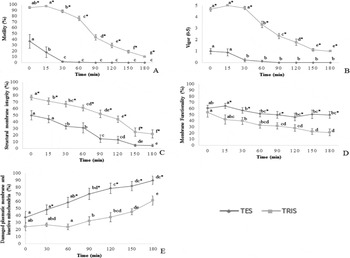
In total, 207.3 ± 44.9 × 10⁶ sperm were recovered when TES was used, while 250.2 ± 47.4 × 10⁶ sperm were recovered using TRIS (P < 0.05). Immediately after the recovery (time 0, Fig. 1), samples recovered in TRIS presented better motility, vigour, membrane integrity and mitochondrial activity than those recovered in TES (P < 0.05). No differences were observed regarding membrane functionality (P > 0.05).
Values (mean ± SEM) of motility (A), vigour (B), structural membrane integrity (C), membrane functionality (D), damaged plasmatic membrane and inactive mitochondria (E) from Spix's yellow-toothed cavy epididymal sperm (n = 9) during the thermal resistance test (TRT) using TES-based and TRIS-based extenders. *Superscripts indicate values with significant difference between experimental groups at each time point (P < 0.05). a,b,c,d,eLowercase letters superscripts indicate values with significant difference in the same experimental group throughout the time (P < 0.05).

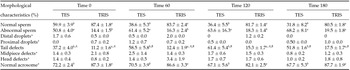
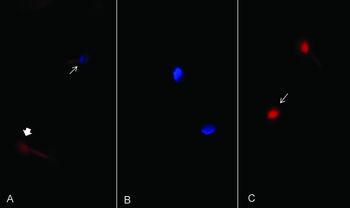
During the TRT, motility (Fig. 1 A) and vigour (Fig. 1 B) were better preserved when using TRIS instead of TES (P < 0.05). However, motility declined 60 min after the start of the test, and vigour after 30 min, in both solutions tested (P < 0.05). As for the preservation of membrane integrity and mitochondrial activity, TRIS provided higher values than TES (Fig. 1 C, E). Although sperm recovered with TES were immotile at 30 min, this solution promoted higher values for membrane functionality (Fig. 1 D) than TRIS (P < 0.05) along the TRT. It was noted that sperm morphology (Table 1) was less damaged along the TRT in the TRIS than TES samples (P < 0.05). Among the morphological defects observed, tail defects such as coiled and bent coiled tail were more predominant, especially when TES was used. Finally, the aspects of cavies’ sperm marked with the fluorescent probes are presented in Fig. 2.
Morphological characteristics (mean ± SEM) of Spix's yellow-toothed cavy epididymal sperm (n = 9), recovered with TES or TRIS, and submitted to a thermal resistance test (TRT) for 180 min

a,b Lowercase letters superscripts indicate significant difference between experimental groups in the same time (P < 0.05).
A,B Uppercase letters superscripts indicate significant difference in each group throughout the time (P < 0.05).
* Superscripts indicate values with no significant difference in the experimental group throughout the time (P < 0).
Plasma membrane integrity and mitochondrial activity of Spix's yellow-toothed cavy epididymal sperm assessed by the association of fluorescent markers. (A) Fine arrow indicates sperm marked in blue with Hoechst 3342 (H-342) presenting intact plasma membrane, associated to a red marking with Mito Traker Red® indicating the presence of mitochondrial activity. The wide arrow indicates sperm marked in red with propidium iodide (PI), presenting membrane damage, but with a red presenting mitochondrial activity. (B) Sperm with intact plasma membrane, but without mitochondrial activity. (C) The fine arrow indicates sperm marked in red indicating membrane damage, without midpiece marked by Mito Traker Red®, indicating absence of mitochondrial activity.

Discussion
To the best of our knowledge, this is the first study to evaluate the effect of different solutions used for epididymal sperm recovery from Spix's yellow-toothed cavies. TES and TRIS are buffer substances employed to maintain the ionic equilibrium and the pH of the solution, as the sperm metabolic activity increases the hydrogen ion concentration, acidifying the medium, hence reducing sperm longevity and fertilizing capacity during conservative procedures (England, Reference England1993). In G. spixii, the solution that promoted a better maintenance of epididymal sperm parameters for short-time conservation was TRIS, which facilitates the preservation of sperm energy by reducing fructose metabolism (Rodrigues, Reference Rodrigues1997). In addition, another compound based on TRIS solution, citric acid, acts similarly to antioxidants present in the seminal plasma, to protecting the gametes from high levels of reactive oxygen species (ROS) and lipid peroxidation (Silva & Gadella, Reference Silva and Gadella2006), as epididymal sperm have low oxidative protection (Sikka, Reference Sikka2004). In fact, TRIS-based solution was already efficiently used to recover and conserve epididymal sperm from another rodent species, the agouti (Silva et al., Reference Silva, Peixoto, Santos, Castelo, Oliveira and Silva2011).
Conversely, the TES-based extender has previously been considered to be efficient in the conservation of epididymal sperm from rats (Varisli et al., Reference Varisli, Scott, Agca and Agca2013), differing from the results obtained in the present study. However, it is necessary to emphasize that even though Spix's yellow-toothed cavies and rats belong to the order Rodentia, they are listed in different infraorders. Cavies are hystricomorphic, and rats are constituents of the Myomorpha infraorder. This classification is based on various anatomical differences (Wilson & Reeder, Reference Wilson and Reeder2005), which are reflected even in differences regarding sperm morphology (Santos et al., Reference Santos, Oliveira, Arroyo, Silva, Rici, Miglino and Assis Neto2013b).
In this sense, the negative action of TES [(HOCH2)3C+NH2CH2CH2SO3 –)] on cavy sperm is hypothesized to be related to its incapacity to capture hydroxyl radicals (OH–), considered to be the most active example of ROS in biological systems (Maia & Bicudo, Reference Maia and Bicudo2009). It is known that the SO– group from TES acts on the H+ bond, but does not have chelating action on the capture of OH–. Nevertheless, TRIS [(HOCH2)3CNH3 +] has a greater affinity in anion capture, and the addition of antioxidants to the extender composition helps the inhibition of ROS, resulting in better sperm conservation. Furthermore, the maintenance of samples at temperatures close to 35°C leads to a greater energy depletion, due to an increase in sperm metabolism (Varisli et al., Reference Varisli, Agca and Agca2015), which is different among species, and it is important to emphasize that the TRIS-based solution presents six-fold energy sources compared with the medium containing TES.
In rodents, the use of fluorescent probes such as the PI (Varisli et al., Reference Varisli, Scott, Agca and Agca2013), CMXRos (Li et al., Reference Li, Hung and Suarez2015) and Hoechst 342 stain to isolate samples (Yamashita et al., Reference Yamashita, Yamagata, Tsumura, Nakanishi and Baba2007) has been described in the literature. However, this time is the first in which the combined use of fluorophores has been reported for cavies, following a methodology initially described for bovines (Celeghini et al., Reference Celeghini, Nascimento, Raphael, Andrade and Arruda2010) and adapted for armadillos (Sousa et al., Reference Sousa, Santos, Silva, Bezerra, Souza, Lima, Oliveira and Silva2016) by our team. Such combination allows simultaneous evaluation of cavies’ sperm membrane integrity and mitochondrial activity, which declined with time in the samples using both extenders in a similar way. Probably, mitochondrial dysfunction with reduction in ATP production may be responsible for decreased sperm motility, generally observed after thawing (Medeiros et al., Reference Medeiros, Forell, Oliveira and Rodrigues2002). According to Ravagnan et al. (Reference Ravagnan, Roumier and Kroemer2002), after the rupture of mitochondrial membranes, there is a release of pro-apoptotic factors, which can cause irreparable structural and functional damage to sperm. Although the PI−CMXRos−Hoechst 342 combination was efficient for the analysis of cavies’ sperm, we emphasize that future studies should consider the use of other biomarkers, including those used for the analysis of specific regions of the sperm as the acrosome, chromatin and membranes, as well as those used for evaluating mitochondrial potential and sperm capacitation (Cunha et al., Reference Cunha, Carvalho and Dode2015).
Despite TRIS showing superiority for the preservation of most parameters assessed, TES was more effective in conserving sperm membrane functionality. However, we cannot rule out the hypothesis that the hypo-osmotic solution used might be inappropriate for cavy sperm. According to Santos et al. (Reference Santos, Sousa, Peixoto, Simão, Oliveira and Silva2013a), the solution used in this test should be adequate for the studied species, as the composition of sperm plasma membrane is species specific. Yet, an interaction between the extender and the hypo-osmotic solution might occur, causing changes on final osmolality, hence interfering with the assay result. For cavies, a hypo-osmotic solution used that was similar to that described for another rodent species, Chinchilla – 100 mOsm/l, but the recovery of epididymal sperm was conducted using Tyrode's solution (Ponce et al., Reference Ponce, Aires, Carrascosa, Fiol De Cuneo, Ruiz and Lacuara1998). Although these species belong to the same order, Rodentia, it is known that the extender can influence the test result, in association with variations in plasma membrane composition and physiology, and intracellular components observed among different species (Holt, Reference Holt2000). In addition, the membrane functionality test consists in the use of an ideal hypo-osmotic solution, which should exert a sufficient osmotic stress to cause a noticeable volume increase, without promoting sperm lysis. As the ideal hypo-osmotic solution varies according to the species (Fonseca et al., Reference Fonseca, Torres, Maffili, Borge, Santos, Rodrigues and Oliveira2005), further studies are necessary in order to evaluate different solutions to assess the sperm membrane functionality of cavies.
It was also observed that TRIS provided a more effective preservation of cavies’ sperm morphology than TES during the TRT. Tail defects were the most prevalent, corroborating the results reported for agoutis (Dasyprocta aguti) (Ferraz et al., Reference Ferraz, Menezes, Pessoa, Cabral, Illera, Silva and Carvalho2011). The predominance of these defects on TES samples might be associated with the inefficiency of this extender in protecting sperm membrane, and therefore exposing the cell to thermal shock, which leads to tail coiling.
In conclusion, the use of a TRIS-based solution is the most indicated for the epididymal sperm recovery from G. spixii. This initial step serves as a basis by which to determine the most efficient extender to be used for cryoconservative proposals, aiming towards the formation of a germplasm bank. These results will also contribute to the development of sperm conservation technologies for other endangered rodent species from the same infraorder.
Acknowledgements
The authors thank CEMAS/UFERSA for providing the animals used in the experiment. A.M. Silva, P.C. Sousa and L.B. Campos thanks the Coordination of Superior Level Staff Improvement – CAPES for grants. J.A.B. Bezerra, A.E.A. Lago and A.R. Silva thanks National Counsel of Technological and Scientific Development – CNPq for grants.