Introduction
One deleterious effect of in vitro embryo production (IVP) is oxidative stress caused by a non-optimized in vitro culture environment, leading to a reduction in the viability of oocytes and embryos. Reactive oxygen species (ROS), or free radicals, are formed from embryonic metabolism or in the in vitro environment surrounding the embryo (Guérin et al., Reference Guérin, El Mouatassim and Ménézo2001) and are associated with changes in embryonic development and the induction of apoptosis (Betts and Madan, Reference Betts and Madan2008).
Several antioxidant molecules have been investigated to mitigate the effects of oxidative stress. Resveratrol (3,4′,5-trihydroxystilbene) is a polyphenolic molecule with antioxidant properties found in different plant species. It is able to remove superoxide radicals, reduce the production of ROS in mitochondria, inhibit lipid peroxidation and regulate the expression of co-factors and antioxidant enzymes (Pervaiz and Holme, Reference Pervaiz and Holme2009). Among its promising biological activities are anticancer, antioxidant, antibacterial, neuroprotective and anti-inflammatory effects. It can also contribute to metabolism, leading to an improvement in the lifespan of various organisms, from yeast to vertebrates (Pirola and Fröjdö, Reference Pirola and Fröjdö2008).
Resveratrol has positive effects on oocyte and embryo development. For instance, blastocyst rate and the quality of pig embryos can be increased when culture medium is supplemented with resveratrol (Lee et al., Reference Lee, Wang, Chaille and Machaty2010). Supplementation of in vitro maturation (IVM) medium with 1 µM resveratrol increased progesterone and decreased estradiol secretion by cumulus cells, improved cumulus expansion and stimulated the formation of polar bodies in bovine oocytes, enhancing blastocyst production (Wang et al., Reference Wang, Tian, Zhang, He, Ji, Li, Tan and Liu2014). Low concentrations of resveratrol in embryo culture medium also improved embryo quality. Several studies have reported that resveratrol at 0.5 µM in embryo culture medium or vitrification solution increased the quality of vitrified bovine embryos (Salzano et al., Reference Salzano, Albero, Zullo, Neglia, Abdel-Wahab, Bifulco, Zicarelli and Gasparrini2014; Hara et al., Reference Hara, Kin, Aoki, Nakamura, Shirasuna, Kuwayama and Iwata2018; Madrid Gaviria et al., Reference Madrid Gaviria, López Herrera, Urrego, Restrepo Betancur and Echeverri Zuluaga2019). However, high concentrations of resveratrol (above 10 µM) in IVM medium had pro-apoptotic effects on cumulus cells (Kim et al., Reference Kim, Choi, Lee, Park, Rhee, Park and Choi2004) and concentrations of 20 and 40 µM during bovine IVM reduced the percentage of oocytes that reached the final stage of maturation (Pocar et al., Reference Pocar, Augustin and Fischer2004).
Given the positive effects of resveratrol on embryo development, we investigated whether a resveratrol analogue could be an alternative antioxidant for the in vitro embryo culture system. Resveratrol analogues may be even more efficient, as they are designed to have a greater activity with less effect on cell viability. Previously, a series of resveratrol analogues was investigated and showed lower cytotoxicity than resveratrol (Zimmermann-Franco et al., Reference Zimmermann-Franco, Esteves, Lacerda, Souza, Santos, Pinto, Scio, da Silva and Macedo2018). In the present study, we investigated the effect of concentrations of RA33, a resveratrol analogue, on in vitro development and apoptosis of the in vitro-fertilized bovine embryo and compared it with resveratrol.
Materials and methods
All chemicals were purchased from Sigma-Aldrich (St Louis, MO, USA) unless otherwise stated. Resveratrol was kindly provided by Dr Nadia Rezende Raposo Barbosa from Universidade Federal de Juiz de Fora (UFJF), Brazil and the resveratrol analogue 33 (RA33) was provided by Dr Gilson Costa Macedo and Dr Adilson David da Silva from UFJF.
Experimental design
Two experiments were carried out to evaluate the effect of RA33 on embryo development and apoptosis. The first experiment investigated the effect of different concentrations of RA33 on embryo development. For that, presumptive in vitro-fertilized zygotes (n = 1314) were distributed randomly in the treatments with different concentrations of RA33 [0 (control), 0.1, 0.5 and 2.5 µM] in synthetic oviduct fluid (SOF) medium with 2.5% fetal calf serum (FCS). Embryo cleavage was assessed on day 3 and blastocyst rates were assessed on days 7 and 8 post-fertilization in six replicates. The second experiment compared RA33 with resveratrol regarding embryo development and apoptosis. For that, in vitro-fertilized presumptive zygotes (n = 1103) were distributed randomly into two treatments (2.5 µM RA33 or 0.5 µM resveratrol) in SOF medium with 2.5% FCS. The control group was composed of presumptive zygotes cultured without RA33 or resveratrol in SOF with 10% FCS. Embryo cleavage was assessed on day 3 and blastocyst rates were assessed on days 7 and 8 post-fertilization in three replicates. Both rates were based on the total number of presumptive zygotes. Total cell number and apoptosis were assessed in blastocysts collected on day 8.
Resveratrol and RA33 dilution
Resveratrol and RA33 were dissolved separately in dimethyl sulfoxide (DMSO) to obtain a 2.5 mM stock of both and then kept frozen until the day of use. The stock solutions were then diluted 1:1000 in SOF medium, resulting in a DMSO concentration of 0.001% or less in the culture medium.
In vitro maturation and fertilization, embryo culture
Bovine ovaries were obtained from a local slaughterhouse and transported to the laboratory in physiological saline solution. Cumulus–oocyte complexes (COCs) were aspirated from 3–8 mm follicles and those with more than three compact cumulus cell layers and homogeneous cytoplasm were selected for IVM. Groups of 20 COCs were matured in 100 µl of tissue culture medium (TCM-199; Gibco Life Technologies, Inc., Grand Island, NY, USA) supplemented with 10% FCS and 20 µg/ml follicle-stimulating hormone (FSH; Pluset, Calier, Barcelona, Spain), covered with mineral oil, for 22 h in a humidified atmosphere of 5% CO2 and 38.5ºC in air.
After maturation, the COCs were washed and transferred to 90-µl microdrops of the in vitro fertilization (IVF) medium (Fert-TALP) covered with mineral oil. Frozen–thawed semen was centrifuged for 10 min at 700 g in a Percoll gradient (45 and 90%). The sediment was resuspended in IVF medium and centrifuged again for 5 min at 700 g. Afterwards, the pellet was resuspended in 100 µl of IVF medium and ∼10 µl was added to the IVM microdrops to reach a final concentration of 1 × 10⁶ sperm/ml. Oocyte–sperm co-incubation for fertilization was performed for 18 h in a humidified atmosphere of 5% CO2 and 38.5ºC in air.
After IVF, the presumptive zygotes were partially denuded by repeated pipetting, washed twice in SOF medium, distributed randomly to the treatments and cultured for 8 days in 50 µl SOF medium (20–25 presumptive zygotes per drop) covered with mineral oil under 5% CO2 and 38.5ºC in air. Half of the culture medium was renewed on days 3 and 5 after fertilization.
Assessment of total cell number and apoptosis
Total cell number and apoptosis in blastocysts on day 8 were analyzed using terminal deoxyribonucleotidyl transferase-mediated dUTP-digoxigenin nick end-labelling (TUNEL) assay and a commercial kit (Dead End Fluorimetric TUNEL System, Promega, Madison, WI, USA), according to the manufacturer’s instructions. Briefly, blastocysts were fixed in paraformaldehyde at 4°C for 25 min and permeabilized in 0.1% Triton X-100 solution at room temperature for 5 min. Samples were then washed twice in phosphate-buffered saline solution and incubated in 50-µl drops with a reagent mixture containing the enzyme solution (terminal deoxynucleotide transferase enzyme) and 90% staining solution (fluorescein dUTP conjugate) for 1 h at 37°C in a dark humid chamber. Embryos mounted on slides were stained at room temperature with Vectashield plus 4′6-diamidino-2-phenylindole (DAPI) (Vector Laboratories Inc., Burlingame, CA, USA) for evaluation by fluorescence microscopy. Positive control embryos had been previously treated with DNase (Promega). Negative control embryos were incubated only in the staining solution without enzyme. Total number of cells and number of apoptotic cells per embryo were counted, and apoptotic cell index was calculated as the proportion of apoptotic cells per total number of cells.
Statistical analysis
Cleavage and blastocyst production rates and apoptotic index were analyzed using logistic regression models (Proc Logistic), and total cell number and apoptotic cell number by mixed linear models (Proc Mixed), using the SAS statistical package (version 9.1). Results are shown as mean ± standard error of the mean (SEM). Differences were considered significant at the 95% confidence level (P < 0.05).
Results
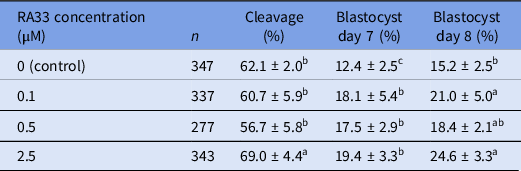
The first experiment evaluated the effect of RA33 concentrations on in vitro development of in vitro-fertilized bovine embryos. The highest cleavage rate (P < 0.05) was found with 2.5 µM, whereas no difference was observed among 0, 0.1 and 0.5 µM RA33. Blastocyst rates on days 7 and 8 with 2.5 µM were higher (P < 0.05) than 0 µM, but similar to 0.1 and 0.5 µM. Concentration of 0.1 and 0.5 µM also resulted in higher (P < 0.05) blastocyst rates than the control on day 7, but on day 8 there was no difference between 0 and 0.5 µM (Table 1).
Effect of different concentrations of resveratrol analogue 33 (RA33) in the culture medium on cleavage and blastocysts rates of in vitro-fertilized bovine embryos

a,b Values with different superscript letters within columns differ (P < 0.05).
Values are shown as mean ± SEM; n, number of presumptive zygotes.
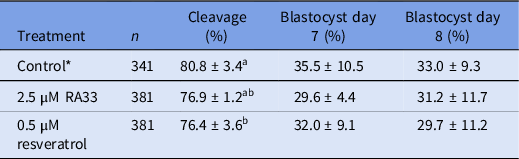
The second experiment compared the effects of RA33 on embryo development, total cell number and apoptosis with those of resveratrol. For this comparison, the concentration 2.5 µM RA33 was chosen because it improved the cleavage and blastocyst development when compared with the control (0 µM) in the first experiment. A concentration of 0.5 µM resveratrol was chosen for comparison because it had been previously demonstrated that it improved the quality of in vitro-fertilized bovine embryos (Salzano et al., Reference Salzano, Albero, Zullo, Neglia, Abdel-Wahab, Bifulco, Zicarelli and Gasparrini2014; Madrid Gaviria et al., Reference Madrid Gaviria, López Herrera, Urrego, Restrepo Betancur and Echeverri Zuluaga2019). Cleavage rate was lower (P < 0.05) with resveratrol than in the control but similar (P > 0.05) to RA33. There was no difference (P > 0.05) between the RA33 and the control groups. Blastocyst rates on days 7 and 8 were also similar (P > 0.05) among RA33, resveratrol and control group (Table 2).
Effect culture medium supplementation with resveratrol analogue 33 (RA33) or resveratrol on cleavage and blastocysts rates of in vitro-fertilized bovine embryos

a,b Values with different superscript letters within columns differ (P < 0.05).
Values are shown as mean ± SEM; n, number of presumptive zygotes.
* Control: embryos were cultured without RA33 and resveratrol.
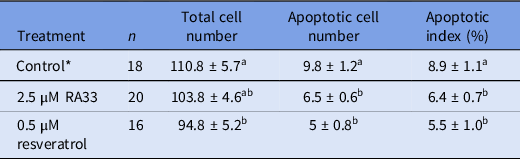
Total cell numbers found in blastocysts from resveratrol treatment were lower (P < 0.05) than in those in the control group but no difference (P > 0.05) was found between RA33 vs resveratrol or RA33 vs the control. The numbers of apoptotic cells and the apoptotic index in blastocysts from RA33 and resveratrol treatments were lower than in blastocysts from the control group (Table 3).
Effect culture medium supplementation with resveratrol analogue 33 (RA33) or resveratrol on total cell number and apoptosis of in vitro-fertilized bovine blastocysts

a,b Values with different superscript letters within columns differ (P < 0.05).
Values are shown as mean ± SEM; n, number of presumptive zygotes.
* Control: embryos were cultured without RA33 and resveratrol.
Discussion
Oxidative stress is one of the main concerns in embryo culture systems. Free radicals generated during the in vitro culture are harmful for embryos, altering preimplantation development and embryo quality (Guérin et al., Reference Guérin, El Mouatassim and Ménézo2001; Betts and Madan, Reference Betts and Madan2008). Resveratrol is an antioxidant that has been shown to favour embryo development during in vitro culture (Lee et al., Reference Lee, Wang, Chaille and Machaty2010; Salzano et al., Reference Salzano, Albero, Zullo, Neglia, Abdel-Wahab, Bifulco, Zicarelli and Gasparrini2014; Sovernigo et al., Reference Sovernigo, Adona, Monzani, Guemra, Barros, Lopes and Leal2017). In the present study we showed that an analogue of resveratrol can be added to culture medium to improve cleavage and blastocysts rates of in vitro-fertilized bovine embryos. In addition, the analogue can improve embryo quality by reducing apoptosis, similarly to resveratrol.
The balance between pro-oxidants and antioxidants is important to avoid a disequilibrium in the cell homeostasis, because an excess of pro-oxidants will increase free-radical generation, but an excess of antioxidants can result in overreduction of free radicals required for cell signalling (Bókkon, Reference Bókkon2012). Therefore, it is crucial to identity the antioxidant concentration that better fits an in vitro culture system. We found that 2.5 µM RA33 concentration improved cleavage rate and that all RA33 concentrations resulted in a higher blastocyst rate than 0 µM (the control group) on day 7; It was still higher on day 8 for 2.5 µM, demonstrating that analogues of resveratrol have beneficial effects when added to culture medium. Indeed, analogues of resveratrol have been used in culture medium of different cell types and have been reported to prevent or repair cellular damage caused by oxidative stress (Boccellino et al., Reference Boccellino, Donniacuo, Bruno, Rinaldi, Quagliuolo, Ambruosi, Pace, De Rosa, Olgaç, Banoglu, Alessio, Massa, Kahn, Werz, Fiorentino and Filosa2019; Hou et al., Reference Hou, Zhang, Mi, Wang, Zhang, Xu, Yang, Liu, Ding, Yang, Chen and Wu2019; Kim et al., Reference Kim, Kim, Byun, Song, Han, Park, Yuk and Byun2020).
Based on our result with RA33, we asked whether 2.5 µM RA33 would have similar effects on 0.5 µM resveratrol. This resveratrol concentration had been reported previously to improve embryo quality (Salzano et al., Reference Salzano, Albero, Zullo, Neglia, Abdel-Wahab, Bifulco, Zicarelli and Gasparrini2014; Madrid Gaviria et al., Reference Madrid Gaviria, López Herrera, Urrego, Restrepo Betancur and Echeverri Zuluaga2019). Our data showed that RA33 resulted in similar embryo development rates for resveratrol and control. The overall cleavage and blastocysts rates achieved in Experiment 1 were somewhat lower than in Experiment 2. Such differences were likely to be due to the source of the oocytes, as the experiments were not concurrent. This suggests that the oocytes collected from slaughtered cows in Experiment 1 were probably from different origins from those collected in Experiment 2, and may have influenced the overall production rates. Indeed, the effect of oocyte origin on developmental competence has been reported elsewhere (Camargo et al., Reference Camargo, Viana, Sa, Ferreira, Ramos and Vale Filho2006; Abraham et al., Reference Abraham, Gustafsson, Ruete and Brandt2012).
Although the blastocyst rates were similar among RA33, resveratrol and control groups, both RA33 and resveratrol improved embryo quality by reducing the apoptotic index in blastocysts. Apoptosis is a process of cell death that plays an important role during embryo development; it is a mechanism to eliminate damaged cells and leads to the formation of embryonic structures (Brill et al., Reference Brill, Torchinsky, Carp and Toder1999). However, an increase in apoptosis can lead to altered embryo and fetal development (Betts and Madan, Reference Betts and Madan2008). The proportion of apoptotic cells can be increased by free radicals generated during in vitro culture (Gjørret et al., Reference Gjørret, Knijn, Dieleman, Avery, Larsson and Maddox-Hyttel2003). In preimplantation embryos fertilized and cultured in vitro, it is usual to detect an increase in apoptosis due to suboptimal culture conditions (Guérin et al., Reference Guérin, El Mouatassim and Ménézo2001). Here, we showed that resveratrol can reduce the apoptosis index of in vitro-fertilized bovine blastocysts. Other studies have reported that resveratrol can contribute to reduce apoptosis. In mice, resveratrol alleviated apoptosis in mouse oocytes aged by in vitro culture (Sun et al., Reference Sun, Tang, Shen, Yin and Sun2019), indicating that it can have a role on regulating apoptosis. In a similar way, RA33 can also play a role in apoptosis in bovine embryos cultured in vitro, contributing to an increase in embryo quality. In a study with several resveratrol analogues it was found that they can be less cytotoxic than resveratrol (Zimmermann-Franco et al., Reference Zimmermann-Franco, Esteves, Lacerda, Souza, Santos, Pinto, Scio, da Silva and Macedo2018). Therefore, the analogue of resveratrol RA33 can be an alternative to resveratrol for in vitro-fertilized bovine embryos cultured in vitro.
In conclusion, the supplementation of culture medium with resveratrol analogue 33 (RA33) enhances the embryo development of in vitro-fertilized bovine embryos. Both resveratrol and its analogue can ameliorate embryo quality by reducing apoptosis. Therefore, RA33 can be an alternative to resveratrol in embryo culture medium.
Financial support
This work was supported by the National Council for Scientific and Technological Development – CNPq and Fundacao de Amparo a Pesquisa do Estado de Minas Gerais – Fapemig (APQ 0562/16) and Biotran LTDA. T. A. Patrocinio was supported by the fellowship Coordenacao de Aperfeicoamento de Pessoal de Nivel Superior – Brasil (CAPES).
Conflict of interest
The authors declare no conflict of interest.
Ethical standard
Not applicable
Authors’ contributions
TAP: methodology, investigation, review. CACF: conceptualization, original draft, review and editing. CGCM: conceptualization, resources, review. ADS: conceptualization, resources, review. NRRB: conceptualization, resources, review. CCRQ: methodology, investigation, review and editing. MESR: investigation and editing. LSAC: conceptualization, supervision, review and editing.