The ‘responsible party model’ of political representation argues that it is normatively desirable for political parties to represent the policy stances of their supporters because ‘citizens in Western democracies are represented by and through parties’.Footnote 1 Therefore, political parties should ‘offer distinct policy options or programs, so that voters are given meaningful electoral choice’.Footnote 2 Yet recent scholarship on the party–voter linkage indicates that voters are often ignorant of or misinformed about political parties’ issue positions.Footnote 3 This phenomenon is typically explained by reference to voter apathy, voter bias resulting from party loyalties and/or misinformation propagated by competing political parties and the media.Footnote 4
Another potential source of voter ignorance or misperception may be political parties intentionally blurring their own issue positions. Although such an ‘obfuscation strategy’ may have a negative electoral effect when party competition exists within a unidimensional policy space,Footnote 5 it can be an efficient electoral strategy when party competition exists within a multi-dimensional policy space.Footnote 6 For example, some political parties in Western Europe can maintain the support of their core voters, who have homogeneous and often extreme stances on non-economic issues, by presenting clear and strong positions on non-economic issues, and at the same time attract new voters, who have heterogeneous stances on economic issues, by presenting ambiguous positions on such issues.Footnote 7
Assuming that position blurring is sometimes a useful party strategy, we examine under what conditions political parties are more or less likely to blur their own policy positions and suggest that voter polarization on an issue provides political parties incentives to present either clear or blurred positions on the issue, and the choice between these two is determined by the priority of the issue for the parties.Footnote 8 Using data on party positions and public opinion on major political issues in Western Europe, we find that when voters are polarized, political parties present clearer positions on an issue that they primarily mobilize on, but less clear positions on other, secondary issues.
The result helps to reconcile the findings in the comparative politics literature that position blurring is electorally harmful in two-party systems (which generally compete in one issue dimension) such as in the United States,Footnote 9 but can be electorally helpful in multiparty systems (which generally compete in two or more issue dimensions) such as is found throughout Western Europe.Footnote 10 However, our research differs from previous studies on position blurring in emphasizing the role of voter polarization, which is not considered by the studies: voter polarization is found in this article to activate the effect of issue priority on position blurring.
This result is also consistent with the literature on issue competition between political parties, which argues that political parties implement dissimilar strategies for issues with different issue priorities. When an issue provides an electoral advantage, political parties emphasize and present clear positions on that issue. However, when an issue does not provide an electoral advantage, political parties downplay and present ambiguous positions on that issue.Footnote 11 Finally, the result implies that, if voters in Western Europe continue to grow more polarized on both economic and immigration issues, political parties will respond differently to this polarization, either by clarifying (many of the mainstream parties on economy and radical right-wing parties on immigration) or blurring their positions on these issues.
BLURRING PARTY POSITION
Position blurring is a political strategy in which a political party or politician intentionally avoids presenting a clear issue position. Political parties blur their positions by presenting only very vague and ambiguous positions without specific arguments: examples include Gerhard Schröder’s ‘vague pledges to reduce unemployment’Footnote 12 in the 1998 German federal election campaign and recent controversies on Donald Trump’s ‘amazingly vague’ presidential election campaign.Footnote 13 In these cases, despite a political party’s (or a politician’s) emphasis on an issue, voters are not certain about what the exact position is on the issue because the party does not present a clear stance on it.Footnote 14
When party positions are vague, voters rely more on non-positional, or non-policy determinants of their voting behavior.Footnote 15 Basic models on voting behavior assume that position proximity on an issue between a party and a voter, as a main determinant of voting behavior, is weighted by factors related to the issue such as its salience levelFootnote 16 and the clarity of the party position on it.Footnote 17 Then, as the vagueness of party position increases (as well as the salience level of the issue decreases), the relative weight that a voter puts on position proximity will decrease. Consequently, ‘voters are encouraged to make decisions on some basis other than the issue, i.e., on the personalities of candidates, traditional family voting patterns, loyalty to past party heroes, etc.’.Footnote 18
The ‘obfuscation’ literature in American politics has conducted empirical tests of the political effects of position blurring.Footnote 19 In particular, many of the studies conclude that position blurring has a negative electoral effect, particularly when voters are risk-averse.Footnote 20 Voters tend to dislike uncertainty, so the perceived distance between their ideal position and a party position is enlarged when voters are uncertain about the party’s policy position.Footnote 21 Then, voters are discouraged from voting for a party whose position is vague. However, political parties that present vague positions during their election campaigns enjoy greater freedom and flexibility in implementing their policies without losing credibility if they are able to win elected office.Footnote 22
Although there is a paucity of literature on position blurring outside of the United States, there is some evidence that suggests that the electoral effect of position blurring in multiparty systems (as are often found in Western Europe) is different from that in two-party systems. Position blurring can be an effective political strategy of shifting policy positions in multiparty systems (where the entry of new parties is easier) because it does not necessarily leave a previous party position vacant and consequently deters a new party from attracting voters around the position.Footnote 23 Position blurring in multiparty systems can be an efficient electoral strategy particularly for political parties’ secondary issues. Although party supporters have relatively homogeneous positions on those issues most focused on by the party, these same supporters are often divided on those issues of secondary concern to the party. In addition, political parties are typically at a comparative disadvantage when it comes to their secondary issues, as they are not perceived to be particularly competent regarding them. Then, position blurring on issues of secondary concern to the party can keep voters’ and supporters’ attention only on the issues for which the party is perceived to have a comparative advantage and on which its supporters hold similar stances.Footnote 24
Thus, we assume that position blurring can be a useful electoral strategy under some circumstances and political parties are motivated to blur their issue positions in Western European politics that is more multi-dimensional than the American party system.Footnote 25 However, the determinants of the blurring strategy not only in Western European countries but also in any other areas are not explored in the party politics literature. Therefore, we explore what encourages political parties to present clear or vague positions in this article. In addition, though previous studies suggest that issue priority is deeply related with a party’s decision on whether it clarifies or blurs its position, they do not consider another factor that creates a circumstance in which political parties feel pressure to make a difficult choice between presenting a clear position and blurring it: voter polarization. Thus, we first show how voter polarization pushes political parties into a dilemma between these two choices in the next section.
VOTER POLARIZATION AND ISSUE (IDEOLOGY) VOTING
Choosing between presenting a clear and a vague position is not easy because there is certainly a trade-off between them. On the one hand, presenting an unambiguous position will provide voters clear information that helps their party choice, but, at the same time, it restricts parties’ freedom and flexibility in implementing their policies without losing credibility if they are able to win elected office.Footnote 26 On the other hand, position blurring constantly brings in not only normative criticism (such as confusion, uncertainty and political cynicism among voters) but also electoral risks (electoral disapproval by risk-averse voters). Then, political parties will not want to run a risk of presenting either a very clear or an awfully vague position.
However, we suggest that voter polarization commands political parties to make the difficult choice by intensifying the behavior of issue (ideology) voting: so voters consider the position (ideological) proximity between themselves and a political party in their voting decision more heavily as they become more polarized from each other on an issue (on the ideological dimension).Footnote 27 There are three main reasons. First, polarization implies that issue position and/or ideology become a more useful decision-making heuristic as voters come to have relatively clear and distinct positions on an issue (on the ideological dimension) and differentiate themselves better in the issue (ideology) dimension.Footnote 28 If voters do not clearly and easily find positional or ideological differences between them, they rely less on positional or ideological factors and more on other factors (strategic voting and split-ticket voting) in their voting decision.Footnote 29 Then, voters’ ignorance of their and parties’ stances can lead to ‘invalid inferences about the link between ideology and voting’.Footnote 30
Second, the political psychology literature suggests that concepts on issue position or political ideology ‘should become more easily accessible to voters’ and ‘more emotionally laden in voters’ mind’ as polarization increases.Footnote 31 Issue (ideological) voting requires cognitive practices of processing and organizing political information. How much voters rely on these cognitive practices is affected not only by individual factors such as political knowledgeFootnote 32 but also by contextual factors such as the intensity of political competitionFootnote 33 and the availability of information.Footnote 34 It can also be determined by how much voters are polarized in their issue positions and/or ideologies: polarization makes issue-positional or ideological ‘cueing information’ more visible, connects voters, parties and elites through ideological correspondence more closely, and makes it easier for voters to make ideology- or value-based party choices.Footnote 35
Finally, the social identification literature suggests that a social feature (for example, ethnicity and income level) becomes a major fault line among people as people become more dissimilar in the feature (with rising ethnic diversity and increasing income inequality):Footnote 36 they find significant dissimilarity and feel a large perceived distance among them regarding the feature, and consequently social identities along the feature are strengthened (ethnic majority vs ethnic minority and the rich vs the poor).Footnote 37 Then, it is implied that as voters’ views on an issue (on an ideological dimension) become more polarized, they perceive a larger perceived difference between people with unlike views on the issue (on the ideological dimension) and the issue (ideology) plays a more substantial role in forming political identities and groups. Because such an issue/ideology (and their own stance on the issue/ideology) comes to be laden in voters’ political mind and identity more deeply, they will incorporate the issue/ideology (and position distance on the issue/ideology) more heavily in their political behavior (such as voting).Footnote 38
Therefore, we hypothesize that voter polarization enhances issue (ideology) voting behavior: that is, the effect of position (ideological) distance regarding an issue (regarding an ideological dimension) between a voter and a political party on her support for the party becomes larger as voters’ opinion on the issue (on the ideological dimension) is more polarized.Footnote 39
Issue (ideology) voting hypothesis: Voters’ opinion polarization on an issue (or ideology) increases the support-weakening effect of position (ideological) distance between voters and political parties.
VOTER POLARIZATION, ISSUE PRIORITY AND POSITION BLURRING
Because voters consider party positions on an issue more heavily in their voting decision as their opinion on the issue becomes polarized, political parties may want to present clearer positions to voters to help them seek out and learn each party’s position on that issue. Voters can utilize party positions as ‘cueing information’, particularly when they are able to be ‘informed’: as when there is a high level of media attention on an issueFootnote 40 and/or when voters are politically knowledgeable.Footnote 41 Then, political parties will want to provide clear information on their own positions for voters in order to help them use it for their voting decision if political parties want them to do so.
However, if voter opinion becomes polarized but political parties do not want voters to heavily consider party position on an issue for any reason, they will want to avoid presenting a clear position on the issue.Footnote 42 First, political parties do not want voters to consider an issue in which political parties do not have comparative advantage. For example, literature on issue ownership finds that issue ownership, particularly its competence aspect, enjoyed by a political party helps voters to support the party particularly when voters put great salience on the issue.Footnote 43 Then, political parties may want to present an ambiguous position on an issue regarding which they do not hold issue reputation and competence to discourage voters from paying attention to the issue and considering their and parties’ positions on the issue in their voting behavior.Footnote 44
Second, a political party may not want to present a clear position on that issue if they believe doing so will create division among their core supporters.Footnote 45 While consensus will exist among political parties’ core supporters on some issues, on many other issues it will not. Though there is variation between political parties (mainstream vs niche parties) and between issues (practical, socioeconomic issues vs principled, sociocultural issues),Footnote 46 political parties’ ‘freedom to set policy is constrained by the policy preferences of current party supporters’Footnote 47 due to party organization, formal or informal (but historical) ties with main supporting groups (such as socialist parties and trade unions) or the role of non-policy factors in voting behavior.Footnote 48 Then, political parties internally divided on an issue will want to present ambiguous positions in an effort to maintain party unity and retain voter support.
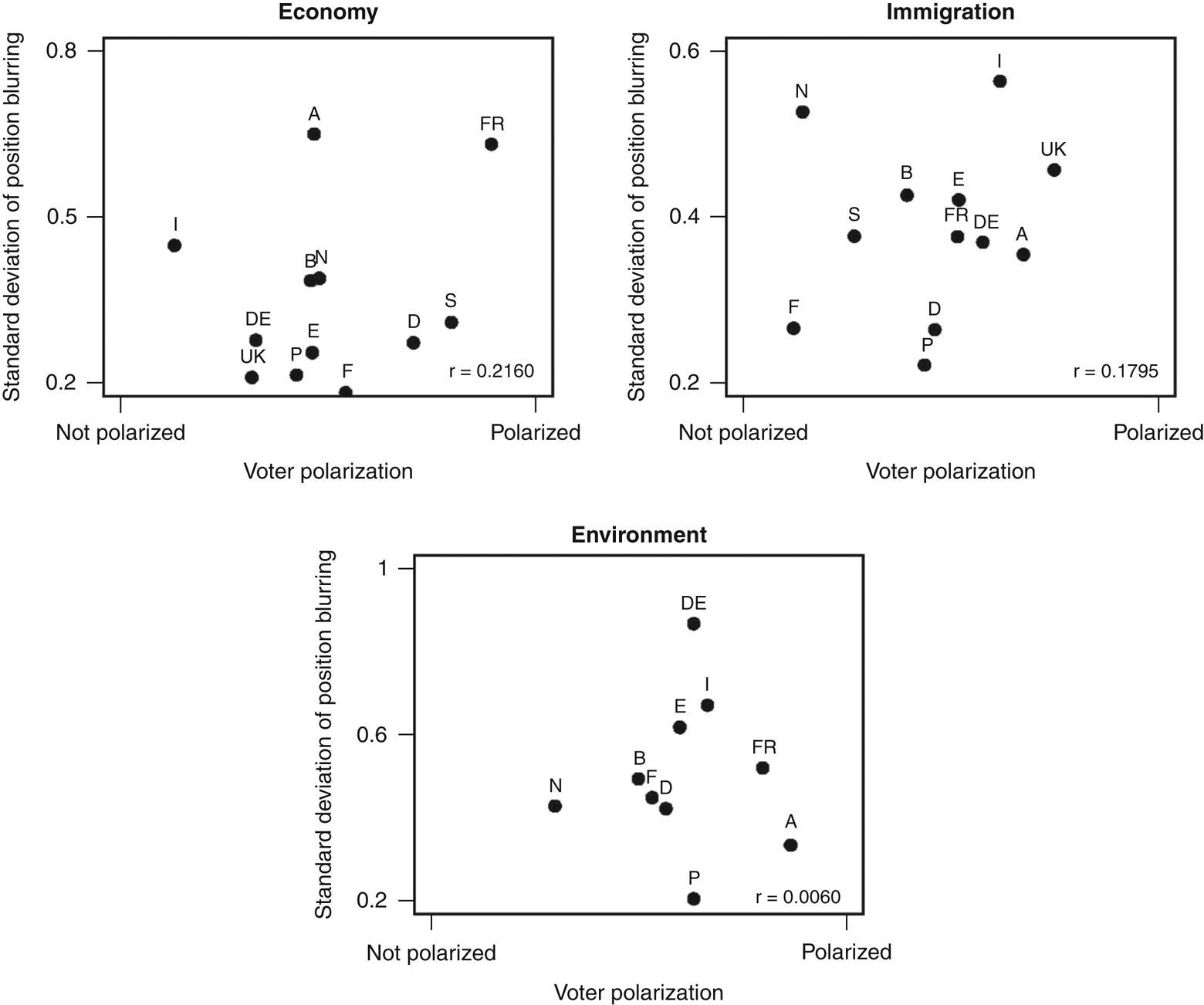
Therefore, voter polarization makes political parties present either clearer or more blurred positions. In other words, political parties do not want to run a risk of presenting either a very clear or an awfully vague position because of the trade-offs between the two when voters’ opinion is not polarized and they do not consider party position very seriously. However, political parties feel pressure to choose between making their position clearer or more blurred when voters become divided in their opinion on an issue. The conflicting incentives confronted by political parties when voters are polarized on an issue can be inferred from the available data on public opinion and party position. Figure 1 shows that the standard deviation of the position blurring variables employed in this article within each country is increased (so some parties come to present vaguer positions while others come to present clearer ones) as voters become polarized.Footnote 49 This pattern is found regarding economy and immigration issues, but not on the natural environment issue. In other words, the graphs imply that voter polarization drives political parties either to make their positions clearer or to blur them more regarding economy and immigration issues.
Voter polarization and the variation in position blurring Note: Voter polarization indicates the standard deviation of public opinion on each issue area in each country. The vertical axes indicate the standard deviation of political parties’ position blurring on each issue in each country (A: Austria, B: Belgium, D: Denmark, DE: Germany, E: Spain, F: Finland, FR: France, I: Ireland, N: the Netherlands, P: Portugal, S: Sweden, and UK: United Kingdom).

We suggest that the effect of voter polarization on political parties’ position blurring can be expected to be a function of issue priority. When political parties confront voter polarization, they present clear positions on their prime issues but blur their positions on secondary issues. Prime issues are issues that demonstrate the core ideological identity of the parties and produce most of the voter support that parties receive.Footnote 50 For example, in Western Europe, environmentalism constitutes the main identity of ecology parties and their supporters and nativism constitutes the main identity of radical right-wing parties and their supporters.Footnote 51 Consequently, ecology and radical right-wing parties put much greater salience on these issues (the natural environment and immigration, respectively) than other political parties do.
Political parties selectively emphasize their prime issues because they have a relatively good reputation on these issues in terms of competence, integrity and reliability.Footnote 52 Since issue ownership, particularly its competence aspect, and position proximity help political parties to gain electoral support, political parties want to take advantage of their reputation and competence by emphasizing their prime issues.
When an issue is a salient issue for political parties and their supporters, voters incorporate the issue more sincerely in their voting behavior.Footnote 53 Moreover, voters care more about how closely a political party’s issue position matches their own when an issue is highly salient (the ‘priming effect’).Footnote 54 Then, when political parties put great salience on an issue either because the issue represents their core ideological identity or because it shows their issue competence and reputation, they need to present a clear position on the issue to emphasize the inter-party difference, help voters consider the issue and take advantage of comparative advantage they have. In contrast, they will want to blur their positions on non-salient issues that do not speak for their identity and competence in order to discourage voters from incorporating the issue in their vote choice.
Issue salience hypothesis: When confronting a polarized electorate, political parties present clear positions on issues salient for them, but blur their positions on non-salient issues.
Party supporters in Western Europe are divided more on the secondary than prime issues of their political parties. For example, mainstream party supporters are divided on non-economic issues and niche party supporters are divided on economic issues.Footnote 55 Although party supporters are divided on secondary issues, political parties can still maintain their support because of party supporters’ homogeneous preferences on the parties’ prime issues that cross-cut their secondary issues. For example, the two main constituencies of radical right-wing parties in Western Europe, manual workers and small business owners, disagree on traditional socioeconomic issues (redistribution and government regulation). However, the cultural threat arising from higher levels of immigration, and greater identification with nation rather than class as a result of rising income inequality,Footnote 56 helped the two constituencies to sustain unity in putting great salience on immigration-related issues and shaping anti-immigrant positions and keep supporting the same parties.Footnote 57
Political parties know that party supporters are critical to the political survival of the parties.Footnote 58 Therefore, when party supporters are divided on an issue, political parties do not want to present clear positions on these issues out of fear that it will result in the loss of what were previously considered core voters.Footnote 59 Instead, they will try to blur their positions and prevent supporters from being disturbed by position distances between themselves and their parties.Footnote 60 For example, many radical right-wing parties consider socioeconomic issues only secondary issues and support both protectionism and anti-egalitarianism.Footnote 61 Then, ‘taking positions may thus be an inappropriate strategy’ under this circumstance and ‘the question “where radical right parties stand” may not be the right one to ask’.Footnote 62
Party supporter division hypothesis: Facing voter polarization, political parties present clear positions on issues regarding which their supporters are not divided, but blur their positions on issues regarding which their supporters are divided.
DATA AND METHOD
Voter Polarization and Issue (Ideology) Voting
We first test whether voter polarization enhances the issue (ideology) voting behavior using the European Election Studies (EES) 2014 data.Footnote 63 The dependent variable is an ordered categorical variable that indicates how probable it is that a person will vote for each party.Footnote 64 The main explanatory variable we want to explore is the interaction term of voter polarization and position (ideological) distance between a person and each party not only regarding the traditional ‘left–right’ dimension but also regarding three specific major political issues (economy, immigration and the natural environment).Footnote 65
The position (ideological) distance variable is the distance between a person’s self-placed position (ideology) and either the estimated party ideololgy (left/right) of hers on each party or ‘objective’ party positions (economy, immigration and the natural environment) from the Chapel Hill Expert Survey on party position data (CHES 2014). The voter polarization variable is the standard deviation of people’s positions (ideologies) on each issue (dimension) (‘left/right’, economy, immigration and the natural environment) in each country seen in EES 2014. The survey questions and the variables of the CHES used in the analyses are summarized in the supplementary appendix.Footnote 66
Voter Polarization, Issue Priority and Position Blurring
We then test how issue salience and party supporter division intermediate the effect of voter polarization on position blurring using the CHES (2010) data.Footnote 67 We use the round of year 2010 because only that round provides all the data needed in this article.
For the dependent variable, two measurements of position blurring are employed in this article. First, it is measured by the standard deviation of expert judgement on party position under the assumption that expert inconsistency on a party’s position arises from the party’s deliberate efforts to make its position vague and ambiguous.Footnote 68 Data are from the CHES (2010). For position blurring on the economy, the average standard deviation of experts’ judgement on party positions on three economic issues is used. For position blurring on immigration, the average standard deviation of positions on three immigration issues is used. For position blurring on the natural environment, the standard deviation of party positions on environmental protection is used.Footnote 69
However, the use of the standard deviation of experts’ judgement on party position for the measurement of the degree of disagreement among experts and position blurring of political parties is not undisputable. First, the standard deviation of responses does not necessarily correlate with the degree to which the responses concentrate on a small number of categories (which can be considered a way of measuring the degree of agreement).Footnote 70 Second, the standard deviation tends to be underestimated for political parties whose positions are located on either end of the scale because the data on their positions are basically censored. Therefore, we also use the degree of multimodality of the distribution of the experts’ judgements as the second measurement of position blurring.Footnote 71 This variable is calculated with the formula invented and presented by van der Eijk.Footnote 72 The two measurements of position blurring are highly correlated (r=0.8850).Footnote 73
This article argues that when voters’ opinion becomes more polarized on an issue, political parties blur their positions when the issue is a secondary issue for the parties but clarify their positions when the issue is a prime issue.Footnote 74 For voter polarization, we use the standard deviation of people’s opinion on each issue from the European Social Survey (ESS, Round 4 in 2008, economy and immigration) and the European Value Survey (EVS, Wave 2008, the natural environment). Answers to two questions that correspond to the economic issues used in the CHES data are used for opinion on the economy, and the average of answers to five questions on immigration are used for opinion on immigration. Finally, for opinion on the natural environment, the answers to a question on environmental protection from the EVS are used.Footnote 75
Two aspects that constitute the issue priority of political parties are measured: issue salience and party supporter division. Issue salience from the CHES data is measured for the economy with the average salience score on three economic issues (improving public services vs reducing taxes; deregulation; and income redistribution); issue salience is measured for immigration with the average salience score on three immigration-related issues (immigration policy, integration of immigrants and asylum seekers, and ethnic minorities); and issue salience is measured for the natural environment using the natural environment salience score.
Regarding party supporter division, we rely on the same data, survey questions and measurements used for the voter polarization variables, but measure the standard deviation of the opinion on each issue (economy, immigration and the natural environment) of people who voted for each political party in the previous election (ESS) or those who would vote for each party in the next election (EVS).
We also add the following control variables. As a party-specific control variable, extremism in party position may determine position blurring. On the one hand, extremism affects position blurring indirectly because political parties with extreme positions and ideologies on an issue tend to want to change the status quo enthusiastically and thus emphasize the issue.Footnote 76 On the other hand, it is difficult to blur extreme positions because of their distinctiveness and visibility.Footnote 77 In addition, the vote share variable needs to be controlled for because the accuracy of people’s perception of party positions may be affected by party size: larger parties not only receive more extensive media coverage but also have more resources for communicating with voters.Footnote 78 Third, skeptics of expert studies suggest that expert judgements are more ‘stable over time because they average together a broad array of evidence’.Footnote 79 Then, people’s certainty about a party’s position may be biased on its age. Therefore, party age in years is included in the model. Finally, while opposition parties are freer in choosing an issue agenda and focusing only on issues that are advantageous to them, incumbent parties are pressured to ‘respond to issues brought up on the party-system agenda’.Footnote 80 Thus, a dummy variable of incumbent parties is included in the analysis.Footnote 81
As environmental control variables, issue dimensionality can be expanded in a system that allows the development and presence of multiple parties.Footnote 82 Then, the dynamic of issue competition (employing unlike strategies between different issues) can be limited in the party system that does not allow multidimensional issue space. Thus, the effective number of political parties is included in the analysis.Footnote 83 In addition, voter attention to an issue as well as voter polarization on the issue needs to be included in the analysis: political parties are pressured to present clear positions on an issue when voters put great salience on the issue. Therefore, a variable indicating the percentage of people who stated that the economy, immigration or the natural environment, respectively, is the most or the second most important issue is included in the analysis. The data are from the ‘most important issue’ questions from the Eurobarometer survey (2008, EB 70.1).Footnote 84
EMPIRICAL RESULTS
Voter Polarization and Issue (Ideology) Voting
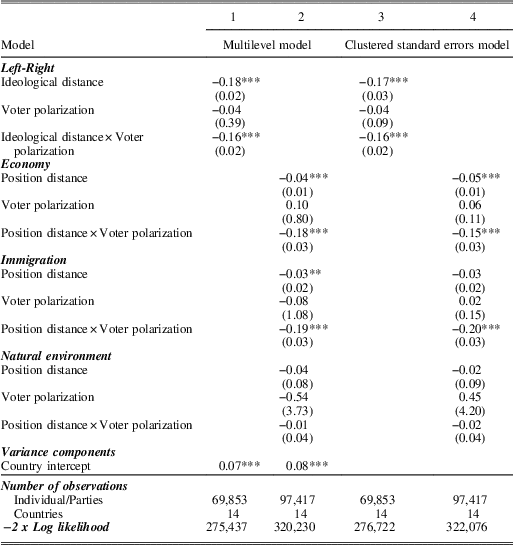
Models in Table 1 examine whether voter polarization enhances the issue (ideology) voting behavior. Models 1 and 2 use the ordered logistic regression with a multilevel analysis model and models 3 and 4 use the ordered logistic model with clustered standard errors. Models 1 and 3 show how voter polarization intermediates the effect of ideological distance on party support regarding the traditional ‘left–right’ dimension, and models 2 and 4 do such an interactive effect on specific issues of economy, immigration and the natural environment.
Voter Polarization and Issue (Ideology) Voting

Note: Standard errors in parentheses; ***p<.01; **p<.05; *p<.1; Estimations on cut-points are not reported.
The results show that voter polarization intensifies the issue (ideology) voting behavior: as voters become polarized on an issue (on the ‘left–right’ ideological dimension), they become more probable to vote for a party whose position on the issue (‘left–right’ ideology) is close to the voters’ ones.Footnote 85 The interactive effect is found among all the issues except for the natural environment issue.Footnote 86
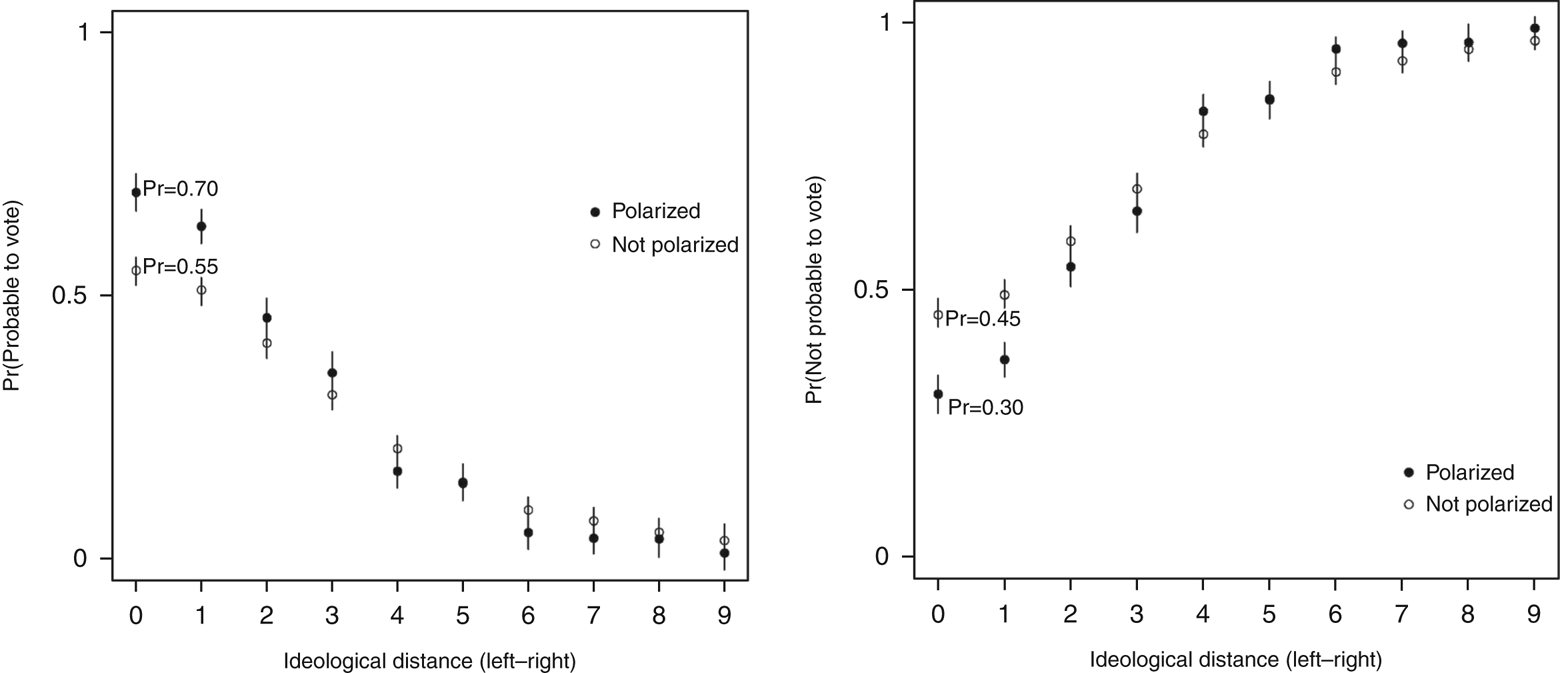
Figure 2 presents the predicted probabilities of whether a person is likely to vote for a party (the answer scale 6~10 of the dependent variable) or not (the answer scale 1~5 of the dependent variable) that are determined by voter polarization and ideological distance regarding the ‘left–right’ dimension.Footnote 87 The graphs first show that as the ideological distance between a person and a party increases, the probability of ‘being probable to vote’ for the party decreases (the left-hand-side graph) while that of ‘not probable to vote’ for the party increases (the right-hand-side graph). Second, voter polarization increases people’s probability to indicate that they are probable to vote for a party (and consequently decreases people’s probability to indicate that they are not probable to vote for a party) that is ideologically very close to themselves: for example, when voters do not find ideological distance (distance=0), their probability of ‘being probable to vote’ for the party increases from 0.55 to 0.70 as voter polarization increases (the left-hand-side graph).
Voter polarization and ideology voting Note: Scales 6–10 in the answer to the question of ‘How probable is it that you will ever vote for the following parties?’ are coded as ‘probable to vote’, and scales 1–5 are coded as ‘not probable to vote’. ‘Polarized’ voter opinion represents the 90th percentile value of the voter polarization variable, and ‘not polarized’ voter opinion indicates its 10th percentile value. Ideological distance is the distance between a person’s self-placed left-right ideology and the estimated party ideology of hers on a party.

All in all, as voters become polarized among them in their ‘left–right’ ideologies or issue positions, they become more likely to vote for a party whose ‘left–right’ ideology or position on the issue is very close to themselves. Therefore, these results confirm that voter polarization enhances voters’ issue (ideology) voting pattern and imply that they consider positional and ideological proximity more heavily as their opinion becomes polarized.
Voter Polarization, Issue Priority and Position Blurring
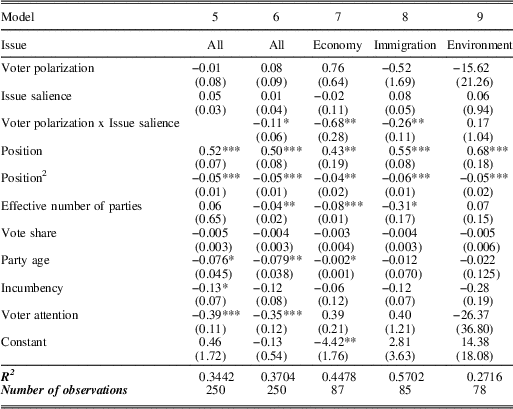
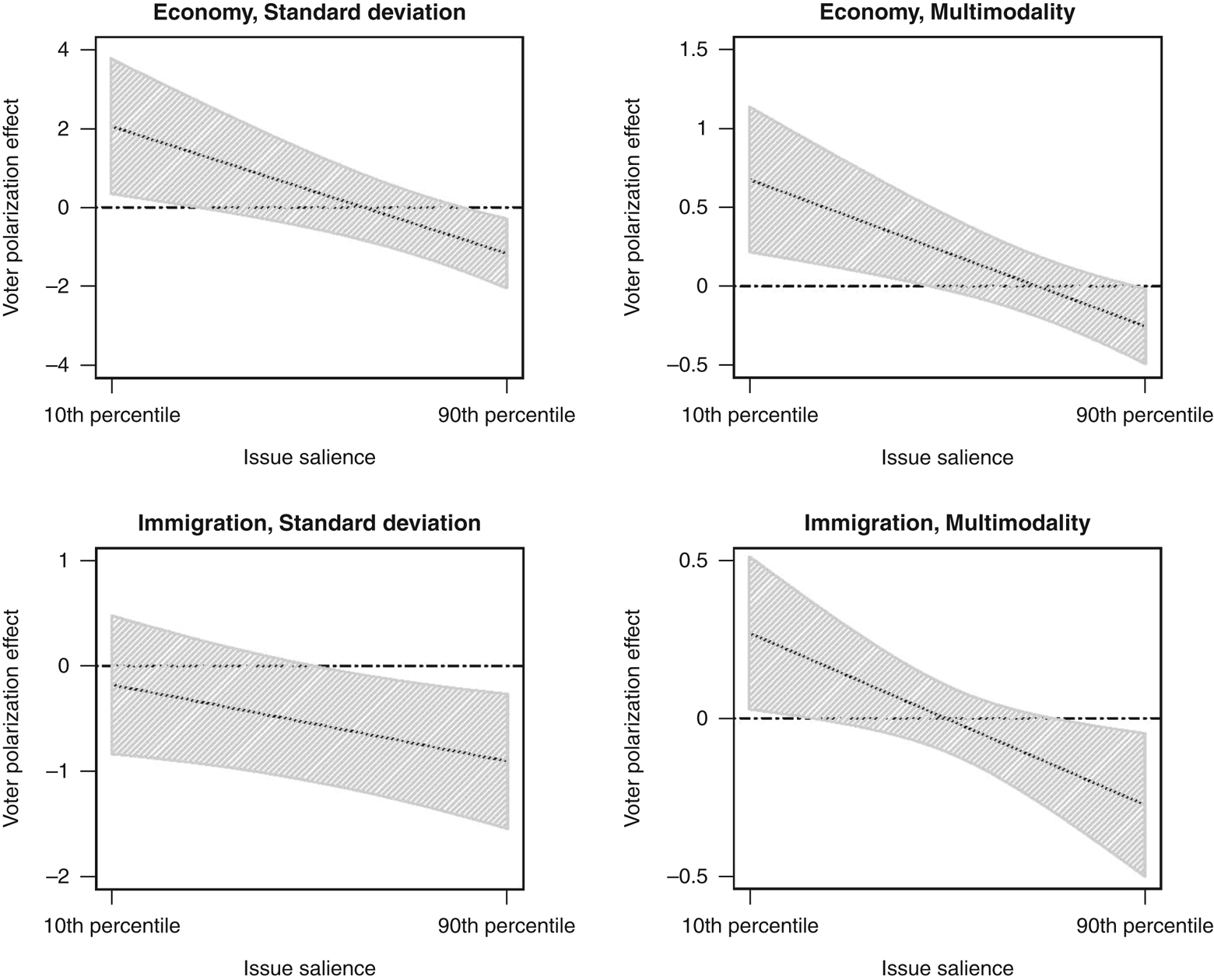
The models in Tables 2 test the issue salience hypothesis and include interaction terms consisting of the voter polarization and issue salience variables. The standard deviation of experts’ party position scores is used to measure position blurring. All the three issues (economy, immigration and the natural environment) are examined all together in models 5–6, but each issue is separately analyzed in the following models. First of all, the result in model 5 that does not include the interaction term of voter polarization and issue salience implies that neither polarization nor issue salience has an independent effect on position blurring. Instead, the result in model 6 shows that voter polarization and issue salience have an interactive effect on position blurring: as the issue salience level increases, the position-clarifying effect of voter polarization increases. However, while such an interactive effect is found regarding economy and immigration issues (models 7–8), it is not observed regarding the natural environment issue (model 9). The results from using the multimodality index, which are very similar to those from using the standard deviation, are reported in the supplementary appendix (Table S5).
Testing the Issue Salience Hypothesis (DV=standard deviation)

Note: Standard errors in parentheses; ***p<.01; **p<.05; *p<.1.
The interactive effect of voter polarization and issue salience is graphically presented in Figure 3. The vertical axes of the graphs indicate the conditional coefficients and standard errors of the voter polarization variable at different levels of issue salience (the horizontal axes). The graphs show that while voter polarization makes political parties blur their issue positions (or does not have an effect on position blurring) when the issue salience level is low for the parties, it encourages them to present clear positions when the issues are salient issues for the parties. The interpretation of the cut-off points suggests that voter polarization on economic issues results in clearer positions on these issues by parties that belong to the social democratic, liberal, conservative and Christian democratic party families, but not other parties. The cut-off points also suggest that while radical right-wing parties present clearer positions on immigration when voters are polarized on the issue, this is not the case for other party families.
Voter polarization, issue salience and position blurring Note: Solid lines are coefficients, and shaded areas indicate 95% confidence levels. The coefficients and confidence levels of the two left-hand-side graphs are calculated using the standard deviation to measure position blurring and those of the two right-hand-side graphs are calculated using the multimodality index to measure position blurring.

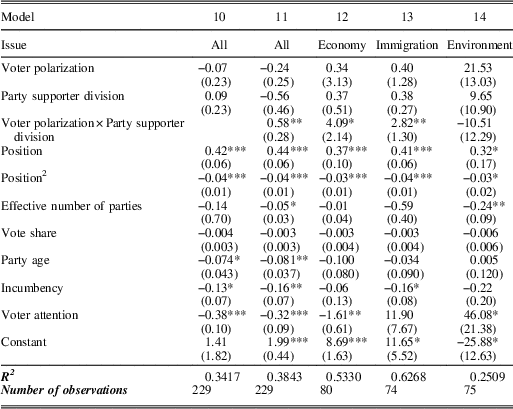
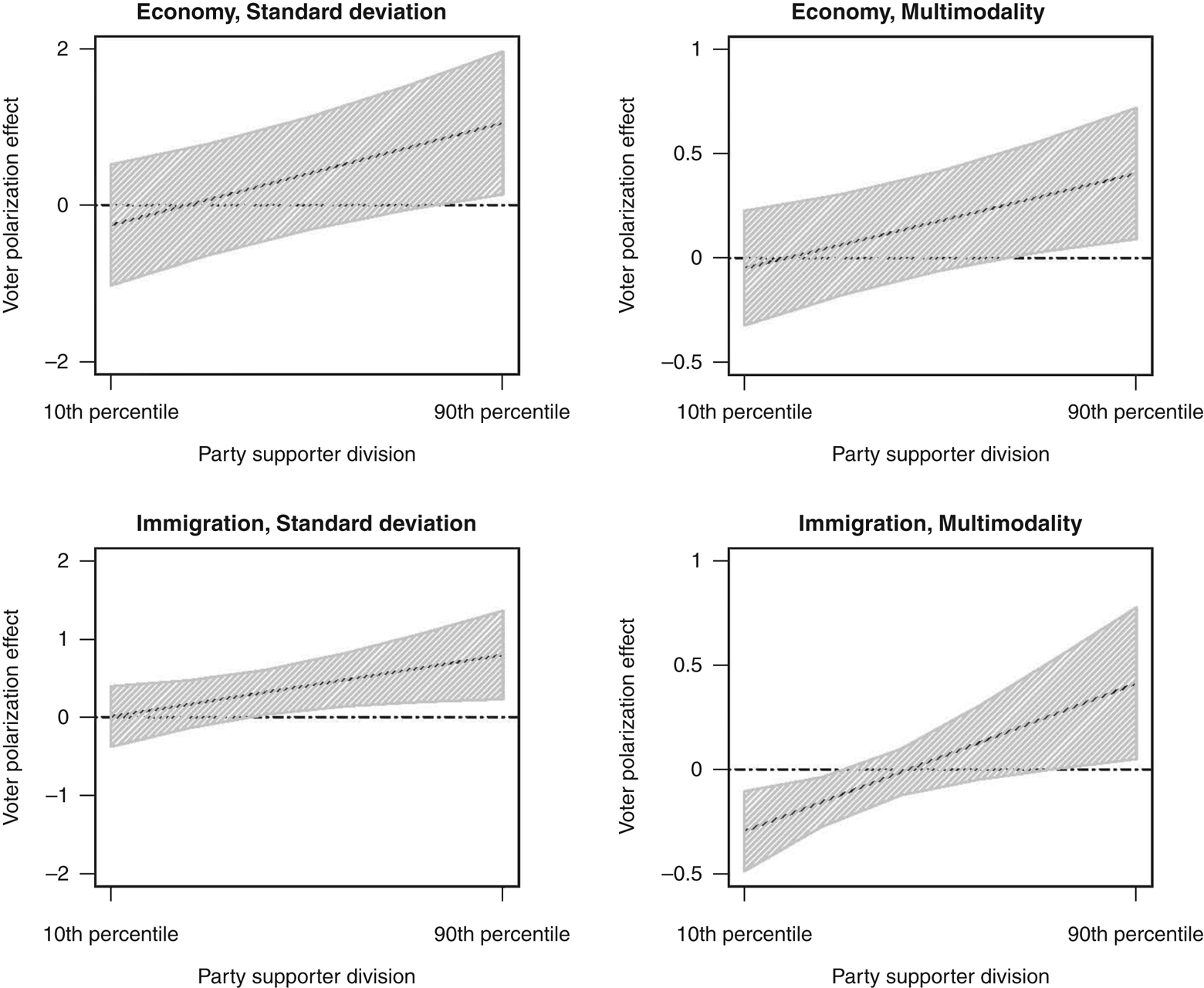
The models in Table 3 test the party supporter division hypothesis and include interaction terms consisting of the voter polarization and party supporter division variables.Footnote 88 Similar implications are drawn to the previous results. First, neither voter polarization nor party supporter division has an independent effect on position blurring. Second, there is an interactive effect of voter polarization and party supporter division on position blurring: the position-blurring effect of voter polarization is intensified as political parties’ supporters become more divided on an issue. Third, such an interactive effect of voter polarization and party supporter division is found only regarding economic and immigration issues.Footnote 89
Testing the Party Supporter Division Hypothesis (DV=standard deviation)

Note: Standard errors in parentheses; ***p<.01; **p<.05; *p<.1.
The interactive effect of voter polarization and party supporter division is graphically presented in Figure 4. The vertical axes of the graphs indicate the conditional coefficients and standard errors of the voter polarization variable at different levels of party supporter division (the horizontal axes). The graphs show that voter polarization makes political parties blur their positions when party supporters are divided on the polarized issue, but not when party supporters are united on that issue. Similar implications are drawn about the cut-off points: ecology parties and radical right-wing parties typically blur their positions on economic issues when voters are polarized on these issues and political parties other than radical right-wing parties blur their positions on immigration when voters are polarized on this issue.
Voter polarization, party supporter division and position blurring Note: Solid lines are coefficients, and shaded areas indicate 95% confidence levels. The coefficients and confidence levels of the two left-hand-side graphs are calculated using the standard deviation to measure position blurring and those of the two right-hand-side graphs are calculated using the multimodality index to measure position blurring.

In sum, the results demonstrate that when political parties confront a polarized electorate, they present clear positions on those issues on which they put great salience and their supporters are not divided, but blur their positions on other issues that are secondary to the party and on which their supporters are divided.Footnote 90 However, this interactive effect of voter polarization and issue priority is found only for economic and immigration issues, not issues pertaining to the natural environment.Footnote 91 One plausible explanation for this finding is that unlike economy and immigration issues, the natural environment issue has a character of valence issues,Footnote 92 which ‘merely involve the linking of the parties with some condition that is positively or negatively valued by the electorate’.Footnote 93 The positional evaluation of a political party is employed by voters regarding a valence issue less actively than regarding a positional issue because voters hold very similar positions on the issue.Footnote 94 Then, position blurring regarding the natural environment issue may not be determined by party competition conditions such as voter polarization and issue priority because the issue is not a positional issue like economy and immigration issues.Footnote 95
In addition, why does issue priority not have an independent effect on position blurring? Why does it need voter polarization as a pre-existing condition that activates its effect on position blurring? As was discussed earlier, political parties face a trade-off between presenting a clear position (and constraining plausible policy alternatives they can choose after winning elected office) and blurring a position (and going through electoral risks and normative criticism). Then, political parties will not want to run a risk of presenting either a very clear or an awfully vague position when voters do not consider position proximity much. However, political parties may have to make a hard choice between making their position more visible (clearer positions) and turning voters’ attention away (more vague positions) when voters find themselves more different to each other in their issue opinion and incorporate party position more heavily in their voting behavior. Then, the choice by political parties is determined by the priority of the issue for the parties.Footnote 96
CONCLUSION
This article finds that the extent to which a political party presents clear positions on an issue in the context of voter polarization is dependent on whether the issue is of primary importance to the party and the extent to which the party’s core supporters are united on the issue. The findings in this article are consistent with the issue competition literature that suggests that political parties attempt to draw voters’ attention to issues advantageous to the parties but attempt to move voters’ attention away from issues that are unfavorable to the parties.Footnote 97 Position blurring can be used by a political party to discourage voters from paying attention to an issue that may place the party at a comparative disadvantage.Footnote 98
The findings in this article may also help to reconcile two seemingly contradictory findings in the literature on the electoral consequences of position blurring. On the one hand, the ‘obfuscation’ literature in American politics suggests that political parties lose votes by blurring their positions on economic issues.Footnote 99 On the other hand, the literature on Western European party politics suggests that political parties, at least some families of political parties, can gain votes by blurring their position on economic issues.Footnote 100 These findings may be the result of economic issues being prime issues for political parties in the United States, but the same issues composing the secondary issues for at least some political parties (niche parties) in Western Europe.Footnote 101
Though the link between issue priority and position blurring is implicitly recognized in the previous literature on position blurring,Footnote 102 the role of voter polarization that increases the functioning of the link is not considered by the literature. As is found in this article, though political parties want to clarify their position on their prime issue and blur their position on their secondary issue, the pattern of such a dual strategy gets stronger when voters are polarized on an issue and they significantly incorporate the position distance on the issue in their voting behavior. Therefore, the finding implies that we need to take voter polarization into account in the discussion on the politics of position blurring.
The ‘responsible party model’ of political representation suggests that it is normatively desirable for political parties to represent the policy stances of their supporters because ‘citizens in Western democracies are represented by and through parties’.Footnote 103 Therefore, political parties are expected to ‘offer distinct policy options or programs, so that voters are given meaningful electoral choice’.Footnote 104 Then, position blurring, regardless of its strategic advantages in election campaigns, will violate the norm on the role of political parties as linkage mechanisms. However, the results reported here suggest that increasingly polarized opinion on economic and immigration issuesFootnote 105 results in some political parties presenting clearer positions on one of these issues (for example, those that focus disproportionately on economic issues such as many of the mainstream parties will clarify their position on economy more and those that focus disproportionately on immigration issues such as radical right-wing parties will present clearer positions on these issues) and others presenting vaguer positions (those that do not focus on economic issues such as many of the niche parties will blur their position on these issues more). Thus, the current political context will lead some political parties to better conform to the ‘responsible party model’ than others, but the answer on which political parties do better will depend on issue priority.