From library to Mediathek
‘By transforming a largely oral scholarly culture into a largely written one’, as Ian F. McNeely and Lisa Wolverton state in Reinventing Knowledge, ‘the library made the Greek intellectual tradition both portable and heritable.’Footnote 2 Both aspects - the availability of information (ubiquity) and the memorability of knowledge (transmission/tradition) - are still key requirements for libraries, even if the (physical) space, as a third factor, has increasingly gained in importance during the last two decades. Remarkable renovation, restoration and/or new constructions within the library sector emphasize this trendFootnote 3 and encourage, simultaneously, the ever-growing demand for a flexible ‘third place’.Footnote 4 Architectural tenders, competitions and concepts reveal the entanglement of specific informational needs, a dedicated culture of media usage and variable spatial ideas and their correlations in the field of academic learning concepts.
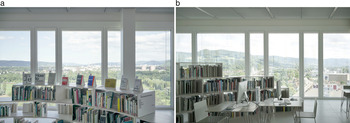
At the Mediathek these (blending) requirements become even more acute and thus explicit, since the place is designed to encourage artistic creativity. The specific place (8th/top floor of the faculty building), its equipment (shelves as in-situ sculpture) and the surrounding environment (mountainous landscape/city panorama) provide an organic structure which is meant to enable flexible (literature) research, cross-disciplinary thinking and the generation of new ideas. Functionality and aesthetics converge into a structure (and structuring) of knowledge that is deeply linked to historic, current and possibly future ideas of information. The historic stocks of six different art and design departments, each with their different ways of thinking, are combined in a postmodern mix of boxes and structures (Fig. 1). At the same time the open arrangement invites users to browse through the boxes (shelves), touch media, use them and relax – even though this mix can cause logistical problems.
Interior with views of the surroundings: the Visual Communication shelf with new acquisitions (left) and the view of the research station and the Schaulager in the background.

From space to catalogue
The media library is shaped by an array of circa 460 book boxes with double-sided access, which merges into 17 alphabetically named rows, echoing the structure of the surrounding hilly landscape (Black Forest, Jura, Voges). The rows vary in length and height and reach sometimes a maximum of four levels. The abandonment of a more conventional, vertical orientation encourages visitors to linger (and literally browse): education as expansion of one's own horizon, for casting a look outside is possible at any moment. The flowing structure leads the formerly separate book and media collections of each institute together so that the concept of a plural space, implicit in the discussion of the space of knowledge as an interplay of real, virtually interconnected and medially communicated (heterotopic) space, becomes graspable.
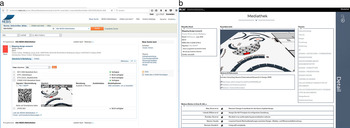
The physical spatial structure and the thematic attachment to – various in total but in detail intentionally dedicated - systematic clusters serves to anchor the media digitally (3D model). Books, magazines and DVDs appear alongside eResources and form meaningful statements. A preview image with its respective location/designation leads directly from the NEBIS library network (the Swiss national co-operative catalogue) to the Mediathek's own integrated catalogue, online at https://mediathek.hgk.fhnw.ch, and back again via Signatur (the German word for shelfmark). Here the specific medium is listed along with all the other resources available in the same box (Fig. 2).
From NEBIS catalogue (left) to Mediathek's “integrated catalogue” (right)

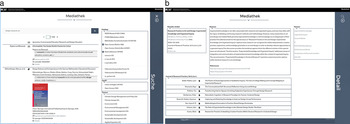
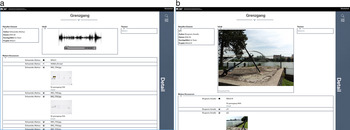
A specific, JavaScript-based presentation template was developed for each media type,Footnote 5 enabling the semantic contextualization of the material/entries of each sub-collection: For the DOAJ articles, the whole issue of a given journal is reconstructed; for ebooks, access is already possible on the level of the list preview (Fig. 3); for research resources, project-specific contexts are retraced (Fig. 4); for external resources, links lead to the local repository. An own data warehouse with full-text index, discovery and data-mining mechanisms was developed for referencing all types of different context, focusing on open-access contents, nationally licensed media and the collection holdings of external data providers (e.g. art and design collections). Thus the central interface enables searching through distinct collections and heterogeneous materials within one website.
“Integrated catalogue” list view and reconstructed issue

Research Project Grenzgang

Research and research data in the Mediathek
Subsequent to the establishment of a technological foundation and a stable, continuously growing database, the question of how content can be presented domain-specifically becomes central. A specific software layer for digital curation is currently implemented which shall enable the presentation of scientific information and data in such a way that users could influence the prioritizing of output results. The clustering of facets and their contextualization will revert thereby to partially automated routines which use standardized thesauri and ontologies. One of the challenges is thus to classify metadata and maintain stability even where the data sets’ IDs vary; as, for example, in our classic library media holdings, for which the metadata is provided with daily updates by the cross-network information provider Swissbib.
Further challenges can be found in the context of (artistic) research data and regarding the ingest of historical media holdings. In both cases, it's primarily the format variety (text, audio, video, GPX, 3D, layer-based image data as well as further contents in proprietary or legacy formats) which becomes a technical challenge, though the varying singular qualities of the metadata offered do too. Confronting such challenges clearly demands a great deal of workmanship and patience. And yet, the threshold to the archive often proves to be a decidedly impressive place, one at which the subjectivity of person-bound knowledge becomes especially palpable. Codifying person- and context-bound knowledge or differentiating between the project-bound knowledge of the research group and documentary standards, classifying the view/interest of the institution, are topics which must be addressed in order to grant each their own space (on the metadata level).
This tension seems important and especially interesting for multiple reasons: It allows for understanding the data gathered as discursive material, which generates new knowledge continuously, rather than stabilizing established knowledge in an orthodox and immutable way. To keep data valuable and relevant, an active accumulation of knowledge is enabled, e.g. by adapting / updating the terminology applied to the users’ experience. Regarding the documentation and communicative (educational) situation, metadata structures and their usage shall therefore become more flexible and customizable. Therefore, we have to consider that new forms of ‘creative archiving’ gain more and more importance. They contribute, according to Athanasios Velios, ‘to the interrelation of an archive’ and result in ‘an additional layer of interpretation, typically through an online interface, which illustrates the archivist's ideas about the core concepts kept within the archive material’.Footnote 6 In technical terms, this additional layer is referred to as an add-on. The original data set is preserved and kept untouched in the index of the ‘integrated catalogue’ of Mediathek. Thus, curation actions can be handled as metadata operations that add value throughout life-cycle.Footnote 7