Introduction
Tropical forests and the primate communities inhabiting them are suffering unprecedented rates of anthropogenic disturbances (Almeida-Rocha et al. Reference Almeida-Rocha, Peres and Oliveira2017, Estrada et al. Reference Estrada, Garber, Rylands, Roos, Fernandez-Duque, Di Fiore, Nekaris, Nijman, Heymann, Lambert, Rovero, Barelli, Setchell, Gillespie, Mittermeier, Arregoitia, De Guinea, Gouveia, Dobrovolski, Shanee, Shanee, Boyle, Fuentes, Mckinnon, Amato, Meyer, Wich, Sussman, Pan, Kone and LI2017). Changes in plant-primate interactions caused by disturbances may trigger other effects rippling through the complex ecological networks of these ecosytems (McConkey & O’Farrill Reference Mcconkey and O’Farrill2016, McConkey et al. Reference Mcconkey, Prasad, Corlett, Campos-Arceiz, Brodie, Rogers and Santamaria2012). Seed dispersal through frugivory is a prominent plant–primate interaction in most tropical forests (Andresen et al. Reference Andresen, Arroyo-Rodríguez and Ramos-Robles2018, McConkey Reference Mcconkey2018). Primate seed dispersal often causes the spatial aggregation of seeds in locations used for resting. Recurrent input of seeds can result in higher densities of juveniles of the dispersed plant species (Anzures-Dadda et al. Reference Anzures-Dadda, Andresen, Martínez-Velázquez and Manson2011, Bravo Reference Bravo2012, Julliot Reference Julliot1997, Russo & Augspurger Reference Russo and Augspurger2004). Thus, a decline in primate abundance may alter plant community patterns (Stevenson Reference Stevenson2011) and ecosystem function (Peres et al. Reference Peres, Emilio, Schietti, Desmouliere and LEVI2016).
Conversion of natural ecosystems to agricultural lands is one of the main drivers of primate declines (Almeida-Rocha et al. Reference Almeida-Rocha, Peres and Oliveira2017, Estrada et al. Reference Estrada, Garber, Rylands, Roos, Fernandez-Duque, Di Fiore, Nekaris, Nijman, Heymann, Lambert, Rovero, Barelli, Setchell, Gillespie, Mittermeier, Arregoitia, De Guinea, Gouveia, Dobrovolski, Shanee, Shanee, Boyle, Fuentes, Mckinnon, Amato, Meyer, Wich, Sussman, Pan, Kone and LI2017). However, certain types of agro-ecosystem may have high value for maintaining biodiversity in general (Goulart et al. Reference Goulart, Jacobson, Zimbres, Machado, Aguiar, Fernandes and Lameed2012, Perfecto & Vandermeer Reference Perfecto and Vandermeer2008) and primates in particular (Estrada et al. Reference Estrada, Raboy and Oliveira2012, Guzmán et al. Reference Guzmán, Link, Castillo and Botero2016, Zárate et al. Reference Zárate, Andresen, Estrada and Serio-Silva2014). Given the current trends of land-cover change, primate extinctions and the consequent loss of their ecological functions might be avoided if populations are able to survive in modified landscapes (Almeida-Rocha et al. Reference Almeida-Rocha, Peres and Oliveira2017), a scenario in which ‘ecologically-friendly’ agro-ecosystems can play a crucial role.
Despite the available information on primate presence in agricultural systems, we know little about how primate interactions with plants are altered in agro-ecosystems (Andresen et al. Reference Andresen, Arroyo-Rodríguez and Ramos-Robles2018, Estrada et al. Reference Estrada, Raboy and Oliveira2012). For example, while several studies have assessed aspects related to seed dispersal by primates in agro-ecosystems, such as diet and foraging patterns (Williams-Guillén et al. Reference Williams-Guillén, McCann, Martínez Sánchez and Foontz2006), very few studies have focused directly on seed dispersal, either of the crop species (Hockings et al. Reference Hockings, Yamakoshi and Matsuzawa2017), or of native plants (Zárate et al. Reference Zárate, Andresen, Estrada and Serio-Silva2014). Further, primary seed dispersal is only one step in the complex multi-phase seed-dispersal cycle (sensu Wang & Smith Reference Wang and Smith2002) of plant regeneration. Given a high context-dependency in the outcome of each phase (Balcomb & Chapman Reference Balcomb and Chapman2003, Feer & Forget Reference Feer and Forget2002), and conflicts among them (Schupp Reference Schupp, Dennis, Schupp, Green and Westcott2007), the direction and/or intensity of the effects of anthropogenic disturbances on plant regeneration are not always easy to predict (Anzures-Dadda et al. Reference Anzures-Dadda, Manson, Andresen and Martínez-Velázquez2016, Kurten Reference Kurten2013).
Primary seed dispersal by the black howler monkey (Alouatta pigra Lawrence 1933) is known to be similar in both rustic cocoa plantations and rain forest in the Lacandona region of Mexico (Zárate et al. Reference Zárate, Andresen, Estrada and Serio-Silva2014). The main objective of our study was to test the hypothesis that, while the post-dispersal fate of seeds dispersed by howler monkeys and the resulting seedling recruitment will be affected by the seed-deposition pattern associated with howler monkeys’ primary seed dispersal, this effect will be similar in the two habitats. We designed two field experiments to assess the following predictions: (1) The post-dispersal fate of seeds and seedlings is not affected by habitat (cocoa vs. forest) but is affected by seed deposition location (monkey latrine vs. control), and (2) the density of naturally recruited seedlings of monkey-dispersed species does not differ between habitats, but differs in monkey latrines vs. control locations.
Study Site
Research was conducted in the Lacandona rain-forest region in the Mexican state of Chiapas (Marqués de Comillas Municipality; 16º8′58.13′′N, 90º53′40.27′′W). The predominant natural vegetation is tropical rain forest. Mean annual temperature and rainfall range between 24–26°C and 2500–3500 mm, respectively (Estrada et al. Reference Estrada, Van Belle and García Del Valle2004). With an area of 13,000 km2, the Lacandona region represents one of the few large remaining areas of tropical rain forest in Mesoamerica and the last one in Mexico and is considered a very important reservoir of biodiversity (Cuarón Reference Cuarón2000). South-east of the main protected area (Montes Azules Biosphere Reserve) lies the human-modified landscape where we carried out this study; it consists of a mosaic of different vegetation types, including large forest areas (> 2000 ha), forest fragments, shade cocoa plantations, annual crops and pastures.
We conducted our study during a 26-mo period (May 2011–July 2013), in a 120-ha area covered by shade cocoa and in the abutting forest (> 2000 ha local reserve where hunting and logging are prohibited). The shade cocoa was under rustic management, which means that the cocoa trees are planted in the understorey of the original forest cover and that management intensity is low (Moguel & Toledo Reference Moguel and Toledo1999). Cocoa trees in the study region were planted in the 1980s. However, in the 1990s most cocoa plantations were abandoned or replaced by other crops, due to a fungal disease. At the time of our research, management of plantations included low levels of cocoa harvest, some pruning and removal of a few shade trees. The number of native tree and liana species was similar in the two vegetation types; in cocoa, mean stem density (diameter at breast height ≥10 cm) of native trees and lianas was lower than in forest, but when cocoa trees were included in the measurement, overall stem density was higher in cocoa plantations (Zárate et al. Reference Zárate, Andresen, Estrada and Serio-Silva2014).
At the time the study was conducted, the number of groups and individuals of howler monkeys in the two habitats was similar (14 and 13 groups in 120 ha; 44 and 41 individuals km−2, in cocoa and forest, respectively). Some groups lived exclusively in one or the other vegetation type and some groups included both cocoa and forest in their home ranges (Zárate et al. Reference Zárate, Andresen, Estrada and Serio-Silva2014). We carried out our experiments within the home ranges of three monkey groups that exclusively inhabited cocoa and three groups that exclusively inhabited forest. The three groups in cocoa and the three in forest had similar activity areas (8.9 ha in cocoa, 5.4 ha in forest), number of individuals (8 in the forest, 6–8 in the cocoa), behavioural parameters and seed-dispersal patterns (Zárate et al. Reference Zárate, Andresen, Estrada and Serio-Silva2014).
Methods
Seed and seedling fate
Focal species and experimental design
We conducted field experiments with seeds and seedlings of one focal plant species in the Moraceae, Brosimum lactescens (S. Moore) C.C. Berg. Brosimum lactescens is a shade-tolerant, slow-growing canopy tree with fleshy fruits consumed by frugivorous birds and mammals, and thus seed dispersal of this plant species does not solely depend on the howler monkey. However, rather than assessing the post-dispersal fate of seeds and seedling of this plant species in particular, our aim was to compare post-dispersal processes between habitats and between seed-deposition sites, for which we used B. lactescens as a model species.
In the study sites B. lactescens has high values of relative density and basal area and is a very important species in the howler monkey’s diet (Zárate et al. Reference Zárate, Andresen, Estrada and Serio-Silva2014). Seeds are relatively large (10 × 9 mm, 0.4 g fresh weight), lack dormancy and germination of seeds collected from fallen fruits occurs mostly within 2 wk (65%) in our study region (Benítez-Malvido et al. Reference Benítez-Malvido, González-Di Pierro, Lombera, Guillén and Estrada2014). Total germination percentage is 80% for seeds from fallen trees and ∼100% for seeds defecated by black howler monkeys (Benítez-Malvido et al. Reference Benítez-Malvido, González-Di Pierro, Lombera, Guillén and Estrada2014). Seedlings establish in the understorey and are shade-tolerant. Fruiting showed a bimodal pattern during our study, with ripe fruits being present during two main periods: March–June and October–December. The first period coincides with the peak fruiting period of the tree community.
In each of the two habitats, within the home ranges of three groups that inhabited the forest and three groups that inhabited the cocoa, we chose 30 experimental sites: 15 monkey latrines and 15 control locations (non-latrine), for a total of 60 sites. Latrines were identified as areas of the forest where ≥25% of all the defecations observed during 18 mo for each monkey group occurred, while control locations were areas where defecations were never observed. Latrines occur underneath trees used for resting, and howler monkeys generally chose large trees for this activity. All cocoa and forest latrines were in areas used by monkeys that exclusively inhabited the cocoa and forest habitat, respectively (Zárate et al. Reference Zárate, Andresen, Estrada and Serio-Silva2014). Distance between experimental sites was ≥50 m; distance between sites and adult B. lactescens trees was also ≥50 m. To characterize the microclimate experienced by seeds and seedlings in the two habitats and the two types of seed-deposition location we measured illuminance (with an Extech light meter at sunrise, between 06h00 and 06h15, to avoid variation due to sunflecks or different degrees of cloudiness among days), relative humidity and maximum air temperature (measured with a HOBO U23-001 v2 data logger for 20 d per plot). Measurements for all 60 sites were taken during March–April 2013.
Seed survival
In May 2011 we obtained 300 B. lactescens seeds from freshly fallen fruits with no external sign of any damage, collected underneath five parent trees. Seeds were manually extracted from fruits and after 1–2 d were marked by attaching a 1.5-m-long nylon thread with epoxy cement in order to facilitate finding seeds that were moved by animals (Forget Reference Forget1990). The following day (to allow for the cement to dry), marked seeds were individually imbedded in 10 g of fresh howler monkey dung (i.e. dung collected that same morning of the experimental setup) and immediately placed on the forest surface. In each of the 60 experimental sites we placed five seeds on the forest floor in a 2 × 2-m area (leaf litter was not removed). Seed fate was recorded for 2 wk (according to the time of germination observed in the next experiment), using the following categories: seed apparently intact and visible on the soil surface (only dung removed by dung beetles), seed apparently intact and buried by dung beetles, seed apparently intact and moved by dung beetles under the leaf litter (dung beetles were identified as the secondary dispersers in these cases, because seeds were found <1 m from the original position and often a dung beetle burrow was observed in the immediate vicinity), seed eaten (by rodents, when husk remains or a partially eaten seed was found; by insects, when a small exit hole was observed and the seed was empty), seed attacked by pathogens (rotten seeds) and seeds removed (when only the thread remained but the seed had been removed, most likely by rodents, and was not found). Seeds in the first three fate categories were considered alive as they did not show any evident damage; seeds in the three latter categories were considered dead. However, we acknowledge that some of the seeds removed by rodents could have been secondarily dispersed, rather than preyed upon immediately, as we discuss later.
The seeds used in this experiment did not germinate (we continued observing them for a total of 60 d). We believe that storing the dry seeds for 2–3 d before placing them in the field may have caused viability loss due to desiccation (seeds of other Brosimum species are known to be recalcitrant or desiccation-sensitive; Mayrinck et al. Reference Mayrinck, Vaz and Davide2016). Nonetheless we believe that the results of this experiment give us a relatively accurate idea of what happens to seeds after being deposited in dung on the forest floor, before germination occurs.
Seed germination, seedling establishment, survival and growth
Because seeds used in the previous experiment did not germinate, we set up an additional experiment in November and December 2011, during the second fruiting period, to assess germination, establishment and seedling performance. We repeated the same experimental design as described above, but the 300 seeds were only extracted from the fruits at the moment of experimental setup (to avoid desiccation), they were not marked nor imbedded in dung, and they were protected against predation/removal by rodents with a small (15 × 10 cm) wire mesh cage (mesh size 0.5 × 0.5 cm). To allow seedlings to continue growing, the top of the cage was removed when seedlings were ∼10 cm tall. We recorded germination at the moment of radicle appearance and seedling establishment when we observed the first two leaves. Seedling survival and growth measurements were carried out for 19 mo. We refer to these seedlings as the ‘experimental cohort’ and they represent an early seedling phase.
We also assessed survival and growth of B. lactescens seedlings that we found naturally established in the same experimental sites in July 2011. In each site we chose five seedlings that were 8–10 cm tall and that still had cotyledons attached; according to field observations we estimate that these seedlings were ∼6 mo old. We refer to these seedlings as the ‘natural cohort’ and they represent a later seedling phase. We recorded initial seedling height and number of leaves; seedling survival and growth was recorded for 24 mo.
Seedling assemblages
To assess the influence of howler monkey primary seed dispersal on the tree and liana seedling bank in both habitats (forest and cocoa), we compared seedling and species densities found in howler monkey latrines and in control locations. In each habitat we selected nine latrines and nine control locations. At each of these 36 sites we set up a 5 × 5-m plot, subdivided into 25 1-m2 subplots. We randomly chose 10 of these subplots and in each we counted and identified all tree and liana seedlings ≤ 50 cm height. Seedlings in the 360 subplots were recorded within a 3-mo period (February–April 2013). Seedlings were identified to species and classified as originating from: (1) all fruits; (2) fleshy fruits found in the howler monkey’s diet by Zárate et al. (Reference Zárate, Andresen, Estrada and Serio-Silva2014); (3) fleshy fruits not found in the monkey’s diet by Zárate et al. (Reference Zárate, Andresen, Estrada and Serio-Silva2014); and (4) dry fruits (dispersal through abiotic vectors or granivorous animals). The three latter categories are mutually exclusive and they add up to yield the seedlings in the first category. For each site we estimated mean seedling and species density calculating the average of the 10 subplots, except for the category of dry fruits. For dry fruits, data contained large number of zeroes, so we used the sum over the 10 subplots.
Data analyses
To evaluate the effects of the two fixed factors, each with two levels, habitat (cocoa vs. forest) and seed-deposition (latrine vs. control), we carried out generalized linear models in the R program version 3.4.4. For the three microclimatic variables, seedling growth and density of seedlings and species, we used normal error structure. For binomial variables (proportions of seeds alive, attacked by predators, attacked by pathogens, germinated and proportions of seedlings established and surviving) we used a quasibinomial variance model to correct for overdispersion. Adequacy of models was verified by examining the standardized residuals vs. the fitted values and the graphical distribution of errors.
Results
Microclimatic conditions
Maximum temperature, relative humidity and illuminance were homogeneous between seed deposition locations (latrine vs. control) within habitats (maximum temperature: F1,57 = 0.299, P = 0.586; relative humidity: F1,57 = 0.001, P = 0.999; illuminance: F1,57 = 0.797, P = 0.375, respectively). However, when comparing habitats, two variables had significantly higher mean values in cocoa, compared to forest: maximum temperature (26.5°C vs. 25.6°C; F1,58 = 16.1, P = 0.001) and illuminance (0.48 vs. 0.03 lx; F1,58 = 9.04, P = 0.003). Relative humidity was similar in cocoa and forest (98.3% vs. 98.2%; F1,58 = 0.021, P = 0.884).
Seed and seedling fate
Seed survival
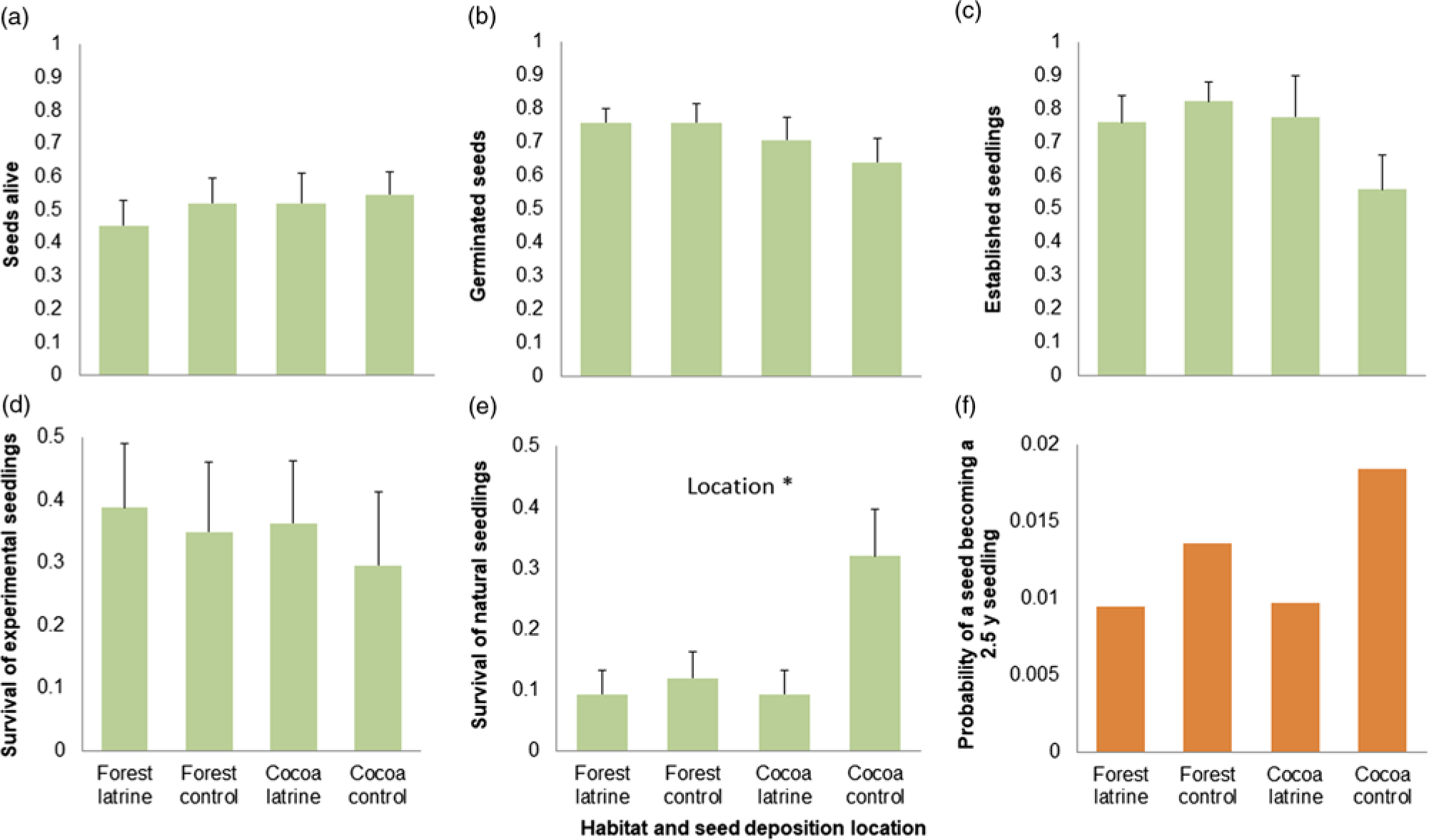
After 2 wk, 55% of the seeds in cocoa were alive (all moved by dung beetles underneath the soil surface or the leaf litter), 28% had been preyed upon or removed by granivorous animals and 17% had been attacked by pathogens; in forest 49% were alive (all moved by beetles), 44% had been preyed/removed and 7% were attacked by pathogens. Seeds buried by dung beetles were found at an average depth of 2.1 ± 2.3 cm (mean ± SD) in the cocoa and 2.8 ± 2.9 cm in the forest. The proportion of seeds alive after 2 wk showed no effect of habitat (F1,58 = 0.359, P = 0.552), seed deposition location (F1,57 = 0.359, P = 0.551) or the interaction between factors (F1,56 = 0.065, P = 0.799; Figure 1a). However, the relative importance of seed mortality causes differed between habitats: in the forest predation/removal was the cause for 86% of seed mortality vs. 62% in the cocoa (F1,58 = 4.19, P = 0.045), while pathogen attack was responsible for 14% and 38% of seed mortality in forest vs. cocoa (F1,58 = 6.43, P = 0.014). Seed deposition location had no effect on seed predation (F1,57 = 1.43, P = 0.237) or pathogen attack (F1,57 = 3.46, P = 0.068), and neither had the interaction between habitat and deposition location (predation: F1,56 = 0.262, P = 0.610; pathogen attack: F1,56 = 0.257, P = 0.614).
Seed and seedling fates of a dominant tree species (Brosimum lactescens) commonly dispersed by howler monkeys in forest and shade cocoa habitats, in two possible seed-deposition locations, monkey latrines and control locations, in the Lacandona rain-forest region, Mexico. For each combination of habitat and seed-deposition location, 15 independent sites were used. Proportion of seeds (from a total of five seeds per site) alive after 2 wk (a); proportion of seeds (from a total of five seeds per site) germinating (b); proportion of seedlings (from the total of seeds germinating) establishing (c); proportion of experimental (early) seedlings (from the total of seedlings establishing) surviving for 19 mo (d); proportion of naturally established (late) seedlings (from a total of five seedlings ∼6 mo of age per site) surviving for 24 mo (e); and, overall probability of a seed surviving to become a 2.5-y-old seedling, calculated by multiplying the proportions in all the previous parts (f). Error bars are + 1 SE of the mean. An asterisk (*) next to the name of the factor (habitat, location, or habitat × location) denotes statistical significance at P < 0.05.

Seed germination, seedling establishment, survival and growth
Of the 300 seeds protected against removal/predation by vertebrates, 72% germinated, 11% were attacked by pathogens, 8% were preyed upon by insects, and 9% did not germinate. The proportion of seed germination was not affected by habitat (habitat: F1,58 = 2.13, P = 0.150), seed-deposition location (F1,57 = 0.318, P = 0.575), or the interaction (F1,56 = 0.264, P = 0.609; Figure 1b). Of all germinated seeds (215), 73% established as seedlings, 26% were attacked by pathogens and 1% was preyed upon by insects. Seedling establishment was not statistically different in the cocoa vs. the forest habitat (67% vs. 79% of seeds that had germinated; F1,58 = 3.84, P = 0.055), but there was a tendency towards lower establishment in the cocoa, particularly in the control locations (56%; Figure 1c). There was no statistical effect of seed-deposition location (F1,57 = 0.111, P = 0.740) or the interaction (F1,56 = 1.04, P = 0.312).
Of the 157 seedlings established in the experiment (experimental cohort), 37.6% (59) survived for 19 mo. We found no significant effect of habitat (F1,58 = 0.438, P = 0.511), seed-deposition location (F1,57 = 0.115, P = 0.737) or the interaction (F1,56 = 0.013, P = 0.910) on seedling survival for the experimental cohort (Figure 1d). On average, these seedlings grew 13.8 ± 2.8 cm in height and grew 5 ± 2.1 new leaves. Factors had no effect on growth, either in height (habitat: F1,58 = 0.238, P = 0.627; seed-deposition location, F1,57 = 1.162, P = 0.286; interaction, F1,56 = 0.003, P = 0.954) or leaf number (habitat: F1,58 = 0.006, P = 0.936; seed-deposition location, F1,57 = 0.038, P = 0.845; interaction, F1,56 = 1.27, P = 0.264).
Of the 300 seedlings of the natural cohort, only 16% were alive after 24 mo. Analysis showed that the effect of seed deposition location was significant, with higher survival in control locations than latrines (F1,57 = 6.36, P = 0.015). The effect of habitat was not significant (F1,58 = 6.359, P = 0.055; Figure 1e), and neither was the interaction between factors (F1,56 = 2.05, P = 0.158). On average, seedlings of the natural cohort grew 13.4 ± 3.5 cm in height and produced 4.5 ± 1.8 new leaves during the 24 mo period. As with the experimental cohort of seedlings, neither habitat nor seed-deposition location affected seedling growth in height (habitat: F1,58 = 0.340, P = 0.561; seed-deposition location: F1,57 = 1.78, P = 0.188; interaction, F1,56 = 0.632, P = 0.430) or leaf number (habitat: F1,58 = 0.002, P = 0.963; seed-deposition location: F1,57 = 2.373, P = 0.129; interaction, F1,56 = 1.65, P = 0.205).
As a final exercise we estimated the overall probability for a B. lactescens seed, in each combination of habitat and seed-deposition location, to survive to a seedling age of ∼2.5 y (Figure 1f). We did this by multiplying the mean proportions of individuals reaching each of the regeneration phases (seed survival, seed germination, seedling establishment, early seedling survival and late seedling survival). For latrine locations in both forest and cocoa the probability was ∼0.010; it was a bit higher for control locations in the forest (0.014) and in the cocoa (0.018).
Seedling assemblages
In total we recorded 7921 seedlings belonging to 62 tree species (7501 seedlings) and 15 liana species (420 seedlings) in 360 1-m2 subplots. In the cocoa habitat we found 4641 seedlings of 59 species, while in the forest we found 3280 seedlings of 68 species. The large majority of seedlings (93.5%) originated from fleshy fruits adapted for seed dispersal by frugivorous animals, while only 6.5% originated from dry fruits adapted for dispersal by abiotic vectors or granivorous animals. Seedlings of two fleshy-fruited tree species represented 68% of all seedlings recorded in the cocoa habitat (Brosimum lactescens 38%, Brosimum alicastrum 30%). Dominance was less pronounced in the forest, with five fleshy-fruited tree species representing 68% of all seedlings (Brosimum alicastrum 17%, Virola guatemalensis 15%, Brosimum lactescens 12%, Ampelocera hottlei 12%, Castilla elastica 12%).
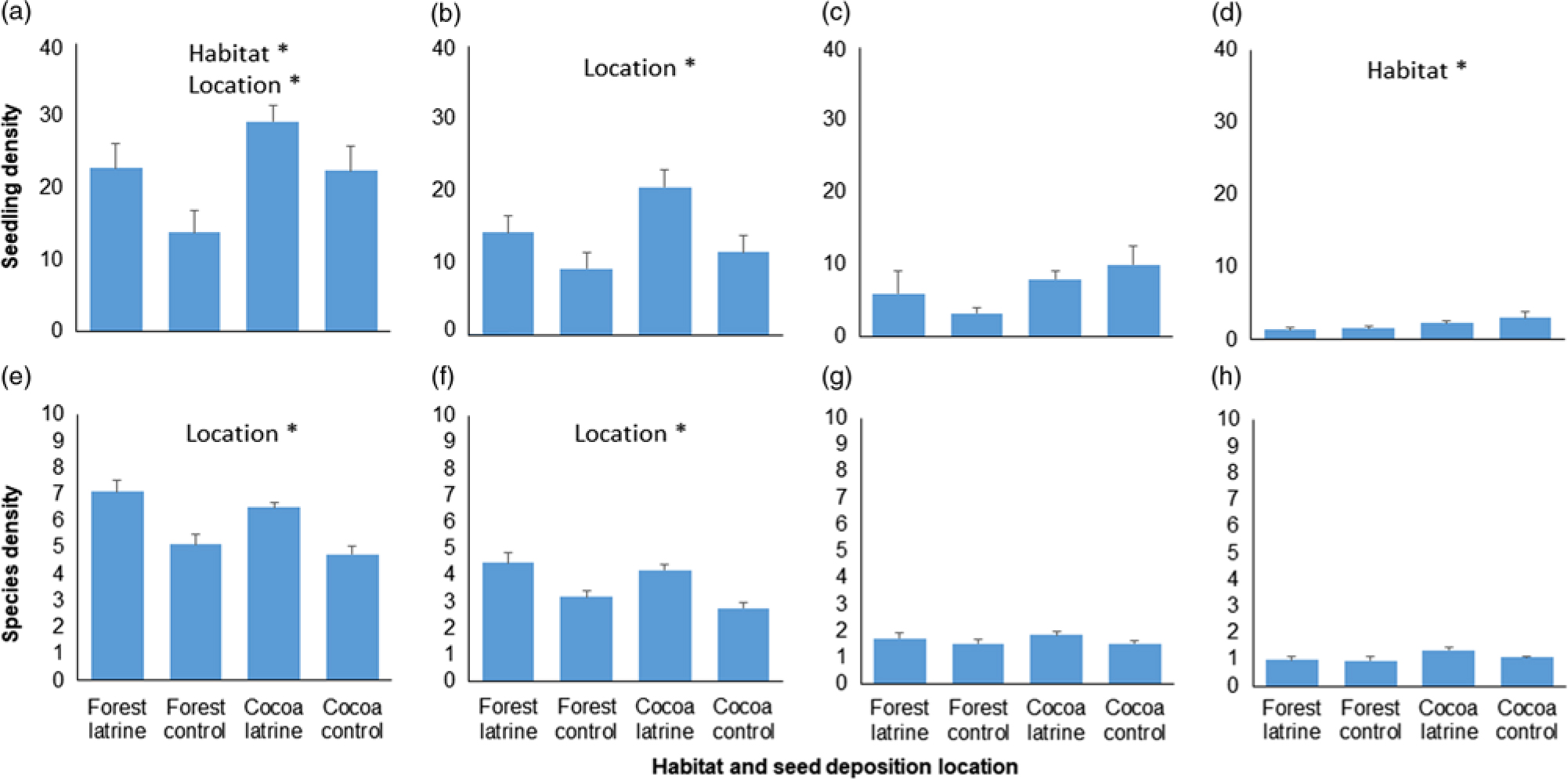
When all seedlings were analysed we found significant effects of habitat (F1,34 = 5.98, P = 0.020) and seed deposition location (F1,33 = 6.538, P = 0.015), but no significant interaction (F1,32 = 0.117, P = 0.734) on seedling density. Higher seedling densities were found in cocoa compared with forest, and in latrines compared with control locations (Figure 2a). Species density was also higher in latrines than in control locations (F1,33 = 30.0, P = 0.001), but habitat (F1,34 = 2.15, P = 0.152) and the interaction of factors (F1,32 = 0.106, P = 0.746) had no effect (Figure 2e).
Seedling and species density of tree and liana seedlings recorded in two habitats of the howler monkey (forest and shade cocoa) and in two seed-deposition locations (monkey latrines and control locations) in the Lacandona rain-forest region, Mexico. According to their origin seedlings were classified into four categories: seedlings from all fruits (a and e), seedlings from fleshy fruits recorded in the howler monkey’s diet according to Zárate et al. (Reference Zárate, Andresen, Estrada and Serio-Silva2014) (b and f), seedlings from fleshy fruits not recorded in the monkeys’ diet (c and g), and seedlings from dry fruits (d and h). For the first three categories, seedling and species densities are expressed on a 1-m−2 basis; for the fourth category (d and h), densities are expressed per 10 m2. Error bars are +1 SE of the mean. An asterisk (*) next to the name of the factor (habitat, location, or habitat × location) denotes statistical significance at P < 0.05.
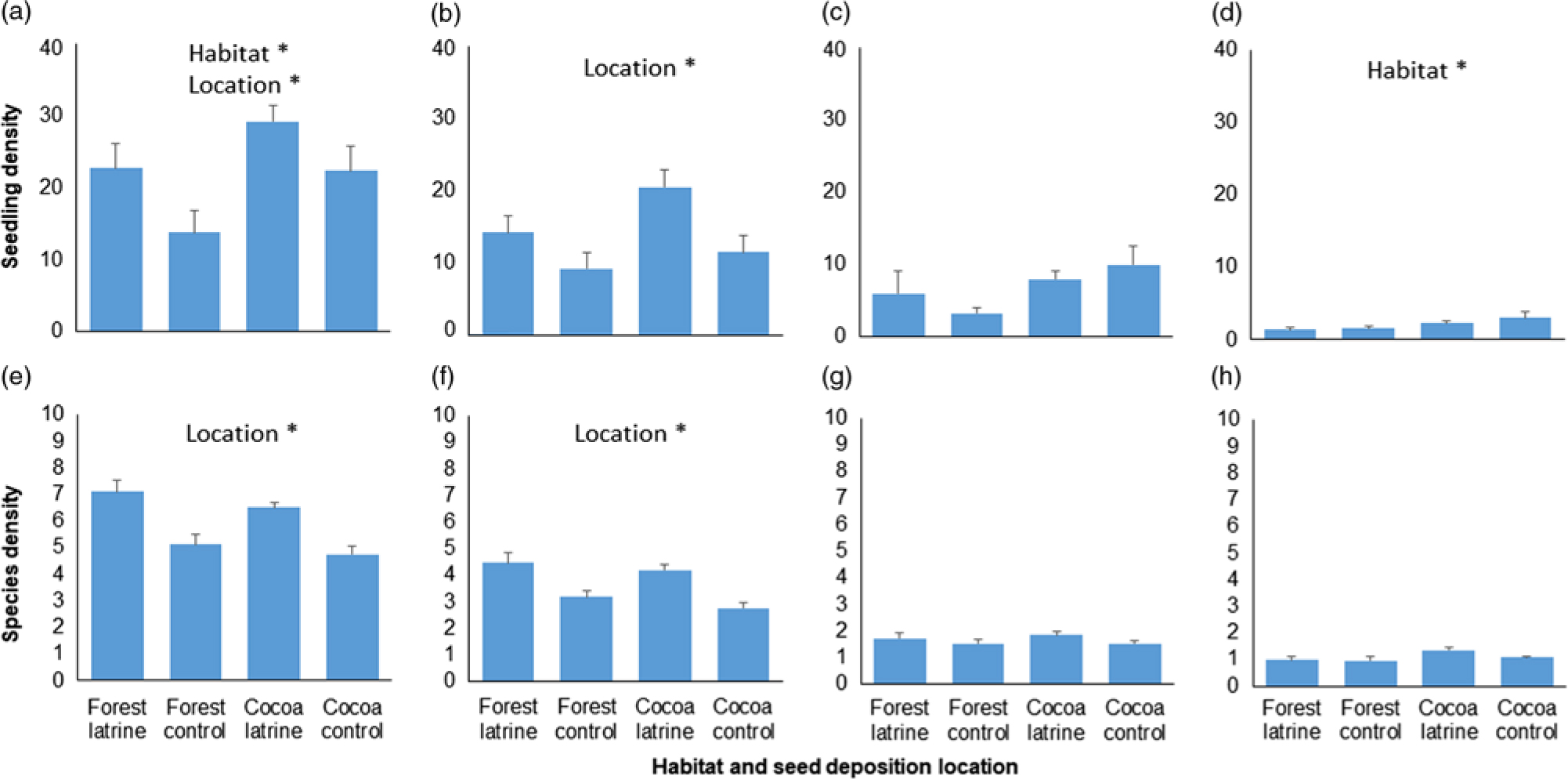
For seedlings originating from fleshy fruits recorded in the howler monkey’s diet the effects of habitat on seedling and species density were not significant (seedling density: F1,34 = 3.40, P = 0.074; species density: F1,34 = 1.77, P = 0.192; Figure 2b, f), but seed deposition location was again significant, with latrines having higher densities of seedlings (F1,33 = 9.14, P = 0.005) and species (F1,33 = 26.8, P = 0.001). There was no effect of the interaction term on either variable (seedling density: F1,32 = 0.744, P = 0.395; species density: F1,32 = 0.054, P = 0.817).
For seedlings originating from fleshy-fruited species not recorded in the monkey’s diet, there was no effect of habitat (F1,34 = 4.020, P = 0.053), seed-deposition location (F1,33 = 0.025, P = 0.876) or the interaction (F1,32 = 1.142 P = 0.293; Figure 2c). Similarly, for species density no factor had a significant effect (habitat: F1,34 = 0.133, P = 0.718; seed-deposition location, F1,33 = 2.81, P = 0.103; interaction, F1,32 = 0.191, P = 0.665; Figure 2g).
Finally, for species with dry fruits, seedling density was higher in cocoa than forest (F1,34 = 4.64, P = 0.039; Figure 2d), but not species density (F1,34 = 3.97, P = 0.055; Figure 2h). For neither response variable did seed-deposition location or the interaction between factors have an effect (seedlings: seed-deposition location, F1,33 = 0.707, P = 0.407; interaction, F1,33 = 0.223, P = 0.640; species: seed-deposition location, F1,32 = 1.59, P = 0.217; interaction, F1,32 = 1.16, P = 0.290).
Discussion
Primates are known to be important seed dispersers in the ecosystems they inhabit, yet we know little about their role in seed dispersal in agro-ecosystems, making this one of the current challenges in primate seed-dispersal research (Andresen et al. Reference Andresen, Arroyo-Rodríguez and Ramos-Robles2018). In one of the few studies assessing primate seed dispersal in an agro-ecosystem, Zárate et al. (Reference Zárate, Andresen, Estrada and Serio-Silva2014) showed that some aspects of primary seed dispersal by howler monkeys inhabiting rustic cocoa plantations in the Lacandona rain forest region were comparable in the agro-ecosystem and the forest. With the present study we went one step further, finding that, in general, seed and seedling fates and the recruitment of monkey-dispersed plants were similar in forest and cocoa, although we did find some phase-specific effects of habitat and seed-deposition location. It is important, however, to point out some limitations of our study. First, to determine if processes affecting the post-dispersal fate of seeds and seedlings were similar in the two habitats, we used one focal plant species as a model. Since plant species vary greatly in the biotic and abiotic factors affecting their early regeneration, our ability to generalize our findings to other species is somewhat limited. Second, while our results provide a valid comparison between habitats and between seed-deposition locations during the study period, between-year variability in the relative importance of factors affecting post-dispersal seed and seedling fates in different habitats can be large in tropical forests (Feer & Forget Reference Feer and Forget2002, Feer et al. Reference Feer, Julliot, Simmen, Forget, Bayart and Chauvet2001). Third, we may have underestimated seed survival by assuming that all seeds that we could not find had been preyed upon by rodents, given that some of these seeds may have escaped predation after being scatterhoarded (Vander Wall & Beck Reference Vander Wall and Beck2012, Vander Wall et al. Reference Vander Wall, Forget, Lambert, Hulme, Forget, Lambert, Hulme and Vander Wall2005). However, the probability of seeds removed by rodents escaping predation is considered to be quite low for Neotropical seeds <1 g weight and ∼1 cm length (Forget et al. Reference Forget, Milleron, Feer, Newbery, Prins and Brown1998) and for seeds with low ‘handling cost’ (little physical and chemical defence; Vander Wall & Beck Reference Vander Wall and Beck2012), both characteristics of B. lactescens.
For our focal plant species, the probabilities of seed survival, germination and early seedling survival were similar in both habitats and in both seed-deposition locations. It is important to note that all seeds that were found in an apparently intact state (49% and 55% in forest and cocoa, respectively) were seeds that had been moved by dung beetles and placed under the soil surface or the leaf litter. After primary seed dispersal through mammal defecation, dung beetle activity is responsible for re-shaping seed-deposition patterns in several ways and consequently seed fate as well (Braga et al. Reference Braga, Carvalho, Andresen, Anjos, Alves-Silva and Louzada2017). In particular, seeds buried by dung beetles are known to have a high probability of avoiding seed predation (Andresen Reference Andresen2001, Estrada & Coates-Estrada Reference Estrada and Coates-Estrada1991, Shepherd & Chapman Reference Shepherd and Chapman1998), and it is likely that seeds moved under the leaf litter experience a similar advantage. In the rustic cocoa plantations studied, the dung beetle community is similar in structure and function (dung removal, soil excavation and seed movement) to the community found in forest (Santos-Heredia et al. Reference Santos-Heredia, Andresen, Zárate and Escobar2018), which is probably one of the reasons why we found no effect of habitat on seed survival. This finding also underscores the importance of mimicking the conditions of primary seed dispersal, in this case the presence of dung surrounding the seeds, when assessing post-dispersal seed fate (Andresen Reference Andresen2001, Santos-Heredia et al. Reference Santos-Heredia, Andresen and Zárate2010). Finally, even though the probability of seed survival was similar between habitats, predation/removal by rodents caused most of the seed mortality in forest (86%) but was less prevalent in cocoa (62%); the reverse occurred for pathogen attack, which caused 14% and 38% of seed mortality in forest and cocoa, respectively. This particular finding points towards potentially important differences in seed removal by rodents between habitats, which ought to be more carefully studied in the future, including the relative importance of rodents in seed predation vs. seed dispersal through scatterhoarding (Feer & Forget Reference Feer and Forget2002, Forget et al. Reference Forget, Milleron, Feer, Newbery, Prins and Brown1998).
The probabilities of seed germination and early seedling survival of B. lactescens were also similar in the two habitats and in the two seed-deposition locations. However, in terms of seedling establishment, the probability was lower in the cocoa control locations, but this effect was compensated by a higher survival probability of older seedlings (natural cohort) in these sites (Figure 1c, e). Contrasting performance of different life stages under particular environmental conditions is common in plants (Schupp Reference Schupp1995, Reference Schupp, Dennis, Schupp, Green and Westcott2007). We think that in our study system these results could have been driven by stage-specific responses to the light environment. Brosimum lactescens is a shade-tolerant species and early life stages, such as seedling establishment, may fare better under shaded conditions (Poorter & Hayashida-Oliver Reference Poorter and Hayashida-Oliver2000). However, even shade-tolerant species are usually favoured by higher light levels during later stages (Iriarte & Chazdon Reference Iriarte and Chazdon2005). The cocoa control sites, where survival of older seedlings was highest, had also the highest values of illuminance (an average of 0.563 lx, compared with 0.407 lx in cocoa latrine locations, and 0.03 lx in forest locations).
Other environmental characteristics, not measured here, could also have accounted for the lower seedling establishment but higher survival of older seedlings in cocoa control locations. For example, cocoa plantations in our study site have a thicker leaf litter layer, when compared with the forest (Cervantes López Reference Cervantes López2017). Although we do not know if litter characteristics were different between control and latrine locations, one study in French Guiana found that topsoil of howler monkey latrines is more homogeneous due to loss of litter (Pouvelle et al. Reference Pouvelle, Feer and Ponge2008). Future studies assessing the fate of animal-dispersed seeds and seedlings in agro-ecosystems will benefit from measuring various biotic and abiotic factors known to affect plant fitness during early stages of regeneration.
When we considered the mean proportions obtained in the field experiments for each regeneration phase as estimates of transition probabilities, we found that overall very few seeds of the focal plant species may become 2.5 y old seedlings: ∼1.0% in latrines of both forest and cocoa, 1.4% in forest control locations and 1.8% in cocoa control locations (Figure 1f). This trend is in accordance with previous findings of diminished per capita seed/seedling survival probabilities in monkey latrines, due to negative density dependent processes in these sites (Russo Reference Russo2005, Russo & Augspurger Reference Russo and Augspurger2004). Nonetheless, seedling density of howler-dispersed plant species was higher in these locations compared with control locations (Figure 2b, f), also in accordance with previous studies (Anzures-Dadda et al. Reference Anzures-Dadda, Andresen, Martínez-Velázquez and Manson2011, Reference Anzures-Dadda, Manson, Andresen and Martínez-Velázquez2016; Bravo Reference Bravo2012, Julliot Reference Julliot1997). The latter pattern is most likely a consequence of: (1) a large input of seeds in latrines used by howler monkeys (Bravo Reference Bravo2009), and (2) an increase in the activity of dung beetles in latrines (Feer et al. Reference Feer, Ponge, Jouard and Gomez2013) and the positive effect of dung beetle activity on the establishment of seedlings from the seed bank (Santos-Heredia & Andresen Reference Santos-Heredia and Andresen2014). For plant species not dispersed by howler monkeys there was no latrine effect, as one could expect, although higher seedling densities were found in the cocoa habitat than in the forest, perhaps due to the increased light levels in the cocoa understorey and/or the decreased activity of rodent seed predators in the agro-ecosystem.
To conclude, many groups of animals that play important ecological roles in forest regeneration, such as primates, dung beetles and rodents, inhabit agro-ecosystems worldwide. Both their long-term conservation, and of the species with which they interact, will to a large extent depend on our success in managing anthropogenic landscapes in a way that the ecological functions of these animals can be sustained. Our results add important evidence underscoring the value of tropical agro-ecosystems with low-intensity management (i.e. rustic and traditional systems, sensu Moguel & Toledo Reference Moguel and Toledo1999) to maintain ecological processes crucial for ecosystem function. However, while agro-ecosystems such as the rustic cocoa plantations studied here can play an important role in conservation, one must keep in mind that agro-ecosystems are foremost productive systems, and as such are prone to change according to socio-economic fluctuations (Estrada et al. Reference Estrada, Raboy and Oliveira2012). Thus, it is necessary that anthropogenic landscapes include permanent well-protected remnants of forest as an insurance against extinction and loss of ecosystem function. One of our roles as ecologists is to work with local communities and local governments to convince them of this necessity.
Author ORCIDs
Ellen Andresen https://orcid.org/0000-0001-8957-4454
Acknowledgements
We thank the local community of Chajul and Playón de la Gloria for their collaboration. We thank Rafael Lombera, Hugo Valdovinos and Moisés Miranda for field assistance. We thank Alejandro Estrada, Juan Carlos Serio-Silva, Julieta Benitez-Malvido, Katherine Renton, Ek del Val and two anonymous reviewers for comments on previous versions of the manuscript. This research complied with protocols approved by SEMARNAT (permit registration number SGPA/DGVS/03075/13), the governmental authority in Mexico for issues regarding the environment and natural resources.
Financial Support
This research was financed by grant SEP-CONACyT 2010-152884, graduate fellowship CONACyT 245258, grant PAPIIT – UNAM IN-207711, The Rufford Small Grants Foundation, and Idea Wild. We are grateful to Universidad Industrial de Santander for a post-doctoral fellowship to CS-H.