Introduction
Payments for ecosystem services (PESs) are an instrument of social-ecological policy providing economic incentives to landowners for the conservation of their forests (TEEB 2010). These initiatives have been implemented in communities, regions and countries around the world (Ezzine-de-Blas et al. Reference Ezzine-de-Blas, Wunder, Ruiz-Pérez and Del Pilar Moreno-Sanchez2016, Börner et al. Reference Börner, Baylis, Corbera, Ezzine-de-Blass, Honey-Rosés, Persson and Wunder2017). However, this approach has been questioned as having limited effects on improving socioeconomic conditions (Jones et al. Reference Jones, Foucat, Pischke, Salcone, Torrez, Selfa and Halvorsen2019) and on stopping deforestation completely (Calvet-Mir et al. Reference Calvet-Mir, Corbera, Martin, Fisher and Gross-Camp2015, Börner et al. Reference Börner, Baylis, Corbera, Ezzine-de-Blass, Honey-Rosés, Persson and Wunder2017).
In Mexico, a national PES programme began operation in 2003 with the establishment of the Mexican Forest Fund (FFM) administered by the National Forestry Commission (CONAFOR) and quickly grew to become one of the largest internationally (Schomers & Matzdorf Reference Schomers and Matzdorf2013). The programme started as payments for hydrological services (PHSs); however, in 2004, the programme operators quickly diversified into payments for carbon sequestration, agroforestry systems such as coffee and biodiversity conservation (Kosoy et al. Reference Kosoy, Corbera and Brown2008). In subsequent years, carbon sequestration was eliminated, and while other services continued to be supported, the PHS component of the programme received 80% of the funding (CONAFOR 2010). The selection criteria of PHS participants have changed over time. At the outset, they were orientated towards forest conservation and the production of hydrological services, but later the programme was reformulated as a public policy instrument to reduce rural poverty (Sims et al. Reference Sims, Alix-Garcia, Shapiro-Garza, Fine, Radeloff and Aronson2014). From 2003 to 2007, CONAFOR selected eligible areas based on ecological criteria such as zones of recharge of aquifers, priority mountains, areas prone to water scarcity, areas at risk of hydrological disasters and areas of water supply to human settlements larger than 5000 inhabitants (CONAFOR 2010). In 2008, social criteria were added to determine eligible landowners and areas for PHSs, such as gender of applicants, poverty and indigenous populations (Muñoz-Piña Reference Muñoz-Piña2011).
PES programmes transitioned from a national scheme to subnational programmes called Matching Funds Programmes, also known as local PESs (Von Thaden et al. Reference Von Thaden, Manson, Congalton, López-Barrera and Salcone2019), which would be funded by local markets and governments and the private sector (Nava-López et al. Reference Nava-López, Selfa, Cordoba, Pischke, Torrez and Ávila-Foucat2018). In Mexico, these programmes are multi-level governance* (terms with an asterisk are defined in Supplementary Table S1, available online) scenarios of natural resources management characterized by their complexity, with multiple stakeholders and institutions involved, each with different interests, agendas and jurisdictions (Rhodes Reference Rhodes1996, Bodin Reference Bodin2017). In such scenarios, the emergence of self-organized social networks can facilitate or obstruct social processes, such as collaboration, innovation and social learning (Bodin & Crona Reference Bodin and Crona2009). These processes are essential to guide natural resources towards adaptive, sustainable and resilient management (Folke Reference Folke2006).
One way to address PES multi-level governance challenges is with social network analysis (SNA), which can help account for the interdependencies between complex human and ecological dynamics that underpin many important environmental problems (Bodin Reference Bodin2017). A network approach focuses on relations between entities to explain the emergent properties of complex systems (Borgatti et al. Reference Borgatti, Mehra, Brass and Labianca2009). SNA also focuses on how patterns of relationships – the structure of the network – affect processes and outcomes (Berardo & Scholz Reference Berardo and Scholz2010, Lubell et al. Reference Lubell, Robins and Wang2014). For example, partnership patterns among resource managers in different areas might influence how information is exchanged and the ways in which projects are coordinated (Bodin & Crona Reference Bodin and Crona2009). Nevertheless, structure must be understood within context; the same network pattern can reinforce coordination when stakeholders trust each other or it can reduce innovation and thus lead to poor management (McAllister et al. Reference McAllister, Robinson, Brown, Maclean, Perry and Liu2017). In ecological systems, habitat connectivity can enhance the spread of disturbances, but also help in habitat recovery (Dakos et al. Reference Dakos, Quinlan, Baggio, Bennett, Bodin, Silver, Biggs, Schlüter and Schoon2015). According to Young and Underdal (Reference Young and Underdal1997), managing the natural environment effectively requires the governance system to align with the characteristics of the biophysical system. The extent to which this does not occur is referred to as the ‘problem of fit’ that exists in two possible configurations: horizontal and vertical fit*. For instance, fit/misfit* describes how the different social and ecological layers are interconnected (Bodin Reference Bodin2017).
Several studies in Latin America have evaluated PES programme coordination challenges relying only on qualitative or behavioural economic perspectives (Nava-López et al. Reference Nava-López, Selfa, Cordoba, Pischke, Torrez and Ávila-Foucat2018, Pfaff et al. Reference Pfaff, Rodriguez and Shapiro-Garza2019). Due to the diversity of actors, jurisdictions and ecosystems in which local PES programmes are implemented in Mexico (Shapiro-Garza Reference Shapiro-Garza2013), a multi-level network approach is required in order to understand what the programmes’ social network structures are likes and how they relate to ecological processes. The effectiveness of a PES programme can increase if it is properly aligned with the social-ecological system in which it is intended to be implemented (Cumming et al. Reference Cumming, Cumming and Redman2006, Guerrero & Wilson Reference Guerrero and Wilson2017). Therefore, spatial misfit might reduce the ability of local PES programmes to address environmental problems effectively.
PES programmes have been widely implemented in Latin America as economic instruments to promote ecosystem conservation (Wunder et al. Reference Wunder, Börner, Ezzine-de-Blas, Feder and Pagiola2020). Accurate and spatially explicit evaluations of their social-ecological influence within watersheds remain limited and are urgently needed to guarantee their social and environmental effectiveness in the long term (Asbjornsen et al. Reference Asbjornsen, Manson, Scullion, Holwerda, Muñoz-Villers and Alvarado-Barrientos2017).
The overall objective of this study was to analyse governance in a local PES programme based on a multi-level social-ecological perspective (Bodin Reference Bodin2017) and then to find alternatives to improve its effectiveness by enhancing its configuration. We focused on four tasks: (1) assessing the vertical fit between social and ecological units in the multi-level governance network in a PES programme; (2) exploring collaboration network properties among different stakeholders (social nodes) involved in the programme in order to visualize the coordination challenges between stakeholders within and outside the sub-watershed; (3) assessing the network connectivity of forest areas (ecological nodes*) because this is critical for enhancing the resilience of ecosystem processes; and (4) identifying opportunities in social and ecological terms to increase the effectiveness of a PES programme.
Materials and methods
Study area and PES programme
We focused on a local PES programme in the Pixquiac sub-watershed in the centre of the state of Veracruz, Mexico (Fig. 1). This sub-watershed has an area of 10 727 ha and includes five municipalities (Vidriales-Chan et al. Reference Vidriales-Chan, García-Coll, Martínez, Gerez, Muñiz-Castro, Paré and Fernandez2012). The area has diverse types of vegetation and land uses, such as forests of pine and pine-oak, tropical mountain cloud forest, grazing land, shade coffee plantations, small fragments of tropical semi-deciduous forest and agricultural crops such as corn, sugarcane and potatoes. The region is inhabited by 7800 residents in 56 local communities (Paré & Gerez Reference Paré and Gerez2012). This sub-watershed supplies c. 40% of the water used by Xalapa and satisfies the needs of the communities within the sub-watershed itself (García-Coll et al. Reference García-Coll, Martínez-Otero and Vidriales-Chan2019).
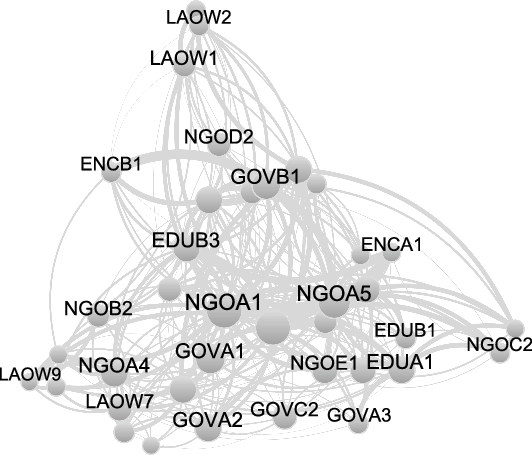
Visualization of the collaboration network of Pixquiac’s payments for ecosystem services programme. The circles represent stakeholders and the lines represent their collaboration links. The size of the nodes represents degree*. The first three letters of the label of each node indicate the sector where each stakeholder belongs: non-governmental organization (NGO), landowner (LAO), government agency (GOV), university or research centre (EDU) and environmental consultant (ENC).

The PES programme in the Pixquiac sub-watershed started as a centralized national PES programme in 2003. However, in 2008, it shifted towards a local and decentralized arrangement with the creation of the Compensation Program for Environmental Services in the Pixquiac River Watershed (PROSAPIX; Nava et al. 2018). Operational rules for the national and local matching PES programmes use similar criteria for selecting areas of PES, administering funds and monitoring effects. The main difference is that, in local matching programmes, CONAFOR provides half of the funds needed for an agreement between buyers and sellers, and the other half of the programme financing might come from user fees, the local government and the private sector (Saldaña-Herrera Reference Saldaña-Herrera2013). Another difference is that there is an extensive overlap between national and local PES programmes; 32% of plots initially receiving PES from the national programme were subsequently paid through local matching programmes. Consequently, we decided not to make a distinction between the payment types and so treated them in the same way.
Data collection
We interviewed two experts who provided a list of key informant stakeholders across the sub-watershed. Then we used two-wave snowball sampling to identify the stakeholders we would interview (Laumann et al. Reference Laumann, Marsden, Prensky, Freeman, White and Romney1989). The respondents had to meet four criteria: (1) appear in the list of key informants; (2) appear in the snowball list; (3) represent different social sectors; and (4) represent different spatial areas of the sub-watershed (upper, middle and lower). From May to July 2017, we approached 41 stakeholders who met the selection criteria and conducted face-to-face sociometric and semi-structured interviews with 38 of them (Hollstein Reference Hollstein, Dominguez and Hollstein2014).
The interviewed stakeholders (social nodes*) were classified into five types according to their affiliation: non-governmental organization (NGO); landowner; government agency; university or public research centre; or environmental consultant. We then used codes to maintain stakeholder anonymity. We obtained social data by asking stakeholders to identify others with whom they had regularly collaborated in the last 5 years (2012–2017) regarding the PES programme that supplies water to Xalapa.
For social-ecological data, we asked stakeholders to draw on a printed land-use map of the Pixquiac sub-watershed (scale 1:100 000) the forest areas in which they conducted conservation activities. To create well-defined forest units from these printed maps, we first digitized polygons and points with QGIS software (Quantum GIS Development Team 2013) and then the overlapping areas were intersected. Although all forest units included multiple land uses, the predominant land use was forest. To differentiate each forest unit, we name them based on a sequential code. In addition, we assessed the ecological connectivity among forest units considering their distances from each other; one forest unit was considered to be linked to another if they were less than 1 km apart (Saura & Rubio Reference Saura and Rubio2010).
We quantified water yield in the sub-watershed (Nelson et al. Reference Nelson, Mendoza, Regetz, Polasky, Tallis and Cameron2009) using the Water Yield module by InVEST v3.3 (Natural Capital Project 2020) to map and evaluate ecosystem processes (Bai et al. Reference Bai, Zhuang, Ouyang, Zheng and Jiang2011). We estimated total water yield from the contribution of each pixel of the landscape, considering how specific characteristics of land-use and land-cover types affect runoff and evapotranspiration, and then subtracting these results from the average annual precipitation (Sharp et al. Reference Sharp, Douglass, Wolny, Arkema, Bernhardt and Bierbower2020). Finally, we overlapped forest units with the water yield model to quantify total water yield for each unit.
Data analysis
We used a multi-level social-ecological approach (Table S1), which consisted of analysing more than one type of link between the same set of nodes on three levels: social, ecological and social-ecological (Baggio et al. Reference Baggio, Burnsilver, Arenas, Magdanz, Kofinas and De Domenico2016, Guerrero & Wilson Reference Guerrero and Wilson2017). For network visualization, we used VOSviewer software (van Eck & Waltman Reference Van Eck and Waltman2010) with a modularity-based cluster analysis*. We divided social networks into groups of nodes that were densely interconnected internally and poorly connected to each other externally (Newman & Girvan Reference Newman and Girvan2004, Waltman et al. Reference Waltman, Van Eck and Noyons2010). We used UCINET software (Borgatti et al. Reference Borgatti, Everett and Freeman2002) to calculate network metrics such as density*.
At the social-ecological level, we used two metrics: social importance as indicated by the intensity of conservation activities; and ecological importance as indicated by water yield for each forest unit. We used the conservation activity links as social importance, because forest management, restoration and monitoring are key conservation actions for water provision, which is the main goal of PES programmes. Each time a stakeholder said that they had completed a conservation activity in a forest unit, we drew a link (Bodin & Tengö Reference Bodin and Tengö2012). We measured the ecological importance as the average water yield in millimetres of each forest unit (Nelson et al. Reference Nelson, Mendoza, Regetz, Polasky, Tallis and Cameron2009). We performed a principal component analysis (PCA) using JMP 10.0.0 software (SAS 2000) as a proxy for the social-ecological spatial fit between stakeholders and forest units. We identified four conservation opportunity areas: high ecological importance and high social importance; high ecological importance and low social importance; high social importance and low ecological importance; and low social importance and low ecological importance, in accordance with Guerrero and Wilson (Reference Guerrero and Wilson2017).
Results
With the multi-level social-ecological approach, we were able to elucidate Pixquiac’s social network that links stakeholders across social sectors and political jurisdictions, within and outside the sub-watershed. In total, 38 stakeholders were interviewed: 13 NGO members, 11 landowners, 8 government agencies, 4 in academia and 2 consultants. The collaboration network exhibited a high density between stakeholders (density = 0.284), with 10.5 links on average. We identified NGOs in brokerage positions based on their betweenness scores (Fig. 1 & Table S2).
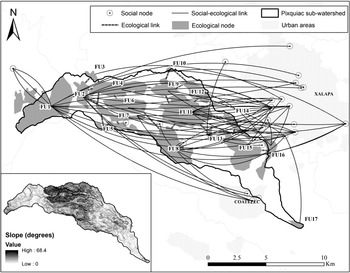
The interviewees identified a total of 56 polygons and 86 points, many of which overlapped. The number of polygons/points drawn per respondent ranged from 1 to 12. In total, 17 forest units were delineated along the Pixquiac sub-watershed where stakeholders performed any type of conservation activities; most were concentrated in forest units FU1, FU2, FU8 and FU11 (Fig. 2). This network shows that different types of stakeholders were executing a variety of conservation activities in different forest units. In FU1, NGOs established slightly more links (36%) than the government (29%), but NGOs and landowners contributed equally to links in FU2 (33%). In FU8, landowners and universities extended the same amount of links (27%), while the government extended most links (44%) in FU11 (Fig. 2).
Spatialized conservation activities in the social-ecological network between 38 stakeholders and 17 forest units in the Pixquiac sub-watershed, central Veracruz. The circles represent stakeholders, the polygons indicate forest units and the lines indicate conservation activity links.

The forest network exhibited a low interconnectedness among forest units (density = 0.169), with only 2.7 links on average. The network connectedness is not complete (0.882), because one forest unit (FU17) was isolated from the forest network, while FU11 and FU9 were the most important for the overall connectivity of the system according to their betweenness centrality* (Fig. S2 & Table S3). We used the water yield as a proxy of the ecological importance of each forest unit. The InVEST water yield model for the Pixquiac sub-watershed shows that the water yield was higher in the middle part of the watershed. Those forest units with higher ecological importance were FU12, FU11, FU8 and FU9 (Fig. S3).
Principal component analysis
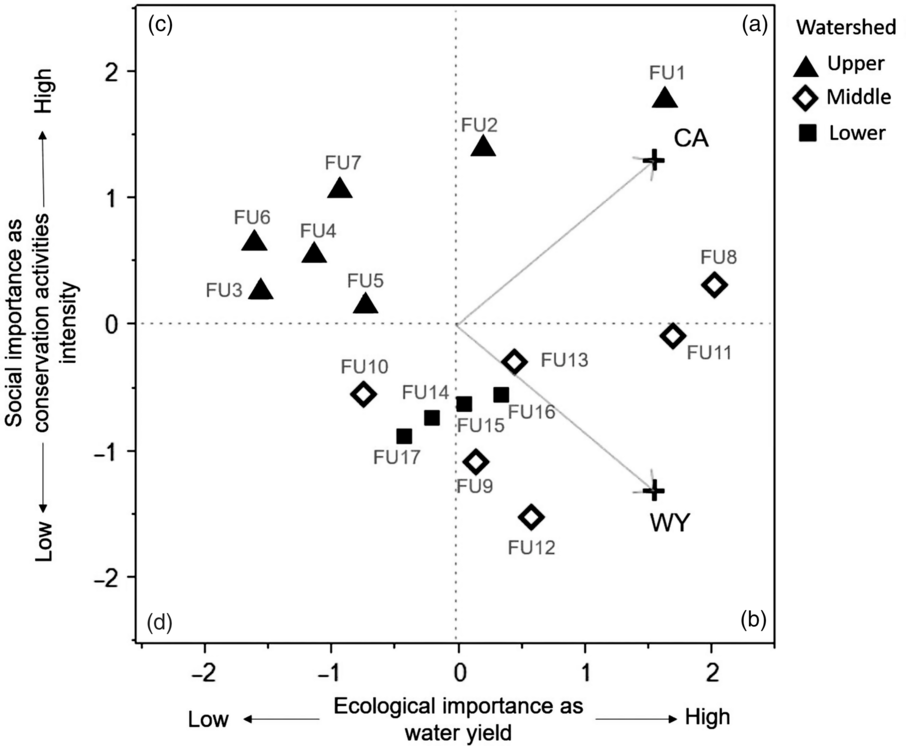
Our main finding was that conservation actions are not completely concentrated in forest units with high levels of water yield, so there is a partial spatial misfit between local PES programmes and the ecosystem processes themselves. The water yield variable explained 58.7% of the arrangement of the units (Component 1), the conservation activity variable explained 41.3% of the arrangement of the units (Component 2) and both variables explained 100% of the arrangement of the units (Fig. 3). FU1, FU2, FU8 and FU11 were clustered according to their social importance, which means these are forest units where stakeholders concentrated their conservation activities. In contrast, FU12 and FU9, for example, were clustered according to their ecological importance, based on high values of water yield. The rest of the forest units showed low or intermediate values for both variables (Fig. 3).
The Pixquiac forest clusters with different levels of water yield (WY) and conservation activities (CA). The x-axis (horizontal) represents the ecological importance in terms of water production, while the y-axis represents the social importance in terms of the number of conservation activities carried out in each of the forest units. Four dimensions were generated in terms of the possible outcomes of the two variables regarding conservation opportunity areas: (a) opportunity in the near term; (b) opportunity in the future; (c) opportunity to redirect efforts; and (d) low opportunity.

Discussion
Previous studies have found evidence of the effectiveness of PES programmes in restraining deforestation (Von Thaden et al. Reference Von Thaden, Manson, Congalton, López-Barrera and Salcone2019), without identifying ways to improve environmental governance. Social-ecological network analysis allowed us to understand the governance forms of the local PES programmes (Ernstson et al. Reference Ernstson, Barthel, Andersson and Borgström2010, Bodin Reference Bodin2017) and to reveal options that enhance collaboration within and across scales of conservation planning and management (Kininmonth et al. Reference Kininmonth, Bergsten and Bodin2015). With SNA, we could observe that the PES network consists of heterogeneous stakeholders, most of them NGO members and landowners, collaborating across municipal and sub-watershed scales (Guerrero & Wilson Reference Guerrero and Wilson2017).
The collaboration network showed contrasting properties. On the one hand, high density may facilitate chances for collaboration and joint action within a PES programme (Bodin & Crona Reference Bodin and Crona2009), but a network tendency towards decentralization might hinder coordination between multiple leaderships (Bodin Reference Bodin2017). PES programmes are strongly linked to NGOs and have a relevant role as intermediaries (Bosselmann & Lund Reference Bosselmann and Lund2013). Organizations that occupy brokerage positions use their relationships across scales to mobilize resources towards ecological research, human development and environmental movements (Langle-Flores et al. Reference Langle-Flores, Ocelík and Pérez-Maqueo2017).
In our study, NGO members were in brokerage positions, connecting segments in the network that otherwise would be disconnected (Burt Reference Burt, Guillen, Collins, Englan and Meyer2003, Bodin & Crona Reference Bodin and Crona2009). These results may be influenced by the snowball sampling method bias given by those who are the first respondents (Kossinets Reference Kossinets2006). In our case, the first respondents were the members of NGOs, who facilitated our access to the social network and, in order to minimize the bias of the snowball method, we also established representativeness criteria. The two most important NGOs in our study act as brokers and facilitate trust-building, cooperation and conflict avoidance. This is because the first of these NGOs (SENDAS A.C.) arose as a social movement in which a multiplicity of stakeholders participated and finally constituted the NGO (Paré & Gerez Reference Paré and Gerez2012). The second one (COCUPIX) emerged later as a sub-watershed transparency and compliance committee that included representatives of ejidos*, four local NGOs, three academic institutions and local, state and federal government. In both organizations, agreements and shared motivations have been institutionalized through a horizontal process of negotiation and participation.
Through the multi-level-network approach, we mapped the social-ecological networks of the local PES programmes in Pixquiac sub-watershed (Bodin & Tengö Reference Bodin and Tengö2012). This network allows regional connectivity between the forest units that contribute to water provision and stakeholders from municipalities within and outside the watershed (Fig. 2). Although different types of stakeholders execute conservation activities in different parts of the sub-watershed, we found partial spatial misfit between the intensity of conservation activities and the forest units with higher water yield (Fig. 3) (Cumming et al. Reference Cumming, Cumming and Redman2006, Guerrero & Wilson Reference Guerrero and Wilson2017). In our study, we considered water yield as the most relevant ecological process (Bruijnzeel et al. Reference Bruijnzeel, Mulligan and Scatena2011) and the intensity of conservation activities as the most relevant social process, one of the key factors in the maintenance of this ecosystem process (Asbjornsen et al. Reference Asbjornsen, Manson, Scullion, Holwerda, Muñoz-Villers and Alvarado-Barrientos2017).
The InVEST model shows that the water yield occurs in the middle part of the watershed, including forest units FU8, FU9, FU11 and FU12. However, forest unit FU1 had more conservation activity links and is located in the upper part of the sub-watershed. Except for forest unit FU8, the topography is rugged in the middle watershed forest units, which may be inhibiting conservation activities (Fig. 2). This might also explain the partial spatial misfit found between water yield and conservation activities (Fig. 3) (Cumming et al. Reference Cumming, Cumming and Redman2006, Guerrero & Wilson Reference Guerrero and Wilson2017).
We found four conservation opportunity areas at the social-ecological level (Fig. 3) (Young & Underdal Reference Young and Underdal1997, Folke et al. Reference Folke, Pritchard, Berkes, Colding and Svedin2007, Guerrero & Wilson Reference Guerrero and Wilson2017). First, there are near-term opportunities where forest units (FU1, FU2 and FU8) have a perfect fit between their high ecological importance for water yield and have a high social importance for conservation activity intensity. The PES programme should continue its conservation efforts for these forest units (Börner et al. Reference Börner, Baylis, Corbera, Ezzine-de-Blass, Honey-Rosés, Persson and Wunder2017). Second, there are future opportunities where forest units (FU9, FU11, FU12, FU13, FU15 and FU16) have a partial misfit in having high ecological importance but low social importance. Incorporating these forest units into the local PES programme is critical to ensuring the provision of ecosystem services in the long term. Third, there are opportunities to redirect efforts in forest units (FU3, FU4, FU5, FU6 and FU7) that have low ecological importance but high social importance. Failure to address these misfits could result in misplaced efforts to accomplish PES outcomes. Fourth, the forest units (FU10, FU14 and FU17) that have a complete misfit (low water yield and low conservation activity intensity) represent areas of low opportunity for conservation, and they can be justifiably omitted from PES programmes, conserving valuable programme resources (Guerrero & Wilson Reference Guerrero and Wilson2017).
When we asked about the types of links between the interviewees and the forest units, we realized that although not all respondents were familiar with maps, all of them could locate the forest areas (Fig. 2). Furthermore, this exercise enhanced awareness of the links respondents had with the forest units (Bodin & Tengö Reference Bodin and Tengö2012). For example, FU1, which is partly inside Cofre de Perote National Park, was easily drawn and identified. This forest unit also has more conservation activities, in part due to historical reasons: the mountain peak is a landmark that has been protected since 1937 (DOF 1937).
This multi-level network approach produced some challenges, such as building confidence with respondents (Albaum & Smith Reference Albaum, Smith and Gideon2012). After a series of meetings with the local NGO SENDAS, A.C. and building on the reputation and trust that it had built, we had access to their contacts in urban–rural areas of the sub-watershed (Lin Reference Lin, Castiglione, Van Deth and Wolleb1997). This allowed us to reach out to the various types of stakeholders involved in the PES programme and to have proportional social and geographical representation of them.
We recommend increasing trust and cooperation among landowners and government through the mediation of NGOs to improve governance of the local PES programme (Bosselmann & Lund Reference Bosselmann and Lund2013, Bodin Reference Bodin2017). Conflicts may occur when landowners do not receive payments on time and when they have concerns about the transparency of the local PES programme (Scullion et al. Reference Scullion, Thomas, Vogt, Perez-Maqueo and Logsdon2011). Our results suggest that these NGO members could act as mediators in conflicts (Scullion et al. Reference Scullion, Thomas, Vogt, Perez-Maqueo and Logsdon2011). In addition, strengthening the links of conservation activities between PES stakeholders in the middle part of Pixquiac’s sub-watershed would enhance the vertical fit of the social-ecological system (Guerrero & Wilson Reference Guerrero and Wilson2017). Due to isolation and the poor connectivity of some forest units, it is important to create ecological corridors between them (Fig. S2) (Albert & Barabási Reference Albert and Barabási2002, Rathwell & Peterson Reference Rathwell and Peterson2012) in order to achieve more resilient forest landscape configurations.
We have shown the key role of NGOs in mediating collaborative relationships among social actors, which has allowed the generation of agreements to conserve high-water-yield areas in the Pixquiac sub-watershed. These arrangements, and especially the brokerage role of the grassroots NGOs mainly between landowners and governmental actors, has allowed and enhanced multi-level governance, which is a type of governance that is now perceived as an emergent response to environmental crises (e.g., Olsson et al. Reference Olsson, Folke and Berkes2004). Nevertheless, the arrangements have not completely solved the problem of fit (Folke et al. Reference Folke, Pritchard, Berkes, Colding and Svedin2007). Addressing misalignments between the structure of a collaborative network and the biophysical environment is useful in order to address the environmental governance of the Pixquiac sub-watershed effectively.
Conclusions
A multi-level social-ecological approach allowed us to find links and misfit between social networks, ecological connectivity and ecosystem processes and to suggest strategies to increase the efficiency and effectiveness of PES programmes, which represent a fundamental part of environmental governance. The local PES programme in the sub-watershed of the Pixquiac River is an example of collaboration across spatial scales, even though a partial spatial misfit between the social-ecological connectivity and water provision was found. However, by combining social-ecological research regarding PES programme implementation, we have been able to identify opportunities and challenges in coupled systems.
Supplementary material
To view supplementary material for this article, please visit https://doi.org/10.1017/S0376892920000478.
Acknowledgements
We thank Raúl Pacheco-Vega and Jaime Sainz Santamaría from CIDE Region Centro for their institutional support and all of the stakeholders who participated in the survey. SENDAS, A.C. and COCUPIX, A.C. were key allies in the completion of this study. Luciana Porter-Bolland, Octavio Pérez Maqueo and Martha Bonilla-Moheno provided backup during fieldwork deployment. Karla Rangel, Rosa Ramírez and Luis A Esparza contributed substantially at different stages of this study. Ginette Morrisseau, Brian O’Malley and Claudia Steinhagen edited the English version of this paper.
Financial support
This research was funded by CONACYT, Mexico grant number 1734 (National Problems); AL-F was supported by SEP PRODEP and CONACYT postdoctoral scholarships numbers 511-6/18-9453 and I1200/94/2020, respectively.
Conflicts of interest
None.
Ethical standards
The authors assert that all procedures contributing to this work comply with applicable ethical standards of the relevant national and institutional committees on research involving human subjects. The authors obtained express permission from human subjects and respected their privacy.