Introduction
Previous studies have shown that the addition of inactivated yeast to poultry feed increases growth performance. Whole yeast products and their cell wall components have been utilised to influence the physiology, morphology, and microflora of the intestinal tract of broiler chickens (Yang et al., Reference YANG, STERLING, STORICI, RESNICK and GORDENIN2008; Morales-López et al., Reference MORALES-LÓPEZ, AUCLAIR, GARCIA, ESTEVE-GARCIA and BRUFAU2009). Yeast can be used in poultry feed as an alternative to antibiotic-based drugs for performance enhancement (Stanley et al., Reference STANLEY, GRAY, DALEY, KRUEGER and SEFTON2004). Red yeasts (Phaffia rhodozyma) can be used safely as natural growth promoters to improve the growth performance of poultry. Phaffia rhodozyma is a species of yeast that produces the carotenoid pigment, astaxanthin (ASX), which exhibits a wide variety of biological activities; including promoting antioxidation in animals (Jeong and Kim, Reference JEONG and KIM2014). Poultry cannot synthesise carotenoids, which are separated into β-carotene and xanthophylls as ASX. These pigments are biosynthesised by algae, plants or microorganisms that are supplemented in poultry through feed. It performs essential metabolic functions in animals, including protecting against diseases by scavenging oxygen radicals, conversion to vitamin A, and supporting the immune system (Goodwin, Reference GOODWIN1986; Bendich and Olson, Reference BENDICH and OLSON1989). It protects against the oxidative damage in cells and tissues or lipid peroxidation (Naguib, Reference NAGUIB2000). Also, ASX is used to prevent diseases such as heart disease and cancer (Yamane et al., Reference YAMANE, HIGASHIDA, NAKASHIMADA, KAKIZONO and NISHIO1997). There are recent trends in the use of natural ASX from red yeast as a feed additive in poultry diets (Cao and Wang, Reference CAO and WANG2014). This review provides knowledge about the impacts of red yeast (Phaffia rhodozyma) as a source of ASX on the productive performance and physiological responses of poultry.
Using Phaffia rhodozyma as an ASX source in the diet
In recent years, various studies have tested the usage of yeast or their by-products (e.g. cell walls, inactive dry yeast, yeast autolysate, live yeast, and live cultures) as natural growth enhancers as replacements for antibiotics in the poultry diets (Aydin and Aydin, Reference AYDIN and AYDIN2012; Mousa et al., Reference MOUSA, SOLIMAN and BAHAKAIM2014). Yeast contains proteins, vitamins, minerals and other nutrients that may produce beneficial production responses (Gao et al., Reference GAO, ZHANG, YU, WU, YOON, QUIGLEY and QI2008). Carotenoids from Phaffia rhodozyma yeast cells can be used to supplement poultry feeds (Johnson et al., Reference JOHNSON, YANG, GELDIAY-TUNCER, HALL, SCHREIHER and HO2010) and have proven beneficial to animal health (Bjerkeng et al., Reference BJERKENG, PEISKER, SCHWARTZENBERG, YTRESTØYL and ÅSGÅRD2007). The previously available studies on the use of natural ASX from red yeast in poultry nutrition and its effect on the productive and physiological performance of poultry are presented in Table 1.
Effect of Astaxanthin (ASX) on productive and physiological performance of poultry.

ADG, average daily gain; ADFI and average daily feed intake; BWG, body weight gain; FCR, feed conversion ratio; FE, feed efficiency; FI, feed intake; SOD, superoxide dismutase; MDA, malondialdehyde; MPO, myeloperoxidase; MCH, mean cell haemoglobin; MCV, mean corpuscular volume; Hb, haemoglobin; Ht, haematocrit; RBCs, red blood cells; WBCs, white blood cells; IgG, immunoglobulin G; IL-1, interleukin-1; IL-6, interleukin-6; IFN-g, interferon-g; GSH, glutathione; GSH-Px, glutathione peroxidase
Red yeast characterisation
Phaffia rhodozyma was firstly isolated from tree exudates in mountainous areas of Alaska and Japan (Miller et al., Reference MILLER, YONEYAMA and SONEDA1976), and, more recently, the isolates have been obtained from the southern region of Chile (Weber et al., Reference WEBER, BECERRA, SILVA and DAVOLI2008), sub-Antarctic regions (Contreras et al., Reference CONTRERAS, BARAHONA, SEPÚLVEDA, BAEZA, CIFUENTES and ALCAÍNO2015) and Argentinian Patagonia (Libkind et al., Reference LIBKIND, MOLINÉ, DE GARCÍA, FONTENLA and VAN BROOCK2008). The red yeast, Phaffia rhodozyma (now renamed as Xanthophyllomyces dendrorhous; Johnson et al., Reference JOHNSON, VILLA and LEWIS1980), is one yeast strain, which is strikingly different from others pigmented yeasts regarding the production of the carotenoid pigment. It has a red colour and is a natural carotenoids source, including ASX (about 0.3%; Johnson and An, Reference JOHNSON and AN1991). It is an excellent source of nutrients, including vitamin B, lipids and proteins (Storebakken et al., Reference STOREBAKKEN, SØRENSEN, BJERKENG, HARRIS, MONAHAN and HIU2004). Red yeast is produced commercially on a large scale as a source of pigment for use in feed (Sanderson and Jolly, Reference SANDERSON and JOLLY1994). Liu and Wu (Reference LIU and WU2006) stated that Phaffia rhodozyma is an outstanding source of ASX in the diet. It has been widely investigated due to its capability in producing ASX (Montanti et al., Reference MONTANTI, NGHIEM and JOHNSTON2011). ASX is used as an antioxidant and food colour and in pharmaceuticals. ASX has a vigorous antioxidative activity which is much stronger than common antioxidants used in animal feeds, e.g. α-tocopherol (Miki, Reference MIKI1993).
Astaxanthin and its biological benefits
Astaxanthin (C40H52O4) is an orange-red carotenoid and belonging to the family of xanthophylls and has a molecular weight of 596.841 g/mol (Wang et al., Reference WANG, ARMSTRONG and CHANG2008) and named 3,3′-dihydroxy-β, β’-carotene-4 or 4’-dione (Andrewes et al., Reference ANDREWES, PHAFF and STARR1976). It is one of the natural pigments, known as xanthophyll carotenoids, and displays a wide assortment of biological activities. Astaxanthin plays a significant role in preventing or delaying degenerative diseases, and has higher antioxidant activity than β-carotene, canthaxanthin and zeaxanthin due to its structure (Wang and Yu, Reference WANG and YU2009).
Studies have shown that ASX-rich yeast has benefits such as (1) protecting cells from oxidative stress and inhibiting lipid peroxidation (Ambati et al., Reference AMBATI, PHANG, RAVI and ASWATHANARAYANA2014), (2) promoting the antioxidant system (Leite et al., Reference LEITE, DE LIMA, KANG, DOS SANTOS and OTTON2014), (3) stimulating use of fat as a source of energy (Ikeuchi et al., Reference IKEUCHI, KOYAMA, TAKAHASHI and YAZAWA2007), (4) reduction of lactic acid secretion (Ikeuchi et al., Reference IKEUCHI, KOYAMA, TAKAHASHI and YAZAWA2006), (5) reducing storage of fat in the liver and helping ensure metabolic energy production, (6) promoting nervous system functions and protecting brain tissue (Lu et al., Reference LU, LIU, SUN, WU, LI and ZHU2010), (7) promoting immune system functions (Takimoto et al., Reference TAKIMOTO, SATO, AKIBA and TAKAHASHI2006), (8) reducing risk of anaemia by stimulating red blood cells production (Ruiz-Núñez et al., Reference RUIZ-NÚÑEZ, SCHUITEMAKER, DIJCK-BROUWER and MUSKIET2014), (9) slowing down development of different types of tumours (Jyonouchi et al., Reference JYONOUCHI, SUN, TOMITA and GROSS1995), (10) improving vision and reducing symptoms of eye fatigue (Suzuki et al., Reference SUZUKI, OHGAMI, SHIRATORI, ILIEVA, KOYAMA, YAZAWA, YOSHIDA, KASE and OHNO2006), (11) maintaining heart health by ensuring homocysteine metabolism (Fassett and Coombes, Reference FASSETT and COOMBES2011), (12) stimulating the pancreas’ ability to produce insulin (Uchiyama et al., Reference UCHIYAMA, NAITO, HASEGAWA, NAKAMURA, TAKAHASHI and YOSHIKAWA2002), (13) reducing low density lipoprotein (bad cholesterol) and improving high density lipoprotein (good cholesterol) (Iwamoto et al., Reference IWAMOTO, HOSODA, HIRANO, KURATA, MATSUMOTO, MIKI and KONDO2000), (14) beneficial effects on reproduction (Comhaire and Mahmoud, Reference COMHAIRE and MAHMOUD2003) and the skin (Lyons and O'Brien, Reference LYONS and O'BRIEN2002), (15) enhancing the pigmentation of yolk and meat colour of poultry (Perenlei et al., Reference PERENLEI, HITOMI TOJO, MASATOSHI, MOTONI and SHINOBU2014), (16) as an intermediary in reproductive processes (Higuera-Ciapara et al., Reference HIGUERA-CIAPARA, FELIX-VALENZUELA and GOYCOOLEA2006) and (17) reducing inflammation inhibitor secretion (Haines et al., Reference HAINES, VARGA, BAK, JUHASZ, MAHMOUD, KALANTARI and TOSAKI2011).
Astaxanthin sources
Synthetic ASX sources dominate the world markets, but modern attention on natural sources of the pigment has substantially increased. Several micro-organisms are considered a natural source of ASX including (1) different green algae including Chlamydomonas nivalis and Neochloris wimmeri (Johnson and Schroeder, Reference JOHNSON and SCHROEDER1995; Boussiba, Reference BOUSSIBA2000) and Haematococcus spp. (Bubrick, Reference BUBRICK1991), (2) Brevibacterium spp. and Mycobacterium lacticola (Simpson and Chichester, Reference SIMPSON and CHICHESTER1981), (3) heterobasidiomycetous yeast Phaffia rhodozyma (Johnson and Lewis, Reference JOHNSON and LEWIS1979) and (4) the basidiomycetous fungus Peniophora sp. (Goodwin, Reference GOODWIN1980). Among all these previous micro-organisms, both the yeast Phaffia rhodozyma (the most advantageous) and the green alga Haematococcus pluvialis are considered as useful ASX sources for industrial production (Zheng et al., Reference ZHENG, HU, WANG and SHEN2006; Hu et al., Reference HU, ZHENG, WANG and SHEN2007).
Biosynthetic pathway of astaxanthin
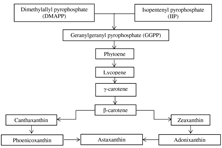
The biosynthetic pathway for ASX synthesis in Phaffia rhodozyma is shown in Figure 1. Firstly, dimethylallyl pyrophosphate (DMAPP) and three molecules from isopentenyl pyrophosphate (IPP) are united to obtain geranylgeranyl pyrophosphate (GGPP). Secondly, every two molecules of GGPP are combined to form phytoene and then interact with lycopene, producing β-carotene and, subsequently, β-carotene. Bioconversion of ASX from β-carotene and γ-carotene includes two pathways, either from zeaxanthin or from canthaxanthin (Barredo et al., Reference BARREDO, GARCÍA-ESTRADA, KOSALKOVA and CARLOS2017).
Biosynthetic pathway of astaxanthin in Phaffia rhodozyma.

Effect of astaxanthin on growth performance
There are conflicting reports regarding whether red yeast affects performance in poultry. Several studies (An et al., Reference AN, SONG, CHANG, LEE, CHAE and JANG2004; Takahashi et al., Reference TAKAHASHI, WATANABE, TAKIMOTO and AKIBA2004) reported that ASX-rich yeast did not influence growth performance and meat production of broiler chicken. Akiba et al. (Reference AKIBA, SATO, TAKAHASHI, MATSUSHITA, KOMIYAMA, TSUNEKAWA and NAGAO2001) concluded that the inclusion of Phaffia rhodozyma rich diets containing 15, 20 and 30 mg ASX/kg diet in broiler chicken nutrition for 14 or 21 days did not affect the performance. Takahashi et al. (Reference TAKAHASHI, TETSUYA and AKIBA2011) noticed that feed intake (FI), feed efficiency (FCR) and body weight gain (BWG) for broiler chicks fed a diet containing 100 mg ASX/kg did not significantly differ from those fed an unsupplemented control diet. Perenlei et al. (Reference PERENLEI, HITOMI TOJO, MASATOSHI, MOTONI and SHINOBU2014) working on 14-day-old female broilers fed diets containing 0 g/kg ASX in the basal diet compared to 10 mg ASX, and 20 mg ASX/kg feed for 28 days and found that diets neither higher nor lower concentrations of ASX-rich yeast in feed influenced BWG, FI, feed efficiency or organ yields. Tapingkae et al. (Reference TAPINGKAE, PANYACHAI, YACHAI and DOAN2018) evaluated the influence of levels 0.5, 1 and 2 g red yeast/kg diet for 12 weeks on the productive performance of laying hens. They reported that FI, hen-day egg production and egg weight were not different between the control and treated groups.
In contrast, several investigations reported a positive effect of ASX on growth performance. Cao and Wang (Reference CAO and WANG2014) reported that supplementation of 10 g ASX or 10 g ASX + 5 mg esterified glucomannan (EMG) per kg diet in a mycotoxin contaminated diet resulted in better average daily gain and daily FI during a 10-42 day growing trial, which indicated that ASX was advantageous to the development of broilers. Jeong and Kim (Reference JEONG and KIM2014) suggested that the inclusion of ASX from red yeast (10 or 20 g/kg) in broiler chicken diets had linearly improved BWG for the overall growing and the finisher period and linearly improved (reduced) FCR in the finisher period which tended to decrease over the whole trial period. Furthermore, Ohh et al. (Reference OHH, SEONGJIN, SOK and KEW-MAHN2016) found that broiler chicks fed a diet containing 100 mg ASX/kg feed had the highest BWG and FI and the best in FCR than other treatments. These results indicated that birds consuming ASX were better able to convert feed into efficient growth.
The differences in these published trial findings may be attributed to differences in diet, experimental conditions, hen species and yeast concentrations. Although the mechanism of red yeast for improved feed efficiency in the different studies was not elucidated, it is possible that yeast cell wall contains oligosaccharides, amino acids, and peptides can enhance FI by increasing appetite. Furthermore, the protein extract from yeast includes nucleotides, which can promote development of the gastrointestinal tract, enhancing nutrient absorption.
Effect of astaxanthin on carcass parameters
Jeong and Kim (Reference JEONG and KIM2014) indicated that broiler chicks fed diets supplemented with ASX from red yeast (10 and 20 g/kg) showed the lowest values of relative spleen weight and the highest values for abdominal fat mass ratio, while supplementation had no effect on breast muscle, liver, gizzard and bursa of Fabricius compared with the control group. Ohh et al. (Reference OHH, SEONGJIN, SOK and KEW-MAHN2016) reported that absolute or relative weights of the heart, liver, bursa of Fabricius and spleen of broiler chicks were not affected by the addition of 100 mg ASX/kg diet. In a study on meat quality, Perenlei et al. (Reference PERENLEI, HITOMI TOJO, MASATOSHI, MOTONI and SHINOBU2014) clarified that meat quality was improved in broiler chickens fed on the diets containing Phaffia spp. yeast as a high source of ASX.
Effect of astaxanthin on haematological parameters
There is little data available on the physiological properties of either ASX derived from red yeast or purified forms on haematological parameters in avian blood. Jeong and Kim (Reference JEONG and KIM2014) pointed out that adding ASX from red yeast (10 and 20 g/kg) into broiler diets did not affect red blood cells (RBCs). Additionally, Cao and Wang (Reference CAO and WANG2014) clarified that supplementation of ASX alone or ASX combined with EMG for protection against aflatoxin B1 (AFB1)-contaminated diet fed to broilers for 35 days caused an increase in RBCs, but there were no effects on mean corpuscular haemoglobin (MCH) or volume (MCV) values, while haematocrit (Ht) and haemoglobin (Hb) significantly decreased compared with AFB1-contaminated diet.
Effect of astaxanthin on blood biochemistry
It has been suggested that the ASX from red yeast or synthetic forms protects the liver from cellular damage. Unfortunately, few types of research have described the biological effects of ASX on poultry. Previous studies by Nakano et al. (Reference NAKANO, TOSA and TAKEUCHI1995) and Nakano et al. (Reference NAKANO, KANMURI, SATO and TAKEUCHI1999) stated that diets containing Phaffia rhodozyma decreased oxidative stress and improved liver function. Dietary supplementation with ASX could induce the total antioxidant capacity (Zhang et al., Reference ZHANG, LI, LENG, ZHANG, HAN and ZHANG2013) which may reduce lipid hydroperoxides and protect the organism from subsequent oxidative damage (Liu et al., Reference LIU, GE, HE, XIE, XU, HE and CHEN2010). In broiler chickens, ingested ASX is transported through plasma lipoprotein (mostly high-density) and deposited in tissues (Takahashi et al., Reference TAKAHASHI, WATANABE, TAKIMOTO and AKIBA2004). ASX inhibited the accumulation of reactive oxygen species intercellularly for stimulated macrophage cells by lipopolysaccharide and reduced iNOS expression in primary macrophages (Lee et al., Reference LEE, BAI, LEE, NAMKOONG, NA, HAN, YIM, CHANG, KWON, LEE and KIM2003; Suzuki et al., Reference SUZUKI, OHGAMI, SHIRATORI, ILIEVA, KOYAMA, YAZAWA, YOSHIDA, KASE and OHNO2006). ASX has high antioxidant activity because it contains unique chemical properties, such as the keto (C=O) moieties hydroxyl (OH) on the ionone ring (Hussein et al., Reference HUSSEIN, SANKAWA, GOTO, MATSUMOTO and WATANABE2006). Supplementation of 100 mg ASX from Phaffia rhodozyma per kg basal diet significantly decreased lipid peroxidation (TBARS) in plasma of broiler chicks (Takimoto et al., Reference TAKIMOTO, TAKAHASHI and AKIBA2007). Cao and Wang (Reference CAO and WANG2014) revealed that ASX was a more powerful scavenger of active oxygen as peroxyl radicals (H2O2) and 1O2 than other carotenoids due to its unusual structure, so ASX could effectively improve the AFB1 mycotoxin-induced deterioration. They illustrated that superoxide dismutase (SOD), malondialdehyde (MDA) and myeloperoxidase levels were significantly improved for the groups fed AFB1-contaminated diets and, at the same time, fed ASX or EMG + ASX. Tapingkae et al. (Reference TAPINGKAE, PANYACHAI, YACHAI and DOAN2018) confirmed that cholesterol and triglyceride in serum and yolk were significantly lower in laying hens fed diets containing red yeast at levels 0.5, 1, 2 g/kg feed compared to the control diet. On the other hand, Takimoto et al. (Reference TAKIMOTO, TAKAHASHI and AKIBA2007) demonstrated that dietary supplementation of Phaffia rhodozyma as a source of ASX was not influential in preventing MDA increases in male broilers.
Effect of astaxanthin on histological alliteration
Little data is available about the influence of dietary supplementation with red yeast as the ASX source on histological parameters of poultry. There are some studies such as Cao and Wang (Reference CAO and WANG2014) who reported small amounts of necrosis and vacuolar degeneration in liver cells and inflammatory cell infiltration in hepatocytes when fed diets supplemented with 10 mg/kg ASX alone or combined with 5 g EMG//kg diet in broilers fed an AFB1 contaminated diet. However, liver sections of chicks fed AFB1-contaminated diet without ASX showed injured pathological changes, including bleeding and necrosis of the liver and inflammatory cell infiltration in hepatocytes. Ohh et al. (Reference OHH, SEONGJIN, SOK and KEW-MAHN2016) determined that supplementation of 100 mg ASX/kg diet for broiler chicks under the stress conditions might be useful for mitigating structural damage in the digestive tract. Additionally, Tapingkae et al. (Reference TAPINGKAE, YINDEE and MOONMANEE2016) recommended that dietary supplementation with red yeast at different levels (0.5, 1.0 and 2.0 g/kg feed) augmented duodenal morphology development in laying hens via increased villus height. As previously seen, yeast cell walls contain metabolites as flavour substances, peptides or some unknown growth factor might improve the energy and protein available for the proliferation of small intestinal cells (Gao et al., Reference GAO, ZHANG, YU, WU, YOON, QUIGLEY and QI2008). Recently, Abd El-Hafez et al. (2018), working on growing Japanese quail chicks, found no histopathological changes when fed low doses of red yeast (4 and 8 g red yeast /kg diet), although the dose of the 12 g red yeast /kg diet caused mild liver and kidney injuries including white blood cells infiltrations, fibroblast cells in the liver and congested blood vesicles in the kidney.
Effect of astaxanthin on immune responses
The results from some published papers show that red yeast can have particular immunomodulatory properties. ASX boosted production of antibodies to T-cell-dependent antigens (Jyonouchi et al., Reference JYONOUCHI, SUN, TOMITA and GROSS1995), stimulated splenocytes function (Chew et al., Reference CHEW, WONG, PARK and WONG1999) and modulated cytokine liberation by splenocytes (Bennedsen et al., Reference BENNEDSEN, WANG, WILLÉN, WADSTRÖM and ANDERSEN1999). Cheng et al. (Reference CHENG, SHEN, PANG and CHEN2001) declared that the addition of ASX to a mule ducklings diet prevented toxicity and induced chemotaxis in macrophages.
Moreover, Takimoto et al. (Reference TAKIMOTO, SATO, AKIBA and TAKAHASHI2006) indicated that feeding chicks a diet containing ASX had an improving effect on xenobiotic metabolism in the liver and T cell-mediated immune responses. Takimoto et al. (Reference TAKIMOTO, TAKAHASHI and AKIBA2007) demonstrated that supplementation of 100 mg/kg ASX from Phaffia rhodozyma in male broiler diets had a positive effect on the proliferation of T cells and production of immunoglobulin G (IgG). Cao and Wang (Reference CAO and WANG2014) noted that supplementation of 10 mg ASX alone or combined with 5 g EMG//kg feed in broilers fed an AFB1-contaminated diet could significantly or partially alleviate the negative effects caused by AFB1. However, Jeong and Kim (Reference JEONG and KIM2014) showed that adding 1 or 2% ASX rich red yeast (2.3 or 4.6 mg ASX/kg, respectively) for broiler diets had no significant effect on WBCs, lymphocyte numbers or IgG levels. The may be due to low concentrations from ASX which may have been inadequate to stimulate the immune system compared with higher levels used in other studies. In addition, ASX has been shown to inhibit lipopolysaccharide-induced systemic inflammation through the inhibition of proinflammatory mediators and cytokines such as interleukin (IL)-1 beta, IL-6, iNOS, interferon (IFN)-g, and tumour necrosis factor (TNF)-a (Lee et al., Reference LEE, BAI, LEE, NAMKOONG, NA, HAN, YIM, CHANG, KWON, LEE and KIM2003; Suzuki et al., Reference SUZUKI, OHGAMI, SHIRATORI, ILIEVA, KOYAMA, YAZAWA, YOSHIDA, KASE and OHNO2006). Takahashi et al. (Reference TAKAHASHI, TETSUYA and AKIBA2011) reported that the addition of 100 mg ASX/kg in male broiler diets fed for two weeks showed an increase in IL-1, IL-6 and IFN-g mRNA expression in the liver compared to the unsupplemented control. There was no difference between the group fed ASX and the control for anti-inflammatory effects and concentration of plasma ceruloplasmin.
Conclusions
Red yeast is a useful source of astaxanthin, which has many biological activities such as antioxidant, immunomodulatory, anti-inflammatory, anti-tumour, stimulating RBC production, increasing metabolic energy production and enhancing the pigmentation of yolk and meat colour of poultry. However, this topic needs further studies to elucidate effective dose levels in poultry.