Introduction
Primary progressive aphasia (PPA) is a clinical diagnosis that is uniquely characterized by initial disruption in language and functional complaints that can be explained by that language disruption (Mesulam, Reference Mesulam1982). Three variants of PPA (logopenic, agrammatic, and semantic) have been identified and are classified based on clinical findings (Gorno-Tempini et al., Reference Gorno-Tempini, Hillis, Weintraub, Kertesz, Mendez, Cappa and Grossman2011). Once it has been determined that an individual meets criteria for PPA in general (i.e., does not have global dementia or cognitive, neuromotor, or sensory deficits that meet criteria for another neurodegenerative disorder), a specific variant is determined. The logopenic variant (lvPPA) is characterized by anomia, poor word retrieval in spontaneous speech, difficulty repeating sentences, and the presence of phonological errors (Gorno-Tempini et al., Reference Gorno-Tempini, Hillis, Weintraub, Kertesz, Mendez, Cappa and Grossman2011). Individuals with the agrammatic variant (agPPA) primarily have difficulty with grammar and syntax (Gorno-Tempini et al., Reference Gorno-Tempini, Hillis, Weintraub, Kertesz, Mendez, Cappa and Grossman2011), and may also have the motor speech disorder, apraxia of speech (Duffy, Peach, & Strand, Reference Duffy, Peach and Strand2007). The semantic variant (svPPA) is characterized by anomia and loss of word knowledge (Gorno-Tempini et al., Reference Gorno-Tempini, Hillis, Weintraub, Kertesz, Mendez, Cappa and Grossman2011).
Neurocognitive differences have been identified in individuals with PPA compared to other neurodegenerative disorders, such as frontotemporal dementia and Alzheimer’s disease (AD), and are particularly evident on measures of language, verbal memory, and attention (Wicklund, Rademaker, Johnson, Weitner, & Weintraub, Reference Wicklund, Rademaker, Johnson, Weitner and Weintraub2007). Longitudinal studies of relatively small groups of PPA patients have documented differences across broad aspects of cognition using brief cognitive screens, such as the Mini-Mental State Examination (MMSE) and Addenbrooke’s Cognitive Examination-Revised (ACE-R) (Hsieh, Hodges, Leyton, & Mioshi, Reference Hsieh, Hodges, Leyton and Mioshi2012; Leyton, Hornberger, Mioshi, & Hodges, Reference Leyton, Hornberger, Mioshi and Hodges2010; Leyton, Hsieh, Mioshi, & Hodges, Reference Leyton, Hsieh, Mioshi and Hodges2013). Other studies assessing differences among or between PPA variants often include neurocognitive data, but the primary aim of such studies is not generally focused on those data (Gorno-Tempini et al., Reference Gorno-Tempini, Dronkers, Rankin, Ogar, Phengrasamy, Rosen and Miller2004; Rohrer et al., Reference Rohrer, Ridgway, Crutch, Hailstone, Goll, Clarkson and Warren2010).
While informative, these studies often limit the description of neuropsychological profiles in PPA variants. Additionally, small sample sizes often limit the ability to detect group differences and to thoroughly characterize each variant (Carthery-Goulart, Knibb, Patterson, & Hodges, Reference Carthery-Goulart, Knibb, Patterson and Hodges2012; Rabinovici et al., Reference Rabinovici, Jagust, Furst, Ogar, Racine, Mormino and Gorno-Tempini2008; Weintraub et al., Reference Weintraub, Rogalski, Shaw, Sawlani, Rademaker, Wieneke and Mesulam2013). Differentiation among the three variants that includes results from comprehensive neuropsychological evaluation may refine our understanding of clinical profiles that distinguish among the variants and eventually improve predictions of unique underlying pathology. We hypothesize that reliable neurocognitive differences exist among the PPA variants beyond those accounted for by the language disturbance alone when clinical assessment includes a comprehensive neuropsychological battery, and, more specifically, that the lvPPA group will perform more poorly on the majority of neurocognitive tasks even after controlling for aphasia severity. Therefore, the present study aimed to assess differences in neuropsychological functioning between an exceptionally well characterized large group of individuals with agPPA, svPPA, and lvPPA.
Methods
Between July 2010 and October 2013, we prospectively recruited 91 participants who met criteria for PPA (Mesulam, Reference Mesulam1982). All participants met our clinical criteria for lvPPA, agPPA or svPPA (described below). We included only subjects who spoke English as their primary language, and who had an informant to provide an independent evaluation of functioning and corroboration of the history of language impairment. Left handedness, as determined by patient report and observation during writing, was not an exclusionary criterion. All participants presented with a chief complaint of language dysfunction, which was also the primary cause for disrupting activities of daily living. None complained of early or prominent deficits in other cognitive domains. All participants underwent a detailed speech and language examination, neurological evaluation, and neuropsychological testing over a span of 48–72 hours.
Standard Protocol Approvals and Patient Consents
The Mayo Clinic Institutional Review Board approved this study. All participants provided written informed consent before participating in the research.
Speech & Language Assessment
All participants had video and audio recordings of their entire formal speech and language assessment, as well as general conversation. The language assessment included the Western Aphasia Battery (WAB, revised) (Kertesz, Reference Kertesz2007), with the WAB Aphasia Quotient (AQ) serving as the primary measure of global language ability and aphasia severity. The WAB AQ reflects a composite score derived from ratings of Spontaneous Speech (including ratings of Information Content and a composite rating of fluency, grammaticality, and paraphasias), and scores on measures of Auditory-Verbal Comprehension, Repetition, and Naming and Word Finding. In addition, a 22-item version of part V of the Token Test (De Renzi & Vignolo, Reference De Renzi and Vignolo1962) and a 15-item Boston Naming Test (BNT) (Lansing, Ivnik, Cullum, & Randolph, Reference Lansing, Ivnik, Cullum and Randolph1999) were administered. Other language measures were also obtained but will not be addressed in this study. Any subject who demonstrated features of progressive aphasia and had a history consistent with PPA was included in this study. A score >2 standard deviations below the mean on all language tests with published or derived mean and standard deviation for normal performance was considered abnormal.
Two speech-language pathologists (J.R.D. and E.A.S.) reviewed the quantitative data from the language assessment as well as viewed crucial aspects of the recorded clinical evaluation for all subjects. Each speech-language pathologist made a judgment about the presence or absence of aphasia and subgroup classification, as described below. Using only the data from this speech and language assessment, and without any knowledge of the neurological or neuropsychological results, the two raters came to consensus on classification for all subjects. Formal interrater reliability was not assessed, but agreement about the presence/absence of aphasia and apraxia of speech was reached without need for discussion in all but a few cases. Subgroup classification was quickly reached (i.e., requiring little or no discussion) for a majority of the subjects; cases in which more discussion was required typically involved re-examination of data, re-review of recordings, or re-review and discussion of classification criteria before a consensus conclusion.
We used criteria published in a previous study to classify individuals according to the PPA variants (Josephs et al., Reference Josephs, Duffy, Fossett, Strand, Claassen, Whitwell and Peller2010). The clinical criteria used to determine a diagnosis for lvPPA were: (1) slowed rate of verbal expression due to pauses for word retrieval or verbal formulation, (2) anomia, but target words typically recognized with cuing, (3) evidence of relatively spared single word comprehension with increased difficulty with complex sentence comprehension, (4) any combination of impaired sentence repetition or sentence comprehension, or phonemic paraphasias, (5) absence of agrammatic or telegraphic verbal output, and (6) no report from subject or informant that the subject no longer understands what a common word means.
The clinical criteria used to determine a diagnosis for agPPA were: (1) verbal or written output characteristics with evidence of agrammatism or telegraphic speech on sentence level responses, (2) difficulties with verbal and reading comprehension and writing can be present, (3) target words are recognized when provided on the majority of confrontation naming errors, (4) reduced word fluency (e.g., rapid word retrieval performance on the WAB Animal Word Fluency task), and (5) apraxia of speech may be present.
The clinical criteria used to determine a diagnosis of svPPA were: (1) aphasia dominated by anomia with failure to recognize target words when provided, (2) poorer single word comprehension than comprehension of complex sentences containing individual words that are comprehended, (3) verbal output is grossly normal in grammar, syntax, phrase length, and prosody, (4) nouns and verbs may lack specificity (e.g., “thing”/table), (5) patients or informants may comment that the patient does not know what some words mean, (6) loss of single word meaning is disproportionate to overall aphasia severity, and (7) repetition should be relatively preserved and phonological errors should be rare.
Neuropsychological and Neurologic Assessments
The neuropsychological evaluation was performed separately from the comprehensive speech and language evaluation and included assessment of (1) memory [Wechsler Memory Scale-III (WMS-III) Logical Memory I/II which assesses immediate and delayed recall of paragraph-length stories; Visual Reproduction I/II which assesses immediate and delayed recall of designs (Wechsler, Reference Wechsler1997); the Rey Auditory Verbal Learning Test (AVLT) (Rey, Reference Rey1964), a list learning test that includes five learning trials, an interference trial, immediate recall and delay recall trials, and recognition]; (2) processing speed [Trail Making Test (TMT) Part A (Reitan, Reference Reitan1958; Reitan & Wolfson, Reference Reitan and Wolfson1993), a test of scanning and visuomotor tracking]; (3) executive function [TMT Part B, which assesses divided attention and cognitive flexibility (Reitan, Reference Reitan1958; Reitan & Wolfson, Reference Reitan and Wolfson1993), and Delis-Kaplan Executive Function (DKEFS) Card Sort (Delis, Kaplan, & Kramer, Reference Delis, Kaplan and Kramer2001), a conceptual task that evaluates problem-solving, verbal and nonverbal concept formation, and flexibility of thinking]; and (4) visuospatial function [Rey-Osterreith Complex Figure Test (Osterrieth, Reference Osterrieth1944), a measure of visual perception and constructional praxis and Visual Object and Space Perception (VOSP) Cube and Incomplete Letters subtests (Warrington & James, Reference Warrington and James1991). The VOSP Cube subtest is a block counting task. The VOSP Incomplete Letters subtest shows a series of large alphabet letters, one to a card, which have been randomly degraded so that only 30% of the original shape remains. The subject is asked to identify the letter.] All participants also underwent a detailed neurologic examination, including general cognition testing, by a behavioral neurologist (K.A.J.).
Published norms were used for the WMS-III (Wechsler, Reference Wechsler1997) and DKEFS (Delis et al., Reference Delis, Kaplan and Kramer2001) subtests. We used Mayo Older American Normative Studies (MOANS) age-adjusted scaled scores for the AVLT and TMT (Ivnik, Malec, Smith, Tangalos, & Petersen, Reference Ivnik, Malec, Smith, Tangalos and Petersen1996; Ivnik et al., Reference Ivnik, Malec, Smith, Tangalos, Petersen, Kokmen and Kurland1992; Machulda et al., Reference Machulda, Ivnik, Smith, Ferman, Boeve, Knopman and Tangalos2007). For the two participants who were younger than the MOANS normative sample, the lowest age grouping was used to derive standard scores. Subjects were assigned a scaled score of one if they attempted but were unable to complete the task. Subjects were assigned a scaled score of zero if they did not comprehend task instructions (Machulda et al., Reference Machulda, Whitwell, Duffy, Strand, Dean, Senjem and Josephs2013). The learning over trials (LOT) score on the AVLT is a measure of learning efficiency over the five learning trails and is calculated by multiplying the trial one score by five and subtracting that value from the total words recalled over the learning trials (Ivnik et al., Reference Ivnik, Malec, Tangalos, Petersen, Kokmen and Kurland1990).
Statistical Analysis
Statistical analyses were performed using IBM SPSS Version 21 for Windows. Non-parametric Chi-Square and parametric one-way analysis of variance (ANOVA) were used to assess demographic features across groups as appropriate. A p value of <.05 was used to determine statistical significance. We completed an analysis of covariance (ANCOVA), using the WAB AQ as a covariate, to compare neuropsychological variables across groups. To correct for multiple comparisons of the neuropsychological data, we used a Bonferroni correction for post hoc comparisons following a significant ANCOVA, with a criterion p<.05. Cases were excluded pair-wise in the event of missing data for a particular analysis.
Results
Group Classification
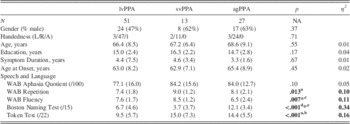
Of the 91 PPA subjects, 51 were classified as lvPPA (47% male), 13 as svPPA (46% male), and 27 as agPPA (63% male). The groups did not differ on demographic variables including age, education, gender, or age at symptom onset and disease duration. There were no handedness or WAB AQ differences among groups. Measures of repetition, verbal fluency, confrontation naming, and receptive language did differ across groups in a pattern consistent with diagnostic criteria (Table 1).
Demographic and speech and language testing by primary progressive aphasia (PPA) classification

Note. Mean (SD); L=left handed; R=right handed; A=Ambidextrous; WAB=Western Aphasia Battery; a=lvPPA<svPPA; b=lvPPA<agPPA; c=agPPA<svPPA; d=svPPA<lvPPA; e=svPPA<agPPA; f = agPPA < lvPPA; *=significance at p=0.06, η 2 = eta squared; Magnitude of effect size: small=.01, medium=.06, large=.14.
Neuropsychological Differences
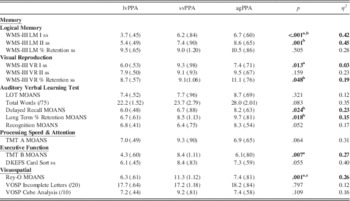
Nearly all of the effect sizes for the significant ANCOVA findings described below are very large (η 2 >0.14) (Table 2).
ANCOVA results of the neuropsychological profiles by primary progressive aphasia (PPA) classification

Note. Above are adjusted means, standard errors, and measure of effect size. ss=scaled score (mean 10, standard deviation 3); MOANS=Mayo Older American Normative Studies (mean 10, standard deviation 3); WMS-III=Wechsler Memory Scale, Third Edition; LM=Logical Memory I (Immediate recall) and II (Delayed recall); VR=Visual Reproduction I (Immediate recall) and II (Delayed recall); LOT=Learning Over Trials; TMT=Trail Making Test (Part A and Part B); DKEFS=Delis-Kaplan Executive Function System; Rey-O=Rey-Osterreith Complex Figure Test; VOSP=Visual Object and Space Perception; a=lvPPA<svPPA; b=lvPPA<agPPA; c=agPPA<svPPA; Post hoc contrasts are Bonferroni p<0.05; η 2 =eta squared; Magnitude of effect size: small=.01, medium=.06, large=.14.
Memory
Participants with lvPPA recalled less information compared to participants with svPPA and agPPA on the immediate recall trial, and less information compared to participants with agPPA on the delayed recall trial on Logical Memory. However, the percentage of information retained did not differ. Immediate recall of Visual Reproduction (VR I) also differed across groups, wherein the lvPPA group scored lower than the svPPA group. The groups did not differ on delayed recall (VR II), but the lvPPA group scored lower on the percent retention index than the agPPA group.
The rate of learning (LOT) and total words learned over the five learning trials of the AVLT did not differ among groups, but the lvPPA group scored lower than the agPPA group on AVLT delayed recall and long-term percent retention.
Processing speed
Total time required to complete the TMT Part A did not differ among groups.
Executive function
The total time to complete TMT Part B was slower in the lvPPA group compared to the svPPA group. Scores on the D-KEFS Card Sort task did not differ significantly among groups.
Visuospatial
The groups differed on Rey-O copy trial performance, with the svPPA group scoring higher than both the lvPPA and agPPA groups. Performance on the VOSP Cube and Incomplete Letters did not differ among groups.
Discussion
Consistent with our hypothesis, we found that there are neurocognitive differences beyond the language domain in participants with well-characterized subtypes of PPA, and that the group differences are not solely due to differences in aphasia severity. In particular, aspects of learning and memory, executive, and visuospatial functions differed among participants with lvPPA, agPPA, and svPPA.
It is difficult, if not impossible, to create a comprehensive neurocognitive assessment without the confound of language given that neurocognitive domains are not discrete entities. Nonetheless, the group differences on measures with minimal language demand suggests that brain regions subserving cognitive skills other than language are differentially affected in individuals with distinct PPA variants, with relatively more widespread neurocognitive impairment in lvPPA. The similar illness duration across groups suggests that the numerous neurocognitive differences observed in participants with lvPPA relative to those with agPPA and svPPA are not simply an artifact of aphasia severity, but rather reflect compromise to different brain regions or circuitry.
Our findings of neurocognitive differences are consistent with neuroimaging studies showing neuroanatomical correlates of brain dysfunction in these clinically defined syndromes of PPA. In particular, compared to normative data, the detected anomia and verbal memory impairment in participants with svPPA is consistent with left anterior temporal lobe disease (Rohrer et al., Reference Rohrer, Ridgway, Crutch, Hailstone, Goll, Clarkson and Warren2010). The mildly lower scores on cognitive flexibility and processing speed tasks in participants with agPPA is consistent with left frontal lobe compromise, which has been reported in other studies (Grossman et al., Reference Grossman, Powers, Ash, McMillan, Burkholder, Irwin and Trojanowski2013). The observed impairments in participants with lvPPA on measures of immediate and delayed memory as well as visuospatial reasoning are consistent with the documented disruption in temporoparietal circuitry in participants with lvPPA (Gorno-Tempini et al., Reference Gorno-Tempini, Dronkers, Rankin, Ogar, Phengrasamy, Rosen and Miller2004). The additional deficit observed in speeded mental flexibility may implicate involvement of frontal lobe circuitry beyond temporoparietal regions. These findings build on prior studies showing that impairment in other cognitive domains, namely impaired working memory in participants with lvPPA, may undermine other cognitive skills (Carthery-Goulart et al., Reference Carthery-Goulart, Knibb, Patterson and Hodges2012; Gorno-Tempini et al., Reference Gorno-Tempini, Brambati, Ginex, Ogar, Dronkers, Marcone and Miller2008; Rohrer et al., Reference Rohrer, Ridgway, Crutch, Hailstone, Goll, Clarkson and Warren2010). Indeed, recent cross sectional and longitudinal neuroimaging studies have identified frontal lobe structural and functional changes in participants with lvPPA (Ash et al., Reference Ash, Evans, O’Shea, Powers, Boller, Weinberg and Grossman2013; Heim et al., Reference Heim, Pieperhoff, Grande, Kuijsten, Wellner, Saez and Amunts2014).
With the rapidly advancing knowledge of the clinical and pathological characteristics of PPA variants, there is increasing impetus to revisit the 2011 diagnostic criteria (Gorno-Tempini et al., Reference Gorno-Tempini, Hillis, Weintraub, Kertesz, Mendez, Cappa and Grossman2011; Harris et al., Reference Harris, Gall, Thompson, Richardson, Neary, du Plessis and Jones2013; Mesulam & Weintraub, Reference Mesulam and Weintraub2014; Wicklund et al., Reference Wicklund, Duffy, Strand, Machulda, Whitwell and Josephs2014). For example, we recently found that 31% of a sample of individuals with PPA was not classifiable by quantitative application of the current 2011 consensus criteria. The speech and language evaluation, along with gray matter volumes, suggested many of these unclassifiable individuals are in the early stages of logopenic and semantic variant PPA (Wicklund et al., Reference Wicklund, Duffy, Strand, Machulda, Whitwell and Josephs2014). The survival of neurocognitive differences, most with a large effect size, after controlling for WAB AQ detected in the present study among participants with logopenic, semantic, and agrammatic PPA raises the possibility that neuropsychological testing may be of additive value to differentiate between clinical groups.
Accurate and comprehensive diagnosis of individuals with primary language disruption is also important given the differences in underlying pathology associated with the PPA variants, which may result in different prognoses. The clinical syndromes of svPPA and agPPA may be more consistently predictive of the underlying pathology of frontotemporal lobar degenerative (FTLD) spectrum disorders, whereas lvPPA is often associated with AD but may also reflect FTLD pathology (Harris et al., Reference Harris, Gall, Thompson, Richardson, Neary, du Plessis and Jones2013) including FTLD associated with a progranulin mutation (Josephs et al., Reference Josephs, Duffy, Strand, Machulda, Vemuri, Senjem and Whitwell2014). Neuropsychological assessment might add useful clinical information to aid in establishing the appropriate classification of PPA subtypes.
To our knowledge, this is the largest prospective study to date that has comprehensively examined neuropsychological function in individuals with logopenic, semantic and agrammatic PPA. A significant strength is the meticulous diagnostic classification made by consensus diagnoses by two speech-language pathologists. A potential weakness of this study is that there was not a formalized protocol for group classification in the event there was disagreement about classification, nor did we quantify interrater reliability value of group classification. However, we are not aware of any other studies on PPA that include this information.
In summary, our study characterizes the neuropsychological differences among PPA variants beyond the primary language disturbance, with the most striking differences found in those with lvPPA. These findings highlight the potential value of comprehensive neuropsychological testing in informing the diagnosis of PPA. Importantly, although the clinical syndrome of lvPPA is most commonly associated with AD pathology, the clinical presentation and course, and pattern of neurocognitive deficits, argue against “typical AD.” These participants presented with language, and not memory concerns that caused impairment in activities of daily living. Thus, all of our subjects met criteria for PPA (Gorno-Tempini et al., Reference Gorno-Tempini, Hillis, Weintraub, Kertesz, Mendez, Cappa and Grossman2011; Mesulam, Reference Mesulam1982). The distinction between lvPPA and dementia with prominent language involvement may be difficult to establish in some cases. The present study shows that neuropsychological evaluation may be a valuable tool to help further differentiate these clinical entities. Future work will benefit from exploring the value of neuropsychological performance in predicting the pathologic PPA subtype, as well as from a longitudinal perspective study on the cognitive trajectories of these clinical groups.
Acknowledgments
This study was funded by NIH grant number R01 DC010367 (PI Josephs). The authors thank Drs. Ahlskog, Boeve, Drubach, Keegan, Knopman, and Petersen, Mayo Clinic, Rochester, MN for subject referral; and Mrs. Sarah Boland for performing the neuropsychological testing and organizing all subject test schedules. The authors have no conflicts of interest to report.