Food safety has been given special attention as an important public health issue in developing countries. The quality and safety of artisan cheeses are influenced by the chemical and microbiological composition of the milk of origin, the technological manufacturing process, and the hygienic conditions during storage (Brooks et al., Reference Brooks, Martinez, Stratton, Bianchini, Krokstrom and Hutkins2012; Montel et al., Reference Montel, Buchin, Mallet, Delbes-Paus, Vuitton, Desmasures and Berthier2014). When these conditions do not meet the established requirements, hazards of foodborne disease outbreaks are favored.
Raw milk and dairy products are included within foods that can transmit disease-causing bacterial hazards. The microbiological composition of cheeses manufactured with raw milk directly depends on the groups of microorganisms present in the milk and on the direct and indirect contact with sources of contamination during the manufacturing process (Hummerjohann et al., Reference Hummerjohann, Naskova, Baumgartner and Graber2014; Montel et al., Reference Montel, Buchin, Mallet, Delbes-Paus, Vuitton, Desmasures and Berthier2014). The links of Listeria monocytogenes, verocytotoxin-producing Escherichia coli (VTEC), Staphylococcus aureus, Salmonella, and Campylobacter with the main microbiological hazards of cheeses made from unpasteurized milk were reviewed by Verraes et al. (Reference Verraes, Vlaemynck, Van Weyenberg, De Zutter, Daube, Sindic, Uyttendaele and Herman2015).
Small volumes of artisan fresh cheeses are manufactured at the cheese maker´s own dairy farm under rustic conditions because this is an old tradition in Latin American countries, besides being among the preferences of the people in this region (Castañeda et al., Reference Castañeda, Soto and Chaidez2017). Cheese making gives support to many families, and the volume produced is appreciable. In Cuba, production of artisan fresh cheeses made from unpasteurized milk has increased. These cheeses are made with raw milk under non-hygienic conditions, usually in unlicensed facilities with no health records. Consequently, these foods show a very variable sensory quality and composition (Martinez et al., Reference Martinez, Ribot, Riverón, Remón, Martínez, Jacsens and Uyttendaele2019), a restricted preservation, and they are prone to contamination and unsafe condition (Ledesma et al., Reference Ledesma, Hernández, Hurtado, Hernández and Martín2005). Therefore, the objective of this work was to identify the presence of bacterial hazards in artisan fresh cheeses produced in six Cuban provinces.
Materials and methods
Milk and cheese samples (n = 190) were collected from 95 artisans fresh cheese producing farms located in six Cuban provinces following the guidance in IDF 050/ISO 707: 2008.
Salmonella spp. was detected according to the method in ISO 6579: 2007. For Escherichia coli O157, the detection procedure in ISO 16654: 2001 and the serological identification with Escherichia coli O157 antiserum (Difco, USA) were used. Listeria monocytogenes and Bacillus cereus were detected following the methods in ISO 11290: 2004 and ISO 7932: 2004, respectively. Enumeration of Staphylococcus coagulase positive was carried out according to ISO 6888-1: 2003; the characteristic isolates were selected for its identification by the standard system API® 20 Staph (BioMérieux®, Marcy-l'Etoile-France).
The occurrence of staphylococcal enterotoxin genes encoding for SEA–SEE was analyzed by PCR. It was performed on a gradient thermo-cycler (Eppendorf) using a 25 μl mixture containing 1× PCR buffer, 1.5 mm MgCl2 (50 mm), 0.2 mm of each dNTP (10 mm), 10 pmol of each enterotoxin oligonucleotide, 1 U of recombinant Taq polymerase enzyme (Invitrogen), 4 μl bacterial DNA, and the volume was completed with sterile Milli-Q water.
The amplification conditions were as follows: an initial cycle at 95°C for 5 min, 15 denaturation cycles at 95°C for 30 s, alignment at 68°C for 30 s, extension at 72°C for 30 s, and a final cycle at 72°C for 2 min. Non-toxigenic Staphylococcus aureus carrying the genes sea (N5), seb (N14) and sec (MC1), sed (C1), and see (N19125) were used as positive control. Staphylococcus aureus (ATCC 25923) without any virulence factors was the negative control. DNA fragments were visualized by electrophoresis at 100 volts, whereas the size was estimated by a 100 pb marker (Promega, USA), displayed on 2% agarose gel in TBE 1× buffer, stained with ethidium bromide solution (0.5 μg/μl) and photographed with a Nikon camera (Coolpix S4400).
In order to know the pathogenicity of the biofilm formed by the microorganisms isolated from milk and cheese samples, and on the molds and utensils used, the biofilm formation was quantified on the abiotic surface according to the method described by Milanov et al. (Reference Milanov, Lazic, Vidic, Petrovic, Bugarski and Seguljev2010), with absorbance (A) modification in spectrophotometer. The absorbance was measured at 492 nm in a spectrophotometer (SUMA, PR-621, Cuba).
Statistical analysis
Descriptive statistics were applied to determine the prevalence of bacterial hazards, specifically frequency analysis using the SAS version 9.0 (2011) program. The simple position (average) and measures of statistical dispersion (standard deviation) were used to analyze the results of S. aureus counts and the biofilm production in bacterial hazard isolates of milk, cheese and surfaces of molds and utensils. A simple analysis of variance (type III SC) and the Duncan´s multiple range test (InfoStat, version 2.0) were used (Di Rienzo et al., Reference Di Rienzo, Casanoves, Balzarini, Gonzalez, Tablada and Robledo2010).
Results and discussion
Several bacterial hazards were detected in the raw milk and artisan fresh cheese samples collected. Listeria spp., Bacillus cereus, Escherichia coli O157, Salmonella spp. and Staphylococcus aureus were respectively detected in 9.5, 23.2, 12.6, 10.5, and 29.5% of the milk samples and in 18.9, 24.2, 13.7, 17.9, and 51.6% of the artisan fresh cheese. Staphylococcus aureus and Bacillus cereus recorded the highest presence of bacterial hazard isolates. These results can be associated with poor hygienic-sanitary conditions during milking and cheese making processes (Verraes et al., Reference Verraes, Vlaemynck, Van Weyenberg, De Zutter, Daube, Sindic, Uyttendaele and Herman2015) and may also be due to the non-compliance of the hygiene and manufacturing practices.
The differences observed between the bacterial hazards in the milk used as raw material and the final product indicated that, in addition to the bacteria from the milk, there were other contamination sources, such as handling, utensils, production environment, and the water used for cleaning (Brooks et al., Reference Brooks, Martinez, Stratton, Bianchini, Krokstrom and Hutkins2012; Montel et al., Reference Montel, Buchin, Mallet, Delbes-Paus, Vuitton, Desmasures and Berthier2014). The percentage of samples with bacterial hazard isolates was higher in cheese than in raw milk.
All samples were negative to Listeria monocytogenes, one of the main pathogens causing foodborne diseases by cheese consumption (Montel et al., Reference Montel, Buchin, Mallet, Delbes-Paus, Vuitton, Desmasures and Berthier2014; Verraes et al., Reference Verraes, Vlaemynck, Van Weyenberg, De Zutter, Daube, Sindic, Uyttendaele and Herman2015). The absence of this bacterium in cheese samples may be associated with the storage of unpacked cheeses in the open air, which increases their outer surface desiccation, due to humidity loss, and decreases the survival of this microorganism (Novak et al., Reference Novak, Vera, Dallagnol and Pucciarelli2013). However, Listeria innocua (9), Listeria seeligeri (7) and Listeria ivanovii (5), species described as environmental contaminants (Novak et al., Reference Novak, Vera, Dallagnol and Pucciarelli2013), were identified.
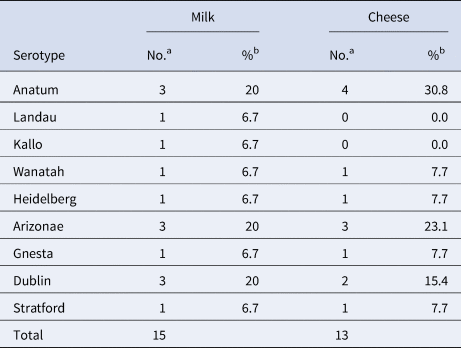
A total of 28 Salmonella spp. isolates were obtained in raw milk and artisan fresh cheese samples. They were serotyped and proved to correspond to Salmonella enterica subsp. enterica and Salmonella enterica subsp. arizonae. The most frequent serogroups found were E1, E4, D, H, C2–C3, and N. Of all the isolates, Salmonella Anatum showed the highest presence in samples. Each serotype was identified in a raw milk sample and its corresponding (Table 1).
Distribution of Salmonella serotypes identified in raw milk and artisan fresh cheese samples

a Number of serotype.
b Percentage of total serotypes found in the respective samples.
Salmonella Anatum has been considered a risk to public health because of its high zoonotic potential, wide geographic distribution and multidrug resistance (Chiou et al., Reference Chiou, Hong, Liao, Wang, Tu, Chen and Chen2019). In Cuba, no Salmonella spp. isolates were found in any of the 75 raw milk and artisan fresh cheese samples analyzed by Ledesma et al. (Reference Ledesma, Hernández, Hurtado, Hernández and Martín2005), thus, our results are the first to establish its presence and serotypes in raw milk and artisan fresh cheeses (Table 1).
The presence of Escherichia coli O157 in milk and cheese samples is a real health risk because of the serious effects it can cause, including the possible loss of life (Montel et al., Reference Montel, Buchin, Mallet, Delbes-Paus, Vuitton, Desmasures and Berthier2014). This microorganism is known to contaminate meat and milk (Brooks et al., Reference Brooks, Martinez, Stratton, Bianchini, Krokstrom and Hutkins2012), although it may also be present in vegetables growing in previous areas of cattle-raising. It was reported in raw milk from several countries, where it was found in samples of raw milk cheeses (Verraes et al., Reference Verraes, Vlaemynck, Van Weyenberg, De Zutter, Daube, Sindic, Uyttendaele and Herman2015).
All the milk and cheese samples were contaminated with Staphylococcus aureus, with concentration higher than 104 CFU/(ml or g). Staphylococcus aureus may be present on the skin of the udder and the hands of the milker, such that poor milking practices enable milk contamination (Brooks et al., Reference Brooks, Martinez, Stratton, Bianchini, Krokstrom and Hutkins2012; Montel et al., Reference Montel, Buchin, Mallet, Delbes-Paus, Vuitton, Desmasures and Berthier2014; Verraes et al., Reference Verraes, Vlaemynck, Van Weyenberg, De Zutter, Daube, Sindic, Uyttendaele and Herman2015; Castañeda et al., Reference Castañeda, Soto and Chaidez2017). Multiple sources of contamination were reflected in the high genetic diversity among isolates from the same raw milk or cheese samples, confirming the contamination from more than one source, as shown in different studies (Hummerjohann et al., Reference Hummerjohann, Naskova, Baumgartner and Graber2014; Castañeda et al., Reference Castañeda, Soto and Chaidez2017).
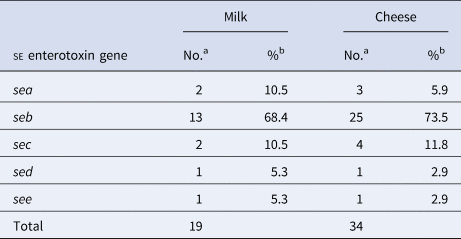
The significant differences (P < 0.05) between S. aureus counts in cheese (4.7 ± 0.8 log CFU/ml) and in milk (5.4 ± 0.7 log CFU/ml) can be explained by the existence of other contaminating sources during the production process, such as utensils, environment, and handling by staff (Brooks et al., Reference Brooks, Martinez, Stratton, Bianchini, Krokstrom and Hutkins2012). Staphylococcus aureus levels can increase further due to both the growth of the organism and the physical concentration effects, which result in an estimated increase of 1 log 10 during the production process of soft raw milk cheese (Peng et al., Reference Peng, Hoffmann, Bockelmann, Hummerjohann, Stephan and Hammer2013). One of the risks of this microorganism is its ability to produce a thermostable enterotoxin when its count exceeds 105 CFU/g (Kadariya et al., Reference Kadariya, Smith and Thapaliya2014), leading to staphylococcal food poisoning. This risk increases because all the gene fragments required for toxin production were detected in 68.8% of 77 Staphylococcus aureus isolates (Table 2).
Distribution of Staphylococcus aureus isolates with the presence of enterotoxin gene fragments

a Number of S. aureus isolates with presence of enterotoxin gene fragments.
b Percentage of enterotoxin gene fragments found in the respective sample.
The seb gene was most frequently found and detected in 38 out of 53 enterotoxin-producing Staphylococcus aureus strains. These results agree with those reported by Hummerjohann et al. (Reference Hummerjohann, Naskova, Baumgartner and Graber2014), who identified Staphylococcus aureus SEB enterotoxin as the major contaminant of Swiss cheese manufactured with raw milk (62%). SEB genotype comprises bovine Staphylococcus aureus strains exclusively associated with very high within-herd prevalence of mastitis (Johler et al., Reference Johler, Weder, Bridy, Huguenin, Robert, Hummerjohann and Stephan2015).
Other results that point to the strain potential pathogenicity in milk and cheeses are a demonstrated capability to produce biofilm; 97.7% (172/176) of all bacterial hazard isolates were found to be biofilm producers. Of these, 7.9% (14/176) were strong producers, 18.8% (32/176) moderate, 56.8% (126/176) weak, and 2.3% (4/176) non-producers. Staphylococcus aureus showed the highest biofilm production: in the category of strong was 18.8% (14/77), moderate 33.8% (26/77) and weak 48.1% (14/77).
As many as 84.6% of the isolates of Staphylococcus aureus obtained from the surface of molds and utensils used during the cheese manufacturing process were strong biofilm producers. The number of strong biofilm-forming strains is of great significance for artisan fresh cheese production, since this physiological condition enables such microorganisms to survive hostile environments and antimicrobial agents and thereby achieve permanence, both in foods and on surfaces in contact with them (Peton and Le Loir, Reference Peton and Le Loir2014). The fact that Staphylococcus aureus strains can adhere to the surface of molds and utensils used during the manufacturing process, besides their ability to be strong biofilm producers, increases their persistence (Milanov et al., Reference Milanov, Lazic, Vidic, Petrovic, Bugarski and Seguljev2010). These results indicate the importance of controlling this microorganism in artisan fresh cheese production due to the risk it can cause to the health of consumers.
In conclusion, this study proved the presence of pathogenic bacteria in the milk used as raw material and artisan fresh cheeses in Cuba. Nine Salmonella serotypes were identified in raw milk and artisan fresh cheeses. Staphylococcus aureus was shown to be a strong biofilm producer and together with the high number of isolates with enterotoxin-producing genes this indicates a significant health risk.