Introduction
Childhood trauma has been robustly associated with a number of mental disorders, including schizophrenia (Varese et al. Reference Varese, Smeets, Drukker, Lieverse, Lataster, Viechtbauer, Read, Van Os and Bentall2012), depression (Nanni et al. Reference Nanni, Uher and Danese2012), anxiety (Kuo et al. Reference Kuo, Goldin, Werner, Heimberg and Gross2011) and bipolar disorder (Etain et al. Reference Etain, Henry, Bellivier, Mathieu and Leboyer2008). In a recent meta-analysis on the link between childhood trauma and schizophrenia in comparison to other disorders, Matheson et al. (Reference Matheson, Shepherd, Pinchbeck, Laurens and Carr2012) found no clear evidence that childhood trauma showed a stronger association with schizophrenia than with depression or bipolar disorder. The authors concluded that, instead of increasing risk for a specific disorder, childhood trauma may increase risk for stress-related disorders through changes of the hypothalamic-pituitary-adrenal axis, alterations of which have been reported in a number of mental disorders including psychosis (Read et al. Reference Read, Fosse, Moskowitz and Perry2014), depression (Vreeburg et al. Reference Vreeburg, Hoogendijk, van Pelt, DeRijk, Verhagen, van Dyck, Smit, Zitman and Penninx2009), anxiety (Elzinga et al. Reference Elzinga, Spinhoven, Berretty, de Jong and Roelofs2010) and mania (Valiengo et al. Reference Valiengo, Soeiro-de-Souza, Marques, Moreno, Juruena, Andreazza, Gattaz and Machado-Vieira2012).
While it is theoretically plausible that the assumed causal effect of childhood trauma would induce comparable biological alterations in different individuals, the issue why some individuals go on to develop depression, while others develop psychosis or mania, remains unresolved. A popular explanation is that one's individual genetic background may determine the expression of psychopathology after exposure to a harmful environmental factor (van Winkel et al. Reference van Winkel, Esquivel, Kenis, Wichers, Collip, Peerbooms, Rutten, Myin-Germeys and van Os2010). However, for childhood trauma, these models have not always been supported by the data at hand. For example, a number of studies found no evidence for an interaction between familial risk for psychosis and exposure to childhood trauma (Arseneault et al. Reference Arseneault, Cannon, Fisher, Polanczyk, Moffitt and Caspi2011; Wigman et al. Reference Wigman, Van Winkel, Ormel, Verhulst, Van Os and Vollebergh2012; Fisher et al. Reference Fisher, McGuffin, Boydell, Fearon, Craig, Dazzan, Morgan, Doody, Jones, Leff, Murray and Morgan2014).
It has also been observed that the early stages of psychopathology are characterized by a mixed collection of symptoms not specific for any one mental disorder (van Os, Reference van Os2013). Studies on high-risk individuals have also shown that predicting which individual is going to develop a particular disorder is extremely difficult (Fusar-Poli et al. Reference Fusar-Poli, Yung, McGorry and van Os2014).
Taken together, these findings seem difficult to reconcile with the relatively simplistic notion that a person at above-average genetic risk for depression may develop an affective disorder following childhood trauma, whereas a person at higher genetic risk for schizophrenia would develop a psychotic outcome.
An alternative explanation is that childhood trauma may not specifically induce a particular disorder, but rather the co-occurrence of depression, psychosis, mania and anxiety over the life course. Depending on which symptoms prevail at any given point, diagnoses given to individual patients may then vary. Some research is available that reports associations between childhood trauma and clustering of multiple symptom domains, such as psychosis combined with depression (Smeets et al. Reference Smeets, Lataster, Dominguez, Hommes, Lieb, Wittchen and van Os2012). If indeed childhood trauma is associated with the admixture of different symptom domains rather than specific mental disorders in individual patients, this would have important repercussions for the treatment of traumatized individuals presenting with mental symptoms (Read et al. Reference Read, Hammersley and Rudegeair2007), as well as for aetiological models involving trauma-induced mental disorders (Read et al. Reference Read, van Os, Morrison and Ross2005).
However, if evidence for trauma-related admixture is found, one could argue that a stronger association with the admixture of symptom domains may simply reflect increased severity in these individuals, as for example, when depressive symptoms become more severe, subjects may be more likely to also experience psychotic symptoms. A related hypothesis is that childhood trauma may initially give rise to affective symptoms, and only later to psychotic symptoms, which has been referred to as ‘the affective pathway to psychosis’ (Myin-Germeys & van Os, Reference Myin-Germeys and van Os2007).
Therefore, the present study investigates whether childhood trauma is associated with specific isolated mental symptoms separately, or with the admixture of affective, anxious as well as psychotic symptoms in a representative, general population sample, with additional analyses investigating alternative hypotheses (increased severity of psychopathology and the affective pathway to psychosis). Moreover, the possible admixture of symptom domains following childhood trauma may have limited clinical relevance if it is only found in general population samples but not in clinical samples. Therefore, similar analyses were performed in a sample of patients with a lifetime mood disorder, a sample of patients with a lifetime anxiety disorder, and in a sample with a (non-affective) psychotic disorder.
Methods
General population sample
The second Netherlands Mental Health Survey and Incidence Study (NEMESIS-2)
The representative, general population sample forms part of NEMESIS-2, a longitudinal study of mental disorders in the Dutch general population. For the present study, the baseline and 3-year follow-up measurements were used. The study was approved by the Medical Ethics Review Committee for Institutions on Mental Health Care. Participants aged 18–65 years were included; insufficient fluency in Dutch was an exclusion criterion. Participants were interviewed by trained interviewers, who were not clinicians, with the Composite International Diagnostic Interview (CIDI) version 3.0 (De Graaf et al. Reference De Graaf, Ormel, Ten Have, Burger and Buist-Bouwman2008), and additional questionnaires. For a more detailed description of NEMESIS-2 methodology see De Graaf et al. (Reference De Graaf, ten Have and van Dorsselaer2010).
Assessment of environmental factors
Childhood trauma was assessed using a format based on the NEMESIS-1 trauma questionnaire (De Graaf et al. Reference De Graaf, ten Have and van Dorsselaer2010). Whenever a subject reported having experienced one of five types of childhood trauma (emotional neglect, physical abuse, psychological abuse, sexual abuse and peer victimization; before the age of 16), they were asked to state how often it had occurred, on a scale with possible scores of 1 (once), 2 (sometimes), 3 (regularly), 4 (often), and 5 (very often). Factor analysis indicated that the five childhood trauma scales loaded onto one factor (eigenvalue 2.47); therefore one childhood trauma scale (range 0–25) was constructed consisting of the sum of the five childhood trauma types, in agreement with previous studies (van Nierop et al. Reference van Nierop, van Os, Gunther, van Zelst, de Graaf, ten Have, van Dorsselaer, Bak, Myin-Germeys and van Winkel2014c ). Cannabis use has been implicated in the development of various mental disorders (Moore et al. Reference Moore, Zammit, Lingford-Hughes, Barnes, Jones, Burke and Lewis2007) and may also be associated with childhood trauma (Harley et al. Reference Harley, Kelleher, Clarke, Lynch, Arseneault, Connor, Fitzpatrick and Cannon2010). Therefore, analyses were repeated using cannabis use as a possible confounder. Cannabis use was assessed in the section Illegal Substance Use of CIDI 3.0. Subjects were asked to state whether they had ever (baseline) or in the previous 3 years (follow-up) used cannabis, and, if so, rated frequency of use in the period of most frequent use on a scale of 1 (less than once per month) to 6 (every day).
Symptom domains
Depressive, manic and anxiety symptoms were assessed with CIDI 3.0 (De Graaf et al. Reference De Graaf, Ormel, Ten Have, Burger and Buist-Bouwman2008). For depression, participants were asked if they ever had (at baseline) or in the time between baseline and follow-up experienced an episode lasting a number of consecutive days during which they felt low, depressed, or had a lack of interest. If endorsed, subjects were asked if, during this period, they had experienced any of a list of 28 depressive symptoms (see online Supplementary material).
For mania, subjects were asked whether they had experienced a period of several days of feeling increased excitement, energy or irritability at baseline (lifetime) or follow-up (incidence). If endorsed, they were asked if they experienced any of a list of 18 symptoms (see online Supplementary material).
Similarly, for anxiety, subjects were asked whether they had experienced a period in which they felt sudden attacks of anxiety or panic [section Panic disorder (PD)], increased worry or nervousness [section Generalized anxiety disorder (GAD)], or anxiety in social situations [section Social phobia (SP)], at baseline or follow-up. If endorsed, they were asked whether they had experienced any of a list of 16 (section PD), 12 (section GAD) or 15 (section SP) symptoms. All items were added to one anxiety scale (43 symptoms, see online supplementary material).
Last, presence of psychotic experiences was assessed using a questionnaire specifically developed, based on CIDI 1.1, for the purpose of assessing psychotic symptoms, since studies on earlier CIDI versions concluded that the instrument did not adequately measure psychotic symptoms (Andrew & Peters, Reference Andrew and Peters1998). Participants were asked at baseline or follow-up whether they had experienced any of a list of 20 positive psychotic symptoms (see online supplementary material). As clinical relevance of psychotic experiences may be difficult to diagnose by lay interviewers (Helzer et al. Reference Helzer, Robins, McEvoy, Spitznagel, Stoltzman, Farmer and Brockington1985), individuals who endorsed at least one psychotic experience were contacted for re-interview over the telephone by an experienced clinician within 8 weeks after the initial interview, similar to the procedure in NEMESIS-1 (Bijl et al. Reference Bijl, van Zessen, Ravelli, de Rijk and Langendoen1998). Re-interviews were conducted using questions from the Structured Clinical Interview for DSM-IV (SCID-I), an instrument with proven reliability and validity in diagnosing psychotic disorders (Spitzer et al. Reference Spitzer, Williams, Gibbon and First1992). Findings from all re-interviews were discussed with a second clinician (M.B.). For the present study, only the validated psychotic experiences, as established by re-interview, were used.
For each symptom category, symptoms were considered present when participants endorsed at least one symptom. All symptoms were assessed using ‘yes’ or ‘no’ questions, and for each symptom cluster sum scores were obtained by adding reported symptoms. If symptoms were endorsed, subjects were asked whether they had sought help for these symptoms.
Sample and attrition
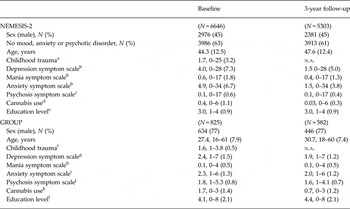
A total of 6646 subjects participated at the baseline measurement, 5303 subjects participated at the 3-year follow-up measurement (Table 1). Baseline symptom scores did not differ between participants who were available for follow-up and participants who were not, except for psychosis; subjects lost to follow-up reported fewer psychosis symptoms at baseline (mean 0.07) than subjects available for follow-up (mean 0.12, t = −2.7, p = 0.006). Subjects who did not participate in the follow-up measurement were slightly younger at baseline than subjects who were available for follow-up (FU) (meanno FU 42.88, meanFU 44.59, t = −4.5, p < 0.001). There were no differences in sex as a function of attrition.
Baseline and first follow-up of NEMESIS-2 and GROUP: demographics and symptom profiles

NEMESIS-2, The second Netherlands Mental Health Survey and Incidence Study; GROUP, Genetic Risk and Outcome of Psychosis study; n.a., not applicable.
Values given are mean, range (s.d.) unless otherwise stated.
a Childhood trauma (NEMESIS-2) is a combination scale of five different types of trauma: emotional neglect [0 (never) to 5 (very often)], psychological abuse (0–5), physical abuse (0–5), sexual abuse (0–5) and peer victimization (0–5).
b Number of lifetime (baseline) or incident (past 3 years at follow-up) symptoms assessed with the Composite International Diagnostic Interview, version 3.0.
c Number of lifetime (baseline) or incident (past 3 years at follow-up) clinically validated positive psychotic symptoms assessed with a self-constructed questionnaire.
d Cannabis use (NEMESIS-2) was rated as frequency of use in the period of most frequent use on a scale of 0 (never) to 6 (every day), lifetime (baseline) and incident (past 3 years, follow-up).
e Education level (NEMESIS-2): 1 (primary education), 2 (lower secondary education), 3 (higher secondary education), 4 (higher professional, university).
f Childhood trauma (GROUP) is an average score of 25 items (physical, sexual and emotional abuse, and physical and emotional neglect) each ranging 1 (never true) to 5 (very often true).
g Severity of present state (past 2 weeks) depression assessed with the Positive and Negative Syndrome Scale (PANSS).
h Severity of present state (past month) mania assessed with the Comprehensive Assessment of Symptoms and History instrument (CASH).
i Severity of present state (past 2 weeks) anxiety assessed with PANSS.
j Severity of present state (past 2 weeks) psychosis assessed with PANSS.
k Cannabis use (GROUP) rated as frequency of use in the period of most frequent use on a scale of 0 (never) to 3 (daily), lifetime (baseline) and incident (past 3 years, follow-up).
l Education level (GROUP); 0 (no education), 1 (primary school), 2–3 (secondary school), 4–5 (high school), 6 (lower vocational), 7 (higher vocational), 8 (university).
Patient samples
From the NEMESIS-2 sample, two clinical samples were derived: a sample of participants with a mood disorder (major depressive disorder, bipolar disorder or dysthymia, n = 1577) and a sample of participants with an anxiety disorder (social phobia, panic disorder or generalized anxiety disorder, n = 1120). Diagnoses were established using CIDI 3.0. Since the number of patients with a non-affective psychotic disorder in NEMESIS-2 was too small (n = 43), we used data from an independent sample of patients with a psychotic disorder, the Genetic Risk and Outcome of Psychosis (GROUP) sample (Korver et al. Reference Korver, Quee, Boos, Simons and de Haan2012). In the GROUP study, patients with a diagnosis of non-affective psychotic disorder were recruited from five university hospitals in The Netherlands and Belgium (Groningen, Amsterdam, Maastricht, Utrecht, Louvain) and their affiliated mental healthcare institutions. Patients were eligible for inclusion if they: (1) were aged 16–65 years, (2) met the Diagnostic and Statistical Manual of Mental Disorders, Fourth Edition (DSM-IV) criteria for a non-affective psychotic disorder [in Amsterdam, Maastricht, Utrecht and Louvain assessed with the Comprehensive Assessment of Symptoms and History (CASH; Andreasen et al. Reference Andreasen, Flaum and Arndt1992); in Groningen with the Schedules for Clinical Assessment in Neuropsychiatry (SCAN 2.1; Wing et al. Reference Wing, Babor, Brugha, Burke, Cooper, Giel, Jablenski, Regier and Sartorius1990)], (3) had first contact with mental healthcare <10 years before initial assessment, and (4) were proficient in Dutch. Participants were excluded if their estimated level of intelligence was below 70.
Participants who were assessed at the Amsterdam, Maastricht, Utrecht and Louvain sites were used for the present study as we used symptom data from CASH, which was not assessed at the Groningen site. Childhood trauma in the GROUP study was assessed with the Dutch version of the Childhood Trauma Questionnaire (CTQ-SF; Bernstein et al. Reference Bernstein, Stein, Newcomb, Walker, Pogge, Ahluvalia, Stokes, Handelsman, Medrano and Desmond2003), a 25-item self-report questionnaire rated on a scale of 1 (never true) to 5 (very often true). The CTQ measures physical abuse, physical neglect, sexual abuse, emotional abuse and emotional neglect. A total trauma score was obtained by calculating the average of all 25 items. Symptom assessments in GROUP at baseline and follow-up included present state depression, anxiety and psychosis (positive psychotic symptoms) using the Positive and Negative Syndrome Scale (PANSS; Kay et al. Reference Kay, Fiszbein and Opler1987). Depression and anxiety were assessed with one item each (depression: have you felt sad, down or depressed; anxiety: worried, nervous, restless or panicked), on a scale of 1 (absent) to 7 (extreme), indicating severity of the symptom. Present state mania was assessed at baseline and follow-up with the CASH, with one item (have you felt overly or abnormally exited or active) on a scale of 0 (no) to 5 (severe). Cannabis use was assessed with the CIDI 2.1 (Andrew & Peters, Reference Andrew and Peters1998). Subjects were asked to state whether they had ever (baseline) or in the previous 3 years (follow-up) used cannabis, and, if so, were rated on frequency of use in the period of most use on a scale of 1 (less than weekly) to 3 (daily).
Sample
In GROUP, 825 subjects participated at the baseline measurement, and 582 subjects were interviewed at the 3-year follow-up measurement. Subjects lost to follow-up did not differ from subjects who were available for follow-up in terms of age, sex, anxiety or mania symptom severity at baseline. Subjects lost to follow-up did, however, report a higher level of depressive symptoms (meanno FU 2.65, meanFU 2.36, t = 2.57, p = 0.011) and psychosis symptoms (meanno FU 1.97, meanFU 1.80, t = 2.80, p = 0.005) at baseline.
Analytical strategy
All analyses were performed using Stata, version 12 (StataCorp, 2011). A priori confounders included in all analyses were age and sex.
Associations of trauma with separate symptoms
As a first step, it was assessed whether childhood trauma showed stronger associations with any of the symptoms using mixed-effects multilevel regression (xtmelogit in Stata) in the NEMESIS-2 sample. These models allow for a proper test for differences in the way to which trauma impacts on depression, mania, anxiety or psychosis. In other words, instead of analyzing the impact of childhood trauma on each symptom cluster separately, this method tests whether the impact of childhood trauma differs significantly between symptoms (van Nierop et al. Reference van Nierop, Lataster, Smeets, Gunther, van Zelst, de Graaf, ten Have, van Dorsselaer, Bak, Myin-Germeys, Viechtbauer, van Os and van Winkel2014a ). For each subject, four dichotomous outcomes were analysed, namely the presence of any depressive, manic, anxiety or psychotic symptom. Both the baseline and follow-up measurements were used, accounting for clustering within persons by including a random effect (intercept) at the subject level. Relevant effect sizes [i.e. ratios of odds ratios (RORs)] were obtained by post-hoc tests using the lincom command. For a more detailed description of this method see (van Nierop et al. Reference van Nierop, Lataster, Smeets, Gunther, van Zelst, de Graaf, ten Have, van Dorsselaer, Bak, Myin-Germeys, Viechtbauer, van Os and van Winkel2014a ). The analysis was repeated including cannabis use (Moore et al. Reference Moore, Zammit, Lingford-Hughes, Barnes, Jones, Burke and Lewis2007) and education level as possible confounders.
Associations of trauma with multiple symptoms
In order to investigate whether childhood trauma shows an increased likelihood of association with multiple symptom domains, rather than association with single symptom domains (e.g. association with depressive symptoms in isolation v. association with depressive symptoms co-occurring with symptoms of mania, psychosis or anxiety), multinomial logistic regression analyses (mlogit command in Stata) were performed, in the general population (NEMESIS-2) sample. The outcome variable consisted of eight categories: (1) no symptoms, (2) depression only, (3) mania only, (4) anxiety only, (5) psychosis only, (6) a combination of two symptom domains (any combination of depression, mania, anxiety or psychosis), (7) a combination of three symptom domains, (8) all four symptom domains combined. Both the baseline and follow-up measurements were used, while accounting for clustering within persons. Effect sizes were obtained by post-hoc tests using the lincom command. The analysis was repeated including cannabis use (Moore et al. Reference Moore, Zammit, Lingford-Hughes, Barnes, Jones, Burke and Lewis2007) and education level as possible confounders.
Similar analyses as described above were performed in a sample of patients with a lifetime mood disorder, a sample of patients with a lifetime anxiety disorder, and in a sample with a (non-affective) psychotic disorder, in order to examine the clinical relevance of reported findings.
Alternative hypotheses to explain possible admixture
Additional follow-up analyses addressed alternative hypotheses (increased severity or the affective pathway to psychosis) in two different ways. First, it was investigated whether the admixture of symptoms was a consequence of an increase in severity of psychopathology by repeating the analyses while controlling for symptom severity (e.g. associations of childhood trauma with depressive symptoms in isolation v. multiple symptoms, adjusted for number of depressive symptoms). A second follow-up analysis aimed to investigate the earliest stages of psychopathology by repeating the analyses in a subsample of individuals who did not meet criteria for a psychotic, affective or anxiety disorder and did not seek help for their subclinical symptoms (n = 3986).
Results
Associations of trauma with separate symptoms
Table 2 shows the result of the analyses with separate symptoms (i.e. association of trauma with depression or mania or anxiety or psychosis, not necessarily in isolation). Childhood trauma was associated with all symptoms (left column), also after adding cannabis as a covariate (results not shown).
Baseline and first follow-up of NEMESIS-2. Associations of childhood trauma and presence of symptoms, and assessment of differences in strength of associations (e.g. whether trauma has a stronger association with one symptom over another)

NEMESIS-2, The second Netherlands Mental Health Survey and Incidence Study; ROR, ratio of odds ratios; CI, confidence interval.
All odds ratios (OR) are adjusted for age and sex. Childhood trauma is a combination scale of 0–25 of five different types of trauma: emotional neglect [0 (never) to 5 (very often)], psychological abuse (0–5), physical abuse (0–5), sexual abuse (0–5) and peer victimization (0–5). (Thus each OR corresponds with a 1-point increase in trauma.)
a Odds ratios express association of childhood trauma and presence of symptoms, other symptoms may be present.
b Ratios of odds ratios express how much higher/lower the association between symptom and trauma was for each symptom-pair.
c Presence of any symptoms. The Composite International Diagnostic Interview, version 3.0 was used for the assessment of depressive, manic or anxiety (social phobia, generalized anxiety or panic disorder) symptoms. A self-constructed questionnaire was used for the assessment of positive psychotic symptoms (self-report).
d Participants that self-reported psychotic symptoms were followed-up with an additional interview performed by a clinician for validation.
* p < 0.05, ** p < 0.01, *** p < 0.001.
Childhood trauma did show a somewhat stronger association with psychosis than with mania [ROR 1.04, 95% confidence interval (CI) 1.01–1.06, p = 0.006] and anxiety (ROR 1.03, 95% CI 1.00–1.05, p = 0.044). However, in the other comparisons (depression v. all other symptoms, anxiety v. mania) no such differences were found (three right-hand columns). Adjusting for cannabis and education level did not significantly influence these results (results not shown).
Associations of trauma with multiple symptoms
General population
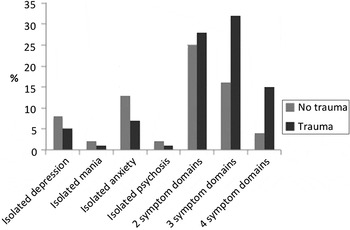
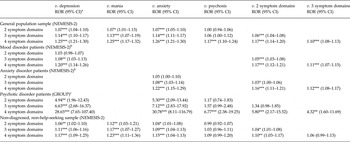
Analysis of the NEMESIS-2 sample revealed a pattern of significantly larger odds ratios (ORs) as more symptom clusters were present (Table 3). Thus, childhood trauma was consistently more strongly associated with combinations of symptom domains than with symptoms in isolation. Adjusting for symptom load, cannabis use and education level did not significantly influence these results. Fig. 1 shows the group sizes (%) of subjects with isolated and co-occurring symptoms in the general population, divided by non-traumatized and traumatized subjects. Childhood trauma was included as a continuous measure throughout the different analyses but dichotomized for illustrative purposes at the 80th percentile, in accordance with previous work (Heins et al. Reference Heins, Simons, Lataster, Pfeifer, Versmissen, Lardinois, Marcelis, Delespaul, Krabbendam, van Os and Myin-Germeys2011). In Fig. 1, a pattern of multiple symptom clusters in traumatized individuals (three right-hand black bars) rather than isolated symptoms (four left-hand black bars) is evident.
Group sizes (%) of isolated and co-occurring symptoms in non-traumautized and traumautized subjects in the general population (NEMESIS-2). The childhood trauma score was dichotomized at the 80th percentile for illustrative purposes. Traumatized individuals tend to report multiple symptoms (three right-hand black bars) rather than isolated symptoms (four right-hand black bars).

Baseline and first follow-up of NEMESIS-2. Associations of childhood trauma and isolated symptoms v. clustering of symptoms

NEMESIS-2, The second Netherlands Mental Health Survey and Incidence Study; GROUP, Genetic Risk and Outcome of Psychosis study; ROR, ratio of odds ratios; CI, confidence interval.
All effect sizes are adjusted for age and sex.
a Post-hoc estimation analyses: e.g. ROR of the association of childhood trauma and depressive symptoms in isolation v. combination of any two, three or all four symptoms.
b In NEMESIS-2, lifetime symptoms are assessed, thus in the ‘mood disorder’ group, no participants exist with only mania, anxiety or psychosis symptoms; in the ‘anxiety disorder’ group no participants exist with only depression, mania or psychosis.
c In GROUP, present state symptoms are assessed, thus participants are present with only depression or only anxiety (and no psychosis). No participants reported mania only.
* p < 0.05, ** p < 0.01, *** p < 0.001.
The pattern of admixture of symptoms associated with childhood trauma was confirmed in the sample of participants without a mood, anxiety, or psychotic disorder, and without help-seeking for mental symptoms (Table 3). Childhood trauma was associated with multiple rather than isolated symptoms of all domains. Adjusting for cannabis use and education level did not significantly influence these results (results not shown).
Clinical samples
The pattern of admixture of multiple symptom domains was also confirmed in the three clinical samples (Table 3). In mood disorder patients, childhood trauma was associated with an increased likelihood of combinations of symptom domains compared to depression in isolation. Results were similar when patients with bipolar disorder were excluded. Similarly, in anxiety disorder, traumatized patients showed an increased likelihood of multiple symptom clusters, compared to anxiety symptoms in isolation.
In the psychotic disorder sample, childhood trauma also showed an increased likelihood of multiple symptom domains, compared to depression, anxiety or psychosis in isolation. In all three clinical samples, adjusting for cannabis use and education level did not significantly influence these results (results not shown).
Discussion
Findings
In a general population sample, childhood trauma was associated with four major mental symptom domains: depression, mania, anxiety and psychosis. The strengths of these associations were similar, except for a somewhat stronger association with psychosis than with anxiety and mania, indicating a central role for reality distortion following childhood trauma, especially since sensitivity analyses suggested that psychotic symptoms are not the ‘end-product’ of severe affective dysregulation, but rather an integral part of psychopathology following childhood trauma, already present in the earliest stages of psychopathology. Importantly, childhood trauma was associated with multiple symptom clusters rather than with isolated symptoms. As more symptom clusters were combined (i.e. two, three or four symptom clusters) the ORs of the association with childhood trauma became significantly larger. The robustness of this pattern of admixture was noteworthy, not affected by controlling for symptom severity, and evident also in the sample of participants specifically selected for the absence of help-seeking or a clinical (anxiety, mood or psychotic) disorder. Moreover, the pattern of admixture was consistently found in three different clinical samples.
Why is this important?
Biological psychiatry aims to understand the pathophysiology of mental disorders. Despite considerable research efforts, however, insights into the origins of mental illness are still limited. Reasons for the limited success may be found in the lack of a biologically informed diagnostic system (‘the missing gold standard’), significance chasing with underpowered studies, approximate replications, and extreme comparisons between patients and (super)healthy controls, rather than focusing on clinically relevant subgroups (Kapur et al. Reference Kapur, Phillips and Insel2012). Kapur and colleagues have recently argued that the application of ‘stratified medicine’ in psychiatry may provide an interesting option to advance our understanding of mental illness. That is: focusing on clinically meaningful differences between homogeneous clinical subtypes across traditional diagnostic categories rather than hypothesis-rejection v. controls (Kapur et al. Reference Kapur, Phillips and Insel2012). In their paper, this approach is illustrated with an example from the field of oncology: overexpression of human growth factor subtype (HER2) in breast cancer tissue was first identified as a form of breast cancer with a poor prognosis. Using a stratified medicine approach, overexpression of HER2 was later identified in subtypes of several types of cancer. Development of specific therapies considerably increased survival for all these subtypes and now HER2 stratification serves as an important guide for treatment (Kapur et al. Reference Kapur, Phillips and Insel2012).
In this paper, we adopted an environmental stratification approach, showing a specific pattern of symptom admixture across a range of different populations, at the subclinical as well as at the clinical level. These findings may have significant aetiological, pathophysiological, diagnostic and clinical repercussion. At the level of aetiology, our results strongly support a causal role of childhood trauma in the development of multiple psychiatric disorders, given the specificity of the pattern of admixture of symptoms that was strongly linked to childhood trauma exposure across multiple diagnostic categories.
In addition, these findings should also inform research strategies, as the present results suggest that future work should examine the long-term consequences of childhood trauma across multiple diagnostic domains, rather than focusing on traditional diagnostic categories, in order to elucidate the biological and psychological mechanisms underlying the transition from a subclinical admixture of symptoms, to help-seeking, and finally a given clinical disorder. One could infer considerable interplay between the implicated symptom domains (van Os, Reference van Os2013), resulting in patterns of psychopathology that are increasingly specific to the individual as symptoms become more severe, and finally result in a diagnosis that to a large degree will depend on which symptoms prevail at that particular point in time (Wigman et al. Reference Wigman, van Os, Thiery, Derom, Collip, Jacobs and Wichers2013). In addition to significant aetiological and research implications, these findings should also inform treatment, and possibly, diagnostic decisions. While the exact clinical implications are as yet unclear, active enquiry and diagnostic attention to multiple symptom domains is warranted, rather than only for the domain that is most prominent at the time of presentation. Moreover, once these findings are independently replicated, and further refined in terms of which specific affective, psychotic and anxiety symptoms are involved, it may be argued that these findings should have direct diagnostic repercussions. Finally, the findings also suggest that treatment of traumatic experiences should be considered irrespective of diagnosis, even though this is not always current practice (De Bont et al. Reference De Bont, van den Berg, van der Vleugel, De Roos, Mulder, Becker, de Jongh, van der Gaag and van Minnen2013). Last, development of therapeutic approaches, tailored specifically at individuals exposed to severe childhood traumatic experiences, should be made a priority.
Strengths and limitations
The current findings should be interpreted in terms of its strengths and limitations. Childhood trauma was assessed by subjective retrospective report, therefore recall bias may have influenced these results, although research suggests good reliability of retrospective assessment of childhood trauma (Fisher et al. Reference Fisher, Craig, Fearon, Morgan, Dazzan, Lappin, Hutchinson, Doody, Jones, McGuffin, Murray, Leff and Morgan2011). Childhood trauma was assessed using different questionnaires in the NEMESIS-2 and GROUP studies, thereby diminishing comparability between these samples. However, as the main focus of this study was the investigation of the association between trauma and symptoms, and not the comparison of different groups in terms of trauma history, this limitation is unlikely to affect the validity of the reported findings. As in earlier studies using these samples no clear evidence was found to support differential psychopathological outcomes depending on different childhood traumatic experiences (van Nierop et al. Reference van Nierop, Lataster, Smeets, Gunther, van Zelst, de Graaf, ten Have, van Dorsselaer, Bak, Myin-Germeys, Viechtbauer, van Os and van Winkel2014a , Reference van Nierop, van Dam, Viechtbauer, Velthorst and van Winkel b ), the different types of trauma were grouped to one trauma scale, however additional studies may be warranted investigating differential effects of separate trauma types in more detail. Additionally, a more detailed investigation of gender differences may be warranted in future studies (Fisher et al. Reference Fisher, Morgan, Dazzan, Craig, Morgan, Hutchinson, Jones, Doody, Pariante, McGuffin, Murray, Leff and Fearon2009). Even though the baseline and first follow-up measurements of NEMESIS-2 were used, the analyses performed used these measurements as cross-sectional data, since the incidence of novel symptoms in this sample was too low to allow for prospective analyses. Therefore, the present study does not allow to fully address the developmental model suggested by the cross-sectional analyses. However, by performing the various sensitivity analyses in separate subsamples at different stages of psychopathology, we were able to address at least part of this issue. Lifetime presence of symptoms was assessed, precluding assessment of simultaneously occurring symptoms. However, this study aimed to assess development of symptoms over the lifetime rather than at the same point in time, making the assessment of simultaneously occurring symptoms unnecessary.
A further limitation is that we did not have comprehensive data on (complex) post-traumatic stress disorder, borderline personality disorder or dissociative disorder, disorders that are also associated with childhood trauma. Future research should incorporate these disorders as well; however, they are known for their prominent mixture of affective and anxiety symptoms, and psychotic symptoms are often described as well, so we would argue that our findings may also extend to these disorders.
Strengths of this study are the multiple and large samples as well as the representativeness of the samples, increasing the generalizability of these results. By incorporating symptom assessments across diagnostic boundaries this study adds important and more comprehensive evidence to psychiatric research focused on the sequelae of traumatic experiences. Last, assessment of symptoms was conducted by trained clinical interviewers in the GROUP study and all reports of psychotic symptoms in the larger NEMESIS-2 study were validated by clinicians, thus increasing reliability compared to self-report measures of particularly psychosis.
In conclusion, these findings provide evidence for childhood trauma as a major risk factor for psychopathology, characterized by an admixture of affective, anxiety and psychotic symptoms, which may already be present at the earliest stages of psychopathology.
Appendix. GROUP investigators
Richard Bruggeman and Durk Wiersma, Department of Psychiatry, University Medical Center Groningen, Groningen, The Netherlands; Wiepke Cahn and Rene S. Kahn, Department of Psychiatry, University Medical Center Utrecht, Rudolf Magnus Institute of Neuroscience, Utrecht, The Netherlands; Lieuwe de Haan and Carin J. Meijer, Department of Psychiatry, Academic Medical Centre, University of Amsterdam, Amsterdam, The Netherlands; Inez Myin-Germeys, Department of Psychiatry and Psychology, School for Mental Health and Neuroscience, EURON, Maastricht University Medical Centre, PO Box 616 (Vijv1), Maastricht, The Netherlands; Jim van Os, Department of Psychiatry and Psychology, School for Mental Health and Neuroscience, EURON, Maastricht University Medical Centre, PO Box 616 (Vijv1), Maastricht, The Netherlands and Department of Psychosis Studies, King's College London, King's Health Partners, Institute of Psychiatry, London, UK.
Supplementary material
For supplementary material accompanying this paper visit http://dx.doi.org/10.1017/S0033291714002372.
Acknowledgements
This work was supported by the Ministry of Health, Welfare and Sports (grant no. 310253); with supplement support from The Netherlands Organization for Health Research and Development (ZonMw). Supported by the European Community's Seventh Framework Program under grant agreement no. HEALTH-F2-2009-241909 (Project EU-GEI).
Declaration of Interest
None.