During the COVID-19 pandemic, political scientists created many virtual workshops to share work and build community. Other political scientists may want to start virtual workshops to bring together a research community, further strengthen existing communities, or overcome significant geo graphic barriers. This Spotlight convenes a large, diverse group of virtual-workshop organizers who share their experiences in these 10 articles, discussing topics that include (1) best practices; (2) how to address issues of diversity, equity, and inclusion (DEI); and (3) the future of workshops in a post-pandemic world.
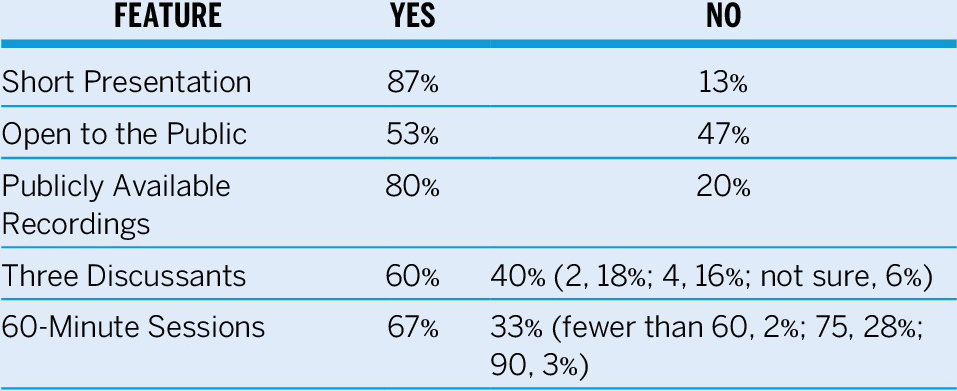
By providing organizational guidance and inspiration, the articles will help other scholars who are contemplating starting their own workshop or a similar endeavor. There likely will be continued interest in these venues. According to results from a multiyear survey of past participants of virtual workshops I organized or co-organized (N=99), about 36% viewed their participation as more useful and 60% as much more useful than a large conference.Footnote 1 Table 1 provides additional information from this survey that can help potential organizers make decisions about common workshop features.
Description of Studies

Spotlight Articles
The 10 articles in this Spotlight focus on the experiences of organizers of 11 virtual workshops. Some of the highlighted workshops focus on particular regions (e.g., Europe, Japan, and the Middle East), some focus on substantive areas (e.g., minority politics and formal theory), and others focus on work produced by certain types of scholars (e.g., junior researchers). All of the workshops were created in the wake of COVID-19 to build community in a world where people suddenly were isolated, and all encountered various challenges related to organization and DEI. These workshops differ, however, in how they addressed these issues.
Running Virtual Workshops
There are broad similarities in how the contributors to this Spotlight run their workshops: most involve the presentation of a paper, comments from one or two discussants, a public question-and-answer period, and an approximate one-hour Zoom session. As highlighted in the articles, however, the organizers run their workshops in different ways with different goals. Thus, each article has much to offer those who are considering creating their own online seminar series.
Before beginning their first virtual workshop, organizers must consider how they will publicize their series to draw presenters and attendees. Early on, O’Brien and Udry et al. considered the need for legitimacy within the community that they serve, which potentially is a common challenge for workshops led by junior scholars, and they made sure to build support among senior scholars in the field before going “live.” After a virtual workshop is up and running, most organizers advertise via social media (mainly Twitter). Gartzke et al., however, took extra steps to promote their workshop using several email listservs and encouraging past participants to recommend attendance and participation to their colleagues. Given the increasingly crowded virtual-workshop space, it may be necessary for organizers of new workshops to use a combination of these and other strategies described in these Spotlight contributions. Virtual-workshop organizers also often want to draw attention to sessions after they are concluded, partly to ensure that the research featured in the workshop attracts as broad an audience as possible. With that in mind, Dorff and Smith maximize researcher visibility by recording and posting their sessions online, noting that these videos receive an average of 123 views. To generate public attention during and after the workshop has concluded, Bracic et al. hired an undergraduate student to live-tweet talks, providing information about key findings. Like Dorff and Smith, they also make their recordings available; some talks have been viewed more than 700 times. Given the survey data mentioned previously—that is, 80% of respondents support the recording and public availability of sessions—and the popularity of recorded-session videos, organizers should consider keeping their virtual-workshop sessions “alive” in this way.
In terms of the virtual-workshop sessions, most contributors to this Spotlight hold sessions that focus on only one paper. Both Lynch and Ladam et al., however, hold workshop-length sessions that include presentations of several papers, which more closely simulates a traditional onsite conference experience. In many cases, this could be a more feasible or practical approach because attendees may be more willing to spend a day in deep thought and conversation about a topic than to add another ongoing commitment to their weekly schedule.
Although the virtual workshops featured in this Spotlight primarily exist to help scholars share their research with relevant communities, many also aim to build scholarly community in various ways. For example, Jolly and de Vries open their Zoom sessions early and close them late to provide space for the informal discussions that often occur before or after in-person panels. Ladam et al. tried to expand community beyond research-oriented sessions by holding well-attended trivia and professionalization events. Catalanic et al. took a similar approach, building community by holding professionalization sessions and a happy-hour event using gather.town—a tool that other organizers have considered exploring in the near future.
Another important aspect of community building is mentorship. Tyson and other co-organizers created a mentoring program within the Virtual Theory Workshop that connected junior scholars—particularly those who did not have formal-theory faculty at their institution—with faculty mentors in a workshop-style meeting. Torres-Beltran and Brannon place mentorship near the center of their seminar series, taking particular care to prepare first-time presenters with advice about how to share their work and effectively address feedback. Given how isolated and disconnected many scholars in the profession feel, this type of effort would be appreciated by participants and attendees.
Diversity, Equity, and Inclusion
Related to the general concern about building community, all contributors to this Spotlight clearly consider DEI issues to be paramount. Tyson captures this sense by noting that virtual-workshop organizers are “ethically obligated to ensure that seminars—through the scholars they elevate and opportunities they bring to departments and research communities—constitute a positive force in shaping the discipline.”
Jolly and de Vries address this charge by proactively asking past presenters for recommendations and then directly reaching out to individuals from underrepresented communities. Gartzke et al. consider DEI in various ways, including in terms of international representation. They schedule their workshops during Asian working hours but also when Europeans and Americans can participate, which maximizes the opportunity for anyone in these communities to attend despite geographic location. Catalanic et al. take a similar approach. Bracic et al. balance participants across countries but also maintain variation in methodological approaches. O’Brien and Udry et al. consider the issue of inclusion in workshop leadership training as well, ensuring that subsequent organizers are balanced across gender, discipline, and sub-subfield.
Other virtual-workshop organizers aim to maximize engagement with scholars who are either at a certain point in their career or at a certain type of institution. For example, Dorff and Smith prioritize holding at least half of their sessions for researchers who are approaching the job market. Whereas most virtual-workshop organizers discuss concrete actions intended to make inclusive spaces for scholars from underrepresented groups, Ladam et al. suggest another group of scholars: those from non-research-oriented departments who often are not sufficiently incorporated. Lynch actively pursues applicants from this group because they likely lack both networks and resources. Torres-Beltran and Brannon considered this matter more broadly, evaluating submissions based on the “demonstrated variation in the resources and support they would receive for their work outside of the working group.” Organizers would do well to consider these differences because virtual workshops provide a vital means for under-resourced scholars to receive feedback on and disseminate their work.
Future of Virtual Workshops
The articles in this Spotlight will help those interested in beginning virtual workshops for their own research community. However, they also provide insight into how we can organize research communities offline, where organizational challenges and diversity issues have been increasingly salient in recent years. I believe that this Spotlight will start an important dialogue within the political science community about ways to improve scholarly communication, community, and inclusion inside and outside of typical presentation venues.