In contemporary U.S. politics, one of the central axes of political competition is the debate over how much the state should intervene in the economy to reduce income inequality or redistribute wealth. The social and economic determinants of preferences on this issue are of crucial concern to scholars across the social sciences (Alesina and La Ferrera Reference Alesina and Ferrara2005; Brooks and Manza Reference Brooks and Manza2013; Gilens Reference Gilens2000). Over the past decades, significant advances have been made in understanding and conceptualizing the forces that shape attitudes about the welfare state, including attitudes about government redistribution from the rich to the poor. At the same time, a large literature has attempted to understand why there is a modest but consistent gender gap in ideology, with women being more supportive, on average, of redistribution and the political party that is usually more pro-redistribution (Conover Reference Conover1988; Stout, Kretschmer, and Ruppanner Reference Stout, Kretschmer and Ruppanner2017). We argue that certain explanatory factors—specifically, the fine-grained heterogeneity in employment experiences and how these experiences interact with gendered expectations of experiences in the labor market—have been largely absent from academic discussions of redistribution preferences in the United States. Thus, the primary goal of this article is to deepen our understanding of welfare state attitudes by examining the relationship between part-time employment experiences and redistribution preferences while considering how this link may fundamentally differ depending on the gender of the worker.
While many individual and social characteristics have been linked to preferences for government redistribution from the wealthy to those with fewer economic resources, one powerful and consistent driver of redistribution preferences is one's position in the economic order. Individuals in less privileged economic positions, on average, prefer more government redistribution (Alesina and Glaeser Reference Alesina and Glaeser2004; Cook and Barrett Reference Cook and Barrett1992; Edlund Reference Edlund1999; Hasenfeld and Rafferty Reference Hasenfeld and Rafferty1989; McCall and Manza Reference McCall, Manza, Edwards, Jacobs and Shapiro2012). Much of the scholarship on the link between individual-level economic positions and preferences for redistribution has focused on the explanatory power of income and earnings. Additionally, researchers in this area often use a binary employment framework to explain redistribution attitudes: an individual is either working or unemployed. In the European context, some scholars have pursued more complex analyses of how one's economic position impacts welfare state attitudes, generally focusing on economic “insiders” versus “outsiders,” a position that generally includes temporary and part-time workers (Häusermann, Kurer, and Schwander Reference Häusermann, Kurer and Schwander2015; Marx Reference Marx2014).
While nearly one in five U.S. workers is employed part-time, working between 1 and 34 hours per week,Footnote 1 limited research has explored the connection between this key economic position—part-time employment—and individuals’ preferences for redistribution in the United States (for an exception, see Gelepithis and Jeannet Reference Gelepithis and Jeannet2017). People enter part-time work for a variety of reasons. One common reason, at least during periods of economic weakness, is that there are no full-time jobs available to them. The U.S. Bureau of Labor Statistics splits Current Population Survey respondents into those working part-time for economic reasons (that is, they would like to work more but cannot find a position) and eight other categories of reasons, ranging from health issues to child care problems to other family obligations (Dunn Reference Dunn2018). Many of these reasons have a clear relationship to traditional gender norms, and so it is not surprising that marriage and family structure shape the decision to enter part-time work “voluntarily.” Part-time work, then, is not just a lower-paid job or a job with fewer hours, and it is not just the result of household decision-making processes about labor allocation. It is an economic and social status that relates to gender differently from full-time employment, unemployment, or staying out of the labor force entirely.
Therefore, we suggest that a more nuanced conceptualization of individuals’ economic standing is needed to develop a holistic account of redistribution preferences in the United States. Specifically, we argue that it is necessary to account for nonstandard employment experiences, such as part-time work. Unemployment and drops in income have been shown to be associated with redistribution attitudes (Margalit Reference Margalit2013; Owens and Pedulla Reference Owens and Pedulla2014). Our question is whether, and under what conditions, part-time workers see the welfare state more like the full-time employed or the unemployed.
Certainly, one's economic position is not the only driver of redistribution preferences. Gender is also a key force shaping attitudes (Box-Steffensmeier, Boef, and Lin Reference Box-Steffensmeier, Boef and Lin2017). Indeed, women, on average, prefer more government redistribution than men (Andersen Reference Andersen1999; Iversen and Soskice Reference Iverson and Soskice2001).Footnote 2 Part-time work is a heavily gendered position in the U.S. economy—approximately 70% of prime-aged (25 to 54 years old) part-time workers are women (authors’ calculation from U.S. Bureau of Labor Statistics 2018b)—raising questions about whether gender differences in the effects of part-time work on political attitudes may exist. Additionally, the reasons that men and women labor in part-time positions are often different. Women are more likely to “voluntarily” work part-time, often for family reasons, whereas men are more likely to involuntarily work part-time, likely because of economic challenges that keep them from full-time work (for a discussion, see Pedulla Reference Pedulla2016). Thus, part-time work may mean very different things for the material position—as well as the self-conceptualization and social standing—of men and women in the United States. In turn, part-time work is likely to influence men and women's preferences for redistribution in distinct ways.Footnote 3
In this article, we ask three primary questions about the drivers of redistribution attitudes in the United States that emphasize a more fine-grained conceptualization of one's economic standing. First, does part-time employment (relative to full-time work) shape individuals’ preferences for government redistribution from rich to poor in the United States? Second, does this association differ by the gender of the worker? And third, what mechanisms may account for these associations? Building on theoretical models of the material underpinnings of political attitudes and the gendered construction of work and family life, we articulate and then test competing empirical predictions about this set of relationships. Our empirical contributions to the literature include both documenting the patterns we identify in a long-term repeated cross-section of Americans and showing that these results appear when individuals move from full-time to part-time work in panel data—making the case for a direct relationship stronger.
The article proceeds as follows: We first review scholarship on the gender gap and redistributive attitudes. Then we move to the material underpinnings of redistribution preferences and develop empirical predictions from this line of thought. Next, we draw on scholarship about threats to status and the construction of masculinity in contemporary society to articulate competing predictions about how part-time work and gender will interact to shape redistribution preferences. We then introduce our data and analytic approach, followed by a presentation of the first set of results. After that, we develop additional observable implications of the theory to allow us to examine potential mechanisms, and test those implications in the same data set. We conclude by discussing the implications of these findings for scholarship on welfare state attitudes, employment relations, and the gendered construction of political preferences.
THEORETICAL GROUNDING
In this section, we build on and extend existing scholarship to develop our argument about how part-time work may be related to redistribution preferences and how gender may shape this association. We begin by discussing scholarship on the “gender gap” in political preferences and then turn to a set of materialist or economic-based drivers of welfare state attitudes. We then discuss ideological arguments about the forces underlying welfare preferences. We conclude the section by offering a set of empirical predictions.
The Gender Gap
A large literature in American politics has worked to explain the relative pro-Democratic lean of women, often referred to as the gender gap. It has settled on a combination of material circumstances, identity, and psychological mechanisms (Howell and Day Reference Howell and Day2000; Schlesinger and Heldman Reference Schlesinger and Heldman2001). The Democratic Party takes more left-leaning positions than the Republican Party on a wide range of issues, including questions of redistribution. Women are more likely to head single-parent households and therefore to be eligible for certain benefits,Footnote 4 and they generally have lower individual incomes.Footnote 5 As Carroll (Reference Carroll and Mueller1988) argues, women who are economically dependent on men face a higher risk of financial hardship and so have good reason to support the welfare state as a form of insurance. In the event of a divorce, married women who make less than their husbands are likely to see their incomes drop, and mothers whose partners leave them are more likely to end up caring for the children.Footnote 6 Greenlee (Reference Greenlee2014) shows that, among women, single motherhood is strongly related to support for government provision of jobs and for food stamps. Women are also more likely to be employed in the public sector (Erie and Rein Reference Erie, Rein and Mueller1988; Mandel and Semyonov Reference Mandel and Semyonov2006), and public sector workers are more likely to support the welfare state (Knutsen Reference Knutsen2005). These considerations are consistent with a materialist argument, and serve as the baseline against which we can compare the material effects of part-time work among men and women.
Other forces, such as identity, are also likely involved in shaping the gender gap. Women's higher likelihood of identifying as feminist is associated with egalitarianism (Conover Reference Conover1988). Similarly, Stout, Kretschmer, and Ruppanner (Reference Stout, Kretschmer and Ruppanner2017) document a clear association between gender “linked fate” and responses to both a partisanship question and a liberalism question. Though linked fate has a material basis, it is also clearly an ideational variable (Donnelly Reference Donnelly2020), so these findings are consistent with an identity grounding for the gender gap. If identity plays a large role in the gender gap in redistributive attitudes and work plays a larger role in men's than in women's self-identities, then we would expect that men would react differently to moving into part-time work than would women.
Additionally, the traditional social roles undertaken by women are sometimes argued to promote compassion and nurturing (Chaney, Alvarez, and Nagler Reference Chaney, Alvarez and Nagler1998; Gilligan Reference Gilligan1982), which then leads to the argument that women are more likely to support redistribution. These same social roles are often those that make part-time work more common among women. Child-rearing, elder care, and household management work falls disproportionately on women (Sayer Reference Sayer2005), each of which can lead women in to part-time employment arrangements.
The Material Underpinnings of Welfare State Attitudes
Existing research documents a powerful link between material resources and redistribution preferences. When individuals have more economic resources at their disposal, they generally prefer less government redistribution from the rich to the poor (Alesina and Glaeser Reference Alesina and Glaeser2004; McCall and Manza Reference McCall, Manza, Edwards, Jacobs and Shapiro2012). Conversely, individuals with fewer economic resources tend to prefer more government redistribution. Material self-interest is one of the key proposed mechanisms for this set of findings (Alesina and La Ferrara Reference Alesina and Ferrara2005; Kluegel and Smith Reference Kluegel and Smith1986; Sears et al. Reference Sears, Lau, Tyler and Allen1980). The logic behind this line of thought is that individuals make calculations (or, more loosely, draw inferences) about the expected benefits of a particular redistributive policy for their own life and support the policy if the net benefits are positive. Relatedly, scholars also argue that it is not just one's current economic standing that matters for redistribution preferences, but also the insecurity of one's material situation and the risks associated with losing that position (Alesina and La Ferrara Reference Alesina and Ferrara2005; Rehm Reference Rehm2009). Individuals in precarious employment positions and with limited incomes may therefore be more likely to support redistributive policies because they are more likely to benefit from those policies.
This insight has important implications for understanding how part-time work may influence redistribution preferences. As might be expected, part-time workers generally make less money than full-time workers. Indeed, according to the U.S. Bureau of Labor Statistics (2018a), the median weekly earnings of full-time workers are more than three times the median weekly earnings of part-time workers. Even when looking at hourly earnings, though, part-time workers make significantly less than full-time workers (Hirsch Reference Hirsch2005). Kalleberg, Reskin, and Hudson (Reference Kalleberg, Reskin and Hudson2000) similarly find that part-time workers, on average, are more likely to have low wages and less likely to have health insurance and pensions than full-time workers (see also Ferber and Waldfogel Reference Ferber and Waldfogel1998). Overall, then, part-time workers in the United States appear to be materially worse off than full-time workers. Therefore, given existing research, there is reason to expect part-time workers to support greater levels of redistribution.
Gender also structures the economic standing of individuals in the United States in important ways. The well-known gender wage gap is clearly on display among full-time workers: full-time women make just 82% of what full-time men make (England et al. Reference England, Farkas, Kilbourne and Duo1988; Leicht Reference Leicht2008).Footnote 7 While a portion of this gap is due to occupational sex segregation, a significant gender gap in earnings remains even after adjusting for key selection processes (Blau and Kahn Reference Blau and Kahn2016). While multiple additional social and cultural factors may influence gender differences in redistribution preferences, a purely material perspective also leads to a prediction that is consistent with the persistent finding in the research literature about women's redistribution preferences being higher than men's (Iversen and Soskice Reference Iverson and Soskice2001).
Materialist perspectives offer clear predictions about how part-time work and gender will independently shape redistribution preferences. How might a material self-interest perspective theorize the intersection between part-time work and gender? The interaction of part-time work, gender, and earnings is actually more nuanced than may be expected. Indeed, the gender earnings gap reverses slightly among part-time workers: the median weekly earnings of women part-time workers are 106% the median weekly earnings of men part-time workers (U.S. Bureau of Labor Statistics 2018a). Relatedly, Ferber and Waldfogel (Reference Ferber and Waldfogel1998) find that part-time employment has strong negative consequences on current wages and wage growth for both genders, but the negative association is stronger for men than women (see also Hirsch Reference Hirsch2005). Thus, a purely materialist line of thought suggests that there should be a convergence between part-time men and part-time women in terms of their redistribution attitudes. In other words, part-time employment may serve to close the gender gap in redistribution preferences, increasing men's preferences for redistribution and bringing them into closer alignment with the redistribution preferences of women.
Ideological Concerns: Threats to Status
While material standing has been closely linked to welfare state attitudes, social and cultural factors have also been shown to matter in this realm. Ideological and normative concerns—such as racial and ethnic attitudes—have been strongly linked to welfare state preferences (Gilens Reference Gilens1995, Reference Gilens2000) as well as other types of political and policy attitudes (Bobo and Kluegel Reference Bobo and Kluegel1993). Scholars have expanded the understanding of these dynamics to examine more broadly how social status—and threats to one's social status—may be implicated in political attitudes (Shayo Reference Shayo2009; Willer et al. Reference Willer, Rogalin, Conlon and Wojnowicz2013).
Shayo (Reference Shayo2009), for instance, argues that people choose between emphasizing national identity or class identity based on which has higher social status, leading the poor to be more nationalistic and the rich to be more class focused in their identity. Brown-Iannuzzi et al. (Reference Brown-Iannuzzi, Lundberg, Kay and Keith Payne2015) show, using laboratory experiments, that participants made to think that they are lower status take more redistributive positions. They argue that their treatments shift both direct support for redistribution and evaluations of the fairness of the laboratory games that they played. Similarly, Gidron and Hall (Reference Gidron and Hall2017) show that threats to the subjective social status of working-class men has led to support for right-wing populist parties, though they emphasize that these parties have more recently moved to the left on economic issues.
Similarly, using both experimental and observational survey data, Willer et al. (Reference Willer, Rogalin, Conlon and Wojnowicz2013) find that when men's masculinity is threatened, they express more conservative attitudes, such as higher levels of support for war and more homophobic attitudes (see also Weaver and Vescio Reference Weaver and Vescio2015). Women, by contrast, are unaffected by threats to their femininity; they display no differences in their political or social attitudes. In a society in which patriarchal norms remain fairly strong, the asymmetry of these two findings may well be driven by men perceiving threats to their masculinity as threats to their status, while women do not experience status threat in the same way. Moreover, our argument does not require that people experience part-time work as a direct threat to their gender identity, but rather that it is a threat to their social status more generally. If men believe that others see them as failing to live up to their normative responsibilities as men, they will experience this as a threat to their position in the social hierarchy. A 2017 Pew Research Center survey, for example, found that 71% of American adults think that being “able to support a family financially” is very important for making a man “a good husband or partner.” For women, that number is just 32% (Parker and Stepler Reference Parker and Stepler2017). It seems likely, then, that many men will experience part-time work as a threat to their social status, while many women will not.
The structure of part-time jobs may also reinforce these gender differences, because the typical part-time job is more likely to be in sectors such as retail (30.6 weekly hours per workerFootnote 8), leisure and hospitality (25.8), or education and health (33.0). On the other hand, full-time jobs are much more common in construction (39.1), manufacturing (40.4), finance (37.5), and professional services (36.1). Part-time jobs in retail, hospitality, and health are relatively low-status jobs in which the role is often to help others, bringing them things and (often quite literally) cleaning up their messes. Part-time work, then, is likely to put (some) men into the unfamiliar position of serving others, while having less effect on women who have been placed in such positions by social expectation for much of their lives.Footnote 9
These insights point to the idea that part-time work may have different effects on the political attitudes of men and women. Gendered norms and expectations about masculinity require that men work full-time, to provide for themselves or for a household (Cha Reference Cha2010; Thébaud Reference Thébaud2010). We argue that this creates a threat to social status for men who work part-time. Whether he is working part-time by choice or by economic necessity, a man may perceive that others look down on him for part-time employment. This perception among part-time male workers may reflect a certain reality (Eagly and Steffen Reference Eagly and Steffen1986), as evidence suggests that employers treat male applicants with part-time employment histories worse than they treat men with full-time employment histories, but that there is no negative effect of a part-time employment history for women (Pedulla Reference Pedulla2016). Additionally, recent scholarship indicates that husbands’ lack of full-time work is associated with higher risk of divorce. However, women's lack of full-time work is not associated with divorce, suggesting that full-time employment for men, but not for women, is important in sustaining married life (Killewald Reference Killewald2016). This finding is consistent with the fact that traditional gendered expectations about femininity do not require women to be breadwinners.
Additionally, the much larger proportion of women in part-time positions makes it unlikely that women will feel as threatened as men when they work part-time. In 2019, almost twice as many women worked part-time as men, and among those older than 24 years, the ratio was closer to two and a half times—roughly 11 million women versus 4.6 million men (U.S. Bureau of Labor Statistics 2018a). Thus, being employed part-time likely serves as a threat to men's social status, but not to the social status of women. Insofar as part-time work is a threat to men's masculinity or their broader social status, men's welfare state attitudes may become even more conservative—relative to women's welfare state attitudes—when they are working in part-time positions. This prediction runs counter to arguments from the material underpinnings of political preferences.
Threats to social status, however, do not necessarily lead to more conservative redistribution preferences for men compared to women. Some individuals may blame themselves for their social and economic standing (for evidence of self-blame among unemployed men and women in the United States, see Sharone Reference Sharone2013). In the search for causal attribution when one experiences distress and status loss (Kelley and Michela Reference Kelley and Michela1980), one's social and material challenges can also be blamed on societal phenomena and structural unfairness (Brown-Iannuzzi et al. Reference Brown-Iannuzzi, Lundberg, Kay and Keith Payne2015; Mills Reference Mills1959). In our case, a more social and structural explanation could result in a part-time worker blaming the economy for making part-time work the best available option. With specific regard to gender, if a man working part-time feels that this employment position is a threat to his status, he may perceive it as a structural or social problem in need of a political solution rather than seeing it as a personal failing.
Shifting the blame for one's own status (correctly or incorrectly) to the wider society has a potentially mobilizing effect on one's political behavior, such as voting (Arceneaux Reference Arceneaux2003; Brody and Sniderman Reference Brody and Sniderman1977; Burden and Wichowsky Reference Burden and Wichowsky2014; Incantalupo Reference Incantalupo2017). Turning out to vote is not the only way to respond to a socially located concern. Adapting one's political preferences is also an option. Believing that part-time work and its associated low status is a result of a social problem could push men to be more supportive of government redistribution from rich to poor. For women things would likely look quite different. Given that the selection into part-time work for many women is “voluntary”—in other words a result of the complex and gendered patterns of balancing work and family life—there is likely little threat to the woman's status. Without the need to blame someone, there is then no need to adapt one's ideology or one's preferences for redistribution. Thus, it is possible that—similar to the empirical predictions of the material perspective—men's redistribution preferences will become more progressive (e.g., wanting more government redistribution from rich to poor), relative to women's, when they work in part-time positions.
Empirical Predictions
The various streams of existing research lead to a set of competing empirical predictions. Materialist scholarship on redistribution attitudes suggests that part-time employment, compared to full-time employment, will be associated with preferences for higher levels of redistribution from the rich to the poor. The consequences of part-time work for redistribution preferences may differ for men and women because of the ways that the gender earnings gap reverses (albeit slightly) for individuals working in part-time positions. Therefore, the materialist line of thought suggests that men in part-time positions will desire more government redistribution than men in full-time positions and that the redistribution preferences of men in part-time positions will converge with the redistribution preferences of women in part-time positions. Thus, our first hypothesis is as follows:
H1: There will be a positive and statistically significant interaction between being male (compared to being female) and working part-time (compared to working full-time) in a regression model predicting redistribution preferences.
Scholarship on threats to status and masculinity, however, offers divergent predictions on how part-time work and redistribution preferences will be influenced by gender. On the one hand, part-time work may threaten men's social status, resulting in a movement toward more conservative political attitudes. Women's social status is likely not impacted by part-time employment and, even if it was, women are unlikely to adapt their political attitudes in response to such identity threats. Responding to this threat, men may come to politicize the situation and demand a policy response in the form of more conservative policies. Thus, this line of thought predicts that part-time work will serve to widen the gender gap in redistribution preferences, leading to men in part-time positions preferring relatively less government redistribution. In other words, this first line of thought on threats to status posits the following:
H2: There will be a negative and statistically significant interaction between being male (compared to being female) and working part-time (compared to working full-time) in a regression model predicting redistribution preferences.
This contrasts directly with H1. It has status concerns pushing men to the right on economics, just as Gidron and Hall (Reference Gidron and Hall2017) say that those concerns push men to the right on cultural issues. Alternatively, individuals who experience threats to status may politicize that threat and seek a social or structural force to blame for their situation. In this case, men may target the economic and political environment as the cause of their economic position and, thus, realign their political attitudes and preferences. This is likely a gender-differentiated process since there is limited status threat to women who work part-time. Thus, this line of thought parallels that of materialist arguments and suggests further reason to think that H1 is likely to be supported.
The theoretical pathways linking gender, part-time work, and redistribution preferences that are articulated earlier—material interests and threats to social status—are distinct but potentially complementary. In fact, were it the case that there was no income difference between part-time and full-time workers, the threats to status explanation would likely be weaker. For example, if men were compensated at high rates for part-time employment, this type of nonstandard work probably would not be seen as a deep violation of masculine breadwinning norms. Relatedly, consider high-status forms of nonstandard work: few would say that skilled construction workers, some of whom routinely claim unemployment during the winter,Footnote 10 or high-wage contract workers, such as consultants, are financially insecure. These individuals are not materially worse off than similar full-time standard workers, and so they are unlikely to experience the threats to status associated with not working a standard full-time, year-round job.
DATA AND METHODS
Our empirical strategy draws on two sources of data from the General Social Survey (GSS) in the United States: repeated cross-sectional data and panel data. The GSS collects data on individuals’ employment status (e.g., full-time, part-time, unemployed, etc.), their political attitudes (e.g., such as preferences for redistribution), standard sociodemographic variables (e.g., gender), and a host of other information. These data enable an empirical investigation of the association between part-time employment and preferences for redistribution, how that relationship differs for men and women, and the potential mechanisms that may drive that relationship.Footnote 11
For the models drawing on the repeated cross-sectional data, we limit the analytic sample to the working-age population: ages 18 to 64. We also restrict the sample to respondents who reported working full-time, working part-time, or being unemployed. Our key dependent variable asks respondents on a 7-point scale about their preferences for government redistribution from the rich to the poor.Footnote 12 We recoded this variable so that higher numbers indicate a preference for more government redistribution. Our key independent variables are the employment status of the respondent—full-time, part-time, or unemployed—and the gender of the respondent. We use linear regression models to examine the associations of interests and the GSS sampling weights are used in all analyses.Footnote 13 We utilize the GSS cross-sectional data collected through the 2016 wave.
In the multivariate models, we include controls for basic demographics, including race/ethnicity, education, age (and age squared), region of residence, religion, religious attendance, and the year the survey was conducted. Each of these is plausibly related both to part-time employment and to ideology. Since we believe that the selection into part-time work and support for redistributive policies is influenced by household structure, we control for the number of children, marital status, and number of earners in the household. Our earlier discussion examined why the structure of the household might be related to entering part-time work. It is likely the case, especially in the U.S. context, where many of the most controversial parts of the welfare state are targeted at families, that support for redistribution is closely related to the presence of children.Footnote 14
The repeated cross-sectional data are limited in their ability to address issues of selection bias: men and women in part-time positions may be different on a host of unobserved dimensions from men and women in full-time positions. These differences, rather than part-time work itself, may actually drive their different redistribution preferences. To gain some traction on this issue, we draw on panel data from the GSS to examine how moving from a full-time job to a part-time job is related to changes in an individual's preferences for redistribution. For the GSS panel data, respondents were interviewed up to three times at two-year intervals. We pool three GSS panels for our analysis: those starting in 2006, 2008, and 2010.
For the models drawing on the GSS panel data, our primary dependent variable is the same as that used in the cross-sectional analyses. However, we examine the changes in that variable between waves as our outcome. Our primary independent variables are changes in employment status and the gender of the respondent.Footnote 15 In the analyses, we compare respondents who transitioned between waves from full-time employment to part-time employment or from full-time employment to unemployment with respondents who remained in a full-time job for both waves. Importantly, in our primary models, we control for each respondent's redistribution preferences in the prior wave. Additionally, we control for the same covariates as in the cross-sectional models (drawing on respondent data from the prior wave): race/ethnicity, education, age (and age squared), number of children, marital status, number of earners in the household, region of residence, religion, religious attendance, and the year the survey was conducted. We also control for the panel wave and our analysis is limited to respondents who were employed full-time at the baseline survey. As in the cross-sectional data, our sample is limited to respondents who were between 18 and 64 years old at baseline, and we use weights provided by the GSS.
RESULTS
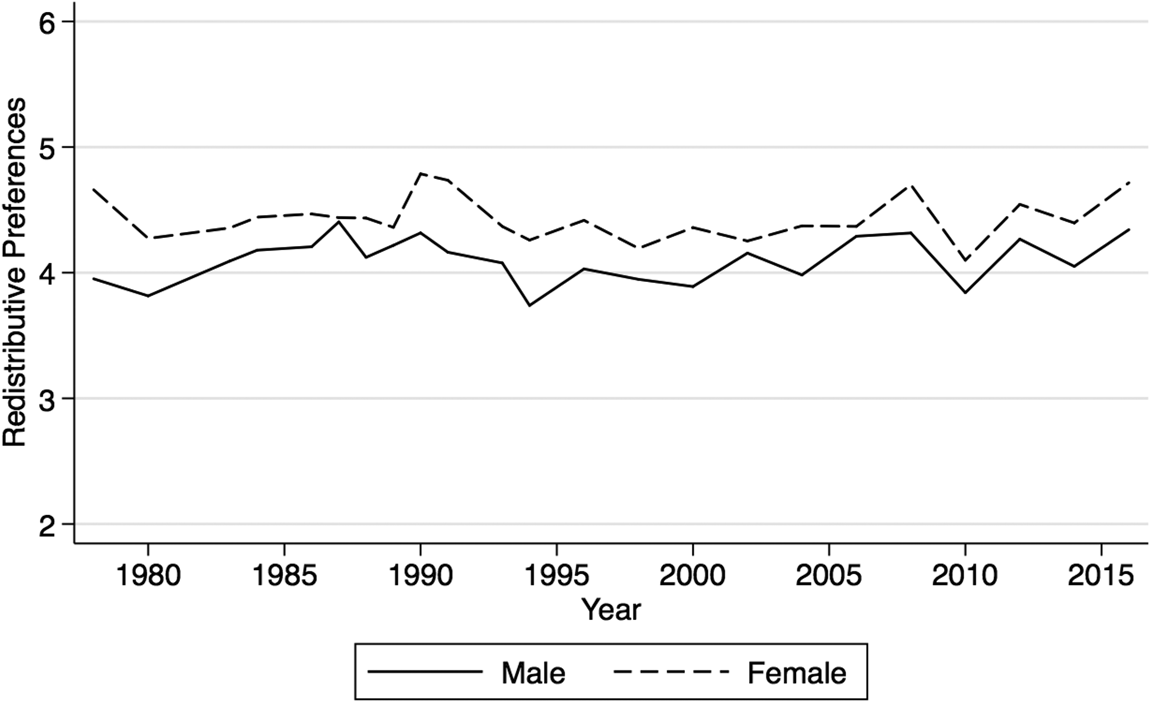
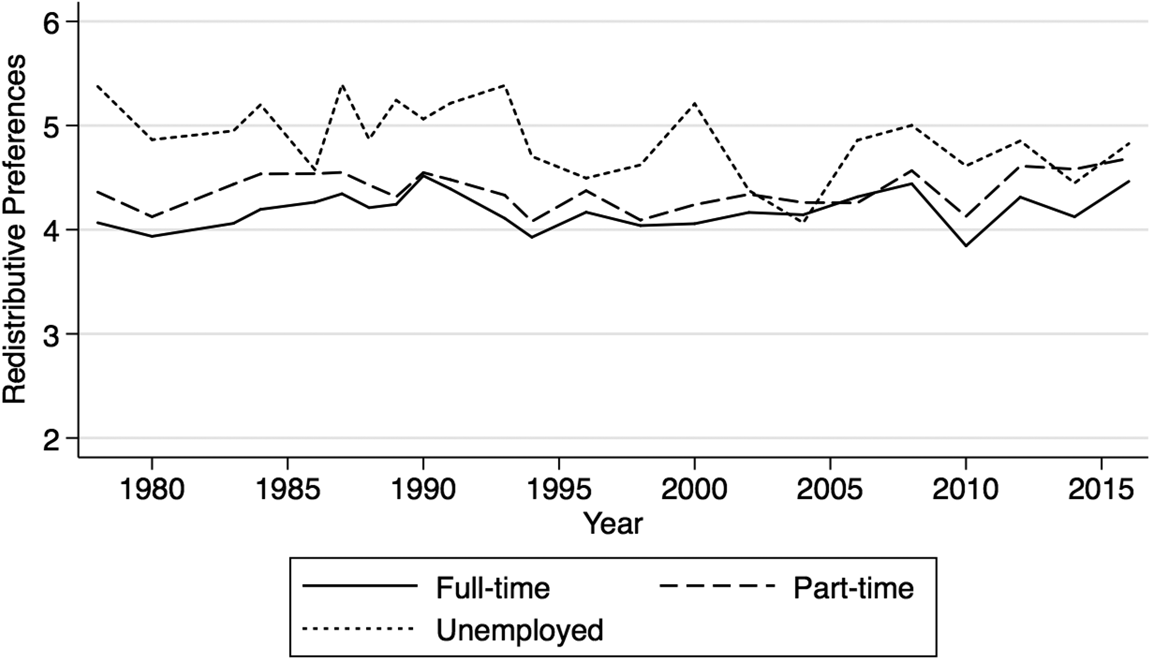
Figures 1 and 2 draw on the repeated cross-sectional data from the GSS and display the over-time variation in (weighted) mean attitudes toward redistribution by gender and work status, respectively.Footnote 16 There are three important takeaways from these figures. First, in almost every year, the average GSS respondent is slightly to the left of center (4 is the midpoint of the 7-point scale). Second, consistent with previous work on the gender gap, the figures show that men are generally more conservative than women, expressing lower levels of support for redistribution, and that this relationship is fairly constant over time. Finally, while the unemployed are generally much more pro-redistribution than employed respondents, the difference between full-time and part-time respondents is generally quite small.Footnote 17 When there is a difference, though, the part-time workers are more pro-redistribution than the full-time workers.
Redistributive Preferences by Gender and Year
Source: General Social Survey.
Notes: Limited to 18–64 year olds who are working full-time, working part-time, or unemployed.

Redistributive Preferences by Employment and Year
Source: General Social Survey.
Notes: Limited to 18–64 year olds who are working full-time, working part-time, or unemployed.

Next, we present the results from our analysis. We begin by examining the association between part-time work and redistribution preferences and how this may vary by gender utilizing the repeated cross-sectional GSS data. We then examine this same set of relationships with the panel data from the GSS. Then, we explore the mechanisms that may underlie these associations by turning back to the repeated cross-sectional data.
Part-Time Work, Gender, and Redistribution Preferences: Repeated Cross-Sectional Estimates
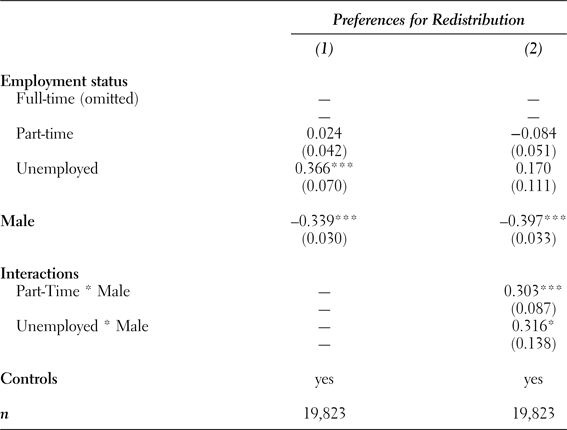
Table 1 presents results from the repeated cross-sectional GSS data about the connections between employment status and preferences for redistribution as well as the ways that this relationship may differ by the gender of the worker. Model 1 in Table 1 estimates a commonly utilized model for the association between individual-level attributes and redistribution preferences. The gender of the respondent is accounted for with a dummy variable, and employment status is captured by a series of dummy variables—comparing part-time work and unemployment status, separately, to working in a full-time position. As would be expected from previous research, there is a strong positive and statistically significant association between unemployment and redistribution preferences. There is also a large negative and statistically significant association between being male and redistribution preferences. However, there is no association—substantively or statistically—between part-time employment (compared to full-time employmentFootnote 18) and redistribution preferences in Model 1. The lack of a significant association between part-time work and redistribution in our data is consistent with the one previous study we are aware of examining the relationship between part-time work and redistribution preferences in the United States (Gelepithis and Jeannet Reference Gelepithis and Jeannet2017).
Regression models examining employment status, gender, and preferences for redistribution (repeated cross-sectional data)

Statistical significance (two-tailed tests): * p < .05; ** p < .01; *** p < .001.
Source: General Social Survey.
H1 and H2 present competing predictions about the way that the association between part-time employment and redistribution preferences will be contingent on the gender of the respondent. In other words, they propose that the average relationship between part-time work and redistribution preferences masks important heterogeneity. Model 2 in Table 1 tests for that possibility by replicating Model 1, but including interactions between the gender of the respondent and the employment status of the respondent. As the results in Model 2 demonstrate, the interactions between part-time work and being male, as well as between unemployment and being male, are both positive and statistically significant. This model provides support for H1, the claim that men in part-time work are more supportive of redistribution than men in full-time work, but that the relationship is, if anything, the opposite for women.Footnote 19 We also note that in models subset by respondent gender, there is a positive and statistically significant association for men between working part-time, compared to full-time, and redistribution preferences. There is no association between part-time work and redistribution preferences for women (see Table C1 in the appendix in the supplementary material online).
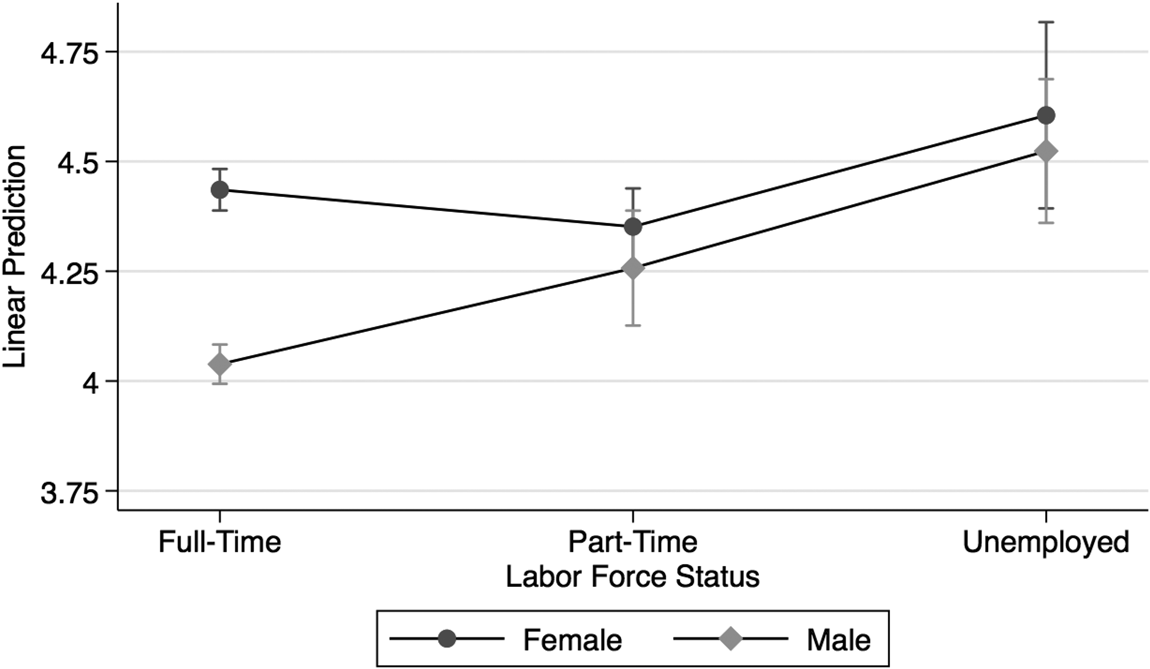
The predicted values from Model 2 are presented in Figure 3 (with 95% confidence intervals around each estimate). The predicted values provide a clear picture of how gender and employment status interact in the production of redistribution preferences. Men who are employed full-time are substantially more conservative in their redistribution preferences than otherwise similar women. On the other hand, men in part-time positions are only slightly more conservative than part-time women, and the gender gap among the unemployed is quite small.Footnote 20
Predicted Redistributive Preferences by Gender and Work Status
Source: General Social Survey.
Notes: Limited to 18–64 year olds who are working full-time, working part-time, or unemployed.

Together, the models in Table 1 provide compelling evidence that the association between one's employment status and one's preferences for redistribution is different for men and women. Given that these estimates are drawn from cross-sectional data, it is possible that this finding could be due to complex selection processes that lead men and women into part-time work and that also correlate with redistribution preferences. Thus, it may not be part-time employment itself that is driving the findings presented earlier, but rather some other attribute of the individuals in the sample. Next, we turn to the analysis of panel data to assist in addressing this concern.
Part-Time Work, Gender, and Redistribution Preferences: Estimates from Panel Data
To gain additional empirical traction on the potential selection issue outlined earlier, we turn to the analysis of panel data from the GSS. With panel data, which tracks the same individuals over time, we can examine whether changes in one's employment status (e.g., moving from full-time work to part-time work) are associated with changes in one's redistribution preferences. This empirical strategy better isolates the direct relationship between employment status and redistribution preferences.
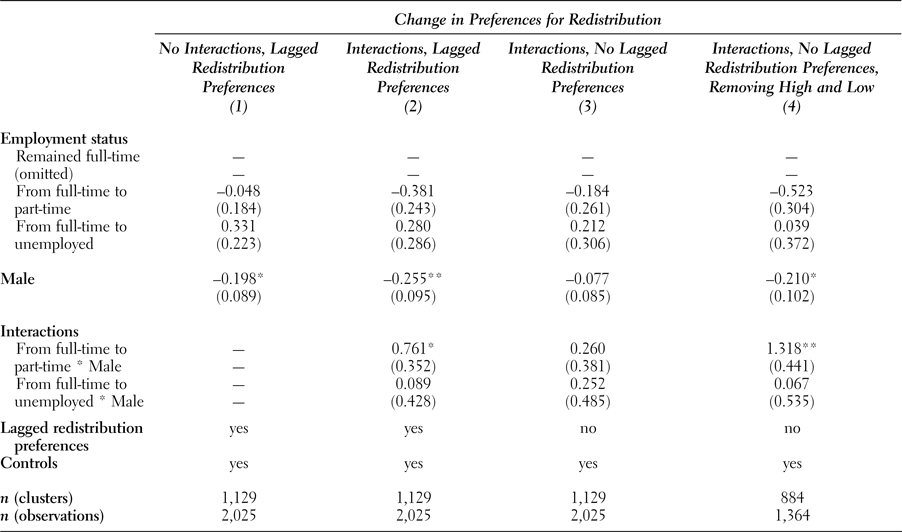
We present the findings from the panel data models in Table 2. Model 1 in Table 2 regresses changes in respondents’ redistribution preferences on changes in respondents’ employment status (compared to respondents who remained in full-time jobs), gender at baseline,Footnote 21 lagged redistribution preferences, and a full set of lagged control variables. We include lagged redistribution preferences here to adjust for where respondents started in terms of their support for redistribution.
Regression models examining changes in employment status, gender, and changes in preferences for redistribution (panel data)

Statistical significance (two-tailed tests): * p < .05; ** p < .01; *** p < .001.
Source: General Social Survey.
Notes: The “male” variable captures respondents' reported gender at the first wave of the survey. Standard errors are clustered by respondent.
The results demonstrate that there is little association between changing employment and changing redistribution preferences. In line with the cross-sectional data, men are more likely to lower their redistribution preferences, on average, than women. Model 2 replicates Model 1, but it adds interactions between respondents’ gender and employment transitions. Consistent with the findings in Table 1, there is a large positive and statistically significant interaction between moving from full-time to part-time work and being a man, providing additional support for H1 over H2. There is no statistically significant interaction between becoming unemployed and being a man. The findings from Model 2 provide compelling support that the relationship between part-time work, gender, and redistribution preferences is not due entirely to unobserved selection processes in the cross-sectional data. Thus, there appears to be something about the movement into part-time work that shifts men's, but not women's, preferences for redistribution.
In Model 3 of Table 2, we replicate Model 2, but we exclude lagged redistribution preferences. Here, we see a positive but not statistically significant interaction between being a man and moving from full-time to part-time work. This indicates that adjusting for respondents’ starting point on redistribution preferences matters. We further examine this in Model 4, which excludes lagged redistribution preferences and also excludes respondents who started at either extreme of the redistribution preferences scale (1 or 7). With these exclusions, we see a large positive and statistically significant interaction between being a man and moving from full-time to part-time work in terms of changes in redistribution preferences.
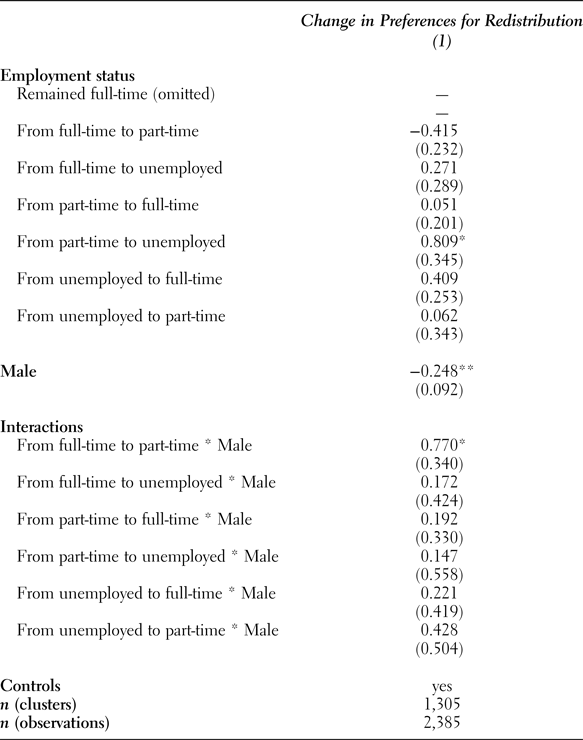
Table 3 investigates the potential asymmetry of this process by examining gender differences in the association between employment changes from part-time work and unemployment and redistribution preferences. The results demonstrate that the difference between the consequences of job status changes for men and women does not appear if those changes are from a baseline of part-time work or unemployment. In other words, we do not see gender-differentiated consequences of moving from part-time to full-time employment in the time-frame that these panel data cover. The same is true for those who move out of unemployment into a new job.Footnote 22
Regression model examining changes in employment status from part-time or unemployed, gender, and changes in preferences for redistribution (panel data)

Statistical significance (two-tailed tests): * p < .05; ** p < .01; *** p < .001.
Source: General Social Survey.
Notes: Controls from Model 2 in Table 2 included. Analysis limited to respondents working full-time, part-time, or unemployed at baseline. The “male” variable captures respondents’ reported gender at the first wave of the survey. Standard errors are clustered by respondent.
MECHANISMS: A RETURN TO THE REPEATED CROSS-SECTIONAL DATA
The evidence presented so far provides compelling evidence that there is a gender-differentiated association between part-time work and redistribution preferences. Relative to women, part-time work for men (compared to full-time work) is associated with preferences for more government redistribution from rich to poor. What might explain this pattern? Our theory argued for two types of mechanisms. First, a material pathway may exist. The general argument here is that part-time employment may negatively impact people's material security, that this effect may be stronger for men than women, and that this change in one's material situation (real and/or perceived) will alter their redistribution preferences accordingly. Second, it is possible that an ideological pathway—emphasizing threats to status—may link part-time work and redistribution preferences. Insofar as part-time work threatens men's position in the social and economic order, men may blame structural features of the economy for their part-time employment. In turn, this may produce a desire for policy interventions to address those challenges (i.e., policies including higher levels of redistribution). Since both of these mechanisms predict that H1 is accurate, which is supported in our analyses, we turn now to additional tests to tease the mechanisms out.
A Material Pathway
First, we empirically test the material pathway, utilizing the repeated cross-sectional data. Specifically, we test the following propositions:
H3: Relative to full-time work, part-time work will be associated with lower income and lower subjective financial status, and these associations will be stronger among men than among women.
H4: A portion of the gender-differentiated association between part-time work and attitudes about redistribution will be accounted for by income and subjective financial status.
We use two measures of respondents’ material standing: household income and subjective financial well-being. Household income is measured as the ratio of the respondent's household income to the (weighted) mean family income in that year. The respondents’ subjective financial well-being is measured with the following item: “Compared with American families in general, would you say your family income is far below average, below average, average, above average, or far above average.” Part-time work may differentially affect men's and women's objective material position as well as their subjective perception of their financial situation, and therefore it may differentially affect their attitudes about redistribution.
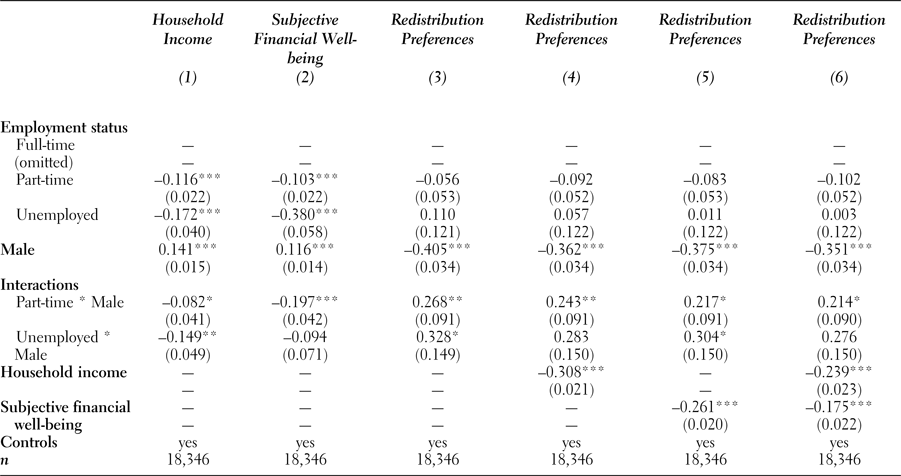
We test for this possibility in Table 4. Model 1 examines respondents’ household income as the dependent variable, with the predictors being employment status, gender, an interaction between the two, and the full set of covariates. Part-time work for women is associated with lower household income, and men in full-time positions have higher household incomes than women in full-time positions. The negative and statistically significant coefficient for the interaction between part-time work and gender also provides evidence that the income penalties for part-time work are stronger for men than they are for women.
Regression models examining whether material concerns explain redistribution preferences (repeated cross-sectional data)

Statistical significance (two-tailed tests): * p < .05; ** p < .01; *** p < .001.
Source: General Social Survey.
Next, Model 2 examines subjective financial well-being as the dependent variable. The findings reveal that, for women, part-time work and unemployment are correlated with lower subjective financial well-being than full-time work. But the interaction between part-time work and being male indicates that the negative association between part-time work and financial well-being is even stronger for men than it is for women.
Model 3 in Table 4 replicates Model 2 in Table 1 using only respondents for whom we have measures of both income and subjective financial well-being. It is included here for direct comparison with Models 4–6. To test the idea that material concerns explain the gender-differentiated association between part-time work and redistribution preferences, Models 4–6 in Table 4 include the income variable and subjective financial well-being variable in the model predicting redistribution preferences. If these variables assist in explaining the gendered relationship between part-time work and redistribution preferences, we would expect the interaction between being male and working part-time to attenuate between Model 3 and the models controlling for material standing (Models 4–6). Model 4 adds household income to the model. Here, we see a limited attenuation of the interaction between part-time work and being male: from 0.268 in Model 3 to 0.243 in Model 4. Next, Model 5 removes the household income variable, but includes the measure of subjective financial well-being. Here we see a more significant attenuation of the coefficient for the interaction term, from 0.268 in Model 3 to 0.217 in Model 5. Thus, subjective financial well-being explains approximately one-fifth of the interaction between part-time work and gender in predicting redistribution preferences. Finally, Model 6 includes both the household income variable and the subjective financial well-being variable in the model. Here, the findings look very similar to Model 5.
We also implemented a more formal statistical test to determine whether income and subjective financial well-being explain a statistically significant portion of the association between part-time employment and redistribution attitudes for men. Using the mediation analysis method proposed by Imai et al. (Reference Imai, Keele, Tingley and Tamamoto2011), we conducted two separate mediation analyses for the role of income and subjective financial well-being. Examining just male respondents, the results indicate that both household income and subjective financial well-being explain about a third of the relationship between part-time work and redistribution preferences for men (see Table E1 in the appendix). In both cases, the proportion of the total “effect” that was explained was statistically significant. The size of the mediation effect for both is substantially smaller among women.Footnote 23 Similarly, using seemingly unrelated regressions to estimate a joint meditation effect, we find that a significant portion of the gendered association between part-time work and preferences for redistribution is explained by the combination of income and subjective financial status (see Table E2 in the appendix). Together, this evidence indicates that material concerns are an important factor in shaping the gendered relationship between part-time employment experiences and attitudes about redistribution.
An Ideological Pathway: Threats to Status
Next, we test the argument that the gender-differentiated association between part-time work and redistribution preferences is driven, in part, by threats to an individual's social status. Given the gendered nature of part-time employment in the United States, these status threats are likely stronger for men than for women. Recall that there are two versions of this mechanism, that provide opposite predictions, and that status threat could push men to the left (reinforcing the material mechanism) or to the right (counteracting it). In the GSS, there is not a consistently asked item that captures the underlying construct of interest in a similar way that household income and subjective financial well-being correspond to the material well-being construct.Footnote 24
Thus, we pursue a series of indirect tests of the mechanism by looking at subgroups of individuals for whom the threat to status of part-time work is likely to be most prevalent. We expect that the status threat of part-time work will be strongest among groups of respondents for whom masculine breadwinner norms are most salient. The salience of male breadwinner norms is likely driven by (a) a perceived need for breadwinning, (b) a worldview that values traditional practices, and (c) those whose peers are most likely to be working full-time. Therefore, we hypothesize the following:
H5: The gender differences in the relationship between part-time work and attitudes about redistribution will be strongest among:
-
a. respondents with children
-
b. respondents with conservative political ideologies
-
c. prime-age workers
Among these groups of respondents (and relative to those without children, those with more liberal ideologies, and those who are younger or older than prime working age), we expect a tighter coupling of status and full-time employment for men but not for women. In other words, working full-time will be more important to the status positions of fathers, conservative men, and prime-aged men. Thus, we would expect the strongest gendered association between part-time work and redistribution preferences among these subgroups.
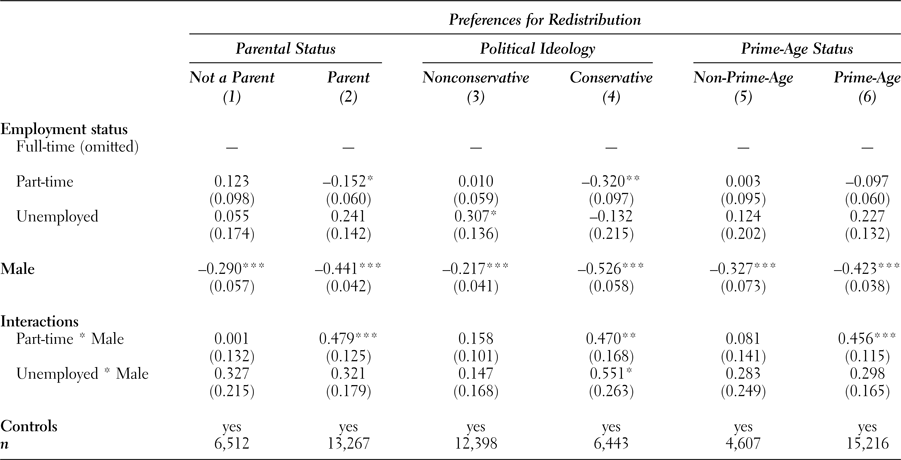
We empirically test for these patterns and report the results in Table 5. First, we explore variation by parental status, then by political ideology, and then by prime-age worker status. Models 1 and 2 in Table 5 are similar to Model 2 in Table 1, but they are designed to test H5a. Model 1 is subset to individuals who are not parents. It demonstrates that men who are employed full-time, on average, are less supportive of redistribution than women employed full-time, but the employment status of the individual does not interact with gender to produce redistribution preferences. Model 2 is subset to parents. Here, the interaction between part-time work and being male is positive and statistically significant, suggesting that the gendered effects of part-time work are concentrated among parents. We also estimated a model pooling parents and nonparents and including a three-way interaction between working part-time, being male, and being a parent. The three-way interaction was positive and statistically significant (see Table G1 in the appendix).
Regression models examining preferences for redistribution, by parental status, political ideology, and prime-age status (repeated cross-sectional data)

Statistical significance (two-tailed tests): * p < .05; ** p < .01; *** p < .001.
Source: General Social Survey.
Next, we examine whether the gendered effects of part-time work are concentrated among conservatives (H5b). Model 3 in Table 5 is limited to nonconservatives. Here, we see that the interaction between part-time employment and being male is not statistically significant. However, in Model 4 in Table 5, which is limited to conservatives, we see a positive and statistically significant interaction between part-time employment and being male. Thus, it appears as if our theoretical intuition aligns with the empirical pattern in the data: the gendered effects of part-time work are concentrated among conservatives. In a model that pools all political ideologies and includes a three-way interaction between part-time work, being male, and being conservative, the interaction is statistically significant (see Table G1 in the appendix).
Finally, it is possible that men who might otherwise be embarrassed to work in a part-time position because of the strong social norm in favor of full-time work might have an easier time justifying nonstandard working hours to themselves and to others if they are young. In this case, they would be more likely to have a peer group that includes more students, more unemployed people, and more people who are still figuring out their employment and career trajectories. At the same time, older men might have an easy time treating part-time work as semi-retirement, and therefore feel less pressure to seek political redress for their part-time status. However, among prime-age workers, expectations of full-time employment are likely strong and the threats to the status of men in that age group are likely felt the most firmly. The implication of this argument is that the gender differences in the association between part-time employment and redistribution preferences will be strongest for prime-age workers (ages 25 to 54) than for those at the beginning or end of the normal working life (ages 18 to 24 and 55 to 64).
We empirically examine this argument in Models 5 and 6 of Table 5. Model 5 is limited to non-prime-age workers: those between 18 and 24 and between 55 and 64. Here, we see that there is no statistically or substantively significant interaction between part-time employment and being male. In Model 6, we focus on prime-age workers (25 to 54). For this group of workers, there is a positive and statistically significant interaction between part-time employment and being male. Thus, the empirical evidence supports the idea that the gendered consequences of part-time work are concentrated among prime-age workers. In a pooled model of workers of all ages, there is a marginally significant (p = .058) three-way interaction between part-time work, being male, and being a prime-aged worker (see Table G1 in the appendix). If all workers in the GSS—even those over the age of 64—are included in the analysis, then the three-way interaction between being male, working part-time, and being prime-aged is statistically significant at the .01 level.
Earlier, we identified two potential reactions to the social status threat embodied (mostly for men) by part-time work. Respondents could move right—emphasizing stories that shift the blame for such issues to minorities, immigrants, or other scapegoats, or left—emphasizing stories that demand more from the state. Our evidence here suggests that, on average, the latter effect is more important for attitudes toward redistribution. That does not, of course, mean that no individuals take the other path, and the conditions under which each of these two paths is more attractive could be a fruitful line of research in the future.
DISCUSSION AND CONCLUSIONS
While significant social scientific scholarship has identified key drivers of individuals’ preferences for redistribution, part-time work—a common experience for American workers—has been underexplored in this literature. Here, we argue that part-time work is important for understanding preferences for redistribution, but its consequences will be shaped in important ways by the gender of the worker. Our analysis of data from the General Social Survey supports this argument. Utilizing repeated cross-sectional data, we find that part-time work is associated with higher levels of redistribution preferences for men, but it is not associated with the redistribution preferences of women. Similarly, drawing on panel data, we find that the relative impact of moving from full-time work to part-time work on changes in redistribution preferences is stronger for men than it is for women.
We also theoretically develop and empirically test two potential pathways—one material and one about threats to status—through which part-time work may have gender-differentiated associations with redistribution preferences. In terms of the material pathway, our findings demonstrate that respondents’ objective and subjective financial standing play an important role in explaining the gender-differentiated consequences of part-time work. To understand the threats to status pathway, we explore theoretically relevant heterogeneity in the gendered consequences of part-time work. We find that the gender-differentiated relationship between part-time work and redistribution preferences is concentrated among parents, conservatives, and prime-age workers. Men who are parents are most likely to feel the pressure of breadwinner norms. Conservative men are most likely to feel pressure around traditional gender norms, including breadwinner expectations. And, prime-age male workers have fewer alternative explanations about their experience of part-time work and, thus, it may lead to stronger status threats for this group.
Thus, our evidence suggests that both material as well as status-based dynamics are important mechanisms linking gender, part-time employment, and attitudes about redistribution. This appears to runs contrary to a portion of the literature and to accounts of the 2016 presidential election that attribute support for Donald Trump to status threat (Mutz Reference Mutz2018). However, Mutz argues that status threat drives a move to the right on cultural issues, not on economic issues. In other words, our results are consistent with the large literature on status threat, but suggest that we need to treat politics as multidimensional, rather than a simple left-right continuum.
While providing important insights about the gendered determinants of redistribution preferences, this article is not without limitations. First, as with the analysis of most observational survey data, it is difficult to make strong causal claims. While we use multiple strategies—including the analysis of panel data—to strengthen the internal validity of our findings, we are unable to rule out all confounding forces. Second, our evidence about the status threat mechanism is indirect. We examine how the gendered relationship between part-time work and redistribution preferences differs across theoretically relevant groups. Our article also does not speak to the ways in which part-time work and gender might interact among different racial or ethnic groups in the data. If our claim about the importance of status loss is correct, individuals who are racial and/or ethnic minorities who regularly experience discrimination may be less affected by the status threat channel, though perhaps more affected by the material mechanism. We do not have a sufficiently large sample of such groups to conduct a rigorous test of this possibility, but we hope that future work using over-samples of racial and ethnic minority groups, such as the Collaborative Multiracial Post-election Survey,Footnote 25 will allow scholars to examine these questions more closely.
Notwithstanding these limitations, this article contributes important insights to the social scientific understanding of attitudes toward the welfare state. In the U.S. context, we are aware of only one other study that focuses on the association between part-time employment and redistribution attitudes (Gelepithis and Jeannet Reference Gelepithis and Jeannet2017). Their findings are consistent with ours, demonstrating that part-time employment has no average association with redistribution preferences. But, Gelepithis and Jeannet (Reference Gelepithis and Jeannet2017) focus on the main effect of part-time work and do not theorize or test for the potentially gender-differentiated consequences of part-time employment. Thus, in addition to providing new empirical evidence about the determinants of welfare state attitudes, our findings have important implications for how social scientists conceptualize redistribution attitudes. By disaggregating full-time and part-time work and showing that these categories operate differently for men and women, we demonstrate that it may be insufficient to simply control for a dichotomous employment variable—employed versus unemployed—when examining political or social attitudes. And, importantly, our results suggest that a more theoretically nuanced conception of the ways that economic and social positions may interact in the production of welfare state attitudes is needed. Additive models of attitude formation do not always do justice to the complex ways that people's lives operate and their worldviews are formed.
Together, the findings from this article shed new light on how one's position in the economic order shapes one's attitudes toward the welfare state. Part-time workers have long made up a substantial minority of American voters, and understanding how they form their attitudes is itself important. In addition, the findings reveal that this relationship is contingent on the worker's sociodemographic position—their gender—and explained in part by gender differences in workers’ material standing and the ways that their status is threatened by not working full-time. As labor markets and gender norms change, these patterns may change as well, but the theoretical insights—that material interests, social status, and gender shape attitudes toward the welfare state—seem likely to persist. Ultimately, these findings hold insights for conceptualizing the ways that social and economic forces interact in the production of political attitudes.
SUPPLEMENTARY MATERIAL
To view supplementary material for this article, please visit https://doi.org/10.1017/S1743923X20000653.