1. Introduction
Forests have been depleted at an alarming rate in recent decades in developing countries (World Bank, 2009). The depletion of forest resources is most likely to occur in state-managed forests because the capacity of and incentives for the governments to protect and manage forests are limited (Ostrom, Reference Ostrom1990; Somanathan, Reference Somanathan1991). Responding to this problem, the community forest management system has become popular in recent decades, particularly in developing countries (Tachibana et al., Reference Tachibana, Upadhyaya, Pokharel, Rayamajhi, Otsuka, Otsuka and Palace2001; Baland et al., Reference Baland, Bardhan, Das and Mookherjee2010).
Since forest resources are non-excludable to a considerable extent, people may extract them excessively under community management, which may lead to ‘the tragedy of the commons’, as described by Hardin (Reference Hardin1968). Hayami (Reference Hayami2009) argues, however, that the community has an inherent informal mechanism that can enforce collective action among community members because information asymmetry is not so serious within the community, where everybody knows everybody else. In particular, if secure use rights on forest resources are granted to the community, the community may be able to protect and manage forests effectively (Gerald et al., Reference Gerald, Enzer and Kusel2001). In fact, some researchers argue that the community management system with forest use rights can be a superior alternative to the individualized management system in the protection of non-timber forest resources (Kijima et al., Reference Kijima, Sakurai and Otsuka2000; Sakurai et al., Reference Sakurai, Rayamajhi, Pokheral and Otsuka2004). Many other studies show that non-timber forests are effectively managed by local people in India (e.g., Murty, Reference Murty1994; Kumar, Reference Kumar2002; Baland, et al., Reference Baland, Bardhan, Das and Mookherjee2010; Bhattacharya et al., Reference Bhattacharya, Pradhan and Yadav2010) and in the Hill region of Nepal (e.g., Edmonds, Reference Edmonds2002; Gautam et al., Reference Gautam, Shivakoti and Webb2004 Tachibana and Adhikari, Reference Tachibana and Adhikari2009). At the same time, however, the community management system is not found to be a panacea; many studies report that community forest user groups are often dominated by local elites, thereby excluding disadvantaged groups from decision making and from the product distribution process (Maskey et al., Reference Maskey, Gebremedhin and Dalton2006), and that poorer households often have limited access to community forests compared to rich households (Adhikari et al., Reference Adhikari, Williams and Lovett2007; Shrestha and McManus, Reference Shrestha and McManus2007; Thoms, Reference Thoms2008; Dhakal et al., Reference Dhakal, Bigsby and Cullen2012).
At the same time, the existing studies have been subjected to methodological criticisms such as the lack of rigorous econometric analysis (e.g., Chakraborty, Reference Chakraborty2001), the subjective judgment of the forest condition (e.g., Agrawal and Chhatre, Reference Agrawal and Chhatre2006), the lack of ground-level data (e.g., Bhattarai and Conway, Reference Bhattarai and Conway2008), and the neglect of the endogenous choice of management regimes.Footnote 1 Despite such methodological shortcomings, the effectiveness of community forest management in preserving non-timber forest seems to have been relatively well documented. In contrast, it is unclear as to whether the community management can be effective in managing timber forests. The distinction between non-timber and timber forests is important because the production of valuable timber trees requires labor for silvicultural operations, while the production of non-timber products usually does not require much labor for the care of the trees. Some researchers argue that community management of timber forests is not viable due to its inability to provide sufficient incentives for its members to carry out the necessary silvicultural operations (Baland et al., Reference Baland, Bardhan, Das and Mookherjee2010; Bhattacharya et al., Reference Bhattacharya, Pradhan and Yadav2010). Yet, the literature on the community management of timber forest has been scant.
The main purpose of this study, therefore, is to conduct a rigorous econometric analysis of the management of timber forests with special reference to the impact of the handover of forest use rights to the community in the Tarai region of Nepal. Methodologically, this paper contributes to the existing literature in three ways. First, this paper is among the few studies utilizing unique ground-level data on forest conditions and management.Footnote 2 Secondly, and more importantly, this paper proposes a novel way of inferring the evolution of forest conditions retrospectively, based on cross-sectional data of the density of trees of different sizes. Knowledge of how fast timber trees typically grow allows us to infer the timing of when forest regeneration likely started. Thus, we identify the impact of community management by correlating the number of small, medium and mature trees per hectare with the year when the forest use rights were handed over to the community. Thirdly, since the timing of the handover is likely to be correlated with the unobserved characteristics of the communities, we explicitly treat the year of handover as an endogenous variable with the use of the two-stage least squares (2SLS) technique, unlike the majority of the existing studies. We find that a longer period of community management is associated with a higher density of pole-size trees, indicating that community management facilitates the rehabilitation of timber forests, which is consistent with the findings of the studies on non-timber community forest management. We also find that population pressure leads to deforestation under state management, but encourages forest management under community management.
This paper is structured as follows. Section 2 discusses the evolution of community forestry in Nepal. Section 3 explains the main issues and hypotheses. Section 4 discusses the data and methodology. Section 5 reports the estimation results and their interpretations. Section 6 concludes the paper.
2. Evolution of community forestry
Historically in Nepal, local governments controlled the forest resources in the feudal Rana regime from 1846 to 1950 (Ojha et al., Reference Ojha, Persha and Chhatre2009). They undertook the harvesting of timber trees, particularly in the Tarai region and in some parts of the Hill region accessible to markets, but the collection of minor forest products was unregulated (Tachibana et al., Reference Tachibana, Upadhyaya, Pokharel, Rayamajhi, Otsuka, Otsuka and Palace2001). The collapse of the Rana regime in 1950, however, led to massive deforestation and forest degradation. Responding to this situation, all the forest areas were nationalized in 1957. However, the government could not manage the forests effectively. Observing the effective and voluntary management of forests by communities in selected areas in the 1960s and 1970s, the government of Nepal has gradually introduced a decentralized management system to arrest deforestation and forest degradation. The Panchayat Forest Rules and Panchayat-Protected Forest Rules in 1978 allowed the locally elected body called the village Panchayat to manage the degraded forestland. The Decentralization Act in 1982 introduced the ‘user group’ concept as an effective means to combat deterioration. The 25-year master plan in 1988 emphasized the importance of forest user groups to revitalize the age-long indigenous practices of forest resource management. After the restoration of the democratic system in 1990, the Nepalese government enacted the new Forest Act in 1993 and Forest Regulations in 1995, which placed a high priority on community forestry and specified a procedure for the formation of community forest user groups (CFUGs) as self-governed autonomous entities (Gautam et al., Reference Gautam, Shivakoti and Webb2004).
In Nepal, about 1.6 million people (one-third of the total population) participate in the community forestry programs, and about one million hectares of forest (more than a quarter of the total forest area) have been handed over to the communities (Ojha et al., Reference Ojha, Persha and Chhatre2009). The community forestry program has been considered successful in enriching the forest conditions in the Hill region. However, there has been a genuine dispute regarding the prospect of the success of community timber forestry in the Tarai region. Forests in the Hill region are copse forests, requiring protection but not much in the way of silvicultural operations for reforestation.Footnote 3 In contrast, forests in the Tarai region are timber forests which require both protection and silvicultural operations to produce valuable timber trees (Tachibana et al., Reference Tachibana, Upadhyaya, Pokharel, Rayamajhi, Otsuka, Otsuka and Palace2001). In order to carry out silvicultural operations properly, work incentives need to be put in place, and whether community management succeeds in the silvicultural operations by organizing collective work is an important empirical question. While some argue with anecdotal evidence that community forestry in the Tarai region has been successful in enhancing forest conditions (e.g., Chakraborty, Reference Chakraborty2001), others point out that community management lacks sufficient incentives for its members to manage timber forests, leading them to pessimistic prognoses on the viability of community forests in the Tarai region (Hobley, Reference Hobley1996; Ojha et al., Reference Ojha, Persha and Chhatre2009). Such debate appears to persist due to the paucity of systematic investigations with quantitative data in the literature, which is precisely the knowledge gap this paper intends to fill.
3. Issues and hypotheses
3.1. Deforestation and forest degradation before the handover
Despite the attempts made in the past, the depletion of forest resources continues. Studies have identified various factors associated with deforestation and forest degradation. Often documented are the extension and expansion of roads, agriculture expansion and population pressure. Most of such studies are based on satellite imagery showing forest conditions (e.g., Kanel and Niraula, Reference Kanel and Niraula2004). Studies using ground-level data on forest conditions and management practices under community management are relatively rare.
Because the state lacks resources to protect forests and motivation to manage trees, state forests are loosely managed or de facto open access and, hence, they tend to be degraded severely (e.g., Metz, Reference Metz1991; Kumar, Reference Kumar2002; Tachibana and Adhikari, Reference Tachibana and Adhikari2009). Under such conditions, higher population pressure and better market access would have accelerated deforestation and forest degradation due to the higher demand for forest products (e.g., timber, firewood and fodder grasses) and forest land (e.g., for agricultural and settlement purposes). If the purpose of felling mature timber trees is sale on the market, it is likely that large trees were felled in forests with favorable access to markets. In line with this, Angelsen's (Reference Angelsen1999) theoretical models show that population pressure and favorable market access increase the rate of the deforestation process. Based on these arguments, we postulate the following hypothesis regarding the effects of population pressure and market access under state forest management:
Hypothesis 1
Higher population pressure leads to deforestation by clearing the forest for the expansion of agricultural land and settlement area as well as by excessive grazing, while better access to markets leads to forest degradation due to the loss of large trees for logging and selling.
3.2. Forest management operations and impacts on reforestation
Community forest management refers to the use and management of forest resources by the local people living in and around the forest area who are integrated ecologically, socially and culturally. Forest management operations refer to the protection, management and harvesting of trees and other forest products. Effective forest protection requires the prevention of grazing, encroachment and illicit harvesting. To ensure sustainability, plantation is needed if the forest is completely destroyed and the self-regeneration of the new trees is not possible. The plantation of new trees in barren forests can significantly reduce the pressure on natural trees in areas where fuelwood collection is a major cause of deforestation (Kohlin and Parks, Reference Kohlin and Parks2001). Silvicultural operations such as weeding, pruning, thinning and singling are needed to improve the timber forest condition and the quality of timber. Such operations not only stimulate the growth of high-quality timber trees but also supply minor forest products for the forest users. We expect that a higher demand for forest products stimulates the forest management activity if the use rights of the forests handed over to the community. This is diametrically opposite to hypothesis 1, which is assumed to hold under state management.
CFUGs generate income from various sources including the sale of forest products and membership fees (Kanel and Niraula, Reference Kanel and Niraula2004). The sustainable generation of revenue from the forest resources has a number of synergetic effects on forest conditions and the livelihood improvement of the people (Kanel and Niraula, Reference Kanel and Niraula2004). For example, such revenues can be invested in forest management, poverty reduction and social development activities (e.g., building fences along forest boundaries and constructing school buildings and village trails). Khanal Chhetri et al. (Reference Khanal Chhetri, Lunda and Nielsena2010) find that income generation by the community groups depends on the forest area, forest quality, species composition and market access, and that CFUGs tend to spend such income on local development activities. We expect that CFUGs carrying out intensive management operations also extract more forest products in a sustainable manner, resulting in a higher revenue per unit of forest area. Based on these arguments, we postulate the following hypothesis:
Hypothesis 2
Higher population density and better market access not only lead to more intensive management of community forests but also help to generate more revenue per unit area after the forest use rights are handed over.
Reforestation is one of the main objectives of community forest management.Footnote 4 Therefore, the extent of reforestation is a good indicator with which to measure the success of initiating community forestry with the devolution of forest use rights to the community. The possession of forest use rights helps strengthen the incentives for community participation in the resource management by assuring their rights to receive the generated benefits (Gerald et al., Reference Gerald, Enzer and Kusel2001; Aggarwal and Elbow, Reference Aggarwal and Elbow2006). Therefore, handing over the forest use rights is expected to encourage the local people to protect forests and improve their condition. While conducting our survey, we observed a large number of small and medium-sized trees growing in our research sites. Based on such an observation, we postulate the following hypothesis:
Hypothesis 3
Community forest management has positive impacts on reforestation after the use right is handed over to the local community.
4. Data and estimation method
Our data set comes from the community forestry program in the Dang district, located in the Inner Tarai region of Nepal. The Dang district, where some communities resumed timber forest management informally around 1980 and the formal handover process started at the beginning of the 1990s (earlier than the other Terai region), is recognized as a pioneer district in community forestry in the Tarai region (Sakurai et al., Reference Sakurai, Rayamajhi, Pokheral and Otsuka2004). Most of the forests in the Dang district are dominated by hardwood trees such as Sal trees except in some places in the hillsides. The use rights of the majority of accessible forests have already been handed over to local communities.
Among the 447 registered CFUGs in the District Forest Office (DFO) of Dang as of 2010, 200 were randomly selected after excluding the 100 planted forests and 20 forests which were registered later than 2005. Planted forests were excluded because the management of these forests is qualitatively different from Sal-based natural forests. Recently registered CFUGs were excluded because they were considered to be too new to assess the impacts of the handover on forest conditions. Relevant data were collected from primary and secondary sources. The secondary sources are the constitutions and operation plans of the CFUGsFootnote 5 submitted to the district forest office. We used data on the forest conditions reported by the operation plan which was originally collected in association with forestry technicians using a standard forestry approach. The number and volume of the different sizes of trees per unit area are used to measure the forest condition. Besides these, other information such as silvicultural activities in terms of the area covered in the last five years, revenue generation in the last year and deforested area was collected by our own survey, based on interviews with the forest user committee members.
Our survey collected the data on the extent of severe deforestation by asking about the newly planted area, the area of barren land, and the area of encroachment for agriculture and human settlement purposes. As mentioned earlier, the Sal (Shorea robusta) tree is dominant in the forests, and it has high regenerative capacity, so that, unless trees are completely uprooted or heavily grazed, regeneration takes place. Therefore, we can interpret all the areas of community forest which are barren, planted artificially and encroached upon as the areas that were severely degraded at least once due to the complete felling of trees and heavy animal grazing. We thus use ‘barren, planted and encroached areas’ as our proxy measure for the extent of deforestation under state management. After the handover of the use rights, some parts of the barren area have been planted to fast growing trees by CFUGs. We should note, however, that this measure is likely to underestimate the deforested area, because the regeneration of trees could have taken place gradually on deforested area over time, if they are surrounded by Sal trees, which is not counted as deforested area in our measure of deforestation. Although there is the possibility that forest areas were degraded after the handover, forest users and forestry officers unanimously argue that they were seriously degraded before that.
The second type of indicators of the forest condition includes (i) the average number of trees per hectare belonging to different diameter classes and (ii) tree volumes per hectare. As shown in table 1, we categorize the trees into three distinctive groups: small, pole and mature, based on the size of the tree. From table 1, we can also see that mature trees are at least older than 27 years. Since the average time elapsed after the forest was handed over in our sample is about 12 years, the presence of large trees in the community-managed forests cannot be a result of reforestation after the handover. Rather, it is more reasonable to assume that these large trees have been protected since the period before the handover. In contrast, the presence of small and pole-size trees can be interpreted as a result of recent regeneration. Thus, the presence of a larger number of small and pole-size trees indicates that reforestation is taking place. For mature trees, data are also available in volume, which is a better measure of biomass than the number of trees.
Estimated relationship between tree size (diameter of the tree) and age of trees a

Notes:
a Source 1 draws on Gautam and Devoe (Reference Gautam and Devoe2006) and source 2 on Sapkota and Meilby (Reference Sapkota and Meilby2009).
b Not available.
c The authors do not explain why tree size declines.
To measure the extent of forest management in recent years, we collected the data on the total area of the forest where the community forest user members carried out silvicultural operations during the past five-year period before the year of data collection (e.g., from 2005 to 2009). Silvicultural operations comprise weeding, singling, thinning, pruning, planting and harvesting. For revenue generation, we asked the amount of total revenue collected by the CFUGs per unit area of the forest in the 2008/2009 fiscal year. The main source of revenue comes from selling the timber. Additional sources of income are sales of firewood, non-timber forest products such as herbs, and non-forestry income such as donations and punishment fees.
Based on informal interviews with a large number of CFUG committee members, we assume that the effective or intensive community management was launched in the year of the handover. However, the timing of handover of the forest use rights to the community is likely to be endogenously determined. Thus, we use the 2SLS estimation to deal with this endogeneity problem. The econometric specification expressing the determinants of forest conditions, management intensity and revenue generation is assumed to take the following form:
 $$\eqalign{Forest\_Condition\comma \; Forest\_Management or Revenue_{i} & = \beta_0 + \beta_1 Handover_i \cr & \quad + \delta X_i + \upsilon_{\iota}\comma \; }$$
where Handover i is the year when the forest was handed over to the community i, and υι is an error term. As discussed earlier, Forest{_}Condition i is proxied by the following set of variables: (i) the percentage of barren, planted and encroached areas; (ii) the volume of mature trees per hectare; (iii) the number of pole trees per hectare; and (iv) the number of small trees per hectare. Forest{_}Management i , is measured by the percentage of managed forest area, and Revenue by the amount of revenue generation per hectare of forest area by the CFUGs in the fiscal year 2008/2009. χi is a vector of the characteristics of the community forest including the physical characteristics of the forests such as the area of the forests, market access, distance to the forest from the village center, the slope of the forests, and demographics such as population pressure.Footnote 6 We incorporate the year of the latest operational plan submission in the model as an explanatory variable in order to control for the effects of the timing of the data collection on forest conditions and management activities. In the regression equations of management and revenue, we also include the characteristics of the president (age, sex and education level) of the CFUG committee as additional explanatory variables to control for the effect of his/her attributes in forest management and revenue generation. Since presidents change frequently, we do not include these variables in the equations for forest conditions, which are stock variables.
In this study, the population pressure is measured by the number of households per unit area of the community forest area, and the market access is proxied by the distance to the main road. We test whether hypothesis 1 holds under state management by examining the associations between the estimated proportion of deforested area at the time of handover and population density, and between the current volume of large trees per unit of area (at the time of survey) and distance to road. We test hypothesis 2 by examining the association between population pressure and the intensity of forest management, and between population pressure and the amount of revenue generated per unit area. To test hypothesis 3, we use the average number of small and pole trees per unit of forest area as proxy measures for the extent of reforestation. We expect that if the forests are managed intensively, pole trees are abundant in the forests handed over relatively early, and small trees are dominant in the forests handed over recently.
The first-stage regression equation for the determinants of the year of the forest handover is assumed to take the following form:
 $$Handover_{i} = \phi_{0} + \phi_{1}{\bf Z}_{i} + \eta {\bf X}_{i} + \xi_{i}\comma \;$$
where ξ i is an error term. Identification of the coefficient on Handover (β1) requires instrumental variables ( Z i) that are correlated with the timing of the forest handover but do not directly affect forest conditions. Our identification assumption is that the timing of the handover is affected by the accessibility to the forest offices and the foresters' workloads. In the process of handing over, foresters help the community people in a number of ways from the formation of the community user groups to the handing-over decision. The handing-over process is tedious and time consuming since the transaction cost is very high in the group formation and collective decision making. The foresters have to go repeatedly to the forests and villages, and need to be involved in activities like group formation, assembly meeting, forest inventory measurement and the preparation of the constitution and the operational plan. Therefore, the foresters might prefer to be involved first in the handing-over to those forests which are easily accessible from the forest offices.
At the same time, only 50 per cent of the forests were under community management and the rest were still under direct government control as of 2009 (Dang District Forest Office, 2009). The effort of forest officers was focused on managing those forests (under direct government control) as well as facilitating the handover of those forests to community groups. As a result, community forest user groups were left to manage their forests on their own without much interference from forest officers. Banjade et al. (Reference Banjade, Paudel, Karki, Sunam and Paudyal2011) observe, for example, that there are few official institutional interactions between community groups and forest authorities. Edmonds (Reference Edmonds2002: 95) also states that ‘the process of creating forest groups is consuming almost all of the forester's available time (Gibbon, Reference Gibbon1996), so there is virtually no monitoring of group activities subsequent to creations’. These observations are consistent with our identifying assumption that the proximity of forest officers is unlikely to affect directly the forests under community management (once those are handed over to community groups). Moreover, the timing of handing-over may also depend on the workload of the foresters. If the forest offices have to cover a large area, the average handing-over rate of the forest is likely to be comparatively low. According to our informal interviews with forestry officials, local forest offices were created in the early 1990s in accordance with the existing administrative demarcation and without any consideration of forest conditions. This suggests that the assigned area for the forest offices is likely to be distributed independently of forest quality. In fact, the results of the Sargan test of over-identifying restriction suggest that the assigned areas of forest offices are uncorrelated with the error term in the second-stage regressions.Footnote 7 Note that the ranger posts are not necessarily located in the nearby market towns to the village or forests. Therefore, time taken to reach the range post is not strongly correlated with distance to road. In fact, the correlation coefficient between the time taken to reach the range posts and the distance to road is 0.31. Based on these arguments, the year of handover is instrumented by the time taken to reach range posts from the forest border (foresters' accessibility) and the total forest area covered by the corresponding range post (foresters' workload).
5. Estimation results
5.1. Descriptive statistics and first-stage regression results
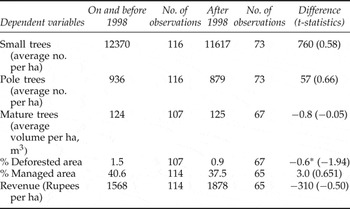
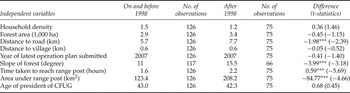
For expository purposes, we divide the samples into two groups by the median year of handover (on or before 1998 and after 1998) and examine the difference in the means of the variables used in the regression analyses between the two groups using the t-test. Since some data are missing, the sample sizes are different for different items. As shown in table 2, for which data were collected from October to December 2010, the difference is significant in the percentage of deforested area, suggesting that severely deforested forests were handed over earlier. Table 3 exhibits the difference in the mean of the explanatory variables. The mean differences are significant in the distance to road, slope of the forest, time taken to reach range post and area covered by the range post. That is, the forests, which were handed over earlier are located in flat places, near to the road and the range posts, and intensively covered by the foresters.
Descriptive statistics of dependent variables by the timing of handover

Notes: *, ** and *** indicate statistical significance at 0.1, 0.05 and 0.01 level, respectively.
Descriptive statistics of independent variables by the timing of handover

Notes: *, ** and *** indicate statistical significance at 0.1, 0.05 and 0.01 level, respectively.T-statistics are shown in parentheses.
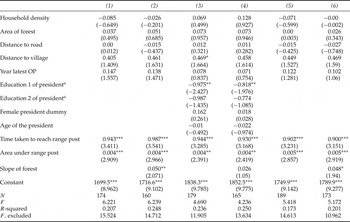
Table 4 presents the first-stage regression results where the year of handover is the dependent variable. The coefficients of the instruments are positively significant in the first-stage regression results regardless of changes in the sample size and specifications, suggesting that the larger the area covered by the range post and the longer the time taken to reach the forest from the range post, the later was the year of the forest handover. The F-statistics for testing the significance of the excluded instruments are equal to or well above 10 in all equations, suggesting that the problem of weak instruments is not of concern Angrist and Pischke (Reference Angrist and Pischke2009). In the test of the over-identifying restriction, we cannot reject the null hypothesis that the instruments are uncorrelated with the error term at the conventional level of significance in all second-stage regressions.Footnote 8 In other words, we find no evidence that our IVs are correlated with forest conditions once the year of handover is controlled for.
First-stage regression of the year of handover

Notes: *, ** and *** indicate statistical significance at 0.1, 0.05 and 0.01 level, respectively. T-statistics are shown in parentheses. Predicted values of the year of handover in equations (1) and (2) are used for the second-stage regressions of deforestation and timber volumes, in equations (3) and (4) for management intensity and revenue per ha, and in equations (5) and (6) for the number of small and poll trees per ha. a Education 1 and 2 refer to secondary and tertiary education, respectively.
5.2. Determinants of deforestation and forest degradation
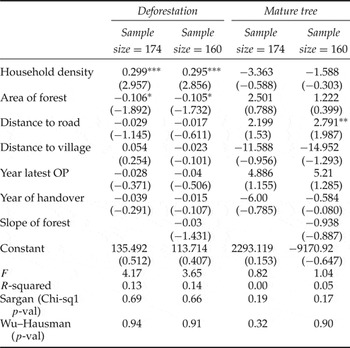
Table 5 reports the 2SLS regression results explaining the percentage of deforested area in the forests and the volume of mature trees. We employ two different specifications: in the second model, we include the slope of the forests as an additional explanatory variable, which contains 14 missing observations, leading to a smaller sample size.
Determinants of deforestation and volume of mature trees per hectare: two-stage least squares estimation

Notes: *, ** and *** indicate statistical significance at 0.1, 0.05 and 0.01 level, respectively.T-statistics are shown in parentheses.
As expected, the year of handover is insignificant in all the cases (i.e., both models and both dependent variables) reported in table 5. These results indicate that deforestation and the loss of mature trees were not affected by the community forest management initiated 12 years earlier on average because many more years are needed to grow large mature trees.Footnote 9
The coefficients of population pressure, measured by the number of households per unit of forest area, are positive and significant when the dependent variable is the percentage of deforested area in the community forests, whereas the coefficients of the distance to road are positive and significant when the dependent variable is the average volume of mature trees per hectare. The former finding indicates that population pressure is the key factor explaining deforestation. The latter finding indicates that favorable road access contributes to the loss of mature trees because it facilitates the transportation of timber to outside markets. Note that, unlike the case of severe deforestation, the felling of some mature trees might have taken place after the handover. If repeated cutting and grazing are prevented, the regeneration of new trees can take place in those places where mature trees were cut down. Therefore, under ordinary conditions, the harvesting of mature trees does not lead to deforestation but only to short-term forest degradation. It is worth emphasizing that the determinants of deforestation due to grazing and the expansion of agricultural land and those of forest degradation due to the felling of large mature trees are quite different. These findings support hypothesis 1. Note, however, that this conclusion is drawn from the sample of forests handed over, but not from the entire sample of forests in Dang district.
5.3. Determinants of management intensity and revenue generation
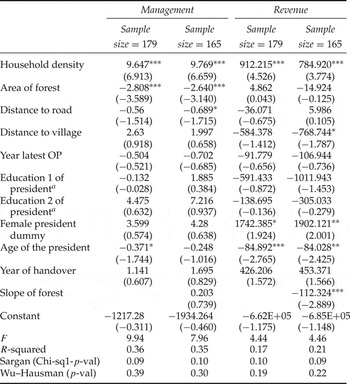
Table 6 presents the 2SLS regression results for the percentage of area where the management operations were carried out and for the revenue generation per hectare under community management, respectively. We find that the year of handover has no significant effect on forest management. This may be taken to imply that the forest management intensity is independent of the year of handover. On the other hand, it has weakly positive effects on the revenue generation.
Determinants of management operation and revenue: two-stage least squares estimation

Notes: *, ** and *** indicate statistical significance at 0.1, 0.05 and 0.01 level, respectively. T-statistics are shown in parentheses. a Education 1 and 2 refer to secondary and tertiary education, respectively.
The estimated coefficients of household density are positively significant in both regression equations (i.e., percentage of area where the management operations were carried out and the revenue generation per hectare), which is in sharp contrast with the results on deforestation. These results together suggest that the large demand for forest resources brought about by population pressure contributes to the deforestation when the forest is open access under government management but intensifies the management activities and generates more revenue per unit area once the user rights are handed over to the local community. Moreover, the coefficient of distance to the road is negatively significant in the equation for the percentage of the management area, which indicates that people manage forests intensively in forests near roads. These results support the validity of hypothesis 2. Contrary to hypothesis 2, however, the coefficient of distance to the road is not significant in the equation for the revenue per hectare. Recall that favorable road access contributes to the loss of mature trees according to the analysis of the volume of mature trees reported in table 4. So far as selling harvested timber is a major source of revenue, these estimation results suggest that mature timber trees were harvested in areas with better market access primarily before the handover of forest use rights when the forests were under government management.
We additionally find that the area of forest and distance to road are both negatively associated with management intensity, as may be expected. We also find that CFUGs headed by younger presidents manage forest more intensively, and that younger and female presidents tend to generate more revenue.
5.4. Determinants of reforestation
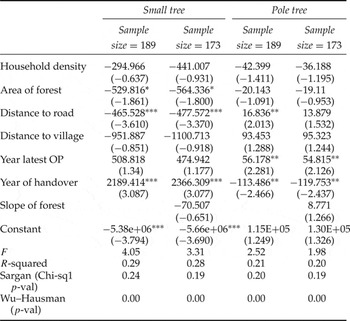
As shown in table 7, the coefficients of the year of handover are positively significant in the equation for small trees and negatively significant for pole trees. These findings indicate that pole-size trees are dominant in the forests which were handed over earlier, whereas small trees are dominant in the recently handed over forests. These results are consistent with our argument that CFUGs began to protect and manage the forests intensively immediately after the handing-over of the forest use rights. Gautam and Devoe (Reference Gautam and Devoe2006) calculate the relationship between the diameter and age of the Sal tree which is shown in table 1 (source 1). We also estimated, based on the diameter growth model of the Sal tree (Shorea robusta) constructed by Sapkota and Meilby (Reference Sapkota and Meilby2009), the relationship between the tree sizes and the age of the trees as shown in the second row of table 1 (source 2). Based on the latter set of estimates, we can see that the diameter of the Sal trees increases by nearly 1 cm annually up to age 15 or 20. If the trees are properly managed, we expect that a newly regenerated Sal tree can graduate to become a pole-size tree after 10 years and a mature tree after 27 years. Since the average age of the CFUGs is around 12 years, we can safely infer that newly regenerated trees after the handover have become pole trees in the forests handed over more than 12 years ago. Under the community management regime, grazing and harvesting the fodder are severely restricted in most cases. Therefore, we expect that regeneration takes place immediately after the forest management begins, which increases the number of small trees in newly handed over forests. The regression results support hypothesis 3.
Determinants of the number of small trees and pole tree per hectare: two-stage least squares estimation

Notes: *, ** and *** indicate statistical significance at 0.1, 0.05 and 0.01 level, respectively.T-statistics are shown in parentheses.
The coefficient of the distance to road is positively significant in the equation for pole trees, but negatively significant in the equation for small trees. These results indicate that pole-size trees are better preserved in remote areas. Small trees generally grow naturally after large trees are harvested because they need enough sunlight and space to grow. Therefore, in recent years, CFUGs may harvest trees from the nearby portions of the forests from roads. However, this conjecture needs further scrutiny, particularly because the distance from road is found to have no effect on the revenue. Although the coefficient of population pressure is significant when the dependent variable is the percentage area of silvicultural operation, it is not significant when the dependent variables are small and pole-size trees. This may be because silvicultural operations are conducted to improve the quality of the forest condition, whereas reforestation can take place if the forest is protected from grazing and harvesting. Therefore, population density may not affect the reforestation, even if it affects the intensity of the silvicultural operation.
In order to examine the validity of our reliance on 2SLS and to highlight the potential biases arising from naïve estimates, we also report the OLS estimation results for comparison purposes in tables A1–A3 of the online appendix, which is available at http://journals.cambridge.org/EDE. The OLS and 2SLS regression results differ quite substantially when the year of handover is a significant determinant of the left-hand side variables in the second-stage regressions, while both the OLS and 2SLS results lead to qualitatively the same conclusions when it is not.
One might expect, for example, that the OLS coefficients on the year of handover may be overestimated if unobserved heterogeneity across community forest groups in their ability to better manage forests leads to both earlier handover and better tree conditions (even at the time of handover). However, comparisons between the OLS and 2SLS results suggest that OLS coefficients consistently underestimate, rather than overestimate, the magnitude of the effects of community management on forest conditions. This suggests that those communities with more degraded forests are more desperate or eager (have higher incentive) to manage the forest sooner than those communities left with better forests, or that the government targeted those forests with relatively worse conditions, rather than better forests, in their effort to facilitate community handover, possibly due to their perception of the higher urgency to protect them. Our informal interviews with forest officers and with community groups were consistent with such interpretations. Our results thus suggest that controlling for the endogeneity of the timing of the handover is indeed important in analyzing the impact of community management on forest conditions and that naïve estimates (such as OLS) could lead to incorrect inferences.
6. Concluding remarks
A considerable number of studies have attempted to explain the success of community forestry in the Hill region of Nepal where non-timber forests dominate (e.g., Gilmour and Fisher, Reference Gilmour and Fisher1991; Tachibana et al., Reference Tachibana, Upadhyaya, Pokharel, Rayamajhi, Otsuka, Otsuka and Palace2001; Edmonds, Reference Edmonds2002). However, there is controversy about the impacts of community management on timber forests in terms of forest conditions, management intensity and income generation. According to Otsuka and Place (Reference Otsuka and Place2001), non-timber forests can be maintained and rehabilitated by preventing the excessive extraction of resources, but timber forests need to be managed intensively by conducting various silvicultural activities, in order to produce valuable trees. It is not obvious whether such activities can be effectively organized by community management because collective management may reduce incentives to work. Thus, whether the community forestry is a viable mechanism to manage timber forests is a remaining issue.
Our analysis revealed that the community forestry program had desirable impacts on the rehabilitation of timber forests. We found that forests handed over earlier contained more pole-size trees, whereas forests handed over more recently contained more small trees. Such evidence clearly indicates that new trees tend to be regenerated after the community forest users start to manage the handed-over forests. Furthermore, population pressure not only fostered the deforestation in the past when the forests were de facto open access but also contributed to better management and the generation of more revenue per unit area in recent years due to the handover of the forest use rights. The results also showed that small trees were actively grown in forests near roads, whereas mature trees were better preserved in more distant forests from roads.
In short, this study demonstrated that the community forestry program contributed to the rehabilitation, intensive management, and income generation in timber forests with high population pressure and favorable market access. In other words, community forest management seems conducive to the sustainable management of timber forests with income generation. Furthermore, to the extent that sustainable timber production is profitable, the promotion of such forests will contribute to reforestation and, hence, carbon sequestration in developing countries. Therefore, a clear policy implication of this study is to encourage the development of community-based forest management systems for timber forests.
Supplementary materials and methods
The supplementary material referred to in this paper can be found online at journals.cambridge.org/EDE.