


Since the nineteenth century, scholars have theorized that income inequality affects a country's prospects for democratization. Recent works emphasize a government's capacity to tax capital in the context of inequality as an influence on democratization. However, empirical tests of these theories have produced inconclusive results on the linkage between inequality and democratization (see, e.g., Houle Reference Houle2009). In addition, important anomalies have been observed. For example, the democratization of much of South America, a highly unequal region with immobile capital assets such as mines, is puzzling in light of most theories about inequality, democracy, and immobile assets.
We theorize that new forms of global financial integration are central to the inequality and democracy debate. Earlier studies emphasized the threat of asset exit as a deterrent to a government's confiscatory tax policies against holders of mobile assets. What is new in our account is that modern portfolio theory recommends that asset holders engage in international diversification, even in a context in which governments have forsworn confiscatory tax policies or other policies unfavorable to holders of mobile assets. Exit through portfolio diversification is the rational investment strategy, not (only) a response to deleterious government policies. Therefore, autocratic elites who engage in portfolio diversification will hold diminished stakes in their home countries, creating an opening for democratization.
Portfolio diversification is facilitated by financial integration, which increases the elite's wealth and a country's inequality. This diversification amounts to an exchange of assets with foreigners who also hold diversified international portfolios. The “swapping” of assets mitigates the risks of adverse political events such as confiscatory taxation for both native and foreign elites. Native elites have little to gain from resisting democracy because they can (and should) diversify their risks. Incoming international (diversified) investors—the behavior of whom is rarely considered in extant theories—are unlikely and unable to resist democracy to the same degree as their native counterparts in financially closed economies (native elites with internationally undiversified portfolios). The dispersion of asset ownership within financially integrated, open autocracies implies a diminished interest in domestic policy by native elites. It also implies—because of the free rider problem—a lower capacity for repression and other forms of collective political action. For their part, citizens will opt for democracy rather than revolution because the former allows for the low, but still, feasible rates of taxation allowed by international financial integration. This is the new bargain that underlies the democratization of unequal societies that we are observing today.
The article is divided into four sections. The first section reviews the major contributions to the literature. We argue that, although these works provide valuable insights into how economic openness affects the origins of democracy, they do not account for how modern financial integration conditions the relationship between inequality and democratization. We present our new explanation for democratization in the second section; at the end of this section, we produce several testable implications of our argument. The third section reports the results of several data analyses that generally support our argument. We discuss the results and some questions for future research in the conclusion.
THE ECONOMIC ORIGINS OF DEMOCRACY RECONSIDERED
The academic literature on inequality and democracy is vast, yet most theories share a similar architecture. Most partition society into distinct groups, especially by factor ownership; for instance, capital owners and wage earners (see Alquist and Wibbels Reference Ahlquist and Wibbels2010, for a discussion). Nearly all theories emphasize the distribution of income earned and/or assets owned by these groups. Median voters are assumed to be poor citizens who have strong redistributive tax preferences that make democracy expensive for elites in highly unequal societies. In addition, nearly every theory emphasizes the movability of assets as giving political voice to the holders of the assets. Two mechanisms of democratization are generally analyzed: revolutions and bargains.
In this section, we review some of the major contributions to the literature on inequality and democracy. We then critically evaluate them, showing that they do not account for how an autocracy's integration into the current world financial system conditions the inequality–democracy relationship.Footnote 1
Literature on Inequality and Democratization
Nineteenth-century theorists saw changes in economic inequality as a determinant of changes in political regimes, but the direction of this relationship differed by theorists. De Tocqueville's core thesis was that rising economic equality—especially the equality of land ownership—was a necessary condition for France's first experiment with democracy and for America's democratic experience. Because “the gradual development of the principle of equality” was the “providential fact” of his time, de Tocqueville claimed that democratization was inevitable (de Tocqueville Reference de Tocqueville1986; Reference de Tocqueville1998).Footnote 2 In contrast, Marx and his followers argued that rising economic inequality spawned revolution, which eventually would produce democratic socialism.
More recent scholarship emphasizes bargaining over tax rates on assets as a vehicle for democratization. Bates and Lien (1985) argue that democracy is the result of a bargain between monarchs and holders of tax-elastic physical assets. Because monarchs need revenue to fight wars and physical assets are mobile, they are forced to bargain with asset holders: “Elasticity of the tax yield made it necessary for [monarchs] to bargain with those who possessed property rights over the moveable tax base and to share with them formal control over the conduct of public affairs” (57). Bates and Lien rely on historical case studies to demonstrate the truth of their argument.Footnote 3
In Acemoglu and Robinson's (AR Reference Acemoglu and Robinson2000; Reference Acemoglu and Robinson2001) account of democratization, the threat of revolution looms large in the bargaining between elites and masses. AR (Reference Acemoglu and Robinson2000; Reference Acemoglu and Robinson2002) show how democratization can be part of the process that gives rise to the Kuznets (Reference Kuznets1955) curve—the idea that inequality rises in early phases of industrialization when national income is relative low but diminishes at later phases of industrialization when national income is relatively high. A rise in inequality under autocracy increases the threat of revolution by the poor. Elites weigh their gains from continuing to set tax rates in an autocracy while continuing to pay the costs of repression relative to their gains from granting democracy and allowing the poor (median) voters to set tax rates. For the poor, democracy represents a credible commitment by the elite to accept limited redistribution of income.
In the first half of their book, Economic Origins of Dictatorship and Democracy, AR (2006) develop a “workhorse,” two-group model of distributive politics. This model stresses the relative gains to the poor and elite from income redistribution under autocracy and democracy conditional on the poor's relative income after a revolution, the cost of repression to elites, and other parameters. It interprets democratization as a credible commitment to redistribution, but it is only one of several possibilities (Proposition 6.2). Empirically, the implication is that the relationship between equality and democracy is an inverted “U” or hump.
The second half of AR's book (2006, chap. 10) contains an open economy extension of their analysis. In it, they assume that, in most countries, labor is abundant and capital is scarce. They also assume that both trade and capital mobility produce global factor price equalization. The result is an increase in the income of the poor and, in turn, a reduction in the poor's (median voters’) preferred tax rate. In this way, trade and financial liberalization produce a lower income loss to the rich relative to what they experience in a closed economy. This makes it more likely that the rich prefer democracy instead of autocracy and repression. However, AR are quick to add that the assumptions underlying their open economy models are controversial, especially the assumption that globalization reduces inequality (346).
Boix (Reference Boix2003) argues that the origins of democracy depend on the interaction of inequality and asset specificity. He defines asset specificity as the “cost of moving capital away from its country of origin” (3).Footnote 4 An innovation in Boix's analysis is that he considers the possibility that the wealthy can earn income abroad. As in the Bates and Lien investigation, native elites have the ability to move some types of assets out of the political jurisdiction, depending on their “specificity.” This possibility of asset exit constrains the ability of the poor to tax elites.
Inequality's effects on democratization are then contingent on the degree of asset specificity in an economy. By definition, in closed economies, the degree of specificity is high, and the threat of exit is therefore not credible. Boix (Reference Boix2003) gives land assets as an example. If, in this case, income is relatively equally distributed, Boix contends that the wealthy will agree to democratize, which is in contrast to the argument of AR but similar to that of de Tocqueville. If, in contrast, in this closed economy, income is unequally distributed, Boix's prediction is for autocracy. If the economy is open—asset specificity is low—the wealthy have an “exit option,” which is what constrains the ability of the poor (median) voter to tax them. In this case, as in the Bates and Lien argument, democratization is the likely outcome: “The decline in the extent to which capital can be either taxed or expropriated as a result of its [specificity] fosters the emergence of a democratic regime” (12). Boix uses a combination of case studies and data analysis to support his arguments.
Recently, another work in this genre has appeared: Ansell and Samuels’ (2010) “contractarian explanation” for democratization. Their argument is similar to that of Bates and Lien, but Ansell and Samuels distinguish land from industrial assets. They derive different expectations for how land (positive) and income (negative) equality affects democratization and use both case studies and data analysis to defend their thesis.
Critique
Most existing analyses assume either a financially closed economy or an economy in which only some types of assets can exit. In addition, most do not include modern financial integration in the opportunities and constraints facing actors. For instance, it is only at the end of their article that Bates and Lien call for inclusion of capital inflows and outflows as an extension to what is otherwise a closed economy formal model.Footnote 5 Ansell and Samuels also assume a closed economy: They make no provision in their contractarian approach for the increased sales of land to foreigners and for the new forms of inequality that financial integration produces. Finally, the models in all the AR articles cited here as well as in the first half of their book assume the economy is closed. In these models and in their workhorse model, they assume that assets are owned only by native poor and native elites; there is no capital inflow and exit occurs only into “informal markets.”
Boix's model and the model extension in the second part of AR's book do usefully recognize the possibility of capital or labor outflows. However, these models do not explain how the rise of international financial integration facilitates these flows or what are these flows’ political implications.Footnote 6
In view of the omission of global financial integration as an analytic consideration, it is not surprising that recent empirical investigations have produced mixed support for leading theories on the inequality–democracy relationship.Footnote 7 Boix's (2003) study covered regime transitions from 1950 to 1990; he found support for his arguments. Using data up through 2002, Houle (Reference Houle2009) recently tested the claims of Boix and AR. He used a dynamic probit model to predict transitions in Przeworski et al.'s (2000) measure of regime and used Rodriquez and Ortega's (2006) data to measure inequality. Houle's main finding is that inequality only affects democratic consolidation, not democratization: If there is any relationship between inequality and democracy, it is U-shaped, not hump-shaped (Houle Reference Houle2009, 610, 615). Neither empirical investigation found support for the AR argument.
Houle (Reference Houle2009), however, makes no provision for financial openness in his empirical analysis, even though a test of Boix's theory would require some controls for capital mobility and the interaction between capital mobility and inequality. Several of the same design problems plague other recent tests such as those reported by Ansell and Samuels (Reference Ansell and Samuels2010).Footnote 8
For these reasons, we need a new account of the economic origins of democracy, an account that incorporates the effects of modern financial integration. We offer one in the next section.
A NEW BARGAIN FOR DEMOCRATIZATION: THE EFFECTS OF FINANCIAL INTEGRATION
Overview
A key insight in the Bates and Lien (1985) and Boix (Reference Boix2003) studies is that the ability of elites to move assets within and out of political jurisdictions strengthens their bargaining position over tax rates. Our argument builds on this insight, but applies it to financially integrated autocracies.
We contend that financial integration alters the calculus of autocratic elites in a way that makes democratization likely. It is through three mechanisms that financial integration ameliorates the adverse effect of inequality on the willingness of autocrats to democratize. First, financial integration gives domestic elites an incentive not only to exit the political jurisdiction but also to construct an internationally diversified portfolio. The diversified portfolio has higher returns than a domestic-only portfolio, which increases economic inequality. Second, the makeup of a country's capital stock—the identities of its owners and its value to those owners in an internationally diversified portfolio—changes with financial integration. Third, financial integration constrains, but does not eliminate, the ability of the median voter to tax capital income. We describe in greater detail later the workings of these mechanisms. Given these considerations, autocratic elites have less at stake regarding median voters’ tax policy preferences under financial integration and less capacity to resist those policy preferences. In turn, median voters are able to capture some of the revenue they need to finance the production of public goods, but redistribution is constrained by financial integration. Hence the poor and the elite opt for democratization rather than for revolution or repression. This, we argue, is the new bargain that underlies democratization in the modern, financially integrated world economy. Empirically, the new bargain means that, as unequal autocracies move from financially closed to financially integrated economies, these autocracies will tend to democratize. Extant democracies will be unaffected by the new phase of world financial integration because they are based on the older, consolidated bargains that are already described in the literature.
International Portfolio Diversification and Democratization
Modern portfolio theory sheds light on how international financial integration helps investors create more diversified portfolios and therefore higher levels of wealth with lower risk. Native investors lower their risks relative to returns by diversifying into foreign equities through two mechanisms. First, international equity market price correlations are lower than intra-country, inter-industry equity price correlations. Second, international markets, by definition, have a bigger “investment opportunity set” (see Bekaert and Harvey Reference Bekaert and Harvey2000, Grubel Reference Grubel1968, and Quinn and Voth Reference Quinn and Joachim Voth2008, for discussions). The risk reduction achievable by a representative investor in the United States through investing in broadly based international portfolios compared to investing in, for example, the “core markets” of the United States, United Kingdom, Germany, and France was estimated to be 65% in 2000 (Goetzmann, Li, and Rouwenhorst Reference Goetzmann, Li and Rouwenhorst2005, 31). For an average U.S. investor between 1970 and 1994, the risk-adjusted return of an internationally diversified portfolio was 28% higher than that of a U.S.-only equity portfolio (DeSantis and Gerard Reference DeSantis and Gerard1997, 1907).
For native investors in a closed emerging economy, the potential returns from international portfolio diversification are much higher. As explained earlier, the asset price correlations internationally will be lower than the within-country asset correlations, and the investment opportunity set will be higher, offering domestic investors the opportunity to decrease risk and increase return. With liberalization of capital account outflows and the international diversification it allows, the domestic investor is able to ensure that his or her assets are not too “specific” (or, more correctly, are not too idiosyncratic in risk; see Bechtel Reference Bechtel2009, for a discussion of several types of investment risks).
Earlier studies emphasized the threat of asset exit or “asset elasticity” if rulers either adopt unfavorable policies or fail to commit credibly to favorable policies through democratic reforms. What is new in our argument is that modern portfolio theory recommends international diversification, even in a context in which governments have adopted policies favorable to holders of mobile assets. Exit is the rational investment strategy, not only a response to confiscatory taxation or deleterious policies.
The incentives for international diversification of elite assets have two political implications. First, international diversification lessens the threat to the autocratic elite from democratization and, more specifically, from the redistribution of capital income. Second, by design, portfolio diversification decreases the concentration of assets held by the native elite in their home economy. Moreover, with decreased elite asset ownership concentration comes a likely decrease in the elite's ability to solve “collective action” problems. Among these collective action problems are repression of democracy and control of tax rates. That is, with greater dispersion of asset ownership, free riding in bearing the costs of maintaining autocratic rule is likely to increase.Footnote 9
These two political implications will influence only autocratic democratizations and will not be associated with democratic reversals. The costs to an elite of organizing to reverse democratization are higher than the costs of maintaining an existing autocratic regime. Given that the forces we identify lessen elite stakes in, and organizing capabilities around, political action, the more costly task of reversing democratization will occur infrequently.
Financial Integration and the Changed Nature of Capital Assets in Autocratic Countries
Paradoxically, when a country with immobile or illiquid assets liberalizes inward capital account transactions, specific assets (or those that have idiosyncratic risks that are uncorrelated with returns in global capital markets) become valuable to foreign investors as components of their global, diversified portfolio. This is because, as explained earlier, the aims of international investors are to diversify risk both by investing in assets whose prices do not co-move with international prices and by expanding their investment opportunity set; (see Dellas and Hess Reference Dellas and Hess2005, for a discussion of stock market synchronization increasing with increasing liquidity and depth equity markets). As Goetzmann, Li, and Rouwenhorst (2005, 1) note, “the benefits from diversification rely increasingly on investment in emerging markets,” which contain assets with more idiosyncratic risk. They show that “the risk reduction from diversifying across all markets is more than double the risk reduction that can be achieved by diversifying across the core [United States, United Kingdom, Germany, and France] markets only” (31).
Capital account openness changes the meaning and economic value of asset specificity. Assets that previously were nonredeployable or immobile are now globally traded in world financial markets. In this way, capital assets—including land—are no longer “specific” in the same way as in the past. Owners of land are able to sell property rights to foreigners seeking diversified portfolios. In turn, these foreigners can trade property rights in secondary markets; with the proceeds from these sales, former (native) landowners are able to purchase new, often highly liquid assets in foreign markets. For these reasons, contrary to the arguments in Ansell and Samuels, the distinction between land and other assets dissolves in a context of international financial integration.Footnote 10
For example, through American Depositary Receipts, Global Depositary Receipts, and other instruments, Argentine landowners now can sell their assets to overseas investors in international equity markets, retain the proceeds from those sales, and buy international assets. Of the public offerings in the American Depositary Receipt (ADR) markets by industry through 2008, nearly 35% of the $175 billion in offerings sold outside home countries were in so-called fixed or immobile industries such as mining and agriculture.Footnote 11 Of the $6.5 trillion in market capitalization value for the top 15 emerging markets, nearly 25% of the value of those markets traded in New York and not in the home market.Footnote 12 In addition to these markets, international investors are buying and leasing immobile assets such as large tracts of land in Africa, Central Europe, and other parts of the world.Footnote 13 Prior to these developments in international financial markets (roughly before 1980), elites in underdeveloped countries had limited ability to convert domestic assets into fungible overseas assets. Financial openness—the ability to exit a country's economy, without the corresponding capability to diversify portfolios and engage in asset swaps—was of limited benefit to autocratic elites.
Through domestic asset sales to foreigners, native capital owners accrue large earnings, which increase inequality between native poor and native elites. Empirical studies show this positive correlation between inequality and financial openness. Financial globalization is a robust correlate of rising income inequality in a cross-section of countries examined in Quinn (Reference Quinn1997). Claessens and Perotti (Reference Claessens and Perotti2007) show that financial liberalization's benefits are highly skewed in favor of small groups of elites, especially in developing countries. Jaumotte, Lall, and Papgeorgiou (Reference Jaumotte, Lall and Papgeorgiou2008) find that, although trade has the effect of reducing income inequality, inward foreign direct investment (FDI) flows increase income inequality (cf. AR 2006, chap. 10, sect. 5.1). A study in 2008 by the International Labor Organization (ILO) also documents the correlation between rising income inequality and stock of FDI (ILO 2008). With an increase in wealth from capital asset sales comes an increased incentive for further international diversification by the native elite.Footnote 14
Exchange of Assets and Exchange of Political Risks
In a sense, native elites in a financially closed economy are holders of a highly undiversified investment portfolio with undiversified political risk. After financial integration, native elites are able to form internationally diversified portfolios, which diversify their political risk. Apart from a few core countries (e.g., the United States), the economic risks inherent in any one investment market are therefore small, and the stakes of the foreign elite in the politics of any given country are correspondingly diminished.
In these ways, modern financial integration potentially has much more complex effects on democratization than the exit option described in the literature on the economic origins of democracy. For one, modern portfolio theory recommends international diversification (or exit) even in cases where governments adopt ‘“virtuous” domestic policies and institutions. For another, the identity of holders of domestic assets changes: Both foreign and native elites hold these assets. And foreign investors holding diversified portfolios are less likely to respond in politically repressive ways to unfavorable domestic tax policies than the undiversified native holders of immobile assets in closed economies. International investors simply will not invest, which constrains the tax rate that can be imposed.
Financial Globalization, Capital Taxation, and Democracy
Many political scientists and economists argue that capital taxation in smaller economies with open capital accounts is difficult to sustain; such taxation is prone to a “race to the bottom” (for models see Devereux, Lockwood, and Redoano Reference Devereux, Lockwood and Redoano2007, and Tanzi Reference Tanzi1995; see Haufler Reference Haufler2001, for a review). For example, the predicted effect of open capital accounts models is that a government's revenue from capital taxation disappears, even if it persists in maintaining tax rates. Note also that AR's open economy extension (2006, 339) assumes that capital inflows and outflows either are not taxed or are taxed at a relatively low rate. Paradoxically, in this model, the unsustainability of high levels of taxation on mobile capital with open capital accounts is good for democratization. In the AR extension, capital inflows increase wages, making the income of the median voter higher, and therefore, ceteris paribus, reducing the redistributive pressures on elites: Democracy becomes less costly.
It is difficult to think of an argument in international political economy research that is more at odds with the observed behavior of governments. Consider Figure 1.Footnote 15 It reports OECD corporate tax collections and rates for 1970 and 2005, both years of world business cycle expansion.Footnote 16 For the average OECD country, corporate tax revenues as a percentage of GDP rose in those 35 years from 2.5% to 3.6% of GDP.Footnote 17 The 35 years between 1970 and 2005 were a period of financial globalization among OECD countries, with no significant capital controls remaining by 2005. Top corporate tax rates fell on average during the same period. However, the tax base was broadened through reductions in investment incentives and other deductions, which contributed to the steep rise in corporate tax collections.Footnote 18 Emerging market corporate tax collections circa 2005 have grown modestly, in contrast to tax collections for OECD member countries, yet the respective governments’ capital tax collections have remained relatively stable.
Corporate Tax Revenue Collections as % of GDP 1970 vs. 2005 (OECD); 1990 vs. 2004 (Emerging Only)

Addressing the discrepancy between theory and evidence, Plümper, Troeger, and Winner (Reference Plümper, Troeger and Winner2009) argue that fiscal rules and equity norms (measured by Gini coefficients) put upward pressure on capital tax rates and revenue. Their results confirm that countries with open capital accounts do not converge on capital tax policies. These findings are consistent with the “system of constraints” results in Swank and Steinmo (Reference Swank and Steinmo2002) and the “tournament” model in Basinger and Hallerberg (Reference Basinger and Hallerberg2004). (See also Hays Reference Hays2003.) Governments, although not free in these analyses to tax capital at confiscatory rates, are able to capture income from capital taxation under conditions of capital account openness. Financial integration thus does not eliminate the tax burden on capital. The foreign capital that flows into and out of countries is taxable, although usually not at rates higher than those in the United States and major OECD countries.Footnote 19 The poor (median) voter therefore has some possibility to choose a tax rate that allows for some redistribution and production of some public goods.
Implications
As AR in their extension, Boix, and others argue, the open economy linkage between inequality and autocracy is likely to differ from the relationship in a closed economy. Where our argument differs is that we contend that modern financial integration allows for portfolio diversification by holders of domestic assets, which includes exchanging of assets with foreigners, who also hold diversified international portfolios. This swapping of assets mitigates the risks of adverse political events, such as confiscatory tax policies, for both native and foreign elites. In this way, financial integration limits the risk of democratization to autocratic elites in highly unequal societies.
We predict the greatest increase in democratization for financially open, unequal autocracies. In this context, the native rich have little to gain from resisting democratization because they can diversify their assets. Incoming international (diversified) investors are unlikely and unable to resist democracy to the same degree as their counterparts in financially closed economies (native elites with internationally undiversified portfolios). The dispersion of asset ownership implies a diminished interest by domestic elites in domestic politics and a lower capacity for collective action regarding its policies and institutions. Because capital asset taxation of foreign and native asset holders is still partly feasible, the poor (median voters) will opt for democratization rather than revolution. Therefore, overall, the prospects for democratization are brighter in financially open economies with high inequality than in financially closed economies with high inequality. Hence, the new phase of financial integration links high levels of inequality in open autocracies with democratization.
In sum, our causal chain is as follows (see Implications 1, 2, and 3). Domestic financial openness with high levels of international financial integration produces portfolio diversification by native elites with resulting increased domestic inequality. This diversification reduces the autocratic elites’ stake in domestic tax policies and their capacity for collective action. Financial openness with financial integration, in turn, reduces the median voter's preferred tax rate to somewhere between “safe haven” and the global average tax rate but still sufficient to make democratization more attractive than revolution. Therefore democracy results in less net redistribution than in the financially closed economy, and elite repression is less attractive in the financially open than in the closed case. Hence there is a greater probability of transition to democracy in financially integrated autocratic economies with high degrees of income inequality in comparison to unequal financially closed autocracies. (See Implications 1, 2, and 3 on the next page).

EMPIRICAL TESTS OF OUR PROPOSITIONS
Data and Measures
Democracy. Our core dependent variable in this investigation is change in democracy, which we measure by using both Polity IV and Regime from 1955–2004. (The latter measure now is also known as DD.Footnote 20) We estimate models using both measures to demonstrate robustness of our results. In using the 21-point Polity measure, we allow for both minor and major changes in democratic institutions. In using the dichotomous Regime variable, we focus on large changes in political institutions. For reasons explained later in this section and in the Appendix, we use five-year panels. For these panels, change in Regime is transformed into an interval variable with values ranging between -1 and 1; change in Regime represents the difference in five-year average values of DD for each country. A positive value of change in Regime thus indicates greater levels of democratization. We show later that the choice of the democracy indicator does not change our results.
An important question is whether the effects we propose are found for autocracies that are democratizing (or retreating deeper into autocracy) or for democracies that are consolidating (or reversing into autocracies). Boix (Reference Boix2003) also distinguishes between these two types of cases in his empirical estimations. We follow the Polity coders and treat countries with combined average Polity scores of 6 and higher in the five-year period prior to the period studied as democracies; we treat countries with Polity scores lower than 6 as autocracies.
Inequality. Cross-national inequality indicators are plagued by measurement difficulties. We use a single indicator of inequality for each country, a Gini coefficient,Footnote 21 based on three standard data sets: Deininger and Squires (D&S; Reference Deininger and Squire1996), Milanovic (Reference Milanovic2005), and United Nations University-WIDER's World Income Inequality Database (WIID; 2008). Because the D&S and WIID data contain information from various sources using diverse methods on diverse populations, they must be adjusted before using them in cross-national, time-series analyses.Footnote 22 The Milanovic data are comparable across time and space, but are limited in time to at most three observations per country.
Dollar and Kraay (DK; Reference Dollar and Kraay2002) develop a method for turning these different Gini measures into a single indicator that can be used in comparative research. We use their transformation algorithm for this purpose. In the appendix we explain in more detail how this is done and why, in the end, our measure of income inequality is sounder than that used by Houle (Reference Houle2009) and others.
Financial Integration. Our measures of financial integration are based on work by Quinn (Reference Quinn1997) and Quinn and Toyoda (Reference Quinn and Toyoda2007). CAPITAL is the main element of capital account openness created from the text published in the International Monetary Fund's Annual Report on Exchange Arrangements and Exchange Restrictions. The indicator is an index for a government's policy stance toward capital account liberalization; it is scaled 0–100. Global and regional averages of capital account openness are also calculated based on CAPITAL (see the Appendix for further details).
In our critique of the literature we emphasized the difference between the effects of a threat of exit of the native elites’ mobile assets and the effects of native and foreign elites’ portfolio management. We argue that the threat of exit is credible now because (a) global financial markets are much more fully developed than in the past and (b) foreign elites seek to exchange assets (risks) with native elites. To capture this part of our argument, we create an interaction term between the indicator of liberalization of capital account openness and the indicator of global liberalization of capital. This indicator is a proxy for the native elites’ capacity for portfolio diversification. We expect the interaction term to have a positive and statistically significant coefficient, which implies that higher domestic financial openness in the context of increased global financial openness allows for increased portfolio diversification, with its attendant effects on democratic prospects in autocracies (see the Appendix for more details).
One additional, influential binary indicator of financial integration is Bekaert, Harvey, and Lundblad's (Reference Bekaert, Harvey and Lundblad2005) EQUITY measure. It dates equity liberalization episodes for 95 countries from 1980 to 1999. The measure takes the value of “0” before the date of financial liberalization and “1” after it. The data are based on Bekaert and Harvey's (Reference Bekaert and Harvey2004) A Chronology of Important Financial, Economic and Political Events in Emerging Markets. EQUITY indicates the first date from which nonresidents are able to conduct transactions frequently in a country's equity market through initial ADR listings. In a sense, EQUITY can be considered an early indicator of a country's financial integration into world markets. We use it as an alternative to CAPITAL to test the robustness of our results.Footnote 23
Panels. Finally, we use five-year average panels instead of annual observations because our argument is that changes in inequality have effects on democratic institutions in periods longer than a year. We also use five- year averages because of the uncertainty in measurement caused by economic fluctuations. Economic cycles are usually accounted for in the economics and finance literature using five-year averages (because business cycles are normally three to five years in duration; see Beck and Levine Reference Beck and Levine2004). In addition, we use economic variables as controls (see later discussion), which are drawn from the Penn World Tables (Heston, Summers, and Aten Reference Heston, Summers and Aten2006).
Measurement error and measurement frequency also affect the inequality, democracy, and financial integration variables. Our use of five-year averages addresses these problems. Inequality data are rarely measured on an annual basis in most countries in our sample, thus creating significant structural breaks in the annual data series.Footnote 24 The annual Polity data during revolutionary or coup episodes lasting more than a year are scored with “interruption” codes, leaving investigators the choice of interpolating the Polity scores, omitting the data in question, or averaging over a longer period of time (see the discussion in the Appendix). The financial integration variables are point-in-time variables (as of December 31 of a given year for CAPITAL and a single date in time for EQUITY). Averaging over five years reduces measurement error while allowing for an estimation of long-run effects. Our specifications use five-year nonoverlapping measures, with the units denoted by i = 1, 2,. . ., x and the index s representing five-year intervals, starting at 1955–59 and continuing onward. For instance, Democracyi,s for the s = 1985–89 period is analyzed using data for the independent variables from the s - 1 = 1980–84 period.
Models and Methods
In this investigation, we are interested in analyzing the separate and joint effects of financial integration and income inequality on democratization. Pooled, cross-section, time-series (PCSTS) models are useful for this purpose because the variation in the dependent variables comes from both the dynamic and cross-sectional factors.
Political economists such as Acemoglu, Johnson, Robinson, and Yared (2008; hereafter AJRY) estimate a simple model with country and time-fixed effects, with Polity levels as the dependent variable. They add the key variable of interest in their investigation (in that case, log of income, lagged once). We adapt their model, adding inequality and inequality squared as the key independent variables conditioned on levels of financial integration. To be more specific, on the basis of our argument and its implications, we add to our statistical specification financial integration measures and interaction terms between income inequality and financial integration. We find, as AJRY (2008) do, persistent serial correlation in some models. We overcome the serial correlation by estimating the dependent variable in changes and by amending the AJRY model with additional lags of the level of the dependent variable where appropriate (see also Barro Reference Barro1999). Because we include lagged levels of the dependent variable on the right side of our equation, we no longer include fixed effects (because the inclusion of unit effects induces serial correlation due to the correlation between the unit effects and the lagged dependent variables). Despite the dynamic nature of our functional form, we focus on marginal effects in the next five-year period.
We used this simple AJRY model to explore the potentially nonlinear relationship derived in AR between inequality and democratization. A hump-shaped relationship, as derived by AR in their Corollary 6.1, implies that intermediate levels of inequality facilitate democratization and higher or lower levels impede democracy. This relationship will appear as a statistically significant positive coefficient on the level of Gini and a statistically significant negative coefficient on Gini squared. A U-shaped relationship between the two variables, as possibly found in Houle Reference Houle2009, would have the opposite and statistically significant signs on the respective coefficients. Contrary to AR's Corollary 6.1, this U-shaped relationship implies that low and high levels of income inequality facilitate democratization. A linear relationship is indicated when the coefficient on the squared inequality measure is not statistically significant, and the coefficient on the base (level) inequality measure is statistically significant when the quadratic term is omitted.
Our argument is that, once we include financial integration's effects, high levels of inequality will be associated with autocratic political reform. The “right-side” of the AR hump will shift up.
Our base model is:

The conditioning effects of financial integration are embodied in the coefficients β6 and β7; these coefficients test Implications 1 and 2. In some models, we substitute the EQUITY measure for CAPITAL. (The procedures for establishing the main effects and the confidence intervals are discussed in the methods section of the Appendix.)
To produce a test of Implication 2, we create an interaction for the financial integration of a domestic economy in world markets: CAPITALi,s*Global_CAPITAL∑j-i,s. (See the data section of the appendix for a description of the construction of the variables.) We predict that the easing of restrictions on an autocratic elite's ability to construct diversified portfolios increases the likelihood of democratization, which implies a positive and statistically significant coefficient on this interaction term. In regard to Implication 3, our argument suggests that only autocracies will be affected by financial integration. We therefore separately analyze autocracies and democracies.
AR (2006, 338–42) argue that “Capital_In” and “Capital_Out” (their terms) potentially have different effects on inequality and therefore on the transition to democracy. CAPITAL distinguishes between restrictions on residents and nonresidents, which correspond to restrictions on capital outflows (CAPITAL_Out) and inflows (CAPITAL_In), respectively (see IMF 1993, 80–81).Footnote 25 Indicators for a country's restrictions on inflows and outflow are created, as are global averages of the indicators (see the Appendix for details). The interaction term between the indicator of liberalization of resident exports of capital and the indicator of global liberalization of capital imports is a proxy for the native elite's capacity for diversification. We expect a positive and statistically significant coefficient on the interaction term, which implies that an elite's ability to export capital into world markets is associated with democratic reforms.
Recent scholarship stresses the importance of investigating and controlling for unobserved cross-sectional or spatial correlation in time-series panel studies; (see, for instance, Franzese and Hays Reference Franzese and Hays2007). Gleditsch and Ward (Reference Gleditsch and Ward2006) find that a country's prospects for democracy are influenced by regional forces, as measured by regional averages for democracy. To assess the influence of the behavior of regional neighbors, we compute the average level of democracy for a given country's region (removing the value for that country).Footnote 26 We also add an indicator for a region's integration into world financial markets by computing the country's regional average for capital account openness (net of that country), as well as another indicator of global trends in financial openness. Still another source of spatial correlation is a country's inclusion into the Soviet Bloc. We include a 0, 1 indicator of Soviet Bloc membership. We add this additional information to the base model.
We begin with ordinary least squares (OLS) estimations. OLS estimations are potentially plagued by methodological problems, including the explanatory variables being correlated with the error term. One reason for this correlation may be that democracy and economic inequality are endogenous, which potentially biases the estimates. To address the biases introduced by the possible correlation between the right-hand side variables and the error term, we also use the generalized method of moments (GMM) estimation method of Blundell and Bond (Reference Blundell and Bond1998); it is the same estimator used by Eichengreen and Leblang (Reference Eichengreen and Leblang2003), Milner and Mukherjee (2009), and Quinn and Toyoda (2007), among others. The validity of the instruments is assessed through the Sargan test.Footnote 27 (Details of the GMM model and estimation procedures are found in the methods section of the Appendix.)
To control for the possible influence of economic variables on democracy, we add some standard variables to the GMM model. These include growth in purchasing power parity (PPP) adjusted per capita income and log of levels of investment (as a share of GDP), as used in Boix (Reference Boix2003). To distinguish between trade effects and financial globalization effects, we add the log of levels of trade openness (imports + exports as a percentage of gross domestic product [GDP]).Footnote 28 To control for the separate effects of domestic investment, we add an indicator of investment as a percentage of a country's GDP.
Results
As explained earlier, we test the implications of our argument with multiple measures and estimators of democracy and of financial integration. To streamline the discussion, we focus first on the results for the change in Polity measure, two measures of financial integration, and OLS estimation. Then, to establish the robustness of our findings, we report the results for an alternative measure of democratization, change in Regime, and GMM estimations.
Inequality, Democracy, and Financial Integration
We begin with the results that are most similar to what has appeared in the literature: The simple full sample results from the base model without interaction variables, but with the financial openness measures: See Models 1.1 and 1.2 in Table 1 (CAPITAL and EQUITY, respectively). The signs on the estimated coefficients on the Gini terms are consistent with the AR hump, but, as has been reported previously in the literature, the coefficient estimates are far from statistically significant.
Change in Democracy (∆Y = ∆Polity), 1955–2004 (Polity and Capital) or 1980–1999 (Polity and Equity)

Notes: OLS estimates. *< 0.1 significance level; **< 0.05 significance level; ***<.01 significance level. Standard errors are listed below the coefficients.
Implication 1 is that financial integration conditions the relationship between inequality and political change in autocracies. These results are reported in Model 1.3 and Model 1.5. The key results are embodied in the coefficients in rows 4–7 of Table 1.Footnote 29 The coefficient in row 6 for Model 1.3 (GINI*CAPITAL) is positive and statistically significant. This indicates that, for autocracies, the combination of a large Gini (more inequality) and larger value of CAPITAL (more financial openness) produces a greater propensity for democratization in the next five-year period.
To assess the magnitude as well as the statistical significance of the effects of inequality conditioned by financial openness on democracy through the full range of Gini scores, we use a customized simulation program based on CLARIFY. (This simulation program was kindly supplied to us by Michael Tomz. See the methods section of the Appendix for details.) Figure 2 shows the results of the simulations. In a closed economy, denoted by the red line, autocracies with intermediate levels of inequality (Gini scores of 30 to 50) experience a statistically significant, mean increase in Polity scores in the +5 range (because the confidence intervals for this case are centered on + 5 and, between Gini values of 30 and 50, do not contain zero). In contrast, the more unequal a financially open autocracy is (Gini values of 30 to 45), the larger the increase in Polity scores it experiences: In this case, the mean increases from +8 to +13 points on the Polity scale in the subsequent five-year period. The mean democratic gains flatten out, but remain statistically significantly different from zero (the confidence intervals in the open case do not include zero from a Gini value of 25 upward).
The Effects of Inequality on Democracy Conditional on Openness (Open – Capital = 100; Closed – Capital = 0; Model 1.3)

The results for the model with the EQUITY measure for financial integration, Model 1.5, are even more striking. Note the signs on the coefficients for the variables Gini, Gini2, Gini*EQUITY, and Gini2* EQUITY. The first pair of coefficients has the signs associated with a hump relationship between inequality and democratization, whereas the latter pair has the signs associated with an inverted U. This means that if the autocratic economy is financially closed (EQUITY = 0), then, as predicted by AR, there indeed is a hump in the relationship between inequality and democracy. But, if the autocratic economy is financially open (EQUITY = 1), the relationship between inequality and democratization is a combination of four terms including Gini*Equity, Gini2*Equity. These last two terms embody the conditioning effect of financial integration on the relationship between inequality and democracy.
The simulation results for Model 1.5 are shown in Figure 3. The overall relationships for the closed and open cases are consistent with Implication 1: Financial openness transforms the shape of the relationship between inequality and democracy from a hump in a closed autocracy to an upward sloping line at higher levels of inequality in an open autocracy. In the financially closed autocratic economy (EQUITY = 0), intermediate levels of inequality (Gini scores of 35 to 40) are associated with +7 to +8.5 mean increases in Polity scores in the next period. The effects of Gini flatten out until Gini scores reach 50 and higher; thereafter the marginal increase in Polity scores decreases. The confidence intervals in the financially closed case do not contain zero from Gini scores of 35 to 58. The financially open autocratic economy case (EQUITY = 1) shows marginal gains in changes in Polity from increasing inequality from a Gini score of 45 upward. At the upper end of the observed Gini scores in our sample (62), a financially open autocratic economy is associated with a +17-point mean increase in Polity. At lower ranges of inequality in financially open autocratic economies, the confidence interval for Gini's effects also does not contain zero.
The Effects of Inequality on Democracy Conditional on Openness (Open – Equity = 1; Closed – Equity = 0; model 1.5)

As Implication 3 suggests, the other models in Table 1 show that there are no such relationships for the democracy-only samples (Model 1.4 and Model 1.6) alone or for the full set of countries (Model 1.7 and Model 1.8); the coefficients in rows 4–7 for these other models are all statistically insignificant. More important, for the models for the democracy-only samples, the Wald statistic for the joint statistical significance of all regressors (except the constant) is not close to statistical significance. The democracy-only models therefore have no explanatory power.
Exchange of Assets and Exchange of Risks
The second major implication of our argument is that the combination of a country's openness to capital inflows and outflows and the development of global financial markets makes it possible for native and foreign elites to diversify their portfolios and, in turn, for native elites in autocracies to more readily accept the consequences of democracy. The key results for this implication are in rows 5, 7, and 8 in Table 2. Model 2.1 shows that changes in the interaction term between the financial openness of autocratic economies (CAPITAL) and Global Markets (Global_CAPITAL) affect the prospects for autocracies becoming more democratic. The overall next-period effect is a combination of three terms including the interaction of these variables. Figure 4 (blue lines) displays this marginal overall effect; it depicts the change in Polity for a one-unit change in domestic capital openness at each observed level of Global Capital. Figure 4 shows that, once Global_CAPITAL reaches 62.5 (roughly three-quarters of a standard deviation above its mean), these effects are all positive, statistically significant, and substantively large. Consider a move by an autocracy from being completely closed (CAPITAL = 0) to being fully open (CAPITAL = 100) under conditions of high Global Capital openness. Such a move would be associated with a subsequent mean +6.3 increase in Polity. A move from complete closure (CAPITAL = 0) to partial openness (CAPITAL = 50) under conditions of high Global Capital openness would be associated with a subsequent +3.2 increase in Polity. Under conditions of low financial integration (Global Capital openness equals 45), moves from a closed to partially open to a fully open autocracy are associated with subsequent mean changes of -1.5 and -3 in Polity, respectively.Footnote 30 Financial exit without financial integration therefore does not appear to be associated with subsequent democratization.
Change in Democracy (∆Y = ∆Polity), 1955–2004 – OLS Estimations

Notes: OLS estimates. *< 0.1 significance level; **< 0.05 significance level; ***<.01 significance level. Standard errors are listed below the coefficients.
The Marginal Effects of Global Financial Integration on Policy Scores in Autocracies [Model 2.1 (Capital) and A2.1 (Capital_out)]

Model 2.3 refines these results by adding into the specification the GINI*CAPITAL (or β6) interaction term from Model 2.1.Footnote 31 The coefficients for both the GINI*CAPITAL term and the CAPITAL*Global_CAPITAL terms in Model 2.3 are positive and statistically significant. Adding the GINI*CAPITAL term increases the explanatory power of Model 2.3 in comparison to Model 2.1. Both effects on democratization—of financial integration and of increasing inequality in the context of financial integration– are found in autocracies. With the addition of the GINI*CAPITAL interaction term to the model, the Gini and Gini2 coefficient estimates for Model 2.3 are again statistically significant: They indicate a hump in the context of a financially closed autocratic economy (CAPITAL = 0). Finally, as suggested by Implication 3, these effects are weaker to nonexistent for democracy-only samples (Models 2.2 and 2.4). The Wald statistic for the joint statistical significance of all regressors (except the constant) is not close to significance in the democracy-only samples. The results for the full sample are reported for reader comparison (Models 2.5 and 2.6); they resemble those of the autocracy-only sample (Models 2.1 and 2.3), although these models for the full samples are characterized by weaker substantive effects.
Robustness
The results in Table 1 and 2 are based on the Polity measure of democracy, and they make no correction for possible correlation between the right-hand side variables and the error term. To address these issues, we performed additional analyses with Polity as the dependent variable and with the Blundell and Bond (Reference Blundell and Bond1998) GMM estimator. Table 3, Models 3.1, 3.2, and 3.5, report GMM estimation results that correspond to OLS Models 1.3, 1.4, and 1.7, respectively, from Table 1. The GMM estimation yields a statistically insignificant Sargan test statistic, which indicates that the instruments are not correlated with the error term and can be considered valid. There is no indication of serial correlation in any of the relevant models. Table 3, Models 3.3, 3.4, and 3.6, report the GMM estimation results using Regime as the dependent variable.Footnote 32 The relevant coefficient estimates for the autocracy-only sample for both the Polity (Model 3.1) and Regime (Model 3.3) for the Gini and CAPITAL variables are larger and estimated more precisely. If measurement error plagues the OLS models, and if the GMM instruments are sound, the accuracy of the estimates will increase.
Change in Democracy (∆Y = ∆Polity or ∆Regime), 1955–2004 – GMM Estimations

Notes: No serial correlation is indicated in GMM models when the Arellano-Bond test for second-order serial correlation is (ABm2) not significant at the .05 level and beyond, and where we expect to find from the ABm1 test evidence of statistically significant negative serial correlation in the differenced residuals. Standard errors are listed below the coefficients. *p value < 0.10; **p value < 0.05; ***p value < 0.01.
Substantively, the results of the robustness checks in Table 3 are reassuring. For example, for the autocracy-only sample, the coefficient on the interaction term for GINI*CAPITAL (s-1) is still positive and statistically significant, indicating that financial integration conditions the effect of inequality on democratization. Equally important, the results hold up for a different measure of democratization: The results for Regime are similar to those for Polity. For instance, for the autocracy-only sample, a highly unequal autocracy (at 62) that has a fully financially liberalized economy is associated with a mean .9 increase in Regime in the subsequent period (Model 3.3).Footnote 33 The evidence is that unequal, financially open autocracies liberalize. Once again, the democracy-only sample shows a Wald statistic for the joint significance of the regressors that is far from statistical significance.
The companion GMM estimations for Table 2 are reported in Appendix Table A1. The Sargan test statistics for the estimations in Table A1 are statistically insignificant, indicating the instruments are not correlated with the errors. These GMM results are substantively similar to those for the OLS models in Table 3, although the coefficient estimates for the key variables are larger and have generally higher levels of statistical significance. The inclusion of both the interaction term for financial integration and the interaction term for inequality and financial openness improves the explanatory power of the respective models. Both effects are found in autocracies. As before, the models estimated on the democracy-only sample have Wald statistics for the joint significance of the regressors that are far from statistical significance. The democracy-only models have little to no explanatory power.
As a final robustness check, we explored the possible differential effects of resident exports of capital compared to nonresident imports of capital. We created disaggregated measures of outflow and inflow restrictions, respectively. The variables are substituted into the models from Table 2 (Models 2.1, 2.2, and 2.5), as well as from Table A1 (Models A1.1, A1.2, and A1.5). The outflow and inflow restriction measures replace the aggregate CAPITAL measure. The results for the disaggregated measures of domestic inward and outward capital flow restrictions in autocracies are reported in Appendix Table A2 (rows 5–10). Both OLS and GMM estimators are used. Again, the overall effect of financial integration is a complex combination of the indicated variables, including the interaction terms. Figure 4 (red lines) depicts the effects for one variable, CAPITAL_Out for Model A2.1, the autocracy-only sample using OLS conditioned on the variable CAPITAL_In (CAPITAL_Out and CAPITAL_In are rescaled from 0–50 to 0–100 so their effects can be compared to CAPITAL.) The statistically significant effects for this variable are evident after Global_Capital_In reaches a level of 56, which is approximately at the series mean. The substantive effect of full financial openness for resident capital exports joined to high levels of global openness for capital imports is large. Given a Global_Capital_In score of 70, a move by an autocracy from closure to openness for resident capital exports produces an estimated mean +8.9 change in its Polity score.Footnote 34 The effects are robust across the OLS (A2.1) and GMM (A2.3) autocracy-only samples. In the democracy-only samples, the p value of the Wald statistic for the joint significance is far from statistical significance. From this evidence, most of the effects from autocratic integration into global markets come from the ability of the native elite to export capital rather than from the ability of nonresident elites to acquire domestic capital.
The control variables are not central to our analysis. Only a few have consistent next-period effects within the autocracy-only specifications. As expected, we find that regional forces affect autocratic prospects for democratization. In most autocracy-only models, the coefficient estimate on the variable for Regional Democracy is positive and statistically significant, as is consistent with the findings in Gleditsch and Ward (Reference Gleditsch and Ward2006). Change in income in the GMM estimations has a positive and statistically significant coefficient in most specifications, suggesting that increasing income is associated with subsequent democratization in these models.
In results available from the authors, generalized least squares (GLS) estimates for Table 1, in place of OLS estimates, are reported. The results are very similar to the OLS results. The estimated coefficient estimates of the relevant variables in GLS tend to be a little larger and the estimates of the standard errors a little smaller compared to the OLS estimates. In results available from the authors, we reanalyze the results from Table 1 using OLS and change in Regime in place of Polity. The results are very similar: Unequal financially open autocracies tend to democratize. Finally, we reanalyze the results of Table 3 using change in Regime as the dependent variable and OLS. The results are again very similar: Financially integrated autocracies tend to democratize. The explanatory power of the democracy-only models ranges from null to negligible.
CONCLUSION
How inequality within a country affects its democratic prospects has been a central question in political and social sciences since at least the nineteenth century and the work of de Tocqueville. Modern scholarship (especially Bates and Lien Reference Bates and Donald Lien1985; Boix Reference Boix2003) generally sees inequality's influence on democracy as being linked to how mobile, elastic, or specific an unequal society's assets are: High inequality with limited asset mobility is seen as infertile ground for democracy. Another strand of modern scholarship predicts that, in closed autocracies, inequality will have a “hump” relationship to democratic prospects (especially AR 2006).
Scholars also have studied the ways in which democratization is affected by the spread of property rights and of market forces. The implications of the rise of global financial markets and of international financial liberalization for democracy are not as well understood, however (see Eichengreen and Leblang Reference Eichengreen and Leblang2008, and Milner and Mukherjee Reference Milner and Mukherjee2009, for reviews and empirical studies).
We join these two literatures. In this article, we argue that the development of global financial markets coupled with the financial opening of unequal autocratic economies facilitates portfolio diversification by the holders of domestic assets. Portfolio diversification increases investor returns relative to risk and thereby increases the wealth of the investor relative to average citizens. We also argue that the characteristics of land and other “site-specific” assets make them potentially attractive investments for foreigners. In contrast to the colonial context, foreigner investors eschew the use of state-sponsored force to acquire these assets because they also tend to hold diversified portfolios. Today, foreigners acquire many of these assets through international financial markets. (See Frieden Reference Frieden1994, for a discussion of international investment and coercion in colonial periods.)
Portfolio diversification, then, amounts to an exchange of assets with foreigners. The swapping of assets mitigates the risks of adverse political events such as confiscatory taxation for both native and foreign elites. In turn, the native rich have little to gain from resisting democracy because they can diversify their risks. The dispersion of asset ownership within financially integrated, open autocracies implies a diminished interest in domestic policy and a lower capacity for repression and other forms of collective political action on the part of native elites. Citizens usually opt for democratization rather than revolution because capital taxation of native and foreign assets is still feasible, although constrained by financial openness.
We demonstrate empirical support for the main implications of our argument: Using multiple measures and estimators, the relationship between inequality and democratization in autocracies is conditioned on financial integration. Greater inequality is associated with increases in Polity scores in financially open compared to financially closed autocracies. We argue that, as global financial markets become open, financial openness in autocracies allows elites to construct internationally diversified portfolios. Hence, we find that the interaction between domestic financial openness and increased global openness has a positive relationship with subsequent democratization in autocracies. In these respects, our findings are consistent with earlier work on asset mobility in Bates and Lien (1985) and Boix (Reference Boix2003).
We also find support for the propositions in AR (2006). In financially closed economies, the relationship between inequality and democracy has a hump shape, with countries at intermediate levels of inequality democratizing more readily than countries with higher or lower levels of inequality. To our knowledge, this is the first empirical demonstration of support for this part of AR's theory.
The development of global financial markets and the financial integration of autocratic economies thus allow for democratization of the unequal autocracies. Important questions remain to be answered, of course. First, why do some autocracies choose financial repression, whereas others choose financial openness? In closed autocracies, how is the restriction of these financial transactions related to the fundamental problems of mass control and autocratic survival? The most recent advances in the study of authoritarianism recognize income inequality as a source of potential societal unrest (see, for instance, Svolik Reference Svolik2008; Reference Svolik2011). To our knowledge, these studies do not explain how financial integration of the kind we analyze exacerbates or solves the problem of authoritarian mass control or of autocratic power sharing. Second, how much room to maneuver do these new democracies have in terms of policy outcomes, given financial integration? How much latitude does elite international portfolio management allow elected governments in achieving employment and other macroeconomic outcomes? Third, and perhaps most important, do newly enfranchised citizens perceive a link between these outcomes and the workings of their financially open economies (see, e.g., Alcaniz and Hellwig Reference Alcaniz and Hellwig2011)? Kaufman (Reference Kaufman2009) reports that, in the recent era of financial openness in Latin America, surveys suggest that citizens do not favor redistributive taxation, and they do not look to left parties or incumbents to redistribute wealth. At the same time, however, citizens who perceive income to be highly unequally distributed are likely to be dissatisfied with their democracy. Future research should probe citizen reasoning to determine whether they perceive international financial integration and elite portfolio diversification as diminishing popular sovereignty over their economies.Footnote 35
Appendix
Data
Inequality Measures. In establishing the values for a country's inequality indicators, we used Dollar and Kraay's (DK) adjustment methods (2002, table 2). They used a regression on Gini with dummy variables for gross income and expenditure (consumption), plus regional dummies. DK subtracted the relevant coefficient estimates of the gross income and expenditure dummies from the Gini coefficient. Identical results were obtained by extracting the residuals of the regression and adding them to the intercept. Dollar and Kraay did not use a dummy for household vs. person because they did not find a statistically significant effect of these units of measure (email correspondence, A. Kraay and D. Quinn, July 21, 2008; telephone conversation, July 17, 2008). We replicated nearly exactly DK's results on their sample. In the WIID 2008 updated sample, however, we found that the coefficient estimate for household is now statistically significant and that the regional dummy effects differ from prior findings. We used a simple model regressing GINI with dummies for all three types of surveys.
An alternative to the DK household income data are wage data from the United Nations Industrial Organization (UNIDO) survey of manufactures in many countries. The Galbraith and Kum (Reference Galbraith and Kum2005) inequality indicator, EHII, uses UNIDO wage data (INDSTAT2) with a Theil T's statistic to generate more than 3,000 country-year observations of pay inequality. An advantage of the Galbraith-Kum approach is that it estimates a fuller data set using wage data. A disadvantage is that their data end in 1999, whereas the WIID data end in 2006.
Houle (Reference Houle2009) uses the UNIDO data, but without the Galbraith-Kum Theil T's statistic adjustments. He describes these data as “capital share” data, following Rodriguez and Ortega (Reference Rodriguez and Ortega2006). However, Rodriguez and Ortega do not treat the “capital share” as indicators of inequality. Rodriguez and Ortega demonstrate that per capita income and national “capital share” from UNIDO exhibit a strongly negative, highly statistically significant, relationship in a variety of specifications (see Rodriguez and Ortega Reference Rodriguez and Ortega2006, fig. 1, plus their results section). In contrast, controlling for country effects, the WIID indicators with a DK adjustment have no statistically significant relationship with per capita income. Several explanations have been offered for this result.Footnote 36 One explanation, germane to our investigation, is that more democratic societies, which tend to be richer and more equitable, do a better job of collecting survey data from respondent firms. In Brazil, for example, 98,280 establishments responded to the UNIDO survey in 1984, 204,184 responded in 1985, but only 29,368 responded in 1986. Large increases (+500% >) and decreases (−80% <) in sample size of respondent firms are frequent in emerging market data (UNIDO INDSTAT2). Even among advanced industrial nations, the UNIDO sample of firms surveyed varies widely year by year within a country. In Germany in 1998, for instance, 37,596 establishments responded, in contrast to 236,284 in 1999. Most advanced industrial nations experience a five- to tenfold increase in the number of firms surveyed. Decreases in sample size among advanced industrial nations are less common and are in the 10 to 15% range.
Change in Democracy (∆Y = ∆Polity), 1955–2004 – GMM Estimations

Notes: No serial correlation is indicated in GMM models when the Arellano-Bond test for second-order serial correlation is (ABm2) not significant at the .05 level and beyond, and where we expect to find from the ABm1 test evidence of statistically significant negative serial correlation in the differenced residuals. Standard errors are listed below the coefficients. *p value < 0.10; **p value < 0.05; ***p value < 0.01.

Whatever the advantages of the inequality or capital share measures based on UNIDO data, the data appear to be highly influenced by collection and reporting methods, which are, in turn, correlated with several of our key independent and dependent variables. In contrast, the WIID data with a DK adjustment do not exhibit a correlation with indicators of development. Therefore we consider the DK-adjusted data to be more reliable for the study of the economic origins of democracy.
Measurement and Timing of the Dependent Variable. Using five-year averages has advantages in the handling of the interruption codes in Polity. For example, the Ethiopia Polity scores from 1990 to 1995 were -8, -77, -88, -88, -88, and 1, respectively, where -77 indicates “interregnum” and -88 indicates “transition.” The authors of Polity propose a procedure for attributing values to dates for -88 codes and -77 codes (the latter equals 0):
Cases of “transition” are prorated across the span of the transition. For example, country X has a POLITY score of -7 in 1957, followed by three years of -88 and, finally, a score of +5 in 1961. The change (+12) would be prorated over the intervening three years at a rate of per year, so that the converted scores would be as follows: 1957 -7; 1958 -4; 1959 -1; 1960 +2; and 1961 +5 (Marshall, Gurr, and Jaggers Reference Marshall, Gurr and Jaggers2009, 16).
If annual data (panel) were to be used, attributing a change in Polity to a particular year would have potentially harmful consequences. In the case of Ethiopia, following the Polity 2009 coding rules, the Ethiopian scores for 1990 through 1995 are -8, 0, -5.75, -3.5, -1.25, and 1, respectively, although data actually exist only for 1990 and 1995. In an annual panel, the change in Polity score for Ethiopia attributed to 1991 would be 8, and the change in Polity scores for 1992 would be -5.75, even though both values are imputed.
In using five-year panels, we lessen the possibilities of attributing democratization to what is an imputed or prorated value of Polity in a given year. To form our dependent variable, we take the average Polity or Regime score for a five-year panel and subtract from it the average democracy score from the prior panel. The use of five-year panels thus lessens the possibility of treating these changes as major shifts in autocracy or democracy when, in fact, they are the result of data proration.
Financial Openness. CAPITAL measures not only the existence (absence) of restrictions but also the severity or magnitude of those restrictions. Data for up to 122 countries from 1950 (or independence) through 2007 are available. Global averages of CAPITAL are calculated as Global_CAPITAL∑j-i,s where ∑j-i,s is the average score for CAPITAL for of all countries worldwide (j), minus the home-country's score (i), at time period s. The observed range of Global_CAPITAL∑j-i,s in our sample is 40 through 70. The interaction of CAPITALi,s*Global_CAPITAL∑j-i,s measures the financial integration of a domestic economy in world markets.
Restrictions on resident exports of capital are measured as CAPITAL_Outi,s; restrictions on nonresident imports of capital into an economy are measured as CAPITAL_Ini,s. Restrictions in the international markets on receiving capital imports are measured as Global_CAPITAL_In∑j-i,s., whereas restrictions in the international markets on sending out capital exports are measured as Global_CAPITAL_Out∑j-i,s. The interaction of CAPITAL_Outi,s*Global_CAPITAL_In∑j-i,s measures the financial integration of a domestic economy in world markets and is a proxy for the elite's capacity for portfolio diversification. The interaction of CAPITAL_Ini,s*Global_CAPITAL_Out∑j-i,s measures the degree to which foreign elites are able to invest in a domestic economy. The range of CAPITAL_In and CAPITAL_Out are 0–50. The observed ranges of Global_CAPITAL_Out and Global_CAPITAL_In series are 22 to 36. For purposes of interpretation, the variables are rescaled 0 to 100.
Methods
To establish the parameter estimates and confidence intervals for Figures 2 and 3, we use a custom program written by Michael Tomz and adapted by the authors. This program is a panel-specific algorithm from CLARIFY (King, Tomz, and Wittenberg Reference King, Tomz and Wittenberg2000). One hundred thousand simulations of the model are run. The figures show, for each indicated level of GINI, the range of the marginal effects that result from model parameters in their 95% confidence intervals, which are determined by simulation. The code is available on request.
The interpretation of the marginal effects when simple interaction terms are in one's specification is well understood (see Friedrich Reference Friedrich1982, and Brambor, Clark, and Goldner Reference Brambor, Clark and Goldner2006). In this investigation, we use some higher order interactions involving Gini, its squared term, and a measure of financial openness. The marginal effects of a change in inequality in Model 1 are given by β3 + 2*β4*GINI + β6*Capital + 2*β7*GINI*Capital. The formula for the standard errors is in the footnote.Footnote 37 The formulas are available in Brambor, Clark, and Goldner (2006) and on the STATA website.
Our GMM design includes an additional transformation of the right-hand side variables. The Gini estimates, the democracy variables, and other right-hand side variables exhibit persistence over time, a persistence that is exaggerated by five-year averaging. The same is true of the lags of the levels of the endogenous variables. The persistence in these variables could make them correlated with the error term, which would produce biased estimates. We therefore difference these variables. Without the difference transformation, the GMM residuals always exhibit serial correlation. Note that in GMM estimation, the absence of serial correlation in the main model is indicated by a negative, statistically significant statistic for the AB m1 test combined with a statistical insignificant statistic for the AB m2 test (see Doornik and Hendry Reference Doornick and Hendry2001, 69).
With the difference transformation, additional conditioning information (controls) and allowance for persistence, the GMM-system model (2) is:

The (internal) instruments for the right-hand side variables in this equation are the third lags of the explanatory variables for the transformed equation, and the second lag of the differences of the lagged explanatory variables for the levels equation (see Doornick and Hendy Reference Doornick and Hendry2001, for a discussion).Footnote 38 Note that this model includes the variables we need to test the main propositions in the AR's argument: Gini indicators (described earlier) and the squared Gini indicator terms. In some models, the addition of another Global_Capital term at (s) was necessary to achieve serially uncorrelated residuals.
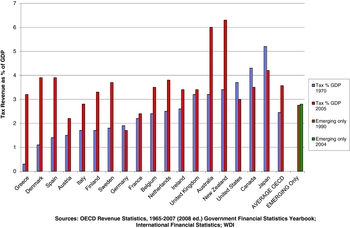
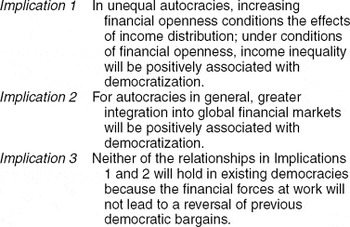
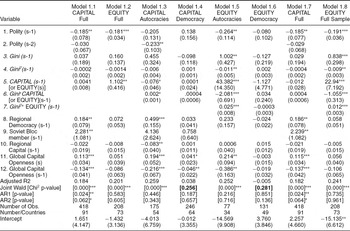
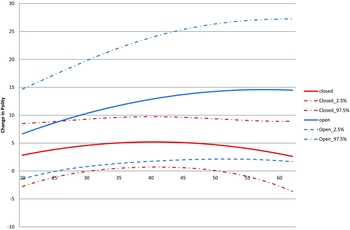
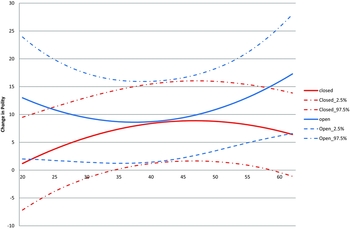
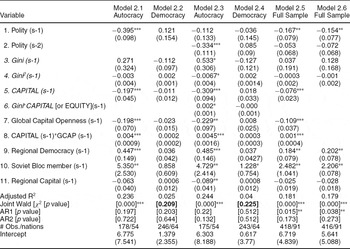
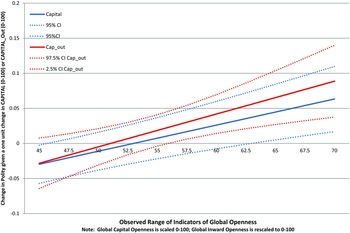
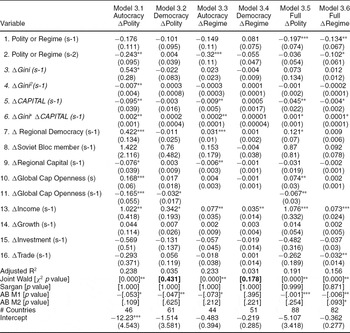
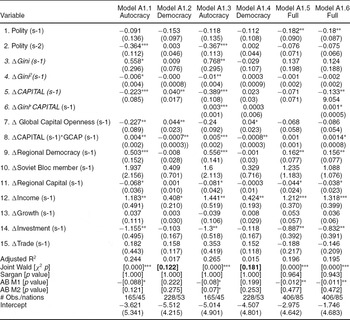
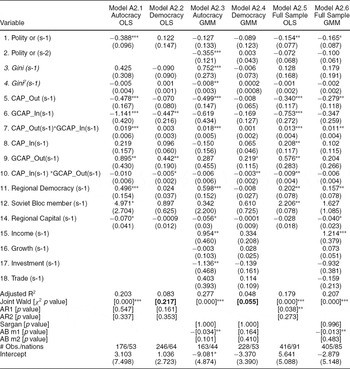



Comments
No Comments have been published for this article.