Introduction
Dacryocystorhinostomy (DCR) is a surgical method used to create an anastomosis between the nasal cavity and the lacrimal sac in patients with lacrimal sac and nasolacrimal duct obstructions. Despite the recent introduction of techniques such as endoscopic DCR, laser DCR, balloon dacryocystoplasty and silicone intubation DCR, the most commonly used procedure remains external DCR, which was developed in 1904.Reference Toti1,Reference Cokkeser, Evereklioglu and Er2
Mucociliary clearance plays a role in nasal defences, immunity and healthReference Unal, Oz, Adigüzel, Vayisoglu, Vatansever and Görür3 by transporting and filtering particles in the upper and lower airways. Mucociliary clearance depends on the amount, quality, activity and co-ordination of airway epithelial cells, as well as their fluid transport properties.Reference Okuyucu, Akoglu, Oksuz, Gorur and Dagli4 Diseases and interventions that affect the cilia on these cells can disrupt mucociliary clearance.Reference Unal, Oz, Adigüzel, Vayisoglu, Vatansever and Görür3 The damage to the nasal mucosa caused by external DCR is thought to adversely affect ciliary activity and mucus quality, potentially leading to mucociliary dysfunction.
Among the methods used to measure mucociliary clearance time, saccharine testing is inexpensive, fast and easy to perform.Reference Yigit, Kirgezen, Taskin and Yener5 Thus, in this study, a saccharine test and the Sino-Nasal Outcome Test (SNOT) were performed, pre-operatively and following external DCR, to determine the effect of this surgical procedure on mucociliary transport and nasal symptoms.
Materials and methods
The patients in this prospective study were aged over 18 years and scheduled for unilateral external DCR. The exclusion criteria were revision surgery, bilateral procedures, previous sinonasal surgery, trauma and concomitant sinonasal disease (e.g. polyps, allergic rhinitis).
The study was approved by the Antalya Training and Research Hospital Clinical Research Ethics Committee (no. 63/12/2015). All patients were informed regarding the study requirements and consent was obtained.
External dacryocystorhinostomy
Nasolacrimal obstruction was diagnosed based on lacrimal irrigation, scintigraphy and paranasal sinus computed tomography (CT).
External DCR was performed by a senior ophthalmologist with the patient under general anaesthesia. After dilation of the upper and lower punctum, a 10- to 15-mm skin and subcutaneous tissue incision was made, starting 6–8 mm from the inner canthus and slightly above the adhesion of the inner canthal ligament. The lacrimal sac was separated from the lacrimal groove by blunt dissection. The periosteum was dissected and a bone window was opened using a Kerrison punch, with H-shaped flaps formed from the sac and mucosa. A 0.64-mm diameter bicanalicular silicone tube (C-Line canalicular intubation set; Medtronic Ophthalmics, Jacksonville, Florida, USA) was implanted in all patients and removed six months post-operatively, at which time the patients were evaluated.
All patients were prescribed topical fluorometholone acetate, netilmicin sulphate eye drops and ciprofloxacin hydrochloride eye pomade three times a day during the first post-operative week. Nasal irrigation with saline five times a day was also recommended.
Sino-Nasal Outcome Test
The Turkish version of the SNOT-22 was used to evaluate sinonasal quality of life.Reference Hancı, Altun, Şahin, Altıntoprak and Cingi6 The test consists of 22 questions, each scored on a scale of 0–5. A higher total SNOT-22 score (range, 0–110) and higher domain scores indicate more severe sinonasal symptoms. The SNOT-22 was re-administered to patients on day 180 post-operatively.
Measurement of mucociliary clearance time
The patients were seated in an upright position in the clinic between 9:00 am and 11:00 am (23°C temperature, 60 per cent humidity). A 1 × 1 cm saccharine tablet was placed in the nasal passage (medial to the lower concha on the side to be treated surgically) using forceps. When the patient noticed a taste change, the test was stopped and the time recorded. Saccharine tests were performed at the same time of day, and under the same environmental conditions, during post-operative month six.
Lund–Kennedy endoscopic scores
The Lund–Kennedy endoscopic scoring system evaluates the two nasal cavities separately. Polyp oedema, discharge and drying are scored on a scale of 0–2 for the right and left nasal passages, such that the total Lund–Kennedy endoscopic score ranges from 0 to 12.Reference Lund and Kennedy7 All patients were examined by the same ENT specialist using a 0-degree endoscope (Karl Storz; Tuttlingen, Germany), before surgery and at six months post-operatively. Pathologies in the nasal mucosa were recorded.
Statistical analysis
All statistical analyses were performed using SPSS software (version 18.0; SPSS, Chicago, Illinois, USA). Descriptive data were generated (mean and standard deviation). The paired sample t-test was used to compare two groups. Relationships between parameters were determined using Pearson correlation analysis. The 95 per cent confidence intervals were calculated; a p-value of less than 0.05 was taken to indicate statistical significance.
Results
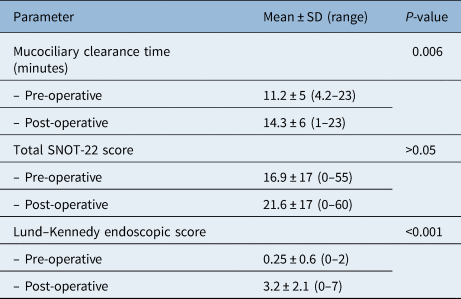
The 28 patients included in the study had a mean age of 47.9 ± 12.8 years (range, 26–71 years); 22 (78 per cent) were female and 6 (21.4 per cent) were male. Their pre- and post-operative findings are presented in Table 1.
Pre- and post-operative findings

SD = standard deviation; SNOT-22 = 22-item Sino-Nasal Outcome Test
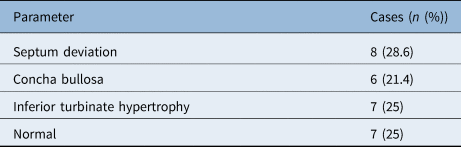
The pre-operative paranasal sinus CT findings are shown in Table 2. None of the patients required additional sinonasal surgery.
Paranasal sinus CT findings

CT = computed tomography
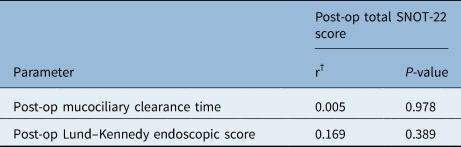
There was no statistically significant difference between the mean pre- and post-operative total SNOT-22 scores of the 28 patients (p > 0.05), whereas the mean pre- and post-operative mucociliary clearance times differed significantly (p = 0.006) (Table 1). There was also no statistically significant correlation between the post-operative mucociliary clearance time, or the post-operative Lund–Kennedy endoscopic score, and the mean post-operative SNOT-22 score (Table 3).
Correlation analysis*

* Analysis of the relationships between post-operative total 22-item Sino-Nasal Outcome Test (SNOT-22) score and post-operative mucociliary clearance time or the Lund–Kennedy score. †Pearson correlation co-efficient. Post-op = post-operative
Discussion
Mucociliary clearance is the main defence mechanism of the airways. The frequency of ciliary motion, length and number of cilia, goblet cell secretions, mucus density, nasal airflow, infection susceptibility, allergy, trauma, nasal polyps and epithelial surface changes vary depending on the nasal anatomy. These parameters are also sensitive to emotional state, stress level, exercise and surgery.Reference Yigit, Kirgezen, Taskin and Yener5,Reference Berkiten, Kumral, Saltürk, Atar, Yildirim and Uyar8 Any obstruction in the nasolacrimal canal can lead to goblet cell loss, decreased mucin, squamous metaplasia and mucociliary clearance time impairment.Reference Okuyucu, Akoglu, Oksuz, Gorur and Dagli4
In healthy adults, mucociliary clearance time ranges from 7 to 15 minutes; values in the range of 20–60 minutes are considered indicative of a mucociliary clearance disorder.Reference Unal, Oz, Adigüzel, Vayisoglu, Vatansever and Görür3 Ünal et al. performed a saccharine test in 17 patients three months after external DCR and found that mucociliary clearance was impaired on the operated side.Reference Unal, Oz, Adigüzel, Vayisoglu, Vatansever and Görür3 Yiğit et al. reported a significantly prolonged mucociliary clearance time at one and three months post-operatively in 50 patients who underwent endoscopic DCR.Reference Yigit, Kirgezen, Taskin and Yener5 In a study by Okuyucu et al., mucociliary clearance was impaired, and the mucociliary clearance time prolonged, in 44 patients three months after endoscopic DCR or external DCR.Reference Okuyucu, Akoglu, Oksuz, Gorur and Dagli4
The results of our study are consistent with those reported in the literature. According to the pre-operative values, mucociliary clearance was impaired, while the mucociliary clearance time (assessed using the saccharine test) was significantly prolonged, at post-operative month six. Although the mean pre-operative (11.2 ± 5 minutes) and post-operative (14.3 ± 6 minutes) mucociliary clearance time values were all less than 20 minutes, the difference between the pre- and post-operative values was statistically significant. Post-operative disruption in mucociliary clearance may be due mainly to a change in ciliary rhythm and structure, but also to the amount of nasal mucus.
The SNOT-22 is widely used to evaluate quality of life related to sinonasal symptoms, and disease-related impairment, especially chronic rhinosinusitis. High scores indicate a poorer prognosis.Reference DeConde, Mace, Bodner, Hwang, Rudmik and Soler9 Miyake et al. used the SNOT-22 at 0, 30, 90 and 180 days post-operatively to assess sinonasal quality of life in 44 patients treated by endoscopic DCR.Reference Miyake, Gregorio, Freitag, Lefebvre, Gray and Holbrook10 The significantly increased SNOT-22 score between days 0 and 30 was attributed to intranasal stent drying and oedema. The authors reported that patients tolerated endoscopic DCR well, and SNOT-22 nasal symptoms returned to baseline within 30 days. They emphasised that concomitant septoplasty does not contribute to nasal obstruction in patients with asymptomatic septum deviation.Reference Miyake, Gregorio, Freitag, Lefebvre, Gray and Holbrook10 Berkiten et al. used the saccharine and SNOT-22 tests (pre- and post-operatively) to evaluate 50 patients who underwent septoplasty. They noted deterioration of mucociliary clearance at six weeks, but also a decrease in SNOT-22 scores.Reference Berkiten, Kumral, Saltürk, Atar, Yildirim and Uyar8
In our literature review, we found no studies in which the SNOT-22 was used to measure the sinonasal quality of life in external DCR patients. The mean pre- and post-operative SNOT-22 scores of our patients were 16.9 ± 17 and 21.6 ± 17, respectively; the difference was not significant (p > 0.05). In addition, there was no correlation between mean post-operative mucociliary clearance time and mean post-operative SNOT-22 scores (p = 0.978). Thus, in terms of quality of life, patients tolerated external DCR well. Invariance in the statistical results of post-operative SNOT-22, despite mucociliary clearance time deterioration, is attributable to the disappearance of trauma effect, which is a result of the dacryocystostomy operation and adaptation to anatomical changes.
After DCR, the reported rates of maxillary sinusitis and frontal sinusitis are 2 per cent and 0.3–2 per cent, respectively, attributed to nasal mucosa damage.Reference Leong, Macewen and White11,Reference Ayet, Racy and Assouline12 The most important mechanisms in the development of rhinosinusitis are chronic inflammation and granulation in response to intra-operative trauma involving osteomeatal structures and prolonged silicone tube intubation. A history of chronic rhinosinusitis has also been associated with acute rhinosinusitis during the post-operative period.Reference Shams and Selva13,Reference Lee, Park, Yang, Choi, Kim and Choung14 No studies have examined the relationship between external DCR and rhinosinusitis. All our patients were negative for rhinosinusitis pre-operatively, as determined by paranasal sinus CT and pre-operative Lund–Kennedy endoscopic scores. The post-operative endoscopic evaluation, after removal of the silicone tube, on day 180, revealed drying and granulation, which are commonly found after a long period of intubation.Reference Lee, Park, Yang, Choi, Kim and Choung14–Reference Çukurova, Caner, Cetinkaya, Gümüsssoy and Söken16
• This is one of a few studies to investigate external dacryocystorhinostomy (DCR) effects on sinonasal function
• The difference between pre- and post-operative mucociliary clearance time values, but not between total Sino-Nasal Outcome Test 22 scores, was significant
• External DCR impairs mucociliary clearance, but surgery was well tolerated and did not significantly change nasal symptom scores
We also found no correlation between mean post-operative SNOT-22 scores and mean post-operative Lund–Kennedy endoscopic scores (p = 0.398). Eyigör et al. reported that concomitant rhinological surgery had no effect on the endoscopic DCR outcome.Reference Eyigör, Unsal and Unsal17 In our study, to avoid interference with the post-operative Lund–Kennedy endoscopic score findings, no additional surgical procedures were performed in patients with pathologies such as minimal septum deviation.
The most important limitation of our study was its small sample size. In addition, post-operative rhinosinusitis was evaluated endoscopically rather than by CT to protect the patient from radiation.
Conclusion
Like other sinonasal surgical procedures, DCR impairs mucociliary clearance and prolongs the mucociliary clearance time. Nevertheless, the surgery was well tolerated by our patients and did not lead to a significant change in nasal symptom scores. Our study is the first to measure changes in sinonasal quality of life following external DCR. The findings should be confirmed by assessing mucociliary clearance time and ciliary function in additional external DCR patients.
Competing interests
None declared