INTRODUCTION
Adolescents and young adults who have been diagnosed with cancer experience the highest levels of psychological distress of any age group (Lebel et al., Reference Lebel, Beattie and Ares2013; Sansom-Daly & Wakefield, Reference Sansom-Daly and Wakefield2013). When compared to pediatric and adult oncology populations, young adults aged 18–35 (Zebrack et al., Reference Zebrack, Bleyer and Albritton2006) have been on the periphery regarding cancer control, prevention, and quality-of-life research in the United States (Wu et al., Reference Wu, Groves and McLaughlin2005) and have been identified as an “orphaned population” (Fernandez & Barr, Reference Fernandez and Barr2006). A diagnosis of cancer is particularly disruptive to the development of young adults as it can interfere with a critical developmental period focused on identity, relationships, and educational and occupational development (Kim & Gillham, Reference Kim and Gillham2013). This disruption can have longlasting effects on psychosocial functioning (Zeltzer, Reference Zeltzer1993). Serious illness is very rare in this age group, and peer support is often lacking. Many young adult patients report that their previously supportive group of friends have difficulty understanding and relating to their experience with cancer.
The literature suggests that supportive group interventions can reduce distress in cancer patients (Breitbart et al., Reference Breitbart, Rosenfeld and Pessin2015; Spiegel & Classen, Reference Spiegel and Classen2000), but such interventions suffer from high levels of attrition, often due to the poor physical health of patients (Applebaum et al., Reference Applebaum, Lichtenthal and Pessin2012). Factors that contribute to attrition are particularly relevant in such large, geographically diverse areas as Colorado (U.S. Census Bureau, 2010), in which 40–60% of residents are medically disenfranchised (Universal Service Administrative Company, 2013). Consequently, young adults with cancer can be further isolated from those who share a similar situation and from treatment centers that can provide targeted psychological interventions designed to reduce cancer-related distress and improve quality of life. Internet-based interventions may help minimize the impact of barriers to participation in support groups.
Telehealth is increasingly popular as a platform for cancer prevention (e.g., Carlson et al., Reference Carlson, Lounsberry and Maciejewski2012; Sabesan et al., Reference Sabesan, Kelly and Budden2015), as well as for monitoring and treating the physical symptoms and side effects of cancer and its treatment (Bouma et al., Reference Bouma, Admiraal and de Vries2015; Breen et al., Reference Breen, Ritchie and Schofield2015; Haozous et al., Reference Haozous, Doorenbos and Demiris2012). Within psychosocial oncology, telemedicine is being utilized to respond to positive distress screens (Mayer & Damore-Petingola, Reference Mayer, Damore-Petingola and Christ2015) and provide support for the psychosocial symptoms of cancer (Bouma et al., Reference Bouma, Admiraal and de Vries2015; Shaw et al., Reference Shaw, Young and Butow2013; Stephen et al., Reference Stephen, Rojubally and MacGregor2013). Telemedicine interventions are generally gaining support within the broader mental health community as well (Hilty et al., Reference Hilty, Ferrer and Parish2013).
From 2011 to 2015, smartphone ownership rates have risen from 35 to 68% of adults in the United States (Anderson, Reference Anderson2015). Rates of smartphone ownership show a substantial gap based on age, with 86% in the 18–29 age range, 83% in the 30–49 range, and then a substantial drop to 58% in the 50–64 range and 30% in the 65+ range (Anderson, Reference Anderson2015). Similarly, tablet use has seen a dramatic recent increase in ownership, with a gain from 4 to 45% of U.S. adults owning a tablet from 2010 to 2015 (Anderson, Reference Anderson2015). Tablet use has a similar trend in higher ownership with younger adults: 50% among 18–29 year olds, 57% among 30–49 year olds, 37% among 50–64 year olds, and 32% in the 65+ age group (Anderson, Reference Anderson2015).
Young adults have high rates of ownership of smartphones and tablets (Anderson, Reference Anderson2015), and young adults with cancer often use the internet to express themselves and share experiences (Kim & Gillham, Reference Kim and Gillham2013). This predisposition to having internet-accessible devices and seeking support online suggests that young adults may particularly benefit from telemedicine interventions. We integrated technology into an existing in-person young adult cancer group in order to address common barriers to attending the group, such as transportation concerns, conflicting work schedules, education, family responsibilities, health concerns and hospitalization.
METHODS
Participants
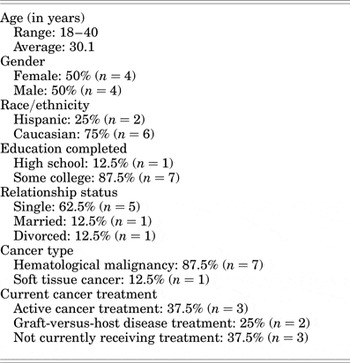
Cancer patients were recruited across the state of Colorado through hospitals and cancer centers. Personal emails were sent to known oncology teams, and flyers were sent to our hospital's email list of patients (who had requested to receive information) and staff (internal and external). This method of recruitment mirrors the recruitment methods we use for our in-person groups, as we are the only comprehensive cancer center in Colorado and advertise our support services throughout the state, as we frequently have people attend our support groups who do not receive their treatment at our center. Our group participants in the present study were all Colorado residents, English-speaking, between the ages of 18 and 40 years, and had a cancer diagnosis. All participants had access to wireless internet and were comfortable using a tablet or computer. Demographic information for the eight participants can be found in Table 1: age, gender, race/ethnicity, education, marital status, cancer type, and current cancer treatment. Additional demographic data (e.g., time since diagnosis, prior history of participation in psychosocial services) were not collected. The first eight eligible participants were enrolled in the group.
Participant demographics (N = 8)

Measures
Participants provided basic demographic data as part of the initial screening process to determine group eligibility. Following the final group, participants completed an online questionnaire evaluating the video platform and their satisfaction with the group. They were also encouraged to provide typed qualitative feedback. Seven of the eight group members completed the questionnaire.
Procedure
As this was a program-development endeavor, institutional review board (IRB) approval was not sought, and this project was not required to go through the IRB because this research was an attempt to develop and expand supportive care services for patients at our cancer center. Patients who participated in the group were not compensated monetarily. Given the nature of the project, we wanted all participants to have the same technology available to them as we attempted this telemedicine group format. Participants received a tablet with wireless capability and instructions to download a HIPAA-compliant video-conferencing application. They attended six weekly 90-minute support group sessions facilitated by two licensed oncology/mental health professionals (one psychologist, one social worker). Groups consisted of initial check-ins with members and discussion of topics of interest that were generated by group members during the initial session. These included connecting with peers and isolation in the cancer process, building interpersonal relationships while battling cancer, developing coping skills specifically to address fear of recurrence and uncertainty, and balancing hopefulness with realism in light of having a potentially terminal diagnosis. Participants received a reminder email one or two days before each session.
RESULTS
Attendance
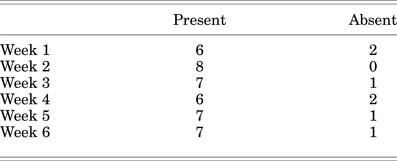
All participants remained in the group for the entirety of the intervention, with at least six of the eight participants joining each session (see Table 2). Reasons for absences included delayed delivery of the tablet (1), planned engagements (2), forgetting (2), a medical appointment (1), and a medical emergency (1).
Group attendance

Distance and Travel
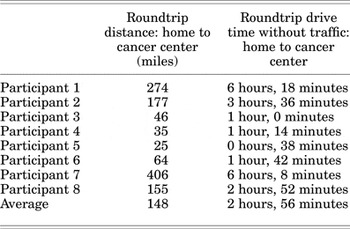
Participants resided in eight different counties in Colorado. Members were able to participate in the group from an average distance of 148 miles (range = 25–406 miles), or nearly three hours away from the cancer center (see Table 3). Participants provided written feedback about the convenience of the online group:
-
■ “I live far from Denver, so it made it much more convenient.”
-
■ “Travel time. I live two hours from Denver. It would not have been feasible for me to drive there every week.”
-
■ “Extremely convenient. Not using gas.”
-
■ “People from all over [Colorado] could join. We could spend more time talking and less time traveling.”
A severe weather event that occurred close to the cancer center shortly before one of the meetings did not deter people from attending the group, since they did not need to travel.
Distance between cancer center and participant homes

Participant Health
Hospitalization is a major stressor in this population and a common cause of attrition in traditional groups. The flexibility of our group allowed young adults in active treatment to participate even while neutropenic and hospitalized, retaining the support of the group during this difficult event. One patient was hospitalized for her cancer the second week of group. In a traditional in-person group, she would not have been able to participate, but she brought her tablet to the hospital and joined in the group from her hospital bed. As a few participants noted,
-
■ “I was neutropenic most of the time, so being in public wasn't much of an option.”
-
■ “Immunocompromised people could participate.”
-
■ “Convenience of being able to participate with low blood counts and not having to drive anywhere.”
Comfort with the Technology and the Group
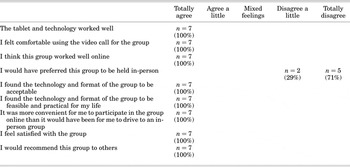
Table 4 illustrates participant responses to questions evaluating the group. Group members reported that they were comfortable using the technology. All participants who completed the follow-up questionnaire evaluating the group agreed that the technology worked well and that they felt comfortable using the video call. Similarly, they reported that the group worked well online, was practical and convenient, and that none would have preferred to attend an in-person group. They unanimously reported feeling an increased sense of connection to others and satisfaction with the group process, and noted that they would recommend the group to others. As a few participants reported,
-
■ “I thought it was great to be able to talk to others my age that can relate. It's difficult to find people that truly understand the hardships of cancer at a young age.”
-
■ “It was great to meet and interact with people that would otherwise have difficulty getting together.”
-
■ “I wish I could have participated in something like this when I was going through treatment. It is important to know you are not alone as a young person with a rare cancer and that others have survived and [so] understand what you have experienced.”
Group evaluation survey results

DISCUSSION
Despite their benefit, sustaining in-person support groups for young adults with cancer can be difficult. Our group was successful in introducing a novel platform for a support group for young adults with cancer. The modern format increased access to care across a geographically diverse population, reducing health disparities between rural and urban communities. Cancer patients who are sick may be the ones who need the most support. Our format allowed people to attend the group and receive support even when they were immunocompromised, sick, or hospitalized. As this was not a research project but a quality-improvement one, its results are nongeneralizable. Nonetheless, the enthusiasm for the group, low attrition rate, and high member satisfaction all indicate the need for further formal investigation.
DISCLOSURES
None of the authors have any conflicts of interest to declare. We have full control of all primary data and agree to allow the journal to review the data if requested.
ACKNOWLEDGMENTS
Funding for this project was provided by a grant from the Colorado Cancer Fund.