Introduction
Earth is an alien planet. It has been for some time now. The paradigm shift of the Copernican revolution cut both ways. Not only did Copernicus make Earths of the planets, he also brought the alien to Earth. The universe of his ancestors had been small, static and Earth-centred. It had the stamp of humanity about it. Constellations bore the names of Earthly myths and legends, and a magnificence that gave evidence of God's glory.
The new Universe was inhuman. The further out the telescopes probed, the darker and more alien it became. ‘The history of astronomy’, suggests Welsh novelist Martin Amis, ‘is a history of increasing humiliation. First the geocentric universe, then the heliocentric universe. Then the eccentric universe – the one we're living in. Every century we get smaller. Kant figured it all out, sitting in his armchair … The principle of terrestrial mediocrity’ (Malik Reference Malik2000).
American astronomer and science fiction writer, Carl Sagan, had gone further. Sagan (Reference Sagan1994) saw that humans had suffered a series of ‘Great Demotions’ in the last five centuries. First there was Earth: it was not at the centre of the Universe, nor was it the only object of its kind, made of a unique material only to be found on terra firma. Next came the Sun: not at the centre of the Universe, not the only star with planets and not eternal.
There were more stars in the Universe than grains of sand on all of Earth's beaches. The Milky Way Galaxy too proved to be neither at the centre of the cosmos, nor the only galaxy within it. A hundred billion other galaxies were also discovered, adrift in an expanding Universe so immense that light from its outer limits takes longer than twice the age of the Earth to reach terrestrial telescopes, and there may be other universes. The final demotion, Sagan suggested, would be the discovery of another biological intelligence in the Universe.
If Copernicanism was not bad enough, there was Darwin. Man among the microbes, with no special immunity from natural law, and vanishingly little evidence of a divine image. Each successive demotion to date has had an immense impact, both on the human condition, and on the meaning of life in the Universe.
In its illustrious past, the themes and icons of fiction became manifest in all areas of society and culture. The aim of this paper is to explore the imaginative way that fiction has considered aspects of evolving astrobiological themes from Darwin to the double helix.
Evolving the post-human
Ever since Copernicus, the post-human has fascinated science fiction. Questions as to what will become of man, what will become of life in the Universe and what (if there is one) is the meaning of life in this new Universe. Since Darwin, thought-provoking science fiction has focused on two crucial developments of life in the Universe, evolution and genetics.
On the one hand, there have been compelling projections of man's evolutionary future based on Darwin's theory. On the other hand, fiction has been gripped by the remaking of man, the awesome potential of genetics. The finest science fiction has provided a sustained, coherent and often subversive check on the contradictions of science, the promises and pitfalls of progress through the ages. So it has been with life in the Universe. Fiction has calculated the human cost of the more unnatural aspects of advances in natural science.
Before falling headlong into the evolutionary future of the post-human, it is worth looking at how science fiction operates. Science fiction has been described as a response to the cultural shock of discovering man's marginal position in an alien Universe. It works by conveying the taste, the feel and the human meaning of the discoveries of science. Science fiction is an attempt to put the stamp of humanity back onto the Universe: to make human what is alien.
Religion, like science fiction, is also concerned with the relationship between the human and the non-human or, more specifically, between the human and the divine. So, as a response to the demotions of life in the Universe, science fiction can be seen, by at least one of the current authors, as a displacement of religion. In this way science fiction may be viewed as the ‘soul’ of science. Its focus is the human–non-human opposition.
With characteristically black humour, Kurt Vonnegut paid tribute to the role of science fiction in his wonderfully creative anti-war novel, Slaughterhouse Five (Vonnegut Reference Vonnegut1969). The main character, recently witness to the firebombing of Dresden, considered that people were ‘trying to re-invent themselves and their universe. Science fiction was a big help’ (Vonnegut Reference Vonnegut1969, p. 73). Vonnegut himself used science fiction to confront the growing horrors of the 20th century. Perhaps if his readers could stand the unreality of science fiction, they could face a little bit more reality after reading Slaughterhouse Five than they could before they read it: ‘everything there was to know about life was in The Brothers Karamazov, by Fyodor Dostoevsky. But that isn't enough any more’ (Vonnegut Reference Vonnegut1969, p. 73).
Space, time, machine and monster
Science fiction seems to present an infinity of nightmares and visions. A bewildering diversity of contrasting elements: aliens and time machines, spaceships and cyborgs, utopias and dystopias, androids and alternative histories (Rose Reference Rose1982, p. 32). However, on a more thoughtful level, there are four conceptual themes: space, time, machine and monster (Rose Reference Rose1982, p. 32). Each of these themes is a way of exploring the relationship between the human and the non-human. Taking a closer look at these themes will enable a clearer understanding of the way in which the genre functions.
• Space. The science fiction of the space theme represents the non-human as some facet of the natural world, such as vast interstellar spaces or the alien, which can be seen as an animated version of nature.
• Time. This theme portrays a flux in the human condition fashioned by some process that is revealed in time. Tales on time often focus on the dialectic of history, so they are of particular relevance to astrobiology. For example, the evolutionary fable Last and First Men, written by Olaf Stapledon (1930), conjures up a post-human homo superior in future history.
• Machine. These are stories that deal with the man–machine motif, including robots, computers and artificial intelligence (AI). Dystopian tales are part of the man–machine theme; it is the social machine in which the human confronts the non-human in such cases (Rose Reference Rose1982, p. 32). Huxley's Brave New World, for example, is a hedonistic and ironically ambiguous biotech utopia of repro-technology and social engineering.
• Monster. Some stories feature the non-human in the form of a mutant or monster situated within humanity itself. In these tales there is often an agency of change, such as a nuclear catastrophe, which leads to the change of human into non-human. It is within this theme that the remaking of man through genetic design is often encountered. Again, Stapledon's (1930) Last and First Men qualifies here, as we shall see. Of course, monsters can be upbeat too, as other countless cases of supermen testify.
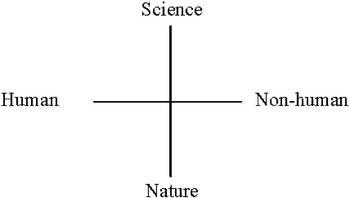
This way of thinking about science fiction, as the human versus the non-human, is satisfyingly elegant and transparent. Rose (Reference Rose1982, p. 32) deserves credit here, because his scheme splendidly serves the purpose of charting science fiction's ongoing dialogue with science (see Fig. 1).
The paradigm of science fiction, after Rose (Reference Rose1982, p. 38).

At times, with films such as Deep Impact (1998) and Armageddon (1998), science and the human are pitched against nature and the non-human. In these cases, the non-human comes in the form of a rogue comet or asteroid, shattering the stability of the human world. In dystopias, such as Brazil (1985) and The Matrix (1999), nature and human are united in opposition to science and non-human. As these dystopias suggest, science fiction may characterize science as non-human and unnatural. In The Matrix, for instance, the natural and organic human homeworld of Zion counters the mechanical and scientific alternative world of The Matrix itself. According to this convention, utopias are imagined societies that are more fully human than the present.
More often, though, science features on both sides of the human–non-human conflict. In The War of the Worlds, for example, science is part of the non-human element symbolized by the invading Martians. They are agents of the void. They also embody science with their vast, cool and unsympathetic intellects. Later, however, these alien invaders fall victim to microbes, a fate which pits the science and the understanding of unsolicited natural selection on the side of the invaded humans.
Anticipations of the coming race in space and time
With this thematic space, time, machine and monster view of science fiction, a history can be told of the hopes and fears for life in the Universe. It is a story of the ongoing relationship between science and the cultural scepticism of its fiction. Indeed, science fiction, as a form of the fantastic, has been the literature of change since the Renaissance. It has provided a commentary on the accelerating pace of change in capitalist society and continues to use the fantastic to make sense of the dark magic of nature.
The publication in 1859 of Darwin's Origin of Species had a tremendous impact on the popular imagination. It radically challenged traditional ideas of human nature, purpose and the relationship with God. Its majestic reach embraced questions of morality, economics and political policy. Social Darwinism arrived. Nationalists used Darwinism to argue for a strong state as the fittest among nations, militarists found in it the sanction for war and imperialists the motive for the conquest of ‘inferior races’.
In his forceful history of science fiction, Billion Year Spree, Aldiss (Reference Aldiss1973) bears witness to the surfacing of the ‘submerged nation’ theme in Victorian fiction. Sybil (1845), written by British Prime Minister Benjamin Disraeli, had first manifested the idea that British society comprised two distinct nations, the Haves and the Have-nots. ‘A grave moral division lay at the basis of Victorian hypocrisy’, suggested Aldiss (Reference Aldiss1973). Guilty consciences had inspired science fiction writers, such as Bulwer-Lytton and H.G. Wells, to use Darwinism to expose such fears. The oppressed (the fictional ‘submerged nation’ races of the Morlocks and the Vril-ya) would have their day in the Sun.
Some rejected Darwinism out of hand. Disraeli drew his battle line:
‘What is the question now placed before society with glib assurance the most astounding? The question is this – is man an ape or an angel? My Lord, I am on the side of the angels’ (Isaacs Reference Isaacs1977, p. 11).
By the 1880s the battle was over. Darwinism was the intellectual creed of the age, and has lit up the conceptual sky ever since. Darwin's theory gave credence to the development of life not just under Earthly conditions. It also raised the possibility of physical cosmic evolution. The rise of spectroscopy transformed astronomy into astrophysics (Hoskins Reference Hoskins1997). Here was evidence that natural law governed throughout the Universe. Like Copernicanism, Darwin's theory transfused lifeblood into extraterrestrial life. It revolutionized the cosmic perspective, suggesting that life was a basic property of the Universe.
So it is hardly surprising that science fiction uses the space and time themes to first explore the question of the post-human. French astronomer Camille Flammarion was evangelical in his support for extraterrestrial life, exercising a great influence on 20th century attitudes to the idea (Sagan & Shklovskii Reference Sagan and Shklovskii1966; Dick Reference Dick1996). Just three years after the publication of Darwin's theory, Flammarion (Reference Flammarion1862) released his La Pluralité des Mondes Habités (Plurality of Inhabited Worlds). Over the next 20 years, 33 editions of La Pluralité were published, a clear indication of the popularity of both Darwinism and the idea of extraterrestrial life. Flammarion argued, with enthusiasm, that alien life, originating spontaneously rather than divinely, evolved through natural selection in its extraterrestrial setting.
Anthropocentrism was cast out. Planet Earth and its inhabitants were relegated to a lowly rung on the evolutionary ladder. It was an idea that would come to dominate 20th century film and fiction, explored through the works of H.G. Wells, Olaf Stapledon, Fred Hoyle and Arthur C. Clarke.
H.G. Wells
Evolution firmly found its way into fiction in the late 19th century. Notwithstanding the development of the idea of the post-human since Copernicus, no one could have predicted that evolution would spark one of the universal motifs of 20th century fiction: the concept of the alien.
As a result, an increasing number of people met the ideas of Darwin, not through science, but as a text, inspiring emotional as well as intellectual reactions. In this way, the concepts of evolution and the future of man were embedded ever deeper into the public psyche. It is worth remembering that the creative morphing of scientific ideas into symbols of the human condition
‘… is often an unconscious and therefore particularly valuable reflection of the assumptions and attitudes held by society. By virtue of its ability to project and dramatise, science fiction has been a particularly effective, and perhaps for many readers the only, means for generating concern and thought about the social, philosophical and moral consequences of scientific progress’ (Isaacs Reference Isaacs1977, p. 6).
Scientists are creatures of the culture in which they swim. Alien contact narratives motivated a significant number of such scientists. The idea of life in the Universe, and man's place within it, was firmly fixed in the scientific as well as the popular imagination. Darwin's theory had given credence to the evolution of life on Earth and to evolution in a cosmic setting. Darwin inspired a wealth of fiction (Henkin Reference Henkin1963) and provided a rationale for imagining what cosmic life might develop. From now on the idea of cosmic life became synonymous with the physical and mental characteristics of the alien. It provided a rubric against which man himself could be measured.
The impact of Wells' fiction was colossal. The Time Machine (1895) and The War of The Worlds (1898) are responsible for igniting both the time and space themes in the genre of science fiction and in the public imagination. Wells created the nexus of the alien, armed with its potential for probing human evolution. Wells' early books ‘are, in their degree, myths; and Mr Wells is a myth-maker’ (Isaacs Reference Isaacs1977, p. 19).
Once developed by Wells, the alien idea proved a potent motif for cultivating fictional explorations of the singularity or insignificance of humanity. During such explorations, the secondary question of the character of alien and interspecies interaction became an issue, which later affected the Search for Extraterrestrial Intelligence (SETI) science programme. As Aldiss (Reference Aldiss1973, p. 133) put it, ‘Wells is the Prospero of all the brave new worlds of the mind, and the Shakespeare of science fiction’.
Olaf Stapledon
If H.G. Wells is the Shakespeare of science fiction, then Olaf Stapledon is its Milton. A philosopher based at the University of Liverpool, Stapledon used the genre to explore nothing less than the meaning of human existence in a cosmic setting. His two key works, Last and First Men (1930) and Star Maker (1937), opened up emergent philosophical and spiritual issues through science fiction.
In the preface to Last and First Men, Stapledon (Reference Stapledon1999, p. xiii) tells the reader that his story is an attempt ‘to see the human race in its cosmic setting, and to mould our hearts to entertain new values’. In a telling evocation of Darwin's theory, he suggests that such attempts to extrapolate man's evolutionary future ‘must take into account whatever contemporary science has to say about man's own nature and his physical environment’ (Stapledon Reference Stapledon1999, pp. xv–xvi). Stapledon produced a fiction that incorporated the most recent ideas of astronomy and cosmology. He synthesized a new form of myth apposite to a scientifically cultured twentieth century. In the words of Stapledon himself, the aim must not be just ‘to create aesthetically admirable fiction … but myth’ (Stapledon Reference Stapledon1999, p. xiii).
Francis Bacon had laid the basis for a militant, aggressive science: a science that actively penetrated the natural world for the relief of man's estate. By the early decades of the 20th century, an even more radical scenario emerged: the improvement of man's estate might best be realized by the biological upgrading of man himself. In 1927 it was discovered that the mutation of reproductive cells could be greatly increased through exposure to X-rays.
Last and First Men
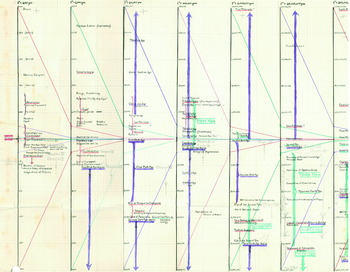
In the emerging world of genetics, Stapledon imagined the future forms of man using science fiction's monster theme, as well as those of space and time. Last and First Men is a future history on a staggering scale. The ‘hero’ of the book is not a man, but mankind. The story embraces 17 evolutionary mutations, from the present ‘fitfully-conscious’ (Isaacs Reference Isaacs1977, p. 24) First Men, to the glorious godlike Eighteenth Men who reign on Neptune. It is a history that spans two thousand million years (see Fig. 2).
Stapledon's (Reference Stapledon1999) timechart storyboard for Last and First Men.

The first and most infamous exponent of the genetic intervention in the human race was Darwin's cousin, Francis Galton. It was he who had introduced the word eugenics. In Last and First Men, Stapledon thought long and hard about eugenic practices. One of the causes of the demise of the First Men, for instance, was their failure to realize a eugenics program
‘In primitive times the intelligence and sanity of the race had been preserved by the inability of its unwholesome members to survive. When humanitarianism came into vogue, and the unsound were tended at public expense, this natural selection ceased. And since these unfortunates were incapable alike of prudence and of social responsibility, they procreated without restraint, and threatened to infect the whole species with their rottenness’ (Stapledon Reference Stapledon1999, chapter IV).
So, human intelligence steadily declined, ‘And no one regretted it’ (Stapledon Reference Stapledon1999, chapter IV).
Later came the irresistible rise of the Third Men. With their rediscovery of eugenics, the Third Men focused their efforts on that most distinctive feature of man, the mind. Seeking to ‘breed strictly for brain, for intelligent coordination of behaviour’ (Isaacs Reference Isaacs1977, p. 47), the climax of their engineering program were the Great Brains.
The Great Brains first helped, then enslaved and finally eliminated their creators. Ultimately they turned their cool intellects on themselves. They created a superior species, the Fifth Men. The Fifth Men were accomplished in art, science and philosophy, perfectly proportioned of body and mind. They were able to travel mentally back through time to experience the whole of human existence. Indeed, the Fifth Men became the most perfect species ever to dwell on Earth.
Star Maker
The conceptual reach of Star Maker beggars belief even further. Its scope is so vast that Last and First Men would warrant a mere page in the cosmic sweep of Stapledon's next book. The presence of the alien in Star Maker is, again in the words of Stapledon (Reference Stapledon2001, p. 13) himself, to ‘explore the depths of the physical universe [and] discover what part life and mind were actually playing among the stars’.
Stapledon was 20 years ahead of the game. The setting in which Star Maker was conceived had undergone a further, although more silent, revolution in cosmology. It was not until the late 1950s that astronomers drew analogies between revolutions in cosmology and the impact of finding extraterrestrial intelligence (Dick Reference Dick1993). It was suggested (Shapley Reference Shapley1958) that alien contact would represent ‘The Fourth Adjustment’ in humanity's outlook, following the shift to the geocentric, heliocentric and ‘galactocentric’ worldviews. This latter revolution, hastened by discoveries showing that our local Solar System was merely at the edge of our Galaxy and that the Galaxy itself was but one of many, was made just prior to the time Stapledon was writing Star Maker.
Astronomy had undergone great revolutions (Struve Reference Struve1961): the Copernican, the galactocentric and Hubble's discovery of an expanding Universe. However, there was one massive upheaval yet to come; the answer to the question ‘Are We Alone in the Universe?’. The revolution had already begun with Stapledon. By the mid-1920s, revolutions, including that of Copernicus, Darwin and Einstein, may have inured the masses to marginalization (Berenzden Reference Berenzden, Beer and Strand1975). Stapledon was preparing the public for the final great demotion and in the process helped develop the myth of the close encounter of the third kind: physical contact.
In Star Maker, alien biologies, together with terrestrials, search for the supreme intelligence in the new Universe. Stapledon's story is a quest for the spirit of the cosmos, an entity at the head of a new, and cosmic, great chain of being. In an early evocation of the implicit inhumanity of the new Universe, he writes
‘it was becoming clear to us that if the cosmos had any lord at all, he was not that spirit [God], but some other, whose purpose in creating the endless fountain of worlds was not fatherly toward the beings that he made, but alien, inhuman, dark’ (Stapledon 2002, p. 89).
Stapledon's fiction, then, emphasized the triviality of humanity in the face of a new and vast cosmos, which itself may harbour truths and meaning as yet unknown to an immature terrestrial race. His fiction on the question of intellectual contact with alien biologies had a great influence on working scientists, such as exobiologist J.B.S. Haldane, physicist Fred Hoyle, Carl Sagan, one of the founders of SETI in the early 1960s, and fiction writer Arthur C. Clarke.
Childhood's End
So, more than science itself, the fictional elaborations of Darwin's theory, especially through the space and time themes, defined the pervasive role of the post-human in popular culture. Arthur C. Clarke's 1953 novel Childhood's End is an archetype of the way in which alien fiction developed the post-human. Clarke had already written a number of short stories on the alien motif. The influential The City and the Stars portrays humanity confronted with extraterrestrial cultures and intelligences ‘he could understand but not match, and here and there he encountered minds which would soon have passed altogether beyond his comprehension’ (Clarke Reference Clarke1956, pp. 174–175).
In Childhood's End Clarke developed the myth of contact through an alien invasion. The ‘Overlords’ are benevolently responsible for guiding humanity to an even greater intelligence, the Overmind. Clarke uses the extraterrestrial context to highlight humanity's immaturity in an aged and cultured Universe. The Overlords exact an end to poverty, ignorance, war and self-government. There is a payoff, however. It is a preparation for the final destiny of humanity; Earth's children are sacrificed and united within the collective of the Overmind.
In the words of Clarke himself,
‘the idea that we are the only intelligent creatures in a cosmos of a hundred billion galaxies is so preposterous that there are very few astronomers today who would take it seriously. It is safest to assume, therefore, that They are out there and to consider the manner in which this fact may impinge upon human society’ (Clarke Reference Clarke1972, p. 89).
Childhood's End was written amidst growing claims for inexhaustible exoplanetary systems. It was not until 1995 that empirical evidence for such extrasolar planets was discovered.
The novel, and indeed much of Clarke's fiction, reflects his scientific belief in extraterrestrial life, and eventual contact. Interestingly, in the preface of a 1990 reprint and partial re-write of Childhood's End, Clarke attempts to unravel pseudoscience from the extraterrestrial message underlining the original narrative,
‘I would be greatly distressed if this book contributed still further to the seduction of the gullible, now cynically exploited by all the media. Bookstores, news-stands and airwaves are all polluted with mind-rotting bilge about UFOs, psychic powers, astrology, pyramid energies’ (Clarke Reference Clarke1990, p. 8).
Clarke is adamant, however, as to the continued relevance of his book,
‘I have little doubt that the Universe is teeming with life. SETI is now a fully accepted department of astronomy. The fact that it is still a science without a subject should be neither surprising nor disappointing. It is only within half a human lifetime that we have possessed the technology to listen to the stars’ (Clarke Reference Clarke1990, p. 8).
Fred Hoyle
Distinguished British scientist Fred Hoyle was one of the first astronomers to advocate a Universe replete with exosystems and the promise of cosmic life. A brilliant non-conformist in the scientific community, Hoyle used his exceptional knowledge to inform his stories. However, his fiction was not forced by his physics. A case in point is Hoyle's first novel, The Black Cloud (1957). The book portrays a disembodied intelligence similar to Clarke's Childhood's End and is clear forerunner of Stanislaw Lem's (Reference Lem1961) famous Solaris. In The Black Cloud a sentient cloud of interstellar matter is able to communicate with terrestrial scientists. Indeed, the scientists are eventually able to convince the cloud, whose first intention is to destroy Earth, to retreat in a peaceable manner.
In this way, Hoyle uses narrative to explore the question firstly of human and alien intelligence, and secondly of whether inter-species communication would be possible. In a very credible extrapolation of Darwinism in space, Hoyle's story discusses whether gravity would provide a limiting force on the size of cosmic life and the scope of its neurological activity. The conclusion points to just how rare, and mediocre, human intelligence may be.
Science fiction and SETI
Science started searching for the alien. The emotional question of man's place in the cosmos was woven into all scientific discussions on life in the Universe. Increasingly, the dialectic between anthropocentrism and pluralism was revolutionized time and again by stunning discoveries in physics. Firstly, there was the progress of relativity and quantum theory. Next came the Big Bang model of an expanding Universe.
The idea of a cosmos centred on our unique and privileged position in space–time became more and more preposterous. Instead, science developed the ‘cosmological principle’. Based on applying General Relativity to the large-scale structure of the Universe, the principle, simply stated, suggests there is no special place in the Universe. It is the belief that Martin Amis referred to as the ‘assumption of mediocrity’.
In the wake of the massive popularity of contact fiction, SETI pioneer Frank Drake became the first radio astronomer to contemplate the transmission of an alien signal. His Project Ozma in 1960 examined two sun-like stars, Tau Ceti and Epsilon Eridani. The project mission was to locate intelligent signals coming from hypothetical planets orbiting the stars. Project Ozma was followed in 1964 by project CETI (Communication with Extra-Terrestrial Intelligences), which greatly influenced the design of listening programmes using the largest radio telescopes on Earth.
In a seminal conference at Green Bank, West Virginia in 1961, Frank Drake presented his now famous ‘Drake equation’. The equation quantifies the factors that may determine the number of communicating civilizations in our Galaxy. The publication in 1966 of Intelligent Life in the Universe by Carl Sagan and Russian astrophysicist Iosif Shklovskii was another telling advance. It was the first seminal scientific text on the question of extraterrestrial intelligence. Sagan (Reference Sagan1985) later developed a fictional exploration of alien contact in his novel Contact and its cinematic counterpart, released in 1997. Both were grounded in Sagan's experience of the scientific search. They portray humanity's destiny, again among culturally and intellectually superior extraterrestrials.
2001: A Space Odyssey
It was Arthur C. Clarke, however, who was instrumental in developing the alien for the mass market. The imaginative flood and sweep of the alien motif in fiction is impressive enough. As far as the propagation of the idea of the post-human is concerned, however, it was the sway of cinema that beamed the broadcast far further. Cosmic fiction and its exploration of humanity could be examined without the alien. However, the inclusion of the alien was evolution's defining moment in the public imagination. In addition, science fiction would have remained marginalized were it not for the opening up of the genre to film and television.
Clarke and Stanley Kubrick's 2001: A Space Odyssey (1968) was delivered during the peak of the extraterrestrial hypothesis (ETH), 1966 to 1969 (Dick Reference Dick1996). The ETH held that UFOs were close encounters with visiting aliens, an hypothesis vastly influenced by the mythic fiction of Wells, Stapledon and Clarke himself.
Famed for the maturity of its portrayal of mysterious, existential and elusive aliens, 2001 raised science fiction cinema to a new level. Eminent US film critic, Roger Ebert, when asked which films would remain familiar to audiences 200 years from now, selected 2001. Another critic claimed the picture was an ‘epochal achievement of cinema’ and ‘a technical masterpiece’ (Youngblood Reference Youngblood1970, p. 139). The film, not the book, made Clarke the most popular science fiction writer in the world. Kubrick's masterpiece, which made dramatic and sophisticated use of the alien premise, quickly became a classic discussed by many, if not understood by all.
Kubrick's bible was Intelligent Life in the Universe. Kubrick had originally filmed interviews with 21 leading scientists about the possibility of alien life as a prologue to the film's narrative. Interviewees included physicists Frank Drake and Freeman Dyson, anthropologist Margaret Mead, roboticist Marvin Minsky and Alexander Oparin, the great Soviet authority on the origin of life, often described as the ‘Darwin of the 20th century’. Kubrick's intention was to lend astrobiology that special dignity it has only acquired since. Although the interviews were cut from the final version of the film, a book of the transcripts was published in 2005.
The ultimate trip
2001 is an epic journey: the ‘ultimate trip’, as it was billed in those New Age counter-culture days. Darwin had inspired German philosopher, Friedrich Nietzsche, to write Also Sprach Zarathustra. The book identifies three stages in the evolution of man: ape, modern man and, ultimately, superman. As Nietzsche put it, ‘What is the ape to man? A laughingstock, or painful embarrassment. And man shall be to the superman: a laughingstock or a painful embarrassment’ (Kaufmann Reference Kaufmann1982, p. 124). Modern man is merely a link between ape and superman. For the superman to evolve, man's will, ‘a will to procreate, or a drive to an end, to something higher and farther’ (Kaufmann Reference Kaufmann1982, p. 227), must power the change.
Likewise, Kubrick's movie traces man's journey though three stages. As the film's subtitle suggests, the narrative is a spatial odyssey from the subhuman ape to the post-human starchild. The unfolding four-million-year filmic story embraces each theme of science fiction: space (contact through alien cultural artefacts), time (evolutionary fable), machine (the man–machine encounter with HAL, computer turned murderer) and monster (human metamorphosis) (Rose Reference Rose1982, p. 32). The opening ‘Dawn of Man’ scene of 2001 sees the Sun rise above the primeval plains of Earth, to the rising soundtrack of Richard Strauss' Nietzsche inspired tone poem, Also Sprach Zarathustra. A small band of man-apes are on the long, pathetic road to racial extinction.
The journey begins with one of the hominids exultantly hurling an animal bone into the air. In an astounding cinematic ellipsis the bone instantly morphs into an orbiting satellite, and three million years of hominid evolution is written off in one frame of film. The agency that drives the guided evolution of these early hominids is an alien artefact in the shape of a black monolith. Like Wells' Martians, the monolith embodies the void (Rose Reference Rose1982, p. 144). Primal bone technology marks the birth of the modern era. Man and machine, from the very outset, are inseparable. The mysterious presence of the monolith transforms the hominid horizon. The journey to superman begins.
The intelligent use of film technology is one of the factors that make 2001 such a tour de force. Winner of an Oscar for special effects, the film seemed to offer a more ‘realistic’ picture of space travel than the endeavours of Armstrong and Aldrin only a year later. Sections of the film were used in training NASA astronauts. Indeed, Arthur C. Clarke later suggested that of all of the responses to the film, the one he valued most highly was that of the Soviet cosmonaut Alexei Leonov, ‘Now I feel I've been into space twice!’ (Clarke Reference Clarke1984, p. 111).
Man's growing maturity through an early space age now unfolds in a three-way narrative of machine, human and post-human. A space voyage leads to further way stations of the monolith. A black obelisk is uncovered at a pioneering Moon base, and a mission is sent to Jupiter, to where the mysterious Lunar artefact seems to be sending its alien signal. The banality and vacuity of the human crewmembers is sharply and ironically contrasted by the robust intelligence of the ship's onboard computer, HAL 9000. The film was one of the very first to carry ‘product placements’ for companies such as IBM, Pan Am and AT&T. Indeed, space travel is replete with corporate logos and trademarks, showing a world,
‘absolutely managed – the force controlling it discreetly advertised by the US flag with which the scientist [Doctor Floyd] often shares the frame throughout his “excellent speech” … and also by the corporate logos – Hilton, Howard Johnson, Bell – that appear throughout the space station. In 1968, the prospect of such total management seemed sinister – a patent circumvention of democracy’ (Miller Reference Miller1994, p. 24).
The irony and satire of the film's portrayal of a bland future dominated by corporations and technology was lost on some. British scientist and software developer, Stephen Wolfram, said the film's futuristic technology greatly impressed him as a boy. Microsoft co-founder Bill Gates has suggested that 2001 inspired his vision of the potential of computers (Burns Reference Burns1997), although whether Gates was also inspired by the picture of sinister corporate domination is pure speculation. Nonetheless, such corporate control is symptomatic of the spiritual crisis of the early space age portrayed in the film.
The potent evolutionary force imparted by the black obelisks is overdue. The space age was ultimately inspired out of the apes by the alien intelligence. Now, the odyssey of self-discovery culminates under the watchful presence of the monoliths when modern man, in the form of the individual astronaut David Bowman, comes to an end. With the massive presence of planet Earth filling the screen, the foetus of the superhuman starchild floats into view. Moving through space without artifice, the image suggests a new power. Man has transcended all earthly limitations.
A ‘scientific definition of God’
Stanley Kubrick claimed the film provided a ‘scientific definition of God’ (LoBrutto Reference LoBrutto1997). There was little drama in Darwin's evolution, just the slow, solid state of inexorable change. So Kubrick and Clarke invoked a fictional form of Stephen J. Gould's ‘punctuated equilibrium’. The film augments the usual driving force of evolution, long periods of steady change, with the episodic guiding hand of superior beings. It is a story of the effective creation and resurrection of Man.
As Clarke suggests in his book of the screenplay:
‘Almost certainly there is enough land in the sky to give every member of the human species, back to the first apeman, his own private, world-sized heaven, or hell. How many of those potential heavens and hells are now inhabited and, by what manner of creatures, we have no way of guessing; the very nearest is a million times further away than Mars or Venus, those still remote goals of the next generation. But the barriers of distance are crumbling; one day we shall meet our equals, or our masters, among the stars’ (Clarke Reference Clarke1968, p. 7).
A final key influence can also be identified. Physical scientists have historically held a deterministic view of the possibility of extraterrestrial life. As the Clarke quote above from 2001 clearly shows, this determinism is based mostly on the physical forces in the Universe. The idea that the sheer number of stars and orbiting planets is statistically sufficient to suggest other Earths lie waiting in the vastness of deep space. Fiction, for many centuries, followed suit. Since Copernicus came before Darwin, and physics before biology, fictional accounts of alien life have usually been positioned firmly in the pro-SETI, pro-life camp of the extraterrestrial life debate. By the 20th century, an entire generation of future SETI-hunters were cast under the same spell.
As the millennium drew to a close, the story changed. Pioneers of the evolutionary synthesis (the fusion of evolutionary biology with genetics) were Theo Dobzhansky and Ernst Mayr. They emphasized that whilst physics and fiction still think along deterministic lines, evolutionists are impressed by the incredible improbability of intelligent life ever to have evolved, even on Earth. We may, after all, be alone in the Universe. Such has been the power of science fiction. Its exploration of evolution and the future of man led directly to a huge investment in the serious search for ET.