
I. INTRODUCTION
Due to the pending need to increase the high temperature capabilities of materials, several new polycrystalline Ni-base superalloys have been developed in recent years for increased temperature capability, strength, and durability. Reference Hardy, Zirbel, Shen, Shankar, Green, Pollock, Harada, Howson, Reed, Schirra and Walston1,Reference Gabb, Garg, Ellis and O’Connor2 These alloys are mostly produced by powder metallurgy, because the rather high γ′ content with correspondingly high γ′-solvus temperatures makes forging and achieving homogeneous microstructures very difficult. Co-base alloys provide a high potential for an application as wrought alloys due to the large gap between solidus and γ′-solvus temperature along with a high γ′ volume fraction. Reference Bauer, Neumeier, Pyczak, Göken, Huron, Reed, Hardy, Mills, Montero, Portella and Telesman3 However, potential wrought alloys have to not only provide a good processability, but at the same time exhibit good high temperature strength, high creep resistance, high low-cycle fatigue resistance, oxidation and corrosion resistance, and high temperature stability. Compared to the simple ternary and quaternary Co–Al–W–X systems, the CoWAlloys contain additional alloying elements to improve the oxidation resistance and the grain boundary strength and to tailor the microstructure and the mechanical properties. Reference Neumeier, Freund and Göken4 In this paper, two alloys CoWAlloy1 and CoWAlloy2 are presented in detail, focusing on mechanical properties at high temperatures including workability, creep properties, tensile strength, and first fatigue results. Additionally, thermophysical properties are listed and the long-term stability is addressed in terms of microstructural stability and hardness.
II. EXPERIMENTAL METHODS
The elemental composition of the alloys investigated is listed in Table I.
Nominal composition of CoWAlloy1 and CoWAlloy2 in at.%.

The alloys were vacuum arc melted from raw elements, cast, homogenized at 1250 °C for 3 h in air, then preheated to 1100 °C, and rolled on a cold rolling mill at Vacuumschmelze GmbH & Co. KG, Hanau, Germany. After recrystallization at 1050 °C/4 h (oil quenched) for CoWAlloy1 and 1000 °C/4 h (oil quenched) for CoWAlloy2, a two-step annealing heat treatment was performed at 900 °C/4 h (air cooled) and 750 °C/16 h (air cooled) to optimize the microstructure in terms of strength. Samples for microstructural investigations were cut, ground, and polished in a final step with colloidal silica. A Zeiss Crossbeam 1540 EsB-focused ion beam microscope (Carl Zeiss AG, Oberkochen, Germany) was used for the characterization of the microstructure. Electron backscatter diffraction was performed with an Oxford Instruments Nordlys2 detector (Oxford Instruments, Abingdon, England) for measuring the grain size. For compression tests, cylindrical samples were manufactured by wire erosion (diameter d = 3 mm/length l = 4.5 mm). Compression tests were performed with an electromechanical Instron 4505 testing machine (Instron GmbH, Darmstadt, Germany) at room temperature (RT), 600, 750, 800, and 850 °C with a strain rate of 10−4 s−1. Tensile samples of CoWAlloy2 were fabricated with a gauge length of 20 mm and a diameter of 5 mm. Tensile tests were conducted using an electromechanical Instron 4505 testing machine at 750, 800, and 850 °C at a strain rate of 10−4 s−1. The strain was measured with a Laser extensometer. For fatigue testing, samples of CoWAlloy2, U720Li, and Waspaloy were machined to have a gauge length of 14 mm and a diameter of 6 mm. The gauge length was polished after machining. Low cycle fatigue (LCF) tests were performed at 750 °C on an MTS 810 in total strain control with a total strain amplitude of 0.5%, a frequency of 0.5 Hz, and a total strain ratio R = −1 (defined as maximum strain e max/minimum strain e min). Samples for long-term stability investigations were annealed for 1024 h at 750 °C in air. To determine the RT hardness in comparison to the initial state, Vickers hardness testing was conducted with a load of 98.1 N. To assess the processability, compression tests at a strain rate of 10−2 s−1 were performed using an Instron 4505 testing machine with cylindrical homogenized samples (d = 6 mm, l = 9 mm) at 1000, 1050, 1100, and 1150 °C. Before the tests, all samples were held at 1100 °C for 30 min to mimic the preheating before rolling. The Young’s modulus was determined by measuring the resonance frequencies of a rod-like specimen with a diameter of 5 mm and a length of 50 mm, as described by Fahrmann et al. Reference Fahrmann, Hermann, Fahrmann, Boegli, Pollock and Sockel5 The coefficient of thermal expansion (CTE) was determined with a vertical dilatometer under vacuum atmosphere.
III. RESULTS & DISCUSSION
A. Physical properties
Table II summarizes some general physical properties of the two investigated CoWAlloys in comparison to U720Li and Waspaloy. The γ′-solvus temperatures are lower than those of U720Li, while the solidus temperatures are higher (more than 100 °C). This large difference between γ′ solvus and solidus/incipient melting temperature is beneficial for cast-and-wrought alloys, because it provides a large processing window. Forging temperatures close to the solidus temperature bear the risk of incipient melting due to adiabatic heating during deformation, especially in regions with macrosegregation. However, at forging temperatures clearly below the γ′ solvus, the alloys exhibit very high strength due to the precipitation of γ′. The forging process has to take place at temperatures carefully balanced between these two limits. The forging of alloys with small processing windows, like U720Li, is therefore rather difficult, especially for larger billet sizes. Reference Bryant, McIntosh, Kissinger, Deye, Anton, Cetel, Nathal, Pollock and Woodford6 The CoWAlloys have processing windows similar to Waspaloy, indicating a good workability, as investigated in more detail in the following paragraph. The density of both CoWAlloys is slightly higher, due to the higher W content compared to Ni-base alloys, but significantly lower than that of the simple ternary Co–Al–W alloys. Reference Bauer7 The Young’s modulus of CoWAlloy2 measured to be 250 GPa is rather large. This corresponds to calculations of the elastic constants of Co3(Al,W) that were found to be much larger than those of Ni3Al. Reference Yao, Xing and Sun8 A high Young’s modulus is favorable to achieve a high creep resistance; however, it might be proven negative for the thermomechanical fatigue life. The average CTE up to 900 °C of CoWAlloy2 ranges between U720Li and Waspaloy and agrees well with data of the ternary Co–Al–W system. Reference Ooshima, Tanaka, Okamoto, Kishida and Inui9
Physical properties of CoWAlloy1, CoWAlloy2, U720Li, and Waspaloy.

B. Workability
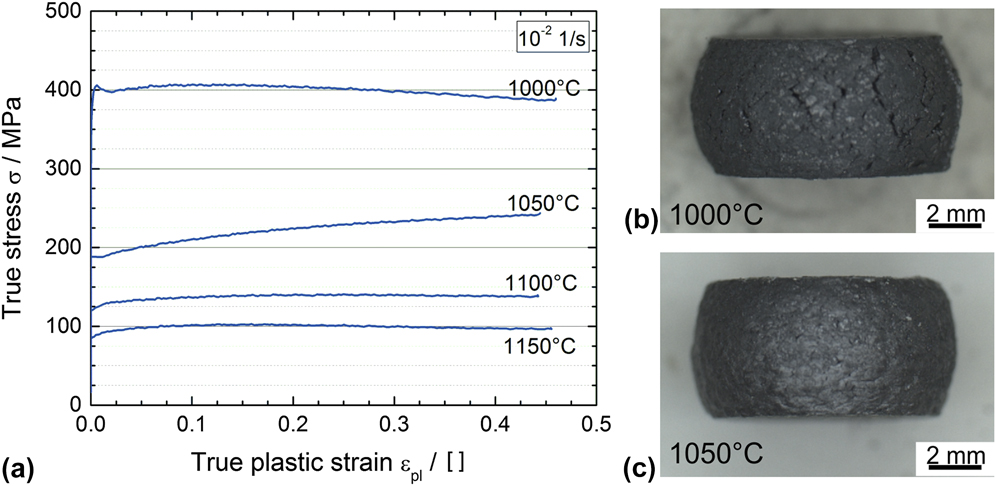
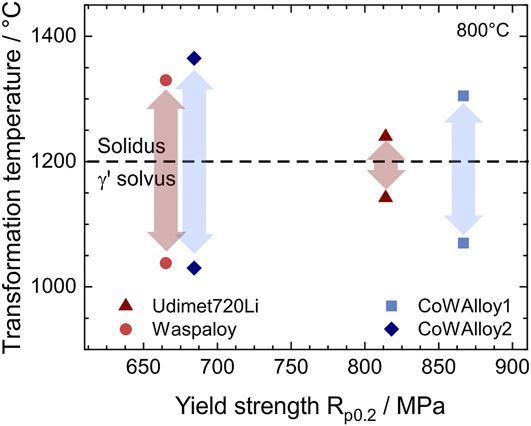
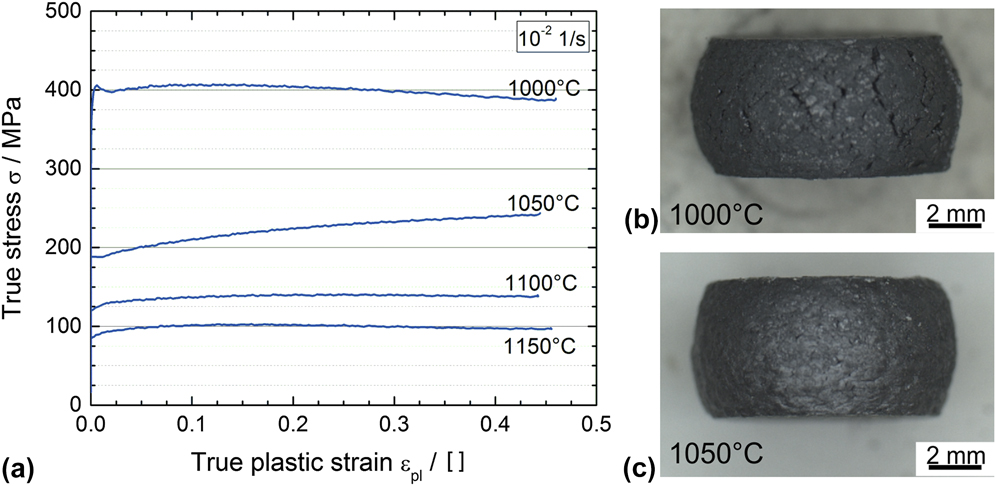
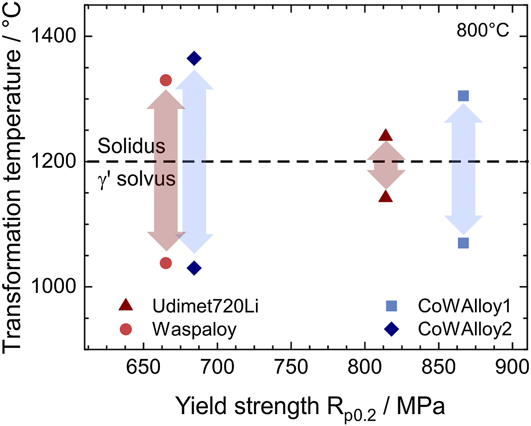
To examine the workability of the CoWAlloys, CoWAlloy1 was chosen as the test material because it has a smaller processing window (1070–1305 °C) and is therefore expectedly more difficult to forge compared to CoWAlloy2 (1030–1365 °C). The workability was investigated by compression tests with a high strain rate of 10−2 1/s after preheating the homogenized material at 1100 °C for 30 min. Figure 1 shows the stress–strain curves for different deformation temperatures together with two macrographs of the compressed samples after testing. It shows that at 1000 °C, which is 70 °C below the solvus temperature, the yield stress is strongly increased by the γ′ present in the alloy and the deformed sample shows several cracks [Fig. 1(b)]. At 1050 °C, the yield stress is rather low due to the much lower γ′ fraction, but continuously increases due to the strengthening effect of the precipitates. Nevertheless, the sample shows no severe cracking after the test [Fig. 1(c)]. The two higher temperatures, 1100 and 1150 °C, lead to a plastic deformation without distinct strain hardening at stresses around 100 MPa, resulting in crack-free samples. The lower limit for deformation of CoWAlloy1 is therefore 1050 °C, slightly lower than the solvus temperature. For CoWAlloy2, the yet lower solvus temperature of 1030 °C enables deformation at even lower temperatures. These low deformation temperatures together with the high solvus temperatures prevent incipient melting due to adiabatic heating and reduce the cost for alloy production. Figure 2 displays the yield stress of both CoWAlloys as well as of U720Li and Waspaloy at 800 °C, as published by Neumeier et al. Reference Neumeier, Freund and Göken4 versus the γ′ solvus and the solidus temperatures. The arrows emphasize the processing window for the respective alloy. Figure 2 illustrates that both CoWAlloys do not only provide a large processing window, but at the same time a high strength at 800 °C. This figure clearly shows that while for the Ni-base reference alloys high strength goes along with a small forging window, CoWAlloy1 displays both, high strength and a large forging window. Both CoWAlloys exhibit a good balance of strength and processability, making them interesting alloys for forging applications.
High temperature deformation: (a) plastic stress strain curves of CoWAlloy1, deformed with a strain rate of 10−2 s−1 at different temperatures and micrographs of a sample deformed at (b) 1000 °C and (c) 1050 °C.
Processing window in comparison to the compressional yield strength at 800 °C. Reference Neumeier, Freund and Göken4
C. Microstructure
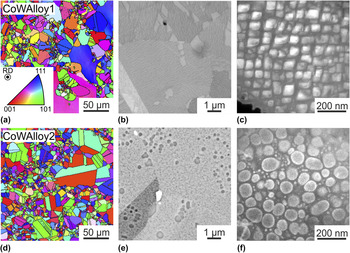
After recrystallization, both alloys exhibit a slightly bimodal grain size with a median of 4.3 µm for CoWAlloy1 and 8.2 µm for CoWAlloy2, derived from the EBSD images in Figs. 3(a) and 3(d). A fraction of unrecrystallized grains remains in center parts of the rolled bar. The two-step annealing heat treatment leads to a trimodal γ′ structure, with a small fraction of inhomogeneously distributed primary γ′ precipitates at the grain boundaries as well as inside the grains and about 50% of secondary γ′ with an average diameter of 60 nm [Figs. 3(b) and 3(e)]. A small average size of the secondary precipitates below 100 nm has been shown to result in a high strength Reference Bhowal, Wright and Raymond15–Reference Sinharoy, Virro-Nic and Milligan17 and to promote the formation of extended stacking faults during deformation. Reference Bhowal, Wright and Raymond15,Reference Sinharoy, Virro-Nic and Milligan17 A third distribution of very small tertiary γ′ precipitates can be identified from the TEM images, especially in CoWAlloy2 [Figs. 3(c) and 3(f)]. These precipitates could additionally increase the yield strength and creep strength. Reference Jackson and Reed16,Reference Locq, Caron, Raujol, Pettinari-Sturmel, Coujou, Clément, Green, Pollock, Harada, Howson, Reed, Schirra and Walston18 The different γ′ morphologies relate to differences in lattice misfit. The cuboidal shape of the γ′ precipitates in CoWAlloy1 suggests a larger lattice misfit, as was found for quaternary Co–Al–W alloys containing Ti and Ta. Reference Yan, Coakley, Vorontsov, Jones, Stone and Dye19,Reference Zenk, Neumeier, Stone and Göken20 CoWAlloy2 exhibits more spherical γ′ precipitates similar to U720Li and Waspaloy, so the misfit has to be rather small. For U720Li, a misfit of about 0.13% was published, Reference Preuss, da Fonseca, Kyriakoglou, Withers, Baxter, Green, Pollock, Harada, Howson, Reed, Schirra and Walston21 so a similar value might be expected for CoWAlloy2.
Microstructures of CoWAlloy1 and CoWAlloy2: (a) and (d) EBSD images obtained with the viewing direction parallel to the rolling direction, (b) and (e) SEM images of the grain structure with primary and secondary γ′ precipitates and some carbides in CoWAlloy2, and (c) and (f) TEM dark field images of the secondary and tertiary γ′ precipitates.

D. Long-term stability
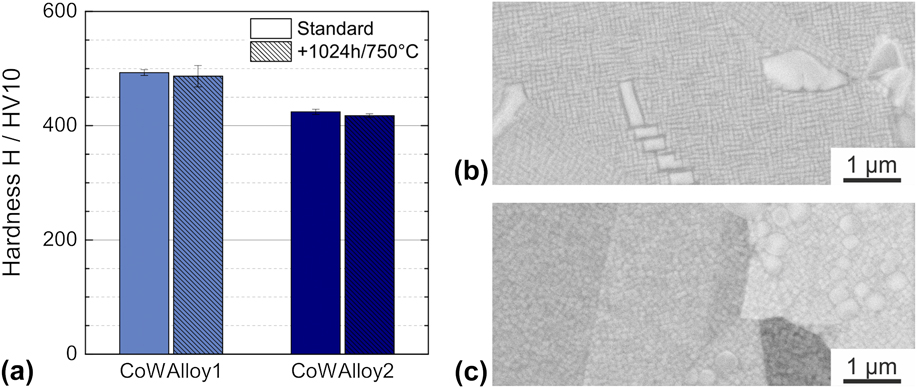
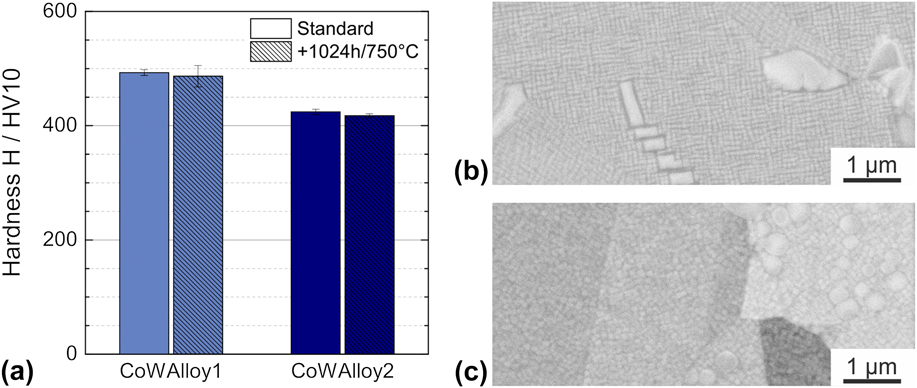
The long-term stability of the microstructure was assessed by Vickers hardness testing [Fig. 4(a)]. Both CoWAlloys prove very stable at 750 °C. No significant loss in hardness is detected, so no changes of the microstructure are expected. This is confirmed by Figs. 4(b) and 4(c), displaying a stable γ/γ′ microstructure with no distinct γ′ coarsening visible. No formation of further phases could be detected in both CoWAlloys. The CoWAlloys thereby achieve a similar thermal stability as Waspaloy, which does form carbides, but no detrimental TCP phases during annealing at 760 °C for 5000 h. Reference Collins and Donachie22 Only a rather small decrease of room temperature yield strength is observed for Waspaloy after 350 h at 760 °C, which is caused by coarsening of the γ′ precipitates. Reference Mannan, Patel, de Barbadillo, Pollock, Kissinger, Bowman, Green, McLean, Olson and Schirra23,Reference Cao, Reed, Green, Caron, Gabb, Fahrmann, Huron and Woodard24 In contrast to that, U720Li precipitates the σ phase when annealed for more than about 500 h at 760 °C which also causes a deterioration of mechanical properties. Reference Helm, Roder, Pollock, Kissinger, Bowman, Green, McLean, Olson and Schirra25 In comparison, the results of the CoWAlloys indicate a high thermal stability at 750 °C, neither being prone to significant γ′ coarsening nor to phase transformations and therefore maintaining the level of room temperature hardness.
(a) Hardness after standard heat treatment and long-term annealing at 750 °C for 1024 h in air, (b) SEM image of the γ/γ′ structure of CoWAlloy1 after 1024 h at 750 °C, and (c) SEM image of the corresponding γ/γ′ structure of CoWAlloy2.
E. High temperature strength
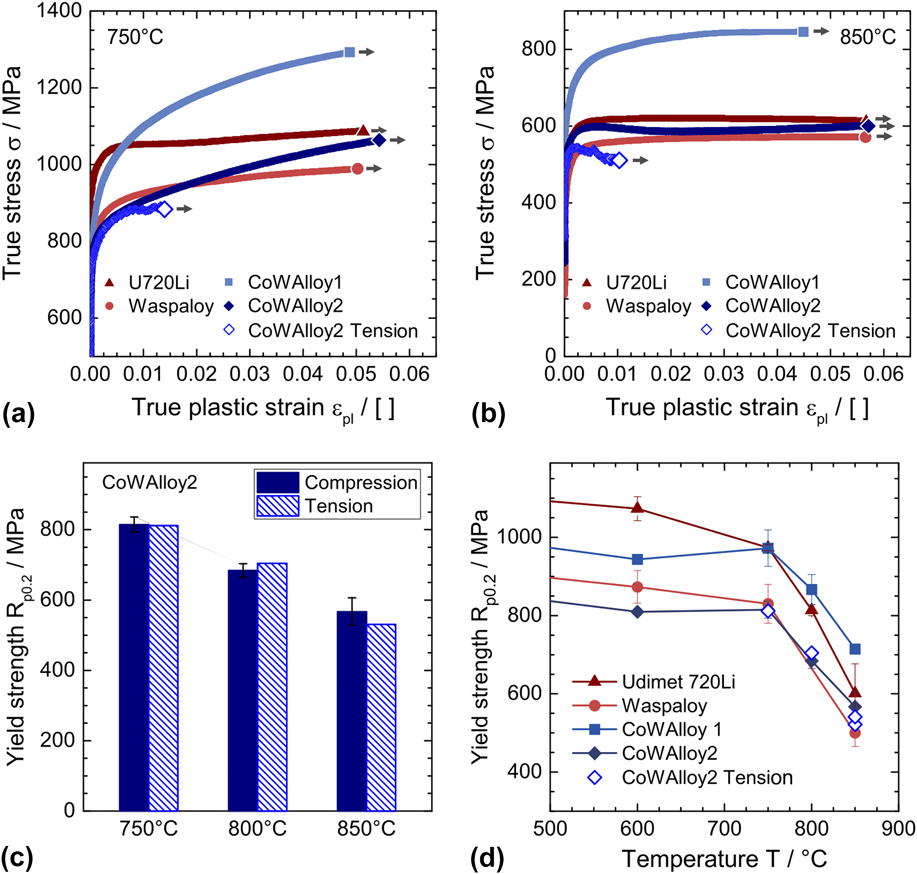
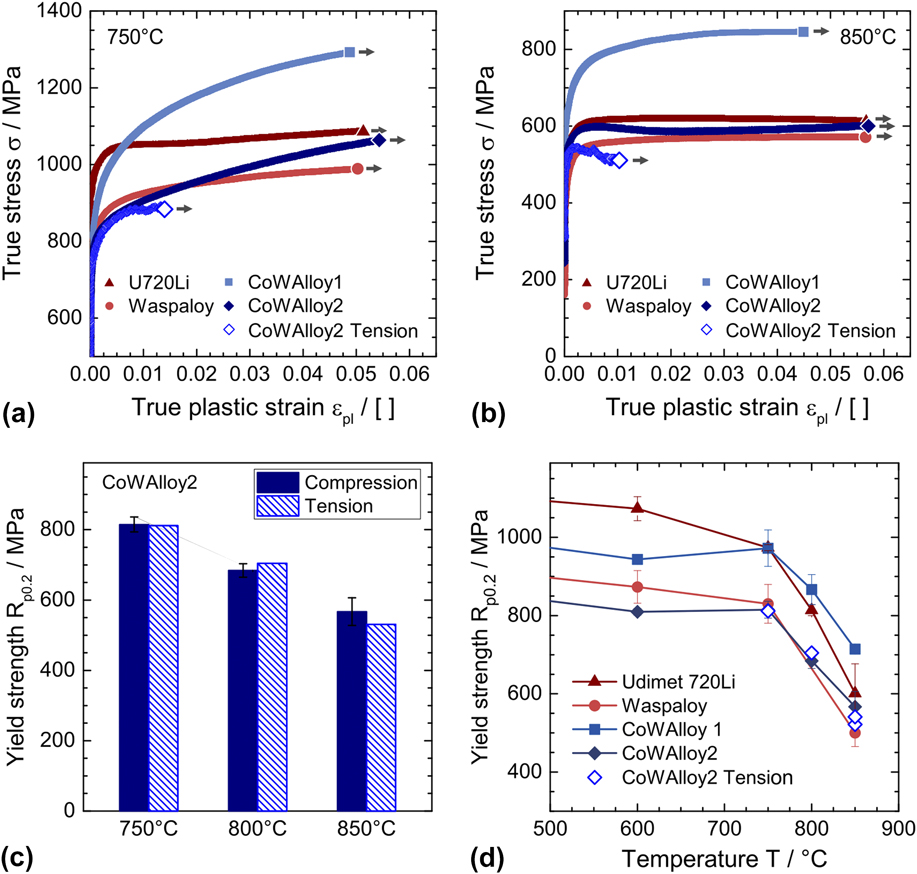
Figures 5(a) and 5(b) show the stress–strain curves of the compression tests at 750 and 850 °C, interrupted at about 5% of plastic strain, together with a tensile test for CoWAlloy2, interrupted at about 1% plastic strain. At 750 °C, the yield stress of CoWAlloy1 equals U720Li, while CoWAlloy2 compares well with Waspaloy. However, both CoWAlloys show a much stronger hardening throughout the test, especially CoWAlloy1, indicating differences in hardening and recovery mechanisms. At 850 °C, CoWAlloy2, U720Li, and Waspaloy have a similar yield strength but show minor differences in hardening behavior. Waspaloy and U720Li exhibit a very homogeneous plastic deformation behavior without significant strengthening or softening, while CoWAlloy2 shows a slight softening before stabilizing after about 1.5% strain. CoWAlloy1 displays a much higher yield stress and still maintains a strong strain hardening. The mechanisms responsible for the strong hardening might therefore be correlated with the γ′ volume fraction or distribution, which is expected to be stable up to higher temperatures for CoWAlloy1 due to the higher solvus temperature. When the compression and tensile curves obtained for CoWAlloy2 are compared, they show a similar trend of deformation behavior, even though the stress level is somewhat lower for the tensile test at 850 °C. This indicates similar deformation mechanisms being active in tension and compression. For a better evaluation of a yield strength asymmetry, the yield strength in tension and compression over temperature is displayed for CoWAlloy2 in Fig. 5(c). At all three temperatures, the compressional and tensile yield strength is similar and no obvious tension–compression asymmetry can be found. Sondhi et al. Reference Sondhi, Dyson and McLean26 supposed that internal stresses due to the lattice misfit between γ and γ′ can induce a tension–compression asymmetry in polycrystalline superalloys. However, the spherical shape of the γ′ precipitates in CoWAlloy2 indicates a rather low lattice misfit and therefore no significant misfit stresses are expected in CoWAlloy2. For CoWAlloy1 on the other hand, the more cuboidal precipitates might lead to significant internal stresses, so CoWAlloy1 might show a tension–compression asymmetry. Therefore, further investigations have to be performed to assess the tension–compression asymmetry in polycrystalline Co-based alloys. To compare the results of CoWAlloy2 in tension and compression with the reference alloys, the high temperature strength versus temperature adapted from Neumeier et al. Reference Neumeier, Freund and Göken4 is depicted in Fig. 5(d), now including the tensile test data and few more compression experiments. The late onset of the yield stress anomaly (YSA) in Co-base alloys Reference Suzuki, Inui and Pollock27 leads to a distinct decrease of strength up to 600 °C in the CoWAlloys. Reference Neumeier, Freund and Göken4 At 750 °C however, when the YSA takes effect, both CoWAlloys equal their Ni-base reference alloys in strength. While the Ni-base alloys show a strong decrease in strength at temperatures above 750 °C, both Co-base alloys maintain higher stress levels. Therefore, at 850 °C, the yield strength of the weaker CoWAlloy2 is in the range of high-strength U720Li and is even exceeded by more than 100 MPa by CoWAlloy1. Reasons for this excellent high temperature strength could be the shift of the range of YSA to higher temperatures and therefore also a later breakdown of the YSA. Reference Suzuki, Inui and Pollock27 The breakdown of the YSA in Co3(Al,W) is determined by a disordering of the γ′ phase before the onset of favorable {001}-slip, which is correlated with the low γ′-solvus temperature in ternary Co–Al–W. Reference Suzuki, Inui and Pollock27 Thus, the higher solvus temperatures of the CoWAlloys in comparison to the ternary system together with the high γ′ fraction could have caused an expansion of the range of YSA to higher temperatures, with eventually also {001}-slip occurring before γ′ dissolution. The two CoWAlloys are therefore promising alloys for applications requiring high strength at temperatures above 750 °C.
High temperature strength: (a) stress–strain curves at 750 °C, interrupted after 1% plastic strain for tensile and 5% plastic strain for compression tests as indicated by the arrows, (b) stress–strain curves at 850 °C, (c) yield strength in tension and compression for CoWAlloy2, and (d) compression and tensile yield strength plotted versus temperature including data from Ref. Reference Neumeier, Freund and Göken4.
F. Low-cycle fatigue
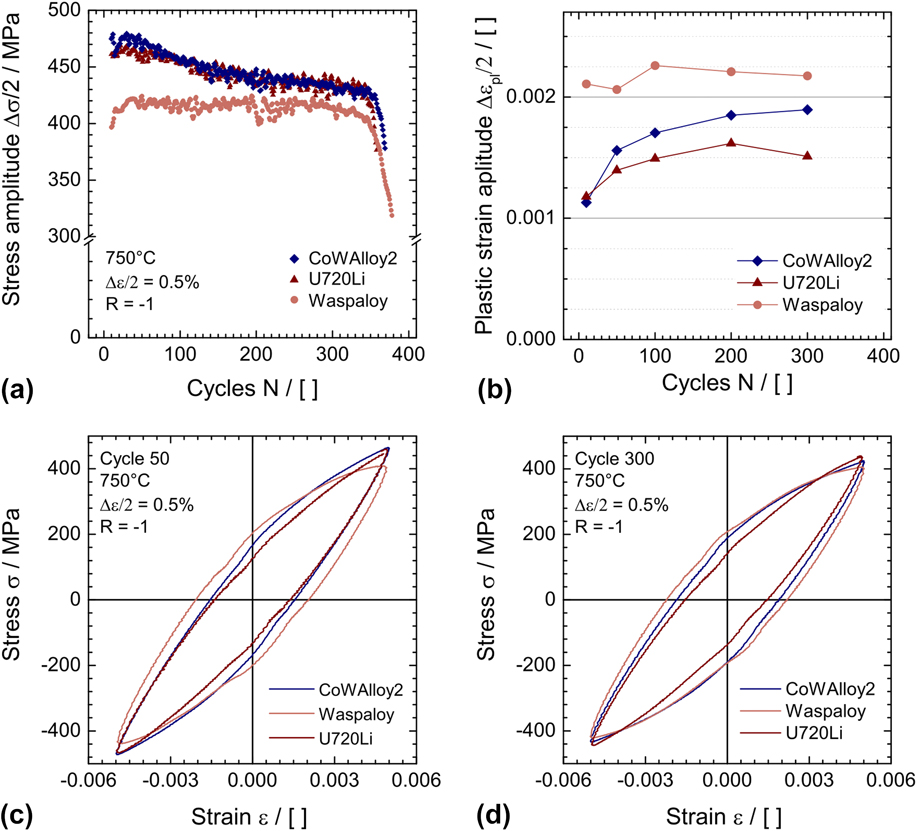
To get a first impression of the low-cycle fatigue behavior of the new CoWAlloys, LCF tests were performed at 750 °C with a total strain amplitude of 0.5%. Figure 6(a) shows the cyclic deformation curve for the investigated CoWAlloy2 and the two reference Ni-base superalloys U720Li and Waspaloy. At the beginning of the test, for CoWAlloy2 and U720Li, a stress amplitude of about 480 MPa is obtained at a constant mean stress of 0 MPa. In contrast, Waspaloy starts with a lower stress amplitude of 400 MPa and shows only a slight cyclic strengthening up to 420 MPa during the first few cycles. This can be attributed to the readjustment of the microstructure within the first 50 cycles of the experiment as the mean stress changes from −50 to 0 MPa. Figure 6(b) displays the corresponding plastic strain amplitude versus the number of cycles. While Waspaloy maintains the same comparatively high plastic strain amplitude of 2 × 10⁻³ during the whole experiment, the plastic strain amplitudes of U720Li and CoWAlloy2 start at about 1 × 10⁻³, which is half of the level of Waspaloy. U720Li reaches a maximum plastic strain of ∼1.5 × 10⁻³ after about 200 cycles which drops again slightly afterward. Overall, its plastic strain is lowest in comparison. CoWAlloy2 shows a steady increase, starting at the same plastic strain level as U720Li and increasing up to a plastic strain amplitude of almost 0.002. However, the obtained stress amplitude remains on the level of U720Li, so CoWAlloy2 has a high tolerance for plastic deformation. The hysteresis loops for the three alloys after 50 and 300 cycles are plotted in Figs. 6(c) and 6(d), respectively. They confirm that U720Li has the lowest dissipated energy and exhibits only a slight loss in strength. CoWAlloy2 starts with a slim hysteresis, but the plastic strain increases while the strength slightly decreases and Waspaloy shows a small variation in plastic strain but maintains its strength over the 300 cycles.
Low-cycle fatigue. (a) Cyclic deformation curves, (b) plastic strain amplitude in dependence of cycle, and hysteresis loops after (c) 50 cycles and (d) 300 cycles.
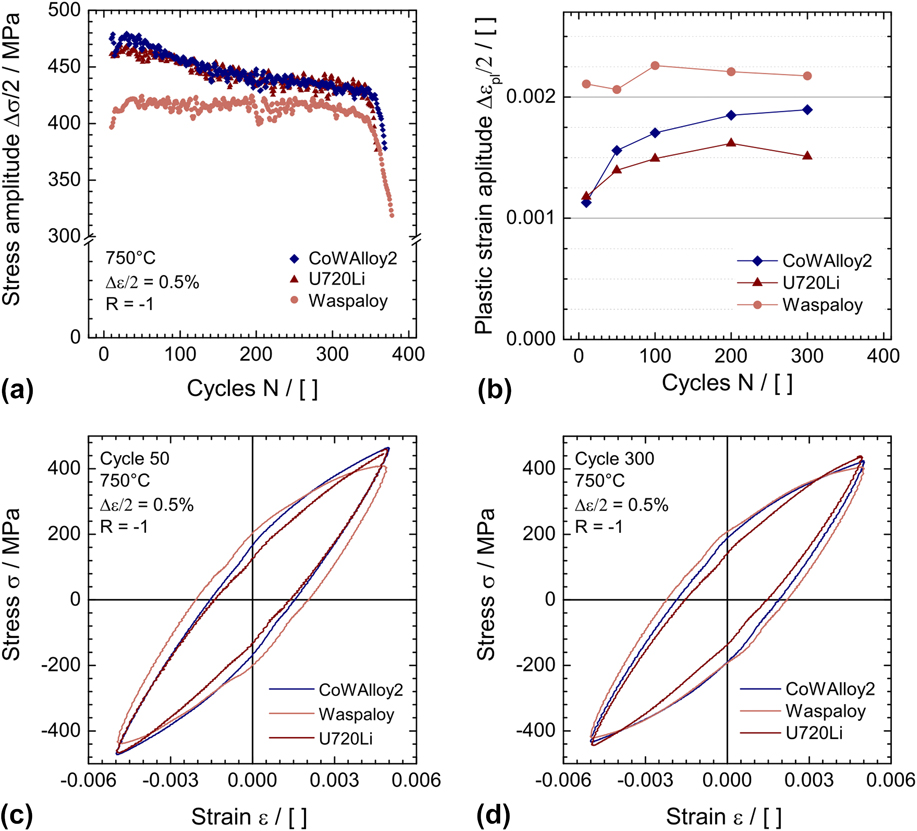
Regarding the fatigue life, the CoWAlloy2 specimen broke after 369 cycles, whereas the U720Li and Waspaloy specimens broke after 359 and 378 cycles, respectively. Thus, for the applied amplitude, it can be stated that CoWAlloy2 shows a very similar fatigue life compared to the investigated Ni-base superalloys. To evaluate the obtained fatigue lives, the data are compared to the data provided for U720Li at a testing temperature of 650 °C, Reference Gopinath, Gogia, Kamat, Balamuralikrishnan and Ramamurty28 since no comparable data are available from literature at 750 °C. For a first estimation, the fatigue data at 750 °C fit reasonably well to the literature data of U720Li obtained with comparable parameters (R = −1, Δε/2 = 0.5%) at 650 °C, with fatigue lives decreased by an order of magnitude when increasing the temperature by 100 °C.
Due to the high stress amplitudes that are obtained for CoWAlloy2 compared to Waspaloy and due to the obtained plastic strain amplitudes, it is supposed that CoWAlloy2 offers a good compromise between fatigue strength and ductility. Further investigations will be performed to characterize the fatigue behavior of these alloys in more detail.
IV. CONCLUSIONS
Two new polycrystalline γ/γ′ Co-base superalloys were compared to Ni-base disc alloys U720Li and Waspaloy in terms of physical properties, microstructure, high temperature strength, fatigue properties, and long-term stability. They exhibited similar microstructures but have a slightly lower γ′-solvus temperature and high solidus temperatures, therefore possessing large processing windows. The alloys were stable for 1000 h at 750 °C in air and showed no sign of TCP phase formation. Regarding the high temperature strength, the CoWAlloys showed excellent properties at temperatures above 750 °C, where CoWAlloy1 exceeded CoWAlloy2, U720Li, and Waspaloy. No tension–compression asymmetry was found for CoWAlloy2. The first fatigue results indicated that CoWAlloy2 achieves a similar fatigue life and strength as U720Li, while showing a higher ductility. The Young’s modulus of CoWAlloy2 is higher than the ones of U720Li and Waspaloy, while the CTE ranges in between the Ni-base reference alloys.
ACKNOWLEDGMENTS
The authors acknowledge funding by the German Research Foundation (DFG) through project B3 of the collaborative research center SFB/Transregio 103 “From Atoms to Turbine Blades—a Scientific Approach for Developing the Next Generation of Single Crystal Superalloys”.