Introduction
Emergencies and disasters related to the people’s health occur across all national, regional, and political boundaries. The Black Saturday bushfires of Australia, Nigerian flood in 2018, Iran flood in 2019, etc., highlight the need to seek for ways to manage and solve problems occurring in emergencies and disasters. Given the multidisciplinary nature of managing disasters and events, hackathons can serve as an invaluable innovation for experts, healthcare professionals and researchers, with each specialty contributing a unique insight to the pressing problems and generating useful ideas. Reference Monsef and Ismail1 To ensure access to the potential reserved in these multidisciplinary events, participatory programs have been followed to progress in emergencies and disasters; In this regard, hackathons have been introduced as a unique model for such events. Reference DePasse, Carroll and Ippolito2,Reference Briscoe and Mulligan3 An increasing number of data challenge series and hackathons are focusing on water, energy, social and physical infrastructure, and climate change issues. Ecuador’s Ciudades Resilientes hackathon, which is designed to manage natural disasters, is illustrative of the convening power of these events.Footnote i The Canadian de Gaspé Beaubien Foundation, as recently held by Aqua Hack, is a policy and innovation event leading to the development of an interprovincial and inter-jurisdictional agreement and a cooperation mechanism.Footnote ii As another example, FloodHack in Jakarta aims to reduce the impact of yearly floods on the livelihood of the residents.Footnote iii, Reference Landry, Webster, Wylie and Robinson4
A hackathon is best defined as an ‘innovation marathon.’ Derived from the words ‘hacking’ and ‘marathon,’ it was initially developed in the IT community. Since its introduction, the model has also been used in a variety of professional fields including public health, to feed and accelerate innovations. Reference Groen and Calderhead5-Reference Walker and Ko7 Bringing a vast range of disciplines to bear on a specific challenge, participants can apply non-traditional methods to achieve unconventional solutions. Reference Asch, Terwiesch, Mahoney and Rosin8
Therefore, given that the main principles of the hackathon model are based on a problem-oriented approach that encourages participants to understand all aspects of a challenge, this study focused on the flash flood and attempts to demonstrate the capacity and applicability of the hackathon in idea generation that can be relevant to managing emergencies and disasters.
Methods
Setting
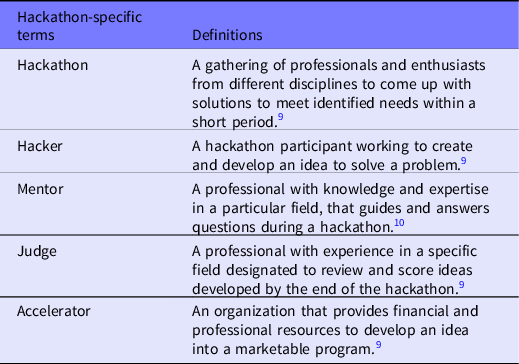
In the hackathon established at the Isfahan University of Medical Sciences (IUMS), called ISFHACK, a variety of students from different universities and diverse fields came together for 4 days (5 hours a day) in May 2019, to explore different ideas to solve problems and reduce barriers associated with emergencies and disasters in Iran floods, from mid-March to April 2019. Participants were encouraged to express their views and contribute their experiences to devise solutions for solving flood problems in their teams. For more clarification, Table 1 provides the terminology and definitions associated with hackathon events.
Hackathon-specific terms and definitions

ISFHACK2019 was a unique opportunity for experts to exchange information in a multidisciplinary event. Since ISFHACK2019 was the first hackathon presented at the IUMS, to ensure success in this event, the organizer (ISFHACK2019) used collaboration and consultation with experts from the University of Aston, England, Johns Hopkins University Medical Center, and the University of Sydney, Australia.
This hackathon event was planned to foster innovation and to solve health problems in emergencies and disasters associated with the Iran flood in March, 2019. This event (competition) was conducted in a multidisciplinary environment of entrepreneurship; 60 participants, 9 mentors, and 6 judges gathered for 4 days. For the participants to get acquainted with the content and purpose of this event, as well as to receive guidance during the event and to become more familiar with the content, mentors who had at least 5 years of experience in this field were invited. Also, some of the invited mentors were members of the Crisis Committee (Flood 2019) who had seen the situation closely and were fully aware of the challenges and problems.
There was no limitation for students to participate and use their knowledge and abilities in this marathon. As participants, there were 60 BSc, MSc and PhD students from different universities and majors; These were divided into 10 groups. The hackathon was planned and carried out in the context of healthcare education systems in university-industry-collaboration and entrepreneurship based on learning innovations. In this event, students were enrolled in such diverse fields as IT, Electrical engineering, Medical field, Urban Economics, Medicine, etc. They could create their team or join other teams; Each team included 6 members. Also, experts as mentors or judges from different fields of expertise attended this event, with a significant impact on guiding students to identify problems in the field correctly and to discover and create the right idea for developing products and services relevant to the theme of the event.
Due to the nature of the event, the rule of ‘Intellectual Property’ (IP) was considered as open-source for teams, so that teams could decide to expand their work privately or with the participation of the university or accelerator.
Procedure
In order to ensure that the event would not interfere with the students’ classes, the event was scheduled to take place in 4 days, from 4 PM till the end of the night. Catering and dinner services were also provided for them.
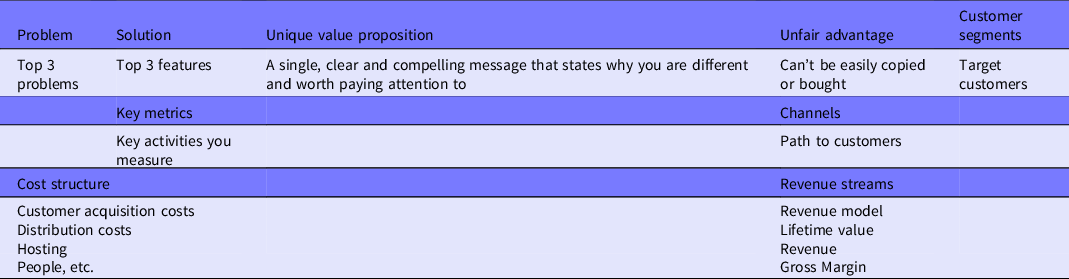
The first day of the event started with a welcome speech and the participants were informed about the challenges of the Iran flood (2019) by expert lecturers. Also, a workshop about Lean Canvas, Reference Maurya11,Reference Link12 was organized to orient participants toward the idea and product development. Lean canvas simplified the test planning and reduced the cost of product testing. Reference Nidagundi and Novickis13 Lean Canvas is a 1-page business plan template created by Ash Maurya; Reference Maurya11 It helps the person to deconstruct an idea into its key assumptions. It has been adapted from Alex Osterwalder’s Business Model Canvas and optimized for Lean Startups and has replaced elaborate business plans with a single page business model. The lean canvas is a whiteboard consisting of several segments on it, showing an overview of the business. It is drawn on a single page, which helps to plan the business ideas and prototypes; It segments the business and validates it, with the help of several segmented blocks. This board can help strategy development, planning, and decision-making; It also assists the team in building better businesses. Reference Nidagundi and Novickis13 Finally, the Lean Canvas covers the following 9 elements, as shown in Table 2: problem, solution, unique value proposition, unfair advantage, customer segments, key metrics, channels, cost structure, revenue streams.

In the next step, teams were formed based on complementary and interdisciplinary skill sets; Teams’ size was a maximum of 6 people. After teams were formed, the remaining time of day 1 was spent on brainstorming and discussing strategies (i.e., hacking) and the potential solutions. In addition, an attempt was made to explain the conditions and environment to the participants using the experiences of the mentors who were present during the flood. Participants also communicated closely with persons who were in the flood condition through Skype.
On day 2 of the event, all teams started their activities at the event venue and 9 internal mentors with expertise in innovation and design, health care administration/management, medical it, technology and innovation, as well as other related experts, were invited to give advice and guide teams to manage their ideas and business models. Due to the need for a broad vision and multidisciplinary area in this contest, experienced and professional mentors from international universities, such as Johns Hopkins University, the University of Technology, Sydney, and the University of Aston, in England, were used. They were in touch via conference call and Skype with teams. All teams began to brainstorm and find the ideas they wanted to provide in this event.
On day 3, all teams focused on designing their lean canvas. During the event period, teams were continually evaluated to score points; They were given explanations about the course of the event. Mentors were also available to guide teams to implement the ideas.
Finally, on the last day of the event, judgment was made in 2 parts. The first part was the lean canvas of each team which was assessed and judged; In the second part, the hackathon teams presented their ideas to the judging panel and the rest of the participants. The judges were familiar and some of them were involved in this natural disaster (flood) and had experience in this field, so, they gave points based on the applicability of ideas. Hence, on this day, the teams continued their work on the lean canvas. Next, the teams were given 1 hour to finalize their lean canvas and to install it in the designated locations for evaluation and review. Appendix 1 represents sample photos of the lean canvas presented at the event.
Evaluation of the lean canvas of each team was based on creativity in design, appropriate naming of the design, application of design, the accuracy and comprehensiveness of the board information, the presence of all members of the team during judging, answers to questions, and installation of the canvas at the appointed time. In the next step, the teams presented their ideas to the referees and other participants in 7 minutes and evaluated it based on the market and sales. In the end, 3 teams were selected and nominated for receiving prizes. Prizes included cash and non-cash awards from the sponsors of the event (i.e., NIMAD and Isfahan Hub accelerator).
Results
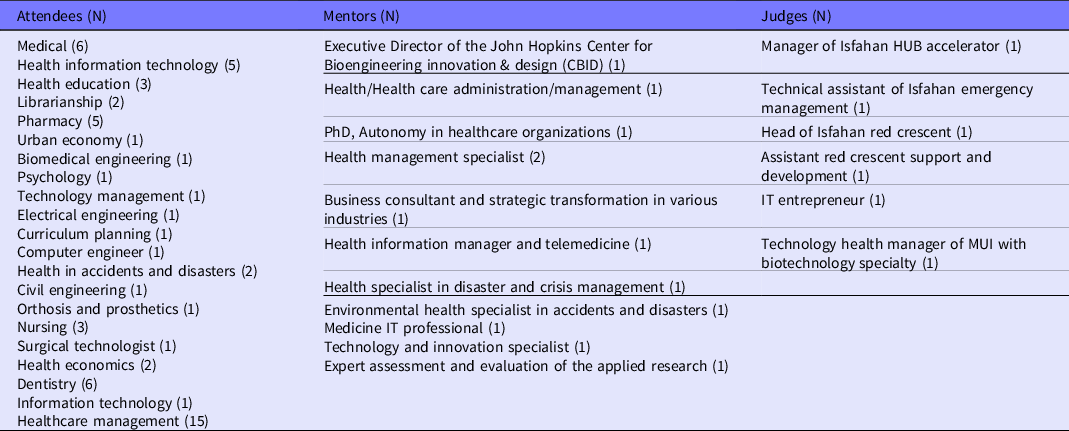
Attendees of this event were from 7 universities and 21 academic fields of study (Table 3). All of them were students (n = 60), with an average age of 21–32. Each of the 10 teams with 6 members worked on a different idea. These teams included interdisciplinary members. For example, 1 of the teams included a computer engineer, a psychologist, a dentist, a nurse, and 2 health service managers. As shown in Table 3, 12 national and international mentors also participated in this event.
Number of participants, mentors, and judges at the ISFHACK 2019

N denotes the number of participants
Also, the panel of 6 judges with different expertise and job positions was included (Table 3). The judges reviewed the ideas of the 10 teams; Eventually, 10 ideas were generated for managing flood. These ideas included: (1) improved efficiency and effectiveness in a separate restroom due to the need to accommodate individuals and families, and to provide temporary accommodation, (2) an open distribution system for medicine and medical equipment to speed up access to the needed medicines, (3) a graded knee splint to accelerate and stabilize the condition of the patient and the transfer to the medical centers, (4) new disaster management training methods with using applications to teach the essentials used in crisis by employing new methods of training information, and gamification for accidents and disasters, (5) a smart container, to create a method of distributing, recording information, and providing medicine items with low error, (6) using info-tag for managing information better and creating an integrated system for managing the people and the services provided to them, (7) the use of a capital finder as a platform to support disaster-stricken businesses, (8) a tent design equipped for population management and services, (9) some Medical System Software to manage facilities online and the service recipients, and (10) health education based on the method of gamification to train and create experience. The winning ideas resulting from the ISFHACK2019 included ideas number 3, 6, and 10, as mentioned above. The reason for the judges’ choice of these ideas was their usefulness and feasibility during natural disasters. After the event, some teams continued their activities. In order to support the ideas and teams, they were introduced to the University Growth and Innovation Center to develop their works and ideas. Also, some teams, such as Team 1, registered their ideas.
By introducing winning teams to the accelerator of Isfahan Hub, and Innovation Center of University and financial and scientific support, they were supported until their idea reached the product. Due to the intellectual property rights protection of ideas, we are not allowed to explain further on the teams’ ideas.
Discussion
A hackathon is not a standalone event. Rather, it is a part of a continuous set of innovation chains to accelerate new solutions and to develop them. Some of the most important steps of an event after its planning and execution are to evaluate the success of the event, support teams in the post-event environment, and track program progress. Additionally, 1 of the essential points in hackathons is creating and developing professional social networks through organizers, which could be performed through advertising, building teams, and attracting talents. Certifications and co-branding should be considered for projects because branding and commercialization will attract capital, which is a factor increasing the hackathon’s legitimacy and success. Finally, to ensure the success of hackathons in emergency and disaster, attendants and organizations should be engaged to be able to look closely at these problems, finding ways to solve budget debates, and to fund ideas. Connie White (2014) has stated that to use knowledge, innovation, and education to build a culture of safety and resilience at all levels, we can use hackathons for information and communication in disaster management capacity building. Reference White14
There is a growing understanding that working under constraints, such as a time constraint in hackathons, generates innovation. Reference Krook and Malaika15 There are other essential elements that a hackathon provides, such as access to experts and mentors, a structured, positive, and safe environment with clear deliverables to work on, and minimal intervention. Reference Krook and Malaika15 Hackathon participants want to learn about new technologies and satisfy their needs to make a good impact on their environment. The number of hackathons focusing on social good is increasing year after year. Reference Krook and Malaika15 The Call for Code Global Challenge in 2018, for example, generated thousands of innovative ideas and technology solutions to support the needs of people affected by natural disasters and the relief workers assisting them. Reference Krook and Malaika15
Furthermore, as organizing a post-event and keeping in touch with teams can be regarded as 1 of the essential challenges for hackathon organizers, the use of social networking and group-based software is suggested. Hackathons can serve as a perfect step in this area and can be used in healthcare fields; also, it can be a significant help for humans in emergencies and disasters all over the world. So, supporting such events can help to solve health problems and bring new ideas to improve safety services required in the event of emergencies and disasters, thereby leading to general health. However, we still need to gain more experience and create new literature for healthcare hackathons to improve its output and results.
Conclusion
Multidisciplinary teamwork and international collaboration are needed to address challenges in the area of health in emergencies and disasters. The Hackathon model and its innovative potential can serve as an excellent way to improve management tools and health services in the case of emergencies and disasters. Scientific meetings in the field of health in emergencies and disasters are conducive to the hackathon’s success, as they can provide an opportunity to include professionals from diverse backgrounds as event participants. These professionals play an essential role as they first identify and present real-world problems, while ensuring that the prototype solutions address the end-user’s needs. Partnerships with local organizations and academic centers are also essential to attract participants with complementing skills, such as entrepreneurship, engineering, and IT. Collaboration to support monetary awards, allocate incubator space, downstream funding, pay attention to the role of accelerators, and business consulting support by mentors for at least 6 months after the event also need to be considered during the hackathon event to ensure project sustainability. A successful hackathon can be used to drive innovation, generate ideas, and promote useful changes in emergencies and disasters.
Funding statement
The present study was funded by Iran’s National Elites Foundation (INEF), Tehran, Iran, as a postdoctoral project.
Ethical standards
This study received the required ethical approval from Isfahan University of Medical Sciences (IUMS), with the ethical code ID: IR.MUI.RESEARCH.REC.1398.190.
Sample photos of the Lean Canvas presented at the event.