


Introduction
Intrusive, prospective imagery is the experience of involuntary, distressing mental images of events in the future that come to mind unbidden. Whereas people who have experienced a traumatic event may “re-experience” the trauma in symptoms such as intrusive memories and flashbacks, imagined events in the future can be “pre-experienced” (Schacter, Addis and Buckner, Reference Schacter, Addis and Buckner2007) in a similarly involuntary, and at times, distressing way. Difficulties with prospective imagery may occur across a variety of disorders though this has been little studied. For example, a deficit in positive prospective imagery has been associated with unipolar depression (Holmes, Lang, Moulds and Steele, Reference Holmes, Geddes, Colom and Goodwin2008; Williams et al., Reference Williams, Ellis, Tyers, Healy, Rose and MacLeod1996). In contrast, an excess of prospective imagery has been associated with bipolar disorder and is predicted to contribute to the pattern of mood fluctuation that characterises the disorder (Holmes, Geddes, Colom and Goodwin, Reference Holmes, Lang, Moulds and Steele2008).
We propose that future orientated imagery may be important for several reasons. First, imagery has been demonstrated to have a stronger impact on emotion than verbal thought (Holmes, Lang and Shah, Reference Holmes, Lang and Deeprose2009; Holmes and Mathews, Reference Holmes and Mathews2005; Holmes, Mathews, Mackintosh and Dalgleish, Reference Holmes, Mathews, Mackintosh and Dalgleish2008) and therefore may be highly relevant for understanding emotional disturbance. We have proposed that imagery can amplify mood disturbance, for example mood swings in bipolar disorder (Holmes, Geddes et al., Reference Holmes, Mathews, Mackintosh and Dalgleish2008). Second, prospective imagery is causal in determining future behaviour – imagining oneself completing a future event can lead to significantly greater likelihood of this event being completed in real-life (Libby, Shaeffer, Eibach and Slemmer, Reference Libby, Shaeffer, Eibach and Slemmer2007). In Libby et al.'s study, people who imagined voting in an election from a third-person perspective were more likely to do so than those who used a first-person perspective. The impact of imaginal simulation on increasing behavioural actions may be of particular concern if the action is negative. For example, Holmes et al. (Reference Holmes, Crane, Fennell and Williams2007) have demonstrated that, in depression, the perceived “realness” of intrusive, prospective imagery of the act of suicide (“suicidal flashforwards”) has been found to be associated with the severity of suicidal ideation on the Beck Scale for Suicide Ideation (Beck and Steer, Reference Beck and Steer1991), which holds predictive validity for suicidality (Beck, Brown and Steer, Reference Beck, Brown and Steer1997; Beck and Steer, Reference Beck and Steer1991).
Finally, mental imagery has already provided a distinct and critical Cognitive Behaviour Therapy (CBT) treatment target in conditions already associated with intrusive imagery, such as PTSD (Ehlers and Clark, Reference Ehlers and Clark2000) and social phobia (Clark et al., Reference Clark, Ehlers, Hackmann, McManus, Fennell, Grey, Waddington and Wild2006). Exposure to, and cognitive restructuring of, flashback images is critical to trauma-focused PTSD therapy (National Institute for Health and Clinical Excellence, 2005). In social phobia, behavioural experiments, video feedback and imagery restructuring are all CBT techniques for working with negative images of self (e.g. Hirsch, Clark, Mathews and Williams, Reference Hirsch, Clark, Mathews and Williams2003). Imagery thus offers a potential transdiagnostic treatment candidate in mood disturbance.
Deficits in generating specific images of the future have been demonstrated in both schizophrenia and depression using an adaptation of the autobiographical memory test (AMT: a well used measure of overgeneral memory) involving future cueing (D'Argembeau, Raffard and Van der Linden, Reference D'Argembeau, Raffard and Van Der Linden2008; Williams et al., Reference Williams, Ellis, Tyers, Healy, Rose and MacLeod1996). The task used required participants to imagine future events using short sentences as specific cues (e.g. “a situation in which you feel guilty about something”; “a situation in which someone smiles at you”). Williams et al. (Reference Williams, Ellis, Tyers, Healy, Rose and MacLeod1996) found that deficits in being able to recall specific memories were associated with deficits in generating specific future images. Other research (Holmes, Lang et al., Reference Holmes, Mathews, Mackintosh and Dalgleish2008; Stöber, Reference Stöber2000) has used ratings for the “vividness” of images generated in response to positive and negative cues on a prospective imagery task as designed and utilized by MacLeod, Tata, Kentish and Jacobsen (Reference MacLeod, Tata, Kentish and Jacobsen1997). Items included events such as “you will do well on your course” and “you will have a disagreement with a good friend”. These studies have found that high depression scores were associated with a reduction in the ability to generate positive prospective imagery. However, this effect appears specific to positive information since the generation of negative prospective imagery was not associated with elevated depression scores (Holmes, Lang et al., Reference Holmes, Lang, Moulds and Steele2008; Stöber, Reference Stöber2000). Further, it is noted that these studies have investigated deliberately generated rather than involuntarily generated prospective imagery. Cognitive models of memory (e.g. Conway and Pleydell-Pearce, Reference Conway and Pleydell-Pearce2000) make an important distinction between voluntary and involuntary memories. A voluntary memory, for example, could include deliberately recalling a stressful event, whereas an involuntary memory would be a spontaneous flashback of that event. These two forms of memory can show independence (Brewin and Holmes, Reference Brewin and Holmes2003; Conway and Pleydell-Pearce, Reference Conway and Pleydell-Pearce2000; Ehlers and Clark, Reference Ehlers and Clark2000). Depression is associated with high rates of distressing, intrusive involuntary memories (Birrer, Michael and Munsch, Reference Birrer, Michael and Munsch2007). We therefore predict higher levels of intrusive, involuntary future imagery in depression compared to non-depressed participants, due to a reduced ability to control involuntary intrusions.
In depression, involuntary intrusive imagery for past negative events (e.g. previously experienced trauma) and the negative appraisal of such intrusions has been suggested to be a maintenance factor in the disorder (Starr and Moulds, Reference Starr and Moulds2006). However, the role of intrusive, involuntary imagery of future events in depression has yet to be explored. The findings discussed above for prospective imagery in depression (Holmes, Lang et al., Reference Holmes, Geddes, Colom and Goodwin2008; Stöber, Reference Stöber2000; Williams et al., Reference Williams, Ellis, Tyers, Healy, Rose and MacLeod1996) relate to laboratory procedures designed to elicit deliberate voluntary imagery of the future using constrained, specific word cues. It would be unwise to generalize findings from these tasks to spontaneous, intrusive imagery as experienced in the real-world for several reasons. These laboratory tasks are known to be subject to transient mood effects, and participant ratings for probability of the imagined event occurring are lower than for personally-relevant salient future events (Hepburn, Barnhofer and Williams, 2009). Finally, it has been argued that individuals may “over-ride” their normal response patterns when using word cueing tasks to generate specific events in the laboratory setting, thus limiting their real-world applicability and validity (Anderson and Dewhurst, Reference Anderson and Dewhurst2009).
There is currently no available measure to adequately assess intrusive, involuntary prospective imagery. We suggest existing measures of mental imagery need to be tailored to best measure aspects of imagery predicted to be relevant in psychopathology. Imagery is a multifaceted domain (Pearson, Reference Pearson and Andrade2001); thus general experimental psychology measures of imagery (e.g. general imagery use as measured by the Spontaneous Use of Imagery Questionnaire) and deliberate imagery generation (e.g. via the AMT) need to be complemented with other measures that tap into how intrusive imagery may manifest in psychological disorders, such as when images “flash-forward” unbidden into mind (Holmes, Geddes et al., Reference Holmes, Lang, Moulds and Steele2008).
The Impact of Event Scale – Revised (IES-R; Weiss and Marmer, Reference Weiss, Marmer, Wilson and Keane1997) is a widely-used self-report measure used after a traumatic event to assess the PTSD symptoms of re-experiencing (e.g. intrusive imagery and flashbacks) and related avoidance and hyperarousal (Horowitz, Wilner and Alvarez, Reference Horowitz, Wilner and Alvarez1979; Sundin and Horowitz, Reference Sundin and Horowitz2002; Weiss and Marmer, Reference Weiss, Marmer, Wilson and Keane1997). In the current study, the Impact of Future Events Scale (IFES) was designed to assess intrusive, prospective imagery, based on an item-by-item adaptation of the IES-R.
This paper reports the development of the IFES and its use in participants categorized into two analogue subsamples for depression (non-dysphoric and mild-dysphoric). This approach is established as an important first step in experimental psychopathology (e.g. Grant and Beck, Reference Grant and Beck2006). We predicted that the impact of intrusive, prospective imagery for the future, as assessed by the IFES, would significantly and positively correlate with current dysphoria (BDI-II) score in the entire sample, independent of general imagery use and trait anxiety. We also predicted that higher IFES scores would be seen in the mild-dysphoric group compared to the non-dysphoric group.
Method
Measures
Impact of Future Events Scale (IFES). The IES-R was specifically adapted to create the IFES in this study. Rather than identify one previous traumatic event as in the IES-R, the IFES required participants to identify three future events and indicate whether each event was “positive” or “negative”. In scoring the IFES, the number of negative events per individual is summed. The maximum score is three.
Participants were provided with the instructions “Below is a list of comments made by people about imagining events in the future. Please read each item, indicating how frequently each comment was true for you during the past 7 days due to imagining the future”. Each item on the IES-R was re-worded so to assess response to prospective, rather than past, intrusive imagery for real events. For example, the original item “Pictures of it <the past> popped into my mind”, was reworded to “Pictures about the future popped into my mind”. To assess hyperarousal due to imagining the future (which, unlike the IES which refers only to trauma, might include positive as well as negative events for a given participant), an additional two questions were added: “I felt elated and optimistic” and “I felt energetic and excitable”. Note that even nominally positive aspects of hyperarousal (i.e. elation and excitability) may be negative when associated with a pre-occupation with the future and goal pursuit such as seen in hypomanic and manic states (Johnson, Reference Johnson2005). The IFES therefore consisted of 24-items, rated on a scale from 0 (“not at all”) to 4 (“extremely”), see Appendix 1.
Scoring for the IFES is calculated as per the IES-R: a summation of the total score of responses (Horowitz et al., Reference Horowitz, Wilner and Alvarez1979; Weiss and Marmer, Reference Weiss, Marmer, Wilson and Keane1997).
Beck Depression Inventory-second edition. (BDI-II; Beck, Steer and Brown, Reference Beck, Steer, Ball and Ranieri1996). The BDI-II was used to measure depressive symptoms. Participants responded to 21 depression-related questions with respect to how they had been feeling during the past 2 weeks. The BDI-II has high validity (Beck, Steer and Garbin, Reference Beck, Steer and Garbin1988) as well as high internal consistency with an alpha level of 0.9 (Beck, Steer, Ball and Ranieri, Reference Beck, Steer and Brown1996). One week test-retest reliability is also high, r = 0.93 (Beck et al., Reference Beck, Steer, Ball and Ranieri1996).
State-Trait Anxiety Inventory – Trait version. (STAI-T; Spielberger, Gorsuch, Lushene, Vagg and Jacobs, Reference Spielberger, Gorsuch, Lushene, Vagg and Jacobs1983). The STAI-T was used to measure trait anxiety. STAI-T consists of 20 anxiety-related items on which participants rated how they “generally feel” on a 4-point scale: almost never, sometimes, often, or always. The STAI-T is widely used with satisfactory reliability and validity (Spielberger et al., Reference Spielberger, Gorsuch, Lushene, Vagg and Jacobs1983).
Spontaneous Use of Imagery Scale. (SUIS; Reisberg, Pearson and Kosslyn, Reference Reisberg, Pearson and Kosslyn2003). SUIS is a 12-item measure of general imagery use in day to day situations, for example: “When I think about visiting a relative, I almost always have a clear mental picture of him or her”. Participants rated each item on a 5-point scale, anchored with the instructions “If a description is always completely appropriate, please write 5; if it is never appropriate, write 1; if it is appropriate about half of the time, write 3; and use the other numbers accordingly.” A significant relationship between scores on the SUIS and the Vividness of Visual Imagery Questionnaire (VVIQ; Marks, Reference Marks1973) has been demonstrated with high-vividness imagers reporting higher use of imagery than low-vividness imagers (Reisberg et al., Reference Reisberg, Pearson and Kosslyn2003), suggesting they measure a related construct.
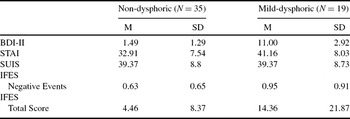
Means and Standard Deviations for both non-dysphoric and mild-dysphoric groups

Note: BDI-II = Beck Depression Inventory; STAI = State Trait Anxiety Inventory – Trait; SUIS = Spontaneous Use of Imagery Scale; IFES = Impact of Future Events Scale
Participants and procedure
Ethical approval was obtained and all participants provided written informed consent. Participants (N = 75; 34 males and 41 females) were students or members of the general public recruited via advertisements placed online, at two university campuses and in the local community. Mean age was 27.3 years (SD = 9.9).
A subgroup of participants were categorized on the basis of BDI-II scores (e.g. Holmes, Lang et al., Reference Holmes, Mathews, Mackintosh and Dalgleish2008) as currently non-dysphoric (with a BDI-II score of 4 or less, n = 35) and mild dysphoric (with a BDI-II score of 8 or greater, n = 19) in order to maximize sensitivity for detecting low mood in a non-clinical sample (e.g. Sprinkle et al., Reference Sprinkle, Lurie, Insko, Atkinson, Jones, Logan and Bissada2002; Wells and Beevers, in press).
Results
Inspection of the individual events on the IFES confirmed participants correctly reported discrete, specific events they had been imagining over the past 7 days. Examples included, “losing friends”, “meeting someone tonight” and “my grandmother's terminal illness”. No participant reported difficulty completing the measure, or provided incomplete or non-events. All responses were credible future events and no responses were overtly past events.
As predicted, IFES total score significantly and positively correlated with BDI-II in the total sample, although with a low correlation coefficient, r(73) = .26, p = .02. No statistically significant correlations were seen between IFES score and STAI-T, r(73) = .12, p = .31, or general imagery use, r(73) = .09, p = .44. Partial correlations confirmed that the correlation between IFES and BDI-II remained significant when controlling for STAI-T, r(72) = .24, p = .04 and for SUIS, r(72) = .26, p = .03.
When split by non-dysphoric/mild-dysphoric subgroup, no differences were seen between age, t(52) = 0.71, p = .48, or gender, x 2 (1, N = 54) = .43, p = .51. No significant differences were seen for general imagery use (SUIS) t(52) = 0.001, p = .99.
As predicted, comparison between the non-dysphoric versus mild-dysphoric subgroups confirmed there was a significant difference between total IFES score, with higher scores in the mild-dysphoric group, t(52) = 2.39, p = .021, d = .65. There was no significant difference between the two groups in terms of the mean number of IFES negative events, χ2 (3, N = 54) = 3.78, p = .29.
Discussion
The IFES was developed for the current study and demonstrated utility to measure the impact of “pre-experiencing” in the form of intrusive, prospective imagery of personally-relevant events. Findings confirmed two core predictions relating to dysphoria, thus demonstrating sensitivity to mild but clinically-relevant phenomena. First, the prediction of a significant correlation between higher IFES scores and BDI-II score was confirmed. Second, as predicted, analyses of the non-dysphoric and mild-dysphoric subgroups confirmed statistically significant greater impact of intrusive, prospective imagery in the mild-dysphoric participants.
In demonstrating increased impact of intrusive, prospective and personally-relevant imagery, these data provide a complementary extension of previous findings assessing responses to deliberately generated, non-personally relevant images in response to specific word cues in depression. Specifically, these data suggest that dysphoria is associated with greater intrusive imagining of personally-relevant future events, in comparison to non-dysphoric participants. Further research is required to establish whether our findings are in accordance with predictions that an overriding focus on negative (rather than positive) imagery may be a mechanism for maintenance of depressed mood (e.g. Holmes, Lang and Deeprose, Reference Holmes, Lang and Shah2009; Holmes, Lang et al., Reference Holmes, Mathews, Mackintosh and Dalgleish2008; MacLeod et al., Reference MacLeod, Tata, Kentish and Jacobsen1997; Starr and Moulds, Reference Starr and Moulds2006). Given the powerful effect of mental imagery on emotion (Holmes et al., Reference Holmes, Lang and Deeprose2009; Holmes and Mathews, Reference Holmes and Mathews2005; Holmes, Mathews et al., Reference Holmes, Lang, Moulds and Steele2008), we predict that intrusive negative mental imagery of the future may be particularly toxic in this way. The interplay between mental imagery and verbal thought is also worthy of exploration. In generalized anxiety disorder, Borkovec and colleagues have proposed that during worry, verbal thought is used to avoid emotional and physiological arousal associated with distressing mental imagery (Borkovec, Alcaine and Behar, Reference Borkovec, Alcaine, Behar, Heimberg, Turk and Mennin2001). Therefore the focus has typically been on verbal thought, which is unsurprising given its predominance over imagery (Freeston, Dugas and Ladouceur, Reference Freeston, Dugas and Ladouceur1996). IFES may provide one tool for use in exploring the impact of prospective mental imagery within worry, for example in the context of generalized anxiety disorder and other anxiety-based psychological disorders.
In conclusion, the data suggest that IFES provides a clinically relevant measure for assessing the impact of “pre-experiencing” in the form of intrusive prospective, personally-relevant imagery. Further investigations are required to extend findings into clinical depression and to explore the psychometric properties of the IFES. We also suggest this measure might be useful in exploring the impact of intrusive, prospective imagery in a range of psychopathological conditions, including bipolar disorder where it is predicted to be problematic (Holmes, Geddes et al., Reference Holmes, Geddes, Colom and Goodwin2008).
Acknowledgements
Emily Holmes is supported by a Royal Society Dorothy Hodgkin Fellowship and in part by a grant from the Economic and Social Research Council (RES-061-23-0030).
Appendix 1
Please identify three future events which you have been thinking about by imagining over the past 7 days (e.g. positive or stressful life events). For each event, please indicate whether your imagining of it was positive or negative by circling the appropriate response below.
1. ____________________________________________________ (Positive/Negative)
2. ____________________________________________________ (Positive/Negative)
3. ____________________________________________________ (Positive/Negative)
Below is a list of comments made by people about imagining events in the future. Please read each item, indicating how frequently each comment was true for you during the past 7 days due to imagining the future. If they did not occur during that time, please circle the “not at all” answer.




Comments
No Comments have been published for this article.