1. Introduction
The study of L3 learners and speakers is a new field, which faces several challenges. One of its crucial goals is to identify similarities and differences between acquisition of L2 and L3 (or any language Ln which follows a second language). By identifying similarities and differences, we can better delineate the phenomenon of L2 (an entrenched second language) and distinguish it from newcomer languages. A first step in attaining this goal is to identify and evaluate the differences and connections between the learner's first language (L1) and his or her non-native languages (L2, L3, etc.). A rich discussion has been underway in the L3 literature about situations in which L2 and L3 are similar to each other but different from L1; some thought has also been given to situations in which L1 and L3 are similar to each other but differ from L2. In all these cases, however, the underlying assumption is that L1 is fully learned and L2 is indeed a second language. In this paper, I bring a different case to the attention of L3 researchers: that of heritage-speakers-turned-learners. Heritage speakers (HSs) acquire their L1 in a naturalistic setting, but arguably not to the same full degree as monolingual speakers. Subsequently, but still at an early age, these speakers acquire a second language, again in a naturalistic setting, and it is this second language which manifests ultimate attainment. Nowadays, more and more HSs undertake to formally re-learn their original L1 in adulthood as an L3. Often this L3 is subtly different from the L1; HSs often learn dialectal variants in the home, whereas formal education usually focuses on the prestige variety of a language. HSs typically lack any schooling in their L1.Footnote 1
Incorporating HSs into the study of L3/Ln acquisition allows us to reevaluate critically three of the main models proposed in the L3 field: the Cumulative Enhancement Model (CEM) by Flynn, Foley and Vinnitskaya (Reference Flynn, Foley and Vinnitskaya2004); the Typological Proximity Model (TPM) advanced by Rothman and colleagues (Rothman, Reference Rothman2010, Reference Rothman2011, published online November 13, 2013; Rothman & Cabrelli Amaro, Reference Rothman and Cabrelli Amaro2010), and the L2 Status Factor Model (L2SFM) proposed by Bardel and Falk (Bardel & Falk, Reference Bardel and Falk2007, Reference Bardel, Falk and Amaro2012; Falk & Bardel, Reference Falk and Bardel2010, Reference Falk and Bardel2011).Footnote 2
Although the three models have several points of convergence, they also differ in a number of assumptions. For the purposes of this paper, the crucial questions addressed in these models include (i) the role of language transfer in L3 acquisition and (ii) the relative proximity of the language systems available to a learner.
Scholars distinguish between facilitative/positive transfer and non-facilitative/intrusive transfer during language acquisition (see Ringbom & Jarvis, Reference Ringbom, Jarvis, Long and Doughty2011, for an overview). Traditionally, facilitative transfer refers to knowledge that boosts the learner's ability to access and analyze information about the target language. This sort of knowledge often stems from similarities between the learner's L1 and his/her target language. Intrusive transfer refers to either the inappropriate use of L1 within L2/L3 or difficulty in the learning of new target structures as a result of L1 interference.
When we apply the notion of transfer to L3/Ln, it is necessary to ask which of the learner's background languages, L1 or L2/Ln–1, is the source of transfer. The three models listed above provide different predictions concerning the answer to this question. According to the CEM, each language system already available to the learner can either facilitate L3/Ln acquisition or remain neutral. Non-facilitative transfer should not be observed during L3/Ln learning, according to this system. According to the TPM, the underlying grammar of either L1 or L2 is expected to be transferred completely. The choice of source language for this transfer depends on the typological proximity between the source and target languages; the most typologically-proximal source language is preferred for transfer. Such proximity could be either actual or perceived, where “perception” is not necessarily conscious, but refers to the parser's sensitivity to linguistic cues in the input stream (Kulundary & Gabriele, Reference Kulundary, Gabriele and Amaro2012; Montrul, Dias & Santos, Reference Montrul, Dias and Santos2011; Özçelik, Reference Özçelik2013; Rothman, Reference Rothman2010, Reference Rothman2011, published online November 13, Reference Rothman and Treffers Daller2013; Rothman & Treffers Daller, in press). Non-facilitative transfer is allowed under this model, provided that it comes from the typologically-proximal source grammar. Finally, according to the L2SFM, L2 plays a privileged role in morphosyntactic transfer under L3/Ln learning. The main motivation for this asymmetry has to do with the accessibility of L1 and L2 (Paradis, Reference Paradis2009); L1 is associated with implicit knowledge and procedural memory, whereas L2 is associated with explicit knowledge and declarative memory – it is this association that gives it a privileged status under this model.
So far, these models have been tested primarily on learners who acquired their L2 and L3 later in life (but see Iverson Reference Iverson, Pires and Rothman2009, Reference Iverson2010). The L3 experience of HSs constitutes a unique acquisition context, which warrants special attention and should be instrumental in testing the boundaries of the existing models. In fact, García Mayo and Rothman explicitly mention this group in the following passage although they do not discuss it in detail:
Even a random review of a limited sampling of L2 studies done over the past decades reveals that many so-called L2 subjects are in fact L3/Ln learners, at least in a chronological sense.
“. . . the field of SLA lacks a clear working distinction between those who are learning a second language and those who are learning third or additional languages . . . it is usually up to the researcher to decide whether learners’ prior knowledge has the potential to bias the result of a study or not. Such freedom of choice, needless to say, conflicts with the most basic principles of methodological rigor in language acquisition research. While it may seem obvious to many that the prior knowledge of a non-native language is a variable that needs to be properly controlled, the reality is that the control for this specific variable is often poor, inadequate, if not lacking altogether . . .” (De Angelis Reference De Angelis2007: 5–6)
It might be the case that some such learners are child bilinguals (simultaneous bilinguals, child L2ers or heritage speaker bilingual adults) learning their first adult-acquired language.
(García Mayo & Rothman, Reference García Mayo, Rothman and Amaro2012, p. 12)
What can heritage languages (HLs) contribute to our understanding of L3/Ln acquisition? HSs are bilingual speakers of an ethnic or immigrant minority language whose L1 does not typically reach native-like proficiency, due to a shift (whether abrupt or gradual) to L2, the socially-dominant language, by the child learner. Thus, the order of linguistic acquisition will not necessarily reflect the relative strength of an HS's L1 and L2.
HSs’ learning process during L3 acquisition is unusual in two respects.Footnote 3 First, many of these speakers, having grown up using the socially-dominant L2 (American English in the USA, German in Germany, etc.), turn to re-learning their home (heritage) language later in life, usually at college level. Second, HSs’ acquisition of their L2 does not fit Paradis’ (Reference Paradis2009) model of explicit knowledge; HSs acquire their L2 in a naturalistic setting, and therefore in a procedural manner. They are, however, exposed to the dominant language in a school setting, and learn most of their metalinguistic skills in and of L2. To anticipate my discussion below, the contrast between later declarative exposure in L2 and relative absence of such exposure in L1 may play a role in HSs’ language learning in adulthood.
For many HSs, adult re-learning will be their first exposure to literacy and structured classroom input in their L1 (Bermel & Kagan, Reference Bermel and Kagan2000; Kagan & Dillon, Reference Kagan, Dillon, Gass and Mackey2012; Montrul & Bowles Reference Montrul and Bowles2010; Valdés, Reference Valdés2005). To quote Kagan and Dillon (Reference Kagan, Dillon, Gass and Mackey2012, p. 500):
Kagan and Dillon . . . propose a macro approach that includes content-based, task-based, and project-based curricula. They suggest a matrix for the HL [learner] curriculum that incorporates proper placement and stresses the significant amount of time that [HL learners] need to relearn and expand their language [emphasis mine – MP]. The matrix includes programmatic rigor, HL specific instructional materials, community-based curriculum, and instructors trained in HL teaching methodologies and approaches.
In childhood, HSs are exposed to the spoken variety of their home language; this spoken variant will not necessarily be the same as the standard version of the language introduced in the classroom. For example, HSs of Vietnamese in the USA have mainly been exposed to the southern dialect of their home language due to the political situation that arose in Vietnam after the fall of Saigon in 1975 (see Tran, Reference Tran2007). In contrast, standard Vietnamese is heavily based on the Central (Hue) dialect (Nguyen, Reference Nguyen1997). Thus, when HSs of Vietnamese enter a Vietnamese class they are expected to perform in a language variety quite different from their own. This type of disparity creates potential difficulties and confusion in the classroom for HSs (Lam, Reference Lam2006). In fact, heritage re-learners may be at a disadvantage compared to L2 learners, who do not have to negotiate dialectal differences. It is not the goal of this paper to comment on pedagogical issues that may follow from a difference in dialects; for my purposes, what is critical is that HSs choosing to re-learn their language in a classroom setting qualify as a special group of L3 learners. Their L1 is the baseline language to which they were exposed at home, their L2 is their dominant societal language, and they choose as their L3 the standard of their L1 tongue. This introduces an unusual dimension in L3 investigations and also raises questions concerning the advantages (or lack thereof) that HSs may have in re-learning their home language. Establishing systematic correspondences between the baseline and the language of instruction can help us in developing more effective practical methodologies for teaching such re-learners. Additionally, it is important to investigate the selective advantages exhibited by heritage re-learners. I will focus on this latter concern in the rest of this paper.
The observations made in this section set the stage for the discussion below. By necessity, I will be referring to a mosaic of case studies in my discussion; both the field of L3/Ln acquisition and the field of HL study are quite new, and there are still many gaps in our understanding of the relevant phenomena. Also by necessity, my survey will include discussions of some well-known publications – the goal is to incorporate their individual findings into a larger, still-emerging picture of HL re-learning.
The rest of the paper is structured as follows. In Section 2, I discuss studies which address the advantages (or lack thereof) that HSs encounter during re-learning. Based on certain phonetic and phonological deficits, we can conclude that HSs benefit from facilitative transfer from their L1 into their L3. However, no facilitation effects from L1 are found outside the sound system. Section 3 explores the roles of heritage re-learners’ L1 and L2 in their approach to L3 morphosyntax. I will demonstrate that HSs show asymmetric transfer effects, relying heavily on their dominant language but not on their HL. Furthermore, facilitation effects are observed equally in production and comprehension, which suggests that at least some of these effects are deeply rooted. Section 4 presents a tentative explanation for the reasons behind such asymmetrical transfer effects. Section 5 concludes.
2. Do heritage speakers make better L3 learners?
The work on re-learning of L1 as L3 is still in its infancy, but initial evidence suggests that the answer to the question posed in the section title above is a qualified “no”. Heritage re-learners seem to have selective advantages in mastering the phonetics and phonology of their L1/L3, but do not experience transfer advantages in other areas of language structure. Phonological competence seems to be the best-preserved aspect of linguistic knowledge in HSs, but even this component of the heritage grammar is not entirely native-like.
2.1 Phonetics and phonology
The main production advantage that HSs possess concerns voice onset time (VOT). VOT is defined as the duration of the interval between the release of a stop and the onset of vocal fold vibration for the following vowel. VOT distinguishes voiced obstruents (indicated by negative/short values) from voiceless obstruents (indicated by positive/long values) (Lisker & Abramson, Reference Lisker and Abramson1964). VOT is a universal feature particularly susceptible to change under language contact (Antoniou, Best, Tyler & Kroos, Reference Antoniou, Best, Tyler and Kroos2010; Chang, Reference Chang2012; Flege, Reference Flege1987; Flege & Eefting, Reference Flege and Eefting1987; Fowler, Sramko, Ostry, Rowland & Hallé, Reference Fowler, Sramko, Ostry, Rowland and Hallé2008), which is one of the reasons that researchers rely on it so heavily. Differential VOT effects are associated with particular phonemes; for instance, Au, Knightly, Jun and Oh (Reference Au, Knightly, Jun and Oh2002) demonstrate that low-proficiency Spanish HSs show no differences in their productions of voiceless stops as compared to native speakers. Y. Kang and Nagy (Reference Kang and Nagy2012) likewise found no difference in the VOTs for aspirated and lenis stops produced by native Korean speakers from Seoul compared to those produced by HSs (“Generation 2”) born and raised in Toronto; moreover, HSs demonstrated the same male/female VOT contrasts observed in modern-day Seoul Korean. Meanwhile, Khattab (Reference Khattab2003, Reference Khattab, Hua and Dodd2006, Reference Khattab2013) shows that Arabic HSs living in the UK have different VOTs for rhotics and laterals than monolinguals do.
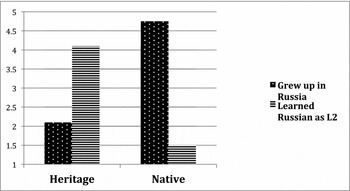
More globally, Au et al. (Reference Au, Knightly, Jun and Oh2002), Godson (Reference Godson2004), Khattab (Reference Khattab2002,; Reference Khattab, Cole and Hualde2007, Reference Khattab2013), Knightly, Jun, Oh and Au (Reference Knigthly, Jun, Oh and Au2003), and Oh, Jun, Knighly and Au (Reference Oh, Jun, Knightly and Au2003) show that low-proficiency Spanish, Korean, Western Armenian, and Arabic HSs (all of them English-dominant) have slight non-native accents in their respective HLs, suggesting that pronunciation is affected in HSs to some extent. In a matched-guise studyFootnote 4 conducted in our lab (http://pollab.fas.harvard.edu/), we played a short recording to 15 naïve native speakers of Russian. The samples included 20-second recordings of Russian speakers talking about a video clip from the popular Russian cartoon Nu Pogodi. The recordings were made by native Russian speakers from Moscow and other cities (N = 8) and by HSs studying Russian at several American universities (N = 10); all the recorded speakers were male, average age 21.7 years. The listeners were all natives of Moscow, Russia, average age 23.1 years, with high school or higher training. The listeners were asked to answer several questions on a Likert scale (1–5, 1: definitely not, 2: unlikely, 3: maybe, 4: likely, 5: definitely yes), including the two questions reported below:
-
(1) Did this person grow up in Russia?
-
(2) Did this person learn Russian as a second language?
The responses to these questions are shown in Figure 1. Of course, since the speakers in the recordings were delivering their own 20 seconds of speech (rather than reading from a script), it is possible that the listeners were picking up morphological/syntactic/lexical cues in the speech of the heritage learners, rather than just phonetic or prosodic cues. The choice to limit speech clips to 20 seconds was an attempt to correct for this potential confound; if the cues were outside segmental phonetics and prosody, we would expect less consistency in the listeners’ judgments, due to the brevity of the clips.
Match-guised listening comparison, Russian native and heritage speakers.

However preliminary, the results of this study indicate that HSs are distinguishable from native speakers on matched-guise listening. However, despite exhibiting slight differences in their phonology from L1 speakers, HSs still outperform L2 learners in both production and perception of sounds and phonological contrasts. Even low-proficiency HSs have unimpeded phoneme perception and discrimination – this has been demonstrated for Korean (Au, Knighly, Jun & Romo, Reference Au, Knightly, Jun and Romo2008; Oh et al., Reference Oh, Jun, Knightly and Au2003), Hindi (Werker & Lalonde, Reference Werker and Lalonde1988; Werker & Tees, Reference Werker and Tees1983, Reference Werker and Tees1984), and Chinese (Chang, Yao, Haynes & Rhodes, Reference Chang, Yao, Haynes and Rhodes2009).
2.2 Beyond phonetics and phonology
In addition to their advantage in the realm of VOT, HSs also have a slight lexical advantage over regular L2 learners. This is especially apparent in the realm of day-to-day vocabulary, which is more familiar to HSs due to the acquisition of the HL in a naturalistic setting (Montrul, Reference Montrul2008; Potowski, Reference Potowski2007). Aside from this restricted lexical advantage, however, there seems to be no evidence that early exposure to a language gives re-learners an unusual facility in domains other than phonology. A number of experimental studies examining Spanish, Korean, and Chinese re-learners show that they perform similarly to L2 learners with respect to morphology and simple syntactic structures (Au et al., Reference Au, Knightly, Jun and Oh2002; Au et al., Reference Au, Knightly, Jun and Romo2008; Jia & Bayley, Reference Jia and Bayley2008; Knightly et al., Reference Knigthly, Jun, Oh and Au2003; Ming & Tao, Reference Ming and Tao2008; Montrul & Bowles Reference Montrul and Bowles2010; Oh et al., Reference Oh, Jun, Knightly and Au2003).
The results of studies investigating classroom interactions and classroom exposure are even more dramatic. Blake and Zyzik (Reference Blake and Zyzik2003) investigate the interactions between Spanish L2 learners and heritage re-learners in the classroom, and show that, while HSs can provide useful lexical feedback, they also face significant problems with respect to morphology and overall literacy. Two studies of Spanish HSs in the classroom offer somewhat contradictory results. Montrul and Bowles (Reference Montrul and Bowles2010) examine the role of explicit grammar instruction for L2 learners and heritage re-learners, demonstrating that such instruction improves all learners’ performance on differential object marking involving the Spanish a personal (AP), as in (3)–(5). However, the degree of improvement is not consistent across-the-board and varies across different structures.
-
(3)

-
(4)
-
(5)


In particular, after explicit grammatical instruction, heritage re-learners outperformed L2 learners on acceptability tasks and cloze tests for indirect objects (4) and dative subjects (5); intriguingly, their performance with animate direct objects (3) did not improve significantly. Similarly, Potowski, Jegerski and Morgan-Short (Reference Potowski, Jegerski and Morgan-Short2009) examined the effect of explicit instruction on speakers’ use of the Spanish subjunctive. After exposure to instruction, both heritage re-learners and L2 learners showed significant improvement on interpretation and production tasks. However, only the L2 learners showed significant improvement on grammaticality judgments. In general, L2 learners outperformed heritage re-learners on the subjunctive.
In a study of production and comprehension of English by Hebrew-dominant HSs, Viswanath (Reference Viswanath2013) observed that his teenage subjects (aged between 12 and 14 years), who were (re-)learning English in an instructed setting at school, produced over-marked and over-regularized forms such as flied, throwed, drived (Viswanath, Reference Viswanath2013, p. 39) as well as the following (Viswanath, Reference Viswanath2013, p. 40):
-
(6) a fox is walking . . . then he sees two mouses
-
(7) a book that is wroten in English
Similarly, in Heritage English spoken by teenage French-dominant speakers, one finds forms such as runned, growed, buyed (Gittelson & Polinsky, Reference Gittelson and Polinsky2013). Such errors are, of course, found in young L1 learners of English as well, but they do not persist into the teenage years; it is particularly striking to see this type of error occur under the structured instruction that the English HSs in question received.
Thus, it appears that there are some unique difficulties associated with heritage re-learning; L3 and L1 are not rushing to connect. This result is particularly important in light of the Typological Proximity Model – after all, even if the standard form of the language that HSs were exposed to in childhood is somewhat different from the baseline, it certainly is quite close to the language HSs count as their L1. Yet, we do not find facilitation effects from L1 beyond the phonetic system.
2.3 Why are heritage re-learners not always better than L2 learners?
It seems perhaps counterintuitive to discover that heritage learners are not always stronger than L2 learners at re-acquiring their original language. What might cause such a discrepancy? I would like to offer two considerations. First, it is important to underscore the preliminary nature of the results introduced above; we are talking about a small set of studies, each of which examines a particular phenomenon in the L3/heritage grammar. Often the phenomena chosen for investigation are in the limelight for a reason; they may pose some inherent difficulty for all types of learners, from L1-acquiring children to L2 and L3 adult students, in which case it is not accidental that heritage re-learners struggle with them as well.
Such considerations make it all the more crucial that more controlled comparisons between L1, L2, and heritage learners be conducted on specific aspects of morphosyntax. It is my hope that this paper will serve to stimulate new studies in this area. If we do continue to observe a sustained pattern of success by heritage re-learners in the realm of phonetics/phonology paired with underperformance in the realm of morphosyntax, there will be important explanatory work ahead of us. At the moment, however, it would be premature to rush into such a project on the basis of the scarce data available.
The second consideration I would like to offer has to do with the nature of the re-learning process that HSs undertake – an issue I have already alluded to in the introduction. HSs acquire their baseline language in a naturalistic setting, while their re-learning of L3/Ln almost always takes place under formal training. It is possible that HSs do not make a strong connection between their original, naturally-acquired language and the language that they are learning in a classroom setting. If this proposal is on the right track, then it will be useful to compare the acquisition of the standard language by HSs to the acquisition of literacy by adult learners. It is possible that the difficulties experienced by HSs are similar to those of illiterate adults or older children learning their language in a formal setting. At this point, I have only one data point, drawn from a pilot study, to support this conclusion.
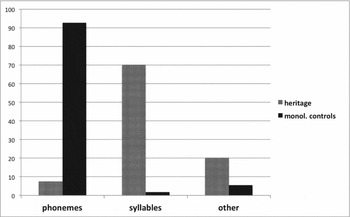
The inspiration for this pilot study came from work by several researchers (Gombert, Reference Gombert1996; Hakes, Reference Hakes1980; Liberman, Reference Liberman1973; Liberman, Shankweiler, Fisher & Carter, Reference Liberman, Shankweiler, Fisher and Carter1974), who found that preliterate children have trouble recognizing phonemes of their language; instead, they rely on syllable recognition or a combination of syllables and phonemes. I conducted a similar pilot study with seven English-dominant HSs of Russian (average age 19.2 years; all born in the USA; two females), all of whom were illiterate in Russian. I asked the speakers to repeat a disyllabic word (18 actual words/18 nonce words, all nouns; see Appendix) and then tap once for each phoneme (this is the methodology used by the authors cited above). I compared the performance of this group with that of five age-matched monolingual speakers from St Petersburg (all males). The groups used are too small to conduct statistical analysis; however, some patterns emerge. No subject in the heritage group exceeded 11% accuracy in tapping the actual phonemes; the average success rate was seven percent. Most subjects tapped twice for each word, indicating sensitivity to the syllabic rather than the phonemic structure.Footnote 5 (Out of the seven subjects, five used the syllable tapping strategy more than 70% of the time, one used it 55% of the time, and one, 33% of the time.) The monolingual controls were at about 93% accuracy in tapping for actual phonemes. There was no difference between the tapping for actual words and for nonce words. The results in percentages, averaged over the two groups, are summarized in Figure 2. Existing data on Russian preliterate children show the same pattern: the children overwhelmingly tapped for syllables rather than phonemes (Dič, Reference Dič2006). In other words, heritage adults perform at a similar level to preliterate preschoolers in terms of their phoneme-to-letter comprehension.
Strategies for tapping out words by heritage speakers of Russian (not literate in Cyrillic) and monolingual controls: Average percentages by groups (seven heritage speakers, five controls, 36 words).

These results lead to a set of testable questions: Are adult HSs who are illiterate in their home language consistently similar to preliterate children in their phonemic representation? Does this representation change after literacy instruction, and how fast is the change?Footnote 6
2.4 Interim summary
Data from HSs re-learning their HL in adulthood do not support the idea, advanced by the CEM, that learners can transfer features and categories from both L1 and L2 to L3. Furthermore, HSs re-learning their childhood language do not show facilitation effects beyond phonetics, which suggests that the TPM might need to be constrained by relativizing proximity effects to different levels of language structure (phonetics, phonology, morphology, etc.).
3. The role of transfer in heritage language re-learning
I have established a tentative case against facilitation from the HL to the related standard language when the latter is acquired in adulthood as L3/Ln. However, L3/Ln learning in general is known to be associated with strong transfer from one or more of the languages that the learner already knows. So the question for us is whether or not HSs show transfer from their dominant language – technically, their L2 – in the re-learning of their HL. The short answer to this question is “yes”: heritage re-learners show intrusive effects from their dominant language in the morphosyntax of the language they are re-learning. This intrusion from the dominant language may explain why heritage re-learners do not perform better than L2 learners in morphosyntax. In the discussion below, I will separate the discussion of transfer effects into production- and comprehension-related phenomena.
3.1 Transfer from the dominant language? Production: Yes
One of the most striking signs of intrusion from the dominant language can be seen in the word order of the HL. I will illustrate this effect with examples from two HLs for which production data are available at the Polinsky Lab Dataverse (Gittelson & Polinsky, Reference Gittelson and Polinsky2013; Visawanath & Polinsky, Reference Viswanath and Polinsky2013). The data were elicited through two types of experiments: a structured production experiment where HSs were shown silent video clips and asked to narrate what they saw, and the Fruit Cart experiment, described below.
Let us start with examples from heritage English, as spoken by second-generation American expatriates in France and Israel. Both French and Hebrew differ from English with respect to verb-raising (see Pollock, Reference Pollock1989, for French, and Borer, Reference Borer1995; Shlonsky, Reference Shlonsky1997, for Hebrew). A well-known symptom of such raising is the placement of adverbials between the verb and the direct object, as in the following examples:
-
(8)
-
(9)
-
(10)


The structural representation of verb-raising is shown below, with the diagnostic adverb in bold:
-
(11)

In the speech of French- and Hebrew-dominant HSs of English, one finds patterns of production where the adverb or a PP follows the verb, as shown below. Such patterns are common in the dominant language.Footnote 7
-
(12) He see upstairs a rabbit. (French Heritage English)
-
(13) He put in his basket carrots. (French Heritage English)
-
(14) He saw also a rabbit. (Israeli Heritage English)
-
(15) I imagined suddenly this picture. (Israeli Heritage English)
-
(16) We don't have nowadays a celebration. (Israeli Heritage English)
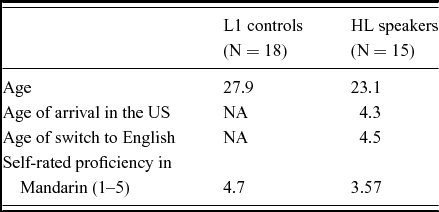
Another example of apparent intrusion from the dominant language comes from Heritage Mandarin Chinese, as spoken by English-dominant speakers. The data were elicited from 15 HSs and 18 controls who participated in a structured production experiment known as the “Fruit Cart experiment” (Aist, Campana, Allen, Swift & Tanenhaus, Reference Aist, Campana, Allen, Swift and Tanenhaus2012).Footnote 8 Demographic information about the subjects is presented in Table 1.
Subjects in the Fruit Cart experiment, Mandarin.

The Fruit Cart task allows researchers to elicit unscripted production data within a sufficiently constrained space. In this task, one participant (the director) gives directions to the other (the confederate) on how to carry out the task. The director wears a headset microphone that collects speech data; the confederate is not allowed to speak.
The Fruit Cart domain has three screen areas: a map, an object bin, and a control panel. Each area is designed to elicit expressions that require continuous understanding and restriction of a reference set throughout the utterance. The map contains named regions, with flags as landmarks. The names of the regions are selected according to the language under investigation (for instance, in the Mandarin experiment described here, all the place names are Mandarin toponyms). The object bin contains fruits and carts, by analogy with food-vendor carts (e.g., hotdog stands). The “fruits” are all truly fruits in the botanical sense, but some are sociologically vegetables: avocados, bananas, cucumbers, grapefruits, and tomatoes. The carts are either squares or triangles, in two sizes, with an optional tag (square carts may have either a diamond or a heart tag; triangle carts may have either a star or a circle). Each component is easy to name, but full characterization of the entire cart shape requires the use of a complex description; simple prenominal modifiers will not suffice. That is, whereas a square with stripes could be either the square with stripes or the striped square, a square with a diamond on the corner is the square with a diamond on the corner but not *the corner-diamonded square. The control panel contains left and right rotation arrows and six paint colors (black, brown, orange, blue, pink, and purple) chosen to be distinct from the colors of the fruit. Participation in the Fruit Cart task involves a series of tasks, all performed with the use of a mouse. To CHOOSE a cart, the user clicks on it. To PLACE it on the map, the user drags it there. To PAINT the cart, the user clicks on the desired color. Painting is a uniformly easy control task. To ROTATE the cart, the user presses and holds down the left or right rotation button. The resulting experimental environment is a source of rich material which allows researchers to investigate speakers’ planning strategies and also collect a corpus of natural speech, from which the examples below are drawn. Because the instructions that the director must give require that s/he specify the qualities of a particular object, the task is naturally conducive to the production of relative clauses. In the discussion below, I will address the position of these relative clauses with respect to the head noun.
In Mandarin, the relative clause (RC), whose right edge is marked by the adnominal exponent de (see DE in the glosses below), must precede the head noun, as shown in the following example:
-
(17)

When Heritage Mandarin speakers participate in the Fruit Cart task, they show a strong tendency to postpose the relative clause; however, the adnominal marker de still remains present at the end of the clause. For example:
-
(18)

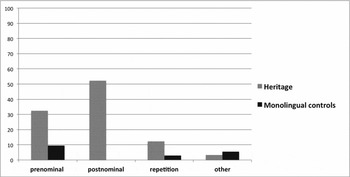
In the Fruit Cart production data, the use of postnominal relative clauses by HSs is extremely widespread. Figure 3 below shows the distribution of relative clause placement strategies (in percentages) by native controls vs. HSs. Native controls did not place relative clauses postnominally at all; however, HSs did so in almost 70% of cases. The difference between the use of the postnominal RC and the prenominal RC by HSs is significant (p = .03, s.d. 10.7), and so is the difference between HSs and native controls (p = .01, s.d. 13.4). HSs also used the strategy of “repetition”, in which the object head noun is placed both before and after the relative clause. This is not a strategy that occurs in the baseline language, and it may reflect the speakers’ confusion with respect to the placement of relative clauses.
Percentage of relative clause options in the production data by native and heritage speakers of Mandarin.

3.2 Transfer from the dominant language? Comprehension: Yes
The experiments surveyed above examined production in L3 by HSs; the results showed strong influence from their dominant language, which is their L2. Could these results arise as a result of superficial transfer from the language that the L3 learner uses the most, due to online production pressures? Viswanath (Reference Viswanath2013, p. 60) presents data which suggest that the transfer effects are deeper than that. Viswanath asked Hebrew-dominant HSs of English to evaluate sentences such as (13)–(16) above. Although the study had some confounds, it showed that HSs accepted postverbal adverbs as grammatical. These results indicate that the transfer effects on morphosyntax extend beyond simple production errors.
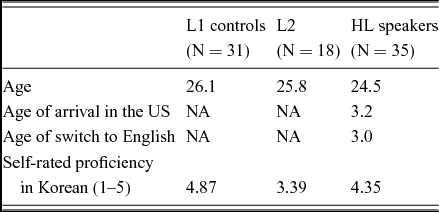
Additional systematic data bearing on the question of degree of transfer come from a comprehension study of heritage Korean (see also Laleko & Polinsky, Reference Laleko and Polinsky2013a, Reference Laleko and Polinskyb). This comprehension study was designed to compare native speakers, English-dominant heritage re-learners, and English-speaking L2 learners of Korean in their assessment of grammatical, ungrammatical, or infelicitous sentences. Subjects were asked to read the sentences and then rate them on a 1–5 scale (1: completely unacceptable, 5: completely acceptable), with no time limit on the assessment. Demographic information about the subjects is presented in Table 2.
Subjects in the comprehension study, Korean.

It is known that HSs often have issues with literacy (Bermel & Kagan, Reference Bermel and Kagan2000; Valdés, Reference Valdés2000); however, since the sentences in this study were presented visually in Korean script (hangul), it was necessary that all the HL subjects be literate. As the demographic questionnaire indicates, the majority of these subjects were enrolled as adults in a Korean language class.
A subset of sentences in the study involved scrambling, as shown in the following examples:Footnote 9
-
(19)
-
(20)


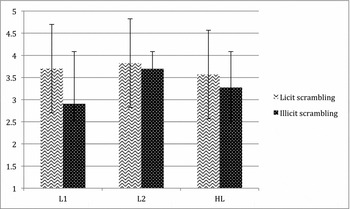
(19a) exemplifies a typical Korean word order, with the subject preceding the object and the verb in the final position. (19b) shows licit scrambling, with the object preceding the subject. Such scrambling is associated with specific discourse effects and is very rare; it occurs about 1.3% of the time in corpora (Kwon, Polinsky & Kluender, Reference Kwon, Polinsky, Kluender, Baumer, Montero and Scanlon2006, p. 3). (20) shows illicit scrambling, where the finite verb is no longer in final position; it is followed by the object and the locative PP. This is similar to the word order in English. The three groups’ responses to the stimuli in (19) and (20) are shown in Figure 4.
Average sentence ratings by L1, L2 and HL speakers of Korean, possible and impossible scrambling (1–5 scale).

All three groups produced comparable ratings for grammatical sentences such as (19a, b); pairwise comparisons yield p = .46 for L1 and HL, p = .53 for L1 and L2, and p = .09 for HL and L2. On ungrammatical conditions such as (20), however, HSs differed significantly from the L1 group (p = .007, s.d. 14.1), although they were not significantly different from the L2 group (p = .05, s.d. 17.3).Footnote 10 This difference indicates that HSs of Korean are similar to L2 learners in their failure to recognize illicit structures in the domain of word order.Footnote 11 This, in turn, suggests that transfer effects in word order are not limited to production, and therefore cannot be considered to be just a surface reflex.
The results of a comprehension experiment targeting quantifier float were similar. L1, L2, and heritage re-learners of Korean were asked to rate the following kinds of sentences:
-
(21)
-
(22)


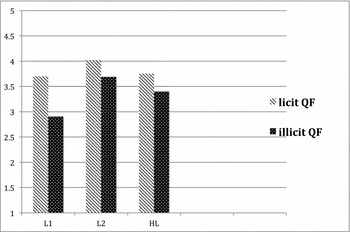
In (21), the floated quantifier motwu “all” is licit; it is hosted by an object and appears in the correct linear position, after the noun that it is associated with. In (22), the floated quantifier is ungrammatical because it is associated with a transitive subject. This is an impossible configuration in Korean, where only VP-internal arguments can license floated quantifiers (see B.-M. Kang, Reference Kang2002; Ko & Oh, Reference Ko and Oh2010, and further references therein). The ratings by the three groups under discussion are given in Figure 5.
Average sentence ratings by L1, L2 and HL speakers of Korean, possible and impossible quantifier float (1–5 scale).

In their ratings of the acceptable condition (21), the native controls and HSs were not different from each other, but they differed from the L2 speakers, who rated the construction more highly than the other two groups (p = .0002). At this point, I have no explanation for such a difference. On the ungrammatical condition, (22), the heritage group and the L2 group patterned the same (p = .14) and were dramatically different from the native controls (p = .006). Essentially, the two non-native groups accepted the illicit floated quantifier. This pattern suggests the possibility of influence from English; the illicit pattern in Korean (22) is licit in English (see Bobaljik, Reference Bobaljik, Cheng and Sybesma2003, for a discussion):
-
(23) The children have all called John's friend. (English)
These results indicate that transfer from the dominant language is equally present in L2 and L3/HSs. Additionally, these results show that transfer from the dominant language is not just a surface phenomenon, and may extend beyond simple linearization (linearization is arguably the most visible linguistic component and thus the most susceptible to change). Thus, at least in some domains of grammar, both HSs and L2 speakers experience significant transfer effects from their dominant language.
We are now left with at least four questions. First: Is there a principled way to predict where transfer effects (from either L1 or L2) may apply, and which aspects of language design may be susceptible to facilitation or intrusion? It would be undesirable to simply investigate phenomenon after phenomenon without a clear set of predictions. The second question is related to the first one: Can we predict areas of language structure that are likely to show surface transfer effects, perceptible in production but not in comprehension? Unfortunately, we are still in the beginning of our exploration of L3 and HLs, so answers to these questions have not yet emerged; nevertheless, it is important that we raise these questions and address them as a field.
The third question concerns possible explanations for the asymmetric transfer effects observed in HL re-learning: Why is it that heritage re-learners do not enjoy a global learning advantage over L2 learners (as we saw in Section 2)? Furthermore, why do heritage re-learners show morphosyntactic transfer only from their dominant (L2) language? I will address this two-part question in the next section, before turning in Section 5 to the final question raised by these data: What are the implications of the results presented in this paper for the three main models of L3/Ln acquisition?
4. Asymmetric transfer
I beg an the present discussion with a comparison of heritage re-learners and “regular” L3 learners. The fact that such a comparison is relevant implies that HSs may manifest properties typical of non-native speakers. Although HSs may enjoy certain advantages associated with bilingualism, they nevertheless face challenges when attempting to (re-)learn an L3 that is close but not identical to the baseline language they were exposed to in childhood. The emerging pattern of results suggests that HSs have only a limited advantage in the re-learning of their childhood language – this advantage, which can be couched in terms of clear facilitation from the childhood language to the L3/Ln, applies at the phonetic level, and to a certain extent, but not globally, at the phonological level.
Beyond the phonological level, heritage re-learners do not show advantages over other L3/Ln learners. Moreover, they show a strong asymmetry in the extent to which the languages they already control affect the process of re-learning; generally speaking, heritage re-learners exhibit a significant degree of transfer from their dominant language (L2), but very little transfer from their L1, even though the L1 is very similar or identical to the new L3.
Why might this be? The dissonance between intrusive transfer from the dominant language and lack of facilitation from the HL could have at least two motivations. First, adult learners come to the heritage-turned-L3 classroom trained in metalinguistic knowledge of their dominant language but not of their HL. I suggest that, when the standard dialect of their HL becomes a language of classroom exposure, HSs are more prepared to apply the skills gained in an educational setting, associated with their dominant language, than the skills learned in a naturalistic setting at home. If this explanation is on the right track, we may expect differences in the pattern of re-learning between HSs who are exposed to their HL in a classroom setting (the population used in this study and similar studies) and HSs who return to the homeland of their HL and re-learn that language in a naturalistic setting. No such comparisons exist to date, so this proposal remains a speculation.
The second consideration has to do with the proximity between the HL and L3. HSs are of course aware that the language they are learning is very close to the language they heard growing up. Although the language used in the classroom is a dialect of their home language, heritage re-learners are constantly reminded by their instructors of the differences between the way they speak and the way they should be speaking (see Leslie, Reference Leslie2012; Parodi, Reference Parodi, Brinton, Kagan and Bauckus2008; Valdés, Reference Valdés2000, pp. 389–392). An emphasis on the standard, or prestige, variety of the language is prevalent in many heritage classrooms. This tendency is particularly apparent, or at least best documented, in the case of Spanish. To quote Valdés (Reference Valdés2000, p. 391):
[T]he acquisition of the prestige variety, is perhaps the approach that has most commonly been used in teaching Spanish to heritage speakers. . . . [H]owever, in spite of our knowledge about the complexity of inter- and intra-individual variation, little is known about how standard dialects are acquired. There are no existing theories that can guide practitioners in deciding how to “teach” such a standard . . .
Consider also the following remarks made by an HS of Spanish who was enrolled in re-learning classes while in high school (interview reported in Leslie, Reference Leslie2012, pp. 16–17):
[W]e all got the idea that Spanish was this very formal thing that we learned and that we presented on, but we liked to relax and enjoy ourselves with our friends and speak English.
If the absence of specific pedagogical guidelines is obvious even in such a widely-taught language as Spanish, it is even stronger in less commonly-taught languages. In the absence of guidelines, it is not uncommon for practitioners of standard teaching to emphasize the differences between the prestige variety and the language brought into the classroom by HSs (see Parodi, Reference Parodi, Brinton, Kagan and Bauckus2008, p. 200, who shows that the teacher's attitude to non-standard varieties tends to be dismissive and discouraging to HL re-learners; see also Leeman, Reference Leeman, Rivera-Mills and Villa2010, who writes that many teachers of HL re-learners often have the belief that certain forms within language variation are “wrong” and should be corrected).
Two related factors emerge: classroom emphasis on the prestige (standard) variety of the HL, and common dismissal or put-down of the language HSs bring into the classroom. This emphasis on the differences between the prestige variety and the learners’ L1 variety of the HL may lead to a subconscious effort on the part of HSs to distance the L1 from the L3, by separating the two and treating them as maximally different. This in turn has unexpected implications for the Typological Proximity Model, one of the three models of L3 acquisition with which we started our discussion. When L3/Ln is perceived as being close enough to an individual's L1 or L2, this may lead to learning facilitation (Rothman, Reference Rothman2010, published online November 13, 2013); however, when two languages are “too close for comfort”, this may compel the learner to enhance the psychologically perceived distance between them. Such a perception may have inhibitory effects on language acquisition, and such effects will only be magnified when a learner's L1 becomes his/her classroom L3.
5. Taking stock
To conclude the discussion, I return to the question posed in the title of this paper: Do HSs make better L3/Ln learners than do speakers with no prior knowledge of their new language of study? It should be apparent from the discussion throughout this paper that no clear answer to this question exists; however, it certainly appears that HSs make different L3/Ln learners. As demonstrated in a number of studies, HSs show principled differences from native speakers in their linguistic performance (see Benmamoun, Montrul & Polinsky, Reference Benmamoun, Montrul and Polinsky2013, for an overview). On the other hand, they also differ from L2 learners and from non-heritage L3 learners in the way they deploy their languages in the learning process.
HSs do show facilitation from their L1 in the domain of phonetics and phonology. This is not trivial, because the language variety they are (re-)learning is not the same as the language they were exposed to in the home; instead, it is the standard or prestige dialect, which may display some differences from the home variety known to heritage re-learners. On the other hand, as far as it is possible to tell from the limited data available, HSs do not show facilitative transfer from their L1 in the domain of morphosyntax. Instead, they show (negative) transfer effects from the syntax of their dominant language, the one that counts as their L2.
Assuming that these results are on the right track, they have a number of implications for existing models of L3/Ln learning: the Cumulative Enhancement Model (CEM), the Typological Proximity Model (TPM), and the L2 Status Factor Model (L2SFM). Recall that, according to the CEM, all the language systems available to the learner can facilitate L3/Ln acquisition or remain neutral. This model is not supported by the current results. Moreover, the differences shown in this article between phonetics/phonology on the one hand and (morpho)syntax on the other suggests that the CEM's predictions may need to be relativized to a particular domain of language knowledge.
According to the TPM, the underlying grammar of either the L1 or the L2 is expected to be transferred completely, and the choice of source language for transfer depends on the typological proximity between the source and target languages. As with the CEM, this proposal seems too global and needs to be relativized to distinct language domains, particularly phonology vs. syntax. In its current form, this model cannot account for the patterns of linguistic behavior exhibited by heritage re-learners.
The TPM may be further tested by comparing data from HSs who are not re-learning their language with data from those who are. It is possible that intrusive transfer from L2 is present in L1 itself, and thus, when HSs start their adult re-learning, they transfer the structures not directly from L2 but from L2 via L1. Such transfer would be consistent with the extreme proximity between L1 and L3. In other words, there may be two sources for dominant language transfer: direct and indirect.Footnote 12
Of course, differentiating between the two sources may be very difficult, since the end result is the same. Teasing direct and indirect transfer apart could be done in two ways. First, one could examine structures that are very infrequent or simply absent from the baseline input (for example, structures present in a particular register that HSs do not learn at home – see Dubinina, Reference Dubinina, Mustajoki, Protassova and Vakhtin2011; Dubinina & Polinsky, Reference Dubinina, Polinsky, Moser and Polinsky2013, for some discussion). L2 transfer in such cases is likely to be direct, since the relevant structures are lacking in the HSs’ L1. Based on data on Russian requests (Dubinina, Reference Dubinina, Mustajoki, Protassova and Vakhtin2011), heritage Russian speakers do indeed superimpose English norms on their newly re-learned Russian. Korean scrambling, which is extremely rare, may also present a good test case for direct versus indirect transfer – if L2 transfer is found in this context, we can conclude that heritage re-learners are transferring directly from English, not via L1.
A second method for teasing apart direct and indirect transfer would be to examine HSs’ linguistic abilities prior to the re-learning period. Conducting a pretest of this sort would permit us to establish a true baseline for individual knowledge of the heritage grammar for a particular property. It would then be possible, during the re-learning phase, to directly observe the state of the heritage grammar for particular structures or grammatical domains. If English transfer were found in such contexts, this would confirm that the source of non-facilitation is indeed the dominant language rather than mediated transfer through the L1.Footnote 13
The final model under consideration is the L2SFM, according to which the second language plays the crucial role in L3/Ln learning. It is this hypothesis which is most consistent with the data on HL re-learners discussed in this paper. However, unlike the “typical” L3 learners assumed in the L2SFM, HSs do not acquire their L2 in an instructed setting; thus, the privileged role of L2 may not necessarily follow from L2's association with explicit knowledge and declarative memory. It is true that HSs will have been primarily exposed to formal training in their L2, the language in which they were schooled, but there may be multiple causes for the privileged status of L2 in morphosyntactic transfer, of which access to declarative memory is just one. Amount of exposure may be another: by the time they reach adulthood, HSs have had more exposure to their L2 than to their L1, and this may play a role in determining which language intrudes on their L3. Data from heritage re-learners offers novel support for the L2SFM, but the contribution of these new results goes beyond that. These results suggest that the L2FSM may be more general in scope than originally expected; this opens up an intriguing potential in this model, one that calls for further exploration.
Appendix. Russian words in the phoneme identification pilot