


Introduction
To improve treatments for chronic pain, understanding treatment failure is necessary. Psychological treatment studies for pain typically report significant group mean improvements, yet these groups will include many individuals who had no improvement. A review of psychological treatment for chronic pain advised attention to adverse events and the use of responder analyses (Morley et al., Reference Morley, Williams and Eccleston2013), where the classification of individual patients as treatment responders, or non-responders, allows researchers to go beyond mean scores in the search for predictors of treatment response.
Elliott (Reference Elliott2010) identified three key methodological approaches in therapy process research. ‘Process-outcome’ uses in-therapy variables to predict outcomes. ‘Sequential process’ analyses the events within and between therapy sessions to establish dependencies between therapist and client responses. Finally, the ‘helpful factors’ design directly asks recipients of treatment about their opinion of effective therapeutic factors.
The ‘helpful factors’ design is attractive as it stays close to the patient's experience, and can be done in routine treatment settings. Recent examples include qualitative analyses of interviews and diary entries. However, the potential power of this design is restricted by the limitations of self-report, as patients’ insight into the causes of their own therapeutic response may be limited.
Results from ‘helpful factors’ research depends on which participants are asked. For instance, barriers to treatment are best explored in those who have most evidently encountered them (i.e. non-responders). However, ‘helpful factors’ studies usually select samples of patients who have experienced a treatment, and do not discriminate whether these individuals benefited from treatment or not.
We extended the value of ‘helpful factors’ design by controlling for difficulties in self-report, in the context of intensive, residential, group-based acceptance and commitment therapy (ACT) treatment for chronic pain. Exploring the reasons for treatment non-response, we asked patients about a range of individual, systemic and therapy-related factors that may have negatively affected their treatment outcome. The factors reflected patients’ reports and therapist formulations for potential treatment success or failure. Responses from ‘responders’ and ‘non-responders’ were compared in order to control for factors that patients did not like, but that were unrelated to outcome. We hypothesized that differences would exist between responders’ and non-responders’ views of helpful and unhelpful factors in treatment.
Method
Participants
A retrospective questionnaire was sent to 130 people with chronic, non-malignant pain who had consecutively attended intensive, residential, psychologically based pain rehabilitation treatment (3 or 4 weeks) at a national specialist service. This included 65 treatment non-responders (69% female) and 65 responders (83% female), with a heterogeneous group of musculoskeletal pain diagnoses. Patients were clinically selected for treatment, and thus had sufficient English and cognitive abilities to engage in group treatment. No further inclusion or exclusion criteria were applied.
Participants completed treatment between 5 and 43 months prior to the study (median = 29), delivered by a team of clinical psychologists, physiotherapists and occupational therapists, all specialists in pain rehabilitation. Participants completed standard outcome measures pre- and post-treatment, and at a three-month follow-up.
Procedure
The study received ethical approval from the relevant NHS (REC reference: 14/EE/0213; IRAS project ID: 146652) and University Ethics Committees (14-050), and the local Hospital R&D Committee.
Participants were identified by reviewing consecutive cases in a treatment outcome database. We included 65 ‘responders’ and 65 ‘non-responders’, identified using the Reliable Change Index (RCI). The sample size was decided pragmatically, based on the size of our database and anticipated return rates. The questionnaire package was posted with a £10 voucher. A reminder letter was sent after two weeks.
Defining non-responders
‘Non-responders’ and ‘responders’ were classified using the RCI (Jacobson et al., Reference Jacobson, Roberts, Berns and McGlinchey1999), which indicates when the magnitude of change seen is unlikely to be due to chance or measurement imprecision [see Vowles and McCracken (Reference Vowles and McCracken2008) for formula]. This differs from clinically significant change, which is defined by the number of participants returning to a ‘normal’ or ‘non-clinical’ range. However, this is less appropriate for chronic pain, where ‘recovery’ is not expected. We looked at RCI inspecting three core clinical outcomes, at pre-treatment and three month follow up: overall disability, pain-related fear, and depression. ‘Non-responders’ were those who did not achieve reliable change in all domains; ‘responders’ achieved a reliable change in one or more domains.
Measures
Routine outcome measures were used to compute RCI. For disability, we used the total score from the Sickness Impact Profile (SIP); for pain-related fear, a total score of the Pain Anxiety Symptoms Scale (PASS); for depression, either the symptom severity subscale of the British Columbia Major Depression Inventory (BCMDI) or the total score from the Patient-Health Questionnaire (PHQ-9) was used. Patients treated prior to December 2011 (65.3%) completed the BCMDI, whereas those who attended later completed the PHQ-9.
Novel ‘treatment factors’ item set
We aimed to survey factors related to the individual, their context, and the therapy itself. To the authors’ knowledge, no instrument that covers these domains exists. The process of design aimed at creating items that closely reflected patient and therapist concerns, which could be structured by subscales.
An initial item set was generated, based on the authors’ clinical experience and the results of a clinical case note audit examining treatment response in a sample of 30 severely disabled patients with chronic pain. We then reviewed 50 ‘patient satisfaction’ forms where patients were invited to describe helpful aspects of the service. The proposed item set was circulated to the clinical team, at a national specialist in pain rehabilitation.
The final set included 80 items. The broad focus necessitated different response formats for certain sets of items. For example, a 7-point scale ranging from ‘1’ (very unhelpful) to ‘7’ (very helpful) was used for items such as ‘being away from my normal routine’. In contrast, a scale from ‘1’ (very untrue of me) to ‘7’ (very true of me) was used for items such as ‘I was personally motivated to engage in treatment’. We grouped these items into six subscales: Change in routine; Communication and trust; Emotional state; Group climate; Medical interference; People outside of programme.
Data analysis
We explored themes by groups of thematically related Items. We considered the internal consistency of items within the pre-defined ‘subscales’, deleting items if they contributed to an unsatisfactory alpha. The remaining items resulted in internally consistent subscales (Cronbach's α .79 to .94) that were used as independent variables in a logistic regression analysis, with Response Group (responder or non-responder) as the dependent variable. The data were screened to ensure that it satisfied the assumptions of logistic regression.
Results
Responder analysis
The responder analysis indicated that a reliable change was observed in at least one domain for 56.8% of cases. Split by outcome measure, a reliable change was found for 34.2% of patients on the BCMDI, 22.0% on the PHQ-9, 30.9% on the PASS, and 43.9% on the SIP.
Demographics
Of 130 questionnaires sent, nine were returned due to incorrect addresses; 75 were successfully returned (62%). This included 40 non-responders (53.3%; 26 females; mean age 42.85 years; median pain 114 months), and 35 responders (24 females; mean age 45.38 years; median pain 71 months). Groups were similar on baseline demographics, although responders reported higher disability (p < .01) and pain-related fear (p < .05).
Logistic regression
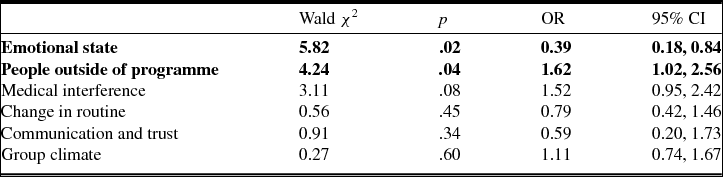
The regression model accounted for a significant amount of variance (p < .01), successfully classifying 70% of the cases overall (60% of responders and 80% of non-responders). Coefficients are given in Table 1. Two variables significantly predicted Response Group: ‘Emotional state’ and ‘People outside of programme’. Being a non-responder was associated with lower reports of bothersome emotional states, and with greater reported interference from people outside of the programme.
Logistic regression coefficients, with variables below as predictors of Response Group (non-responder or responder)

p < .05 represented by bold type. OR, odds ratio; CI, confidence interval.
Discussion
We surveyed a group of patients who did not respond to pain rehabilitation treatment. ‘Non-responders’ reported that their treatment was negatively affected by people outside of treatment, and paradoxically that they were experiencing fewer distressing emotional states at the time of the programme, compared with the ‘responder’ control group.
To extend traditional approaches to studying treatment process, our design permitted examination of a range of clinically relevant factors, and introduced a comparison group. Certain factors that non-responders cited as ‘not helpful’ in treatment were endorsed equally by responders, indicating the value of the controlled comparison. Our design responds to calls for research using responder analysis in the pain literature (Morley et al., Reference Morley, Williams and Eccleston2013), and for practitioner-oriented research in the cognitive behavioural therapy literature (McMain et al., Reference McMain, Newman, Segal and DeRubeis2015).
Non-responders reported that others outside of the programme were physically or emotionally abusive, or that they were worried about such abuse. They reported more difficult communications with others. It might seem obvious that ongoing interpersonal adversity would affect treatment, but this is seldom discussed in the more theoretically oriented treatment process literature.
Contrastingly, non-responders also reported lower levels of emotions such as guilt, frustration, and sadness at the time of treatment. It seems that the non-responders were less distressed by the treatment experience. Although this may seem counterintuitive, this echoes theoretical and empirical accounts from ACT-based pain rehabilitation. For instance, positive treatment outcomes are related to patients’ ability to openly accept, and avoid suppression of, emotions in general (McCracken and Gutierrez-Martinez, Reference McCracken and Gutiérrez-Martínez2011). Thus the current study lends weight to previous findings indicating that enhanced emotional openness during ACT treatment (and thus increased experience of distress) can be associated with treatment response.
These findings have potential clinical implications – for example, psychosocial adversity might be episodic or open to intervention. Assessing clinicians can benefit from knowing that high reported distress is not necessarily a barrier to successful treatment. Thus there may be an argument for focusing treatment efforts on the social and family environment, as is now commonplace in interventions for psychotic conditions. Also, clinicians often intuitively assess whether it is ‘the right time’ for a patient to undertake treatment, given the patient's overall state and circumstances. The results from this study add credence to the clinical assessment of ‘psychosocial stability’, but add the counterintuitive observation that reporting intense negative emotional states need be no barrier to successful ACT treatment.
This study was preliminary and has several limitations. Our method of combining single items into ‘subscales’ was improvisational, rather than principled. However, in the absence of measures that reflected the wide range of factors cited by patients and clinicians, this approach was warranted. Similarly, we were unable to look at clinically significant change, as normative scores are not available and return to sub-clinical levels is not expected for this population. Our findings may also be limited by the retrospective nature of participants’ reports and sample size. Prospectively employing this method in a treatment setting seeing a higher volume of patients would overcome this, whilst enabling exploration of factors related to specific outcome domains.
In summary, we surveyed treatment non-responders and compared their responses with responders. This was a methodological innovation that, arguably, allowed the study of a wide range of treatment factors with the rigour of a controlled design. The results included theoretically relevant and counterintuitive findings that seemed to vindicate the design.
Acknowledgements
Jane Carter and Janine McCaulder-Ojeda provided invaluable help with funding and governance.
Financial support: The authors would like to thank the Donated Funds Committee of the Royal National Hospital for Rheumatic Diseases for supporting this study financially (RBB430).
Conflicts of interest: None.
Ethical statement: The authors assert that all procedures contributing to this work comply with the ethical standards of the relevant national and institutional committees on human experimentation and with the Helsinki Declaration of 1975, and its most recent revision.
Supplementary material
To view supplementary material for this article, please visit https://doi.org/10.1017/S1352465817000595




Comments
No Comments have been published for this article.