Introduction
There is a gap in knowledge about the attitude of males towards domestic violence against women. In comparison with industrialized nations, an understanding of precipitating and protective factors for this issue is in general inadequate in developing countries (Krug et al., Reference Krug, Dalberg, Mercy, Zwi and Lozano2002; Koenig et al., Reference Koenig, Ahmed, Hossain and Mozumder2003, Reference Koenig, Stephenson, Ahmed, Jejeebhoy and Campbell2006). Despite copious research evidence pointing to men as perpetrators of domestic violence (WHO, 2002; Koenig et al., Reference Koenig, Stephenson, Ahmed, Jejeebhoy and Campbell2006), most studies examine risk factors that render women vulnerable to male abuse (Yodanis, Reference Yodanis2004; Jeyaseelan et al., Reference Jeyaseelan, Kumar, Neelakantan, Peedicayil, Pillai and Duvvury2007). Information is usually indirectly obtained from the wives, even for studies exploring characteristics of male batterers (Panchanadewaran & Koverola, Reference Panchanadeswaran and Koverola2005; Rastogi & Therly, Reference Rastogi and Therly2006; Pandey et al., Reference Pandey, Dutt and Banerjee2008). The majority of studies focus on the link between demographic risk factors and violence.
Domestic violence is an acute issue in India (Dalal, Reference Dalal2008; Ackerson et al., Reference Ackerson, Kawachi, Barbeau and Subramanian2008). However, few studies have examined men's attitudes on domestic violence, especially in India (Martin et al., Reference Martin, Moracco, Garro, Tsui, Kupper, Chase and Campbell2002; Fikree et al., Reference Fikree, Razzak and Durocher2005; Koenig et al., Reference Koenig, Stephenson, Ahmed, Jejeebhoy and Campbell2006; Jeyaseelan et al., Reference Jeyaseelan, Kumar, Neelakantan, Peedicayil, Pillai and Duvvury2007). A study on Indian men's attitude on violence against women is of critical importance because opinions in this regard have been found to predict violent behaviour (Fikree et al., Reference Fikree, Razzak and Durocher2005). Norms of the acceptability of domestic violence against women have been proven to affect a woman's likelihood of being battered (Go et al., Reference Go, Johnson, Bentley, Sivaram, Srikrishnan, Celentano and Solomon2005; Nayak et al., Reference Nayak, Byrne, Martin and Abraham2003; Krishnan, Reference Krishnan2005; Ackerson et al., Reference Ackerson, Kawachi, Barbeau and Subramanian2008).
To the best of the authors' knowledge, there has been no previous study whose participants all have a family history of domestic abuse. All the participants in this study had witnessed father-to-mother abuse when young. Whether they all endorse, or to what extent they justify domestic violence, is examined in the background of their childhood experience.
Objectives
The overall objective of this study was to address the gaps in knowledge on men who grew up in violent homes, and their adult attitude towards domestic violence. Specifically the paper examines whether more household rights perceived by the men with childhood parental violence history increases the likelihood of their justification of wife beating; and whether higher autonomy of the man in family decisions increases the likelihood of their justification of wife beating.
Methods
This investigation was part of the male survey of the National Family Health Surveys-3 (NFHS-3) initiated by the Ministry of Health and Family Welfare of the Government of India. Household interviews were conducted using structured questionnaires (the Men's Questionnaire).
Sampling
The sampling frame for the men's survey included men between 15 and 54 years of age from both rural and urban areas in 29 Indian states. Within each state, the sample was drawn proportionally to the size of the state's urban and rural populations according to the sampling procedure probability proportional to population size (PPS). Rural villages were selected by PPS as Primary Sampling Units (PSUs). Within each PSU households were selected randomly. Municipality wards were selected by PPS as PSUs. From each sample ward one census enumeration block (CEB) was randomly selected. Finally random selection of households within each selected CEB was performed (for more details see http://www.nfhsindia.org/).
Current study samples
The questions of the questionnaires for each state were bilingual: English and the principal language of the state. Men aged 15–54 who were usual residents of the selected sample household or visitors who stayed in the household the day before the survey were included in the study. A total of 74,369 men were asked to respond to the questionnaire. The response rate for men was 87% (n=64,701). In the questionnaire, one specific question was on whether the man had childhood exposure to father-to-mother domestic violence. Of these 64,701 men, 18,047 met the condition of having had childhood exposure to parental violence and were included in the current study.
Dependent variables
Men's attitude towards physical violence against their wife was determined from whether they justify wife beating to the following questions: if the wife disobeys him, neglects household tasks, refuses sex, is suspected of being unfaithful and is disrespectful to in-laws (i.e. to respondent's parents and senior relatives). All the responses are dichotomous: ‘yes’ or ‘no’.
Independent variables
Socio-demographic characteristics include: age (15–19, 20–24, 25–29, 30–34, 35–39, 40–44, 45–49, 50–54), residency (rural, urban), education (no education, primary, secondary, higher), religion (Hindu, Muslim, Christian, Other) and economic status (poorest, poorer, middle, richer, richest).
Men's perceived rights are for the husband to get angry, to refuse economic support, to use force for unwanted sex, and to have sex with another woman. The response is dichotomous.
Men's perceived autonomy in household decisions includes final say, attributable to the respondent, wife or jointly, on: large household purchase, daily purchase, visit to family/relatives, how to spend wife's earning and the numbers of children to have.
Statistical analysis
Prevalence estimates were calculated to reflect supportive attitude from men on physical abuse against their wife. The proportions and χ 2 test were performed to explore the cross-relationships between dependent and independent variables. Logistic regression was calculated to study the potential association between justification of wife beating and subjects' socio-demographic status, perceived rights and household autonomy. Data were analysed using SPSS version 17.0.
Ethical considerations
Ethical approval for the survey was obtained from the Institutional Review Board of Opinion Research Corporation (ORC), Macro International Incorporated. Informed consent was obtained from the participants prior to starting the survey, and the right to withdraw was emphasized throughout the survey.
Results
Among 18,047 participants, 11% justified wife beating for her refusal of sex, and 32% justified it for her suspected unfaithfulness. For each of disobedience and neglect of household tasks, 46% of men justified beating, while 49% approved of wife beating for her disrespect of in-laws. In general, 67% of men justified wife beating for any reason.
Proportion of men justifying wife beating by demographic characteristics
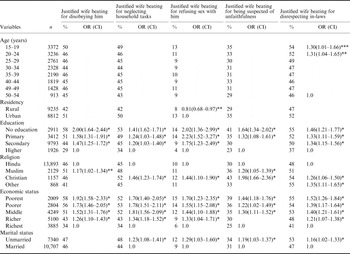
A total of 18,047 participants entered the study. There was no significant difference in attitudes across age groups, with the exception of justifying wife beating for disrespecting in-laws. The proportion in the youngest age group is 54%, as compared with 46% in the oldest group. A higher proportion of unmarried men justified wife beating than their married counterparts. The proportion of men with no education who justify wife beating for all five reasons is approximately twice that of men with highest education. For example, 58% of non-educated men justified wife beating for disobedience while 29% of highly educated men did so; the proportions were 14% and 4% respectively for refusing sex. A similar inverse relationship can be observed in economic status (Table 1).
Demographic factors as predictors of men justifying wife beating
As demonstrated in Table 1, participants in the age groups 15–19 (OR 1.30) and 20–24 (OR 1.31) justified violence against their wife on the basis of disrespecting in-laws. Being Christian confers a higher likelihood for justifying for suspected unfaithful (OR 1.98), neglecting household tasks (OR 1.46) and refusing sex (OR 1.45). ‘Other’ religions seem to agree the most with wife beating for disrespecting in-laws (OR 1.36). Being unmarried, rather than married, raises the risk of justifying wife beating for four out of five reasons.
A likelihood gradient exists from the most likely to justify violence in participants with no education, to less likely in men with increasing educational attainment. ‘No education’ (OR 2.01) renders twice the likelihood than the highest education level of justifying wife beating for disobedience; similarly for neglecting household chores. On wife's suspected unfaithfulness, however, there is no significant difference between secondary and higher education levels, while ‘no education’ (OR 1.64) still yields highest predictability. For refusing sex, men with primary education (OR 2.23) are the most likely to justify wife beating. For disrespecting in-laws, the secondary-educated men were second most likely to justify beating (OR 1.34).
A similar inverse relationship applies between men's economic status and their justification of wife beating. For example, participants who are the poorest are almost twice as likely to justify wife beating for disobedience (OR 1.92) and refusing sex (OR 1.70) than their richest counterparts. However, for neglecting household tasks, it is most likely for men in the ‘richer’ quartile (OR 1.81) to have a violent attitude. There exists no difference between the ‘richest’ and ‘richer’ groups regarding wife's unfaithfulness (Table 1).
Proportion of men justifying wife beating by their perceived rights and autonomy in household
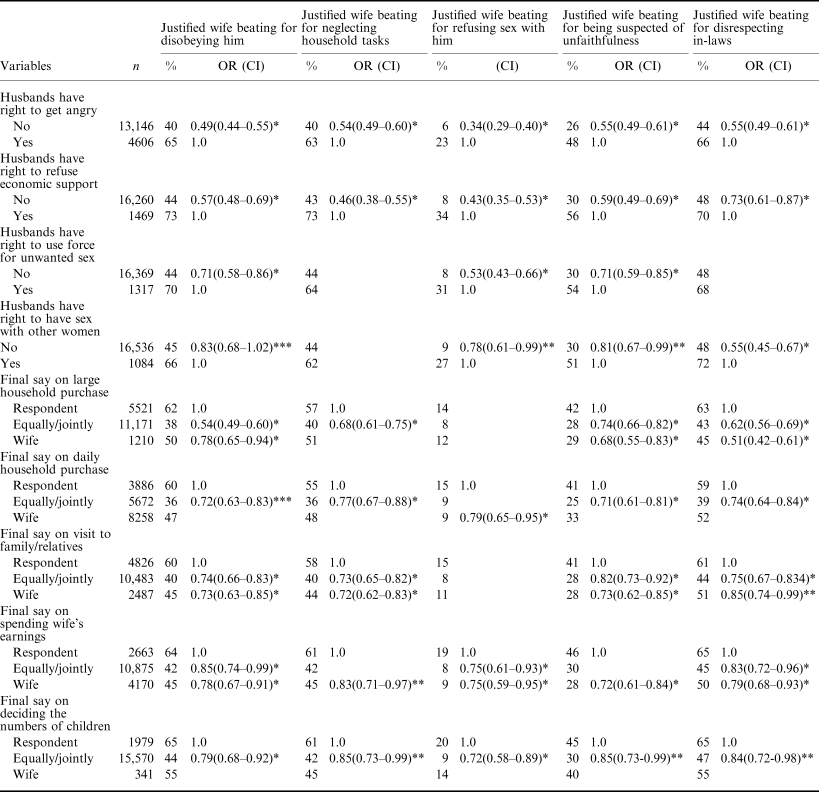
A four times higher proportion of men who endorsed three out of four rights (to get angry, refuse economic support, force sex) justified wife beating for refusing sex in comparison with their counterparts. Three times more men who endorsed the right to have sex with another woman did so for wife's refusal of sex. About 1.5 times more men who embraced the right to get angry justified beating for disobedience, neglecting household tasks and disrespecting in-laws. A similar proportion hold for the right to extramarital sex, and use force for unwanted sex. Almost twice the proportion of men who embraced the right to refuse economic support justified violence for all but refusing sex (Table 2).
Individual demographic factors and men's justification of wife beating

The adjusted odds ratio (OR) shown for each variable has been adjusted for all other variables (i.e. demographic, perceived rights and household autonomy). All variables were used as categorical variables, with the reference category denoted as OR=1. 0.
* p<0.001,
** p<0.01,
*** p<0.5.
99% level CI.
Men's perceived rights and household autonomy and their justification of wife beating
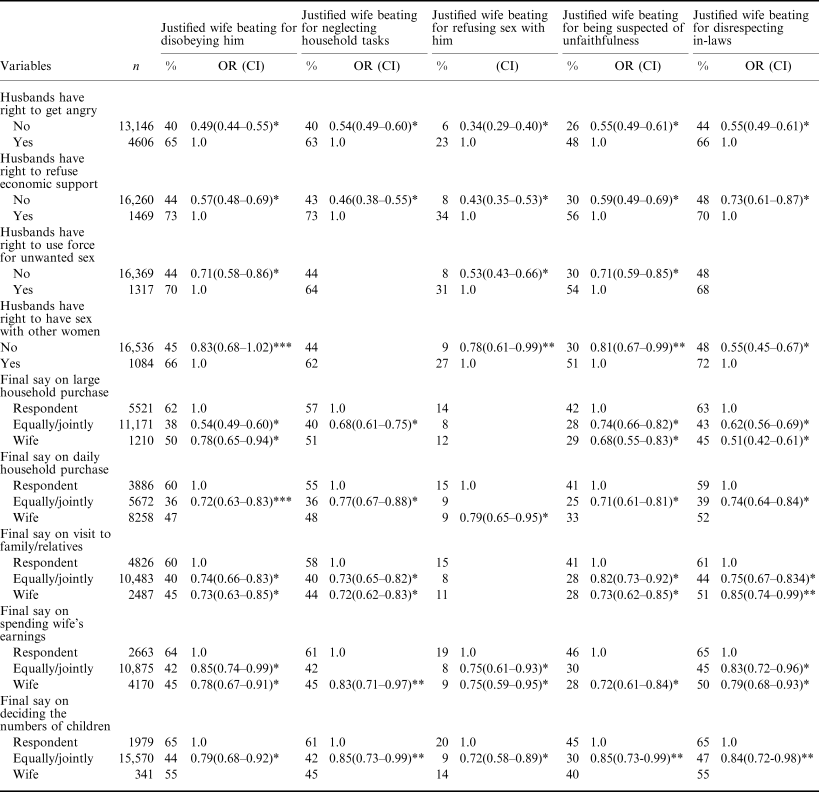
The adjusted odds ratio (OR) shown for each variable has been adjusted for all other variables (i.e. demographic, perceived rights and household autonomy). All variables were used as categorical variables, with the reference category denoted as OR=1.0.
* p<0.001,
** p<0.01,
*** p<0.5.
99% level CI.
Across five reasons for justifying wife beating, if the participant attributed household autonomy to himself, the highest proportion of them would justify violence. The proportion of men who justified wife abuse was less if they attributed decision-making power to their wife, and the least proportion was associated with a joint or equal decision.
Men's perceived rights and household autonomy as predictors of justifying wife beating
When it was considered that husbands did not have the right to get angry (OR 0.36) or refuse economic support (OR 0.43), they had a significantly lower chance of justifying wife beating for all five reasons, especially for refusing sex. If it is not considered a husband's right to have sex with another woman, the respondents are least likely to justify violence for disrespecting in-laws (OR 0.55).
Respondents were asked to attribute their household autonomy to the men, or wives or jointly. Regarding the number of children to have, there is no difference between a respondent or wife's decision in wife abuse justification. However, when the decision is made jointly, the likelihood is significantly reduced for all five reasons, especially refusing sex (OR 0.72). On daily household purchase, a joint decision lowers the likelihood of violence justification for all but refusing sex. When it comes to making large household purchases, a joint decision reduces all five, especially wife's disobedience (OR 0.54), while wife's decision reduces mostly justification for disrespecting in-laws (OR 0.51). With respect to deciding whether to visit family/relatives, respondents are less likely to justify domestic violence with a joint or wife decision, except for justifying refusing sex. The most significant reduction is justification for neglecting household chores from a wife's final say (OR 0.72) or jointly (0.73 CI). If the wife has the final say on how to spend her earnings, the likelihood of justifying wife beating for any reason is significantly lowered, especially for neglecting household chores (OR 0.72). A joint decision, however, reduces the likelihood of justifying violence for only three reasons (Table 2).
Discussion
The unique nature of this study lies in the structure of the entire nationally representative sample as men who have witnessed parental violence in childhood. It also represents one of the few studies that look at men's attitude toward domestic violence against women. The breadth of attitudinal questions provides valuable insight from a male perspective, given the rarity of studies on men's attitude and justification of wife beating in South Asia. The prevalence of wife beating justification among Indian men who witnessed parental violence is 67%. A few other studies that have examined the prevalence of wife abuse in men yielded rates of 34% in North India (Koenig et al., Reference Koenig, Stephenson, Ahmed, Jejeebhoy and Campbell2006), 37% in China (Parish et al., Reference Parish, Wang, Laumann, Pan and Luo2004), 27.5% in South Africa (Gupta et al., Reference Gupta, Silverman, Hemenway, Acevedo-Garcia, Stein and Williams2008) and 49.3% in Pakistan (Fikree et al., Reference Fikree, Razzak and Durocher2005). And men's acceptability of wife abuse ranges from 1% to 2% in the EU (Garcia-Moreno et al., Reference Garcia-Moreno, Jansen, Ellsberg, Heise and Watts2005). The apparently greater prevalence of men's supportive attitude to wife beating in our study highlights the significance of this study's unique sample of men, who have all been exposed to parental violence in childhood, the experience of which undoubtedly impacts the men in their own acceptability of wife beating across generations.
It is proposed that domestic violence can be passed down through generations by means of social learning, and economic and individual mechanisms (Gil-Gonzalez et al., Reference Gil-Gonzalez, Vives-Cases, Ruiz, Carrasco-Portino and Alvarez-Dardet2007; Dalal, Reference Dalal2008; Dalal et al., Reference Dalal, Rahman and Jansson2009). Young boys had witnessed parental violence and accepted it as normative, and thereby learnt to use violence against women from childhood, as the teenaged respondents did (see Table 1). When they have their own intimate partners, they in turn resort to violence as a response to conflict resolution (Dalal, Reference Dalal2008). This study is a nationally representative group with 18,047 participants, to which size few other studies of similar objectives can compare. The strong association between childhood exposure to parental violence and violence in adulthood has been shown in India: with a smaller sample size and study restricted to one region (Martin et al., Reference Martin, Moracco, Garro, Tsui, Kupper, Chase and Campbell2002; Koenig et al., Reference Koenig, Stephenson, Ahmed, Jejeebhoy and Campbell2006) or in a women's study (Jeyaseelan et al., Reference Jeyaseelan, Kumar, Neelakantan, Peedicayil, Pillai and Duvvury2007). Studies pointing to a similar trend also exist in high- and middle-income nations (Schafer, Reference Schafer, Caetano and Cunradi2004; Gupta et al., Reference Gupta, Silverman, Hemenway, Acevedo-Garcia, Stein and Williams2008; McKinney et al., Reference McKinney, Caetano, Ramisetty-Mikler and Nelson2009) and low-income countries (Fikree et al., Reference Fikree, Razzak and Durocher2005). The sample sizes of these studies range from hundreds to thousands, in contrast to the current study, which had over 18,000 participants.
Individual-level factors positively associated with justification attitude were low education attainment, low economic status, being unmarried and, to a lesser extent, being a Christian or of ‘Other’ religion. The inverse relationship between low education and economic status, and domestic violence against women, was established in this study. It is in accordance with prior findings (Jewkes et al., Reference Jewkes, Levin and Penn-Kekana2002; Simister & Makowiec, Reference Simister and Makowiec2008), but not others (Rao, Reference Rao1997). The delivery of the message of gender equality through the education system may not have achieved its full coverage, as in the study conducted by Rao (Reference Rao1997). Our study, furthermore, found a generally inverse gradient between economic and educational status and men's likelihood of justifying wife beating. Wife's disobedience was found to be significant in justifying violence for men with no education and in the poorest group. It has been suggested that men from the lower classes, unable to make an influence in the public sphere, are concerned more with relationship hierarchy such as that of wife to husband (Dalal, Reference Dalal2008). Wife's refusal of sex was also of major concern for men with no education, reflecting their expectation of wife's sexual obligation. The role of poverty and no education as a stress marker and limited economic and social security (Heise et al., Reference Heise, Ellsberg and Gottemoeller1999; Ackerson et al., Reference Ackerson, Kawachi, Barbeau and Subramanian2008), as well as failed masculine identity (Gelles & Starus, Reference Gelles, Straus, Wesley, Hill, Nye and Reise1974), help explain men's violence against women. While higher education attainment and economic status even protect men from violent childhood, men with both childhood exposure to domestic violence and low status are prone to developing a wife-beating attitude. This group needs special educational help in adjusting their attitudes.
While an Israeli study found the highest level of partner violence against women among Muslims (Eisiovits et al., Reference Eisikovits, Winstok and Fishman2004), other Indian studies concluded an insignificant relation between being a Hindu or Muslim (Pandey et al., Reference Pandey, Dutt and Banerjee2008), or a Muslim and non-Muslim (Fikree et al., Reference Fikree, Razzak and Durocher2005; Dalal et al., Reference Dalal, Rahman and Jansson2009). The highest proportion of Christian men justified wife beating for all but disobedience. Being a Muslim predicted his odds to do so for disobedience and unfaithfulness. A prior study found no significant differences (Eisikovits et al., Reference Eisikovits, Winstok and Fishman2004), but our study pointed out that unmarried men, compared with married men, were more likely to justify wife beating for all but wife's disobedience. They held a more rigid picture of marital relationship and much higher expectation from future wives. The two youngest age groups were more concerned with wives' disrespecting in-laws. A young age had been found to be associated with increased risk in developed countries (Ratner, Reference Ratner1993; Bachman & Saltzman Reference Bachman and Saltzman1995), but a null relation was found in less developed nations (Faramarzi et al., Reference Faramarzi, Esmailzadeh and Mosavi2005; Jeyaseelan et al., Reference Jeyaseelan, Kumar, Neelakantan, Peedicayil, Pillai and Duvvury2007). Young and unmarried men were possibly under greater influence of childhood experience of parental violence compared with their counterparts. Education on gender equality for risk groups such as young and unmarried men is recommended to be developed in the school curriculum.
Men who did not endorse household rights were significantly less likely to justify wife beating. Refusing sex is the most significant predictor for three of four perceived rights as getting angry, refusing economic support and forcing sex. Neglecting household chores and refusing sex were the most significant predictors for the right to refuse economic support. They are what the wife can provide in immediate service for the husband, such as intercourse and housework. Men who endorsed the right to force sex were mostly likely to justify wife beating for refusing sex and suspected unfaithfulness. It seems to men in this group, that women should have little control over their sexuality. The right to extramarital sex conferred the highest likelihood of justifying wife beating for disrespecting in-laws. This may partially be explained by men's awareness of their wrong-doing as a responsible husband; they want to compensate by stressing their role as a dutiful son who ensures that his extended family is respected by their wife. To reduce wife-beating attitude among men, there is a clear need to disseminate the message that men are not automatically entitled to such rights.
Indian women's decision-making power in reproductive matters (Visaria, Reference Visaria1999; Jejeebhoy, Reference Jejeebhoy2002) and limited control over allocation of resources (Rao, Reference Rao1997) have been documented. However, few studies have described Indian men's perceptions of women's autonomy (Jejeebhoy, Reference Jejeebhoy2002). Men's final say in household decisions was associated with significantly higher odds of wife-beating justification for all reasons. A joint decision in daily household purchase was apparently giving the wife more protection. It highlights the need for mutual and frequent communication to reduce the husband's wife-blaming attitude, supporting previous finding (Naved & Persson, Reference Naved and Persson2005). A husband's controlling behaviour, such as discouraging his wife's relations with her family, has been linked with his aggression (Pandey et al., Reference Pandey, Dutt and Banerjee2008). The present study supports this finding. Whether it is the wife's or the couple's equal decision, the outcome of visiting family relatives provides social support and protection for the wife. The only exception is in a wife's refusing sex. The private nature of the matter may lead men to believe it is not a business for interference, even by family or relatives.
A wife's decision in how to spend her own income gives her equal power as a man's own autonomy. According to the resource theory, wife's monetary income is probably regarded as a significant resource leading to greater power and protection for her. The message promoting woman's autonomy in spending her income should be delivered, especially to families in which women also contribute wages. The outlook of her decision-making power on the family reproductive decision is quite opposite to that concerning wife's income. The wife is at risk for all five justifications, the most prominent being refusing sex. A Ghanaian study highlighted men's narrative justification of wife abuse if she uses contraceptives secretly without the husband's knowledge (Bawah et al., Reference Bawah, Akweongo, Simmons and Philips1999). Women's reproductive autonomy raises concern in the husbands about their reproductive obligation and possible unfaithfulness. Notably, men are least likely to justify wife beating for refusing sex if the reproductive decision is equally made. A woman's refusal of sex may have implications for unwanted pregnancy and fear of transmission of STDs. A joint decision in household reproductive pattern should be promoted among married couples, given the highly protective effect it has on deterring man's wife-beating justification in general.
Due to the cross-sectional design of this study, no causal relationship can be established between wife-beating justification and the covariates. Screening bias may result from recall bias, or deliberate unwillingness to disclose family violence history. Childhood family violence is known to be prone to both under-reporting and faulty recall (Hardt & Ruter, Reference Hardt and Rutter2004). The participants may have been reluctant to justify wife beating given the sensitive nature of the questions and strong social stigma. Under-reporting in the questions may have reduced the actual statistics. A recommendation for further study is to include a comparable sample of females to contrast. However, similarity on gender ideology between the two sexes has been suggested in India (Nayak et al., Reference Nayak, Byrne, Martin and Abraham2003). The high prevalence of wife-beating justification by respondents in this study cannot be readily attributed to their childhood violence background, due to the lack of a feasible reference group of comparable size. However, comparisons have been made with several other nationally representative studies (Koenig et al., Reference Koenig, Ahmed, Hossain and Mozumder2003, Reference Koenig, Stephenson, Ahmed, Jejeebhoy and Campbell2006; Parish et al., Reference Parish, Wang, Laumann, Pan and Luo2004; Fikree et al., Reference Fikree, Razzak and Durocher2005; Gupta et al., Reference Gupta, Silverman, Hemenway, Acevedo-Garcia, Stein and Williams2008), and the heightened supportive attitude towards wife beating in our study is possibly embedded in the outstanding factor of intergenerational transmission of violence.
Over two-thirds of participants justified wife beating. As all the participants had childhood exposure to parental violence, the high prevalence of their wife-beating justification may significantly imply intergenerational transmission of violence against wife over the generations. This study reveals young and unmarried men who have been exposed to parental violence, and men who have received little education and of low economic status, as being at higher risk for adopting wife-beating justification. Young men ready for marriage need education on gender equality. Men's perceived entitlement to relationship rights and autonomy also predicts their wife-beating justification. Autonomy to the couple jointly is generally protective for men to develop such attitudes. Policies aim at decreasing the prevalence of domestic physical violence against women need to address it at the individual level of acceptability in men. The message of physical beating of wives, for any reason, being wrong and unacceptable needs to be disseminated (Dalal et al., Reference Dalal, Rahman and Jansson2009). Men especially need education on their not being entitled to such relationship rights as refusing economic support, forcing sex or having extramarital sex. Decision-making power in the household on financial matters and reproductive decisions should be shared by the couple. The detrimental effect of domestic violence is not only limited to the female victim; it has a long-term hazardous effect on the children witnessing violence such that this is transmitted over the generations.
Acknowledgment
The authors acknowledge Measure DHS and ORC Macro International Inc. for providing the data set for producing research papers with due ethical permission.