Introduction
‘Outlaw’ is not a common category of archaeological thought. The term, describing someone engaging in behaviours defined against or outside what is or was legal, is laden with judgement and historical specificity, inhibiting its use as an analytic with which to think comparatively across time and space. However, a vibrant body of recent scholarship indicates that outlaws have much to offer us, particularly in archaeologies of colonialism and the modern world (e.g. Casella Reference Casella2000; Dante Reference Dante2017; Dawdy Reference Dawdy2008; Winter Reference Winter2013). While outlaws can be defined through legal systems, they can also be constructed from perceptions of behavioural, locative and affective traits, or as identities adopted by those who choose to act in ways deemed illegal (‘against the law’) or illicit (‘against social norms’) (Hartnett and Dawdy Reference Hartnett and Dawdy2013, 39). The outlaw thus has a great deal of archaeological relevance, as a bundle of traits that describe spatiality, economy and material culture. This linkage between the structural and material conditions of people designated as criminal (and often linked with poverty) has been the topic of recent scholarship emanating largely from the Americas and Europe (Orser Reference Orser2004, 31; Spencer-Wood and Matthews Reference Spencer-Wood and Matthews2011).
Here, I explore what some outlaws reveal about archaeological ways of thinking – our habits of reasoning and interpretation. Focusing on assumptions about mobility, settlement and subsistence, I consider where ideas about what constituted ‘normal’ or ‘traditional’ material practices condition our sensitivities to ‘deviance’, often construed as antisocial or as reactions to stress. I do this by examining archaeological narratives (including historical accounts relying heavily on the archaeological record) of social distress in 19th-century southern Africa, a period characterized by expanding colonialisms; aggressions among African chiefdoms; and widespread cattle rustling, rebellion and punitive violence. These narratives are, I suggest, affective: they were produced by colonial observers relying upon actions and objects to shape ideas about order and about deviation therefrom, by people inadvertently or deliberately enacting forms of dissent, and later by archaeologists thinking in terms of patterns and departures from these patterns.
A critical literature has developed around informal economies and the characters that populated them: pirates, prostitutes, smugglers, vagrants (Hartnett and Dawdy Reference Hartnett and Dawdy2013). Often these figures are imagined through historical sources, as notions of criminality emerged from legal codifications, and the ‘informality’ of an economy became increasingly apparent in capitalist global systems. I join this literature in describing how outlaws were shaped through affect and gesture as much as through text and law. I submit that, where global capitalism penetrated slowly and unevenly, conceiving of outlaws was not so much a matter of distinguishing between formal and informal economies as of navigating grey spaces between long-standing and transgressive economies, highlighting how disorderly actors were rooted in ideas about what disorder looked, acted and felt like. In 19th-century southern Africa and other colonial contexts (Rao and Pierce Reference Rao, Pierce, Pierce and Rao2006), racialized taxonomies drew on observed subsistence patterns; as these were criminalized, designations of ‘outlaw’ grappled with confusing assemblages of material culture, movement and geography, coloured by memory, imagination and rumour. We can thus observe how archaeological identities were criminalized, and how decisions to persist in these economies represent political choices, or ways of ‘being in the face of the state’ (González-Ruibal Reference González-Ruibal2014).
Outlaws prompt us to look to the ambiguities surrounding informal and traditional economies, ethnicized and racialized typologies, and political authority, and to those who transgressed it. Examining three paradigmatic outlaw figures (the raider, the vagrant and the rebel), I explore the material, affective basis for describing order and unruliness in the southern African past, especially where this referenced archaeological signatures. This sort of archaeological thinking implicates how bodies and landscapes, in addition to objects, behaved. Outlaws made themselves felt in different ways in different contexts, and in some cases were rendered most tangible through apparatus erected to control them (gaols, labour reservations) rather than through materials that they created. As such, the discussions here are equally about presence and absence, materiality and ephemerality. One of the main points they highlight is that while some material traces may have been transient, their affects endured and continued to have an effect on the world.
These observations echo Martin Hall's (Reference Hall2000, 39) focus on the modern world as an ‘inherently unstable system’. I am interested in how instability and uncertainty related to (usually violent) colonialist efforts to make sense of disorderly actors, and how these actors answered back. Further, I treat practices of describing and managing deviance as lingering in some historical narratives – as leitmotifs in the process of writing history (cf. Stoler Reference Stoler2008). As such, this discussion encourages archaeologists working with colonial contexts to interrogate materials, places and movements underpinning some histories, which may be more archaeological than we think (cf. Van Schalkwyk and Smith Reference Van Schalkwyk, Smith, Reid and Lane2004). It also takes up themes such as resistance and disruption that are crucial to archaeological understandings of expanding hegemonies, suggesting different avenues for considering how unruly dispositions were enacted over time.
The good, the bad and the bad-looking
Nearly five decades ago, Eric Hobsbawm argued that criminals had distinctly social meanings rather than legal ones. Hobsbawm's seminal Bandits (Reference Hobsbawm2000) described two broad categories of thieves:Footnote 1 venal bandits who steal for self-enrichment, and social bandits who steal not just to prey on the wealthy or productive but to right the wrongs perpetuated on the lumpenproletariat by the ruling class. Over the past half-century, scholars have grappled with whether and how to treat Hobsbawm's bandits as folklore versus as empirical observations, particularly questioning the existence of bandits in non-agrarian societies (Seal Reference Seal2009).
Two aspects of Hobsbawm's argument retain particular salience for archaeological approaches to outlaws. First, inasmuch as ‘banditry’ refers to the idea that crime has social meaning, it directs us to examine how disorder and attributions thereof are rooted in particular social circumstances and expressions of power. Second, Hobsbawm's ‘fundamental project’ was to understand ‘criminal deviance’ as a form of existence against dominant social values, often drawing on an awareness of historical circumstances (Austen Reference Austen and Crummey1986, 102).
Criminal deviance as dissent from sociopolitical order is often elided into discussions of resistance, located within the arsenal of ‘weapons of the weak’, which range from outright rebellion and guerrilla tactics to prosaic ‘foot-dragging’ (Scott Reference Scott1985, 29). In this sense, outlaws not only undermine state apparatus, but also form part of a larger moral community materialized through an array of cultural institutions and landscapes (Scott Reference Scott2009; cf. Comaroff Reference Comaroff1985).
‘Outlaws’ – embodying the social meaning of crime and resistance – are largely absent from African archaeology (but see King and Challis Reference King and Challis2017; Lane Reference Lane, Lane and MacDonald2011; Marshall Reference Marshall and Marshall2014), partly because of a consensus that pre-colonial African politics offered few opportunities for transgressing existing leadership, and partly because the self-enrichment that banditry connotes relies heavily on Western notions of property ownership (Austen Reference Austen and Crummey1986). But dissent certainly existed; recent work by Alfredo González-Ruibal (Reference González-Ruibal2014) in north-eastern Africa argues that ontologies of resistance could materialize as a direct acknowledgement of and engagement with authority, chiming with archaeological and historical ethnographic foci on the connections between disorder and discipline in colonial milieux (Dawdy Reference Dawdy2008, 4–5, 11).
From the latter half of the 19th century, colonial states became ‘ethnographic, taxonomic states, where minute distinctions of race and status were elaborately encoded into forms of rule’ (Rao and Pierce Reference Rao, Pierce, Pierce and Rao2006, 4). These ideas about race and status included observations of criminality, rebelliousness and other forms of non-compliance with the norms and expectations of colonial authority. Attributions of disorder implicated observations about culture:
Objectifications of culture – the most visible end of a more complex process by which culture and biology were conflated and often deployed as a justification of the natives’ civic disability – served to make the ‘other’ body a natural object for racially discriminatory governance, even while the violence that went along with it promised scandal (Rao and Pierce Reference Rao, Pierce, Pierce and Rao2006, 4).
Perceptions and misperceptions of outlaws affected colonist and colonized, albeit in different ways. We should further exercise caution before subscribing to an overextended conception of the state's power, especially in settler colonies (King Reference King2017b). While representatives of the colonial state in Africa were empowered to regulate and punish native bodies, they also acted out of anxiety, uncertainty and flawed efforts to characterize ‘normal’ African cultures and behaviours – often through material, physical, linguistic and locative traits. ‘Objectifications of culture’ and codifying racial differences did, indeed, enable governmental practices of control, which were often based on impartial or erroneous understandings of where the boundaries of these differences lay (cf. Stoler Reference Stoler2009). From these (mis)understandings arose systems of racial and ethnic segregation, forced labour and genocide, and more quotidian policies such as criminalizing certain kinds of living arrangements and behaviours.
Outlaws were thus affective figures, and as such represented accretions of memory and imagination. Feminist interventions in archaeologies of colonialism have highlighted connections between ‘assemblages of affects’, including objects, anxieties and desires (Casella and Voss Reference Casella, Voss, Casella and Voss2011, 2), and identity. Barbara Voss (Reference Voss, Voss and Casella2011, 17) has argued that where sexuality, criminality, race and other identifications emerged within historical contexts, we should pay attention to where social agents and institutions acted on these identifications. Put differently, we should look to how affect and effect were intertwined: dispositions like deviance, obedience, fear or sympathy were manifested in (often stereotyped) practices and behaviours, which agents of empire acknowledged or acted against.
Here, I focus on how identifications referencing ideas about criminality drew on affective qualities like bodily gesture and location, personal appearance, material accoutrements and living arrangements. This resonates with Oliver Harris and Tim Flohr Sørensen's (Reference Harris and Sørensen2010, 150) conception of affect as a dynamic ‘network of relations’, implicating physical and material qualities as much as memory, rumour, imagination and sensation. Indeed, conceiving of affect as sensuous – inhering in the intersection of what people, objects and places embody and what they evoke – offers a useful way of considering power, transgression and discipline (Fleisher and Norman Reference Fleisher, Norman, Fleisher and Norman2015, 12). This is particularly visible when one considers outlaws in colonial contexts, where criminality and disorder were imagined along with or against other forms of social identity, and where these imaginations produced tangible, material reactions like the construction of police stations and gaols – instances where affective forces reverberated beyond the physical person of the outlaw. To the extent that colonialism encompasses changing regimes of material significance (Gosden Reference Gosden2004), these disreputable or disorderly figures emerged at a point of slippage between these changing regimes and the desires or anxieties that they provoked.
Alexandra Hartnett and Shannon Lee Dawdy (Reference Hartnett and Dawdy2013, 38) note that conceiving of outlaw regimes as informal economies presumes the presence of state-sanctioned and -structured economies. As such, they are not a useful category for non-state societies or, I suggest, many settler colonial contexts where state power was diffuse or unevenly applied. Hartnett and Dawdy's work offers a useful rejoinder to bandit historiographies, demonstrating the need to interrogate not simply the function and extent of state power, but also the material experiences of people wishing to subvert or exploit it.
Rather than focus on defining outlaws against order and risk undercutting their agency, Dawdy and Joe Bonni (Reference Dawdy and Bonni2012, 676) direct us to examine how the moral ambiguities of outlaw cultures lend themselves to a variety of ‘material fantasies’ and ‘political interpretations’. This affective potency and explanatory or epistemic power leads back to the question whether bandits are fact or folklore (or both): outlaw narratives rely on moral judgements, adopting dispositions towards people on the basis of traits that are varyingly apprehended as deviant or compliant. Whether or not historical outlaws actually did all the things described in texts may be beside the point, if contemporaries behaved as though they were real: laws were enacted, fences constructed, gaols built, all to address these senses of disorder.
Outlaws are thus material, affective, epistemic phenomena as much as historical, economic and legal ones. They encourage us to consider the logical and material basis for describing transgression and disorder, and the forms of order and conformity that these entail. When considering narratives of southern Africa's recent past, and how these implicate outlaw figures such as the three described below, we should look to the broader – and, often, deeper – physical world whence they emerged.
Sites of imagination: southern Africa, 1652–1879
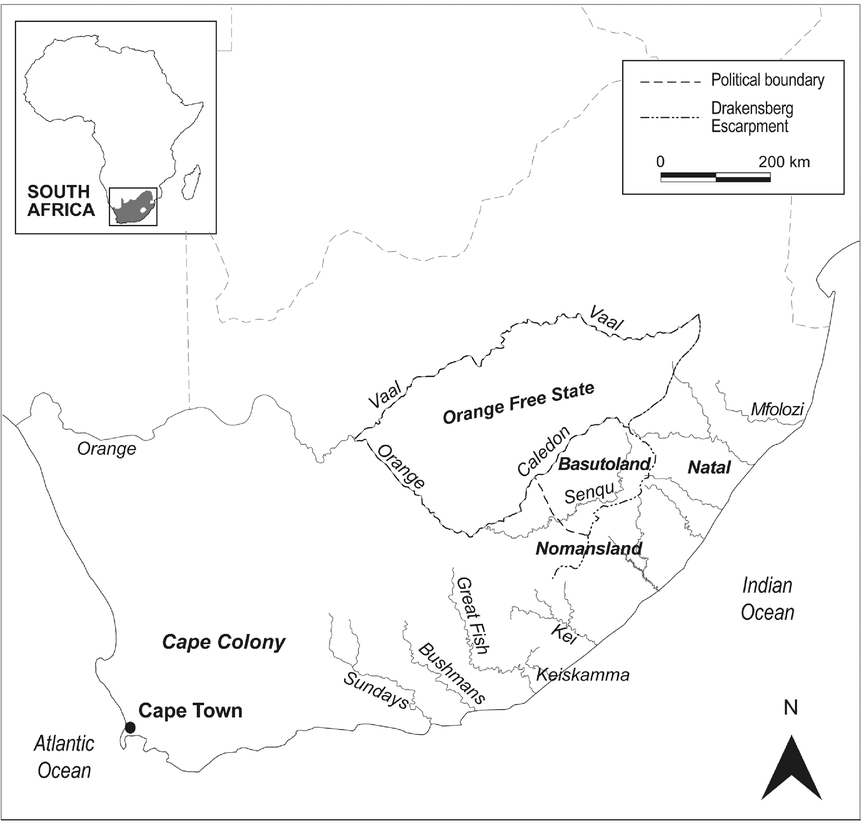
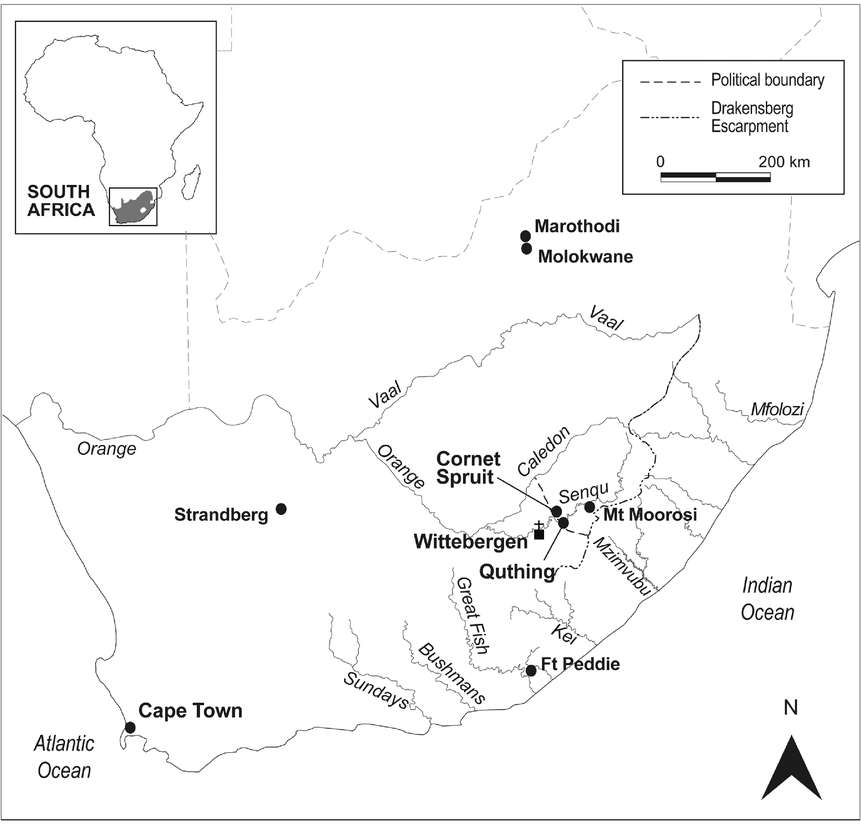
Before moving forward, an overview of the contexts for these unruly figures is necessary (figures 1 and 2). Although it was not the first instance of global mercantilism arriving on southern African shores (Mitchell Reference Mitchell2005), the 1652 establishment of the Dutch East India Company's refuelling station at the Cape of Good Hope is traditionally taken as the implantation of colonialism here. Dutch settlement remained concentrated around the western Cape for more than a century, with burghers pushing outward to establish farms on land hitherto occupied by pastoralists and hunter-gatherers speaking languages historically grouped as Khoisan (Elbourne Reference Elbourne2002; Schrire Reference Schrire1992); I refer to these communities collectively as Khoe/San.Footnote 2
Map showing regions and political territories in southern Africa mentioned in the text. The Cape Colony's eastern boundaries stretched variously to the Bushmans (1778), Fish (1819), Keiskamma (1847) and Kei (1847–65) rivers. The Drakensberg escarpment divides the Maloti and Drakensberg mountain systems; I refer to these collectively as the Maloti–Drakensberg mountains.

Map showing places in southern Africa mentioned in the text.

The 1806 establishment of the British Cape Colony (centred on Cape Town), and especially the importation of British settlers in 1820, heralded over a century of colonial boundaries expanding and contracting eastward along the coast and northward into the interior. This expansion manifested at different paces and in different colonialisms: mission stations (King and McGranaghan forthcoming), the eastward migration of Afrikaans-speaking trekboere dissatisfied with British rule, land speculators and surveyors driving competition for agricultural production, market demands for (often coerced) African labour, and the formation of new Afrikaaner republics and British protectorates (Etherington Reference Etherington2001).
These projects, encounters and appropriations intersected with and fuelled transformations within African political cultures in the eastern subcontinent during the late 18th and the 19th centuries. Predominately agropastoralist, Bantu-speaking chiefdoms competed for followers, cattle (useful for securing followers through marriage payments) and territory across the high plains (Highveld), the eastern coast and adjoining midlands. Ascendant leaders like the Basotho chief Moshoeshoe and the Zulu chief Shaka articulated novel political formations and strategies, from military structures to new national affinities designed to sublimate historical difference (Hamilton Reference Hamilton1998; Landau Reference Landau2010). Colonialist intrusions into the subcontinent both impacted these events and created an audience for imagining these complex political processes as disorderly obstacles to civilization's progress, as we shall see. This period of mobility and political upheaval has been referred to as the lifaqane (Sotho, ‘time of trouble’) in the historiography of the last two centuries (Etherington Reference Etherington2001, 333; Parsons Reference Parsons and Hamilton1995).
Amidst this choreography, the Maloti–Drakensberg mountains in the south-eastern subcontinent emerged as an ‘interior world’ for those people wishing to keep themselves at the edges of the colonial stage, although the mountains were certainly influenced by the events described above. From at least the 1820s until the late 1870s, this rugged and somewhat inhospitable environment saw influxes of people designated as socially marginal (freebooters, raiders, runaways), but whose misbehaviours became decidedly commonplace in the mountains among people who engaged in broadly similar sorts of movements, raids and efforts to evade authorities’ notice (King and Challis Reference King and Challis2017).
All of these processes were coloured by different sorts of violence: government-led genocide against Khoe/San, settler militias (known as commandos) pursuing and punishing cattle raiders (often based on little to no evidence), British military expeditions to subdue chiefdoms perceived as obstacles, and aggressions among African chiefdoms, to name only a few.
The regions and groups of actors introduced in this broad sketch of southern Africa will appear throughout the remainder of this paper in greater detail and context. For the moment, it is sufficient to note the variety, pace of change and forms of violence that inflected the different sites of imagination discussed below.
The raider
During the last few centuries in southern Africa, cattle raiding was so widespread and varied that there exists no archetypal raider (cf. Marks Reference Marks1972; Morton Reference Morton2009; Penn Reference Penn2005). Disentangling how and why individual raiders became construed as criminals thus charts only one of many affective and epistemic trajectories, and is too specific to be broadly useful. As a middle ground, I suggest we think of some raiders as situated amidst questions around the mobility and violence of southern African chiefdoms in the late 18th and early 19th centuries.
Early 19th-century travellers in the southern African interior returned repeatedly to descriptions of ruined, abandoned villages in recounting their expeditions. Missionaries like James Campbell and explorer–traders like Andrew Geddes Bain – travelling between 1813 and 1835 – described the prevalence and extent of stone ruins, many of which represented the residues of extensively walled townscapes previously occupied by Sotho–Tswana chiefdoms (Lane Reference Lane, Reid and Lane2004). Compared with earlier (1801–2) accounts of these population centres, the impression created is one of towns rising amid increased competition among chiefs for followers and cattle, and falling when raiding to secure cattle spiralled out of control (cf. King Reference King2017a). Writing of their 1836 visit to a more southerly part of the Highveld, the missionaries Thomas Arbousset and François Daumas (Reference Arbousset and Daumas1968) similarly described encounters with abandoned villages scattered with bones. These were, they said, the results of Africans’ cattle raids, a cautionary tale about the consequences of theft and war.
These accounts pertain to the period of the lifaqane described above. Cattle raiding looms large here, treated as cause and consequence of political disruption, responsible for widespread migration, and often glossed as an analogue for warfare (chiefs raiding to defeat rivals and build authority) or social pathology (raiding as a last resort under socio-economic stress) (King Reference King2017a). Historically and historiographically, chiefs who raided were at best ambitious, at worst rapacious; they were always in conflict with colonial sensibilities – and, often, legislation – that equated raiding with theft (Lester Reference Lester2005, 21).
Raiders figure in some significant lines of archaeological enquiry: if they are responsible for precipitating widespread un-settlement and disruption, to what degree does this latter actually differ from earlier practices of settlement? How disruptive was raiding, materially speaking? And if raiders were violent or disruptive, what precisely was the nature – the ontology – of this violence? Recovering perspectives on conflict and violence in the African archaeological past has been a politically and materially challenging exercise: the potential for misconstrual is high, violence and its social consequences are often evaluated in contrast to order, and histories of violence may have immediate political ramifications (Giblin Reference Giblin2014; Lane Reference Lane, Lane and MacDonald2011). Thus, there is a particular imperative to scrutinize the assumptions underpinning idioms like ‘war’ and ‘theft’.
Colonial travellers’ portrayals of disorder and carnage (evinced by abandoned villages) betray their equation of ordered village life with sedentism. Campbell, Bain, Arbousset, Daumas and others made an assumption that archaeologist Tim Maggs (Reference Maggs1976, 130–37) would caution colleagues against nearly 150 years later: assuming that stone architecture implied permanence and obscuring other modes of settlement and duration. Recently, Gavin Whitelaw and Simon Hall (Whitelaw and Hall Reference Whitelaw, Hall, Hamilton and Leibhammer2016; Hall Reference Hall2012) and Per Ditlef Fredriksen and Shadreck Chirikure (Reference Fredriksen and Chirikure2015) have argued that, prior to the late 18th century, life within these villages and even the villages themselves were more mobile than travellers’ accounts would suggest.
In their review of Iron Age archaeology from the Highveld, Whitelaw and Hall (Reference Whitelaw, Hall, Hamilton and Leibhammer2016) suggest that from the 14th and 15th centuries A.D., ‘newcomer’ agropastoralists migrating into the southern African interior engaged ‘firstcomers’ through force and marriage in forging new forms of political and material culture. From c.1500 A.D., the area north-west along the Vaal river became a locus of dense agropastoralist settlement, featuring building traditions in dry-walled stone and wood-and-pole (Hall Reference Hall2012, 306). The early 18th century saw the emergence of agglomerated, stone-built towns here, with economies focused on livestock transhumance and crop agriculture (mainly sorghum and millet). Here, archaeological evidence joins with oral traditions to describe this as a period of political consolidation, as new chieftaincies emerged with authority rooted in a combination of consent and ancestrally derived mandates. Significantly, while these traditions cannot provide a founding date for specific settlements, they do describe political entities that were far from mono-ethnic and that were capable of remodelling settling layouts in concert with political change (Boeyens and Hall 2009, 476–77).
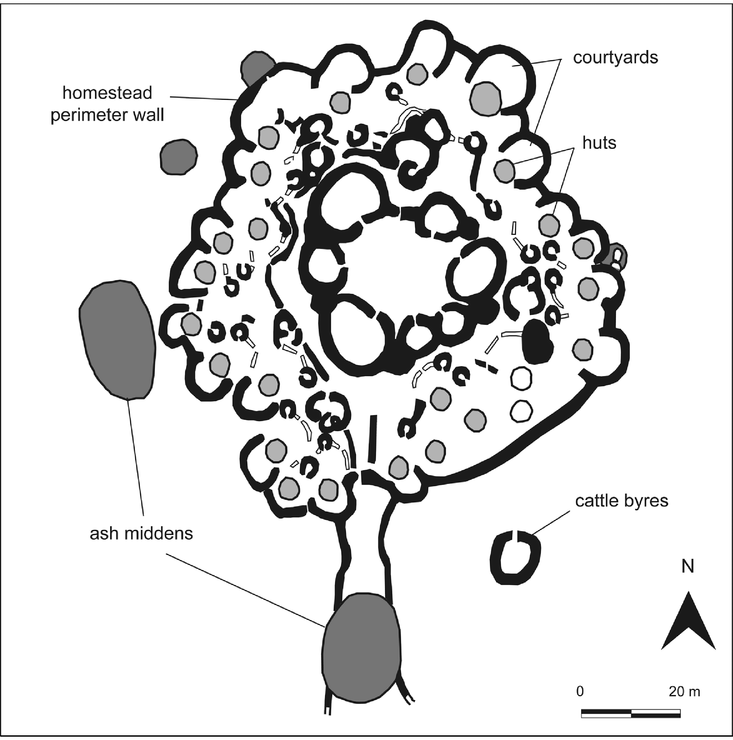
By the late 18th century, these townscapes had taken on forms of the kind that European travellers would encounter: large (some of more than forty hectares) stone-walled agglomerations of multiple individual homesteads, representing the capitals of specific chiefly lineages. Towns like Marothodi and Molokwane sprawled across the western Highveld, characterized by elaborate walling that defined semi-private spaces for specific houses and their living areas, including space for preparing food and manufacturing crafts like pottery (figure 3). Cattle kraals and public ‘court’ spaces were central to this arrangement, and some homesteads were laid out to guide cattle along paths running through hubs of local activity (Anderson Reference Anderson2009, chapter 5; Hall Reference Hall2012, 314).
Map of a Molokwane-type homestead on the Highveld showing ‘scalloped’ perimeter walls, cattle track, cattle byres and placement of ash. Adapted from Hall (Reference Hall2012, 308).

Fredriksen and Chirikure (Reference Fredriksen and Chirikure2015, 603) note that an increased emphasis on cattle accumulation from c.1700 A.D. accompanied the rise of these towns, along with hilltop sites characterized as refugia (based on their small size, defensive locations on steep-sided ridges, and sporadic occupation) (Hall Reference Hall and Hamilton1995). Complementary oral traditions characterize this period as one of increased cattle raiding from the west along the Orange river. This raiding appears in historical literature as the impetus for defensive refugia and agglomeration just described: different modes of coping with the increased threat to security that raiding represented. The material impression left on historical observers, then, was one of dense village life offering a measure of security against raids but subject to disruption as people fell back upon temporary hilltop sites for greater safety (King Reference King2017b).
Nevertheless, Fredriksen and Chirikure and Paul Lane (Reference Lane, Reid and Lane2004) have argued that models of defensiveness and stress presume too much about the relevant permanence of these settlement sites, the relationships between people and landscape, and the cosmological and social reasons behind how and why people moved. Indeed, Zoë Crossland (Reference Crossland2013) has queried the willingness – by 19th-century observers and archaeologists alike – to believe that towns did not want to move. Lane (Reference Lane, Reid and Lane2004) posits that these townscapes moved with respect to the availability of water and cosmological connections with rainfall. Fredriksen and Chirikure (Reference Fredriksen and Chirikure2015) suggest that while stone architecture may be somewhat permanent, it should be situated amidst changing relationships with the surrounding landscape, cattle acquisition and crop cultivation.
These observations accord with Whitelaw and Hall's (Reference Whitelaw, Hall, Hamilton and Leibhammer2016) conception of political dynamics during this period as about managing a heterogeneous cultural landscape, composed of different lineages with different cultural backgrounds (recalling the variety of ‘newcomer’/‘firstcomer’ encounters described above), through material transformations. Hall (Reference Hall2012, 311) has drawn attention to changes in paces and habits of building, waste disposal and ceramic manufacture at towns on the western Highveld to illustrate this. If in the late 18th century there was a ‘patchwork’ of ‘separate histories and affiliations’, then individual towns reflected this patchwork through unique combinations of ceramic styles and architectural motifs. Marothodi and Molokwane, for instance, share some building features (perimeter walls) but differ in others (structure of central courts), housed different ceramic traditions, and disposed of ash waste in very different ways (within versus without perimeter walls). Hall interprets these practices as a change of place, referencing changes in political identities between capitals as well as the circulation of different sorts of knowledge among them, facilitated by the movement of craft specialists (especially women through marriage; cf. Fredriksen and Bandama Reference Fredriksen and Bandama2016; Hall Reference Hall and Kent1998). Movement and settlement transformation were relatively commonplace, central to processes of configuring political power. Ultimately, we are left with the conclusion that spatially elaborate townscapes did not prohibit mobility.
Synthesizing this archaeological work demonstrates that the movement of agropastoralist chiefdoms prior to the lifaqane has been historically understated, creating an overstated contrast in regional historiography between lifaqane-period chaotic migration and earlier sedentism. Such revisions join a more global archaeological turn towards mobility, which critiques equations of demographic shifts with turmoil and aberrant behaviour (Beaudry and Parno Reference Beaudry and Parno2013; Van Dommelen Reference Van Dommelen2014). One outcome of these interpretive shifts is that narratives of 19th-century southern African political disruptions no longer appear so cataclysmic or so atypical, but rather as variations on or recontextualizations of earlier practices.
Now we might ask, if things were not as unstable as assumed, whether and to what degree cattle raiders should still be characterized as destabilizing. It further opens the possibility of querying the causal connections between violence and mobility associated with raiding, in keeping with recent drives to see movement as a social strategy rather than a response to stimulus (Ashley, Antonites and Fredriksen Reference Ashley, Antonites and Fredriksen2016). With the linkage between cattle raiding, violence and distress weakened, we need to interrogate precisely what sorts of violence raiding denoted: what ontologies of violence does cattle raiding – in all its forms and experiences – disclose? Archaeologies of violence in southern Africa are discussed in vocabularies of refuge, stress and expanding colonialisms; the cattle raiders of the interior illustrate the need for more nuanced considerations of how cattle were moved as willing exchange, theft, spoils of war or something more complex.
Elsewhere (King Reference King2017a) I have argued that some ways to achieve this nuance are through considering cattle as social agents (cf. Oma Reference Oma2010), thereby moving away from the idea of cattle as property and – by extension – from raiding as property theft. Historians (Landau Reference Landau2010, 84) and anthropologists (Kuper Reference Kuper1982; White Reference White2011) have detailed how cattle in southern African agropastoralist societies of the last few centuries were embedded in relationships among the living and the dead: embodying connections between humans and ancestors, and among households through loans and bridewealth. Raiding cattle, then, was raiding relationships – cosmological linkages that were not necessarily severed when animals were physically moved (King Reference King2017a). This active, embedded and connecting role for cattle is suggested in the literal paths that they traversed through the centre of life in Marothodi and Molokwane described above. Rethinking the ontological role of cattle in the past, then, entails reconsidering the ontologies of violence surrounding them: as not always or not only about divesting someone of an object, but tied to statements about interpersonal and intergenerational obligation. Of course, raids of this character were certainly disruptive; they cut to the heart of significant social relationships. However, shifting the discussion of violence, settlement and stress in this way moves the narrative of cattle raiding in the interior from one driven by acquisitiveness and disorder to one of self-awareness and social intelligence. This, of course, applies to raids among African polities rather than to raids on white farmers – a topic for another time.
Dawdy and Bonni correctly caution against relying overmuch on dichotomies between order and disorder, suggesting that these minimize agency. Here, however, it is instructive to look to where figures such as raiders – who conjure explanations of widespread upheavals and dislocation – are implicated in deeper understandings of the past, and where historical inferences made from material traces (abandoned villages) have built flawed narratives of turmoil.
The vagrant
Vagrants emerged in southern Africa through laws that also created a racial category: the ‘Hottentot’. Around the turn of the 19th century, the British Cape government passed legislation to regulate or eradicate traits associated with ‘primitive’ nomadism and pastoralism, and by extension with lawlessness. In criminalizing nomadic behaviour, the designation ‘Hottentot’ subsumed a range of Khoe/San identities and their roles in colonial servitude. ‘Vagrants’ were those who transgressed this category by failing to work, and became synonymous with primordialism, mobility and danger (Elbourne Reference Elbourne1994). The figure of the vagrant featured as a foil in administrative efforts to ensure a supply of labour for the colony and generate stability on the Cape's frontier. In this, we see echoes of Ryan Gray's (Reference Gray2011) observations that New Orleans's ‘wandering poor’ emerged in the 19th century through the conflation of locative and criminal traits – being in the wrong sort of place at the wrong time.
What distinguishes the southern African situation – and makes it archaeologically useful – is that vagrancy represented the criminalization of subsistence lifeways with an extensive archaeological presence. Pastoral nomadism emerged at the Cape from roughly 2200–2000 B.P. (depending on how one defines ‘pastoralism’) (Mitchell Reference Mitchell2002, 223–25; Orton Reference Orton2015; Sadr Reference Sadr2015; Smith Reference Smith2008). In 1809, these strategies became illegal within the colony, although they could be mitigated through offenders submitting to servitude. As the colony's borders expanded northward and eastward, ‘vagrancy’ as a construct ran up against African political and economic institutions that challenged colonial desires but did not fit neatly within the law or rhetoric of vagrancy. Notional associations between mobility, material culture, traditional economy and vagrancy had to be reworked in light of encounters with people practising different sorts of subsistence in new contexts. In other words, because ‘vagrant’ was created using hunter-gatherer-pastoralists as a template, applying the term to other societies and economies encountered during the Cape's expansion required modifying the construct of ‘vagrant’ to fit its new circumstances.
Although we may think of colonial states as producing increasingly rigid categories of subject during their tenures (Dawdy Reference Dawdy, Pierce and Rao2006), southern Africa presents a problem, highlighting the limits of colonial fantasies and regulatory power. The vagrant illustrates the restrictions on state imagination set by the materials and economies employed by past peoples, and elucidates the unintended consequences of criminalizing subsistence strategies, one of which can be the creation of new assemblages of labour (read, knowledge and skill) and community.
The vagrant also illustrates the simultaneous ephemerality and endurance of certain outlaw figures. Vagrants were conceived as bodies misbehaving or out of place, and thus as archaeologically ephemeral. They did leave material traces, however: in colonial efforts to control them.
In 1809, the Caledon Code created the ‘Hottentot’ as a category of non-white labourer, thereby entrenching the vagrant as a figure of wilful indolence and instability who often reverted to raiding and theft. Rehabilitation was available through service (in labour to whites) and Christianization (at mission stations). To be a vagrant was to be something ‘empty’ and primordial, abrogating one's place in society. As one Khoe/San man put it, ‘I fear a vagrant is something like a dog, you may knock him on the head and no notice will be taken of it’ (quoted in Elbourne Reference Elbourne1994, 140).
Legislation proposed in 1834 clarified the connection between vagrants and nomadic pastoralists. It permitted the arrest of anyone who could not account satisfactorily for how they had subsisted over the preceding three days, could not demonstrate a legal residence, and was guilty of finding food through (for instance) digging for roots, robbing bees’ nests or picking berries. These last were well-established means of subsistence for Cape Khoe/San peoples, and though they were drafted in colour-blind language, the missionary John Philip noted that these restrictions clearly targeted hunter-gatherers and pastoralists (Elbourne Reference Elbourne2002, 237).
Renewed discussions of vagrancy laws in the 1840s saw continued associations between vagrancy and a lack of commitment to sedentism, agriculture and employment (Crais Reference Crais1992, 142). However, ideas about vagrancy were revised and adapted as they – along with the Cape's boundary – moved farther east, accounting for the different sorts of economies and lifeways active in different parts of the colony. Put differently, the language of vagrancy and squatting were still in use, but this language had to acknowledge and describe other sorts of undesirable mobility and economy that came within the colony's ambit.
The Cape Colony's eastward march manifested itself in part through the establishment of native settlement projects, such as Fort Peddie (Webster Reference Webster and Hamilton1995), that paired cultural and spiritual improvement with the creation of rural labourers. The Wittebergen Native Reserve (established in 1850) offered African agropastoralists individual land ownership (free from traditional laws favouring chiefly authority) and proximity to a mission station, creating an agricultural labour force (King Reference Kingforthcoming). Squatters – unregistered and unsettled people within the reserve – threatened this project, not necessarily (or not only) because of the activities they practised but rather because of the activities they did not practise. ‘Squatters’ harkens back to ‘Hottentot’ vagrants (Crais Reference Crais1992, 142), but at Wittebergen these were not berry-pickers or nomadic herders; they were people without arable plots, not paying the requisite hut taxes, and liable to participate in cattle raids (King Reference Kingforthcoming).
The area around Wittebergen had, for roughly three hundred years, served as a crossroads for people of diverse cultural backgrounds (including agropastoralist chiefdoms) raiding cattle and leading more mobile, less-settled lifeways; a fact literally immaterial to Wittebergen's administration. Contouring to the landscape's aridity, mobility had enabled these people to exploit a variety of ecological niches, and participate in cattle raids that escalated throughout the 18th and 19th centuries (King and Challis Reference King and Challis2017). When people accustomed to practising these strategies opted not to settle in Wittebergen, they became squatters – by dint of continuing their accustomed movements through Wittebergen's landscape (King Reference Kingforthcoming). With this territorial expansion, the Khoe/San ‘vagrant’ of Cape legislation shifted to accommodate new constituents, who spoke different (southern Bantu) languages and had connections to recognized chiefdoms.
East of Wittebergen and two decades after its establishment, the creation of Basutoland's borders illustrates where squatters were defined by contravening legislative aims, rather than by membership in a legislative category. Before it annexed Basutoland as a protectorate in 1871, the Cape government took measures to ensure stability there: ‘filling up’ the land with compliant subjects loyal to the Basotho leader Moshoeshoe I, ensuring that the new territory did not become attractive to fugitives, and coaxing (or coercing) recalcitrant chiefs down from the Maloti–Drakensberg highlands so they could be watched more closely (Theal Reference Theal and Thabane2002, 133). A significant part of this strategy was to convince some Basotho working as labourers and servants in the neighbouring Orange Free State to return to Basutoland as farmers and herders. This proved challenging, however, and Basotho often chose to remain in the Free State, encouraged perhaps by the offer of work or a lack of confidence in the new administration, at which point they were designated as squatters. Officials worried that squatter communities emerging in the Free State attracted ‘freebooters’ and unscrupulous traders trafficking in guns and ammunition, posing a threat to the Free State and Basutoland alike (ibid., 195–96). Squatters were dangerous because they attracted other outlaws, and frustrating because they refused to respect the boundaries of the new protectorate.
Squatters in and around Basutoland were interstitial figures – a source of anxiety because, while administrators could say where they did not want squatters to be, it was often less clear where they should be. At the Cape the solution for vagrancy was service and settlement; on the Basutoland–Free State border, however, vagrants were defined as such because they were trying to obtain farm work. Squatters here were not emblems of primitive subsistence or nomadism, but were bodies out of place, transgressing the bounds established by political treaties.
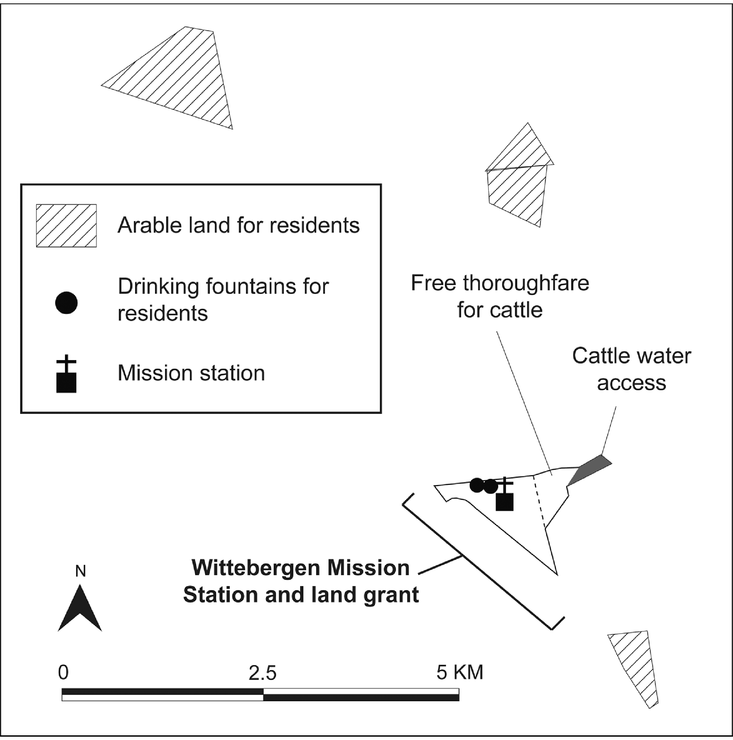
Archaeologically, vagrants may appear fleeting and ghost-like, but while their physical presences may have been ephemeral, their affects – the sensuous, imaginative power they exerted on the world around them – could linger. We can see this in the institutions established to control their bodies (cf. King Reference King2017b). At Wittebergen, for instance, the archaeological residues of this control are the fences surrounding plots of arable land assigned to ‘settled’ workers, as well as the accompanying houses grouped into neighbourhoods and built to represent idealized versions of African homesteads (figure 4) (King Reference Kingforthcoming). Indeed, the varied legislative and institutional controls on vagrancy had a transformative effect on southern Africa's political and economic landscapes, often creating new communities of labourers (including new towns) and giving rise to forms of ‘peasant resistance’ (Beinart and Bundy Reference Beinart and Bundy1987).
Map of Wittebergen Native Reserve showing fenced plots set aside for arable land and mission station. Drawn after Surveyor General Herschel Region Document TR63/1883.

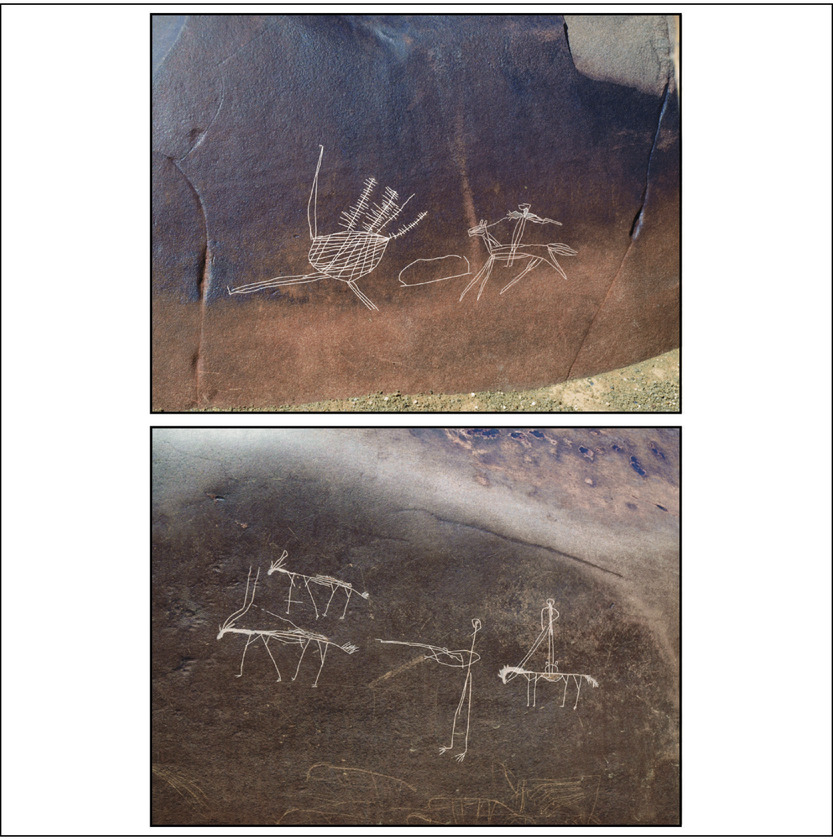
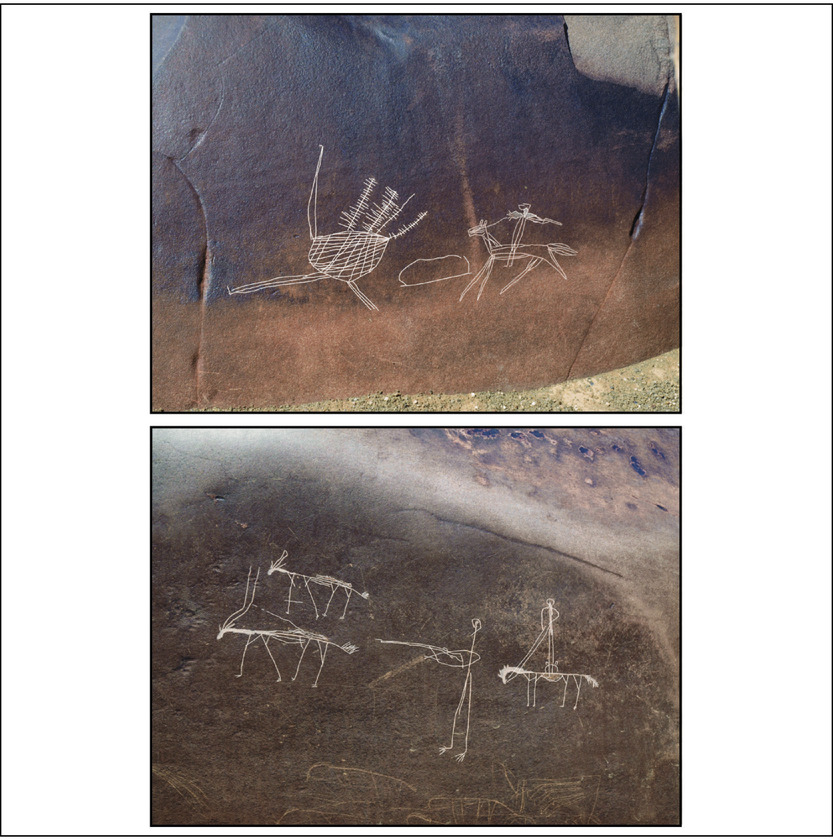
In certain contexts we may even have access to archaeological signatures of erstwhile vagrant communities. Mark McGranaghan's (Reference McGranaghan2016) work on the Cape's northern frontier has drawn attention to culturally creative processes at work within groups of hunter-pastoralists. Using engraved historical-period rock art, verbatim testimony of 19th-century Khoe/San farm labourers and other historical texts, McGranaghan charts how the emergence of ostrich farming as a major industry drew in (through choice or force) large numbers of people who had hitherto led nomadic lifeways that earned them the designation of vagrants. The rock art of this landscape – with imagery coupling ostriches, colonial material culture, long-standing rain-making motifs, and satirical or scatological themes (figure 5) – embodies a situation where vagrants were transformed into groups of rural labourers, articulating a way of life in the interstices of commercial farming and hunting and gathering.
Rock art of the Strandberg showing associations between ostrich herding/hunting, horsemanship and European material culture. Images courtesy Mark McGranaghan.
While vagrancy may have been a criminal offence, it illustrates how we should be wary not only of subscribing to an overextended interpretation of state imagination (the state's ability to expand the idea of vagrancy ad infinitum) but also of state power. While much of the original debates around vagrancy took place in Cape legislature, ‘vagrancy’ as a concept and ‘vagrant’ as a criminal type became somewhat unmoored from their legal frameworks and travelled. In doing so, they bundled subsistence, economic and locative traits, and were used to describe experiences of a particular place and type of person in that place, as well as shape the reactions to those figures.
The rebel
Rebellion represents a cataclysmic moment in the relationship between power and the governed. Within archaeological discussions of resistance and how to discern it in the past, rebellions were not only major events in the history of dissent but also moments of unusually clear insight into how dissent worked. González-Ruibal (Reference González-Ruibal2014, 9–11) has argued that we need to avoid stretching the concept of resistance farther than we have already, and should look instead to distinctions between peoples’ ‘cultural coping mechanisms’ when confronted with regimes of power. By this, González-Ruibal means to look to ontologies of resistance, in which material gestures were enacted in ways that incorporated an awareness of how state power was manifested and undermined.
Where, then, is it possible to discern resistance being practised as such, and where did actions with longer histories appear as resistance simply because they transgressed the desires of the state (King Reference King2017a)?
South Africa in the late 18th and the 19th centuries saw a good deal of fairly unambiguous resistance and uprising. At the Cape in the latter half of the 18th century, Khoe/San rebels stole cattle from Dutch settlers and verbally proclaimed themselves as resisting European settlement (Adhikari Reference Adhikari2010, 31; Cullinan Reference Cullinan1992, 34). The 1870s in particular saw widespread, vocal and often violent dissent blossom among African chiefdoms farther east, the prevalence of which fuelled colonists’ fears that a mass African uprising was imminent, in turn prompting enhanced efforts to identify and control suspected or potential rebels (Eldredge Reference Eldredge2007, 48–49).
These efforts and anxieties contributed to the first rebellion in Basutoland (newly annexed to the Cape Colony) in 1879, an event that illuminates how and where ‘rebelliousness’ rested upon material dispositions. For all that rebellion offers a clear way of enacting a programme of resistance addressing certain aspects of state rule, the tactics and strategies of rebellion often referenced particular sorts of historical consciousness (cf. Fleisher Reference Fleisher, Reid and Lane2004). Here, I am not invoking Hobsbawm's (Reference Hobsbawm1959) and Ranger's (Reference Ranger, Hobsbawm and Ranger2012) ‘archaic forms of dissent’ – social movements inflected by a ‘deep’ class consciousness that offered cultural resources for resisting the state. Rather, I want to acknowledge how different elements of rebellion – as both contingent and historically embedded – were materialized at certain points over a longer period of time.
In the case of the Basutoland conflict – known as Moorosi's War – historical analysis has focused on the battleground: the points at which colonial forces engaged Moorosi's rebels in combat and attempted to scale his mountain stronghold, known as Mount Moorosi (Atmore Reference Atmore, Rotberg and Mazrui1970; Sanders Reference Sanders2011). Looking more broadly to the practical components of how rebellion functioned and what rebellion looked like offers insight into where coordinated resistance fits into longer-term lifeways and use of the material world. Consequently, rebellion appears (archaeologically and historiographically) less like an anomalous occurrence and more familiar, materially speaking.
The proximate causes of Moorosi's War relate to two broad forms of regulation and punishment: British legislation prohibiting Africans from owning firearms, and the enforcement of new legal penalties against Moorosi and his followers (known by the ethnonym ‘BaPhuthi’). Basutoland's 1871 annexation by the Cape brought new administration, including the installation of a magistrate at Cornet Spruit specifically charged with monitoring Moorosi's movements and activities in the area (which often included raiding cattle) (Burman Reference Burman1981). By this point, Moorosi had served as a subordinate chief to Moshoeshoe I for at least four decades, and held a degree of autonomy over lands along and south of the Senqu into the southern Maloti–Drakensberg mountains (King and Challis Reference King and Challis2017). The infrastructure and surveillance established in the protectorate were, for him, particularly potent reminders of this new colonial presence.
While many historians have pointed to the enactment of the 1878 Peace Preservation Act – demanding that African subjects surrender their firearms – as the immediate cause of Moorosi's War, the Act capped nearly a decade of legislative actions against Moorosi. Magistrates (a second was eventually installed at Quthing, closer to Moorosi's settlements, when the first proved inadequate) aggressively enforced laws curtailing Moorosi's chiefly rights, and arrested and fined BaPhuthi, often on flimsy evidence (King Reference King2014, 195). For their part, Moorosi and his BaPhuthi responded with disruption, harrying constables and staging shows of force (e.g. assembling large numbers of men in front of the magistracy) (Eldredge Reference Eldredge2007, 46–49).
Moorosi's rebellion was sparked on New Year's Eve 1878, when his followers attacked a gaol to free his son Doda who was incarcerated there, sending the magistrate and his family fleeing over the border in fear of their lives (ibid., 54). By March 1879, Moorosi and his followers had entrenched themselves atop Mount Moorosi. Allied British and Basotho forces arrayed themselves at the base of the mountain and embarked upon a siege that would last eight months and cost around £300,000 (Atmore Reference Atmore, Rotberg and Mazrui1970).
Depictions of Moorosi's War as a siege do not quite capture the geographic extent of the conflict, the transformations it wrought on the landscape, and the participation of BaPhuthi supporters at a remove from the mountains. Looking to these broader sites of resistance illuminates where longer-term patterns of BaPhuthi movement and subsistence, and intelligence about the landscape, were part of how Moorosi's War played out in material terms.
Before the war, Moorosi and his followers had been fairly peripatetic, moving through a series of dispersed settlements as they ranged through the Maloti–Drakensberg mountains to raid cattle. They used rock shelters and steep-sided mountains as fall-back positions after raids, as places to store food and supplies, and for longer periods of dwelling. Settlements like Bolepeletsa (an example of a mountaintop site), occupied throughout the 19th century, were geared towards expediency: walls for huts and kraals were dry-walled and repaired with undressed stone, the few avenues of ingress onto the hilltop were easily blocked with defensive walling, and the only local water sources were naturally occurring cupules in the hill's sandstone bedrock (King Reference King2017b). Moorosi's BaPhuthi were well aware of the difficulties that colonial police and military faced in pursuing cattle raiders into the Maloti–Drakensberg, and used landscape features like inaccessible hilltops to their advantage (King and Challis Reference King and Challis2017).
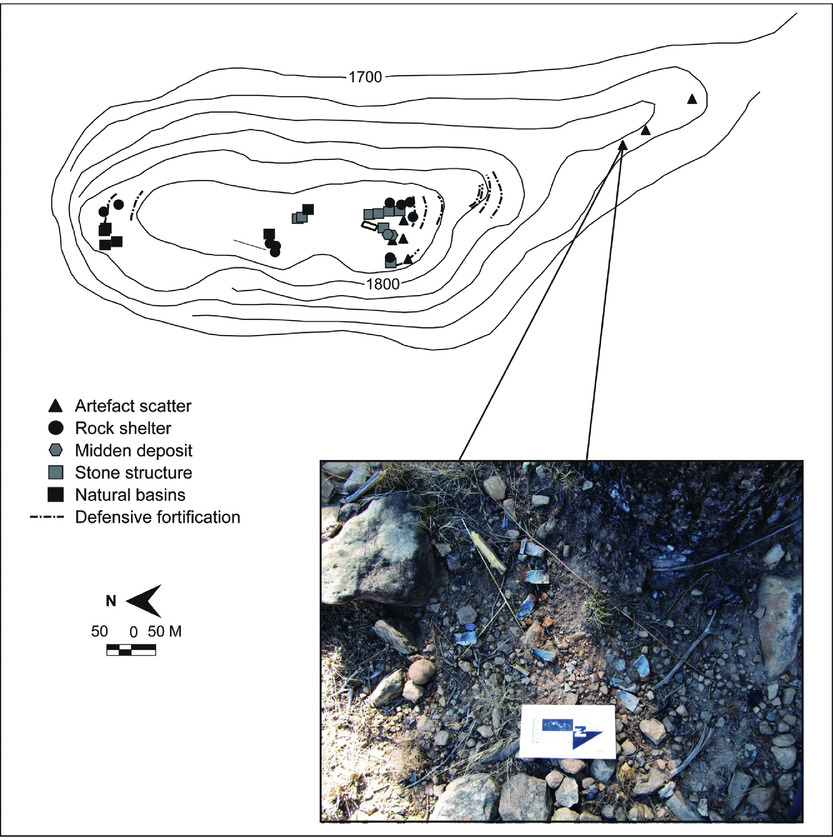
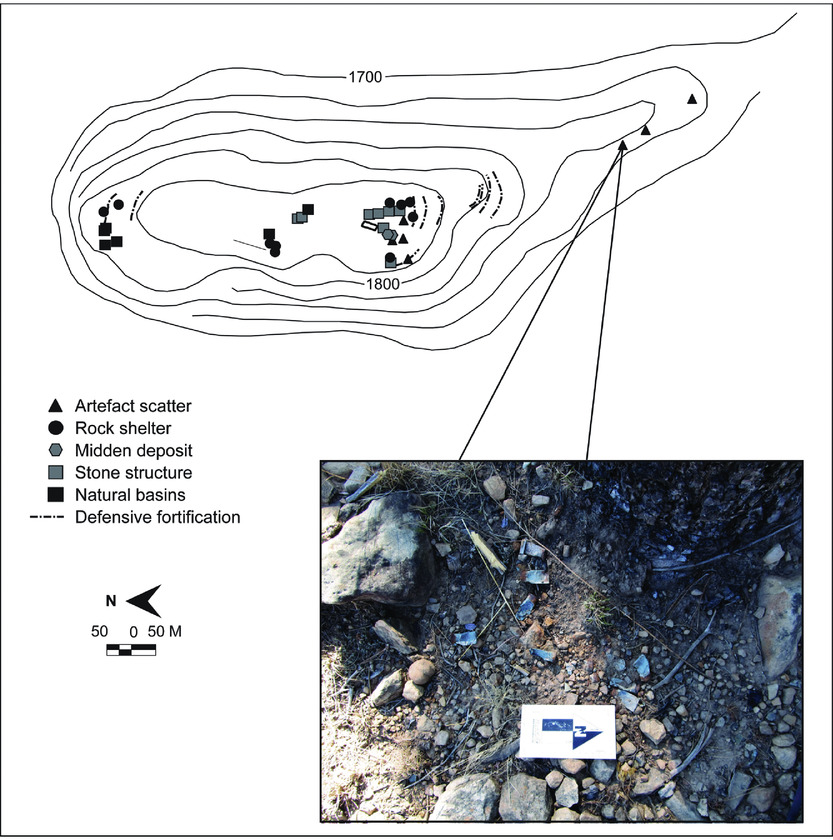
We see these same strategies in how rebels used Mount Moorosi, and the flat-topped mountains surrounding it. While significantly larger than Moorosi's other settlements, Mount Moorosi (figure 6) shares many of the features that made it a desirable redoubt: precipitous sides and limited access points, proximity to a water source (the Senqu river) and natural basins on the mountaintop, and relatively unobstructed views of the surrounding terrain. But Mount Moorosi was a more heavily fortified version of these earlier locales. A series of defensive walls on krantz lines running up the mountain's one slope offered cover for rebels fighting colonial forces below, and stone-walled structures possibly representing huts or kraals (a lack of archaeological deposit here makes this conjectural) cluster densely near this battle-facing side.
Survey map of Mount Moorosi, with bullet casings dating to the late 19th century.
Within the first few months of the rebellion, though, much of the fighting between British/Basotho and BaPhuthi forces occurred off Mount Moorosi and in the surrounding landscape. Several of Moorosi's sons were stationed atop mountains along the Senqu river and its tributaries. From these positions, they were tasked with guarding supplies and harassing colonial troops. While colonial attacks initially targeted Mount Moorosi, it soon became apparent to the military leadership that they could damage the rebels’ resources by targeting these peripheral sites (Browning Reference Browning1880, 299; Brabant Reference Brabant1931, 80–82).
According to evidence given by rebels who surrendered and then testified before the local magistrate, Mount Moorosi was home to between one hundred and three hundred combatants encamped atop the mountain fairly continuously (Austen Reference Austen1879b; Martin Reference Martin1879). Although Moorosi kept cattle on the mountain prior to the war, combatants were supplemented and provisioned through a network of collaborators that would keep supplies, livestock and refugees in rock shelters elsewhere along the Senqu, even up into the highlands (Austen Reference Austen1879a; Martin Reference Martin1879, 10; Southey Reference Southey1879, 21).
This last strategy of keeping livestock at higher altitudes and beyond the reach of colonial security forces had a long history in the Maloti–Drakensberg (King and Challis Reference King and Challis2017). ‘Bushman’ raiders – heterogeneous cohorts of people who took cattle and horses from African and European farmers in the surrounding lowlands – used rock shelters as encampments for varying durations and purposes, especially to hide contraband animals (Wright Reference Wright1971, 126; Challis Reference Challis2012). Colonial officials tasked with pursuing or assessing the threat that raiders posed drew attention to these patterns of rock shelter use from the 1840s: Henry Francis Fynn interviewed raiders who camped in rock shelters at the headwaters of rivers in the Drakensberg escarpment (Vinnicombe Reference Vinnicombe, Mitchell and Smith2009, 55); in 1869 Albert Allison tracked a cohort of raiders to a rock shelter stocked with horses, cattle and guns (Allison Reference Allison1869); raiders told Sir Walter Stanford in 1884 how they would camp and paint in rock shelters in the Maloti–Drakensberg highlands (Macquarrie Reference Macquarrie1958, 29). One shelter was so closely associated with an infamous cattle raider and associate of Moorosi called Soai that his shelter was occasionally called ‘Lehaheng la Soai’ (‘The Place of the Cave of the Village of Soai’) (Mitchell Reference Mitchell2010, 154–55). Rock arts depicting horses (a chronological marker, as horses arrived in the region c.1835) are found in shelters across the Maloti–Drakensberg mountains, and have been attributed to culturally creolized groups of cattle raiders for whom the horse was a potent being and an essential economic participant (Challis Reference Challis2008; Reference Challis2012; Reference Challis, Deacon and Skotnes2014; Reference Challis, Hamilton and Leibhammer2016). The widespread use of these spaces by communities for whom raiding was a meaningful social practice (Challis Reference Challis, Deacon and Skotnes2014; Reference Challis, Hamilton and Leibhammer2016) underscores the significance of these rock shelters in a landscape in which raiding and ‘outlaw’ behaviours were not only commonplace, but also means of enacting social cohesion among cohorts of diverse peoples (King and Challis Reference King and Challis2017).
Thus, when Moorosi and his rebels relied upon collaborators to maintain a supply network between highland shelters and their mountain redoubt, they were drawing upon a well-established use of the Maloti–Drakensberg mountains and longer-term intelligence about how to keep supplies away from colonial entities. This is not to suggest that the rebellion represents a colonial misconstrual of long-standing practices, or that it was enacted without an awareness of the specificities of its historical situation. Rather, it is to demonstrate how the tactics and strategies of Moorosi's War drew upon intelligence about the material world that was rooted in experience and memory; and which references widespread ways of engaging with how the terrain enabled ‘outlaws’ to evade retribution.
One final observation about rebellion more broadly: Hobsbawm's discussion of ‘primitive rebels’ suggests that one person's rebel may be another's freedom fighter. Put differently, rebellions denote the existence of a moral community: people linked through mutual obligation and shared interests in resisting the state. We do not know much about the constituents of Moorosi's polity prior to the rebellion, but testimonies from surrendered rebels suggest that the moral community atop Mount Moorosi entailed connections that included and also cut across familial ties. One informant, Litsilsa, offered the magistrate a list of seventeen rebel names, almost all of whom belonged to Moorosi's sons, grandsons and subordinate chiefs (Austen Reference Austen1879b; Martin Reference Martin1879). Whether these kin-based relationships were actually consanguineal or more fictive (Landau Reference Landau2010), being a Phuthi rebel could entail some form of identification with Moorosi. The remaining participants fought on the mountain for other reasons, perhaps drawn by anti-colonialist or anti-royalist sentiment or by Moorosi's cult of personality (Austen Reference Austen1879b; Reference Austen1879c; Reference Austen1880). What insights we have into the long-term workings of Moorosi's polity suggest that his chiefdom was capable of incorporating people from an array of sociocultural backgrounds (including ‘Bushmen’ raiders), as attested to in genealogies and oral histories (King Reference King2017b). Concerning ‘Bushmen’ raiders, archaeological scholarship has highlighted how raids could foster cohesion through shared practices: planning and executing manoeuvres, caring for and hiding livestock, producing rock art. Rock art scholars in particular have debated the character of this cohesion, postulating scenarios of casual socio-economic cooperation and deeper cultural creolization (Blundell Reference Blundell2004; Challis Reference Challis, Hamilton and Leibhammer2016; Mallen Reference Mallen2008).
I am not arguing that Moorosi's followers achieved cohesion in the same way as these raiders, nor is there scope here to explore notions of community formation in southern African chiefdoms in detail. I raise this issue of moral community to prompt examination of what we take for granted about how rebel movements operated. As we have seen, living ‘in the face of the state’ was not simply a reactionary existence, but drew on peoples’ awareness of their historical position – visible in the adaptation of different BaPhuthi landmarks for use in the rebellion. Inasmuch as we may think of rebellion as responding to a specific trigger, Moorosi's BaPhuthi demonstrate that we should also consider the practices, vocabularies and use of space that fostered obligatory relationships beyond and before the battlefield. This resonates with calls to expand archaeologies of warfare to include a more diverse array of arenas and actors involved in conflict (e.g. Nielsen Reference Nielsen, Nielsen and Walker2009; Vandkilde Reference Vandkilde2003); to these I would add a need to nuance violent resistance in a similar manner.
Conclusion
Class warriors, folk heroes, bogeymen (and -women) – in these and other incarnations of ‘outlaw’ we see not only their narrative power but also their material and epistemic power. Outlaws are indeed ‘material fantasies’, speaking to particular sensory experiences, anxieties, fears, desires, memories and rumour. But there are limits to imagination (Hamilton Reference Hamilton1998; Spear Reference Spear2003): these fantasies are not endlessly creative but constrained by the material world, its accretions, temporalities and affordances. Those limits direct us to examine where constructions of outlaw were affective, sensuous experiences, emerging from longer pasts and shaped in historically specific contexts. These affective experiences could be subtle and messy, more concerned with making sense of outlaws with material culture rather than from it: the vagrant illustrates that we are often better positioned to recover materials that refract desires to control deviant figures than to recover the traces that they created.
This reinforces earlier points about ephemeral traces leaving enduring affects, and leads me to highlight where the discussion here connects with archaeologies of incarceration and coercive spaces. These institutions have been scrutinized as representing almost utopian visions of the state, projects designed to monitor and transform the consciousness of those interned as well as society more broadly (Moshenska and Myers Reference Moshenska, Myers, Myers and Moshenska2011). Prisons, internment camps and gaols are thus in many ways the apotheosis of the dynamic just described, where outlaws (or at least state visions of them) are perhaps at their most material. It is, however, important to foreground how these spaces were built on understandings (often partial or misguided) of what outlaw bodies were capable of, which drew on observations and encounters in the wider world. Joining my discussion here with this literature allows us to glimpse the long, often unwieldy, nearly always violent processes of trial and error that characterized efforts to regulate deviance in so many parts of the globe (Rao and Pierce Reference Rao, Pierce, Pierce and Rao2006). Far from mitigating or excusing state exercises in control, this highlights where institutional authority may have penetrated slowly and insidiously (especially on colonial frontiers) through the experimentation and instabilities that Martin Hall (2000, 125) described.
While criminality is often assumed to go hand-in-glove with state power (and thus appears irrelevant to non-state contexts), I have also endeavoured to illustrate how criminality can emerge from our own habits of archaeological or historical thinking. These habits can be more concerned with patterns of movement than with objects directly. The cattle raider demonstrates how construing violence and disruption from long-term settlement patterns can conjure culprits responsible for such depredations based largely on perceived departures from earlier norms. Outlaws thus encourage us to reflect critically on how we build archaeological narratives about transgression, order and disorder in the past. This is especially the case where attention to process and pattern suggests an archaeological status quo that (deliberately or not) becomes a baseline for measuring changes that may appear socially disruptive but were not always connected to antisocial actors.
Indeed, a key point for colonial contexts or political-economic mosaics more broadly (Stahl Reference Stahl2004) is to observe where outlaws were constructed not simply through the entrenchment of legal systems but through the displacement of traditional or long-term subsistence lifeways. Through changing hegemonies and/or material regimes of value, the traditional can shade into the transgressive, and identifying and regulating transgressors becomes an exercise in discerning material precedent and historical consciousness. This may appear to return us to a post-colonial focus on subalterns via some scenic circumlocution. What I have endeavoured to emphasize here is how ‘outlaws’ were bricolages of affects and sensibilities, and so archaeologists – as ‘intellectual bricoleurs’ (Dawdy Reference Dawdy2005, 153) – are well suited to exploring the theoretical and historical directions that these figures may lead us in (cf. Joffe Reference Joffe2003).
Methodologically, this suggests some avenues for archaeologists working with words and things across diverse source materials. If we treat these as sites of imagination (cf. Casella and Voss Reference Casella, Voss, Casella and Voss2011; Dawdy Reference Dawdy2008) – in which we observe affect and sense commingling – then we can begin to approach textual and oral sources with a more nuanced eye to the work that the material world did in these contexts. This allows archaeologists to claim a more expansive, interdisciplinary role in global historical studies, and assert that some aspects of the past were more material than they may initially appear. This position is particularly compelling in places where historical and archaeological scholarship has struggled to find common ground. Outlaws highlight the futility of such divides: raiders, vagrants and rebels are literally undisciplined, crossing sources and scholarly communities; there is much to gain from following them.
Acknowledgements
The fieldwork for this research was funded by a Clarendon Scholarship from the University of Oxford. This paper was written during my tenure as Smuts Research Fellow in African Studies and with generous support from the Smuts Memorial Fund. I thank Mark McGranaghan for comments on earlier drafts of this paper and comments from two anonymous reviewers.