Introduction
Anxiety disorders are one of the most common mental disorders (Kessler et al. Reference Kessler, Berglund, Demler, Jin, Merikangas and Walters2005; Kadri et al. Reference Kadri, Agoub, El Gnaoui, Berrada and Moussaoui2007), commencing early in life (Kessler et al. Reference Kessler, Amminger, Aguilar-Gaxiola, Alonso, Lee and Ustun2007) and following a chronic course (Antony & Stein, Reference Antony and Stein2009). As anxiety disorders are associated with substantial impairment (Weiller et al. Reference Weiller, Bisserbe and Maier1998) and use of primary care services (Kessler & Greenberg, Reference Kessler, Greenberg, Davis, Charney, Coyle and Nemeroff2002), up-to-date information around the burden of anxiety disorders is needed to inform decision-making in public health policy and service planning.
The Global Burden of Disease (GBD) project provides a framework for evaluating the comparative impact of disease based on composite measures of disease occurrence, mortality and disability. The original GBD 1990 study demonstrated that mental disorders, especially depression and anxiety disorders, made a substantial contribution to the global burden (Murray et al. Reference Murray and Lopez1996).
A new GBD study (GBD 2010) commenced in 2007 and aims to include a broader range of diseases, including mental disorders, with a greater focus on empirical data (Murray et al. Reference Murray, Lopez, Black, Mathers, Shibuya, Ezzati, Salomon, Michaud, Walker and Vos2005; Degenhardt et al. Reference Degenhardt, Whiteford, Hall and Vos2009). While previous GBD estimates reflected only three anxiety disorders: post-traumatic stress disorder (PTSD), obsessive–compulsive disorder (OCD) and panic disorder (Murray & Lopez, Reference Murray and Lopez1996), GBD 2010 will report burden for ‘any’ anxiety disorder inclusive of the common anxiety disorders, for example, generalized anxiety disorder, and early-onset disorders such as separation anxiety disorder (see online Supplementary Appendix A). Previously an overall estimate could not be made for anxiety disorders as the high co-morbidity between specific disorders means that prevalent cases cannot simply be summed. Whilst acknowledging that estimates for ‘any’ anxiety disorder will not capture the variability in individual anxiety disorders, it ensures burden is not over-estimated through ‘double counting’ of individuals with multiple disorders. This paper describes the review undertaken to identify global data for prevalence of anxiety disorders.
Whilst a substantial body of data is available on the epidemiology of anxiety disorders, it is highly fragmented and reported prevalence varies considerably (Marks, Reference Marks1986; Weissman, Reference Weissman1988; Somers et al. Reference Somers, Goldner, Waraich and Hsu2006; Tanios et al. Reference Tanios, Abou-Saleh, Karam, Salamoun, Mneimneh and Karam2009). This variability presents a challenge in deriving regional burden estimates, as it is unclear the extent to which differences in prevalence estimates are real or are being influenced by cultural, methodological or other factors. In addition to gender and age, research has identified a range of factors associated with the occurrence of anxiety including: urbanicity (Prina et al. Reference Prina, Ferri, Guerra, Brayne and Prince2011); marital status (Kessler et al. Reference Kessler, Berglund, Demler, Jin, Merikangas and Walters2005; Pirkola et al. Reference Pirkola, Isometsä, Survisaari, Aro, Joukamaa, Pöikolainen, Koshinen, Aromaa and Loennqvist2005); psychosocial stressors, for example, socio-economic disadvantage (Vorcaro et al. Reference Vorcaro, Rocha, Uchoa and Lima-Costa2004; Moffitt et al. Reference Moffitt, Caspi, Harrington, Milne, Melchior, Goldberg and Poulton2007; Kawakami et al. Reference Kawakami, Abdulghani, Alonso, Bromet, Bruffaerts, Caldas-de-Almeida, Chiu, de Girolamo, de Graaf, Fayyad, Ferry, Florescu, Gureje, Hu, Lakoma, LeBlanc, Lee, Levinson, Malhotra, Matschinger, Medina-Mora, Nakamura, Oakley Browne, Okoliyski, Posada-Villa, Sampson, Viana and Kessler2012) and relationship difficulties (Overbeek et al. Reference Overbeek, Vollebergh, de Graaf, Scholte, de Kemp and Engels2006; Beesdo et al. Reference Beesdo, Pine, Lieb and Wittchen2010); and exposure to violence (Campbell, Reference Campbell2002; Espié et al. Reference Espié, Gaboulaud, Baubet, Casas, Mouchenik, Yun, Grais and Moro2009; Stein et al. Reference Stein, Williams, Jackson, Seedat, Myer, Herman and Williams2009), trauma (de Graaf et al. Reference de Graaf, Bijl, Smit, Vollebergh and Spijker2002; Galea et al. Reference Galea, Ahern, Tracy, Hubbard, Cerda, Goldmann and Vlahov2008; Hovens et al. Reference Hovens, Giltay, Wiersma, Spinhoven, Penninx and Zitman2012; Kessler et al. Reference Kessler, McLaughlin, Koenen, Petukhova and Hill2012) and conflict (de Jong et al. Reference de Jong, Komproe, van Ommeren, El Masri, Araya, Khaled, van de Put and Somasundaram2001; Steel et al. Reference Steel, Chey, Silove, Marnane, Bryant and van Ommeren2009a).
Early reviews of anxiety disorders in the general population were descriptive studies largely from North America, Western Europe and Australasia (Marks, Reference Marks1986; Weissman, Reference Weissman1988; Costello et al. Reference Costello, Egger and Angold2005). Prevalence estimates for adults were reported between 0.5% and 20.9% and methodological differences were identified as potential sources of variability (Marks, Reference Marks1986; Weissman, Reference Weissman1988; Costello et al. Reference Costello, Egger and Angold2005). More recent reviews with greater global coverage show that prevalence varies by region and culture (Eaton, Reference Eaton1995; Somers et al. Reference Somers, Goldner, Waraich and Hsu2006) and similar differences have been reported by cross-national collaborative projects (World Health Organization, 2000; Steel Reference Steel, Silove, Giao, Phan, Chey, Whelan, Bauman and Bryant2009b).
Reviews focusing on non-western populations have demonstrated that sensitivity of diagnostic systems (Steel et al. Reference Steel, Silove, Giao, Phan, Chey, Whelan, Bauman and Bryant2009b) and survey instruments (Tanios et al. Reference Tanios, Abou-Saleh, Karam, Salamoun, Mneimneh and Karam2009) can influence estimates for prevalence and potentially obscure real variation across cultures. To elucidate the true difference in anxiety disorders across populations, environmental and methodological factors associated with changes in prevalence need to be identified.
The aims of the present study were to review the global prevalence of anxiety disorders and to explore substantive and methodological factors that account for inter-study variance, following the analysis strategy reported by Steel et al. (Reference Steel, Chey, Silove, Marnane, Bryant and van Ommeren2009a). We present the predicted prevalence of anxiety disorders, adjusted for methodological factors identified in the multivariate regression model. These data and explanatory factors will inform estimates for the burden of anxiety disorders in the new GBD study.
Method
Search strategy
A systematic search was conducted to document the global availability of prevalence data for anxiety disorders. Methods were consistent with those recommended by the Meta-analysis of Observational Studies in Epidemiology (MOOSE) group (Stroup et al. Reference Stroup, Berlin, Morton, Olkin, Williamson, Rennie, Moher, Becker, Sipe and Thacker2000). A broad search string was developed with the assistance of a research librarian to search relevant electronic databases (Medline, PsycINFO and EMBASE) and included both the broad term ‘anxiety disorders’ and specific anxiety disorders AND epidemiolog* OR prevalen*. Results were limited to ‘human’ studies published between 1980 and 2009. No limitations were set on language of publication.
Titles and abstracts were scanned to identify papers containing epidemiological data and then the full text was obtained for relevant articles and reviewed for eligibility criteria. Reference lists and texts were manually searched for further studies and an online search was conducted for unpublished data. Experts in the field were invited to review our list of studies and to provide details of additional sources, including those available after 2009. The World Mental Health Survey (WMHS) Consortium was approached for results from their ongoing cross-national population surveys. The WMHS comprises national or regional household surveys in which structured surveys were administered between 2000 and 2009. Data were provided for age- and gender-specific prevalence of anxiety disorders for 22 countries (World Mental Health Survey Consortium, 2008).
Studies reporting data for current (point/past month) or period prevalence of anxiety disorders were sought. Lifetime prevalence was excluded, as evidence suggests that symptom recall is less reliable over time (Kruijshaar et al. Reference Kruijshaar, Barendregt, Vos, de Graaf, Spijker and Andrews2005; Moffitt et al. Reference Moffitt, Caspi, Taylor, Kokaua, Milne, Polanczyk and Poulton2010). Studies were excluded if they were not based on community samples, for example, if they were clinical samples, refugee groups or war veterans. The majority of prevalence studies are based on a cross-sectional survey design; however, to maximize coverage of age groups, we also accepted longitudinal and birth cohort studies. Where studies report prevalence at intervals within the same sample, the estimate at baseline was extracted except where more informative estimates were provided at a later stage.
Data extraction
Information about design and participants were extracted as recommended by PRISMA (Preferred Reporting Items for Systematic Reviews and Meta-Analyses) guidelines (Moher et al. Reference Moher, Liberati, Tetzlaff and Altman2009) and entered into a database with forced entry of key variables and drop-down boxes to ensure quality control. Consistency was monitored through random double-extraction of papers and regular meetings with the primary investigator to discuss issues. Where reporting of data was unclear or incomplete, authors were contacted for further clarification.
Measures
Anxiety disorders were defined as meeting the threshold for ‘any’ anxiety disorder according to Diagnostic and Statistical Manual of Mental Disorders (DSM) or the International Classification of Diseases: Classification of Mental and Behavioural Disorders (ICD) diagnosis. Where a survey instrument was used, it needed to map to one of these diagnostic criteria. Estimates for single disorders such as PTSD were not included in this analysis.
Estimates of uncertainty [standard error (s.e.) or confidence interval (CI)] were extracted where reported. If not reported, and the author was unable to provide the information, s.e. was calculated using s.e.=√[P×(1 – P)]/N, where P was the proportion of cases and N the denominator.
Substantive factors
Gender
Gender was categorized according to the most informative level of estimate, that is, ‘male’ and ‘female’ if reported, and ‘person’ where only overall prevalence was reported.
Age categories
Where age-specific estimates were reported, these were aggregated into age categories: ‘child/adolescent’ (3–17 years); ‘young adult’ (18–34 years); ‘mid-adult’ (35–54 years); and ‘older adult’ (55 years and older). Where an overall estimate only was reported (e.g. 18–65 years), this was coded separately as a ‘broad age range’.
Conflict
Conflict was dichotomously classified as ‘conflict’ or ‘non-conflict’ based on previous reviews of the literature (Murray et al. Reference Murray, King, Lopez, Tomijima and Krug2002) and reports from independent organizations such as the United Nations (http://www.un.org/en/peace/), the Stockholm International Peace Research Institute (http://www.sipri.org/) and the Centre for International Research on the Epidemiology of Disasters (http://www.cedat.be/). Conflict was defined as exposure to war (between or within states), revolution or widespread persecution either during or within the 10 years preceding the study period (Ajakaiyea & Alib, Reference Ajakaiyea and Alib2009).
Culture
Culture was catgeorized as a six-level variable: ‘Euro/Anglo’; ‘Indo/Asia’; ‘Africa’; ‘Central and Eastern Europe’; ‘North Africa and Middle East’ and ‘Ibero/Latin’. As no established protocol currently exist for categorizing cultural groups in epidemiological research we allowed previous findings of cross-cultural differences in mental health to inform our initial approach to classifications. Cultural classifications were then refined based on observed trends in the data. For example, a higher rate of anxiety disorders have previously been reported in Western European, North American and Australasian populations and this was supported in the descriptive analyses of our data; hence these populations were commonly classified as ‘Euro/Anglo’.
Economic status
The population economic status was based on World Bank income classifications (http://data.worldbank.org/about/country-classifications/country-and-lending-groups). We used the term ‘developing’ countries for low- and middle-low-income countries as classified by the World Bank, ‘emerging’ countries for those classified as upper-middle-income countries, and ‘developed’ countries for those with a high income.
Urbanicity
Reported urbanicity of samples was categorized as ‘urban’, ‘rural’ and ‘mixed’. Where insufficient information was given to determine urbanicity, these estimates were classified as ‘mixed’.
Time
Change in prevalence over time was explored by categorizing the mid-point of the data collection period into decades (‘1980s’, ‘1990s’ or ‘2000s’).
Methodological factors
Prevalence period
We conducted preliminary descriptive analyses of the prevalence period and found that 3-month prevalence was statistically similar to past-month and point-prevalence estimates and that 6-month prevalence approximately equated to 12-month prevalence. Therefore point, past-month and 3-month estimates were categorized as ‘current prevalence’ and 6-month and 12-month estimates were categorized as ‘past year prevalence’.
Response rate
The response rate for studies was categorized into ‘low’ (<60%), ‘average’ (60–79%) and ‘excellent’ (80% and higher). Categories for sample size were dichotomized into studies ‘below median’ (n<2419) and those of ‘median or greater’ (n⩾2419).
Coverage
Coverage describes the geographical representativeness of the study sample and was categorized as ‘national’, ‘regional’ (e.g. based on a state or province) and ‘community’, indicating limited coverage such as a city or several villages.
Diagnostic criteria
The effect of diagnostic criteria was explored by diagnostic system (DSM versus ICD) and by recency of criteria (DSM-IV and ICD-10 versus DSM-III, DSM-III-R and ICD-9).
Survey instruments
Survey instruments are difficult to categorize conceptually, and attempting this risks loss of explanatory information. Our classification of survey instrument was partly conceptual (e.g. combining of the Diagnostic Interview Schedule and Clinical Interview Schedule – Revised) but also informed by the degree of variability found in our analysis, for example, aggregation of semi-structured clinical instruments.
Survey administration
The method of survey administration was classified as either ‘clinical’ (i.e. by trained clinicians) or ‘lay interviewer’.
Number of disorders
Variability in estimates of ‘any’ anxiety disorder may be due to the number or type of specific disorders captured in the estimate. To examine this we derived a variable that reflected the number of disorders captured. Other variables were created to mark studies where ‘specific phobias’, ‘generalized anxiety disorder’ or ‘anxiety disorders – not otherwise specified’ were excluded.
Statistical analyses
All analyses were conducted using Stata SE11 (StataCorp LLP, USA). Prevalence estimates for anxiety disorders and measures of within-study uncertainty (s.e.) were log transformed. Heterogeneity was evaluated using the I 2 statistic to determine whether differences in reported estimates were greater than could be expected by chance. I 2 values are based on Cochrane's heterogeneity statistic (Q) but incorporate degrees of freedom to control for low or excessive power (Harris et al. Reference Harris, Bradburn, Deeks, Harbord, Altman and Sterne2008). As we obtained a substantial proportion of data from the grey literature, an examination of publication bias was not warranted.
As around 25% of our studies came from the WMHS Collaboration, and share similar methodology, it is possible that these data could influence the model. We ran a sensitivity test to see whether the WMHS studies biased the regression model and found that adjusting for these data had negligible effect on associations between prevalence and other covariates (results available upon request).
A random-effects meta-regression model for identifying sources of variability in prevalence of anxiety was developed through an iterative process of model building and testing (Homer & Lemeshow, Reference Homer and Lemeshow1989). An initial multivariate model of a priori substantive factors was calculated for factors identified in previous research, specifically gender, age, exposure to conflict, culture, economic status and urbanicity. Univariate models were then calculated for methodological factors and those with a p value of 0.3 or less were added to the multivariate model. Covariates were subtracted using a backward step-wise elimination process until the best-fitting model was identified. Inter-study variance was estimated using the residual maximum likelihood (REML) method to produce an adjusted R 2 statistic (Thompson & Sharp, Reference Thompson and Sharp1999).
We tested for collinearity using the conditional number of the model and then calculated variance-decomposition proportions to identify potential sources (Belsley, Reference Belsley1991). Outliers and influential studies were identified using residual values calculated from predicted prevalence and estimates of leverage based on regression coefficients (Chen et al. Reference Chen, Ender, Mitchell and Wells2003).
Global prevalence estimates for anxiety disorders were predicted for the average weight of substantive factors and adjusted by the reference value of methodological factors included in the final model. Model-based odds ratios with 95% CIs are reported for each covariate in the final multivariate regression model and adjusted current prevalence estimates for each strata of the substantive factors.
Results
Of the 15 488 potential studies identified in the systematic review, 87 met our inclusion criteria, with one-third of these identified through the secondary literature search (i.e. reference lists, on-line reports, doctoral theses and experts in the field; see Fig. 1). The final dataset included studies from 44 countries, with a total of 456 012 individuals based on study sample sizes. Summary characteristics of studies included in the analysis are described in online Supplementary Appendix B.
Flowchart of the systematic search for prevalence of anxiety disorders.

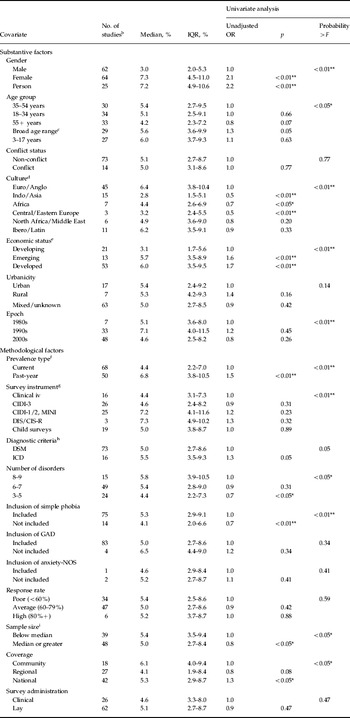
Substantial variability was found between studies, with estimates of current prevalence ranging from 0.9% in China (World Mental Health Survey Consortium, 2008) to 28.3% in Afghanistan (Ventevogel et al. Reference Ventevogel, De Vries, Scholte, Shinwari, Faiz, Nassery, van den Brink and Olff2007) and past-year prevalence ranging from 2.4% in Italy (Gigantesco et al. Reference Gigantesco, Palumbo, Mirabella, Pettinelli and Morosini2006) to 29.8% in Mexico (Benjet et al. Reference Benjet, Borges, Medina-Mora, Zambrano and Aguilar-Gaxiola2009). More than half the prevalence studies in our dataset focused on Euro/Anglo populations while Central/Eastern European populations were the focus of only 3% of studies (see Table 1). Few studies were found for conflict populations and those from emerging economy countries (16% and 13% of studies, respectively) and almost half of those were identified from sources other than peer-reviewed literature.
Unadjusted median prevalencea of anxiety disorders and univariate associations between substantive and methodological factors and disorder prevalence

IQR, Interquartile range; OR, odds ratio; GAD, generalized anxiety disorder; NOS, not otherwise specified.
a Includes current and past-year prevalence estimates.
b Number of studies sums to greater than 87, as prevalence is reported for multiple categories.
c Broad age group: studies only provided an overall age estimate, e.g. 18–65 years.
d Euro/Anglo: Western Europe, North America, Australasia; Indo/Asia: India, Bangladesh, Afghanistan, China, Japan, South Korea, Vietnam; Central/Eastern Europe: Romania, Bulgaria, Ukraine; Ibero/Latin: Spain, Colombia, Mexico, Chile.
e World Bank income classifications – developing: low- and middle-income countries; emerging: upper-middle-income countries; developed: high-income countries.
f Current prevalence: point, past-month or 3-month prevalence; past-year prevalence: 6-month or 12-month prevalence.
g Diagnostic instruments – Clinical iv: Structured Clinical Interview for DSM (SCID) and the Schedules for Clinical Assessment in Neuropsychiatry (SCAN), other semi-structured interview administered by a clinician; CIDI-3: Composite International Diagnostic Interview (v3); CIDI-1/2, MINI: Composite International Diagnostic Interview (v1 or 2) and the Mini-International Neuropsychiatric Interview; DIS/CIS-R: Diagnostic Interview Schedule and Clinical Interview Schedule – Revised; Child surveys: Child and Adolescent Psychiatric Assessment (CAPA), Development and Well-Being Assessment (DAWBA), Diagnostic Interview Schedule for Children (DISC), Kiddie-Schedule for Affective Disorders and Schizophrenia (K-SADS).
h DSM: Diagnostic and Statistical Manual; ICD: International Classification of Mental and Behavioural Disorders.
i Sample size – below median: n<2419; median or greater: n⩾2419.
* p<0.05, ** p<0.01.
The present review identified 15 different diagnostic instruments, including revised versions of original instruments. The most common instrument used in identifying anxiety disorders was the Composite International Diagnostic Interview, version 3.0, which was reported in one-third of studies. A total of six different diagnostic criteria were identified and, of these, over 80% of studies used a version of the DSM diagnostic system. The number of studies and unadjusted median prevalence are presented with the results of univariate analyses in Table 1.
Adjusted prevalence and factors associated with anxiety disorders
The global current prevalence for anxiety disorders is 7.3% (95% CI 4.8–10.9%), suggesting that one in 14 people around the world at any given time has an anxiety disorder and one in nine (11.6%, 95% CI 7.6–17.7%) will experience an anxiety disorder in a given year.
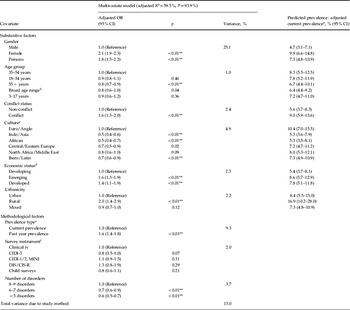
Multivariate analysis of associations between substantive and methodological factors and prevalence of anxiety disorders, and predicted current prevalence adjusted for methodological factors

OR, Odds ratio; CI, confidence interval.
a Prevalence adjusted to reference value for methodological factors (prevalence type: point; diagnostic instrument: clinical interview; number of disorders: 8–9).
b Broad age group: studies only provided an overall age estimate, e.g. 18–65 years.
c Euro/Anglo: Western Europe, North America, Australasia; Indo/Asia: India, Bangladesh, Afghanistan, China, Japan, South Korea, Vietnam; Central/Eastern Europe: Romania, Bulgaria, Ukraine; Ibero/Latin: Spain, Colombia, Mexico, Chile.
d World Bank income classifications – developing: low- and middle-income countries; emerging: upper-middle-income countries; developed: high-income countries.
e Current prevalence: point, past-month or 3-month prevalence; past-year prevalence: 6-month or 12-month prevalence.
f Survey instruments – Clinical iv: Structured Clinical Interview for DSM (SCID) and the Schedules for Clinical Assessment in Neuropsychiatry (SCAN), other semi-structured interview administered by a clinician; CIDI-3: Composite International Diagnostic Interview (v3); CIDI-1/2, MINI: Composite International Diagnostic Interview (v1 or 2) and the Mini-International Neuropsychiatric Interview; DIS/CIS-R: Diagnostic Interview Schedule and the Clinical Interview Schedule – Revised; Child surveys: Child and Adolescent Psychiatric Assessment (CAPA), Development and Well-Being Assessment (DAWBA), Diagnostic Interview Schedule for Children (DISC), Kiddie-Schedule for Affective Disorders and Schizophrenia (K-SADS).
* p<0.05, ** p<0.01.
Regression model
All substantive factors were significantly associated with the prevalence of anxiety disorders once methodological factors were included in the model. Of the substantive factors, gender and culture explained the greatest variance in estimates (25.1% and 4.9%, respectively). Methodological factors in the final model accounted for an additional 13.0% of variance and included prevalence period, survey instrument and number of anxiety disorders. In total, 59.5% of variance in the prevalence of anxiety disorders was explained by factors in the final model. Factors associated with the prevale`nce of anxiety disorders and the attributable variance of each are presented in Table 2.
Substantive factors
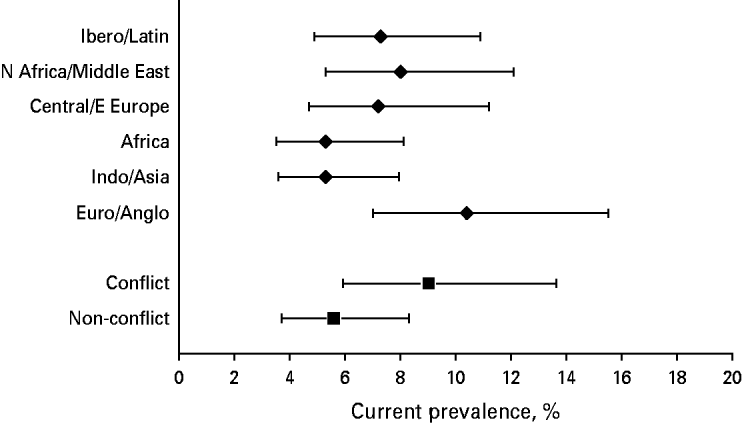
The greatest variance in the data was explained by gender (adjusted R 2 25.1%), with females more than twice as likely to have an anxiety disorder compared with males. Older adults (55 years plus) were 20% less likely to have anxiety compared with younger adults (35–54 years), and risk for anxiety was 20–50% lower in all cultures compared with Euro/Anglo cultures (Table 2). Model-based predictions show that prevalence of anxiety is similar across Indo/Asian and African cultures (5.3%) and across Central/Eastern European, Ibero/Latin and North Africa/Middle East cultures (7.2%, 7.3% and 8.0%, respectively) when adjusted for methodological factors. Conflict populations were 60% more likely to report anxiety compared with non-conflict populations (see Fig. 2).
Current prevalence and 95% confidence intervals for anxiety disorders adjusted for methodological factors. N Africa, North Africa, E Europe, Eastern Europe. For definitions of the regions, see Table 1.
Methodological factors
As expected, the prevalence period explained the greatest variance between estimates among the methodological factors (9.3%) (Table 2), which is consistent with the episodic course of anxiety disorders. Studies that captured eight or more disorders were statistically more likely to report a higher prevalence than those that reported seven disorders or fewer. Once the number of disorders was considered, the survey instrument was no longer statistically significant although it did explain a proportion of inter-study variance (2%). Diagnostic criteria, survey administration by a clinician, response rate and study sample size were not associated with prevalence after adjustment for other factors.
Discussion
The present review confirms that anxiety disorders are common worldwide, with one out of 14 people meeting diagnostic criteria at any point in time. Global prevalence varies considerably as evidenced by the wide CIs surrounding adjusted estimates. Previous burden of disease estimates for anxiety disorders were based on global prevalences of 0.28% for PTSD, 1.1% for OCD and 0.4% for panic disorder (Murray et al. Reference Murray and Lopez1996). Our current prevalence estimate of 7.3% for ‘any’ anxiety disorder is substantially higher and this will inform the new estimates for disease burden. Our model found no evidence for an increase in prevalence for anxiety disorders over time, which is salient in the new GBD estimates that will be made for 1990, 2005 and 2010.
To our knowledge this is the first systematic review to report worldwide current prevalence for anxiety disorders. A previous review reported a pooled past-year prevalence of 10.6% and lifetime prevalence of 16.6% (Somers et al. Reference Somers, Goldner, Waraich and Hsu2006). This is a little lower than our predicted estimate for past-year prevalence of 11.6% (7.6–17.7%); however, more data have become available in recent years to inform our analysis and the model-based prevalence reported here is adjusted for methodological factors.
Non-western cultures were associated with a reduced risk for anxiety disorders. However, the question remains whether this is a true difference in prevalence or whether it can be attributed to limited validity in diagnostic criteria or lack of measurement equivalence (Johnson & Malgady, Reference Johnson and Malgady1999; Hinton et al. Reference Hinton, Parl, Hsia, Hofmann and Pollack2009). Existing diagnostic criteria are thought to exclude different cultural presentations of anxiety disorders (Hinton et al. Reference Hinton, Parl, Hsia, Hofmann and Pollack2009; Lewis-Fernández et al. Reference Lewis-Fernández, Hinton, Laria, Patterson, Hofmann, Craske, Stein, Asnaani and Liao2010). Research demonstrates that DSM-IV diagnostic criteria identify fewer cases of anxiety in Vietnam compared with an indigenously based psychiatric scale (Steel et al. Reference Steel, Silove, Giao, Phan, Chey, Whelan, Bauman and Bryant2009b). An additional issue in identifying cases in non-western cultures is that endorsement of symptoms may be limited due to the inability to rephrase questions and probe for comprehension and further explanation of responses in fully structured survey instruments (Phillips et al. Reference Phillips, Zhang, Shi, Song, Ding, Pang, Li, Zhang and Wang2009). The limited number of studies available and the broad overlapping of CIs between non-Euro/Anglo cultures mean that results from these cultures should be interpreted with caution.
Prevalence estimates were significantly higher in populations exposed to conflict compared with non-conflict populations. Previous studies have reported an increased risk for mental disorders, particularly depression and PTSD, in groups exposed to conflict situations (de Jong et al. Reference de Jong, Komproe, van Ommeren, El Masri, Araya, Khaled, van de Put and Somasundaram2001; Steel et al. Reference Steel, Chey, Silove, Marnane, Bryant and van Ommeren2009a), yet large-scale epidemiological studies have reported mixed findings (World Mental Health Survey Consortium, 2008). The WMHS found that current prevalence of anxiety disorders was highest in non-conflict countries such as the USA (10.1%) and New Zealand (8.3%) compared with countries experiencing conflict such as Iraq and Lebanon (5.4% and 6.2%, respectively) (World Mental Health Survey Consortium, 2008). It may be that the lower estimates in conflict populations found by the WMHS surveys are due to their use of nationally representative sampling frames in contrast to other studies where single regions (possibly one known to have been exposed to direct conflict) were selected. Additional research is required to elucidate the impact of conflict on mental health at the population level.
In addition to gender, culture and conflict, the present review found that anxiety disorders were more commonly identified in emerging and developed countries compared with developing countries, based on an average measure of income for the population. While increased risk of anxiety disorders has been linked to low individual or household income within communities (Vorcaro et al. Reference Vorcaro, Rocha, Uchoa and Lima-Costa2004; Kawakami et al. Reference Kawakami, Abdulghani, Alonso, Bromet, Bruffaerts, Caldas-de-Almeida, Chiu, de Girolamo, de Graaf, Fayyad, Ferry, Florescu, Gureje, Hu, Lakoma, LeBlanc, Lee, Levinson, Malhotra, Matschinger, Medina-Mora, Nakamura, Oakley Browne, Okoliyski, Posada-Villa, Sampson, Viana and Kessler2012), results for cross-national surveys in developing countries show that this relationship is not consistent when looking at country-level wealth (household per capita consumption) (Das et al. Reference Das, Do, Friedman, McKenzie and Scott2007). While it is possible that relative income within a population has a greater impact on mental health than average population income (Kahn et al. Reference Kahn, Wise, Kennedy and Kawachi2000), countries classified as having high income disparity such as Zimbabwe and South Africa (United Nations Development Programme, 2010) report a lower prevalence of anxiety compared with more equitable countries such as New Zealand. More research is required to tease out which aspects of ‘wealth’ are associated with risk for anxiety disorders.
Previous research suggests that study methodology such as sample size, response rate (Somers et al. Reference Somers, Goldner, Waraich and Hsu2006), diagnostic criteria (Regier et al. Reference Regier, Rae, Narrow, Kaelber and Schatzberg1998; Andrews et al. Reference Andrews, Henderson and Hall2001) and diagnosis by a clinician (Phillips et al. Reference Phillips, Zhang, Shi, Song, Ding, Pang, Li, Zhang and Wang2009) are associated with prevalence estimates. The present review found little evidence for these once other factors were considered.
Strengths and limitations
It must be acknowledged that anxiety disorders are a diverse group of disorders with differing levels of symptom severity and disability. The decision to define anxiety in GBD 2010 as ‘any’ anxiety disorder was based on the issue of co-occurrence between anxiety disorders, such that prevalent cases were not double-counted, and also on the availability of data. We found that prevalence was primarily reported for individual disorders and/or as a total estimate that represented all anxiety disorders in the study. Whilst it could be argued that only disorders with high disability or high mortality rates should be included in GBD estimates, insufficient data were available to ‘pick and choose’ a subset of disorders. To address the variability within the anxiety disorders, the next stage of the GBD 2010 study will be to apportion cases into categories of mild, moderate and severe disability with corresponding disability weights. Papers are currently in preparation to describe this process.
A number of methodological issues in this analysis should be acknowledged. ‘Culture’ is a difficult concept to categorize and our analyses have been unable to identify important aspects of population characteristics. This review necessarily takes a broad approach to populations for the purposes of informing GBD estimates. We anticipate that future work will build on these findings and provide greater clarification of cultural aspects that are associated with anxiety disorders. Factors such as psycho-stressors have also been linked to elevated rates of anxiety disorders; however, these factors are difficult to quantify as population-level covariates. While it was not feasible to consider these individual-level factors in our analyses, this clearly remains an important area for public health research. Whilst we made every effort to identify available data, the systematic review may not have captured all relevant studies. Sources such as electronic databases, textbooks and reference lists necessarily have a limit to the information they represent. In the past, foreign-language journals were often not included in the electronic databases, so some relevant papers may not have been identified. However, as our review included a manual search, online search for unpublished sources and expert consultation it is likely that this review reflects the majority of data available.
Limited data for rural populations were included in our analyses. As the GBD study requires estimates representative of the population, studies that focused on rural areas were unlikely to have met inclusion criteria. Therefore our finding that anxiety is higher in rural populations should be interpreted with caution.
Our review was also limited to estimates of current and past-year prevalence to avoid potential issues around the precision of lifetime prevalence. Consequently, informative studies may have been excluded at the expense of minimizing variability in the data.
A number of studies could not be included as the diagnostic instrument was a screening tool and did not reflect DSM or ICD definitions of anxiety disorders. This substantially reduced the data available for developing and emerging countries, and populations exposed to conflict. With only limited health resources available in these countries it is important that the evidence-base for priority-setting and planning is accurate. This highlights the need for studies that use consistent definition of anxiety disorders and methodological approach in these regions.
Differences in study design, for example, birth cohort studies, may introduce additional variability in estimates for prevalence. However, as our analyses tested for outliers and influential studies and did not find evidence to support this, we found no reason to exclude these studies.
Finally, it is likely that interaction effects exist between the factors associated with the prevalence of anxiety disorders. While that work fell outside the parameters of the present review, clarifying the nature of these relationships is an important area for further research.
Conclusions
Measuring mental disorders across different cultures presents complex challenges (Cheng, Reference Cheng2001). Many factors can influence the reported prevalence of anxiety disorders, as highlighted by this review. As burden of disease measures are commonly used to inform international public health policy (Kapiriri et al. Reference Kapiriri, Norheim and Heggenhougen2003), epidemiological data must be representative of community cases across all countries. Recent research suggests that it is possible to successfully combine universalistic and culturally specific approaches to produce more meaningful estimates for anxiety disorders (Phillips et al. Reference Phillips, Zhang, Shi, Song, Ding, Pang, Li, Zhang and Wang2009; Steel et al. Reference Steel, Silove, Giao, Phan, Chey, Whelan, Bauman and Bryant2009b). Future research should consider how to improve the sensitivity of case-finding measures with specific attention paid to culture and methodological aspects of research.
Supplementary material
For supplementary material accompanying this paper visit http://dx.doi.org/10.1017/S003329171200147X.
Acknowledgements
Special thanks go to Dr Nirmala Pandeya for her guidance with statistical approaches, and to Adele Somerville, Keryl Mitchener and Roman Scheurer for their contribution to the data extraction process. Contribution of data from the WMHS Initiative Collaboration is acknowledged with particular thanks to Professor R. Kessler and Mrs N. Sampson. Other study investigators are acknowledged for their assistance and contribution of data at http://www.gbd.unsw.edu.au/gbdweb.nsf/page/Contribution%20of%20Data. The Expert Group on Mental and Illicit Drug Use Disorders comprises the following core members: Professor Harvey Whiteford (co-chair), Professor Louisa Degenhardt (co-chair), Professor John McGrath, Professor Wayne Hall, Dr Guilherme Polanczyk, Dr Shekhar Saxena, Professor Oye Gureje, Professor Ronald Kessler, Dr Cille Kennedy, Dr Maria Elena Medina-Mora and Professor Martin Prince. The conclusions in this paper are those of the authors and may not necessarily represent those of the expert group members.
A.J.B. and H.A.W. are affiliated with the Queensland Centre of Mental Health Research (QCMHR), which receives its core funding from the Queensland Department of Health. T.V. has received funding from the GBD project. K.S. is affiliated with the University of Otago and has received no funding for this project.
Declaration of Interest
None.