Implications
Rabbit does are generally housed individually. Recently, some welfare organizations and researchers are in favour of group housing of does, because they believe that this system resembles the living conditions of the European wild rabbit. In this study, a housing system offered by an animal welfare organization was compared with individual housing of rabbit does. The results of the experiment, the related literature and the ethological studies of European wild rabbits justify that in group housing and group living aggression, stress and related injuries, higher mortality and shorter lifespan are observed more frequently, all of which are unfavourable from the welfare aspect. At the same time, production decreases substantially, which makes the production more expensive in group-housing systems.
Introduction
When they were first domesticated and raised intensively, rabbits were reared in groups. In the 19th century, cage rearing became widespread. However, because of several problems, housing rabbit does in groups was abandoned in France in the late 1970s (Mirabito et al., Reference Mirabito, Galliot, Souchet, Dumont and Thomeret2005a). Numerous advances including introduction of wire mesh cages, intensively selected genotypes, artificial insemination, cycled reproduction, balanced pelleted feed and automatic feeders were important steps towards intensive rabbit production (Lebas et al., Reference Lebas, Coudert, Rochambeau and bault1997). Nowadays, rabbit does are generally housed individually (European Food Safety Authority (EFSA), 2005). However, there is an increasing demand for products originating from rabbits reared using natural systems. There are recommendations suggesting group housing of rabbit does or even regulations that make this system compulsory (such as Bio Suisse /www.bio-suisse.ch/, Naturland/www.naturland.de/). Some principles of group housing rabbit does is similar to those of the European wild rabbits. In this regard, rabbits are group-living social animals, exhibiting several social behaviours (aggressive or friendly); mating is natural, and maternal behaviour is not restricted (EFSA, 2005). In rabbit farms, some does are housed together with a buck and the does can freely choose their place of kindling (there is at least one nest box for each doe) and the does can freely nurse their kits.
Various group-housing systems have been evaluated. In the following sections, we summarize the key features of these systems. In one of the first experiments, one buck and four does were housed in a pen having a basic area of 9 m2, which was split into various areas: feeding (feeder, drinker and hay rack), breeding (deep litter floor and four nest boxes with tunnel-like entrances) and resting places, with various elements to enrich the environment (Stauffacher, Reference Stauffacher1992). In this system, does could freely nurse their kits. However, there was no control group as a basis of comparison. In another study (Baumann et al., Reference Baumann, Bigler, Buchwalder and Huber-Eicher2003), one buck was kept with 8 to 10 does in a structured multi-level pen, with areas for withdrawal, feeding, nesting and for the kits. It is noteworthy that natural mating was replaced by artificial insemination (AI) in several studies (Mirabito et al., Reference Mirabito, Galliot, Souchet, Dumont and Thomeret2005a and Reference Mirabito, Dumont, Galliot and Souchet2005b; Mugnai et al., Reference Mugnai, Dal Bosco and Castellini2009). Mirabito et al. (Reference Mirabito, Galliot, Souchet, Dumont and Thomeret2005a) reared together four young females and when these rabbits became adults they were housed in groups. The pens had a basic area of 4.5 m2 and were split into two parts: feeding, breeding and rearing the kits, and the area with four nest boxes. Free nursing was applied. Mugnai et al. (Reference Mugnai, Dal Bosco and Castellini2009) placed four does in a cage of 1.14 m2. Two subgroups were formed: trained or not trained to recognize their own nest box. They were housed in groups 5 days before kindling, and after weaning they were inseminated in individual cages. The does nursed their kits once a day. In Switzerland, the rabbit does are generally group housed (G). The buck is usually placed into the pen postpartum (33-day reproduction rhythm) for 10 days. Nowadays, many breeders start to apply artificial insemination using 33- or 42-day reproduction rhythm. In the 42-day rhythm, the does are housed individually in a separate compartment with a nest within their group pen from day 30 of pregnancy until insemination at day 12 after parturition, when they are inseminated (Andrist et al., Reference Andrist, Bigler, Buchwalder and Roth2011).
Ruis and Coenen (Reference Ruis and Coenen2004) summarized the main problems of group housing of rabbit does as follows: (1) high suckling mortality, basically caused by the free entrance of does to nest boxes of other does; (2) problems with the replacement and introduction of new does in groups, owing to high aggression in group housing during the breeding period; (3) labour-intensive system, owing to monitoring and cleaning; (4) the need for a high hygienic standard; (5) the inability to conclusively identify the dam, making selection of breeding does more difficult; and (6) higher production costs in group-housing v. individual-housing systems. To overcome previous problems and deficiencies, a new group-housing system, similar to the Stauffacher system, was developed (Rommers et al., Reference Rommers, Boiti, De Jong and Brecchia2006; Ruis, Reference Ruis2006). The pen (basic area: 4.5 m2) was divided into three parts: breeding part with elevated floor and a tunnel-like link to the nest box, feeding area and kit area where the does could not enter. Unique to this system was the individual electronic nest box recognition system (INRS). A clip was attached to the ear of each doe, enabling only her to open the door to her nest box (and excluding all other adults, as well as her kits, once they left the box). First, natural mating was applied, but later it was changed to artificial insemination (Rommers et al., Reference Rommers, Boiti, De Jong and Brecchia2006).
Despite the problems and limitations with group housing of does, this system is widely recommended and there are efforts to make its use obligatory. Therefore, the objective of this study was to compare the generally used individual-housing system (single-caged) with the group-housing system recommended by an animal protection group.
Material and methods
This experiment was conducted at the Kaposvár University using maternal line rabbit does of the Pannon Rabbit Breeding Program. The temperature in the room was 15°C to 17°C, and it was illuminated by natural light (windows), with artificial lighting used to achieve 16 h of light. Rabbits received a commercial pellet ad libitum. The G does and kits had access to hay and litter material (straw). Water was available ad libitum from nipple drinkers.
From 10 weeks of age, female rabbits were housed individually and at the age of 17 weeks they were randomly allocated to three treatments. In two treatments (S-33 and S-42), does were housed individually in wire mesh cages. The size of the cage was 84 × 38.5 cm, including the nest box (26 × 38.5 cm). The individually housed rabbits were inseminated artificially (AI). The litters were equalized only within treatments. In case of individual housing, does that died or were culled during the experiment were not replaced. The characteristics of the three experimental treatments were as follows:
Treatment S-33 (n = 18): a reproduction rhythm of 33 days was used; does were inseminated 2 days after kindling, applying a single-batch system. This reproduction rhythm corresponded to group housing where the buck was kept continuously with the does and could mate with the does immediately after kindling. The does could freely nurse, and the kits were weaned at 28 days of age.
Treatment S-42 (n = 16): a reproduction rhythm of 42 days was used. Does were inseminated 11 days after kindling, applying a single-batch system, the system most frequently used on large-scale rabbit farms. Does could freely nurse their kits. However, for 3 days before AI, does were allowed to nurse their kits only once a day (in the morning). Kits were weaned at 35 days of age.
Treatment G (n = 16): does were housed according to the recommendation of an animal protection group (Vier Pfoten; Supplementary Photo S1). Four does and one buck were placed in each of the four pens, with a basic area of 7.7 m2. Within the pen, one part of the basic area (2.8 × 1.5 m) was covered with straw (replaced as needed), whereas the floor of the other part (2.8 × 1.25 m) was plastic mesh. Every pen was equipped with a 40-cm-wide feeder, five nipple drinkers, hay rack, four wooden nest boxes (30 × 40 × 30 cm) and a plank tube for hiding. The does could build their own nests. Before the first kindling, straw was placed in the nest boxes; this material was removed by the does and they collected the nest material in the pen. Daily observations and management procedures (including putting kits back into nest boxes) were made with the least possible disturbance. Kits were weaned at 28 days (all treatments). In group housing, to maintain the group size, does that had died or were culled were replaced on a single occasion (126 days after the start of the study) with females of similar age (production of these does were not evaluated). The duration of the experiment was 193 days. Throughout the experiment, the does of the G and S-33 treatments had five kindlings, whereas S-42 does had four kindlings.
Suckling mortality was noted on a daily basis. In group housing, the occurrence of ‘abnormal’ behaviours (e.g. two does kindling in the same nest box, or locating the kits outside the nest box) was also recorded. The litter sizes of the G treatment were known only while the kits remained in the nest boxes. In addition to comparison of production traits, the number of rabbits weaned annually in each treatment was related to each doe. In the G treatment, infrared cameras (placed above the pens) enabled 24-h recordings throughout the experiment. The does were marked (to allow individual identification), and their behaviour before and after kindling (e.g. nest building, nursing) was assessed.
At 145 to 146 days after the start of the experiment, faecal samples were collected to determine corticosterone concentrations. Individual samples were easily collected from single-caged (S) does, whereas from G treatment mix faeces, as pooled samples, were collected. Assays were done at the Veterinary Faculty of Szent István University, using a slight modification of the method described by Palme et al. (Reference Palme, Robia, Messmann, Hofer and Möstl1999). For this, 0.5 g of faeces was dispersed in 0.5 ml of double-distilled water in thick-walled glass tubes suitable for centrifugation, 4 ml methanol (80%) was added and samples were shaken for 3 min with a multi-tube vortex. After centrifugation (3600 g, 30 min, +4°C), the samples were cooled (−50°C 30 min) to separate the phases, methanol (above) and frozen water with the extracted faeces (below). Then 1 ml of the methanol phase was pipetted into clean tubes and 1 : 10, 1 : 20 or 1 : 50 working dilution solutions were diluted with phosphate-buffered saline buffer (pH 7.4). Corticosterone concentrations were measured in triplicate 20-μl aliquots of faecal extracts with H3-RIA method. Standards were: 3.9, 7.81, 15.625, 31.25, 62.5, 125, 250, 500, 1000, 2000, B/T%: 28.
Data were evaluated with the SPSS 10.0 software package. Production traits were evaluated by means of one-factor ANOVA. The applied model was as follows:
 $${{Y}_i}\, = \,\mu \, + \,{{G}_i}\, + \,{{e}_i}$$
where μ is the general mean and Gi the effect of the treatment (i = 1–3). Kindling rate and suckling mortality were analysed by χ 2-test and doe survival was evaluated by survival analysis using the SPSS 10.0 software.
Results
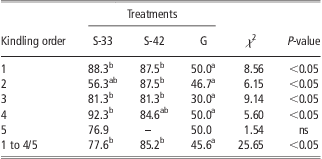
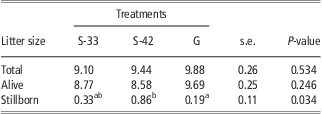
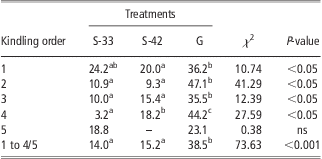
For the whole period (193 days), G does had lower (P < 0.05) kindling rates than S-33 and S-42 treatments (45.6%, 77.6% and 85.2%, respectively; Table 1). The kindling rate never exceeded 50% in the G treatment. The kindling rate was highest for S-42 does (81.3% to 87.5%), and overall the S-33 treatment was also high, except for the primiparous does where it was low. Twenty-three and 25% of does that survived until the end of the experiment in the S-33 and S-42 treatments, respectively, kindled at every occasion (5 times and 4 times, respectively), although none of the G treatment does had similar performance. None of the does in the S-33 or S-42 treatments kindled only once or twice during the experiment, whereas that occurred in 41.7% in the G treatment. Litter size was not significantly different among treatments (Table 2). However, the number of kits born dead was the highest for the S-42 treatment (P < 0.05); this was consistent among kindlings. Suckling mortality was more than twofold in the G treatment compared with the S-33 or S-42 treatments (P < 0.001; Table 3).
The effect of housing system on kindling rate (%) of does
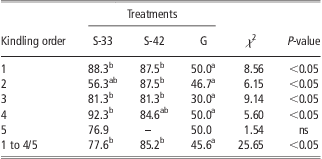
S-33 = single-housed does, reproduction rhythm of 33 days; S-42 = single-housed does, reproduction rhythm of 42 days; G = group-housed does.
a,bMeans within a line with different superscripts differ (P < 0.05).
The effect of housing system on litter size (1 to 4/5 kindlings)
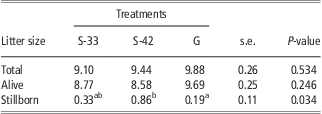
S-33 = single-housed does, reproduction rhythm of 33 days; S-42 = single-housed does, reproduction rhythm of 42 days; G = group-housed does.
a,bMeans within a line with different superscripts differ (P < 0.05).
The effect of housing system on suckling mortality (%)
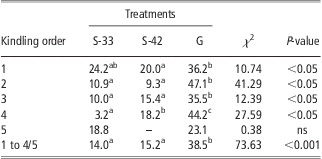
S-33 = single-housed does, reproduction rhythm of 33 days; S-42=single-housed does, reproduction rhythm of 42 days; G = group-housed does.
a,b,cMeans within a line with different superscripts differ (P < 0.05).
The frequency of multiple kindling in the same nest box was 7.7% for the does housed in groups. For example, on one occasion, a doe gave birth to 10 well-developed kits. Four days later, another doe kindled 15 kits in the same nest box. Up to 20 days of age, 80% of the kits born into this nest box were dead. In addition, two does kindled in deep litter, and all kits died within 1 or 2 days (as exact litter sizes could not be determined for the does, these kits were not used for calculating suckling mortality). In the G treatment, 49 young rabbits (<14 days old) were found outside the nest box, either on the plastic slats or in deep litter. Many of these kits had injuries attributed to biting or chewing, some of which may have incurred when kits were removed from the nest box. On one occasion, kits were scraped out of the nest box by a buck and this buck also chewed some kits.
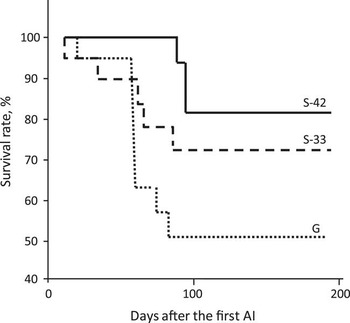
Survival rates of does are shown in Figure 1. At the end of the experiment, the survival rates of the S-33, S-42 and G does were 71%, 81% and 50%, respectively (P = 0.084). Most of the G does that died were emaciated, although one died subsequent to fighting (confirmed by the video recording) and was in good body condition.
The effect of housing system on survival of the does. S-33 = single-housed does, reproduction rhythm of 33 days, S-42 = single-housed does, reproduction rhythm of 42 days, G = group-housed does.

The ‘kit index’ (kindling rate times litter size total born kits) led to large differences between treatments, calculating the number of total born kits per 100 inseminated does at 706, 804 and 451 in S-33, S-42 and G treatments, respectively. During the entire experiment (193 days), the number of weaned rabbits per doe (calculated on the basis of the number of reproductive cycles (five or four in treatments G and S-33 v. S-42, respectively), kindling rate, litter size (number of kits born alive) and suckling mortality in the S-33, S-42 and G treatments were 29.3, 24.9 and 13.6, respectively.
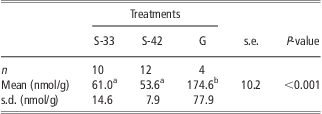
Faecal corticosterone concentration of does housed in groups was approximately 3 times higher than for does caged individually (174.6 and 56.9 nmol/g, P < 0.001; Table 4).
The effect of housing system on corticosterone level in does
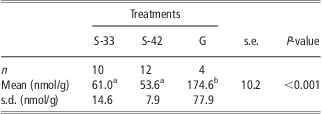
S-33 = single-housed does, reproduction rhythm of 33 days; S-42=single-housed does, reproduction rhythm of 42 days; G = group-housed does.
a,bMeans within a line with different superscripts differ (P < 0.05).
Discussion
Kindling rate and litter sizes (total, alive, weaned) of rabbit does mated naturally or inseminated artificially did not differ significantly (Alabiso et al., Reference Alabiso, Bonanno, Alicata, Leto and Todaro1996); therefore, the differences between G and S-33 or S-42 treatments were independent of the reproductive method.
Kindling rates of S does were 77.6% and 85.2% in the S-33 and S-42 treatments, respectively. The best results were achieved in the S-42 treatment, which was expected, but the results of S-33 treatment was excellent compared with our former results (Szendrő et al., Reference Szendrő, Radnai, ment, Jovánczai, meth, Milisits and Poigner1999). Postpartum mating or insemination typically results in low kindling rates (Poujardieu and Theau-Clèment, Reference Poujardieu and Theau-Clèment1995). Only primiparous does in the S-33 treatment had a reduced kindling rate (56.3%), which was attributed to a negative energy balance during the first pregnancy and lactation (Xiccato, Reference Xiccato1996). The kindling rate (45.6%) of the G treatment was in contrast to a previous report (Stauffacher Reference Stauffacher1992) of excellent fertility in group-housed does. Similarly, Mirabito et al. (Reference Mirabito, Galliot, Souchet, Dumont and Thomeret2005a) found no significant differences between the kindling rates of G and S does, whereas Rommers et al. (Reference Rommers, Boiti, De Jong and Brecchia2006) and Mugnai et al. (Reference Mugnai, Dal Bosco and Castellini2009) reported a lower kindling rate for G does, although the rates were not suppressed to the extent that they were in the present study. Compared with our study, these authors found smaller differences to the advantage of the S rabbits. Both of these studies used AI 11 days after kindling (Rommers et al., Reference Rommers, Boiti, De Jong and Brecchia2006) or after weaning (Mugnai et al., Reference Mugnai, Dal Bosco and Castellini2009). Rommers et al. (Reference Rommers, Boiti, De Jong and Brecchia2006) kept the does in groups until AI, but Mugnai et al. (Reference Mugnai, Dal Bosco and Castellini2009) after weaning moved the does into a single cage and submitted to AI. Andrist et al. (Reference Andrist, Bigler, Buchwalder and Roth2011) also reported a low kindling rate, which was independent of the mating system (natural mating or AI).
The percentage of does surviving until the end of the experiment and within one kindling of the maximum number was 92%, 83% and 16.7%, respectively, for S-33, S-42 and G does. Furthermore, in the S-33 and S-42 treatments, none of the does had only one or zero kindlings, whereas this was the case for 41.7% of G does. The low kindling rate in the G treatment was attributed to aggressive behaviour and stress, consistent with faecal corticosterone concentrations ∼3 times higher in the G treatment does than in the other two treatments. These findings are in line with the publications of Holst et al. (Reference Holst, Hutzelmayer, Kaetze, Khashei and Schönheiter1999 and Reference Holst, Hutzelmayer, Kaetze, Khashei, Rödel and Schrutka2002) on wild rabbits. Similarly, Rommers et al. (Reference Rommers, Boiti, De Jong and Brecchia2006) and Mugnai et al. (Reference Mugnai, Dal Bosco and Castellini2009) reported high corticosterone concentrations for G rabbits. Rommers et al. (Reference Rommers, Boiti, De Jong and Brecchia2006) reported 23% pseudopregnant does, which could also contribute to the unfavourable kindling rate. Andrist et al. (Reference Andrist, Bigler, Buchwalder and Roth2011) evaluated 28 Swiss rabbit farms and reported that 33% of 661 rabbit does had injuries, with severe injuries in 9%. The mean lesion score was higher on farms with an isolation period between littering and AI than in farms without the isolation phase. These results demonstrated that group housing was associated with stress, aggressive behaviour and more injuries.
With regard to litter size, the total number of kits born and the number of kits born alive were not significantly different among treatments. Similarly, other authors (Mirabito et al., Reference Mirabito, Galliot, Souchet, Dumont and Thomeret2005a; Rommers et al., Reference Rommers, Boiti, De Jong and Brecchia2006; Ruis, Reference Ruis2006) reported no effect of group housing on litter size, except for Mugnai et al. (Reference Mugnai, Dal Bosco and Castellini2009) who reported a decreased litter size.
In G rabbits, suckling mortality was very high (∼40%), which was 2.5 to 2.7 times higher compared with S rabbits. Similarly, in another study (Mirabito et al. Reference Mirabito, Galliot, Souchet, Dumont and Thomeret2005a), suckling mortality was approximately doubled when four does were housed in a pen. The high suckling mortality could be related to several factors. One of them is more than one doe kindling in a single nest box. In our study, the prevalence was 8%, similar to a previous report (Stauffacher, Reference Stauffacher1992). On the contrary, in the experiment of Mirabito et al. (Reference Mirabito, Galliot, Souchet, Dumont and Thomeret2005a) the frequencies of double and triple kindlings to the same nest box were 31.3% and 6.3%, respectively. When there is a time gap between successive litters kindled in the same nest box, the older kits are more likely to find teats and nurse during the short suckling time; therefore, they consume more milk (at the expense of the younger kits). In our study, two does kindled 25 kits in one nest box, 4 days apart, and the suckling mortality in this box was 80%. Suckling mortality could be also increased by does scraping out the kits of other does from the nest box. According to Stauffacher (Reference Stauffacher1992), neither the doe nor the buck showed aggressive behaviour towards the kits. On the contrary, in our study, does (and in one case, a buck) often scraped out other does’ kits (and litter material) from the nest box. As a result, 49 young kits were found on the plastic slat or in the deep litter. If the kits are removed at night, they could be out of the nest box for several hours, reducing the chance of survival, as their body temperature quickly decreases when they are out of the nesting box. Furthermore, they were occasionally covered with bites, and in one litter ears and legs were missing.
In our experiment, the survival of G treatment does was substantially lower than that of the S-33 and S-42 does. Similarly, Mugnai et al. (Reference Mugnai, Dal Bosco and Castellini2009) reported that the annual replacement was 13% to 15% higher in G does. The substantial differences in faecal corticosterone concentrations were a clear indicator of stress in G rabbits. The association between the stress and health status is well known. In previous studies, 8% to 33% of G does were injured (Rommers et al., Reference Rommers, Boiti, De Jong and Brecchia2006; Mugnai et al., Reference Mugnai, Dal Bosco and Castellini2009; Andrist et al., Reference Andrist, Bigler, Buchwalder and Roth2011). In our study, several times does sought refuge from aggression by going into the narrow space between the side wall of the pens and the nest boxes. Furthermore, nearly all G does that died or were culled were in poor body condition, which was attributed to stress.
Group housing of does is against some points of ‘five freedoms’ (Farm Animal Welfare Council, FAWC, 1992) and the rabbit welfare recommendation (Hoy and Verga, Reference Hoy and Verga2006). From the economic viewpoint, the annual number of weaned rabbits per doe is important. This parameter was best for the S-42 treatment, ∼12% lower for the S-33 treatment and more than 50% lower for the G does. Furthermore, when the number of weaned rabbits was calculated per 100 m2 basic area of rabbitry, the difference between the S-42 and S-33 treatments remained constant, but the efficiency of the group-housing system was only 12.4% than that of the S-42 treatment, making it extremely inefficient and likely not cost-effective for meat production.
The disadvantage of group housing of domesticated rabbit does (competition, aggressiveness, fightings, injuries, stress, lower productivity, high mortality of kits, shorter lifespan of does) are well known in the European wild rabbits. Aggressive behaviour is common in different animal species (Kutsukake, Reference Kutsukake2009), mainly in group-living species, such as the European wild rabbits (Southern, Reference Southern1948). A dominance hierarchy exists between the females and a separate one between the males in European wild rabbits (Holst et al., Reference Holst, Hutzelmayer, Kaetze, Khashei and Schönheiter1999 and Reference Holst, Hutzelmayer, Kaetze, Khashei, Rödel and Schrutka2002). Dominant does had higher BW, lower corticosterone level and lower heart rate than subdominant females (Holst et al., Reference Holst, Hutzelmayer, Kaetze, Khashei and Schönheiter1999). Social subordination leads to stress responses that can greatly impair the reproductive functions of females (Holst, Reference Holst1998). Holst et al. (Reference Holst, Hutzelmayer, Kaetze, Khashei, Rödel and Schrutka2002) reported 45.7% kindling rate for the European wild rabbits. The fertility of dominant does was higher, they produced more litters and offspring and the survival of kits was higher than for does with lower ranks. The average suckling mortality of the European wild rabbits was about 40%. The individuals that gained a higher social position had 50% longer reproductive lifespan than lower ranking counterparts (Holst et al., Reference Holst, Hutzelmayer, Kaetze, Khashei and Schönheiter1999). According to Mykytowycz and Dudzinski (Reference Mykytowycz and Dudzinski1972), does tolerated their own kits but attacked other young kits. For the European wild rabbits, a doe–doe competition for a limited number of breeding burrows may have been resulted in infanticide, the killing of conspecific young (Künkele, Reference Künkele1992). According to Rödel et al. (Reference Rödel, Starkloff, Bautista, Friderich and von Holst2008), the occurrence rate of infanticide for the whole litter was 5% to 6%. Signs of biting were detectable on 68% of dead kits.
On the basis of these findings, it can be concluded that the disadvantages of G domesticated rabbit does also exist for the group-living European wild rabbits. It may be asked why the European wild rabbits live in groups contrary to the mentioned disadvantages, The advantages and disadvantages of living in groups were generally summarized by König (Reference König1997) and Kutsukake (Reference Kutsukake2009), and for the European wild rabbits by Cowan (Reference Cowan1987). The most important benefits for the European wild rabbits include decrease in predation risk and cooperative construction of warren. Most important costs include increased competition aggressiveness among group members, subdominant female lives under higher stress, increased probability of infection and visibility of predator, defence of territory and vigilance. Animals and also European wild rabbits form groups when the benefits of group living exceed its costs. For domesticated rabbits, there are no predators, there is no need to pay attention to predators and dig a warren, which are the most important benefits of the living in groups; thus, the remaining benefits are the larger available space and the possibility of social interactions. On the contrary, all costs of living in groups remain.
Conclusions
In conclusion, the production of G rabbit does was substantially lower than that of the S does. From the aspect of animal welfare, group housing of rabbit does had several disadvantages: stress related to aggressive behaviour, frequent and harmful injuries, high suckling mortality and short lifespan. Therefore, there was no advantage to the group housing management.
Acknowledgements
The authors thank Prof. Gy. Huszenicza and Dr M. Kulcsár for measuring corticosterone concentrations. They thank Rose Kastelic and John Kastelic for valuable comments and suggestions that improved the manuscript.