


Introduction
It is well documented that older African Americans tend to perform more poorly on cognitive function tests than older Whites, even after adjustment for years of education (Manly, Reference Manly2005). Literacy, a commonly used marker for quality of education typically assessed by performance on reading tests, has often been found to attenuate, but not completely eliminate, the differences (Manly, Jacobs, Touradji, Small, & Stern, Reference Manly, Jacobs, Touradji, Small and Stern2002), suggesting that other factors may play a role in the poorer performance among African Americans (e.g., Barnes, Lewis, et al., Reference Barnes, Shah, Aggarwal, Bennett and Schneider2012). Some investigators have argued that neuropsychological tests may be biased against racial/ethnic minority populations because they were developed with and standardized on the majority white population (Arnold, Montgomery, Castaneda, & Longoria, Reference Arnold, Montgomery, Castaneda and Longoria1994; Loewenstein, Arguelles, Arguelles, & Linn-Fuentes, Reference Loewenstein, Arguelles, Arguelles and Linn-Fuentes1994). In fact, there is a growing body of evidence that suggests that background variables such as strategies, cognitive styles, and familiarity with testing may vary by race/ethnicity as well (e.g., Early et al., Reference Early, Widaman, Harvey, Beckett, Park, Farias and Mungas2013; Jones, Reference Jones2003), potentially influencing interpretation of performance.
Another potential explanation for the poorer performance of older African Americans on neuropsychological tests is that the underlying latent structure of the tests themselves differs as a function of race. That is, the tests used to assess cognition may not reflect the same underlying construct in different population groups. Although equivalence of latent cognitive structure (i.e., measurement invariance) is critical for comparative research with neuropsychological testing, relatively few studies test for equivalence in comparative studies, whether over age, or time, race, or other groupings. Measurement invariance is observed when, “…under different conditions of observing and studying phenomena, measurement operations yield measures of the same attribute” (p. 117; Horn & McArdle, Reference Horn and McArdle1992). To interpret differences in mean scores across groups, the mean values over the groups must represent the same attribute (Bollen & Curran, Reference Bollen and Curran2006). In this case, “different conditions” could refer to independent groups or the same group over time. The validity and utility of representing a complex measurement process within a single theoretically and empirically supported model are critically dependent on the demonstration of invariance of that model over time and across groups.
Measurement invariance is a characteristic of any measurement tool, and has its modern conceptualization arising originally from concerns regarding performance on admissions tests by different populations (Meredith & Teresi, Reference Meredith and Teresi2006). Since the mid-1980s, measurement invariance has been examined more widely, particularly in the cognitive aging literature with older populations. For example, some studies have examined the measurement invariance of cognitive abilities across age (e.g., Bowden, Weiss, Holdnack, & Lloyd, Reference Bowden, Weiss, Holdnack and Lloyd2006; Hertzog & Schaie, Reference Hertzog and Schaie1986; Schaie, Willis, Jay, & Chipuer, Reference Schaie, Willis, Jay and Chipuer1989), gender (Maitland, Intrieri, Schaie, & Willis, Reference Maitland, Intrieri, Schaie and Willis2000), neurological impairment (Hayden et al., Reference Hayden, Jones, Zimmer, Plassman, Browndyke, Pieper and Welsh-Bohmer2011; Siedlecki, Honig, & Stern, Reference Siedlecki, Honig and Stern2008), and language (Siedlecki et al., Reference Siedlecki, Manly, Brickman, Schupf, Tang and Stern2010; Tuokko et al., Reference Tuokko, Chou, Bowden, Simard, Ska and Crossley2009). Although several studies have examined racial differences in cognitive function and cognitive decline among older adults, including change within specific domains of function (e.g., Brewster et al., Reference Brewster, Melrose, Marquine, Johnson, Napoles, MacKay-Brandt and Mungas2014; Early et al., Reference Early, Widaman, Harvey, Beckett, Park, Farias and Mungas2013; Schwartz et al., Reference Schwartz, Glass, Bolla, Stewart, Glass, Rasmussen and Bandeen-Roche2004; Sloan & Wang, Reference Sloan and Wang2005), relatively few have examined measurement invariance specifically as a function of race in late-life (e.g., Blankson & McArdle, Reference Blankson and McArdle2013; Jones, Reference Jones2003; Mungas, Widaman, Reed, & Tomaszewski, Reference Mungas, Widaman, Reed and Tomaszewski2011). This is essential, as the model and test scores must accurately reflect the particular latent traits measured by the test across different populations and/or time to make valid interpretations of differences or apparent changes in performance (Horn & McArdle, Reference Horn and McArdle1992).
Invariance is not an all-or-none characteristic; it falls on a continuum. A “hierarchy” of invariance moves from strict invariance, which involves the same model form, factor loadings, residual variances for items and factors, and intercepts for all models under consideration; to strong invariance, relating to equivalence in model form and intercepts (not loadings); to weak (metric or pattern) invariance, which requires the same model form and factor loadings for all models (Meredith & Teresi, Reference Meredith and Teresi2006). Invariance in model form means that the same (multiple) observed variables represent the same latent construct at each timepoint (Bollen & Curran, Reference Bollen and Curran2006). Invariant factor loadings means that, given the same model form and scaling, the observed variables relate to (load on) the latent variable(s) the same way over time. Invariance in intercepts of the observed items or variables/indicators means that the items or indicators are functioning in the same way to represent the latent variable invariantly over time. These invariance characteristics pertain to the fit features of the model either to the same group over time or to independent samples at a single time point. Models that can be replicated across independent samples and over time improve science (Mulaik, 2010), making invariance an early, important, step in modeling and measurement. Invariance of the residual variances, which is a defining characteristic of “strict” invariance, is often difficult to obtain (Chen, Reference Chen2007). Invariance up to the level of intercepts (“strong-plus”) permits interpretable comparisons of latent mean differences across groups, whereas invariance up to the level of residual variances means that group differences on the indicators of the factors are comparable (Chen, Sousa, & West, Reference Chen, Sousa and West2005). A focus on the latent means (“strong-plus”), rather than on the individual observed test scores (“strict”), means that potential sources of bias in the observed test scores (e.g., age, education), which are the indicators or items of the latent factors in our model, are de-emphasized.
The purpose of the current analysis, therefore, was to examine the degree to which the latent factor structure of a well-established cognitive battery (Wilson et al., Reference Wilson, Beckett, Barnes, Schneider, Bach, Evans and Bennett2002) is invariant across race (African American vs. White) and over time. Data come from three longitudinal community-based cohort studies:the Minority Aging Research Study (MARS), the Rush Memory and Aging Project (MAP), and the Religious Orders Study (ROS). The studies have similar recruitment strategies and operational components, and use the same cognitive battery, which facilitates merging the data. This project tested the hypothesis that the 18 cognitive tests that are common to all three longitudinal studies, which have been reported elsewhere to define five cognitive domains (Wilson et al., Reference Wilson, Beckett, Barnes, Schneider, Bach, Evans and Bennett2002) within a single structural equation (latent measurement) model of “cognition,” are invariant over race and over time.
Method
Participants
Data for this project were obtained from participants enrolled in one of three community-based cohort studies of aging and cognition:MARS, MAP, or ROS. The Institutional Review Board of Rush University Medical Center approved all studies and all participants signed written informed consent. Given essentially identical recruitment techniques and a large overlap of identical data collection (including cognitive testing) across all three studies, data were merged to examine measurement invariance across race. In the current analyses, all self-reported African Americans (from all three cohorts) were grouped together, and compared to Whites (from MAP and ROS).
MARS enrolls older African Americans without known dementia living in the community, who agree to annual clinical evaluations (Barnes, Shah, Aggarwal, Bennett, & Schneider, Reference Barnes, Shah, Aggarwal, Bennett and Schneider2012). From the start of enrollment in August 2004, 477 persons enrolled in the study, of whom 466 completed a baseline clinical evaluation. Of these, 13 met criteria for dementia at baseline (see Clinical Evaluation, below) and were excluded from the current study. MAP enrolls older persons of all races without known dementia from retirement communities and senior subsidized housing facilities across the Chicago metropolitan area (Bennett, Schneider, Buchman, et al., Reference Bennett, Schneider, Arvanitakis and Wilson2012). Participants agree to annual clinical evaluations and donation of their brain, spinal cord, and selected nerves and muscles at time of death. From the start of enrollment in 1998, 1459 persons enrolled and 1450 completed a baseline clinical evaluation. Of these, 79 met criteria for dementia and were excluded from the current study. ROS enrolls older Catholic nuns, priests, and brothers, from more than 40 groups across the United States (Bennett, Schneider, Arvanitakis, & Wilson, Reference Bennett, Schneider, Arvanitakis and Wilson2012). Participants are without known dementia and agree to annual evaluation and brain donation. From the start of enrollment in January 1994, 1108 persons enrolled in the study, of whom 1106 completed a baseline clinical evaluation. Of these, 76 met criteria for dementia at baseline and were excluded from the current study.
Materials and Procedure
Clinical evaluation
Participants underwent uniform, structured, clinical evaluations annually, which included a detailed medical history, neurologic examination, and neuropsychological testing, as previously described (Barnes, Shah, et al., Reference Barnes, Shah, Aggarwal, Bennett and Schneider2012; Bennett, Schneider, Arvanitakis, et al., Reference Bennett, Schneider, Arvanitakis and Wilson2012; Bennett, Schneider, Buchman, et al., Reference Bennett, Schneider, Buchman, Barnes, Boyle and Wilson2012). On the basis of this evaluation, an experienced clinician classified subjects with respect to Alzheimer’s disease and other neurologic conditions following criteria set forth by the National Institute of Neurological and Communicative Disorders and Stroke and the Alzheimer’s Disease and Related Disorders Association (McKhann et al., Reference McKhann, Drachman, Folstein, Katzman, Price and Stadlan1984).
Other variables
Each participant was asked to self-report their racial category, based on questions used by the U.S. Census Bureau (1990).
Cognitive tests
A battery of 19 cognitive function tests was administered in a 1-hr session. The Mini-Mental State Examination (MMSE) was used to describe the overall cognitive functioning of the cohorts, but not in analyses. The remaining 18 performance-based tests assess the levels of episodic memory, semantic memory, working memory, perceptual speed, and visuospatial abilities. Details of the cognitive function tests have been reported previously (Wilson et al., Reference Wilson, Beckett, Barnes, Schneider, Bach, Evans and Bennett2002, Reference Wilson, Barnes, Krueger, Hoganson, Bienias and Bennett2005). There were seven tests of episodic memory: immediate and delayed story recall of story A from the Logical Memory subtest of the WMS-R (Wechsler, Reference Wechsler1987) and of the East Boston Story (Albert et al., Reference Albert, Smith, Scherr, Taylor, Evans and Funkenstein1991), and Word List Memory, Word List Recall, and Word List Recognition from the procedures established by CERAD (Morris et al., Reference Morris, Heyman, Mohs, Hughes, van Belle, Fillenbaum and Clark1989); two tests of semantic memory: a 15-item version of the Boston Naming Test (Wilson et al., Reference Wilson, Barnes, Krueger, Hoganson, Bienias and Bennett2005; Kaplan, Goodglass, & Weintraub, Reference Kaplan, Goodglass and Weintraub1983) and semantic Verbal Fluency from CERAD (Wilson et al., Reference Wilson, Barnes, Krueger, Hoganson, Bienias and Bennett2005; Morris et al., Reference Morris, Heyman, Mohs, Hughes, van Belle, Fillenbaum and Clark1989); three tests of working memory: Digit Span Forward and Digit Span Backward from the Weschler Memory Test-R (Wechsler, Reference Wechsler1987) and Digit Ordering (Cooper & Sagar, Reference Cooper and Sagar1993); four measures of perceptual speed: Symbol Digit Modalities Test (Smith, Reference Smith1982), Number Comparison (Ekstrom, French, Harman, & Kermen, Reference Ekstrom, French, Harman and Kermen1976), and two indices from a modified version of the Stroop Neuropsychological Screening Test: the number of color names correctly read aloud in 30 s minus the number of errors, and the number of colors correctly named in 30 s minus the number of errors (Trenerry, Crosson, DeBoe, & Leber, Reference Trenerry, Crosson, DeBoe and Leber1989); and two tests of visuospatial ability: a 15-item version of Judgment of Line Orientation (Benton, Sivan, Hamsher, Varney, & Spreen, Reference Benton, Sivan, Hamsher, Varney and Spreen1994) and a 16-item version of Standard Progressive Matrices (Raven, Court, & Raven, Reference Raven, Court and Raven1992). We created a global composite with all tests, and composite measures of episodic memory, semantic memory, working memory, perceptual speed, and visuospatial ability, by converting raw scores on each component to z scores, using the baseline mean and SD in the entire cohort, and then averaging the Z scores, as previously described (Wilson et al., Reference Wilson, Beckett, Barnes, Schneider, Bach, Evans and Bennett2002, Reference Wilson, Barnes, Krueger, Hoganson, Bienias and Bennett2005).
Data analysis
Multi-group confirmatory factor analyses (CFA) were carried out using MPlus 6.12 (Muthén & Muthén, Reference Muthén and Muthén1998) with full-information maximum likelihood (FIML) estimation in all models (Allison, Reference Allison2003) to capture as much information as is present in the observed data. In all cases, we sought to test the hypothesis that the model was invariant over time and race via CFA, and so we fit a fully constrained model first, relaxing constraints iteratively from fully constrained (“strong-plus,” which includes factor structure, indicator loadings, and indicator intercepts each constrained to be equal), to measurement constrained (“strong,” i.e., releasing constraints on the intercepts, but not loadings or factor structure), to structural (“weak,” i.e., same items loading on same factors without the values of the loadings or intercepts constrained), to fully unconstrained (all factors, loadings, and parameters in the set of models estimated separately). We did not constrain factor or indicator residual variances to be equal in any model. We did not plan to release any specific constraints but to move from level to level of invariance by releasing all constraints consistent with the next level when a more-constrained version failed to fit. Residuals and modification indices were never used to identify constraints to release, because our focus was on testing the hypothesis that the model was invariant, and determining the extent to which this invariance could be said to exist for this model. Instead, the analysis plan was to examine residuals to identify how or where the hypothesis that the model is invariant was not supported. We did not plan to change features of the model based on residuals or modification indices, but to characterize failures of invariance according to these residuals in case any were informative about lack of fit.
We used a factor-analytically derived model that was described in a previous publication (Wilson et al., Reference Wilson, Beckett, Barnes, Schneider, Bach, Evans and Bennett2002), but which has never been tested for its invariance over time or race. Model fitting specifics are provided below. We first fit this model to the data all together at baseline to ensure that the tests of measurement invariance over race and time would proceed using a well-fitting model. Fit statistics (described below) were used to study this model as well; residuals and modification indices were also used at this step only to better understand any sources of misfit in this overall measurement model. For the invariance modeling, we fit the most-constrained version of this structural equation model for cognitive measurement first (releasing constraints as described above) within racial groups (White and African American), separately over time. We proceeded to the point where a well-fitting model (representing the supported level of invariance) over time was identified for each racial group. Once we had iterated the CFA within racial group over time, we then started again with samples together (i.e., testing invariance across racial groups) at baseline, at year 1, and at year 2. Finally, we planned to follow the same iterative process to fit a single CFA for invariance over both time and across racial group, moving from the most- to the least-constrained version.
Four different aspects of fit to the data were assessed for each model: model
 $$\chi ^{2} $$
, a general data-model fit statistic; comparative fit index (CFI), representing incremental model fit relative to independence—the closer to 1.0 the better, with acceptable models having CFI >.96; standardized root mean square residuals (SRMR) summarizing mean absolute value of the covariance residuals—the smaller (and <0.09) the better; and root mean square error of approximation (RMSEA) representing the error in the approximation of the data by the model—acceptable models have an upper bound on the 90% RMSEA confidence interval (CI) <0.06 (Hu & Bentler, Reference Hu and Bentler1999). Hu and Bentler (Reference Hu and Bentler1999) propose that an acceptable model has all of the following fit characteristics: CFI>0.96; and SRMR<0.09; and RMSEA<0.06. When we were comparing more- to less-constrained models, in addition to observing that all fit indices were in the required ranges, we also required that the CFI values change less than 0.01 (Byrne, Reference Byrne2006, Reference Byrne2011) between more- and less-constrained models. This way, we could be confident of both the fit of the model to the data and also that the incremental model fit was not changing in practically important but possibly not statistically significant ways.
Once we had our base model, the invariance testing began with the most constrained model, and as soon as a model fit the data well according to all fit indices and (if applicable) the CFI values having changed by less than 0.01, the modeling procedure stopped and the level of constraints in this model was taken as the level of invariance. In the event that a more- and a less-constrained model seemed to fit comparably, we planned to use a likelihood ratio test, using the difference in numbers of parameter estimates as the degrees of freedom, to determine if the less-constrained model was a significantly better fit than the more constrained model. If it was not, then the more-constrained model was retained. In every case, we planned to release all constraints consistent with the next level of invariance, that is, we did not plan to release constraints on any specific path but rather, planned to move from strong-plus to strong; from strong to weak; and from weak to no invariance—stopping as soon as a good fitting model was identified.
In addition to examining and comparing fit indices outlined above, we planned to examine the residuals (comparing the observed and model-implied variance-covariance matrices) and modification indices for two competing levels of invariance to identify, where relevant, those indicators for which the models did not fit well over time, across cohorts, or both (Tractenberg, Aisen, Weiner, Cummings, & Hancock, Reference Tractenberg, Aisen, Weiner, Cummings and Hancock2006).
Results
Table 1 lists demographic characteristics across the three study cohorts; other than racial composition, characteristics were similar across cohort. Within the combined sample, African Americans were slightly younger [73.0 (SD=6.8) vs. 78.4 (SD=7.4] years) and had fewer years of education [14.9 (SD=3.5) vs. 16.3 (SD=3.5)] compared with Whites. However, baseline MMSE score 27.8 (SD=2.4) for African Americans versus 28.2 (SD=1.9) for Whites and distribution of women (76.6% in African Americans vs. 71.4% in Whites) were similar across the two groups.
Demographic characteristics by study cohort
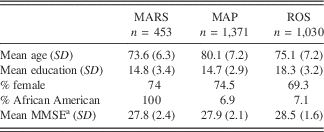
a Mini-Mental State Examination.
MARS, Minority Aging Research Study; MAP, Rush Memory and Aging Project; ROS, Religious Orders Study.
All data at the baseline visit were used to estimate the “base” model to be tested for invariance within groups over time and across groups at each visit. Table 2 shows the sample sizes that were used in the modeling. Because the sample size for the African Americans dropped off significantly after the 2nd year of follow-up, our analyses focused on the three annual evaluations in the baseline–2nd year time frame.
Sample sizes, across racial groups, over time
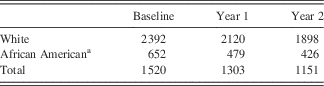
a African American participants in Religious Orders Study (ROS) and Rush Memory and Aging Project (MAP) were combined with those in the MARS cohort; ROS and MAP Whites were combined for the other group.
The five-factor model that has been reported previously (Wilson et al., Reference Wilson, Beckett, Barnes, Schneider, Bach, Evans and Bennett2002) was fit to the data to ensure that our conceptual model would be an appropriate starting point. This pre-specified model fit the baseline data from all participants together well [CFI=0.961; SRMR=0.037; RMSEA=0.052 (90% CI [0.049, 0.055]) with model
 $$\chi ^{2} $$
=1129.467 on 122 df], once covariances were added (based on modification indices) among the errors associated with 3 of the 18 cognitive tests (Story A from the Logical Memory subtest; East Boston Story recall; and Word List Recall). This was the model (see Figure 1) we used for the invariance analyses.
Model used for the invariance analyses. Abbreviations: DF=Digits forward; DB=Digits backward; DOPerf=Digits Ordering; Bname=Boston Naming Test; Catflu=Category Fluency; LoPair=Line orientation; Pmat=Progressive Matrices; Story=Story A Immediate Recall; Delay=Story A Delayed Recall; EBMT=East Boston Memory Test; EBDR=East Boston Delayed Recall; WLI=Word List Learning; WLII=Word List Recall; WLIII=Word List Recognition; SDMT=Symbol Digits Modality Test; NCCRTD=Number Comparisons Test; Cname=Stroop, color naming test; WREAD=Stroop, word reading test. SE=Semantic Memory; PO=Visuospatial Abilities; PS=Perceptual Speed; EP=Episodic Memory; WO=Working Memory.

Invariance over Time
Table 3 shows the fits of the most-constrained model within each group separately to test invariance of the model over time. Because this most-constrained model fit within required ranges of all fit indices, we stopped at this level and did not fit less-constrained versions.
Fit of most-constrained invariance in the five factor model over time (baseline, 1 year, 2 year) within racial group
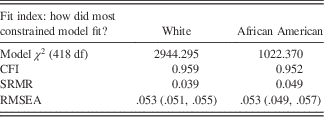
CFI: comparative fit index; SRMR: standardized root mean square residuals. RMSEA: root mean square error of approximation.
Our methods specified that we would stop releasing constraints as soon as we hit the model that met fit index criteria and where the CFI value did not change from the previous model (where possible) by 0.01 or more. The model fit information shown in Table 3 shows that the most-constrained model, where factor loadings, indicator intercepts and factor structure were all fixed to be equal within one race group at each of three annual assessments, fit the data well in both groups. As was specified earlier, covariances among the latent factors and between errors on any test score; the residual variances on the 18 tests; latent variable means; and latent variable variances were not constrained to be equal within a group over time. The most constrained model generally fit well over time within each group. The fit is marginally better for the larger sample (Whites) than for the smaller, African American sample, and examination of the modification indices and the residual matrices suggested no specific areas of misfit to address in the model for either group. The most constrained model that was fit was a good fit by all our fit indices within each group, so less-constrained versions of this model were not attempted. These results support the characterization of invariance of the measurement model over time within each group.
Invariance across Groups
Table 4 shows the fits of the most constrained model (equivalent factor loadings, indicator intercepts and factor structure for each racial group) to the data from African American and White participants at each visit (baseline, year 1, year 2).
Fit of most-constrained invariance in the five factor model for racial group: participants in the two racial groups from all three cohorts were all modeled together, separately by year
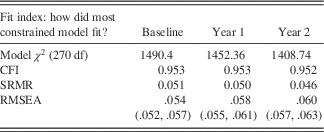
CFI: comparative fit index; SRMR: standardized root mean square residuals. RMSEA: root mean square error of approximation.
The model fit results in Table 4 show that, when analyzed with our five-factor model constrained to be equivalent across racial group, the most constrained model was a good fit to the data at each of the three visits. The upper bound on the 90% CI around the RMSEA value exceeded the recommended limit [0.06] (Hu & Bentler, Reference Hu and Bentler1999) in years 1 and 2, so we examined the modification indices and residuals matrices. There was no evidence of specific contributions to misfit in the residuals matrices. Modification indices suggested that the most theoretically and clinically plausible sources of this specific aspect of misfit involved three of the test scores (indicators) for the episodic memory (EP) factor. Given the critical contribution of episodic memory assessment in the definition and detection of cognitive aging, we re-fit this most-constrained model with all of the EP indicators’ loadings unconstrained. That is, to determine if the equivalence constraint on loadings for the indicators on the EP factor was driving the too-wide range in the RMSEA 90% CI, we fit the same model, but without the constraints of equivalence on the EP factors. The fit was marginally statistically significantly better by likelihood ratio test (χ2 30=44.48; p=.043), but Akaike’s Information Criterion (AIC) favored the most-constrained model over the one without equivalent loadings on the EP factor indicators. Since AIC is not sensitive to sample size (and this likelihood ratio test is well known to be so), we conclude that overall, these results generally support the characterization of the measurement model as invariant across these two racial groups at each of the three annual assessments.
Given the results in Tables 3 and 4 that the model with the same (highest) level of constraints fit within group over time (Table 3), and across groups at each time point (Table 4), we proceeded to test the fit of the model to the two groups over time. This multigroup CFA tested the theoretical - general - invariance (“strong-plus”: equivalent factor loadings, indicator intercepts and factor structure) of this five factor model of cognitive functioning based on these 18 tests over time and racial group.
The most constrained model, with factor structure, indicator loadings, and indicator intercepts each constrained to be equal across racial groups and over time, was a good fit to the data (CFI=0.950; SRMR=0.051; RMSEA=0.057 (90% CI [0.056, 0.059]; the model=4600.68 on 862 df). All fit indices were within recommended range, suggesting that the measurement model, shown in Figure 1, is invariant across these racial groups and over time.
The final model is shown in Figure 1; the final standardized parameter estimates are included in the Figure. Table 5 presents the latent factor means.
Standardized mean factor scores from invariant model over time, by racial group

a MEAN for standardized scores=0; SD for standardized scores is 1. White baseline scores were arbitrarily selected to be the reference group and their mean at baseline was constrained to be zero.
The observation of good fit of this model to the data enables us to estimate “true” group means and explore their differences across cohorts over time. Table 5 shows the standardized mean factor scores from our final model (shown in Figure 1), estimated for racial group and time. These factor score means are standardized, so that the overall average is zero, and standard deviations are equal to one. The values in Table 5 show that, while the estimated group means for African Americans are lower in nearly every case than they are for Whites, all group values are well within one standard deviation of the mean (zero). That is, even if these particular groups differ in their means at any timepoint, relying on an invariant model from which factor scores can be reliably derived (as in Table 5) permits us to discern that the groups are not “significantly different” in their mean levels of any cognitive factor at any of the three annual exams. With a factor score that has been shown to be invariant to time and racial group, the observed differences—whether or not they are statistically significant—can be interpreted with confidence. Now that we have demonstrated the time and group invariance of the measurement models, these models may be used in future studies in the analysis of other outcomes like neuropathology, MRI volumetrics, or the evaluation of intra-individual variability.
Discussion
The present study examined the measurement invariance of a performance-based neuropsychological test battery, used in three ongoing longitudinal epidemiologic cohort studies, across race and time. Starting with the published measurement model for cognitive functioning (Wilson et al., Reference Wilson, Beckett, Barnes, Schneider, Bach, Evans and Bennett2002), we iteratively tested the hypothesis that this model was invariant over time within racial group, across racial group by visit, and finally, for both racial group and time within a single multi-group confirmatory analysis. In each case, we found that the most-constrained (“strong-plus”) model fit the data well, supporting the characterization of this model of cognitive test scores as invariant over time and racial group. These results support the conclusion that the cognitive test battery used in MARS, MAP, and ROS is invariant across race and time and can be used to assess cognition among African Americans and Whites in our longitudinal studies. As noted, invariance up to the level of intercepts (“strong-plus”) permits interpretable comparisons of latent mean differences across groups (Chen et al., Reference Chen, Sousa and West2005).
We focused our analyses on invariance at the level of latent factor means (“strong plus), rather than on the individual observed test scores (“strict”), for two reasons. First, cognition is a complex construct, requiring assessment of many complementary domains (i.e., the full 18-test battery). Thus, invariance on the individual test scores is not of interest in our longitudinal work, whereas the latent factors represent cognition at a sufficiently comprehensive level. Second, emphasis on the factor, rather than the individual, scores attenuates the likelihood of bias in the observed test scores (e.g., possibly arising from age, education, or other factors that we could and did not test) in group comparisons. This study of measurement invariance tested the hypothesis that the model was invariant and was, therefore, more confirmatory in nature than many other examples in the literature. We took the modeling approach articulated by Burnham and Anderson (Reference Burnham and Anderson2002), treating the effects of time and race as potential sources of bias (as described by Millsap, Reference Millsap2011).
In all cases, we fit a more-fully constrained model first, planning to relax constraints iteratively from this level of constraint (“strong-plus”: factor structure, indicator loadings, and indicator intercepts each constrained to be equal), to measurement constrained (“strong,” i.e., releasing constraints on the intercepts, but not loadings or factor structure), to structural (“weak,” i.e., same items loading on same factors without the values of the loadings or intercepts constrained), to fully unconstrained (“none,” all factors, loadings, and parameters in the set of models estimated separately). Because this type of modeling specifically sought to test the hypothesis of measurement invariance, releasing constraints stopped as soon as a model fit the data well. In the cases where a less-constrained model was also attempted, likelihood ratio testing of these nested models showed the less-constrained model did not fit the data statistically significantly better than the more-constrained version did, so the more constrained models were retained in all cases.
Previous studies have examined measurement invariance of cognitive abilities across age (Bowden et al., Reference Bowden, Weiss, Holdnack and Lloyd2006; Hertzog & Schaie, Reference Hertzog and Schaie1986; Schaie et al., Reference Schaie, Willis, Jay and Chipuer1989), gender (Maitland et al., Reference Maitland, Intrieri, Schaie and Willis2000), neurological impairment (Hayden et al., Reference Hayden, Jones, Zimmer, Plassman, Browndyke, Pieper and Welsh-Bohmer2011; Siedlecki et al., Reference Siedlecki, Honig and Stern2008), and language (Siedlecki et al., Reference Siedlecki, Manly, Brickman, Schupf, Tang and Stern2010; Tuokko et al., Reference Tuokko, Chou, Bowden, Simard, Ska and Crossley2009). Relatively few studies, however, have examined measurement invariance as a function of race (Blankson & McArdle, Reference Blankson and McArdle2013; Jones, Reference Jones2003; Mungas et al., Reference Mungas, Widaman, Reed and Tomaszewski2011). Measurement invariance as a function of race is important because it is well established that older African Americans consistently perform at lower levels on cognitive function tasks compared to older Whites, and these differences often persist despite adjustments for education (e.g., Jones, Reference Jones2003; Manly, Reference Manly2005; Manly et al., Reference Manly, Jacobs, Touradji, Small and Stern2002). While biological and social factors such as, physical illness or vascular disease (Crowe et al., Reference Crowe, Sartori, Clay, Wadley, Andel, Wang and Allman2010), educational quality (Crowe et al., Reference Crowe, Clay, Martin, Howard, Wadley, Sawyer and Allman2013), and psychosocial constructs like perceived discrimination and stereotype threat (Barnes, Lewis, et al., Reference Barnes, Shah, Aggarwal, Bennett and Schneider2012; Thames et al., Reference Thames, Hinkin, Byrd, Bilder, Duff, Mindt and Streiff2013) are most commonly proposed as factors underlying differences in test performance, measurement variance is often offered as a possible explanation for the discrepancy in performance across race (Brickman, Cabo, & Manly, Reference Brickman, Cabo and Manly2006; Jones, Reference Jones2003; Manly, Reference Manly2005). Our results demonstrate that measurement variance is not a reason for lower cognitive performance among the African Americans in this study. However, we did not test for other sources of bias (e.g., education or age); our focus on “strong-plus” rather than “strict” invariance as our highest level was in part an effort to minimize contributions from these sources, including any inherent test bias associated with the cognitive measures used in our battery. The findings that the group mean factor scores were lower, albeit not significantly so, for African Americans relative to Whites are consistent with the idea that differences in test performance between African Americans and Whites likely reflect a combination of multiple social and environmental experiences over the life course (e.g., Jones, Reference Jones2003). For example, differences in literacy between older African Americans and Whites born before the historic Brown versus Board of Education decision are well established, and have been shown to not only attenuate racial differences in cognitive test performance (Manly et al., Reference Manly, Jacobs, Touradji, Small and Stern2002), but also to be an important construct to account for differences compared to years of education or race-stratified normative data (Silverberg, Hanks, & Tompkins, Reference Silverberg, Hanks and Tompkins2013). Other race-relevant variables such as perceived discrimination (Barnes, Lewis, et al., Reference Barnes, Shah, Aggarwal, Bennett and Schneider2012) and segregation (Aiken-Morgan, Gamaldo, Sims, Allaire, & Whitfield, Reference Aiken-Morgan, Gamaldo, Sims, Allaire and Whitfield2014) have been shown to be important covariates of cognitive performance in African Americans as well. Older African Americans and Whites in the United States differ with respect to social environment, history, experience, cultural norms, beliefs, and attitudes. Future studies are needed to determine whether these differences may influence cognitive test performance, and whether these factors can account for the lower performance observed in this and other studies. Importantly, given that the underlying latent construct of our cognitive battery was found to be invariant across race, we are now free to investigate lifestyle factors and other racial experiences that may explain the lower performance.
The study has some limitations. First, all models considered in these analyses were linear. This does not preclude future tests of hypothesized nonlinear relationships among these cognitive test scores or among the factors conceptualized as representing “cognitive function.” However, our linear modeling is consistent with current models of Alzheimer’s disease and change in symptoms or biomarkers, which are typically derived as simple differences over time, that is, focused on linear change. While not necessarily ideal, linear models are simple to interpret and can bring statistical models closer to clinical applications, supporting this common modeling stance. Our model involves 18 tests and specialized estimation, and while a less complex conceptualization of “cognitive function” might be simpler to interpret, reducing the complexity of the cognitive battery might very well reduce the validity of the assessment overall—and might not be invariant as ours appears to be. Along this line, this study focused specifically on the level of invariance, and not on the model itself (which has been validated elsewhere; Wilson et al., Reference Wilson, Fleischman, Myers, Bennett, Bienias, Gilley and Evans2004). Therefore, overlap in factor constructs or factor makeup was not studied and was instead treated as “given.”
Second, our methodology was to start with the most constrained (“strong-plus”) invariance and proceed through “strong” to “weak” invariance by iteratively releasing constraints for the models consistent with each level of invariance. An alternative approach is to begin with a freely estimated model and add constraints (moving from “none” to “weak” to “strong” to “strict” invariance) instead. This is more common and is advisable in projects where the measurement model is not well established, especially if the model fit has never been replicated in an independent sample. However, there might be highly localized invariant parameters within this model that were missed in our approach. Our argument is that, since cognition is so complex that the particular components of the model are unlikely to be meaningful measurement models on their own, this overall model fits the construct (cognitive function) sufficiently well and invariantly over time and race to yield useful and clinically meaningful assessments and—most importantly—comparisons over time. Because the measurement model we tested here has been used/fit in independent samples, we believed that the assumption that meeting our identified model fit criteria at any of the three levels would be sufficient to rule out any non-invariance that has practical or clinical significance.
Third, because MARS (from which the African American sample we analyzed was derived) started approximately 6 years after ROS and MAP, we were only able to model 2 years of follow-up data. Future studies with these cohorts will be able to include more years of longitudinal data collection. These analyses establish the invariance of our measurement model, so we are now more confident about pursuing structural models of cognitive change, and over longer time periods.
A final consideration is the variation in the strengths of associations of each test with its factor (factor loadings). Some factors have many fewer indicator tests than others, which is more of a function of the availability of valid cognitive tests than it is of our modeling or results. Although the results support the use and interpretability of factor scores that are derived from this model and its constituent tests, these results do not suggest that these assessments are “ideal” for capturing these cognitive domains. If other tests are preferred or used, these results suggest that establishing measurement invariance over time and race is achievable; best practices in the assessment and measurement fields dictate that they are also necessary.
This study also has strengths. First, our data come from three well-characterized epidemiologic cohorts with large sample sizes for both African Americans and Whites. Second, the five-factor cognitive model used in this study is fairly complex and factor analytic support for the five domains has been previously reported (Wilson et al., Reference Wilson, Beckett, Barnes, Schneider, Bach, Evans and Bennett2002). Third, the modeling approach that we used is consistent with best practices for studying and establishing measurement invariance (see e.g., Bollen & Curran, Reference Bollen and Curran2006; Horn & McArdle, Reference Horn and McArdle1992; Meredith & Teresi, Reference Meredith and Teresi2006). Finally, our three cohorts were recruited with similar strategies, and cognitive function was assessed using a uniform and fairly elaborate collection of assessments. The cohorts do not represent a random sample from the general population of Whites or African Americans of this age range, and the assessments—while standard neuropsychological instruments—are not typically all assessed in the same individuals. Therefore, our cohorts all have similar years of education, and possibly other social similarities that we did not assess, and our model—and its invariance—could have been affected by these factors. As stated previously, most racial differences stem from multiple cultural and social attributes often associated with race including, but not limited to, socioeconomic status, low literacy and education, racial discrimination, residential and school segregation, and lack of access to quality healthcare. Future studies will need to examine these and other factors in studies that compare cognitive performance between African Americans and Whites. However, it is important to note that the purpose of a measurement model is to represent whatever is being measured for anyone in whom it would be measured, and these results suggest that our complex model (Figure 1) for cognitive assessment functions as intended over time and across race (White and African American). Although there is clearly room for improvements, including stronger associations between indicators and factors, more indicators for some factors (e.g., semantic and working memories) and fewer for others (episodic memory), this validated measurement-invariant model of cognitive function in older African Americans and Whites can now be confidently used in other studies, including exploration of cognitive effects of neuropathology and studies of neuroimaging and other biomarkers.
Acknowledgments
The authors thank the participants of the Minority Aging Research Study, the Rush Memory and Aging Project, and the Religious Order Study, for their invaluable contributions. We thank Charlene Gamboa, MPH; Tracy Colvin, MPH; Tracey Nowakowski, Barbara Eubeler, and Karen Lowe-Graham, MS, for study recruitment and coordination, and John Gibbons, MS and Greg Klein for data management, and the staff of the Rush Alzheimer’s Disease Center. This research was supported by National Institute on Aging Grants (R01AG22018, R01AG17917, P3010161), and the Illinois Department of Public Health. The authors have no conflicts of interest.



