Introduction
Mapping and monitoring wildlife has been a major goal and the subject of considerable effort of Antarctic researchers since the beginning of Antarctic survey programmes (Harris et al. Reference Harris2015). There are some inherent obstacles to research in this environment (e.g. accessibility and weather conditions), which demand significant effort in data collection; hence, even nowadays, there is a lack of up-to-date data for most localities and some have yet to be surveyed properly (Harris et al. Reference Harris, Carr, Lornez and Jones2011). Nonetheless, researchers have been able to create a general panorama of Antarctic populations by gathering scattered information for most species (Sander et al. Reference Sander, Balbão, Costa, dos Santos and Petry2006, Reference Sander, Balbão, Polito, Costa and Carneiro2007, Patterson et al. Reference Patterson, Woehler, Croxall, Cooper, Poncet, Hunter and Fraser2008, Harris et al. Reference Harris, Carr, Lornez and Jones2011, Sierakowski et al. Reference Sierakowski, Korczak-Abshire and Jadwiszczak2017). In addition, most surveys conducted in Antarctica are limited to areas where there are research stations and good logistical support, e.g. King George Island (Petry et al. Reference Petry, Valls, Petersen, Krüger, Piuco and dos Santos2016, Sierakowski et al. Reference Sierakowski, Korczak-Abshire and Jadwiszczak2017), Nelson Island (Coria et al. Reference Coria, Favero, Silva and Casaux1995, Lumpe & Weidinger Reference Lumpe and Weidinger2000) and Deception Island (Kendall et al. Reference Kendall, Ruhl and Wilson2003, Petersen et al. Reference Petersen, Valls, Aver and Petry2015). Thus, the species and population trends of many remote areas remain unknown.
Seabirds are top predators and bioindicators of environmental conditions (Sergio et al. Reference Sergio, Caro, Brown, Clucas, Hunter, Ketchum, McHugh and Hiraldo2008). Therefore, monitoring populations of Antarctic seabirds is an important activity for the conservation of the whole ecosystem. The Commission for the Conservation of Antarctic Marine Living Resources (CCAMLR) recommends annual censuses as a method of monitoring breeding populations in the region. In addition, the Agreement on the Conservation of Albatrosses and Petrels (ACAP) strongly recommends research on population trends of listed threatened species, such as the southern giant petrel Macronectes giganteus Gmelin. Although population status and trends are already known for some species, mainly for penguins, which are the most studied species, there is a lack of information about others because their colonies are hard to access, making it difficult to estimate population trends (Woehler & Croxall Reference Woehler and Croxall1997).
Stinker Point is located on the south-west coast of Elephant Island and is one of the Antarctic areas designated as an Important Bird Area (IBA) (Harris et al. Reference Harris, Carr, Lornez and Jones2011, Reference Harris2015). According to Fishpool & Evans (Reference Fishpool and Evans2001), IBAs are zones of high value for bird conservation and are sites ‘thought regularly to hold significant numbers of a globally threatened species, or other species of global conservation concern.’ Despite its relevance, few studies have been conducted in this area (Bruce & Furse Reference Bruce and Furse1973, Petry unpublished data), and the available information on seabird populations is more than 20 years old (see references in Harris et al. Reference Harris2015) and may not reflect current conditions.
Considering the constant need to improve seabird conservation data (Phillips et al. Reference Phillips, Gales, Baker, Double, Favero, Quintana, Tasker, Weimerskirch, Uhart and Wolfaardt2016), we present in this study a large temporal series of population trends from Stinker Point. We also update information on seabird species using the area as a breeding site, as well as their spatial distribution on Stinker Point.
Study area
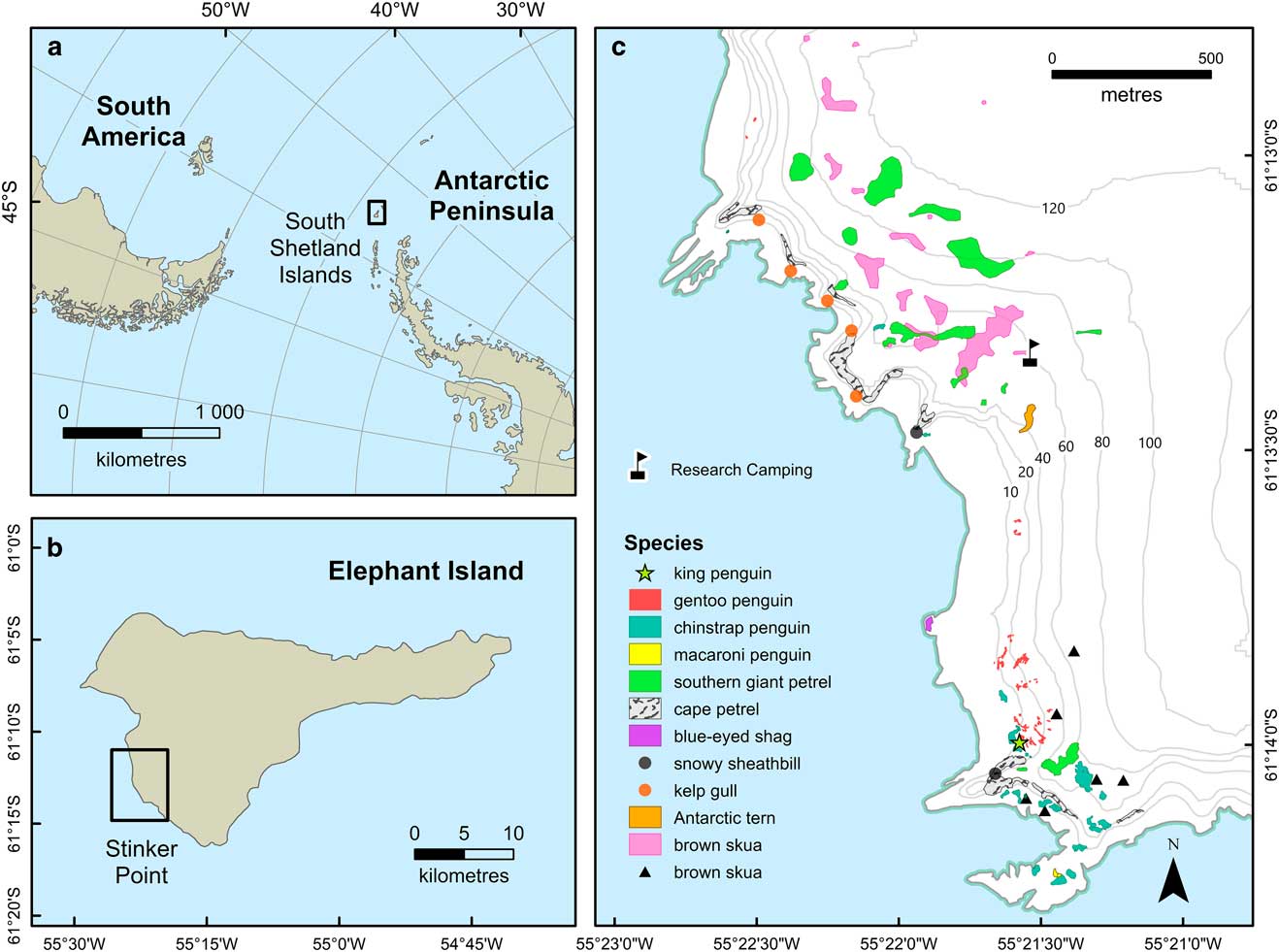
Elephant Island is one of the northernmost portions of land of the South Shetlands Archipelago, Maritime Antarctica (Fig. 1a). The Stinker Point region, located on the south-western coast of Elephant Island (61.13°S, 55°21'W; Fig. 1b, c), has a 4300 m long coastline, with 13 well-defined beaches composed of sand, pebbles and boulders. The terrain also encompasses plateau areas with steep scree cliffs and large moss fields on the top. Throughout the summer, Stinker Point remains ice-free, allowing many seabird and marine mammal species to use the area for breeding (Harris et al. Reference Harris, Carr, Lornez and Jones2011).
a. Location of the South Shetland Islands in the Maritime Antarctic. b. Elephant Island, showing the location of Stinker Point. c. Distribution of seabird breeding groups at Stinker Point.

Methods
To assess annual and interdecadal changes in seabird populations we conducted ground counts of active nests at the end of egg-laying periods, between early November and late December, in two separate blocks of summers: 1985/86–1991/92 and 2009/10–2013/14. Three observers counted nests simultaneously. If one count differed from others by more than 10%, procedures were repeated until agreement was reached. Total population size was estimated as an average of the three counts (following CCAMLR standard methods). To determine the areas and locations of current colonies we mapped colony edges with a hand-held GARMIN GPSMAP® 60CSX receiver (accuracy of ±4 m) within two years of breeding periods (2010/11 and 2011/12), whereas isolated nests were recorded as single points. We prepared one unified distribution from the two mapping efforts. A group of nests more than 500 m distant from another group was defined as a colony. Nests less than 50 m apart were defined as a breeding group (CCAMLR 2004). We digitized and georeferenced an image of contour lines with 5 m intervals from a 1976 map by the British Military School in order to generate elevation and topography slope grids of Stinker Point. Using the raster package in R (Hijmans Reference Hijmans2013) we extracted the mean and standard deviation values of elevation and slope within the colony polygons. Mapping was done using ArcGis 10.2 (ESRI, Redlands, USA).
We estimated population trends using the rtrim package in R (Bogaart et al. Reference Bogaart, van der Loo and Pannekoek2016). The rtrim package uses a log-linear Poisson regression model, accounting for missing counts, serial autocorrelation and overdispersion to estimate temporal trends and variability of population counts (van Strien et al. Reference van Strien, Pannekoek, Hagemeijer and Verstrael2004, Pannekoek & van Strien Reference Pannekoek and van Strien2005). We tested the significance of temporal trends with a Wald χ2 test (Pannekoek & van Strien Reference Pannekoek and van Strien2005, Bogaart et al. Reference Bogaart, van der Loo and Pannekoek2016). Two years were taken off the analysis for gentoo penguins (2009, 2010), as they were outliers (see results).
Results
Our first survey (1985–93) revealed 12 seabird species breeding in Stinker Point: four Sphenisciformes: gentoo penguin Pygoscelis papua Forster, Adélie penguin Pygoscelis adeliae (Hombron & Jacquinot), chinstrap penguin Pygoscelis antarcticus Forster, macaroni penguin Eudyptes chrysolophus Brandt; four Procellariiformes: Wilson’s storm petrel Oceanites oceanicus Kuhl, black-bellied storm petrel Fregetta tropica Gould, southern giant petrel Macronectes giganteus Gmelin and cape petrel Daption capense Linnaeus; one Suliforme: blue-eyed shag Phalacrocorax atriceps King; and three Charadriiformes: snowy sheathbill Chionis albus Gmelin, kelp gull Larus dominicanus Lichtenstein and brown skua Catharacta antarctica Lesson. After a gap of 17 years, two additional species were recorded breeding in the area during 2009–14: the king penguin Aptenodytes patagonicus Miller and the Antarctic tern Sterna vittata Gmelin. However, breeding Adélie penguins were not recorded during the second period, and therefore 13 seabird species currently breed in ice-free areas of Stinker Point.
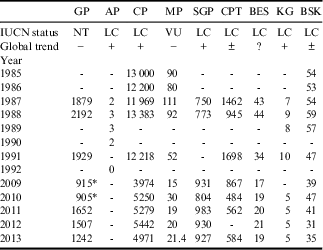
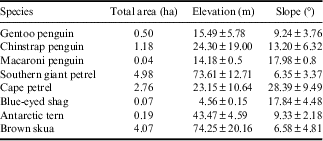
During 2009–2013 chinstrap penguins had the highest number of breeding pairs in Stinker Point (4983±589), followed by gentoo penguins (1467±208) (Table I). Chinstraps breed in three different colonies occupying 1.17 ha, covering plateaus and coastlines, at altitudes of 0–75 m above sea level (Fig. 1c, Table II). Gentoo penguins are distributed in two colonies: a northern colony, which is the smallest and is divided into two very small breeding groups (< 10 m2), and a southern colony, which is divided into several breeding groups (Fig. 1c). Both colonies occupy similar terrain, at 10–30 m altitude with slight slopes (Table II) that help soil drainage. Unlike chinstrap and gentoo, macaroni penguins (21±6 pairs) breed only at one site in Stinker Point (0.04 ha) (Fig. 1c, Table II). Most macaroni nests are laid centrally between two rocky cliffs, in a mixed colony with chinstrap penguins. A single pair of macaroni consistently bred in the middle of the largest chinstrap colony of Stinker Point, apart from all other macaroni penguins, and the pair has maintained this pattern since 1986. Two pairs of king penguins attempted to breed in all surveyed years. Year after year, a group of no more than four individuals remained in the same area close to a chinstrap breeding group (Fig. 1c).
Annual counts of seabird breeding pairs in Stinker Point between 1985 and 2013. The sign indicates the global population trend for each species: increasing (+), decreasing (−), stable (±) or unknown (?). The status of conservation and global population trends follows BirdLife International/IUCN Red List (http://iucnredlist.org/): NT=Near Threatened, LC=Least Concern, VU=Vulnerable. Gentoo penguin (GP), Adélie penguin (AP), chinstrap penguin (CP), macaroni penguin (MP), southern giant petrel (SGP), cape petrel (CPT), blue-eyed shag (BES), kelp gull (KG) and brown skua (BSK).

* Outlier counts removed from regression analysis
Total area and topographical characteristics of seabird colonies on Stinker Point, Elephant Island sampled during 2010–2012. Elevation and slope are presented as mean±standard deviation.
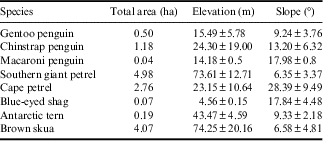
The southern giant petrel population size was estimated to be 915±66 breeding pairs between 2009 and 2013 (Table I). Two major colonies occur at Stinker Point, covering 4.98 ha (Fig. 1c, Table II). Both colonies are on plateaus up to 50 m high. Rocky moss fields, a thaw lake, nests of brown skuas and a small colony of chinstrap penguins characterize the surroundings of the northern colony, whereas rocky slopes surround the southernmost colony, which lies close to the large chinstrap colony. Cape petrels breed on steep cliffs on the shoreline, 10–75 m high. They occupy an area of almost 28 ha distributed over two breeding colonies (Fig. 1c, Table II).
The blue-eyed shag breeds exclusively in one site of 0.07 ha, with 19±2 breeding pairs (Tables I & II). The colony lays on top of a 7 m high rock in the intertidal zone. This rock is accessible to researchers only during low tide (Fig. 1c, Table II).
Currently, only two pairs of snowy sheathbills breed in Stinker Point. Their nests are located near the shoreline, close to penguin colonies (Fig. 1c). Both nests are hidden in crevices of rocks. Brown skuas breed in a major colony divided into several breeding groups on the northern plateau of Stinker Point (4.10 ha), with a few isolated southern nests (Fig. 1c, Table II). Seven pairs of Antarctic terns were recorded breeding near the moraines formed by the summer melting of glaciers, on rocky and usually irregular terrain (Fig. 1c, Table II). The few kelp gull pairs (n=5) in Stinker Point breed in isolated nests on elevated rocks near the tide line (Fig. 1c).
Wilson’s storm petrels and black-bellied storm petrels were frequently seen flying over the area, probably close to breeding locations. However, neither counting nor mapping was done because of the difficulties in reaching and finding their low-profile nests.
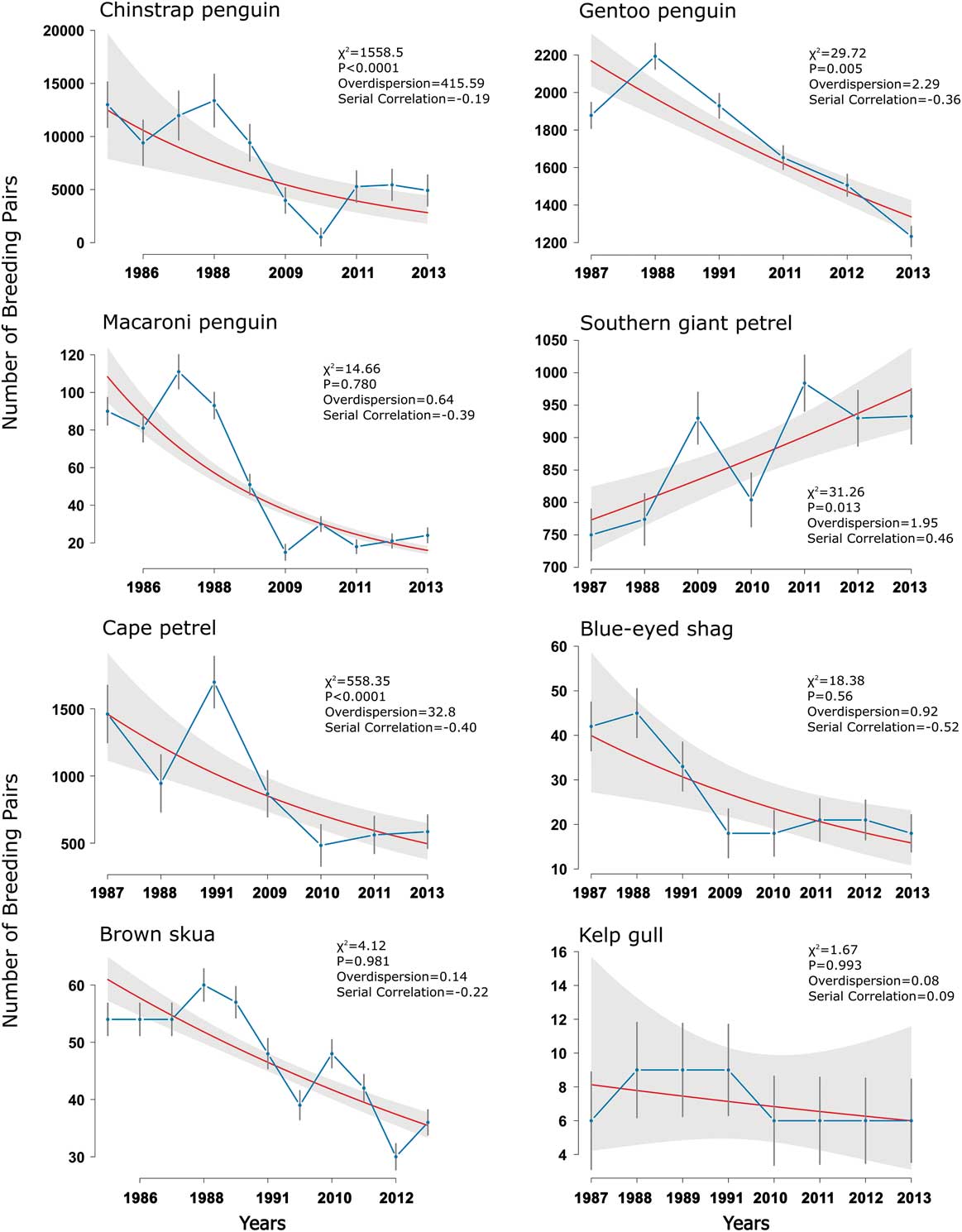
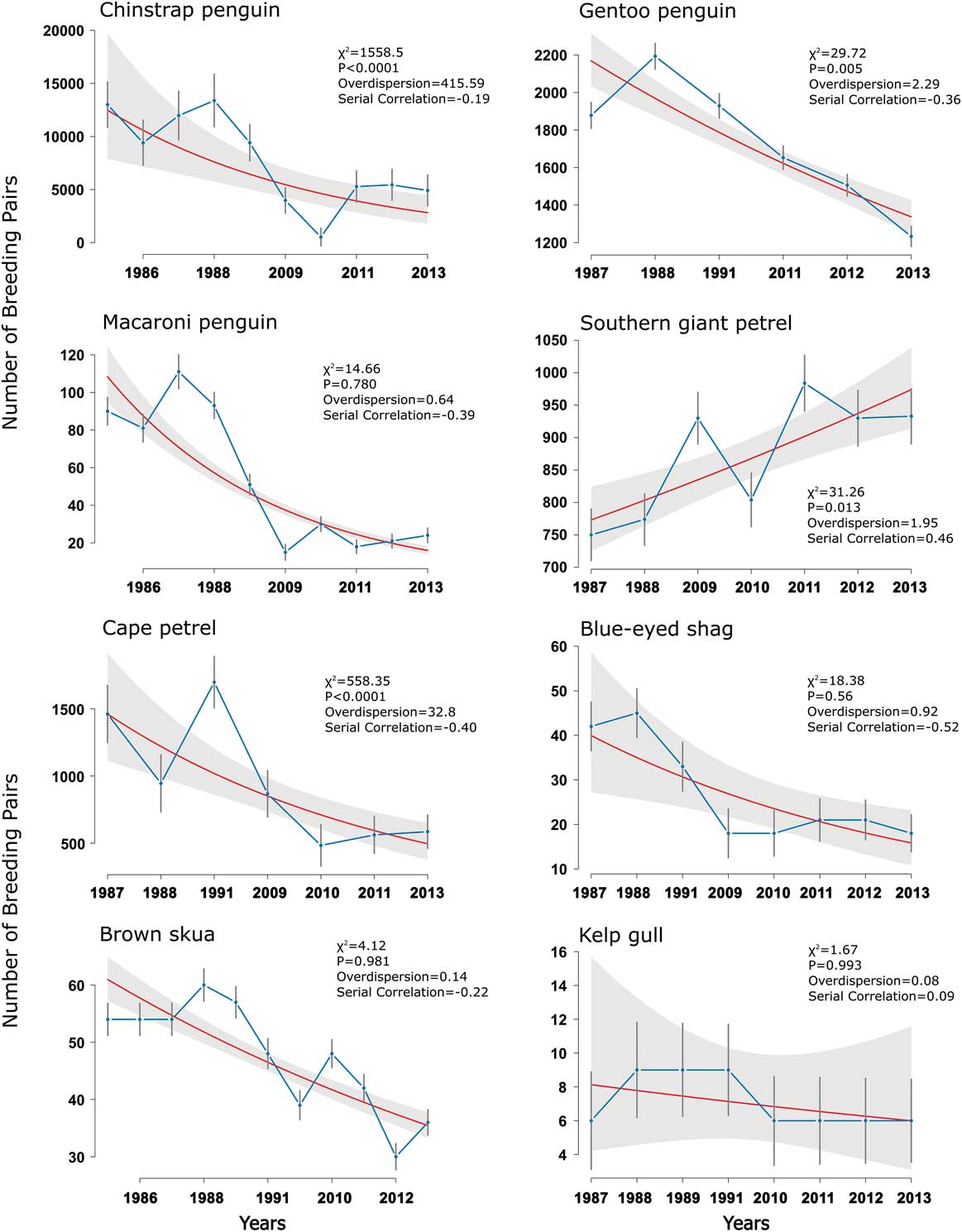
We observed clear shifts in the seabird population size between the previous survey and current counts (Table I). All species except the southern giant petrel tended to decrease (Fig. 2). Species with a significant decrease were chinstrap penguin (Wald χ2=1558.5, P<0.001), gentoo penguin (Wald χ2=29.72, P=0.005) and cape petrel (Wald χ2=558.35, P<0.001). The southern giant petrel showed a significant increase (Wald χ2=31.26, P=0.013). Chinstrap penguins have suffered a loss of 62% of the breeding population since the summer of 1987. On the other hand, the number of breeding pairs of southern giant petrels has increased by 18%.
Observed population counts of seabird species at Stinker Point (blue line)±standard deviation estimated from a log-linear Poisson regression (taking into account over-dispersion and serial correlation), and the linear estimated trend (red line)±standard deviation (grey area) over sampled years. The significance of trends was tested using a Wald χ2 test.
Discussion
Our report provides updated information on the breeding seabird species of Stinker Point, Elephant Island and their population sizes and trends. Bruce & Furse (Reference Bruce and Furse1973) conducted the first seabird survey in Stinker Point and recorded ten species breeding in the area: gentoo, chinstrap and macaroni penguins, cape and southern giant petrels, Wilson’s storm petrel, blue-eyed shag, snowy sheathbill, brown skua and kelp gull. Since 1980, M.V. Petry has performed new surveys (unpublished data) and recorded two additional breeding species: black-bellied storm petrel and Adélie penguin. Prior to this study, all population data available in the literature were from the 1970s (Bruce & Furse Reference Bruce and Furse1973, Croxall & Kirkwood Reference Croxall and Kirkwood1979). Our findings add more species to the inventory, and a new location for a sub-Antarctic species. Although king penguins are distributed in sub-Antarctic areas, we recorded recurring breeding attempts by this species in recent years at Elephant Island. This is the first record of southern breeding activity for this species (Petry et al. Reference Petry, Basler, Valls and Krüger2013).
Our results highlight the need for up-to-date information, as some species are undergoing severe local declines. Chinstrap penguins, in particular, are experiencing profound decreases on the Antarctic Peninsula (Sander et al. Reference Sander, Balbão, Polito, Costa and Carneiro2007, Lynch et al. Reference Lynch, Naveen and Fagan2008), and this decrease is attributed mainly to climate change (Forcada & Trathan Reference Forcada and Trathan2009, Trivelpiece et al. Reference Trivelpiece, Hinke, Miller, Reiss, Trivelpiece and Watters2011). In contrast, gentoos experienced local increases on the Antarctic Peninsula, primarily as a result of their generalist behaviour (Lynch et al. Reference Lynch, Naveen and Fagan2008, Forcada & Trathan Reference Forcada and Trathan2009, Herman et al. Reference Herman, Valls, Hart, Petry, Trivelpiece and Polito2017). We observed that the number of breeding pairs of penguin species is declining in Stinker Point, with higher decreases among chinstrap penguins relative to gentoo and macaroni penguins. Such decreases in populations are probably related to a reduction in food availability in this region (Sander et al. Reference Sander, Balbão, Polito, Costa and Carneiro2007, Trivelpiece et al. Reference Trivelpiece, Hinke, Miller, Reiss, Trivelpiece and Watters2011). According to our results and to global population trends, macaroni penguins have been decreasing in recent decades (BirdLife International 2017). We infer that this local decrease in Stinker Point could be due to shifts in breeding sites (e.g. to other places on Elephant Island), as also observed for gentoo breeding pairs on King George Island (Petry et al. Reference Petry, Valls, Petersen, Krüger, Piuco and dos Santos2016).
In contrast, the global population of southern giant petrels seems to be increasing (Patterson et al. Reference Patterson, Woehler, Croxall, Cooper, Poncet, Hunter and Fraser2008, BirdLife International 2017), with increases in the local populations in Stinker Point (Krüger et al. Reference Krüger, Paiva, Petry and Ramos2017), Argentina (Quintana et al. Reference Quintana, Punta, Copello and Yorio2006), and Aitcho and Livingston islands (Lynch et al. Reference Lynch, Naveen and Fagan2008), in line with our findings. Increases in populations of southern giant petrels are attributed to measures to reduce bycatch in longline fisheries (Yeh et al. Reference Yeh, Huang, Dietrich and Melvin2013) and the use of fisheries discard as a food source (Copello & Quintana Reference Copello and Quintana2003, Quintana et al. Reference Quintana, Punta, Copello and Yorio2006, Krüger et al. Reference Krüger, Paiva, Petry and Ramos2017). However, there have been local decreases even in the Antarctic Peninsula, attributed to human presence (Sander et al. Reference Sander, Balbão, Costa, dos Santos and Petry2006, Chwedorzewska & Korczak Reference Chwedorzewska and Korczak2010, Petry et al. Reference Petry, Valls, Petersen, Krüger, Piuco and dos Santos2016).
According to global population trends, the cape petrel is considered to be stable, given a lack of evidence of decline. On a couple of islands in the South Shetlands Archipelago (Nelson and Ardley), there seems to be population growth (unpublished data from N.R. Coria, M. Favero & G.E. Soave reported by Woehler & Croxall Reference Woehler and Croxall1997). Our data, however, indicate a significant decline of cape petrels breeding at Stinker Point. Divergences between sites may be related to variations in the timing of counts, which strongly influence the presence of breeding pairs (SCAR 1992).
The Antarctic Peninsula is experiencing considerable environmental changes due to climate influences over recent decades, as the increase in temperature drives decreases in sea and land ice cover (Turner et al. Reference Turner, Colwell, Marshall, Lachlan-Cope, Carleton, Jones, Lagun, Reid and Iagovkina2005, Pezza et al. Reference Pezza, Rashid and Simmonds2011). These changes have been reducing the breeding success of seabirds (Croxall Reference Croxall2002, Croxall et al. Reference Croxall, Butchart, Lascelles, Stattersfield, Sullivan, Symes and Taylor2012), which in the long term affects the recruitment rate and population size (Sydeman et al. Reference Sydeman, Thompson and Kitaysky2012).
Our results make Stinker Point one of the best known areas with the greatest number of species breeding together in the South Shetland Islands. There is only scattered information available for remote areas such as Stinker, most of it over 20 years old. As shown by this study, these data may not reflect current diversity and abundance. We strongly recommend that such areas receive periodic monitoring rather than occasional inspections.
Ackowledgements
This work would not have been possible without the monitoring effort of numerous colleagues from Laboratório de Ornitologia e Animais Marinhos at the Universidade do Vale do Rio dos Sinos over the last 28 years. Surveys during 2009–2014 received financial support from the National Institute of Science and Technology of Antarctic Environmental Research (INCT-APA), funded by the National Council for Research and Development (CNPq process: no. 574018/2008-5) and Carlos Chagas Research Support Foundation of the State of Rio de Janeiro (FAPERJ no. E-16/170.023/2008). We also acknowledge the support of the Brazilian Ministries of Science, Technology, Innovation and Communications (MCTIC), and of Environment (MMA), and the Inter-Ministry Commission for Sea Resources (CIRM). Finally, we are very grateful to the anonymous reviewers, whose comments helped to improve the manuscript.
Author contributions
MVP coordinated and designed the study. MVP, FCLV, ESP, JVGF and LK performed field observations, collected data, analysed the results and prepared the manuscript. LK performed the statistical analyses. JVGF and LK produced the map.
Details of data deposit
A dataset with shapefiles for the seabird breeding colonies at Stinker Point, along with the elevation of Stinker Point and the contour of Elephant Island are available from the Open Access repository PANGAEA: https://doi.pangaea.de/10.1594/PANGAEA.887844.