Introduction
Pathological gambling is a significant public health problem estimated to affect approximately 1% of the US population (Cunningham-Williams et al. Reference Cunningham-Williams, Cottler, Compton and Spitznagel1998;Shaffer et al. Reference Shaffer, Hall and Vander Bilt1999). Prevalence is likely to be similar across other countries, though data are sparse. Many of the features central to pathological gambling are similar to those of substance addiction and implicate common underlying dysregulation of frontostriatal circuitry (e.g. Clark, Reference Clark2010; Grant et al. Reference Grant, Potenza, Weinstein and Gorelick2010). Notable features that share commonality between pathological gambling and addiction include persistent engagement in a behavior despite negative consequences, loss of self-control, compulsive engagement (‘drive’), craving, tolerance and withdrawal (Potenza, Reference Potenza2008). Furthermore, diagnostic criteria for pathological gambling resemble those for substance dependence, and both show co-morbid overlap (Petry et al. Reference Petry, Stinson and Grant2005; van Holst et al. Reference van Holst, van den Brink, Veltman and Goudriaan2010a). As such, pathological gambling represents a valuable model for studying the neurobiology of addiction, without the potential confounding pernicious brain effects from chronic alcohol or illicit substance abuse.
Understanding the chain of progression from recreational gambling to pathological gambling is vital towards understanding the pathogenesis. Comparing people with pathological gambling with those at an increased risk of developing pathological gambling would help to elucidate whether cognitive deficits in pathological gambling (i) are evident prior to the development of overt pathology (perhaps representing an intermediate vulnerability marker or candidate endophenotype); or (ii) stem from the disorder itself, perhaps even reflecting the harmful effects of recurrent gambling on brain function. It may be that some cognitive problems in pathological gambling fall into the former and latter categories.
The differences in clinical and cognitive characteristics between recreational gamblers and those with a pathological form of gambling behavior have received only slight research attention. Studies have found that pathological gamblers are more likely to wager larger sums of money, gamble more frequently, and have more financial and social dysfunction secondary to their gambling when compared with recreational gamblers (Cox et al. Reference Cox, Kwong, Michaud and Enns2000; Schreiber et al. Reference Schreiber, Odlaug, Kim and Grant2009). Studies to date are suggestive of clinically progressive gambling severity and dysfunction secondary to gambling. Whether cognitive characteristics follow a similar progression is unknown.
Studies have identified cognitive deficits in pathological gambling across a variety of domains (for an excellent review, see van Holst et al. Reference van Holst, van den Brink, Veltman and Goudriaan2010b). Response suppression is indexed by stop-signal and go/no-go tasks, which require subjects to withhold simple motor responses when a stop-signal occurs (stop-signal tasks) or when a particular kind of stimulus is presented (go/no-go tasks). The ability to suppress responses is dependent on distributed neural circuitry including the right inferior frontal gyrus and bilateral anterior cingulate cortices (Aron et al. Reference Aron, Robbins and Poldrack2004; Hampshire et al. Reference Hampshire, Chamberlain, Monti, Duncan and Owen2010). The majority of studies have reported impaired response inhibition performance (i.e. increased motor impulsivity) in pathological gambling (Goudriaan et al. Reference Goudriaan, Oosterlaan, de Beurs and van den Brink2005, Reference Goudriaan, Oosterlaan, de Beurs and van den Brink2006; Fuentes et al. Reference Fuentes, Tavares, Artes and Gorenstein2006; Kertzman et al. Reference Kertzman, Lowengrub, Aizer, Vainder, Kotler and Dannon2008; Roca et al. Reference Roca, Torralva, López, Cetkovich, Clark and Manes2008). Rodriguez-Jimenez et al. (Reference Rodriguez-Jimenez, Avila, Jimenez-Arriero, Ponce, Monasor, Jimenez, Aragües, Hoenicka, Rubio and Palomo2006) reported impaired stop-signal response inhibition in pathological gamblers with a history of attention deficit hyperactivity disorder compared with pathological gamblers without such a history, although the clinical groups did not differ significantly from healthy controls. Lawrence et al. (Reference Lawrence, Luty, Bogdan, Sahakian and Clark2009) reported intact response inhibition using a stop-signal task in a group of mostly problem (rather than pathological) gamblers, compared with healthy controls, while a group with alcohol dependence was impaired on multiple measures of the task including impulse control. Indeed, a variety of substance-use disorders have been linked with stop-signal impairments (e.g. Fillmore & Rush, Reference Fillmore and Rush2002; Monterosso et al. Reference Monterosso, Aron, Cordova, Xu and London2005).
Flexible responding has traditionally been assessed with the Wisconsin Card Sorting Test (WCST) and its variants, which are dependent on distributed neural circuitry including the ventromedial and ventrolateral prefrontal cortices (Hampshire & Owen, Reference Hampshire and Owen2006; Buckley et al. Reference Buckley, Mansouri, Hoda, Mahboubi, Browning, Kwok, Phillips and Tanaka2009). Consequently, the majority of available studies have reported on WCST performance in pathological gambling compared with healthy controls. Results are conflicting, with some studies reporting deficits in pathological gambling (Rugle & Melamed, Reference Rugle and Melamed1993; Goudriaan et al. Reference Goudriaan, Oosterlaan, de Beurs and van den Brink2006; Forbush et al. Reference Forbush, Shaw, Graeber, Hovick, Meyer, Moser, Bayless, Watson and Black2008; Marazziti et al. Reference Marazziti, Dell'Osso, Conversano, Consoli, Vivarelli, Mungai, Di Nasso and Golia2008) and others showing no deficits (Cavedini et al. Reference Cavedini, Riboldi, Keller, D'Annucci and Bellodi2002; Brand et al. Reference Brand, Kalbe, Labudda, Fujiwara, Kessler and Markowitsch2005) in overall cognitive flexibility. Regarding substance-use disorders, Ersche et al. (Reference Ersche, Clark, London, Robbins and Sahakian2006) reported that set-shifting was broadly intact across amphetamine and opiate users, compared with healthy controls.
The aim of the current study was to expand significantly on the above work by examining clinical features, response inhibition and cognitive flexibility in gamblers with varying clinical severity, without the potential confounding influences of current axis I co-morbidities including substance-use disorders. Two translational computerized neurocognitive paradigms that have been widely utilized elsewhere, the stop-signal test (SST) and intra-dimensional/extra-dimensional (IDED) set-shift test, were used in this sample. Computerized tests such as these offer potential advantages in that the neural and neurochemical substrates have been explored in translational models across species (for a discussion, see Chamberlain et al. Reference Chamberlain, Robbins, Winder-Rhodes, Müller, Sahakian, Blackwell and Barnett2010). Many previous studies have used non-clinician assessment (e.g. client-administered questionnaires) to assess gambling severity and to screen for co-occurring psychiatric illness. To avoid potential disadvantages of this approach, we ensured rigorous clinical screening by board-certified psychiatrists experienced in the evaluation of gambling and other impulse disorders.
Method
Subjects
Participants comprised adults aged 18–65 years who had gambled in any form at least five times during the past 12 months. Recruitment of ‘gamblers’ was conducted through community advertising in local newspapers and posted fliers with no mention of compensation within the advertisement. Interested subjects contacted the research clinic and were subsequently scheduled for an assessment. Exclusion criteria included: current axis I disorder (besides pathological gambling in the clinical group), brain injury/trauma, history of seizures, implementation or dose changes of psychoactive medication within 6 weeks of study enrollment, and an inability to understand the procedures to provide written informed consent.
The Institutional Review Board of the University of Minnesota approved the studies from which this sample was obtained. After study procedures were explained and subjects had the opportunity to ask questions, all study participants provided voluntary written informed consent.
Assessments
All subjects being evaluated for either a longitudinal study of gambling behavior or a treatment study (psychotherapy or pharmacotherapy) were evaluated using the Structured Clinical Interview for Pathological Gambling (SCI-PG), a reliable and valid, 10-question, clinician-administered, diagnostic instrument for Diagnostic and Statistical Manual of Mental Disorders, fourth edition (DSM-IV) pathological gambling (Grant et al. Reference Grant, Steinberg, Kim, Rounsaville and Potenza2004). A score of 0 indicated negligible/no risk of pathological gambling, 1–4 ‘at-risk’ gambling, and 5+ current pathological gambling. Psychiatric co-morbidity was assessed using the Structured Clinical Interview for DSM-IV (SCID) disorders (First et al. Reference First, Spitzer, Gibbon and Williams1995) and valid and reliable SCID-compatible modules for impulse-control disorders (Grant et al. Reference Grant, Levine, Kim and Potenza2005). The sample was wholly assessed by board-certified psychiatrists (J.E.G. or S.W.K.) who performed a comprehensive psychiatric evaluation using these assessment tools.
The pathological gambling adaptation of the Yale–Brown Obsessive–Compulsive Scale (PG-YBOCS; Pallanti et al. Reference Pallanti, DeCaria, Grant, Urpe and Hollander1995) was administered to all subjects to assess gambling severity. The PG-YBOCS is a reliable and valid, 10-item, clinician-administered scale that rates gambling symptoms within the last 7 days on a severity scale from 0 to 4 for each item (total scores range from 0 to 40 with higher scores indicating greater severity of illness).
All subjects completed the Quality of Life Inventory (Frisch et al. Reference Frisch, Cornell and Villaneuva1992), a valid and reliable, 16-item, patient-administered rating scale that assesses various life domains such as health, occupation, friendships, recreation, love relationships, home (including neighborhood) and self-esteem.
Demographic variables, including age, gender, highest level of education completed, and employment status were recorded for all participants. Clinical variables included PG-YBOCS total score, SCI-PG score, Quality of Life Inventory T-Score, any lifetime psychiatric co-morbidity (other than substance-use disorders) and any lifetime history of substance-use disorders. History of addictions in first-degree relatives (alcohol, illicit substances, gambling) was also obtained, although first-degree relatives were not interviewed directly.
Cognitive assessments
Subjects undertook two computerized cognitive paradigms from the Cambridge Neuropsychological Test Automated Battery (CANTABeclipse, version 3, Cambridge Cognition Ltd, UK) quantifying aspects of motor impulse control and cognitive flexibility, domains that were the focus of this study. Though such tasks can yield many different measures, we focused only on a priori primary outcome measures to minimize the number of multiple comparisons.
SST
The SST quantifies the ability of participants to suppress already-initiated motor responses (Logan et al. Reference Logan, Cowan and Davis1984; Aron et al. Reference Aron, Robbins and Poldrack2004). Subjects observe a series of directional arrows appearing one at a time on a computer screen, and make rapid motor responses depending on the direction of each arrow. On a subset of trials, an auditory beep occurs (the ‘stop signal’) which indicates to the volunteer that they should attempt to withhold a response on that particular trial. This task uses a dynamic procedure to adjust the time between presentation of the directional cue and the stop signal, which is contingent upon the performance of the particular individual. This procedure is designed such that the expected number of successful inhibition trials over the whole task is approximately 50%. The paradigm provides a sensitive estimate of the time taken to stop a pre-potent response, which is referred to as the ‘stop-signal reaction time’. Longer stop-signal reaction times represent poorer response inhibition (i.e. greater impulsivity). The other primary outcome measure is the median reaction time on ‘go’ trials, which is independent from the stop-signal reaction time.
IDED set-shift task
The IDED task was derived from the WCST (Lezak et al. Reference Lezak, Howieson, Loring, Hannay and Fischer2004). Volunteers observe a series of stimuli on-screen presented two at a time, and attempt to learn an underlying rule about which stimulus is ‘correct’. This is accomplished via feedback on-screen (the word ‘correct’ or ‘incorrect’ presented after each choice). Once the volunteer reaches the learning criterion of six consecutive choices of the correct stimulus, the underlying rule is changed by the computer, and the user must show learning and flexible responding in acquiring the new rule. There are nine stages to the task in all. The primary outcome measure is the total number of errors made throughout the task, corrected for stages not attempted. Other primary measures, typically explored when ‘total errors’ differs significantly between groups of interest, are total errors at the intra-dimensional (ID) shift stage, total errors at the extra-dimensional (ED) shift stage and total reversal stage errors. ID shifting involves keeping one's attention on the same previously relevant stimulus dimension, while ED shifting involves cognitive flexibility: shifting attention away from a previously relevant dimension towards a dimension that was previously irrelevant (‘set-shifting’). Reversal stages require the subject to switch responding within a stimulus dimension.
Data analysis
Subjects were grouped a priori into one of the following three groups based on overall number of DSM-IV pathological gambling (using the SCI-PG scores indicated in parentheses): no risk (0); ‘at-risk’ gambling (1–4); pathological gambling (⩾5). Group differences in background demographic and clinical characteristics were explored using an initial multivariate analysis of variance (mANOVA) model. For variables not suited for parametric analysis, χ2 tests were used instead. Since age differed significantly between the groups due to the older age in pathological gamblers as a whole versus the other groups (see below), we conducted an additional analysis in a subgroup of pathological gamblers matched to the other groups for age. The cut-off for this was objective and based on exclusion of pathological gambler subjects more than 1.5 standard deviations away from the mean age for non-pathological gambler subjects (cut-off <33 years).
Significant effects of group in the mANOVAs were explored further using protected least significant difference tests. We also reported whether post hoc tests were significant with Bonferroni correction for multiple comparisons. Significance was defined as p<0.05, two-tailed, throughout. Based upon the clinical similarities between pathological gambling and substance-use disorders, especially in relation to impulsivity, a secondary exploratory analysis of pathological gamblers with and without a lifetime history of a substance-use disorder was also conducted.
Results
Demographic characteristics of the sample are indicated in Table 1, where it can be seen that the pathological gambling group was significantly older than both the no-risk and at-risk gambling groups.
Demographic and clinical characteristics of the varying levels of gambling severity

mANOVA, Multivariate analysis of variance; NR, no-risk group; AR, at-risk group; PG, pathological gamblers group; PG_s, pathological gamblers, age-matched subgroup; s.d., standard deviation; PG-YBOCS, pathological gambling adaptation of the Yale–Brown Obsessive–Compulsive Scale; SCI-PG, Structured Clinical Interview for Pathological Gambling; QoLI, Quality of Life Inventory; SUDs, substance-use disorders.
Data are given as mean (s.d.) or number (%).
a Least significant difference post hoc tests.
b Also significant with Bonferroni correction.
c χ2 tests (Yates' corrected where appropriate).
As expected, the pathological gamblers displayed significantly higher scores on the PG-YBOCS [mean 20.59 (s.d.=5.83)]. At-risk gamblers also had significantly elevated PG-YBOCS scores, but to a lesser degree [mean 4.43 (s.d.=4.25)v. 2.33 (s.d.=2.64), respectively] compared with the no-risk group. Quality of life was reported to be significantly lower in pathological gamblers versus both other groups (both p<0.001), which did not differ significantly from each other on this measure (p=0.054) (Table 1).
With respect to personal history of substance-use disorders, both pathological and at-risk gamblers showed significantly higher rates compared with the no-risk group. Pathological gamblers also reported higher rates of addiction in first-degree relatives, whereas the at-risk gamblers did not. Both pathological and at-risk gamblers reported significantly higher rates of psychiatric co-morbidity (other than substance-use disorders) compared with the controls (Table 1).
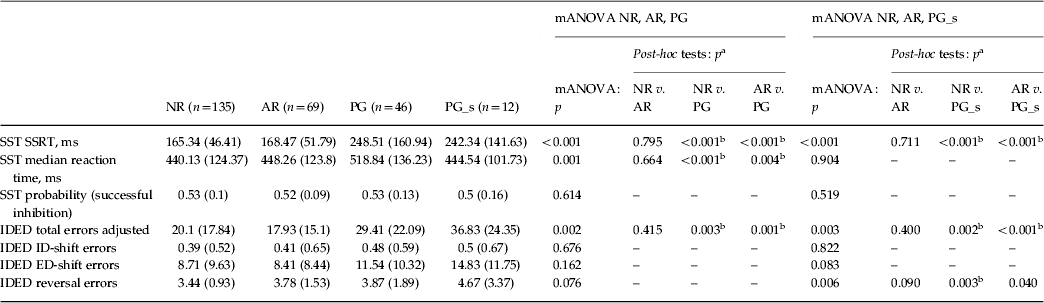
Cognitive measures are presented in Table 2, along with results from the mANOVAs. The models yielded highly significant effects of group overall (both p<0.001).
Results of mANOVA models for cognitive indices

mANOVA, Multivariate analysis of variance; NR, no-risk group; AR, at-risk group; PG, pathological gamblers group; PG_s, pathological gamblers, age-matched subgroup; SST, stop-signal test; SSRT, stop-signal reaction time; IDED, intra-dimensional/extra-dimensional.
Data are given as mean (standard deviation)
a Least significant difference post hoc tests.
b Also significant with Bonferroni correction.
In the analysis of all study recruits, pathological gamblers showed significantly longer stop-signal reaction times and significantly longer median ‘go’ response times on the stop-signal task, compared with both other groups. The at-risk and no-risk groups did not differ significantly from each other on these task measures. Significantly longer stop-signal reaction times were also present in the subgroup analysis of age-matched pathological gamblers, as compared with other groups, while the median ‘go’ reaction time effect was no longer present. Across all study groups, the overall probability of successful inhibition was close to 0.5, and did not differ statistically between groups, confirming that the tracking algorithm functioned as expected.
On the IDED task, the number (%) of people failing to pass all stages of the task were: 27 (20%), six (8.7%), 17 (37.0%) and six (50%), respectively, for no-risk, at-risk, pathological and age-matched pathological gambler groups. Drop-out was mostly at the ED-shifting stage (stage 8) as expected. Pathological gamblers made significantly more total errors compared with both other groups, which did not differ significantly from each other on performance. Interestingly, there was a non-significant trend towards a main effect of group on the number of reversal errors made, due to numerically more errors occurring in the pathological gamblers. There were no significant group differences with respect to ID and ED shift errors viewed individually. In the subgroup analysis of age-matched pathological gamblers, the finding of increased IDED total errors compared with other groups was confirmed. Furthermore, the main effect of group on reversal errors was significant, due to significantly more errors occurring in the pathological gamblers compared with the no-risk recruits. There were trends towards the at-risk group differing from other groups on reversal errors, due to numerically more errors than no-risk recruits and numerically fewer errors than pathological gamblers.
There were no significant differences in performance on the response inhibition and ED set-shift measures between pathological gamblers with (n=7) and without (n=39) a personal history of substance abuse (all p>0.10, data not shown).
Discussion
This study objectively compared clinical characteristics and key aspects of cognition in pathological gamblers, ‘at-risk’ gamblers and no-risk subjects (people gambling at least five times per year but not fulfilling any criteria for pathology). We identified elevated rates of psychiatric co-morbidity (including substance addiction) in pathological (69.6%) and at-risk (34.8%) gamblers compared with no-risk (17.0%) gamblers, while pathological gamblers alone showed increased rates of addiction in first-degree family members (84.8%) and a lower overall quality of life (p<0.001). From a cognitive perspective, pathological gamblers showed deficient motor response inhibition and cognitive flexibility, as compared with non-gamblers. These findings have important implications both from a clinical perspective, given the prevalence of gambling, the negative effect it often has on everyday functioning, and from the point of view of underlying neurobiological substrates and relationships with addiction more broadly.
The finding that significantly more individuals with pathological gambling had a first-degree relative with a lifetime history of addiction is potentially valuable from a clinical perspective. The early identification of problematic gambling through targeted screening of individuals with family history positive for addiction may aid in the reduction of pathological gambling onset for these individuals; however, our results indicate no clinically significantly differences for those with and without a lifetime history of a substance-use disorder. Similarly, the relatively high proportion of individuals in the pathological and at-risk gambling groups with a lifetime history of substance-use disorders is interesting and the relationship between pathological gambling and substance-use disorders has been investigated previously, demonstrating significant commonality between these conditions (Topf et al. Reference Topf, Yip and Potenza2009; Wareham & Potenza, Reference Wareham and Potenza2010). Recent research has indicated that these individuals may represent a specific subtype of gambling addiction (Alvarez-Moya et al. Reference Alvarez-Moya, Jiménez-Murcia, Aymamí, Gómez-Peña, Granero, Santamaría, Menchón and Fernández-Aranda2010), characteristically sharing high rates of impulsivity.
As outlined previously, problems with cognitive functions dependent on cortico-subcortical circuitry have long been implicated in the manifestation of pathological gambling. Behaviors in people with pathological gambling are often repetitive, hard to suppress, and are impulsive in that they result in negative long-term outcomes. Furthermore, people with the disorder often have difficulty shifting their thoughts and behavior away from gambling towards other areas of life that may be less damaging. Therefore, we were particularly interested in two cognitive domains often reported to be deficient in patients compared with controls in the extant literature: response inhibition and cognitive flexibility. In prior cognitive studies, there has been a lack of clarity regarding whether deficits stemmed from the pathophysiology of recurrent gambling itself or rather reflected deficits that can pre-date symptoms and exist in people ‘at risk’. We attempted to address this issue in part by recruiting a group of subjects with ‘at-risk’ gambling, viewed as being in an intermediate state between health and disease.
This study has several limitations. First, the age of pathological gamblers in this study was significantly older than both the no-risk and at-risk sample of individuals. We confirmed, however, that these findings remained robust in a subgroup of pathological gamblers that were objectively matched to the other groups in terms of age. Second, although all subjects from this study were respondents to community-based poster or newspaper advertising, many of the pathological gamblers assessed in this analysis were treatment-seeking individuals who may differ from a non-treatment-seeking population of gamblers. No subjects, however, were recruited from out-patient or in-patient psychiatric clinics. Third, IQ data were not recorded. Fourth, a number of subjects were currently taking psychoactive medications which may influence executive function and confound the neurocognitive assessments. All subjects, however, were required to have been on a stable dose of medication for 6 weeks preceding testing. Lastly, no direct interviews with the first-degree family members of subjects assessed for this sample were conducted, leaving the possibility of information bias.
Despite these limitations, this is the first study to use sensitive neuropsychological testing to assess the impact of gambling symptomatology not only in pathological gamblers, but also in subjects with ‘at-risk’ gambling, compared with a no-risk gambling sample. All subjects were assessed by board-certified psychiatrists with extensive knowledge of pathological gambling and the scales used for assessment, thus limiting information bias due to differential misclassification. Pathological gamblers showed impaired response inhibition, a function dependent on the integrity of the right frontal lobe, notably the right inferior frontal gyrus and anterior cingulate cortices (Aron et al. Reference Aron, Robbins and Poldrack2004). Pathological gamblers as a whole showed significantly slower reaction times on ‘go’ trials (independent of stop-signal reaction times), but the age-matched group did not, while stop-signal reaction times were abnormally lengthened in the whole-group and subgroup analyses. This suggests that the slower reaction times seen in the pathological gambling sample as a whole was due to older age, and that impaired impulse control occurred even when groups were age-matched.
Subjects with pathological gambling also made disproportionate errors on the IDED task. In the whole-group analysis, there were more errors overall in the pathological gamblers, and there was a trend towards more reversal errors occurring in the pathological gamblers in comparison with the no-risk group. In fact, this difference was highly significant in the subgroup analysis of age-matched pathological gamblers, implicating orbitofrontal dysfunction in the pathophysiology, consistent with recent neurobiological models of the disorder (see Clark, Reference Clark2010).
Intriguingly, ‘at-risk’ gamblers did not differ significantly from the no-risk group in terms of these performance indices. Thus, it appears that motor impulse dyscontrol and cognitive inflexibility manifested in pathological gambling, indexed by these tests, may not exist in people at elevated risk of developing the disorder. The category of ‘at-risk’, however, may be too heterogeneous with some at low risk and some at slightly elevated risk of problematic gambling. Our subsequent grouping of these individuals may have eliminated this distinction. This hypothesized heterogeneity will need to be confirmed formally in studies of first-degree relatives using larger sample sizes, and in longitudinal studies of at-risk individuals. It is important to also note that although these findings count against the notion of response inhibition and/or set-shift deficits as candidate endophenotypes for pathological gambling, there may well be other cognitive measures – not considered here – that fulfill this role. In particular, our preliminary findings here with reversal errors on the IDED test suggest that cognition in pathological and at-risk gamblers should be further evaluated using tests specifically designed to assess the integrity of the orbitofrontal cortices.
Acknowledgements
This research is supported by a Center for Excellence in Gambling Research grant by the Institute for Responsible Gaming and an American Recovery and Reinvestment Act (ARRA) Grant from the National Institute on Drug Abuse to J.E.G. (no. 1RC1DA028279–01). All work was completed in Minneapolis, MN, USA.
Declaration of Interest
This study does not report on treatment for gambling nor does it advocate for the use of specific medication in the treatment of gambling addiction. Disclosures of interest include that B.L.O. has received honoraria from Oxford University Press. S.R.C. has consulted for Cambridge Cognition, P1Vital, and Shire Pharmaceuticals. J.E.G. has received research grants from Forest Pharmaceuticals and Psyadon Pharmaceuticals.