Implications
Bruising in cattle for slaughter can occur at any point from the farm up to exsanguination. Research regarding the moment of infliction and the type of bruising events will help to identify the factors and circumstances that contribute to impaired animal welfare and, in consequence, this knowledge can be used to install measures to prevent bruise occurrence.
Introduction
In Chile, cows are primarily kept for milk production and, when culled, are transported to the slaughterhouse to enter the meat chain (Pinedo et al., Reference Pinedo, Risco and Melendez2011). More than 200 000 cows are slaughtered annually (ODEPA (Oficina de Estudios y Políticas Agrarias), 2011), representing over 25% of the total slaughtered cattle in the country. In Chile, the bruise prevalence is higher in cow carcasses than in other cattle categories (Strappini et al., Reference Strappini, Frankena, Gallo, Metz and Kemp2010); however, the causes of the bruises are frequently unknown. Bruises may negatively affect meat quality and carcass value, and are at the same time indicators of impaired welfare during the pre-slaughter stages as they indicate that animals underwent poor handling, harmful situations and likely pain.
During transport and at the slaughterhouse, animals may be exposed to incidents that potentially lead to bruises (Nanni Costa et al., Reference Nanni Costa, Lo Fiego, Tassonel and Russo2006), which become visible on the carcass after the animal is dehided. Jarvis and Cockram (Reference Jarvis and Cockram1994) introduced the term ‘potential bruising event’ to describe a traumatic action that could cause a bruise to the animal. For cattle, several potentially bruising events have been indicated, such as forceful handling (Grandin, Reference Grandin2000), inadequate design of the slaughter facilities (Weeks et al., Reference Weeks, McNally and Warriss2002), mounting and butting between animals (Kenny and Tarrant, Reference Kenny and Tarrant1987; Warriss, Reference Warriss1990), especially during loading (Minka and Ayo, Reference Minka and Ayo2007), and rough driving during transport (Broom, Reference Broom2003). However, the contribution of each of these potential bruising events to actual bruising of the carcass is not well documented.
To use bruises as indicators for impaired welfare, it is relevant to know the characteristics of the bruises. For prevention, the events that caused the bruises should be known as well. Video recording and/or direct observation can be used to investigate the handling and behaviour of the animals during the pre-slaughter period and therewith identify potential bruising events. Subsequently, the observations can be related to the presence and anatomical location of bruises observed post mortem to assess the cause of a bruise (Cockram and Lee, Reference Cockram and Lee1991; Nanni Costa et al., Reference Nanni Costa, Lo Fiego, Tassonel and Russo2006). In this study, potentially bruising events were identified during the pre-slaughter stages and subsequently their relationships with type and anatomical location of the bruises observed on the carcass were examined.
The aim of this study was to identify ‘when’ bruises were inflicted (time before slaughter), ‘where’ (in which pre-slaughter stage) and ‘how’ they were inflicted (type of potential bruising event) in Chilean culled cows.
Material and methods
Animals
The study was conducted under commercial conditions during April and May 2010 (autumn season), in Southern Chile (Región de los Ríos) and the animals used were a typical sample of culled cows. Fifty-two culled dairy cows were transported in batches from three local farms (one batch from each farm) under standard commercial conditions to the slaughterhouse. The cows were Black and Red Friesian crosses, the majority were hornless (n = 48; 92.3%) and ‘old’ (96.2%, defined as animals with eight permanent incisor teeth). All the cows could stand without assistance, were free from visible disease or injury and were not pregnant; therefore, they were considered fit for transport. At post mortem evaluation, 70.0% of the carcasses were deemed as presenting ‘scarce fat cover’ (grade 1, Chile INN (Instituto Nacional de Normalización), 2002) and the rest as ‘with absence of fat cover’ (grade 0, Chile INN, 2002). The mean hot carcass weight was 261.5 ± 40.8 kg.
Transport conditions, loading and unloading
The truck used to transport the cows from the farm to the local slaughterhouse was a medium-sized vehicle with open roof, as commonly used for commercial livestock transportation (Chile MINAGRI (Ministerio de Agricultura), 2005). All three batches of animals were transported in the same vehicle and piloted by the same driver. The animal compartment was 8.50 m long, 2.80 m wide and 1.80 m high. The rear door consisted of two adjacent but independent panels opening outwards. The first journey concerned 15 cows and a distance of 115 km, the second concerned 19 cows and 100 km and the third concerned 18 cows and 130 km. The animals were not restrained. The space allowance per animal was between 1.25 and 1.58 m2 per animal.
Before loading at the farm, the animals of the same batch were individually identified with a legible sign using fluorescent paint.
During loading, the rear doors of the truck were opened outwards making contact with the walls of the fixed ramp available at the farm, demarcating in this way the loading zone. The stockpersons of the farm, together with the truck driver, drove the animals onto the truck using wooden sticks with sharpened points and an electric prod.
When the vehicle arrived at the slaughterhouse, the personnel of the abattoir unloaded the animals with the help of the truck driver. No driving aids were used. Next, the animals were driven onto a scale and weighed as one batch.
Lairage conditions
After weighing, the cows of each farm were kept in lairage in roofed pens (one pen per batch) where they received water ad libitum but no feed. The pens had a solid concrete floor without bedding. The space allowance in the pen was ∼2 m2 per animal.
After lairage, the animals were moved from their holding pen to a single-line squeeze chute. No driving aids were used. The chute was curved, had solid walls and its narrow width prevented animals from turning. At the end of the chute, a manually operated vertical rising gate (‘guillotine-type’) allowed the entrance of the first animal of the line into the stunning box. Two persons moved the cows into the stunning box, using flags or an electric prod. All the cows were stunned using a non-penetrating captive bolt pistol and then exsanguinated.
Recording and analysis of potential bruising events throughout stages
During transport and lairage, continuous video recording of the animals was carried out using a multi-camera system, waterproof, metal shell, model IP 67, infrared with DVR mobile and anti-shock (Toshiba Corporate, Japan). Two cameras were located in the animal compartment of the truck, one on the front and the other on the back part. The cameras recorded and displayed all the activities of the animals in real time. At the slaughterhouse, two other infrared cameras were set up in the holding pen where the cattle remained in lairage. Potential bruising events in other stages – during loading and unloading, and during the entrance of the animals in the chute and inside the stunning box – were recorded by direct observation by one observer (background in veterinary science, skilled in behavioural observations).
The digitalized videos were analysed by another observer (background in animal science, skilled in behavioural observations). For the assessment of the potential bruising events, each animal was followed separately using focal animal sampling technique (Martin and Bateson, Reference Martin and Bateson1996). The number of potential bruising events per minute was calculated as the number of bruising events observed in each stage divided by the minutes the animals stayed in that stage.
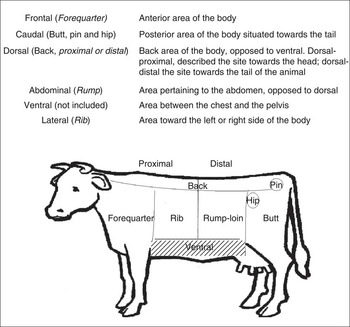
From the video recordings and direct observations, the moment of infliction (hours and minutes), stage of infliction (e.g. lairage or loading), anatomical area and the side affected (right or left) were assessed for each observed potential bruising event (Figure 1).
Orientation of anatomical areas used for video and direct observations.

Types of potential bruising events recorded
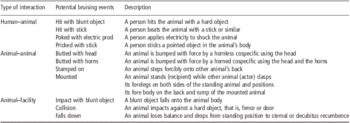
Three categories of potential events were distinguished (Table 1):
Protocol used to record potential bruising events by direct observation and video tracking during loading, transport, unloading, lairage, at the entrance of the stunning box and inside the stunning box

1. Human–animal interaction: actions performed by a person to an animal that involved the use of force or electric shock (i.e. hitting, poking, pricking and use of electric prod).
2. Animal–animal interaction: forceful actions between two animals in close proximity involving physical contact. The animal that performed the action was called ‘actor’ and the animal receiving the aggression was the ‘recipient’. The focus was on the recipient animal that was mounted, butted or stamped.
3. Animal–facility interaction: impacts the animal because of direct contact with permanent or temporary structures of the physical environment (i.e. facility). For instance, impacts with a gate, collisions against a door or impacts with the floor of the truck when the animal falls down during transport. The combination of the events ‘falling down’ and subsequently ‘being stamped upon’ in the truck was considered as two independent events when the impacts affected different anatomical sites.
Post mortem evaluation of bruises on the carcass
After removing the hide and before splitting – ∼30 min after bleeding – the 52 entire carcasses (hanging by both hind legs) were evaluated for the presence of bruises by one trained board-certified (Chile MINAGRI, 2009) veterinary meat grader. Bruises were defined as lesions where tissues were crushed with the rupture of vascular supply and the accumulation of blood and serum (Chile INN, 2002). The carcass was virtually divided into various areas and the observer was instructed to record the number and the characteristics of the bruises: size, severity grade, shape and colour as defined in Strappini et al. (Reference Strappini, Frankena, Metz, Gallo and Kemp2012). The head and the belly of the animal were excluded.
Statistical analyses
For all bruises detected on the carcass, an attempt was made to identify a potential bruising event as recorded on the basis of the video recordings and direct observations. If no event was linked to a bruise then the causal event was recorded as ‘unknown’.
The association between pre-slaughter stage and the type of bruising event on one hand, and the anatomical distribution of the bruises over the carcass and their visual appearance (grade, size, shape and colour) on the other, were tested using contingency tables (Fisher exact test). The relative risk (expressed as odds ratio) of developing a bruise after a human–animal, animal–animal or animal–facility interaction was assessed using logistic regression in SAS, version 9.1 (SAS Institute Inc., Cary, NC, USA).
Results
Pre-slaughter conditions
Duration (hours and minutes) of the five pre-slaughter stages (loading, transport, unloading, lairage and time in the stunning box) is presented in Table 2. The duration of the total pre-slaughter period – from the farm to slaughter and before bleeding – was over 20 h. Most of the time was spent in lairage at the holding pen (mean 19 h 20 min). Loading and unloading took nearly the same time (mean 11 and 8 min), whereas time in the stunning box was the shortest (mean 1 min).
Duration of the pre-slaughter stages loading, transport, unloading, lairage and stunning box for 52 cows transported in three batches

Occurrence of potential bruising events
A total of 1792 potential bruising events were recorded for 52 cows. During lairage, 91.2% of the events were observed, 5.4% in the stunning box, 2.5% at loading, 0.4% during transport and 0.5% at unloading.
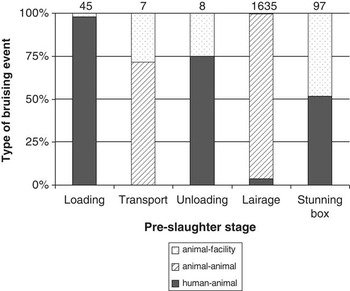
Figure 2 shows that during loading, unloading and in the stunning box, most of the events were of human–animal type (97.7%, 75.0% and 51.5%, respectively). At lairage and during transport, most events were animal–animal interactions (99.7% and 71.4%, respectively).
Human–animal, animal–animal and animal–facility interactions during loading, transport, unloading, lairage and in the stunning box (n = 1792 events of 52 cows).

The number of potential bruising events per minute was 1.3 events/min for loading, 0.01 events/min for transport, 0.4 events/min for unloading and 0.5 events/min for lairage.
Occurrence and visual appearance of bruises
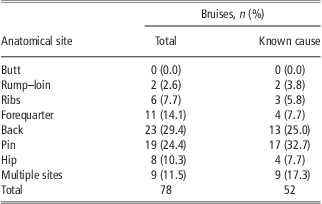
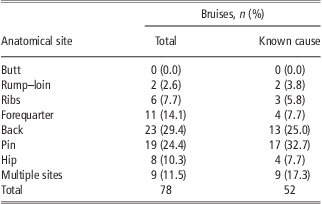
From the 52 carcasses evaluated, 37 (71.2%) presented a total of 78 bruises. The mean number of bruises per carcass per batch was 0.87, 1.79, 1.72 for batches 1, 2 and 3, respectively, and it was not significantly different between batches (P = 0.11). The bruises were most frequently found on the back (29.4%) and the pin (24.4%) sites of the carcasses (Table 3). On back site, the dorsal distal area was most often bruised (83.3%). No bruises were observed on the butt site of the carcasses.
Anatomical distribution of 78 bruises found on 37 carcasses and 52 bruises with cause known
Of all bruises, 80.8% were of grade 1, most had an irregular shape (94.9%), had red colour (57.7%) and showed a diameter between 2 and 8 cm (55.1%). The bruises of the three batches did not significantly differ in grade, size, shape and colour (Fisher exact P-value = 0.29, 0.41, 1.00 and 0.30, respectively).
Moment, stage of infliction and type of potential bruising event
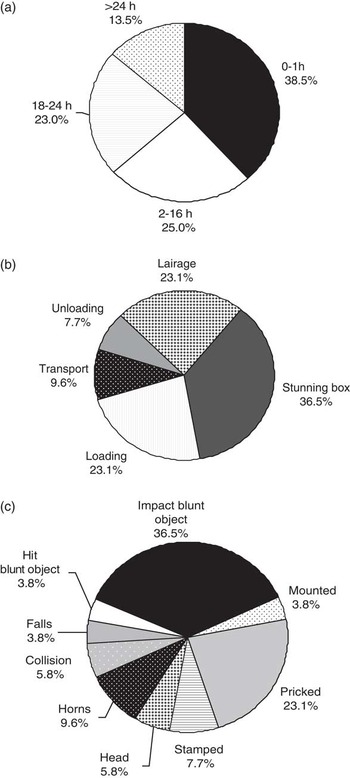
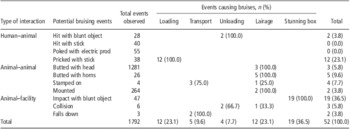
For 52 bruises (66.7%) out of the 78 observed bruises, it was possible to identify the moment, stage of infliction and the type of event that caused the lesion. Of the bruises, 38.5% were inflicted within 1 h of the slaughter (Figure 3a). The majority of the bruises (67.3%) occurred at the slaughterhouse (during unloading, lairage and in the stunning box, Figure 3b). The ‘impact with a blunt object’ caused 36.5% of the bruises (Table 4), and rough handling, such as ‘pricked with stick’, contributed with 23.1%, whereas 9.6% of the bruises were caused by interactions between animals like ‘butted with horns’ (Figure 3c). Three animals lost balance and ‘fell down’ during transport because of rough braking of the truck driver (falls), causing 3.8% of the total number of bruises. Shortly thereafter, it was observed that the downer animals were trampled and ‘stamped’ by other animals and could not stand up again. A fourth animal was stamped during lairage while it was lying on the floor.
Pie charts showing ‘when’, ‘where’ and ‘how’ bruises were inflicted (n = 52 bruises on 37 cows). (a) Time elapsed from loading at the farm until stunning; (b) pre-slaughter stage at which animals were at the moment of infliction; and (c) type of event that caused the bruise.

Type of potential bruising event according to the pre-slaughter stage where the cows were likely to have received a bruise

The use of sticks and the application of electric prods did not result in any bruise. From the number of bruises with known origin (n = 52), 26.9% resulted as consequence of a human–animal bruising event, 26.9% from an animal–animal bruising event and 46.1% from an animal–facility bruising event. The risk of bruising because of the animal–facility events (OR = 83.6; 95% CI: 39.6–176.4) or human–animal events (OR = 10.6; 95% CI: 5.0–22.7) was significantly (P < 0.0001) higher than the risk for bruising because of the animal–animal interactions.
The potential bruising events and whether or not they resulted in a bruise are presented in Table 4. Out of 161 potential human–animal bruising events, 9.0% resulted in a bruise. Of the 1575 potential animal–animal bruising events, <1.0% resulted in a bruise. In contrast, of the 56 potential animal–facility bruising events, 43.0% resulted in a bruise.
The highest number of bruises were inflicted by animal–facility events in the stunning box (n = 19, 36.5%).
Distribution and visual appearance of the bruises and stage of infliction of the bruising event
Most of the bruises allocated on the back site were inflicted when the animal was in the stunning box (90.5%). The majority of the bruises found on the pin site (75.0%) were inflicted during loading at the farm. The anatomical site of the bruises was significantly associated with the stage at which the animal was at the moment of infliction (Fisher exact P < 0.0001; χ 2 = 88.7, d.f. = 20).
At all stages, most of the bruises inflicted were of grade 1. The severity grade was not significantly related to the pre-slaughter stage where the bruise was inflicted (Fisher exact P-value = 0.28; χ 2 = 4.1, d.f. = 4). Small bruises were most frequently inflicted in the stunning box (40.7%, n = 52) and at the farm during loading (37.0%); medium-sized bruises were mainly inflicted during lairage (43.8%); and large bruises – bigger than 16 cm – were mainly produced during transport (33.3%). The size of the bruises was significantly associated with the stage where bruises were sustained (Fisher exact P-value = 0.01; χ 2 = 18.5, d.f. = 8). Most of the bruises had irregular shape (92.3%) and were red coloured (61.5%); these characteristics of the bruises were not significantly associated with the pre-slaughter stage (Fisher exact P-values = 0.62 and 0.68; χ 2 = 6.1 and 2.5, d.f. = 8 and 4, respectively).
Bruises with unknown causes (n = 26) were mainly grade 1 (92.3%), had small size (61.5%), with irregular shape (100.0%) and 50.0% of them were red and 50.0% bluish coloured.
Discussion
The aim of this study was to assess the causal event of bruises during the pre-slaughter period in culled cows under standard conditions in Chile. At post mortem evaluation, a high proportion of bruised carcasses (71.2%) and also multiple bruises per carcass (mean 2.1 ± 1.2) were found. Video recording and direct observational analyses revealed that a high percentage of the bruises (36.5%) were caused by the impact of the animal with a metallic gate – ‘guillotine-type’ – present in the stunning box. This vertical gate had a bottom edge without protection and impacted the animals on their back when the box was closed. However, it should be considered that this was not an automatic gate as it was operated manually. Therefore, training of the operators (María, Reference María2008; Gallo, Reference Gallo2009), as well as improvements in the condition of the facilities (Grandin, Reference Grandin2000) can contribute to decrease the risk of bruises.
Rough handling increases the incidence of bruises on carcasses (Nanni Costa et al., Reference Nanni Costa, Lo Fiego, Tassonel and Russo2006), and according to Jarvis et al. (Reference Jarvis, Selkirk and Cockram1995), it is possible to assess a relationship between the handling events and the occurrence of bruising in the cattle. Our data are in line with these findings. It was observed that during loading of animals at the farm, stock persons placed themselves behind the animals trying to move the cattle quickly. Wooden sticks were frequently used to hit and also to prick (especially reluctant) cows. This rough handling caused 23.1% of all bruises and all of them were located on the pin site. There is a wide variety of animal-friendly devices available such as flags, flappers and bags, which can be used to move cattle and to make them move forward (OIE (Office International des Epizooties), 2011). Even sticks can be used in a friendly way as an extension of the arms to move the cattle without causing physical damage.
At first glance, it appears that during loading at the farm the animals faced a lower number of bruising events (45) compared with lairage (1647) at the slaughterhouse. However, when the total number of bruising events was expressed per minute, the number of events that occurred during loading was higher (1.3 events/min) than for lairage (0.5 events/min). Although a high number of animal–animal interactions (mounting and butting) was observed during lairage, this was not proportional to the number of bruises that resulted from those events (14 bruises from 1575 events). Kenny and Tarrant (Reference Kenny and Tarrant1987) reported that the use of an overhead electrified wire grid in lairage prevented the mounting behaviour in regrouped animals and this resulted in a significant reduction of carcass bruising. In addition, Warriss (Reference Warriss1990) and Blackshaw et al. (Reference Blackshaw, Blackshaw and Kusano1987) reported that mounting and aggressive interactions increase the risk for bruising. Our data did not concur with these findings. The difference may be explained by the fact that cows kept in the same pen were already familiar with each other, and in consequence physical contacts are expected to be less severe. However, prolonged lairage time likely increases the opportunity of animal–animal interactions and the subsequent occurrence of bruises, and therefore should be avoided (Gallo, Reference Gallo2009).
In the present study, most of the bruises were observed on the back and pin sites of the carcasses (53.8%). Grandin (Reference Grandin2000) reported that it is feasible to predict the bruise-inducing event observing the distribution of the bruises on the carcass. Our data are in line with this as the bruises located on the back of the animal were caused by equipment problems – and also because of the performance of the operator of the equipment – such as collisions with structures, whereas bruises present on the pin were typically inflicted by rough handling during loading at the farm. However, it was not possible to associate 33.3% of the bruises with a bruising event.
Bruises can be a source of pain and fear for the animals (Gregory, Reference Gregory2004) because a bruise could make a cow fearful of suffering additional pain from an event over which it may have little control and predictability. In welfare assessment, pain and sources of pain should be evaluated, where possible, in order to establish how far the animal's physical and, also likely, emotional state is affected (Broom, Reference Broom1986). Bruises on the carcass surface are straightforward to quantify and represent an indirect measurement of likely painful events, and therefore they are useful to evaluate the welfare of meat production animals and this study provides evidence of it.
Conclusion
We identified factors that likely posed the greatest risk for bruising during the pre-slaughter stages of cows. These included rough handling because of the inappropriate use of aids to drive animals during loading and unloading, and inadequate stunning facilities at the slaughterhouse. Improvements in these areas through designing appropriate structures and training of people for the handling of cattle can reduce the occurrence of bruises and, in consequence, lead to better welfare conditions of cattle for slaughter.
Acknowledgements
The authors are most grateful to the farmers, truck driver and to the slaughterhouse personnel of Carnes del Sur, who generously participated in this study. Among our colleagues of the Animal Welfare Group, we thank specially Grisel Navarro, Graciela Estrada, Romina Concha, Gabriela Heim and Ricardo Valenzuela for their contribution during data collection.