Introduction
According to the World Health Organization (WHO, 2018), cancer is the second leading cause of mortality worldwide and is accountable for about 9.6 million deaths. Moreover, roughly 70% of deaths from cancer takes place in low- and middle-income countries, with breast cancer being the second most commonly occurring cancer in women (World Cancer Research Fund International (WCRFI), 2018). In the Philippines, a low-middle- income country, one out of 13 Filipino women is expected to develop breast cancer in their lifetime (Philippine Cancer Society (PCS), 2015).
Breast cancer patients are seriously affected by psychological distress once they have been diagnosed and have undergone treatment. Hence, developing effective strategies to cope with stressful situations in relation to breast cancer is imperative. Furthermore, coping is essential in dealing with health issues and has been closely connected to stress that involves a process by which a person attempts to restore balance in response to a stressful life event (Henderson et al., Reference Henderson, Gore and Davis2003).
Coping pertains to the attitudes and behaviors that are used to maintain emotional well-being and to adjust to the stresses caused by cancer (Rosenbaum et al., Reference Rosenbaum, Rosenbaum and Kneir2019). In order to deal with such situations, several ways of coping have been proposed; however, people with stress cope in different ways, which can include spiritual coping. Krok (Reference Krok2008) considered spirituality as an important element that may help people cope with their stress and difficulties. It is a multidimensional concept that encompasses a wide range of behaviors, attitudes, and experiences and can be reflected within various fields, and affects the overall attitudes and behaviors of humans (Roff et al., Reference Roff, Simon and Nelson-Gardell2009). According to Hatamipour et al. (Reference Hatamipour, Rassouli and Yaghmaie2015), the spiritual needs of cancer patients should be recognized, realized, and considered since they seek comfort in spiritual beliefs that may, in turn, result in a positive psychological outcome in dealing with their diagnosis. Furthermore, when dealing with struggles of breast cancer, spiritual practice is used as a positive health regimen that can reinforce their self-transcendence (Thomas et al., Reference Thomas, Burton and Griffin2010).
Self-transcendence is a framework for inquiry and practice regarding the promotion of spiritual well-being in the midst of difficult life situations such as having breast cancer or facing loss or life-limiting illness (Reed, Reference Reed, Smith and Liehr2014). It is expressed through various behaviors and perspectives such as sharing wisdom with others, integrating the physical changes of aging, accepting death as part of life, having an interest in helping others, letting go of losses, and finding spiritual meaning in life. Some individuals at the end of life are able to transcend their circumstances and achieve harmony and integrity, which enriches the quality of their lives. Therefore, people achieve self-transcendence by adopting an attitude of acceptance when faced with a predicament such as an unchangeable situation like having breast cancer (Reed, Reference Reed1991).
Patients who are diagnosed with breast cancer need to be treated not only physically and emotionally but also spiritually. Hence, a holistic approach to nursing care should be emphasized among nurses. However, Zamanzadeh et al. (Reference Zamanzadeh, Jasemi and Valizadeh2015, as stated by Soriano et al., Reference Soriano, Aranas and Tejada2019) revealed a compelling evidence that most nurses have been educated with a biomedical allopathic focus and are not familiar with holistic care; therefore, they ignore this model of caring and only consider patients' corporeal needs. Hence, failing to address their “other” needs make these nurses biological machines (Kolcaba, Reference Kolcaba1997; Selimen and Andsoy, Reference Selimen and Andsoy2011).
The study was conducted to determine the relationship between spiritual well-being and self-transcendence among Filipino women with breast cancer and to identify the spiritual practices used by Filipino patients who are recovering from breast cancer.
Methods
Study design and participants
A descriptive correlational research design was utilized in this study to determine the relationship between self-transcendence and spiritual well-being among Filipino women with breast cancers. In addition, a purposive sampling technique was used to select the participants. The sample comprised of breast cancer patients from selected breast cancer organizations and associations in Manila. Participants were recruited based on the following inclusion criteria: (1) aged 45 years or older; (2) women who were diagnosed with breast cancer less than 5 years ago; (3) women who are conscious, coherent, and oriented; (4) those willing to participate in the study; (5) those who are actively undergoing breast cancer treatment, such as chemotherapy, surgery, or radiotherapy. Exclusion criteria include those who have completed chemotherapy and radiotherapy or those who have the recurrence of breast cancer. A sample size of 170 was needed in order to achieve a power of 0.95; the medium effect size for correlation was set at 0.30, while the alpha was set at 0.05 (Cohen, Reference Cohen1988).
Instrumentation
The study utilized a four-part questionnaire that had undergone forward and backward translation and validation following the guidelines of the World Health Organization (WHO, n.d. as cited by Soriano and Calong Calong, Reference Soriano and Calong Calong2019).
A demographic profile sheet was used to obtain information on the participant's age of the diagnosis with breast cancer, religion, occupation, civil status, working status, educational attainment, annual income, and treatment received for breast cancer.
The Self-Transcendence Scale (STS) is a 15-item unidimensional scale developed by Reed (Reference Reed, Smith and Liehr2014), which was used to measure the patients' experiences that demonstrate expanded boundaries and was answered using a 4-point Likert scale. The Content Validity Index (CVI) was measured using the Item-CVI (I-CVI) and the Scale-CVI (S-CVI). The instrument had 1.0 I-CVI and S-CVI, while Cronbach's alpha was 0.914.
The Spirituality Index of Well-Being was developed by Frey et al. (Reference Frey, Daaleman and Peyton2005), which was used to measure the meaningfulness of life and, thus, of spiritual well-being, which included two subscales, namely, self-efficacy and life scheme. It contained 12 items, and each item was answered using a 5-point scale and was validated into Filipino by Soriano (Reference Soriano2020). The I-CVI of the validated tool ranged from 0.86 to 0.92 while the S-CVI was 0.95. For the internal consistency reliability, the overall Cronbach's alpha was 0.903 while self-efficacy and life scheme subscale had a Cronbach's alpha of 0.864 and 0.889, respectively.
The spiritual practices (SpREUK-P) is a 17-item scale developed by Büssing et al. (Reference Büssing, Matthiessen and Ostermann2005), which was used to determine the spiritual practices of the patients. Each item was answered on a 3-point scale ranging from 0 to 3: never (0 point), seldom (1 point), often (2 points), and regularly (3 points). For the CVI, the instrument got an I-CVI and S-CVI of 1.0, while the internal consistency reliability of the SpREUK was 0.841.
Data collection procedure
In order to collect the necessary information, the data gathering procedure was divided into several phases. The researchers first wrote a letter of permission to conduct the study to different heads of breast cancer organizations and associations in Manila.
After the requests were granted, the researchers coordinated with the heads of the organizations and associations with regard to the possible time to select the possible participants based on the set inclusion and exclusion criteria. The researchers asked permission from the participants. The purpose and objectives of the study were explained to the participants, and a written informed consent form was secured. Afterward, the participants were given 30 min to answer the four-part self-administered questionnaire.
In order to analyze the data gathered, frequency, percentage, weighted mean, standard deviation, and Pearson's r correlation were computed using IBM SPSS Statistics for Windows, Version 23.0 (IBM Corp., Armonk, NY, USA).
The study conducted was approved by the Arellano University Ethics Review Board (AU-EB).
Results
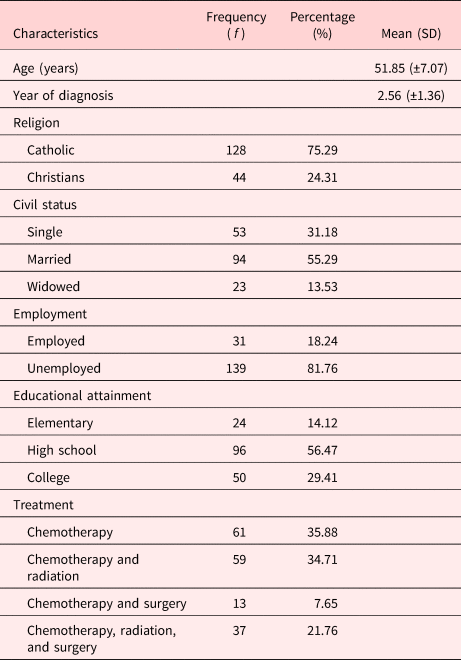
Table 1 shows the respondents' demographic profile of the participants. The mean age of the respondents was 51.85 (±7.07), and the mean year of diagnosis with breast cancer was 2.56 (±1.36). In addition, the majority of the participants in this study were mostly Catholics (75.29%) and married (55.29%). Also, the majority of the participants managed to finish high school (56.47%) and were mostly unemployed (81.76%). Chemotherapy was the most common treatment being given to the respondents with a percentage of 35.88%.
Demographic profile of the participants (n = 170)

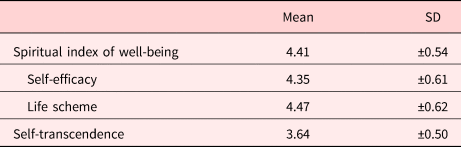
As illustrated in Table 2, the overall mean score of the spiritual index of well-being among the participants was 4.41 (±0.54). Specifically, its subscales, which included self-efficacy and life scheme, got a mean score of 4.35 (±0.61) and 4.47 (±0.62), respectively. On the other hand, the overall mean score of self-transcendence was 3.64 (±0.50).
Spiritual index of well-being and self-transcendence among the participants

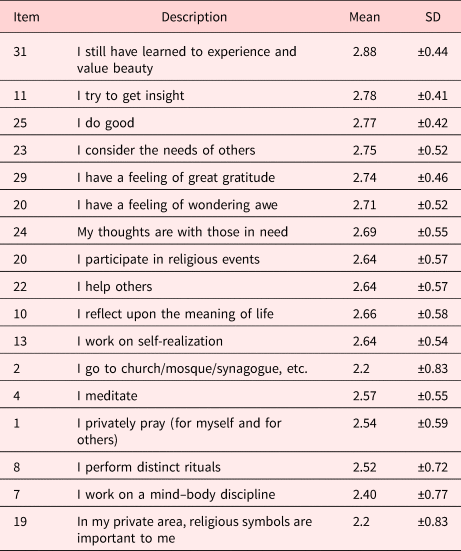
Table 3 shows the spiritual practices with the highest ratings among the participants. The five spiritual practices with the highest mean were “I still have learned to experience and value beauty,” “I try to get insight,” “I do good,” “I consider the needs of others,” and “I have a feeling of great gratitude.”
Spiritual practices with the highest ratings as perceived by the participants

The relationship between the spiritual index of well-being and self-transcendence was measured using Pearson's r correlation. The study revealed that a significant relationship exists between the two variables, as shown by a p-value of 0.000 (Table 4).
Relationship between the spiritual index of well-being and self-transcendence

* p-value is significant at 0.05 level.
Discussion
The objectives of the study were to assess the levels of spiritual well-being and self-transcendence among Filipino women with breast cancer and determine the most common spiritual practices they utilized and to correlate spiritual well-being and self-transcendence.
In the study, the participants reported a high level of self-transcendence and spiritual well-being. This is consistent with existing literatures which show a higher level of spiritual well-being and self-transcendence among people with severe diseases. Thomas et al. (Reference Thomas, Burton and Griffin2010) found a high level of self-transcendence and spiritual well-being among breast cancer women, while Iwamoto et al. (Reference Iwamoto, Yamawaki and Sato2011) found a higher level of self-transcendence among Japanese people with intractable diseases. Landis (Reference Landis1996) explained that persons with a high level of self-transcendence and spiritual well-being view life's struggles like having disease such as breast cancer as something to be overcome and find meaning to the situation that they find themselves in.
The results revealed a high level of self-transcendence and spiritual well-being among the respondents as well as in the selfefficacy and life-scheme sub-scales. While life scheme examines life's purpose, self-efficacy denotes high confidence in personal capabilities which may be related to the experience of a significant life transition. Coward (Reference Coward2007) defined self-transcendence as a positive life outcome, especially to people near the end of life and to those experiencing disease. Hence, newly diagnosed women experienced spiritual disequilibrium and they sought information about their condition and support from other people around them. Also, an awareness of one's vulnerability may force a person to widen personal boundaries in order to restore a sense of equilibrium or balance as they engage in new activities that promote a sense of purpose and meaning to their life, and a positive outlook about their condition to better manage life situations.
In terms of spiritual practices, people with certain disease and near the end of life reported spiritual practices that help them achieve self-transcendence by having a high level of spiritual well-being (Haugan, Reference Haugan2013). Spiritual and religious practices are known to be the culture of Filipinos, and this is why breast cancer patients turn to spiritual ways to manage life's changes and challenges, which are reflected in this study. This was supported by the study of Lagman et al. (Reference Lagman, Yoo and Levine2012) among Filipino immigrant breast cancer survivors who took solace in the Filipino cultural concept of “bahala na” and found peace of mind in “leaving it to God.” On the other hand, some studies have found that women who prayed found positive aspects in their experience with breast cancer (Levine et al., Reference Levine, Aviv and Yoo2009) because they believed that spirituality was a significant part of their battle and treatment. Through spirituality, an individual has an heightened sense of meaning in their lives, an increased level of life contentment or satisfaction, and a reduced level of anxiety and stress (López et al., Reference López, Mccaffrey and Griffin2009).
Having strong beliefs have a great impact on the acceptance of physical and emotional changes and challenges in life that can alter a person's normal functioning. Distress caused by illness such as breast cancer and its treatment process involves every part of an individual's life and includes their spiritual, emotional, physical, psychological, and social aspects, which affects an individual's well-being and quality of life. Individuals who are battling breast cancer will always have fear and anxiety, as they realize that they are finite beings and death could come any moment. This fear of death is what drives cancer warriors, such as women diagnosed with breast cancer, to fight and hope. Hence, they reach out both inside and outside of themselves to make meaning of their experience. Hope can be found within ourselves and the people around us, and it is what gives meaning to their battle and meaning to their life as well (Coward and Kahn, Reference Coward and Kahn2005).
The study noted that a significant relationship exists between self-transcendence and spiritual well-being. This was supported by Coward (Reference Coward1990), who revealed that people near the end of life facilitate healing by having self-transcendence which is a resource in reaching beyond self-boundaries and leads to a sense of spiritual well-being, wherein a person was able to have enhanced self-awareness and find meaning in their illness.
Conclusion
The study showed that there was a significant relationship between spirituality and self-transcendence among Filipino women with breast cancer. Hence, it is critical to incorporate strategies that will enhance spiritual well-being and self-transcendence as part of holistic nursing care. This may enable nurses to assist women with breast cancer to bring about transcendent perspectives that they have developed in their life span and will help them find meaning in life and a sense of well-being despite the presence of affliction.
Another important component in nursing is spiritual practices. There is a dearth of literature with regard to the spiritual practices that are utilized by Filipino women with breast cancer. Thus, spiritual practices should be included in the care of individuals, as Filipinos are considered to be highly religious and spiritual people.
Acknowledgment
The authors would like to express their deep and sincerest gratitude to Ms. Trisha Leigh Jasmin Marcos and Ms. Vanessa Lacdao, who served as research assistants and helped in the collection of data. Furthermore, the authors are grateful to all the individuals who participated in the study.
Conflicts of interest
The authors declare that there is no conflict of interest in this study.