Kinship care is defined as ‘family-based care within the child's extended family or with close friends of the family known to the child, whether formal or informal in nature’ (United Nations General Assembly, 2010). Of the 43,399 children in out-of-home care in Australia, 20,528 are living in formal kinship care (Australian Institute of Health and Welfare AIHW, 2016). In Victoria, 8564 children are placed in formal kinship care, with kinship care placements (54.9%) currently exceeding foster placements (49.1%) (AIHW, 2016). These prevalence rates continue to rise. One Australian study suggests ‘informal’ kinship care may be three times higher than ‘statutory’ kinship care (Smyth & Eardley, Reference Smyth and Eardley2007), however, inconsistencies with data collection make prevalence rates problematic.
Kinship carers, particularly grandparents, experience greater vulnerability than foster carers – including older age and greater poverty, social isolation, health issues and increased likelihood of being sole carers (Boetto, Reference Boetto2010). The close relationship between kinship carers and the children's parents – often itself a problematic parent–child relationship – adds another level of complexity, given the impact on family relationships of parental substance abuse, concomitant mental illness and family violence (Boetto, Reference Boetto2010).
A growing body of research has identified the many advantages of kinship care over other care alternatives, including improvements to child wellbeing and stability of care (Winokur, Holtan, & Valentine, Reference Winokur, Holtan and Valentine2009). Kinship care also provides many children with a web of intimate kin support for life. However, these benefits to children often come at the cost of significant stress for their carers.
Family Violence and Kinship Care
There has been significant discourse around the use of language in the context of domestic and family violence and inconsistencies in language present in policy, legislation, practice and research. This has resulted in the lack of agreement on a definitive and overarching description of domestic and family violence (Boxall, Rosevear, & Payne, Reference Boxall, Rosevear and Payne2015; Tinning, Reference Tinning2010).
Laing and Humphreys (Reference Laing and Humphreys2013, p.4) offer an inclusive definition of domestic and family violence that considers the context of a range of family types, including kinship care families. For this paper, this definition guides the conceptualisations of family violence:
Domestic violence is physical, sexual, psychological or financial violence that takes place within an intimate or family type relationship and that forms a pattern of coercive and controlling behaviour. Domestic violence may involve a range of behaviours that are abusive but not necessarily violent.
Kinship care arrangements are often complicated by family dysfunction, including violence (Dunne & Kettler, Reference Dunne and Kettler2008). Dunne and Kettler (Reference Dunne and Kettler2008) cite the circumstances in which the children enter the care of kin as a key contributing factor to conflict with the birth parents, as well as the economic losses to the parent of relinquishing care of the child. Relationship issues between the children's parents and the kinship carers are also cited as a key reason for conflict which can escalate to violence (O'Brien, Reference O'Brien2012). Farmer (Reference Farmer2009a) and Boetto (Reference Boetto2010) reported examples of hostility, threats, intimidation, abuse, physical attacks, false allegations and undermining of placements as specific elements of conflict between parents and carers. There is some evidence to suggest that there are greater levels of exposure to family violence in kinship care than foster care (Berrick, Reference Berrick1997; Brown & Sen, Reference Brown and Sen2014). Due to lack of restriction and authorisation around parental contact with children in kinship care, there is a greater likelihood for children to witness the hostility between carers and parents (Brown & Sen, Reference Brown and Sen2014; Connolly, Reference Connolly2003).
In general, domestic and family violence in Australia is under-reported (Campo, Reference Campo2015; Richards, Reference Richards2011) and therefore the uncertainty around reporting rates for family violence within the kinship care context may be attributed in part to a lack of reporting (Font, Reference Font2015). Reasons for lack of reporting of violence in kinship care include a fear of negative responses to the report, such as the child being removed from the placement, judgment, punitive responses from statutory authorities (Briggs & Broadhurst, Reference Briggs and Broadhurst2005; Uliando & Mellor, Reference Uliando and Mellor2012) and the difficulties in taking legal action against family members (Argent, Reference Argent2009). Kin carers tolerate difficulties longer than foster carers and under-report difficulties which can, in turn, lead to significant periods of placement stress (Farmer, Reference Farmer2009b). This may be due to a conflict between keeping children safe versus maintaining family connection with the children's parents (Cooper, Reference Cooper2012). While this may demonstrate both strength and resilience within kinship carers facing adversity without support, it may also place kinship carers and the children in their care at greater risk.
There is a paucity of research on family violence in kinship care, specifically the number of kinship carers who are subject to family violence directed at them by a family member of the child in care or by the child, him/herself. Family violence directed towards kinship carers has been briefly identified in research as part of the complex picture of the out-of-home care system and is often identified and verbalised as difficult relationships, conflict, threats, intimidation or hostility (Brown & Sen, Reference Brown and Sen2014; Dunne & Kettler, Reference Dunne and Kettler2008; O'Brien, Reference O'Brien2012), but with little reported violence.
Baptcare is a community organisation in Victoria and Tasmania that provides a range of services to vulnerable adults, families and children, including kinship care. Baptcare undertook this research to gain a better understanding of how family violence directed towards kinship care placements was impacting children and families in kinship care in Victoria.
The aims of this research were to explore the (1) types, (2) frequency and (3) impact of family violence perpetrated by a close family member of the child in care, directed towards the kinship care placement (i.e., the carers and child in care).
Research Methods
This study used a mixed methods approach including an on-line survey and qualitative interviews. A purposive sampling approach of kinship carers was used. In total, 101 kinship carers from Victoria responded to the survey. Data collection occurred from November 2016 to June 2017.
Findings
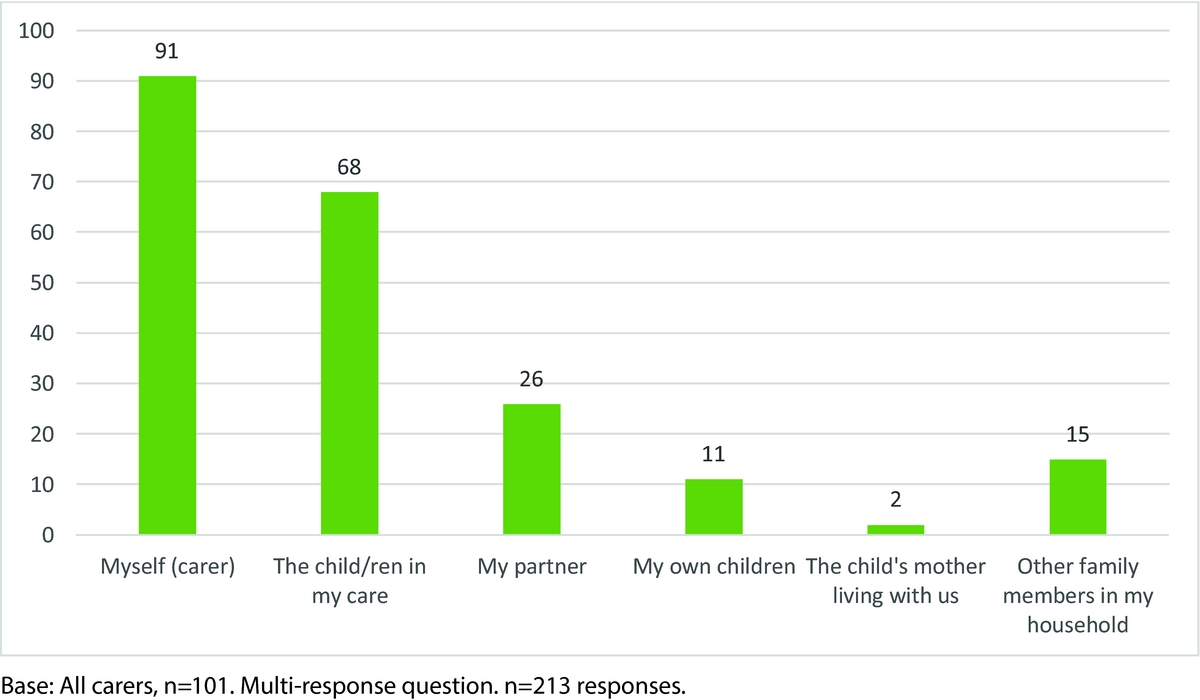
Most of the carers who participated in the survey were female (96%), two-thirds were aged over 51 years of age (66%) and most were the grandparent of the child being cared for (68%) or their aunt (18%). The main perpetrators of the family violence were the child's mother (68%), the child being cared for (46%) and the child's father (36%). Some carers experienced violence from more than one perpetrator. The violence was mainly directed towards the carer (91%), the child in care (68%) and the partner of the carer (26%). The violence was directed towards more than one family member for many carers (see Figure 1).
FIGURE 1
Household members to whom violence was directed (%).
Carers Experience and Impact of Family Violence
Carers were asked whether they had direct experience of any type of: physical violence, psychological, verbal and emotional abuse or property damage since the placement began, caused by close family members of the child being cared for. Half of the carers had direct experience of physical violence (51%). Many of these carers experienced multiple acts of physical abuse (198 responses obtained from 51 carers). The most common types of physical abuse that carers experienced included: carers being pushed, grabbed or shoved (n = 31), carers having something thrown at them, smashed or an object broken (n = 26), carers attempted to be hit with something (n = 22) and carers being punched (n = 22).
A higher proportion of carers experienced psychological, emotional and verbal abuse (82%) and most experienced multiple incidents (682 responses obtained from 82 carers). The most common types of psychological, emotional and verbal abuse included: carers being verbally abused (n = 75), carers being harassed over the telephone (n = 71), being blamed for the perpetrators violent behaviour (n = 62), intimidation (n = 60) and carers receiving threatening letters, texts and emails (n = 54). Of alarming concern is the number of carers who reported various threats being made against them. For example, 40 carers were threatened to be hurt, 25 carers received threats to be killed, 24 carers were threatened by a knife or weapon, and for 18 carers, threats were made to hurt the child being cared for. These examples of violence are criminal behaviours and are clearly a threat to the physical and psychological safety of carers and the children.
Half of the carers had direct experience of property damage (50%) and some experienced multiple acts of violent incidents (95 responses obtained from 50 carers). The most common types of property damage included: carers having a wall, door or furniture being kicked (n = 34), threats made to destroy the carers property (n = 31) and something being destroyed that belonged to the carer (n = 30).
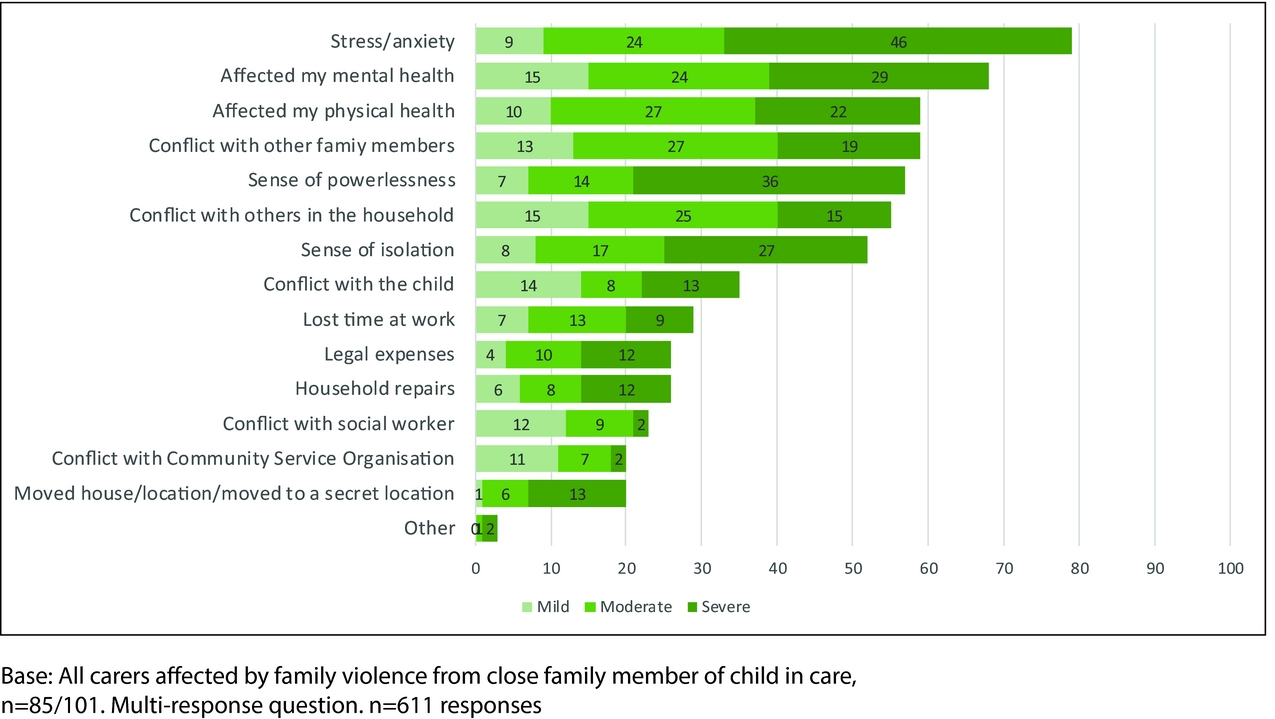
Carers reported multiple impacts of the family violence (see Figure 2). The greatest impact the abuse and violence were having on the carer included: stress/anxiety (n = 79), detrimental effects on mental health (n = 68) and physical health (n = 59), conflict with other family members (n = 59) and a sense of powerlessness (n = 57).
FIGURE 2
Impact of the family violence on the carer (n).
Children's Experience and Impact of Family Violence
Two-thirds of carers reported that the child/ren had experienced family violence caused by their close family member since the placement started (68%). Half of these carers reported that the child had experienced family violence that happened while in front of the carer (50%). Many children experienced multiple forms of abuse upon contact visitation with their parent(s) and carers (270 responses obtained from 50 carers). The main forms of abuse for the child included: verbal abuse (n = 34), intimidation (n = 29), threats to hurt other family members of the child (n = 25) and the child being pushed grabbed or shoved (n = 18). Approximately one-third of carers reported that the child experienced family violence that happened while out of their immediate care (32%). Many of these children experienced multiple types of abuse by their family member that occurred in the absence of their carer (179 responses obtained from 32 carers). The main forms of abuse for the child included: verbal abuse (n = 22), intimidation (n = 21), the child being pushed grabbed or shoved (n = 14) and threats to damage something the child cares about (n = 12).
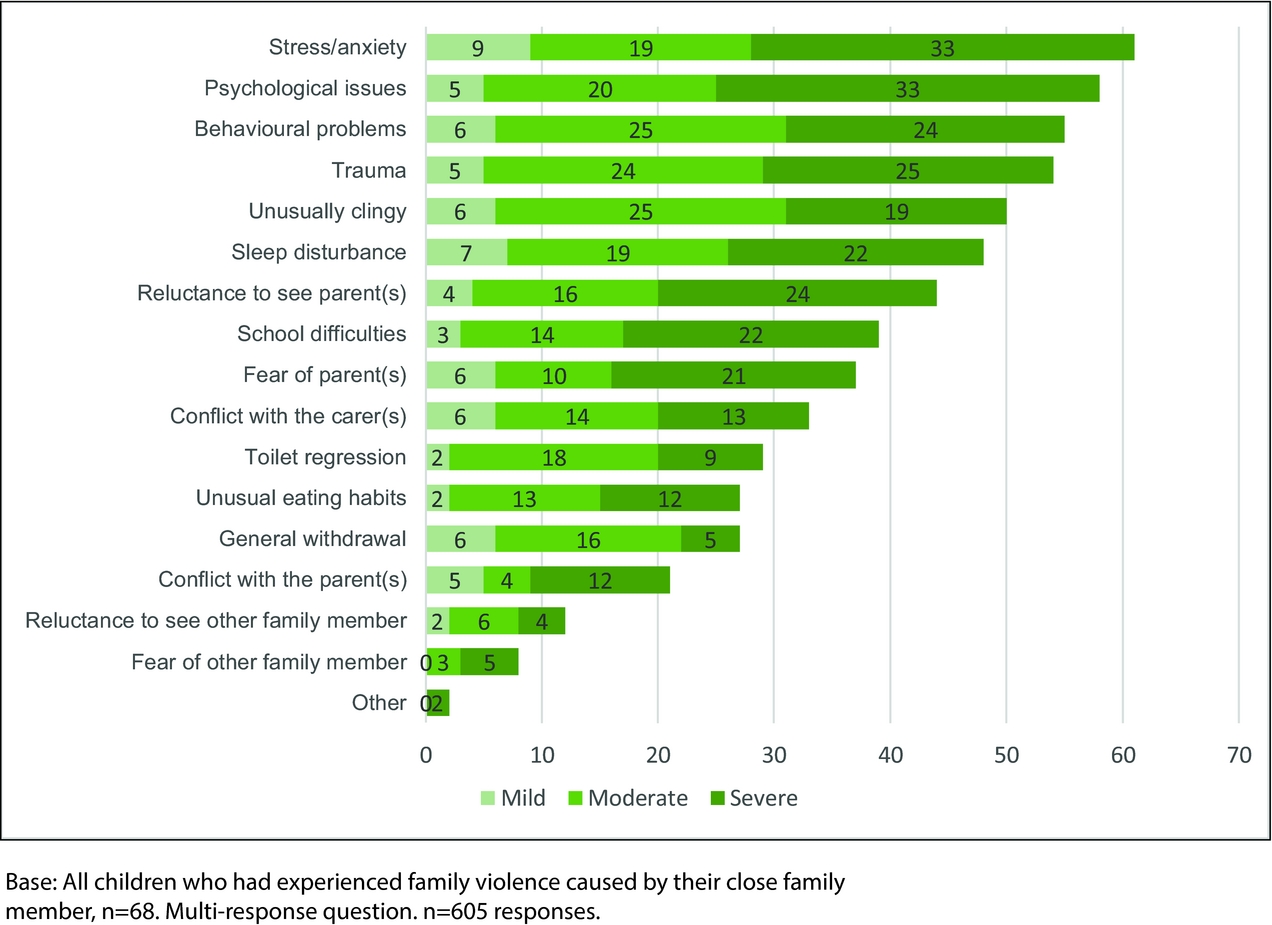
Carers reported that the children experienced multiple impacts of the family violence (see Figure 3). The greatest impact the abuse and violence were having on these children included: stress/anxiety (n = 61), psychological issues (n = 58), behavioural problems (n = 55), trauma (n = 54), the child being unusually clingy (n = 50), sleeping difficulties (n = 48), problems at school (n = 39) and reluctance to see their parents (n = 44).
FIGURE 3
Impact of the family violence on the children (n).
Discussion
This study has demonstrated that significant amounts of violence from family members are being experienced by kinship carers and the children in their care in Victoria. In the context of what is known about the risks to physical and psychological safety because of family violence, these findings must be of concern to authorities and support services charged with responding to children who have experienced abuse or neglect.
Of great concern is that carers are reporting violence towards the child in care, both when the carer is present and absent. This suggests that some of these children who have been placed in kinship care are being subjected to further abuse and re-traumatisation both in the home with the carer and during contact visits with their parents. While much unsupervised parental contact is positive or takes place without undue problems, without the presence of formal access or protective orders, children's contact with parents may present real threats to safety.
There is an evidence base for many aspects of safety and the child's best interest in the context of kinship care, however, there is also evidence that this belief is based on multiple assumptions (Brown & Sen, Reference Brown and Sen2014; Kiraly & Humphreys, Reference Kiraly and Humphreys2013a). It would be naïve to believe that removing a child from their environment and placing them in a new one is sufficient to mitigate the risks that are inherent in the complexity of child trauma. Scaffolding of support services and specialised treatment of the child, as well as a focus on key aspects of relationship building and psychosocial development are essential to work towards safety. However, many children are placed in care without any follow-up support.
Kinship carers are provided with little to no support or training around caring for a traumatised child depending on the circumstances in which the child is placed in their care (Berrick, Reference Berrick1997; Boetto, Reference Boetto2010; Briggs & Broadhurst, Reference Briggs and Broadhurst2005). Formal kinship carers may receive some support in terms of financial support and support from services however this is reported to be significantly less than formal foster carers and they are not subjected to the assessment and training foster carers receive (Uliando & Mellor, Reference Uliando and Mellor2012). Informal kinship carers receive very little or no support financially or from services and are provided with no training or assessment of suitability (Uliando & Mellor, Reference Uliando and Mellor2012).
A systemic approach is needed to improve the safety of kinship carers and children in care, as well as providing adequate support for carers to sustain placements and to provide children with the best chance to lead a healthy, loving and fulfilling life.
Conclusions
This study used a purposive sampling approach. Given the nature of the sample no prevalence data was obtained. To address this study shortfall, Baptcare will be repeating this study in New South Wales using a random sample of kinship carers. This will help build the evidence base around the issues raised in the research.
Baptcare is proactively working with kinship carers, the government and the not for profit sector to find solutions to issues identified in this research. In response to the recommendations outlined in the report (https://www.baptcare.org.au/why-baptcare/advocacy), Baptcare is advocating for kinship carers in several ways including: disseminating the research findings at state and international conferences, briefing DHHS on the key findings obtained from a workshop recently conducted at the International Foster Care Organisation conference in Malta, and undertaking policy development to see improvements for kinship carers. Baptcare is providing access to specialised trauma support counselling through its ‘Reaching Children through Universal Service’ demonstration program for children in kinship care who are affected by family violence and specialist support groups for kinship carers. Baptcare staff are also developing an online training package for kinship carers that has a focus on caring for traumatised children and the impact of family violence. Education is being provided to the biological parents of the child in relation to the long-term impacts of their perpetration of family violence on both the carers and the child in care via the Circle of Security groups facilitated by Baptcare. Finally, a specialised trauma training package, designed to meet the needs of kinship carers, is under development and will be implemented late 2018.
This paper is the first in a series of three papers on family violence in kinship care.





 You have
Access
Kinship care is defined as ‘family-based care within the child's extended family or with close friends of the family known to the child, whether formal or informal in nature’ (United Nations General Assembly, 2010). Of the 43,399 children in out-of-home care in Australia, 20,528 are living in formal kinship care (Australian Institute of Health and Welfare AIHW, 2016). In Victoria, 8564 children are placed in formal kinship care, with kinship care placements (54.9%) currently exceeding foster placements (49.1%) (AIHW, 2016). These prevalence rates continue to rise. One Australian study suggests ‘informal’ kinship care may be three times higher than ‘statutory’ kinship care (Smyth & Eardley, Reference Smyth and Eardley2007), however, inconsistencies with data collection make prevalence rates problematic.
Kinship carers, particularly grandparents, experience greater vulnerability than foster carers – including older age and greater poverty, social isolation, health issues and increased likelihood of being sole carers (Boetto, Reference Boetto2010). The close relationship between kinship carers and the children's parents – often itself a problematic parent–child relationship – adds another level of complexity, given the impact on family relationships of parental substance abuse, concomitant mental illness and family violence (Boetto, Reference Boetto2010).
A growing body of research has identified the many advantages of kinship care over other care alternatives, including improvements to child wellbeing and stability of care (Winokur, Holtan, & Valentine, Reference Winokur, Holtan and Valentine2009). Kinship care also provides many children with a web of intimate kin support for life. However, these benefits to children often come at the cost of significant stress for their carers.
Family Violence and Kinship Care
There has been significant discourse around the use of language in the context of domestic and family violence and inconsistencies in language present in policy, legislation, practice and research. This has resulted in the lack of agreement on a definitive and overarching description of domestic and family violence (Boxall, Rosevear, & Payne, Reference Boxall, Rosevear and Payne2015; Tinning, Reference Tinning2010).
Laing and Humphreys (Reference Laing and Humphreys2013, p.4) offer an inclusive definition of domestic and family violence that considers the context of a range of family types, including kinship care families. For this paper, this definition guides the conceptualisations of family violence:
Domestic violence is physical, sexual, psychological or financial violence that takes place within an intimate or family type relationship and that forms a pattern of coercive and controlling behaviour. Domestic violence may involve a range of behaviours that are abusive but not necessarily violent.
Kinship care arrangements are often complicated by family dysfunction, including violence (Dunne & Kettler, Reference Dunne and Kettler2008). Dunne and Kettler (Reference Dunne and Kettler2008) cite the circumstances in which the children enter the care of kin as a key contributing factor to conflict with the birth parents, as well as the economic losses to the parent of relinquishing care of the child. Relationship issues between the children's parents and the kinship carers are also cited as a key reason for conflict which can escalate to violence (O'Brien, Reference O'Brien2012). Farmer (Reference Farmer2009a) and Boetto (Reference Boetto2010) reported examples of hostility, threats, intimidation, abuse, physical attacks, false allegations and undermining of placements as specific elements of conflict between parents and carers. There is some evidence to suggest that there are greater levels of exposure to family violence in kinship care than foster care (Berrick, Reference Berrick1997; Brown & Sen, Reference Brown and Sen2014). Due to lack of restriction and authorisation around parental contact with children in kinship care, there is a greater likelihood for children to witness the hostility between carers and parents (Brown & Sen, Reference Brown and Sen2014; Connolly, Reference Connolly2003).
In general, domestic and family violence in Australia is under-reported (Campo, Reference Campo2015; Richards, Reference Richards2011) and therefore the uncertainty around reporting rates for family violence within the kinship care context may be attributed in part to a lack of reporting (Font, Reference Font2015). Reasons for lack of reporting of violence in kinship care include a fear of negative responses to the report, such as the child being removed from the placement, judgment, punitive responses from statutory authorities (Briggs & Broadhurst, Reference Briggs and Broadhurst2005; Uliando & Mellor, Reference Uliando and Mellor2012) and the difficulties in taking legal action against family members (Argent, Reference Argent2009). Kin carers tolerate difficulties longer than foster carers and under-report difficulties which can, in turn, lead to significant periods of placement stress (Farmer, Reference Farmer2009b). This may be due to a conflict between keeping children safe versus maintaining family connection with the children's parents (Cooper, Reference Cooper2012). While this may demonstrate both strength and resilience within kinship carers facing adversity without support, it may also place kinship carers and the children in their care at greater risk.
There is a paucity of research on family violence in kinship care, specifically the number of kinship carers who are subject to family violence directed at them by a family member of the child in care or by the child, him/herself. Family violence directed towards kinship carers has been briefly identified in research as part of the complex picture of the out-of-home care system and is often identified and verbalised as difficult relationships, conflict, threats, intimidation or hostility (Brown & Sen, Reference Brown and Sen2014; Dunne & Kettler, Reference Dunne and Kettler2008; O'Brien, Reference O'Brien2012), but with little reported violence.
Baptcare is a community organisation in Victoria and Tasmania that provides a range of services to vulnerable adults, families and children, including kinship care. Baptcare undertook this research to gain a better understanding of how family violence directed towards kinship care placements was impacting children and families in kinship care in Victoria.
The aims of this research were to explore the (1) types, (2) frequency and (3) impact of family violence perpetrated by a close family member of the child in care, directed towards the kinship care placement (i.e., the carers and child in care).
Research Methods
This study used a mixed methods approach including an on-line survey and qualitative interviews. A purposive sampling approach of kinship carers was used. In total, 101 kinship carers from Victoria responded to the survey. Data collection occurred from November 2016 to June 2017.
Findings
Most of the carers who participated in the survey were female (96%), two-thirds were aged over 51 years of age (66%) and most were the grandparent of the child being cared for (68%) or their aunt (18%). The main perpetrators of the family violence were the child's mother (68%), the child being cared for (46%) and the child's father (36%). Some carers experienced violence from more than one perpetrator. The violence was mainly directed towards the carer (91%), the child in care (68%) and the partner of the carer (26%). The violence was directed towards more than one family member for many carers (see Figure 1).
Household members to whom violence was directed (%).
Carers Experience and Impact of Family Violence
Carers were asked whether they had direct experience of any type of: physical violence, psychological, verbal and emotional abuse or property damage since the placement began, caused by close family members of the child being cared for. Half of the carers had direct experience of physical violence (51%). Many of these carers experienced multiple acts of physical abuse (198 responses obtained from 51 carers). The most common types of physical abuse that carers experienced included: carers being pushed, grabbed or shoved (n = 31), carers having something thrown at them, smashed or an object broken (n = 26), carers attempted to be hit with something (n = 22) and carers being punched (n = 22).
A higher proportion of carers experienced psychological, emotional and verbal abuse (82%) and most experienced multiple incidents (682 responses obtained from 82 carers). The most common types of psychological, emotional and verbal abuse included: carers being verbally abused (n = 75), carers being harassed over the telephone (n = 71), being blamed for the perpetrators violent behaviour (n = 62), intimidation (n = 60) and carers receiving threatening letters, texts and emails (n = 54). Of alarming concern is the number of carers who reported various threats being made against them. For example, 40 carers were threatened to be hurt, 25 carers received threats to be killed, 24 carers were threatened by a knife or weapon, and for 18 carers, threats were made to hurt the child being cared for. These examples of violence are criminal behaviours and are clearly a threat to the physical and psychological safety of carers and the children.
Half of the carers had direct experience of property damage (50%) and some experienced multiple acts of violent incidents (95 responses obtained from 50 carers). The most common types of property damage included: carers having a wall, door or furniture being kicked (n = 34), threats made to destroy the carers property (n = 31) and something being destroyed that belonged to the carer (n = 30).
Carers reported multiple impacts of the family violence (see Figure 2). The greatest impact the abuse and violence were having on the carer included: stress/anxiety (n = 79), detrimental effects on mental health (n = 68) and physical health (n = 59), conflict with other family members (n = 59) and a sense of powerlessness (n = 57).
Impact of the family violence on the carer (n).
Children's Experience and Impact of Family Violence
Two-thirds of carers reported that the child/ren had experienced family violence caused by their close family member since the placement started (68%). Half of these carers reported that the child had experienced family violence that happened while in front of the carer (50%). Many children experienced multiple forms of abuse upon contact visitation with their parent(s) and carers (270 responses obtained from 50 carers). The main forms of abuse for the child included: verbal abuse (n = 34), intimidation (n = 29), threats to hurt other family members of the child (n = 25) and the child being pushed grabbed or shoved (n = 18). Approximately one-third of carers reported that the child experienced family violence that happened while out of their immediate care (32%). Many of these children experienced multiple types of abuse by their family member that occurred in the absence of their carer (179 responses obtained from 32 carers). The main forms of abuse for the child included: verbal abuse (n = 22), intimidation (n = 21), the child being pushed grabbed or shoved (n = 14) and threats to damage something the child cares about (n = 12).
Carers reported that the children experienced multiple impacts of the family violence (see Figure 3). The greatest impact the abuse and violence were having on these children included: stress/anxiety (n = 61), psychological issues (n = 58), behavioural problems (n = 55), trauma (n = 54), the child being unusually clingy (n = 50), sleeping difficulties (n = 48), problems at school (n = 39) and reluctance to see their parents (n = 44).
Impact of the family violence on the children (n).
Discussion
This study has demonstrated that significant amounts of violence from family members are being experienced by kinship carers and the children in their care in Victoria. In the context of what is known about the risks to physical and psychological safety because of family violence, these findings must be of concern to authorities and support services charged with responding to children who have experienced abuse or neglect.
Of great concern is that carers are reporting violence towards the child in care, both when the carer is present and absent. This suggests that some of these children who have been placed in kinship care are being subjected to further abuse and re-traumatisation both in the home with the carer and during contact visits with their parents. While much unsupervised parental contact is positive or takes place without undue problems, without the presence of formal access or protective orders, children's contact with parents may present real threats to safety.
There is an evidence base for many aspects of safety and the child's best interest in the context of kinship care, however, there is also evidence that this belief is based on multiple assumptions (Brown & Sen, Reference Brown and Sen2014; Kiraly & Humphreys, Reference Kiraly and Humphreys2013a). It would be naïve to believe that removing a child from their environment and placing them in a new one is sufficient to mitigate the risks that are inherent in the complexity of child trauma. Scaffolding of support services and specialised treatment of the child, as well as a focus on key aspects of relationship building and psychosocial development are essential to work towards safety. However, many children are placed in care without any follow-up support.
Kinship carers are provided with little to no support or training around caring for a traumatised child depending on the circumstances in which the child is placed in their care (Berrick, Reference Berrick1997; Boetto, Reference Boetto2010; Briggs & Broadhurst, Reference Briggs and Broadhurst2005). Formal kinship carers may receive some support in terms of financial support and support from services however this is reported to be significantly less than formal foster carers and they are not subjected to the assessment and training foster carers receive (Uliando & Mellor, Reference Uliando and Mellor2012). Informal kinship carers receive very little or no support financially or from services and are provided with no training or assessment of suitability (Uliando & Mellor, Reference Uliando and Mellor2012).
A systemic approach is needed to improve the safety of kinship carers and children in care, as well as providing adequate support for carers to sustain placements and to provide children with the best chance to lead a healthy, loving and fulfilling life.
Conclusions
This study used a purposive sampling approach. Given the nature of the sample no prevalence data was obtained. To address this study shortfall, Baptcare will be repeating this study in New South Wales using a random sample of kinship carers. This will help build the evidence base around the issues raised in the research.
Baptcare is proactively working with kinship carers, the government and the not for profit sector to find solutions to issues identified in this research. In response to the recommendations outlined in the report (https://www.baptcare.org.au/why-baptcare/advocacy), Baptcare is advocating for kinship carers in several ways including: disseminating the research findings at state and international conferences, briefing DHHS on the key findings obtained from a workshop recently conducted at the International Foster Care Organisation conference in Malta, and undertaking policy development to see improvements for kinship carers. Baptcare is providing access to specialised trauma support counselling through its ‘Reaching Children through Universal Service’ demonstration program for children in kinship care who are affected by family violence and specialist support groups for kinship carers. Baptcare staff are also developing an online training package for kinship carers that has a focus on caring for traumatised children and the impact of family violence. Education is being provided to the biological parents of the child in relation to the long-term impacts of their perpetration of family violence on both the carers and the child in care via the Circle of Security groups facilitated by Baptcare. Finally, a specialised trauma training package, designed to meet the needs of kinship carers, is under development and will be implemented late 2018.
This paper is the first in a series of three papers on family violence in kinship care.
Acknowledgements
The authors would like to thank Baptcare for funding the project and the wonderful carers who took part in the survey and interviews. Our thanks and appreciation also extends to Dr Meredith Kiraly and Professor Cathy Humphreys from the University of Melbourne, Elizabeth McCrea and Ruth Chattey from the Mirabel Foundation, Anne McLeish from Grandparents Victoria and The Centre for Excellence in Child and Family Welfare.