Introduction
The concepts “purpose in life” and “meaning in life” are closely related and have been explained both as a person's strongest motivation for living (Frankl, Reference Frankl1958) and as a sense of life's coherence (Antonovsky, Reference Antonovsky1979; White, Reference White2004). A feeling of purpose or meaning in life comprises a set of beliefs that make the world understandable and include elements such as worthy goals to strive for and relationships to maintain with other people, nature, or a higher power (Antonovsky, Reference Antonovsky1979; White, Reference White2004). The basic tenet of Frankl's theory (Reference Frankl1958) is that all human beings have a unique capacity to perceive meaning or purpose and can reduce despair in severe circumstances by incorporating personal meaning into the situation. Every human being also has a unique will – the desire and ability to choose how to react and confront each situation in life. Absence of purpose in life can weaken that will and result in an “existential vacuum,” a state of emptiness manifest as boredom, which can lead to anxiety and depression. Frankl later wrote that “such widespread phenomena as depression, aggression and addiction are not understandable unless we recognize the existential vacuum underlying them” (Frankl, Reference Frankl2004, p. 112). Psychological suffering that cannot be understood cannot be treated, thus it is essential to recognize the existential vacuum of low purpose in life.
Cross-sectional studies among different age groups (Nygren et al., Reference Nygren, Aléx, Jonsén, Gustafson, Norberg and Lundman2005; Molasso, Reference Molasso2006) have found similar mean scores on the Purpose in Life (PIL) Test developed by Crumbaugh (Reference Crumbaugh1968) and Crumbaugh and Maholick (Reference Crumbaugh and Maholick1981), indicating that purpose in life does not change over the course of a lifetime. Society's attitude toward very old people might be important for their maintaining purpose in life (Ebersole and de Paola, Reference Ebersole and de Paola1989). A study by Tornstam (Reference Tornstam2007) showed that almost 90% of Swedes believed that retired pensioners suffer from loneliness. If old people are viewed stereotypically by society as living lonely and meaningless lives, their risk of reduced purpose in life will increase (Tornstam, Reference Tornstam2007), because the dominant social view probably influences their own views of their own aging. In a recent study, our research group found that attitudes toward one's own aging were strongly related to purpose in life and that undecided feelings about their purpose in life were related to poorer psychological health in very old people (Hedberg et al., Reference Hedberg, Gustafson and Brulin2010a).
Feelings of having lived a meaningful life and fulfilled life goals seem to be important in purpose in life (Ebersole and de Paola, Reference Ebersole and de Paola1989). But among very old women, purpose in life was also found in just having the strength to wipe off the table (Hedberg et al., Reference Hedberg, Brulin and Aléx2009). In cross-sectional studies, depressed mood has been associated with lack of meaning or purpose in life (Ryff and Keys, Reference Ryff and Keyes1995). However, cross-sectional studies have design limitations that preclude the determination of causality.
In a prospective study Hedberg et al. (Reference Hedberg, Gustafson, Aléx and Brulin2010b) found that purpose in life at baseline did not protect very old people from developing depression five years later. Participants who scored high on the PIL test were diagnosed as depressed after five years as often as those who scored low on the test. It is noteworthy that the study by Hedberg et al. (Reference Hedberg, Gustafson, Aléx and Brulin2010b) focused on depression as the outcome of interest; as far as we know, no other studies to date have investigated purpose in life among very old people using a prospective approach. The PIL test was developed in order to detect existential vacuum (Crumbaugh, Reference Crumbaugh1968), which is not factorially independent of depression (Dyck, Reference Dyck1987). Because the PIL test is used worldwide and the results from cross-sectional studies are contradictory, it is important to investigate purpose in life among very old people prospectively. In this study, our hypothesis was that purpose in life is stable over a five-year period. However, factors such as depressed mood, depression, malnutrition, inactivity in daily life, and cognitive impairment may influence the stability of purpose in life among a very old population.
The aim of this study was to examine changes in purpose in life over a five-year period among very old men and women living in the northern part of Sweden, and furthermore to investigate whether depressed mood, malnutrition, inactivity in daily life, and cognitive impairment were associated with an increased risk for low purpose in life.
Methods
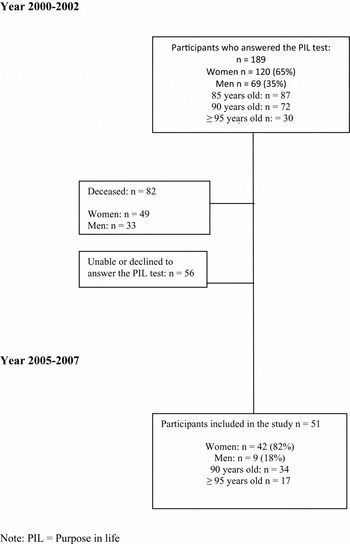
This study is a smaller part of the population-based Umeå 85+ study/ GERDA (GErontological Regional Database) study, which is a multi-professional collaboration between nurses, occupational therapists, physicians, physiotherapists, and social workers. Elderly people from a medium-sized town and surrounding rural areas were included. The inclusion criteria for participants were age (95 years or older, 90 years, or 85 years) and lack of severe cognitive impairment. Every person in the first two age groups and every second 85-year-old was selected as a potential participant from lists received from the National Tax Board. The selection of the participants in this study is shown in Figure 1.
Flow chart of the population included in the study.

This study included 51 participants (42 women and 9 men) who were still living and had no severe cognitive impairment during the data collection period. All the participants answered the PIL test at baseline in 2000–2002 and five years later in 2005–2007.
Data collection
The participants were informed about the study and invited to take part by letter and again by telephone. Data collection was carried out in each participant's home, by means of questionnaires, interviews, and assessments. Due to the large number of questions, all of the participants were visited more than once. The researcher read the questions out loud and the participants had an enlarged copy of the answer alternatives in front of them. The participants answered the questions verbally or by pointing to a figure on the enlarged copy. In the follow-up study we used the same data collection procedure as in the baseline study.
The participants were assured of confidentiality and anonymity in the presentation of the results and were also informed of their right to withdraw from the study without giving any reason for doing so. The study was approved by the Ethics Committee of the Medical Faculty, Umeå University (§ 99–326, § 00–171, and § 05–063M).
Measurements
We used one scale (PIL) to assess the dependent variable, purpose in life, and four scales to measure the independent variables: Geriatric Depression Scale (GDS), the Minimal Nutritional Assessment (MNA), the Barthel Index for activities of daily living (ADL), and the Mini-mental State Examination (MMSE) for cognitive impairment. The participants completed the various tests and their scores were collected on two sets of occasions, once during the years 2000 to 2002 (I) and once during 2005 to 2007 (II). Depression was diagnosed according to DSM-IV criteria based on the GDS and the Organic Brain Syndrome (OBS) scale, and further validated by the Montgomery-Åsberg Depression Rating Scale (MADRS) and documentation in medical records.
The PIL scale consists of 20 items on a 7-point Likert scale. The total scores range from 20 to 140. According to Crumbaugh and Maholick (Reference Crumbaugh and Maholick1981), scores of 113 and above suggest a definite PIL; scores of 92 to 112 represent undecided feelings about PIL, and scores of 91 and below indicate a clear lack of PIL (Crumbaugh and Maholick, Reference Crumbaugh and Maholick1981). The PIL scale was translated into Swedish by Åkerberg (Reference Åkerberg1987).
The level of depressed mood was screened for using the GDS, a measure developed to screen for depression among the elderly. In this study the shorter 15-item version (GDS-15) was used rather than the original 30-item scale. Items are scored 0 or 1 and the range of total scores is 0 to 15; scores from 5 to 9 indicate mild depression, and a score of 10 or more indicates moderate to severe depression (Sheik and Yesavage, Reference Sheikh, Yesavage and Brink1986). The GDS-15 has been evaluated in a very old population and found to have high sensitivity and specificity in diagnosing depression (de Craen et al., Reference de Craen, Heeren and Gussekloo2003).
Depression was diagnosed according to the DSM-IV criteria by a specialist in geriatric medicine and was dichotomized as “yes” or “no”. Depression was screened for with the GDS-15 and the OBS scale and further validated with the MADRS. Patients with a diagnosis of depression and ongoing treatment documented in their health records were also diagnosed as depressed, and those with a GDS-score <5 were regarded as responders to treatment. The OBS scale (Jensen and Dehlin, Reference Jensen and Dehlin1993) was developed for clinical evaluation of disturbance of orientation, as well as for assessing various emotional and behavioral symptoms in elderly patients. The OBS scale is considered to be a sensitive and balanced rating scale, easy to use among very old people (Björkelund-Björkman et al., Reference Björkelund-Björkman, Larsson, Gustafson and Andersson2006). The MADRS scale (Montgomery and Åsberg, Reference Montgomery and Åsberg1979) was administered by a specialist in geriatric medicine in order to validate the diagnosis of depression among those who scored ≥5 on the GDS-15. The MADRS rating is based on a clinical interview that investigates ten symptoms of depression. The inter-rater reliability of the MADRS is reported to be high (Montgomery and Åsberg, Reference Montgomery and Åsberg1979).
Cognition for the participants was screened for using the MMSE (Folstein et al., Reference Folstein, Folstein and McHugh1975), which has a maximum score of 30. The MMSE covers orientation, registration, attention and calculation, word recall, and language (including naming, reading, following instructions, writing, and copying) (Folstein et al., Reference Folstein, Folstein and McHugh1975). A score of 23 or less is often considered to indicate cognitive impairment (Tombaugh and McIntyre, Reference Tombaugh and McIntyre1992). However, among very old people with low levels of education and often with vision and hearing impairments, the cut-off score of 23 is not applicable. Nutrition was measured using the MNA, a screening instrument for nutritional status among old people (Guigoz and Vellas, Reference Guigoz and Vellas1994). The maximum score on MNA is 30. Scores ranging from 24 to 30 indicate good nutritional status, scores ranging from 17 to 23.5 indicate risk of malnutrition, and scores below 17 indicate malnutrition. ADLs were measured with the Barthel Index, a well-established scale that has been found to have high validity and sensitivity (Collin et al., Reference Collin, Wade, Davies and Horne1988). The Barthel Index measures what people actually do in daily life, rather than what they can do, and has scores ranging from 0 to 20, with higher scores indicating greater independence.
Statistics
We used the McNemar test as well as paired samples t-test and Student's t-test to analyze differences between groups. To determine which of the independent variables contributed most to PIL, a multilevel approach was used for the multiple linear regression with repeated observations for the individuals on PIL, GDS, Barthel Index, MNA, MMSE, living alone, and living in an institution. An exchangeable correlation structure was assumed and the parameters were estimated using generalized estimating equations (GEE). Pearson's correlation coefficient was used to test for multicollinearity, and none was found. In the univariate analysis, a p-value of <0.1 was the criterion for entering a variable into a multiple regression model. In the multiple linear regression (MLR), a p-value of ≤0.05 was considered significant. As the diagnosis of depression was partly based on the GDS score, two MLR analyses were performed, one with GDS score (MLR 1) and one with the diagnosis of depression (MLR 2). The analysis was performed using the Statistical Package for Social Sciences (SPSS) for Windows, version 17.0 (SPSS Inc., Chicago, IL).
Results
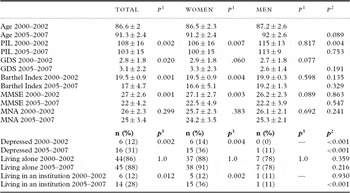
The PIL mean score for all the participants (N = 51) was 108 (SD = 16) at baseline; after five years it had decreased to 103 (SD = 15; p = 0.002). For women, the five-year decrease in PIL mean score (PIL I m = 106, SD = 16; PIL II m = 100, SD = 15) was significant (p = 0.007), while for men the decrease in PIL mean score (PIL I m = 115, SD = 12; PIL II m = 113, SD = 8) was not significant (p = 0.817). Mean PIL value decreased over time for three men out of nine (33%) and for 27 women out of 42 (67%) (p = 0.013).
Mood (GDS), cognition (MMSE), and ADL (Barthel Index) also deteriorated significantly during the five-year period. The mean score for the GDS for the total group was 2.8 (SD = 1.8) at baseline and 3.1 (SD = 2.2) at follow-up (p = 0.020). The corresponding value for the MMSE was 27 (SD = 2.6) at baseline and 22 (SD = 4.2) at follow-up (p = 0.001). The mean score on the Barthel Index was 19.5 (SD = 0.9) at baseline and 17 (SD = 4.7) at follow-up (p = 0.001). For the MNA, the mean score was 26 (SD = 2.3) at baseline and 25 (SD = 3.4) at follow-up (p = 0.229).
Seven participants lived with someone, and their PIL scores at baseline (m = 110, SD = 10) were higher than those who lived alone (m = 102, SD = 15), however the difference was not significant (p = 0.087). There were no significant differences among the mean PIL scores at baseline between those living at home (m = 108, SD = 16) and those living in an institution (m = 103, SD = 11) (p = 0.383). However, at the follow-up, mean PIL scores for those living at home (m = 107, SD = 13) were significantly higher than for those living in a institution (m = 93, SD = 15) (p = 0.001) (Table 1).
Mean differences between 2000–2002 and 2005–2007 and between women (n = 42) and men (n = 9)

PIL = purpose in life; GDS = Geriatric Depression Scale; MMSE = Mini-mental State Examination; MNA = Minimal Nutritional Assessment.
1p-value within groups, differences between years. Paired samples t-test.
2p-value between women and men. Student t-test.
3p-value between times. McNemar test.
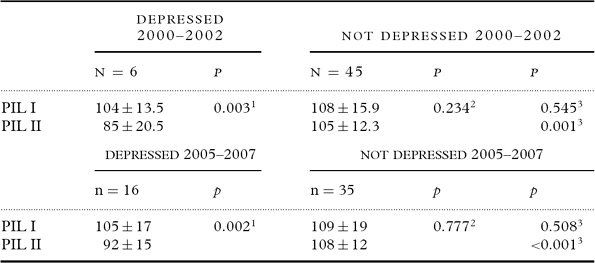
There were no significant differences in mean PIL I scores among those with a diagnosis of depression at baseline (m = 104, SD = 13.5) compared with those without depression (m = 108, SD = 15.9, p = 0.508). However, those with depression had a significantly decreased mean PIL score after five years (PIL I m = 104, SD = 13.5 vs. PIL II m = 85, SD = 20.5; p = 0.001). The mean baseline PIL score among those who developed depression over the five-year period (n = 10) was 106 (SD = 19.8) compared with baseline 109 (SD = 14.9) among those who did not develop depression (n = 35). However, after five years the PIL mean value for those who developed depression (n = 10) decreased from 106 (SD = 19.8) to 96 (SD = 9.8; p = 0.089) (Table 2).
Mean value for purpose in life (PIL) and p-value among participants with and without depression
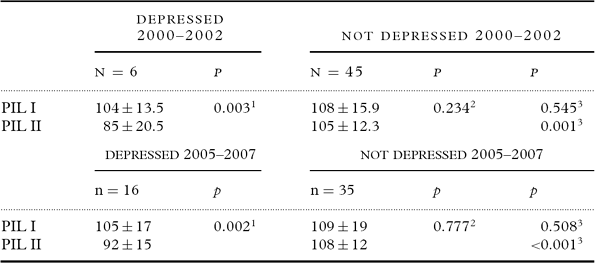
1p value among those depressed.
2p-value among those not depressed.
3p-value between depressed and not depressed.
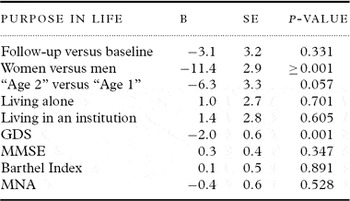
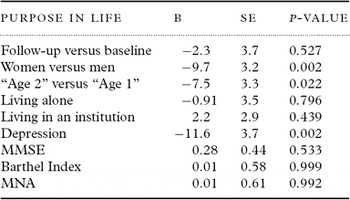
In the first multivariate analysis (MLR 1), a loss of PIL after five years was significantly associated with being a woman (p < 0.001) and baseline GDS score indicative of depression or depressed mood (p = 0.009). In MLR 2, a loss of PIL after five years was significantly associated with being a woman (p = 0.002) and the diagnosis of depression (p = 0.002) (Tables 3 and 4).
Multiple linear regression (MLR1) with purpose in life as the dependent variable

Generalized equations were used to estimate the parameters.
GDS = Geriatric Depression Scale; MMSE = Mini-Mental State Examination; MNA = Minimal Nutritional Assessment.
Multiple linear regression (MLR2) with purpose in life as the dependent variable

Generalized estimating equations were used to estimate the para- meters.
MMSE = Mini-Mental State Examination; MNA = Minimal Nutritional Assessment.
Discussion
Our main finding is that very old people showed decreased purpose in life over a five-year period and that depressed mood and being depressed at baseline increased the risk of deterioration in purpose in life five years later. Our hypothesis that purpose in life is stable over five years was not supported. Purpose in life decreased among women but not among men. When previously reported factors associated with purpose in life, such as depressed mood, malnutrition, inactivity in daily life, and cognitive impairment, were tested in the regression model, depressed mood, depression, and being a woman were significantly associated with lower PIL scores after five years.
Purpose in life decreased in proportionately twice as many women as men, with 27 women out of 42 (67%) showing decreased purpose in life compared with three men out of nine (33%). Butler defines ageism as “a process of systematic stereotyping and discrimination against people because they are old” (Butler, Reference Butler and Maddox1995, pp. 38–39), and argues that it is important to the ability of very old people to maintain purpose in life that society has a positive view of them. Ageism is apparent at the individual level, the institutional level, and the societal level (Palmore et al., Reference Palmore, Branch and Harris2005). Social aspects of ageism include age norms, patronizing behavior, ageist language, and age segregation (Butler, Reference Butler2009). Ageism is associated with serious impairments in purpose in life in very old people (Levy and Myers, Reference Levy and Myers2004). Werntoft and Edberg (Reference Werntoft and Edberg2009) found that physicians were more likely than politicians to think that younger patients should be prioritized. Women are also generally discriminated against, so very old women are doubly vulnerable to bias (Palmore et al., Reference Palmore, Branch and Harris2005).
In Western society, much stress is placed on looking young and healthy, especially for women. Aging and old age are seen as something that should be avoided, as we are constantly reminded by advertisements for different products that will help us look younger (Coupland, Reference Coupland2009), and women tend to be judged as old at a younger age than men (Calasanti and Slevin, Reference Calasanti and Slevin2001). It has been suggested that society's views about very old people play an important role in whether or not old people are able to maintain purpose in life, and that being seen as someone who no longer counts in society may decrease purpose in life (Tornstam, Reference Tornstam2007).
A large proportion of women in our study had decreased their ADL as measured by the Barthel Index. A decrease in ADL is associated with the risk of developing depression (Gadalla, Reference Gadalla2009), and it is well known that depression and disability have a reciprocal relationship; disability affects depression and depression affects disability (Lenze et al., Reference Lenze2001). Very old women are also more likely to be depressed than very old men, and very old women express their depression differently from men (Bergdahl et al., Reference Bergdahl, Gustavsson, Kallin, Heideken-Wågert, Lundman, Bucht and Gustafson2005; Reference Bergdahl, Allard, Aléx, Lundman and Gustafson2007).
The majority of participants with depression at baseline had died after five years. Thus, those with depression at baseline who had survived were probably a select subset of very old people. This assumption is supported by the finding that these participants did not have low scores on the baseline PIL test despite being depressed. However, all of them had lost their purpose in life over the five years, which indicates that living with depression results in loss of purpose in life.
The strengths of this study include its prospective design and unique sample of very old people followed over five years. There are few studies with a prospective design among very old people, and, as far as we know, no study measuring purpose in life over five years. Since the population in this age group is increasing, it is important to learn more about their purpose in life and what influences it in order to learn how to maintain purpose in life over the course of an entire lifespan.
The PIL test has been described in studies as an established link between purpose in life and depressed mood (Dyck, Reference Dyck1987). Dyck (Reference Dyck1987) described the PIL test as a measure for depression, since many items on the scale verbalize depressive feelings or attitudes. The link between depression and purpose in life could be one explanation of the strong association between PIL and GDS. Moreover, the PIL scale was developed among younger people (Crumbaugh, Reference Crumbaugh1968) and when it was translated into Swedish, it was validated for Swedish conditions among upper secondary school students (Åkerberg, Reference Åkerberg1987). However, despite the fact that the participants in our study were much older they did not seem to have difficulty answering the questions. A limitation of the study is that the study sample is small, especially among men, and thus the results should be interpreted with caution. The participants in this study are a selected group of cognitively healthy individuals who answered the test both at baseline and five years later and who may not be representative of the entire population aged 85 years and older.
Conclusion
Our results show that a strong purpose in life does not seem to protect very old people from developing depression, and that being depressed at baseline and living with depression over five years is associated with a loss of purpose in life.
Conflict of interest
None.
Descriptions of authors' roles
P. Hedberg, L. Aléx, C. Brulin, and Y. Gustafson collected the data. P. Hedberg, C. Brulin, and Y. Gustafson preformed the data analyses. P. Hedberg wrote the first draft of the paper and all the authors commented critically and contributed with important intellectual content to the writing of the paper. All authors approved the final version.