Many studies show that disasters and other traumatic events have short- and long-term consequences for mental health, particularly in childhood.Reference Stratta, Carmassi and Bertelloni1 Several studies have examined the onset of mental disorders in children and adolescents after an earthquake. For example, the study of UemotoReference Uemoto, Shioyama and Koide2 5 months after the 1995 earthquake in Japan reported that subjects, particularly younger children, presented mainly symptoms of anxiety and depression. This report also mentioned that being in a heavily damaged area was a risk factor for psychopathology. In a study performed 5 years after the 1988 earthquake in Armenia,Reference Goenjian, Walling and Steinberg3 the authors reported a high frequency of posttraumatic stress disorder (PTSD), depressive disorder, and separation anxiety disorder. This report underlined the recommendation of early clinical intervention following a natural disaster to prevent chronic disorders.
On September 19, 2017, an earthquake measuring 7.1 on the Richter scale affected Mexico City and other states in the south of Mexico, resulting in hundreds of deaths and thousands losing their family and friends. There were also losses in terms of housing, workplaces, and schools.Reference Federal de México4 Mental health services were sought for adults, children, and adolescents. The Child Psychiatric Hospital, a public mental health facility in Mexico City, evaluated and treated children and adolescents following World Health Organization guidelinesReference Sarmiento, Ulloa and Avila5 to provide assistance during this period.
METHODS
The present report is based on a chart review of 171 children and adolescents who visited the hospital in the first 5 months after the earthquake and compares the demographic and clinical characteristics of children and adolescents who required long-term treatment (LTT) with those who were discharged after a brief intervention, to determine which characteristics could predict the need for LTT after a disaster.
Sample
The sample included male and female children and adolescents from 3 to 17 years old who were Mexico City residents and attended the emergency department of the Child Psychiatric Hospital from September 2017 to January 2018. The following variables were registered for further analysis: demographics (age, sex), psychiatric diagnosis according to ICD 10 criteria,6 source of referral (other health facilities, outpatient services, government agencies at a highly affected area, or on their own initiative), number of weeks elapsed between the earthquake and attention seeking, the need for pharmacological treatment, and the need for LTT defined as a pharmacological and/or psychotherapeutic treatment for mental health problems lasting at least 9 months.
Statistics
The analyses were performed with SPSS software, version 19 (IBM Corp, Armonk, NY). Demographic and clinical characteristics were compared between patients who required LTT and those who did not use a chi-square, unadjusted odds ratio, and student t-test. A multivariate logistic regression analysis was used to examine the above mentioned variables as covariates and the need for LTT as a dependent variable. For all analyses, a significant value was established as P ≤ 0.05.
RESULTS
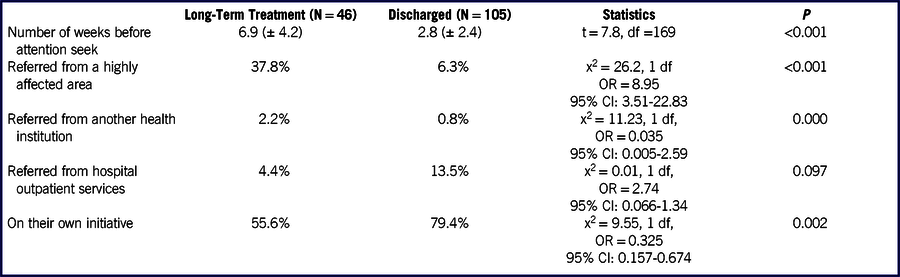
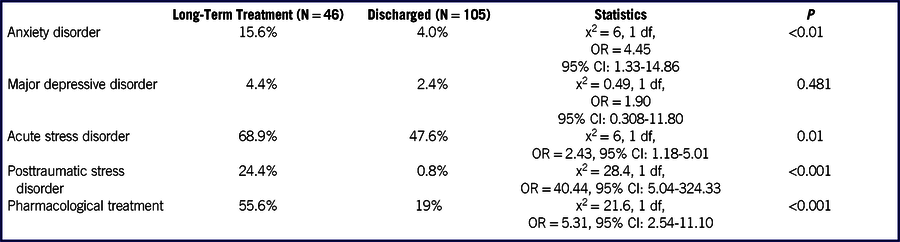
From the 171 patients, 20 (11.7%) were lost to follow-up, 105 (61.4%) were discharged after a crisis intervention or brief psychotherapy (D), and 46 (26.9%) were classified as in need of LTT. The LTT and D groups were compared, showing that patients in the former group were younger (mean age 8.6 ± 2.9 years old vs 10.3 ± 3 years old, t-test = 3.1, degree of freedom = 149, P < 0.001), had a longer delay to seek attention, and were more frequently referred from other health institutions or from a highly affected area (Table 1). The LTT group also showed significant differences regarding psychiatric diagnosis and the need for pharmacological treatment (Table 2). A multivariate logistic regression showed that a younger age (odds ratio = 0.802, 95% confidence interval = 0.683–0.941), a longer delay in attention seeking (odds ratio = 1.312, 95% confidence interval = 1.087–1.587), and to receive pharmacological treatment (odds ratio = 0.182, 95% confidence interval = 0.073–0.454) were predictors of the need of LTT.
Comparison of Patients Source and Delay to Treatment Between Long-Term Treatment and Discharged Groups

Notes: df = degree of freedom; OR = unadjusted odds ratio; CI = confidence interval.
Diagnostic and Treatment Differences Between Long-Term Treatment and Discharged Groups

Notes: df = degree of freedom; OR = unadjusted odds ratio; CI = confidence interval.
DISCUSSION
The present report aimed to determine which patient´s characteristics were associated with the need for LTT after the 2017 earthquake. Results showed that patients in the LTT group were younger, had a higher frequency of anxiety and stress-related disorders, and had a longer period before seeking attention.
The fact that young children were more likely to need LTT could be related to a greater vulnerability for developing a psychiatric disorder due to their cognitive development and their possible overexposure to information and news related to the earthquake, which has been associated with the onset of psychopathology.Reference Yeung, Lau and Yu7
Acute stress disorder (ASD) was the most frequent diagnosis (50.8%). The prevalence reported here is higher than the 13–37% reported by Bryant in 2017Reference Bryant8 who cited the temporal nature and the different causes of ASD among the difficulties to obtain an exact prevalence. In contrast, the prevalence of PTSD was lower than that reported for other pediatric samples exposed to earthquakes (10–40%).Reference Ayub, Poongan and Masood9 For the current study, this could be explained either by the short period elapsed after the earthquake, or by the fact that the diagnosis was based on a diagnostic interview with a psychiatrist rather than on a self-rated questionnaire.
The results of the logistic regression emphasize the need for disaster recovery programs that include links with the community and other health institutions to prevent the onset of psychopathology requiring LTT. Longitudinal studies that examined the search for care after a natural disaster showed that up to 16% of the subjects who were exposed to earthquakes sought medical attention within the first 2 months after the event.Reference Leyva-Flores, Kageyama and Erviti-Erice10 In Mexico, more than half of the population chose self-treatment, even when they perceived that they may have a serious illness; this is particularly frequent in people living in poverty who could be also at high risk for losing their households during the earthquake. Therefore, a larger effort is needed to promote the search for mental health care in vulnerable populations.
The present findings must be evaluated in light of limitations, such as the lack of information on variables regarding parents’ use of mental health services or further search for mental health care services by the discharged subjects.
CONCLUSION
A considerable number of children and adolescents in need of mental health care will need LTT, in particular, those with a longer delay in attention seeking. These findings support the need for effective early interventions in young, vulnerable populations in the aftermath of major natural disasters.
Conflict of Interest Statement
The authors have no conflicts of interest to declare.
Acknowledgments
The authors wish to thank Dr Lino Palacios Cruz for his advice on data analysis, and the psychologists Ricardo Díaz Sánchez and Helena Mora for their assistance in the manuscript preparation.