The underpinnings of adult health are laid out early in life. Both animal and human investigations conclusively document that warm nurturant contact in early life has beneficial effects on the functioning of biological stress regulatory systems across the life span and ultimately on health (e.g., Cicchetti & Rogosch, Reference Cicchetti and Rogosch2001; Cichetti, Rogosch, Gunnar, & Toth, Reference Cicchetti, Rogosch, Gunnar and Toth2010; Francis, Caldji, Champagne, Plotsky, & Meaney, Reference Francis, Caldji, Champagne, Plotsky and Meaney1999; Lui et al., 1997; Repetti, Taylor, & Saxbe, Reference Repetti, Taylor, Saxbe, Grusec and Hastings2007; Repetti, Taylor, & Seeman, Reference Repetti, Taylor and Seeman2002). However, the origins of poor health are laid down early in life as well. It is well established that childhood maltreatment, trauma, and abuse can adversely affect biological stress regulatory systems and health across the life span (e.g., Felitti et al., Reference Felitti, Anda, Nordenberg, Williamson, Apitz and Edwards1998; Gunnar & Donzella, Reference Gunnar and Donzella2002; Shonkoff, Boyce, & McEwen, Reference Shonkoff, Boyce and McEwen2009).
Recently, the understanding of how pervasive and subtle these effects can be has grown. Research indicates that often relatively mild forms of family dysfunction, including conflict, cold, nonnurturant behavior, or neglect, can also exert lifelong effects on health (Repetti et al., Reference Repetti, Taylor and Seeman2002). Similarly, socioeconomic status (SES) in childhood exerts effects on health across the life span into old age, independent of adult SES (e.g., Ramsay, Whincup, Morris, Lennon, & Wannamethee, Reference Ramsay, Whincup, Morris, Lennon and Wannamethee2007; van de Mheen, Stronks, Looman, & Mackenbach, Reference van de Mheen, Stronks, Looman and Mackenbach1998), effects that are believed to be least partially due to the greater stress burden that low SES confers.
The surprisingly strong relations between early experience and adult health prompt several questions: Why do events so early in life affect health so much later, long into adulthood? Why is damage due to early childhood events often not seen in diagnosable form until well into adulthood? What are the underlying mechanisms by which early experience is maintained in the form of active regulation of ongoing events, if at all? In addition, how is the damage from early life stored in ways that affect health so much later in life?
Impact of Early Environment on Biological Stress Regulatory Systems
Allostatic load
The concept of allostatic load (McEwen & Stellar, Reference McEwen and Stellar1993) provides a useful theoretical perspective for developing answers to these questions and understanding the underlying processes. Allostatic load is based on the idea of allostasis, the viewpoint that multiple physiological regulatory systems are constantly adjusting to the demands that the environment poses. Over time, the process of ongoing adaptation can lead to alterations in physiological systems; they may lose their ability to function efficiently and effectively in the face of persistent needs to adapt. The concept of allostatic load refers to physiological dysregulation in multiple biological systems, as the cumulative toll that the body pays for adaptational efforts. Thus, allostatic load represents a higher order construct of collected dysregulations across the major biological regulatory systems, including cardiovascular, metabolic, endocrine, and immune systems (Lupien et al., Reference Lupien, Ouelle-Morin, Hupback, Walker, Tu, Buss, Cicchetti and Cohen2006). Growing evidence points to the development of differences in biological risk profiles, often at very early ages and links these differences to more adverse childhood conditions. For example, work by Evans and English (Reference Evans and English2002) has also shown evidence among children as young as 10–13 for increased activation of major stress response systems in response to chronic stress in childhood.
Sympathetic nervous system and hypothalamic–pituitary–adrenal (HPA) axis
What are these systems? In response to stress, the body releases the catecholamines, epinephrine, and norepinephrine, with concomitant sympathetic nervous system arousal. Stress also engages the HPA axis, involving the release of corticosteroids, including cortisol. These sets of responses have short-term protective effects in response to threats, because they mobilize the body to meet the demands of pressing situations. However, with chronic or long-term activation, they can be associated with deleterious long-term effects on health (e.g., McEwen & Seeman, Reference McEwen, Seeman, Davidson, Scherer and Goldsmith2003). For example, excessive or repeated discharge of epinephrine or norepinephrine can lead to the suppression of cellular immune function, produce hemodynamic changes such as increases in blood pressure and heart rate, provoke abnormal heart rhythms, such as ventricular arrhythmias, and produce neurochemical imbalances that may be related to psychiatric disorders. Intense, rapid, and/or long-lasting sympathetic responses to repeated stressors have been implicated in the development of hypertension and coronary artery disease, consistent with the allostatic load model (McEwen, Reference McEwen1998).
Related to these changes, stress, including stress in early life, can lead to alterations in immune functioning that may leave a person vulnerable to opportunistic diseases and infections. Corticosteroids, such as cortisol, have immunosuppressive effects, and stress-related increases in cortisol have been tied to decreased lymphocyte responsivity to mitogenic stimulation and to decreased lymphocytotoxicity, among other changes suggestive of compromised immune functioning. These immunosuppressive changes may leave people vulnerable to immune-related disorders and to destruction of neurons in the hippocampus that fosters cognitive dysfunction (McEwen & Sapolsky, Reference McEwen and Sapolsky1995). Chronic stress can also diminish the immune system's sensitivity to glucocorticoid hormones that normally terminate the inflammatory cascade that occurs during stress, leaving people vulnerable to immune disorders marked by excessive inflammation (Miller, Cohen, & Ritchey, Reference Miller, Cohen and Ritchey2002).
These biological systems influence each other, consistent with a basic principle of the allostatic load model. To the extent, then, that early environment influences the functioning of one system, it may have corresponding adverse or beneficial effects on other systems as well, in turn, predicting health outcomes.
Early Adversity and Psychosocial Pathways to Adult Health Outcomes
The guiding allostatic model that emphasizes a cumulative toll of stress on multisystem physiological responses is paralleled by a psychosocial model that examines the relations among early adversity, psychosocial functioning, and adult health outcomes. In important respects, the psychosocial variables to be described may represent routes by which the adverse effects of a harsh early environment are instantiated in ongoing psychosocial form. That is, to the extent that socioemotional functioning is altered by experiences early in life, these socioemotional dispositions likely influence how children, adolescents, and adults cope with the ongoing stressful events they encounter across the life course. If socioemotional skills are compromised and coping is consequently poor, one may expect the toll of allostatic load to be greater.
Thus, a psychosocial model that parallels the allostatic load may be important first, because it helps address the question, what are the underlying mechanisms by which early life experience is maintained in the form of active regulation of ongoing events? A well-developed psychosocial model may pinpoint exactly how stressful events are regulated in ways that have adverse effects on health. Second, in so doing, psychosocial processes may be considered one of the multiple systems that are compromised by stress and result in concomitant patterns of physiological arousal that are implicated directly in accumulating allostatic load.
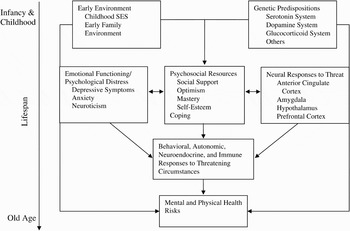
Our research program of the last several years has been dedicated to identifying the impact of the early environment on adult health and clarifying the underlying pathways, especially the psychosocial pathways, that explain these relations, with a focus on integrating psychological and biological outcomes. In our approach (Figure 1), genetic predispositions and aspects of the early environment are represented as joint predictors of the ability to develop psychosocial resources. These psychosocial factors, in turn, influence and are influenced by neural responses to threat in the brain that regulate autonomic, neuroendocrine, and immune responses to threatening circumstances. The cumulative impact of these inputs ultimately influences health risks. (In addition, there are direct paths from genes and the early environment to compromised physiological functioning that do not route through psychosocial resources.)
Genetic predispositions and aspects of the early environment are represented as joint predictors of the ability to develop psychosocial resources.

As such, Figure 1 characterizes (a) a developmental model of stress-related health outcomes across the life span, (b) the metatheoretical perspective that has guided our work, and (c) the methodological procedures that have guided some of our specific research investigations. In the following, we first explicate the psychosocial variables that are critical to our model. We then review evidence from our laboratory that tests the model in Figure 1. Finally, we address two less well-studied pathways in the model: the neural regulation of stress responses and how they may be influenced by early childhood experience; and genetic factors that may interact with early childhood experience to affect mental and physical health outcomes.
A psychosocial model that parallels an allostatic load model demands specification of exactly what psychosocial variables may be implicated. We focus on emotional and social functioning and concomitant psychosocial resources that may be fostered or compromised by nurturant or adverse early environments, respectively.
Emotional functioning
Problems in the regulation of emotional states are implicated in the pathways linking early adversity to adverse health outcomes. Emotion regulation is a broad term that includes skills for recognizing one's own and others' emotions, controlling one's emotional reactions to potentially stressful or challenging situations, and expressing one's emotions in socially appropriate ways (Eisenberg & Spinrad, Reference Eisenberg and Spinrad2004). A variety of investigations have tied a harsh family environment to children's reactions to emotionally charged circumstances, understanding of emotions, and abilities to regulate their emotions (for a review, see Repetti et al., Reference Repetti, Taylor and Seeman2002). Offspring from harsh family environments may overreact to threatening circumstances, responding aggressively to situations that are only modestly stressful (Reid & Crisafulli, Reference Reid and Crisafulli1990), but may also tune out or avoid stressful circumstances, as through behavioral escape/avoidance or substance abuse (Johnson & Pandina, Reference Johnson and Pandina1991; O'Brien, Margolin, John, & Krueger, Reference O'Brien, Margolin, John and Krueger1991; Valentiner, Holahan, & Moos, Reference Valentiner, Holahan and Moos1994). Deficits in emotion regulation skills related to early family environment may appear in early childhood and compromise the development and use of socioemotional skills in adulthood (Repetti et al., Reference Repetti, Taylor and Seeman2002).
A harsh family environment also predicts an incomplete understanding of emotional experience in others. Investigations with young children have found those who were maltreated or whose homes were marked by high levels of anger and distress are less accurate in their understanding of emotions, compared to their peers (Camras et al., Reference Camras, Ribordy, Hill, Martino, Spaccarelli and Stefani1988; Dunn & Brown, Reference Dunn and Brown1994). Relatedly, children with insecure attachments show less emotion understanding and less accurate appraisals of emotions in others (Laible & Thompson, Reference Laible and Thompson1998). In short, growing up in a harsh family environment appears to interfere with the development of skills for processing emotional information relevant to self and others.
Chronic negative affect
Deficits in emotional regulation may stabilize into enduring negative affect and risk for major emotional disorders, such as anxiety and depression. Numerous studies tie a history of child abuse to an enhanced risk for adult depression (e.g., Bradley et al., Reference Bradley, Binder, Epstein, Tang, Nair and Liu2008; Caspi et al., Reference Caspi, Sugden, Moffitt, Taylor, Craig and Harrington2003; Polanczyk et al., Reference Polanczyk, Caspi, Williams, Price, Danese and Sugden2009). These states may act as predisposing factors for adverse physical health outcomes (Hemingway et al., Reference Hemingway, Shipley, Mullen, Kumari, Brunner and Taylor2003). For example, hostility has been tied to the development of metabolic syndrome among children and adolescents (Dembroski, MacDougall, Williams, Haney, & Blumenthal, Reference Dembroski, MacDougall, Williams, Haney and Blumenthal1985) and to an increased risk for coronary heart disease (CHD) and hypertension (Julkunen, Salonen, Kaplan, Chesney, & Salonen, Reference Julkunen, Salonen, Kaplan, Chesney and Salonen1994). Major depression, depressive symptoms, and history of depression have all been identified as predictors of cardiac events (Frasure-Smith, Lesperance, & Talajic, Reference Frasure-Smith, Lesperance and Talajic1995), and depression is a risk factor for mortality following myocardial infarction, independent of cardiac disease severity (Frasure-Smith et al., Reference Frasure-Smith, Lesperance and Talajic1995). State depression, as well as clinical depression, have been related to sustained suppressed immunity (Herbert & Cohen, Reference Herbert and Cohen1993). Anger appears to play a significant role in the development of coronary artery disease and hypertension, at least among some individuals (e.g., Julkunen et al., Reference Julkunen, Salonen, Kaplan, Chesney and Salonen1994; Smith, Reference Smith1992). Depression and anxiety are implicated in numerous health risks, including all-cause mortality (Martin et al., Reference Martin, Friedman, Tucker, Schwartz, Criqui and Wingard1995), and evidence points to a dose–response relation between anxiety and CHD (Kubzansky, Kawachi, Weiss, & Sparrow, Reference Kubzansky, Kawachi, Weiss and Sparrow1998).
Links between negative emotional states and health outcomes may result from chronic or recurring engagement of biological stress regulatory systems. Negative emotional states have been tied to heightened biological stress responses, including evidence of stronger autonomic responses to stressful circumstances (e.g., Matthews, Woodall, Kenyon, & Jacob, Reference Matthews, Woodall, Kenyon and Jacob1996) and stronger HPA responses to stress (e.g., Chorpita & Barlow, Reference Chorpita and Barlow1998; Flinn & England, Reference Flinn and England1997). Studies also suggest links between negative emotions and reduced heart rate variability (e.g., Kawachi, Sparrow, Vokonas, & Weiss, Reference Kawachi, Sparrow, Vokonas and Weiss1995), implicating potential compromises in parasympathetic functioning in these relations. Chronic negative emotional states may, then, represent one pathway by which a harsh early environment exerts adverse effects on adult health outcomes (McEwen, Reference McEwen1998; Repetti et al., Reference Repetti, Taylor and Seeman2002), effects that may be mediated, at least in part, by intense, chronic, or recurring biological stress responses.
Social skills
A harsh family environment has been tied to poorer social skills for facilitating interactions with peers (Crockenberg & Lourie, Reference Crockenberg and Lourie1996; Pettit, Dodge, & Brown, Reference Pettit, Dodge and Brown1988). Children from harsh families who show emotion regulation deficits are more likely to behave in an aggressive or antisocial manner with their peers (Repetti et al., Reference Repetti, Taylor and Seeman2002), undermining their ability to develop friendships. Several studies attest to the peer rejection and even victimization experienced by children from harsh families (Dishion, Reference Dishion1990; Schwartz, Dodge, Pettit, & Bates, Reference Schwartz, Dodge, Pettit and Bates1997). Similarly, children whose parents are unresponsive, cold, and insensitive are less likely to initiate social interactions, and they demonstrate more aggression and criticism in their social relationships (see Repetti et al., Reference Repetti, Taylor, Saxbe, Grusec and Hastings2007). Children of parents who are cold, unsupportive, or neglectful show deficits in social relationships throughout their lives, with more problematic and less supportive social networks (Repetti et al., Reference Repetti, Taylor, Saxbe, Grusec and Hastings2007).
Inadequate social support networks may translate into some of the adverse health effects in adulthood tied to a harsh early environment. More than 100 investigations have shown that social support reduces health risks of all kinds, affects the initial likelihood of illness, influences the course of recovery among people who are already ill, and affects mortality risk more generally (House, Umberson, & Landis, Reference House, Umberson and Landis1988; Seeman, Reference Seeman1996; for a review, see Taylor, Reference Taylor and Friedman2010). To the extent that social support is undermined by poor social skills, health risks may increase.
Individual differences in psychosocial resources
Psychosocial resources are critical for regulating responses to threat and have been demonstrated to beneficially affect both mental and physical health. Four such resources that have been consistently tied to these benefits are optimism, mastery, self-esteem, and social support.
Optimism refers to outcome expectancies that good things rather than bad things will happen to the self (Scheier, Weintraub, & Carver, Reference Scheier, Weintraub and Carver1986). It predicts greater psychological well-being (e.g., Scheier & Carver, Reference Scheier and Carver1992), lower vulnerability to infection (Cohen, Doyle, Turner, Alper, & Skoner, Reference Cohen, Doyle, Turner, Alper and Skoner2003; Segerstrom, Taylor, Kemeny, & Fahey, Reference Segerstrom, Taylor, Kemeny and Fahey1998), faster recovery from illness (Scheier et al., Reference Scheier, Matthews, Owens, Magovern, Lefebvre and Abbott1989), and a slower course of advancing disease (Antoni & Goodkin, Reference Antoni and Goodkin1988) (for a review, see Carver & Scheier, Reference Carver, Scheier, Snyder and Lopez2002).
Personal control or mastery refers to whether a person feels able to control or influence his/her outcomes (Thompson, Reference Thompson1981). Studies have shown relationships between a sense of control and better psychological health (Rodin, Timko, & Harris, Reference Rodin, Timko and Harris1985; Taylor, Helgeson, Reed & Skokan, Reference Taylor, Helgeson, Reed and Skokan1991) and better physical health outcomes, including lower incidence of CHD (Karasek, Theorell, Schwartz, Pieper, & Alfredsson, Reference Karasek, Theorell, Schwartz, Pieper and Alfredsson1982), better self-rated health, better functional status, and lower mortality (Seeman & Lewis, Reference Seeman and Lewis1995).
A positive sense of self or high self-esteem is also protective against adverse mental and adverse health outcomes. For example, research consistently ties a positive sense of self to lower autonomic and cortisol responses to stress (e.g., Creswell et al., Reference Creswell, Welch, Taylor, Sherman, Gruenewald and Mann2005; Seeman & Lewis, Reference Seeman and Lewis1995). Ties to health outcomes are modest but consistently positive (Adler, Marmot, McEwen, & Stewart, Reference Adler, Marmot, McEwen and Stewart1999; Taylor & Seeman, Reference Taylor, Seeman, Adler, Marmot, McEwen and Stewart1999).
An early family environment marked by harsh or conflict-ridden parenting is reliably associated with deficits in offspring psychosocial resources (Repetti et al., Reference Repetti, Taylor and Seeman2002) and with difficulty in managing challenging circumstances (Brody & Flor, Reference Brody and Flor1998; Dishion, Reference Dishion1990; Repetti et al., Reference Repetti, Taylor and Seeman2002). Substantial research links economic adversity (low SES) to problems in the enlistment or use of psychosocial resources (Adler et al., Reference Adler, Marmot, McEwen and Stewart1999; Repetti et al., Reference Repetti, Taylor and Seeman2002; Taylor & Seeman, Reference Taylor, Seeman, Adler, Marmot, McEwen and Stewart1999). Deficits in psychosocial resources related to early family environment may appear in latent form in early childhood and contribute to a propensity for chronic negative affect and to a lack of psychosocial resources in adulthood (Repetti et al., Reference Repetti, Taylor and Seeman2002).
Empirical Tests of the Model
Having outlined the pivotal psychosocial variables that we believe are implicated in a psychosocial model that parallels the allostatic load model, we now turn to studies from our laboratory that have tested the model. All of these studies were guided by the model in Figure 1, although given sample and data collection limitations, most of these studies test only a portion of the model, as will be seen.
Early adversity and autonomic functioning
In an early study, we assessed the relationship of the family environment to autonomic and neuroendocrine responses to stress (Taylor, Lerner, Sage, Lehman, & Seeman, Reference Taylor, Lerner, Sage, Lehman and Seeman2004). Young adults completed measures assessing the early environment, including the family environment and childhood SES. They then participated in a laboratory stress test, specifically a modified version of the Trier Social Stress Task (TSST), a well-validated set of challenging procedures (Kirschbaum, Pirke, & Hellhammer, Reference Kirschbaum, Pirke and Hellhammer1993). The research uncovered a strong relationship between childhood SES and a harsh family environment. Specifically, low childhood SES was associated with a more harsh family environment.
Effects of the early environment on physiological functioning were evident as well. For men only, those from the harshest early family environments had elevated heart rate and blood pressure during the challenges and throughout the postchallenge recovery. These effects were largely mediated by negative emotional states, especially depression and anxiety. Because risk factors for CHD and cardiovascular disease frequently show up earlier in life for males than for females (Allen, Matthews, & Sherman, Reference Allen, Matthews and Sherman1997), the fact that the results were significant only for males is not surprising. A harsh early family environment did not, however, predict elevated baseline blood pressure, which would be suggestive of accumulating allostatic load. It may be that exaggerated sympathetic responses to stressful events is a step along the way, and that through such repeated exposures, ultimately the elasticity of the system is altered, resulting eventually (e.g., by middle age) in chronic elevated blood pressure, that is, hypertension. Accordingly, we next turned our attention to blood pressure and hypertension.
Hypertension. Hypertension is a serious and prevalent medical problem, with one in three adults in the United States estimated to have high blood pressure (Fields et al., Reference Fields, Burt, Cutler, Hughes, Roccella and Sorlie2004). Hypertension is also a primary risk factor for coronary artery disease, the major cause of death in the United States, yet nearly 90% of hypertension is essential, that is of unknown origin.
We undertook a collaborative investigation with the Coronary Artery Risk Development in Young Adults Study (CARDIA) to address the viability of our model for explaining the development of elevated blood pressure (Lehman, Taylor, Kiefe, & Seeman, Reference Lehman, Taylor, Kiefe and Seeman2009). CARDIA is an ongoing prospective epidemiologic investigation of risk factors for coronary artery disease involving more than 3000 participants at four different sites. The samples are evenly balanced between African American and White participants and between men and women. At the initial examination, participants were between the ages of 18 and 25. There have been six follow-up studies since that time, most recently at year 20 (2005–2006). Participants completed our measure of early family environment at this time. We used structural equation modeling to identify aspects of the early environment predicting both initial systolic blood pressure (SBP) and diastolic blood pressure (DBP) and blood pressure change over 10 years. We excluded all participants who were on medication treatment for hypertension, but many participants in the sample had clinically significant elevated blood pressure levels.
The model proved to be a good fit for several aspects of blood pressure regulation. Early family environment was related to chronic negative emotional states, including depression, anxiety, anger expression, and hostility, which in turn predicted baseline DBP and SBP as well as change in SBP. Low childhood SES, as indexed by parents' education, also predicted increases in blood pressure over time indirectly through associations with early family environment, negative emotions, and health behaviors. Although African American participants had higher SBP and DBP at baseline and steeper increases over time, the strength of the pathways was similar across race and gender. Accordingly, low childhood SES and a harsh early family environment do help to explain cardiovascular risk, in part through their association with chronic negative emotions.
Early environment and HPA activation
As noted, the HPA axis is one of the major stress systems of the body. The hypothalamus releases corticotropin releasing factor (CRF), which stimulates the pituitary gland to secrete ACTH, which in turn stimulates the adrenal cortex to release glucocorticoids. Cortisol, in particular, is especially significant, as it acts to conserve stores of carbohydrates, helps reduce inflammation in the case of injury, and helps restore the body to its normal state following activation in response to stress.
Repeated activation of the HPA axis in response to chronic or recurring stress, however, can ultimately compromise its functioning. When the HPA axis becomes dysregulated, signs of allostatic load may emerge in any of several forms. Daily cortisol rhythms may be altered; that is, normally cortisol rises quickly upon wakening in the morning, reaching a peak approximately 30–45 min postwakening, and then decreases over the day (with some transient elevation following lunch) until it flattens out at low levels in the late afternoon and evening. People under chronic or recurring stress, however, can show elevated cortisol levels long into the afternoon or evening (e.g., Powell et al., Reference Powell, William, Matthews, Meyer, Midgley and Baum2002). A general flattening of the diurnal cortisol rhythm (McEwen, Reference McEwen1998), an exaggerated cortisol response to a challenge, a protracted cortisol response following a stressful event (poor recovery), or alternatively, no cortisol response to stress at all, can also be potential signs of dysregulation of the HPA axis (McEwen, Reference McEwen1998; Pruessner, Hellhammer, Pruessner, & Lupien, Reference Pruessner, Hellhammer, Pruessner and Lupien2003).
Early trauma is known to be associated with alternations in the HPA axis functioning (Heim, Newport, Mletzko, Miller, & Nemeroff, Reference Heim, Newport, Mletzko, Miller and Nemeroff2008; Klaassens et al., Reference Klaassens, van Noorden, Giltay, van Pelt, van Veen and Zitman2009). For example, Heim et al. (Reference Heim, Newport, Heit, Graham, Wilcox and Bonsall2000) found elevated plasma adrenocorticotropin levels in response to a stress challenge in women who had been sexually abused in childhood (see also Gunnar & Donzella, Reference Gunnar and Donzella2002; Heim, Newport, Bonsall, Miller, & Nemeroff, Reference Heim, Newport, Bonsall, Miller and Nemeroff2003); Klaassens and colleagues (Reference Miller, Chen, Fok, Walker, Lim and Nicholls2009) reported a blunted HPA axis response to a biological challenge among childhood trauma victims (see also DeBellis et al., Reference DeBellis, Chrousos, Dorn, Burke, Helmers and Kling1994); van der Vegt, van der Ende, Kirschbaum, Verhulst, and Tiemeier (Reference van der Vegt, van der Ende, Kirschbaum, Verhulst and Tiemeier2009) found that neglect and abuse early on in life were associated with a flatter diurnal cortisol slope that persisted even after children had been adopted into new environments; Fries, Shirtcliff, and Pollack (Reference Fries, Shirtcliff and Pollak2008) reported HPA axis dysregulation in internationally adopted children who had experienced early institutional care; and Gonzalez, Jenkins, Steiner, and Fleming (Reference Gonzalez, Jenkins, Steiner and Fleming2009) found a higher awakening cortisol response among women experiencing childhood loss or maltreatment. Numerous other investigations also attest to dysregulation of the HPA axis as a result of maltreatment in childhood (e.g., Carpenter et al., Reference Carpenter, Carvalho, Tyrka, Wier, Mello and Mello2007; Gordis, Granger, Susman, & Trickett, Reference Gordis, Granger, Susman and Trickett2008; Tricket, Noll, Susman, Shenk, & Putnam, Reference Trickett, Noll, Susman, Shenk and Putnam2010). Thus, early trauma or abuse has been tied to most of the indicators of potentially compromised HPA axis functioning identified by the allostatic load researchers (see McEwen, Reference McEwen1998).
Evidence from our laboratory suggests that even mild family dysfunction can lead to dysregulation of the HPA axis as indicated by cortisol responses to stress. In the Taylor et al. (Reference Taylor, Lerner, Sage, Lehman and Seeman2004) paper described earlier, we examined whether young adults who had grown up in harsh early environments were more likely to show signs of HPA axis dysregulation than those who had not. As noted, these young adults had completed measures of the family environment and childhood stress and then participated in a modified TSST. The results revealed that low childhood SES and a harsh family environment were related to an elevated flat trajectory of cortisol levels across the stress tasks. Although this is not sufficient evidence in its own right to indicate dysregulation of the HPA axis, it is suggestive of dysregulation. Thus, even in families in which only modest dysfunction occurs, evidence of potential compromise of HPA axis functioning can be seen.
Early environment and metabolic functioning
An important assumption underlying the theory of allostatic load is the idea of multisystem dysregulation. One indicator of multisystem functioning that is prognostic for health outcomes is metabolic functioning. Metabolic functioning is typically defined by fasting glucose levels, cholesterol, triglycerides, blood pressure, and abdominal obesity. Elevations in metabolic functioning can lead to metabolic syndrome, defined as exceeding recommended standards on three or more of these indicators (National Cholesterol Education Panel, 2001). Metabolic syndrome is prognostic for heart disease (Lindblad, Langer, Wingard, Thomas, & Barrett-Connor, Reference Lindblad, Langer, Wingard, Thomas and Barrett-Connor2001), diabetes, inflammatory disorders (Brunner et al., Reference Brunner, Hemingway, Walker, Page, Clarke and Juneja2002; Groop & Orho-Melander, Reference Groop and Orho-Melander2001), and all-cause mortality (Lakka et al., Reference Lakka, Laaksonen, Lakka, Niskanen, Kumpusalo and Tuomilehto2002; Trevisan, Liu, Bahsas, & Menotti, Reference Trevisan, Liu, Bahsas and Menotti1998). The prevalence of metabolic syndrome in the United States is approximately 22% (Ford, Giles, & Dietz, Reference Ford, Giles and Dietz2002), making it an important contributor to chronic disease.
Drawing on the CARDIA sample in the Year 15 assessment (ages 33–45), we (Lehman, Taylor, Kiefe, & Seeman, Reference Lehman, Taylor, Kiefe and Seeman2005) examined whether childhood SES, early family environment, psychosocial functioning (depression, hostility, and positive and negative social contacts), and adult SES were predictive of metabolic functioning. (The prevalence of metabolic syndrome in the sample was 9.7%, although the low figure may be due to the youth of the sample and the fact that participants on blood pressure medication were excluded.)
Structural equation modeling indicated that childhood SES and a harsh early family environment were significantly associated with metabolic functioning via their association with psychosocial risk factors, specifically high levels of negative affect and poor social relationships. There was also a significant direct path from childhood SES to metabolic functioning. The results, then, suggest that low childhood SES and a harsh early family environment contribute to adverse changes in adult metabolic functioning through pathways that implicate depression, hostility, and poor social relationships.
Early environment and inflammatory processes
Evidence that early adversity can have an effect on immune functioning is plentiful as well. For example, Shirtcliff, Coe, and Pollak (Reference Shirtcliff, Coe and Pollak2009) found that children exposed to early deprivation through institutionalization or physical abuse had elevated antibody levels to herpes simplex virus type 1, effects that persisted long after they had been adopted into more beneficial environments. Dube and colleagues (Reference Dube, Fairweather, Pearson, Felitti, Anda and Croft2009) found that childhood traumatic stress increased the likelihood of being hospitalized for diagnosed autoimmune disease in adulthood. Relatedly, low SES in childhood has been tied to heightened vulnerability to respiratory and cardiovascular diseases in adulthood, and it is generally thought that the stressors associated with low SES are largely responsible for these relations; a mechanism that may underlie these relations involves genes that regulate inflammation (Miller & Chen, Reference Miller and Chen2007).
To identify the potential role of psychosocial variables in findings such as these, we used our model to examine C-reactive protein in the CARDIA data set. C-reactive protein is a biomarker of inflammatory processes that has been reliably related to depression (Hemingway et al., Reference Hemingway, Shipley, Mullen, Kumari, Brunner and Taylor2003; Jousilahti, Salomaa, Rasi, Vahtera, & Palosuo, Reference Jousilahti, Salomaa, Rasi, Vahtera and Palosuo2003; Miller, Rohleder, Stetler, & Kirschbaum, Reference Miller, Rohleder, Stetler and Kirschbaum2005; Suarez, Reference Suarez2004) and to enhanced risk for cardiovascular disease (King, Mainous, & Taylor, Reference King, Mainous and Taylor2004), among other disorders. C-reactive protein is an important intermediate outcome between dysregulation and disease, first, because it is prognostic for but can be identified before adverse mental and physical health conditions related to inflammation can be diagnosed; and second, because it may help to explain the striking comorbidities that are often observed between psychiatric illness, such as depression, and certain chronic disorders, such as hypertension and coronary heart disease (Barth, Schumacher, & Herrmann-Lingen, Reference Barth, Schumacher and Herrmann-Lingen2004; van Melle et al., Reference van Melle, de Jonge, Spijkerman, Tijssen, Ormel and van Veldhuisen2004).
The Year 15 CARDIA participants completed measures of childhood SES, early family environment, and adult psychosocial functioning, and participated in a physical examination that assessed body mass index and C-reactive protein (Taylor, Lehman, Kiefe, & Seeman, Reference Pettit, Dodge and Brown2006). Structural equation modeling indicated that childhood SES and a harsh early family environment were associated with elevated C-reactive protein via their association with poor psychosocial functioning (depression, low mastery, and poor social contacts) and high body mass index. These results, then, attest both to the impact of an early family environment on inflammatory functioning and to a particular mediator, C-reactive protein, that may be linked to multiple chronic disorders.
Other investigations have also reported alterations in inflammatory processes associated with adverse events in childhood. Pace and colleagues (Reference Pelleymounter, Cullen and Wellman2006) found increases in IL-6 and NF-κB in response to laboratory stress among male depressed patients, responses that were especially pronounced if they had also experienced early life stress. Danese and colleagues (Reference Danese, Moffitt, Pariante, Ambler, Poulton and Caspi2008) found that a history of childhood maltreatment contributed to the co-occurrence of depression and elevated indicators of inflammation. In a second investigation, Danese, Pariante, Caspi, Taylor, and Poulton (Reference Danese, Pariante, Caspi, Taylor and Poulton2007) found that childhood maltreatment showed a significant graded increase for clinically significant C-reactive protein levels 20 years later; a similar association was found for fibrinogen and white blood cell count. As will shortly be seen, G. E. Miller and colleagues (Reference Miller, Chen, Fok, Walker, Lim and Nicholls2009) report evidence at the genetic level for low early life SES on decreased glucocorticoid signaling and increased pro-inflammatory signaling. Thus, evidence relating early adverse experience to inflammatory processes in adolescence and adulthood is plentiful, and our research suggests that psychosocial functioning is implicated in these relations.
Neural and Genetic Factors Linking Early Adversity to Psychosocial and Biological Responses to Stress
As the research just examined shows, early adversity can lead to the accumulation of allostatic load, and psychosocial factors appear to be implicated in these processes. To this point, we have not discussed the genetic or neural factors implicated in these pathways. We now turn to these less-studied, but potentially critical variables in the model.
Early environment and neural regulation of stress responses
An obvious candidate for understanding how the mind and body communicate with each other is the brain, which both controls and reflects psychological and biological functioning. The difficulties that offspring from harsh early environments have with developing effective socioemotional and self-regulatory skills may be evident in neural activity that affects downstream physiological and neuroendocrine stress responses. Brain regions implicated in threat detection and responses to emotional stimuli may mediate the relation between a harsh early family environment and elevated biological responses to stress.
A brain region consistently associated with threat detection and affective processing is the amygdala. The amygdala responds to a variety of emotion-related stimuli, including pictures depicting physical threats (Hariri, Tessitore, Mattay, Fera, & Weinberger, Reference Hariri, Tessitore, Mattay, Fera and Weinberger2002) and faces depicting fear and anger (Hariri, Bookheimer, & Mazziotta, Reference Hariri, Bookheimer and Mazziotta2000). Once activated, the amygdala sets in motion a cascade of responses to threat via projections to the hypothalamus and prefrontal cortex (LeDoux, Reference LeDoux1996). A neural region that appears to be critical for regulating responses to emotional stimuli is the ventrolateral prefrontal cortex (Hariri et al., Reference Hariri, Tessitore, Mattay, Fera and Weinberger2002). Studies have shown that the labeling of negative affective states activates the right ventrolateral prefrontal cortex (RVLPFC) and that increased activity in RVLPFC is associated with decreased activity in the amygdala (Hariri et al., Reference Hariri, Bookheimer and Mazziotta2000, Reference Hariri, Tessitore, Mattay, Fera and Weinberger2002; Lieberman, Hariri, Jarcho, Eisenberger, & Bookheimer, Reference Lieberman, Hariri, Jarcho, Eisenberger and Bookheimer2005). This pattern of increased RVLPFC activity and decreased amygdala activity may be implicated in effective emotion regulation in response to threat.
To test these ideas, we (Taylor, Eisenberger, Saxbe, Lehman, & Lieberman, 2006) recruited young adult participants who had previously completed assessments of family background. We conducted a functional magnetic resonance imaging investigation that examined amygdala and RVLPFC reactivity under three conditions. The first condition involved viewing slides of fearful and angry faces, a task that typically evokes a threat reaction accompanied by activation in the amygdala. The second task involved labeling the emotions pictured in the slides, a task that typically evokes RVLPFC activity, potentially representing efforts to cope with threat. Activity in the amygdala and RVLPFC are typically negatively correlated in this condition, suggesting that RVLPFC is damping down amygdala responses to threat. The third task, a control task, required participants to indicate the gender of the person pictured, and patterns of brain activation in the first two conditions are compared with activations in this control condition.
We found that offspring from nurturant families showed expected amygdala activity in response to observing the fearful and angry faces and expected activation of RVLPFC while labeling the emotions portrayed in the pictures. The relation between RVLPFC and amygdala reactivity was significantly negative, consistent with the idea that RVLPFC activity inhibits amygdala responses to the threatening faces. Offspring from harsh families, however, showed a strikingly different pattern. During the observation of fearful and angry faces, they showed little activation of the amygdala. During the labeling task, they showed expected activation of RVLPFC; however, they also showed strong amygdala activation and a strong positive correlation between RVLPFC and amygdala activation, the opposite of what was seen in offspring from nurturant families. Thus, offspring from risky families exhibit atypical responses to emotional stimuli that are evident at the neural level (Taylor, Eisenberger, et al., 2006).
Of particular interest is the fact that this pattern of neural responses to threat cues maps onto behavioral research showing maladaptive coping among offspring from harsh families. That is, as noted, offspring from risky families may avoid threat-relevant stimuli with which they need not engage (analogous to the observation of threatening faces), but overreact to and demonstrate an inability to regulate emotional responses to emotional stimuli with which they must engage (as in the labeling task). These maladaptive responses to stress are thus evident at both the behavioral and the neural levels.
Genetic moderators of the effects of early life experience
Recent studies of genetic variation in the serotonin and dopamine systems as well as in genes more directly involved in regulating HPA axis activity suggest that there are individual differences in the way that children respond to the early environment that affect their health later in life. A particular advantage of a genetic approach is that it not only identifies individual differences in responsivity to the early environment, but also points toward involvement of a particular neurochemical system in regulating this responsivity.
Because of the important role of the HPA axis in responding to stressors, genes associated with regulating activity in the HPA axis have been examined for a role in moderating reactivity to the early environment. An accumulating body of evidence points toward the receptor for corticotrophin releasing hormone (CRHR1) as being involved in this process. This receptor is located in emotion-related brain areas as well as the anterior pituitary, where it initiates the release of ACTH into the bloodstream (Steckler & Holsboer, Reference Steckler and Holsboer1999). Three studies have demonstrated a role for variation in intron 1 of the CRHR1 gene in moderating the effects of childhood abuse on depression-related phenotypes in adulthood (Bradley et al., Reference Bradley, Binder, Epstein, Tang, Nair and Liu2008; Polanczyk et al., Reference Polanczyk, Caspi, Williams, Price, Danese and Sugden2009). Furthermore, these same variants also moderate the effects of early adversity on the cortisol response to the dexamethasone/CRH challenge test. The findings reveal that the activation of cortisol release by stimulation with CRH has been sensitized by early maltreatment experiences in individuals with the reactive (rs110402 G/G or rs242924 G/G) genotype (Tyrka et al., Reference Tyrka, Price, Gelernter, Schepker, Anderson and Carpenter2009). As frequent and protracted exposure to high levels of cortisol increases the probability of depressive disorders (Van Praag, Reference Van Praag2004), this may be a mechanism linking an adverse early environment to an adverse mental health outcome.
There is robust evidence that genetic variation in the serotonin neurotransmitter system also moderates the effects of the early environment on later adverse mental health outcomes. Most investigations have examined a polymorphism (5-HTTLPR) in the promoter of the serotonin transporter gene that gives rise to two principal alleles: long and short. Our group and others have found that people with the short allele, particularly the short/short genotype, are more sensitive to the effects of early life experiences. In a seminal study, Caspi et al. (Reference Caspi, Sugden, Moffitt, Taylor, Craig and Harrington2003) found that childhood maltreatment interacted with the 5-HTTLPR to influence the prevalence of major depressive disorder. Individuals with the short allele had a higher risk for depression if they had also been the victims of childhood matreatment. Our data are consistent with this result, as we found that even in the case of a mildly adverse early family environment, people with the short/short genotype had higher levels of depressive symptomatology than those with s/l or l/l genotypes (Taylor, Way, et al., 2006).
The increased sensitivity of individuals with the short allele to the adverse effects of the early environment does not appear to be specific for depression, as it also increases risk for other mental health outcomes. People with the short allele who experience maltreatment in early life have been shown to have an increased risk for suicide (Roy, Hu, Janal, & Goldman, Reference Roy, Hu, Janal and Goldman2007), attention-deficit/hyperactivity disorder (ADHD; Retz et al., Reference Retz, Freitag, Retz-Junginger, Wenzler, Schneider and Kissling2008), and anxiety sensitivity (Stein, Schork, & Gelernter, Reference Stein, Schork and Gelernter2007). Although not all studies have found these effects (Chipman et al., Reference Chipman, Jorm, Prior, Sanson, Smart and Tan2007; Surtees et al., Reference Surtees, Wainwright, Willis-Owen, Luben, Day and Flint2006), the inconsistencies may occur because the 5-HTTLPR interacts with variation in other locations of the serotonin transporter gene or with other genes in the serotonin system. For example, Cicchetti and colleagues (Cicchetti, Rogosch, & Sturge-Apple, Reference Cicchetti, Rogosch and Sturge-Apple2007) found that child maltreatment and both the serotonin transporter and monoamine oxidase (MAO-A) polymorphisms interacted to increase the likelihood of depressive symptomatology among at-risk individuals from low socioeconomic stress backgrounds.
The broad range of psychological outcomes associated with the 5-HTTLPR may be due to the early environment differentially affecting levels of serotonin in the brain. In a particularly compelling demonstration of this phenomenon, Manuck, Flory, Ferrell, and Muldoon (Reference Manuck, Flory, Ferrell and Muldoon2004) showed that short/short individuals of low SES had reduced central serotonergic function. As serotonin is critical for emotion regulation, such alterations may affect the expression of a broad spectrum of disorders for which impairments in affect regulation are a central component. Note, however, that the Manuck et al. (Reference Manuck, Flory, Ferrell and Muldoon2004) study assessed current, not early SES, and so the relevance of these findings to early life stress is conjectural.
A common pathway also influencing the broad range of mental health outcomes associated with the 5-HTTLPR is the HPA axis. The serotonin system is an upstream modulator of the HPA axis, as it can activate the CRH neurons that initiate the HPA signaling cascade (Heisler et al., Reference Heisler, Pronchuk, Nonogaki, Zhou, Raber and Tung2007). Accordingly, the HPA axis appears to be differentially activated according to 5-HTTLPR genotype. We found that short/short individuals had greater cortisol reactivity to a modified version of the TSST (Way & Taylor, Reference Way and Taylor2010a). Whether early life experiences potentiate this greater cortisol reactivity in short/short individuals is a question for future research. However, in a sample of adolescent girls, short/short individuals had higher cortisol reactivity to a social stress test, suggesting that similar processes are operating in adolescence (Gotlib, Joormann, Minor, & Hallmayer, Reference Gotlib, Joormann, Minor and Hallmayer2008). In another study, short/short individuals who had experienced a high number of traumatic life events (either in childhood or adulthood) exhibited greater cortisol reactivity to the TSST than did those who had not experienced many such events (Alexander et al., Reference Alexander, Kuepper, Schmitz, Osinsky, Kozyra and Hennig2009). Although this measure was not exclusively an assessment of childhood experience, it does suggest that the 5-HTTLPR may interact with the childhood environment to effect cortisol reactivity. Again, these findings point toward excessive cortisol exposure as a potential mechanism by which short/short individuals exposed to early life experiences may be at higher risk for physical and mental health related outcomes.
In addition to serotonin, another signaling molecule that appears to be involved in transmitting early experiences into adult health outcomes is brain-derived neurotrophic factor (BDNF). BDNF appears to not only influence health-related measures independent of the serotonin system, but also in interaction with it. For example, a recent meta-analysis confirmed that serotonin transporter inhibitors (e.g., Prozac) increase plasma levels of BDNF, which are significantly reduced in depressed patients relative to controls (Sen, Duman, & Sanacora, Reference Sen, Duman and Sanacora2008). Consistent with the relationship between the serotonin system and BDNF, several studies have found that the 5-HTTLPR and a polymorphism in the BDNF gene that affects the availability of BDNF for activity-dependent release (Val66Met) interact in moderating the influence of early life stress on depressive symptomatology (Kaufman et al., Reference Kaufman, Yang, Douglas-Palumberi, Grasso, Lipschitz and Houshyar2006; Wichers et al., Reference Wichers, Kenis, Jacobs, Mengelers, Derom and Vlietinck2008). Independent of the 5-HTTLPR, the Val66Met has also been found to moderate the effects of early life adversity on adult risk for depression (Aguilera et al., Reference Aguilera, Arias, Wichers, Barrantes-Vidal, Moya and Villa2009; Gatt et al., Reference Gatt, Nemeroff, Dobson-Stone, Paul, Bryant and Schofield2009). These effects do not appear to be limited to depression, as the presence of the Met allele also increases the risk for inattentive symptoms of ADHD in people of low SES, relative to those with the Val/Val genotype from the same socioeconomic strata (Lasky-Su et al., Reference Lasky-Su, Faraone, Lange, Tsuang, Doyle and Smoller2007).
This increase in risk of stress-related mental disorders for carriers of the Met allele may be a result of altered neuronal function. In a small study of children who were raised in an orphanage, the Met allele was associated with reduced cortical volume and increased amygdala volume (Casey et al., Reference Casey, Glatt, Tottenham, Soliman, Bath and Amso2009). Preliminary data from these same people indicates that the cortisol response to separation distress is potentiated in the Met allele carriers who were raised in an orphanage (Casey et al., Reference Casey, Glatt, Tottenham, Soliman, Bath and Amso2009), suggesting that their greater cortisol responsivity to stress may place them at risk for later negative health outcomes.
With respect to physical health-related markers, BDNF has an important role in maintaining energy balance and glucose homeostasis, and so it may affect risk for metabolic syndrome as well. In animal models, mice with disruption of the BDNF gene not only display alterations in serotonergic functioning, but also adult onset obesity that is associated with hyperphagia, hyperinsulinemia, and hyperglycemia (Lyons et al., Reference Lyons, Mamounas, Ricaurte, Coppola, Reid and Bora1999; Xu et al., Reference Xu, Goulding, Zang, Cepoi, Cone and Jones2003). Conversely, administration of BDNF decreases food intake and increases energy expenditure (Pelleymounter, Cullen & Wellman, Reference Pelleymounter, Cullen and Wellman1995). In humans, several studies have found reduced levels of BDNF in Type II diabetics, relative to controls. In addition, there is a negative relationship between BDNF levels and obesity as well as with plasma glucose and triglyceride levels (Fujinami et al., Reference Fujinami, Ohta, Obayashi, Fukui, Hasegawa and Nakamura2008; Krabbe et al., Reference Krabbe, Nielsen, Krogh-Madsen, Plomgaard, Rasmussen and Erikstrup2007). Although the effects of the early environment on serum BDNF levels either directly or in interaction with Val66Met have not been studied in the context of metabolic syndrome, this is likely to be a fruitful area of investigation.
Genetic variation in the dopamine system can also affect sensitivity to the early environment. Most studied has been variation (Exon 3 variable number tandem repeat) in the dopamine D4 receptor gene (DRD4). In a study of preschool children, an interaction between maternal parenting style and this DRD4 polymorphism was found. Children with the long allele (7 repeat) who received insensitive parenting had the highest levels of externalizing and aggressive behavior in the sample (Bakermans-Kranenburg & van IJzendoorn, Reference Bakermans-Kranenburg and van IJzendoorn2006). A similar interaction was found in a different sample of preschool children when sensation seeking was the outcome (Sheese, Voelker, Rothbart, & Posner, Reference Sheese, Voelker, Rothbart and Posner2007). Although the persistence of these effects into adulthood has not been demonstrated, a study of adolescents aged 10 to 14 suggests that it may (Nobile et al., Reference Nobile, Giorda, Marino, Carlet, Pastore and Vanzin2007). As in the preschoolers, adolescents raised in a low SES environment who had the long allele had the highest levels of aggressive behavior in the sample, but there was no relationship between the environment and aggressive behavior in those coming from higher SES backgrounds or in individuals with the short allele (4 repeat).
Genetic moderation of sensitivity to the positive aspects of the environment
Up to this point, we have focused on genes that may predispose to sensitivity to the adverse effects of the environment, but the polymorphisms described here also appear to affect sensitivity to the positive aspects of the environment. Thus, for example, rather than the 5-HTTLPR short allele predisposing to depression, it may confer greater sensitivity to the environment in general. People with one or more short alleles who grow up in an adverse early environment may be more vulnerable to adverse outcomes, but when growing up in nurturant environments, they may be less vulnerable to adverse outcomes.
This perspective arose from our study of the effects of the early family environment on depressive symptomatology. We examined whether a supportive early environment might reverse the risks associated with the short allele of the 5-HTTLPR (Taylor, Way, et al., 2006). A Gene × Environment interaction was observed between the 5-HTTLPR and early family environment, such that people homozygous for the short allele (s/s) had greater depressive symptomatology if they had experienced early adversity (as described previously), but significantly less depressive symptomatology if they had experienced a supportive early environment, compared to people with short/long or the long/long genotypes. This study, then, indicates that the beneficence of the early environment can actually reverse the potential adverse effects of a genetic risk. More important for the present arguments, the study provides evidence that the early environment strongly moderates the impact of a genetic predisposition on its expression.
This pattern of effects was also seen in the studies assessing the interaction between the early environment and the 5-HTTLPR with respect to suicide risk (Roy et al., Reference Roy, Hu, Janal and Goldman2007), ADHD (Retz et al., Reference Retz, Freitag, Retz-Junginger, Wenzler, Schneider and Kissling2008), anxiety sensitivity (Stein et al., Reference Stein, Schork and Gelernter2007), and depression (Cichetti et al., 2007). In these studies, individuals with at least one short allele who experienced positive early environments, or at least the absence of an abusive one, fared better than long/long individuals. Relatedly, Eley and colleagues (Reference Eley, Sugden, Corsico, Gregory, Sham and McGuffin2004) reported a gene–environment interaction of serotonin system markers on adolescent depression. In this study, the interaction effect was limited to females, but it showed that a positive early environment had a greater magnitude of effect in the protective direction than the negative environment had in enhancing risk, a finding mirrored in the Taylor, Way, et al. (2006) results as well (see also Brody, Beach, Philibert, Chen, & Murry, Reference Brody, Beach, Philibert, Chen and Murry2009).
For the dopamine system as well, alleles conferring greater sensitivity to negative environmental influences also appear to confer greater sensitivity to positive experiences. Thus, for example, Bakermans-Kranenberg and van IJzendoorn (2007) found that children with the DRD4 long allele who received sensitive parenting actually had the lowest levels of aggressive behavior in the sample. Again, these findings indicate that genetic variation may reflect a general sensitivity to the environment rather than being solely a “risk” allele for adverse health outcomes.
Epigenetic impact of early life experience
Another important candidate for understanding mind–body communication involves the epigenetic impact of early life experience. Epigenetic modification to genes represents an intriguing candidate mechanism for explaining the lasting impact of early life experience. Put simply, epigenetic modifications are enduring changes to the DNA (typically either methylation of the DNA itself or modification of the proteins that package the DNA) that do not affect the sequence but do affect gene expression (Jirtle & Skinner, Reference Jirtle and Skinner2007). These changes induced by the environment can be so enduring that they are passed on to the next generation. Research has identified several genes whose expression appears to be influenced by the social environment, including the childhood environment.
Given the evidence that early family environment can affect HPA axis responses to stress across the life span, a logical candidate for epigenetic programming by the early environment involves genes in the glucocorticoid system. There is evidence for decreased hippocampal glucocorticoid receptor expression in several types of psychopathology, and so researchers have focused especially on glucocorticoid receptor expression. A particularly elegant animal model has focused on the effects of maternal care (Meaney & Szyf, 2005). Rat pups receiving low levels of maternal care, particularly low licking and grooming, exhibit higher cortisol responses to stressors in adulthood (Liu et al., Reference Liu, Diorio, Tannenbaum, Caldji, Francis and Freedman1997). These lasting effects on cortisol reactivity are due to epigenetic modifications of the promoter of the glucocorticoid receptor gene within the hippocampus that permanently change expression of this gene. As the glucocorticoid receptor in the hippocampus is responsible for feedback inhibition of the HPA axis, animals receiving low levels of maternal care have less capability to shut off the cortisol response to stress due to these epigenetic changes (Weaver et al., Reference Weaver, Cervoni, Champagne, D'Alessio, Sharma and Seckl2004). Thus, these findings suggest a mechanism by which the early environment can have lasting effects upon stress reactivity.
Recent evidence has extended these findings to humans. Postmortem examination of the hippocampus of suicide victims revealed that those who had been abused as children had very similar epigenetic alterations to the glucocorticoid receptor gene (McGowan et al., Reference McGowan, Sasaki, D'Alessio, Dymov, Labonté and Szyf2009) as rats who had received low levels of maternal care. Such changes to the glucocorticoid receptor gene were not present in controls or suicide victims who had not been abused. Related alterations have been detected in the glucocorticoid receptor of nonneuronal tissues as well. Mononuclear cells taken from cord blood of human newborns showed increased methylation of the glucocorticoid receptor gene promoter when the mothers were depressed during the third trimester (Oberlander et al., Reference Oberlander, Weinberg, Papsdorf, Grunau, Misri and Devlin2008). Furthermore, the degree of methylation in these cells was positively correlated with cortisol responses to a visual stressor at three months of age, suggesting that these epigenetic effects also affect stress reactivity in humans. Based on parallels between animal research and human findings, it appears that a common effect of early experience involves the epigenetic regulation of hippocampal glucocorticoid receptor expression.
These alterations to the glucocorticoid receptor and the associated changes in stress reactivity due to an adverse early environment could potentially have widespread effects across multiple physiological systems. To pursue this idea, G. E. Miller et al. (Reference Miller, Kinnally, Ogden, Oquendo, Mann and Parsey2009) examined the expression of over 18,000 genes in peripheral blood mononuclear cells of adults matched on current SES, health behaviors, and perceived stress, but who had experienced either low or high SES in childhood. On a genome-wide level, the experience of low SES in childhood was associated with a gene expression profile indicative of reduced responsivity to glucocorticoid mediated signaling, such that genes involved in the proinflammatory response were upregulated, as were genes associated with stress-related activation of the autonomic nervous system. The findings thus suggest that low SES in early childhood leaves a biological footprint characterized by decreased glucocorticoid signaling and presages the expression of a proinflammatory phenotype in adolescence.
An intriguing finding that helps to tie these epigenetic results together with previously discussed genetics studies is that the maternal licking and grooming a rat pup receives increases hippocampal serotonin levels (Meaney & Szyf, Reference Meaney and Szyf2005), which initiates the cascade of cellular events that lead to differential epigenetic changes of the glucocorticoid receptor. It is not surprising that rats deprived of maternal care show decreased serotonin levels and serotonin transporter gene expression in adulthood (Lee et al., Reference Lee, Kim, Kim, Ryu, Kim and Kang2007). As in the rat, humans who have experienced childhood abuse show decreased levels of adult serotonin, as measured by the serotonin metabolite 5-HIAA in the cerebrospinal fluid (Roy et al., Reference Roy, Hu, Janal and Goldman2007) and also have decreased levels of the serotonin transporter (J. Miller et al., Reference Miller, Kinnally, Ogden, Oquendo, Mann and Parsey2009). These findings suggest that one means by which the 5-HTTLPR could be affecting sensitivity to adverse early experiences is by influencing the serotonergic response to parental care, which affects the degree of methylation of the glucocorticoid receptor, which in turn influences cortisol reactivity to stress.
The early environment has similar effects upon BDNF levels. Thus, an enriched social environment increases adult levels of BDNF (Branchi et al., Reference Branchi, D'Andrea, Sietzema, Fiore, Di Fausto and Aloe2006), whereas adverse maternal care leads to decreased neuronal BDNF levels in adulthood (Lippmann, Bress, Nemeroff, Plotsky, & Monteggia, Reference Lippmann, Bress, Nemeroff, Plotsky and Monteggia2007) via methylation of the BDNF promoter (Roth, Lubin, Funk, & Sweatt, Reference Roth, Lubin, Funk and Sweatt2009). In humans, the BDNF Val66Met allele, associated with increased risk for depression in the face of early environmental adversity, is associated with lower levels of serotonin transporter binding (Henningsson et al., Reference Henningsson, Borg, Lundberg, Bah, Lindström and Ryding2009), indicating that these effects of BDNF may be operating in concert with the serotonin changes just described.
The understanding of epigenetic programming by the early environment is an unfolding story that is still in its early stages. Nonetheless, several important insights can be drawn. First, evidence such as this strongly challenges the assumption of genetic determinism that underlies much of the public's thinking as well as scientific thinking about the impact of genes on behavior. Instead, there is growing evidence of predictable phenotypic diversity related to the nature of the early environment, particularly the degree to which it is harsh or nurturant. Second, these effects may be distinctively social in nature (Way & Taylor, Reference Way and Taylor2010b). The social nature of the early environment, especially maternal nurturance, is most clearly tied to these epigenetic consequences, which in turn appears to confer particular sensitivity to the social nature of the current environment.
Conclusions and Future Directions
The evidence from our own and others' laboratories indicates that a harsh early childhood has adverse effects on mental and physical health. As noted, it is not immediately obvious why adverse events in childhood would affect health so much later into adulthood and old age. In keeping with calls for a multilevel perspective in developmental psychopathology more generally (Cicchetti & Toth, Reference Cicchetti and Toth2009), our laboratory has focused on an integrative approach to the childhood experience—adult health relationship that involves several routes. The first involves psychosocial skills: a nurturant early environment enables offspring to develop emotion regulation and social competence skills, which facilitate effective coping with interpersonal stress across the life span. In the second, we have focused on biological stress responses: over time, recurring or exaggerated responses to stress may lead to cumulative changes in biological stress regulatory systems, contributing to the accumulation of allostatic load and corresponding adverse health outcomes. The third pathway is neural mechanisms: the early environment influences how the brain responds to stress. In the fourth, we have focused on genetic predispositions and epigenetic effects of the early environment: we conclude that the early environment influences the expression of certain genes related to stress responses. These pathways, of course, are not independent of each other, and as Figure 1 shows, they converge in a guiding theoretical model for exploring the relation of early life stress to adult health outcomes.
As noted throughout this article, the origins of maltreatment can often arise from adverse economic and social conditions, especially low childhood SES. At the risk of stating the obvious, it is important to note that harsh parenting in the face of adversity may be functional in certain respects. Harsh parenting shapes socioemotional skills in ways that may lead to acute sensitivity to threat in the environment. Increased sensitivity to threat in environments with a high risk of adversity is adaptive, and may enhance the likelihood of survival on the short term (cf. Zhang et al., Reference Zhang, Bagot, Parent, Nesbitt, Bredy and Caldji2006). Nonetheless, there are clear long-term psychological and biological trade-offs.
Most of the focus of this paper has been on the health-compromising effects of early childhood environments marked by adversity. One of our major points has been that early environments need not be traumatic or abusive for adverse effects on stress regulatory systems and health to occur. Even quite modest levels of family dysfunction in the form of harsh or neglectful parenting can have similar effects. Although this point is important and represents a critical take-away message of our work, it can sometimes obscure the fact that a beneficent early environment can reverse potential early risks, moderate the phenotypic expression of potentially risky genotypes, and protect against adverse mental and physical health consequences. Even risks incurred during prenatal life can be reversed by postnatal stimulation (e.g., Lemaire, Lamarque, LeMoal, Piazza, & Abrous, Reference Lemaire, Lamarque, LeMoal, Piazza and Abrous2006).
Implications for interventions
An overarching implication of the preceding analysis concerns the importance of including biological measures in assessing the effects of interventions on mental and physical health outcomes (see Cicchetti & Gunnar, 2008). Some of these measures involve genetic factors. For example, as noted, Bakermans-Kranenburg and van IJzendoorn (Reference Bakermans-Kranenburg and van IJzendoorn2007) found that children with the DRD4 long allele were more response to a parenting intervention that involved increasing sensitivity than were children with other allelic combinations. HPA axis activity, as assessed for example by awakening cortisol levels, the diurnal cortisol trajectory, and cortisol responses to stress, may also help elucidate the efficacy of interventions. Cardiovascular assessments, especially to stress and especially in boys, may reflect effects of interventions with families, parents, and children. Recent research (Miller & Chen, Reference Miller and Chen2010) suggests that childhood stress due to low SES confers a risky inflammatory profile, and so immune measures that assess chronic inflammatory activity and/or inflammatory responses to stress may be valuable additions to assessments of the efficacy of interventions. Examining neural signatures in response to threat has proven useful for evaluating efficacy of treatments for such psychopathological disorders as phobia and obsessive compulsive disorder, and neural signatures to threat may, likewise, provide insights into the effects of intervention, especially if patterns suggestive of maladaptive brain regulation of threat (e.g., Taylor, Way, et al., 2006) can be changed with interventions.
Additional questions that arise concern whether childhood maltreatment–adult health relations are immutable. Are there ways to avoid or reverse them? Clearly, one would want to avoid the adverse consequences of risky families as much as possible, and interventions with families is one way. Parenting skills training is an important topic that unfortunately receives little attention in our educational system. This is one avenue to pursue. Failing effective training on the front end, early detection in even mildly troubled families to offset these dynamics is desirable. Research suggests that interventions to improve parenting in families that have problems are reasonably effective (McLoyd, Reference McLoyd1998). One caveat, however, is that during times of economic strain, parenting deteriorates again (McLoyd, Reference McLoyd1998).
Consequently, reducing stress and improving coping skills in people from risky families represent alternative types of interventions. Stress management interventions involve several types of training in several stages (Antoni et al., Reference Antoni, Lehman, Kilbourne, Boyers, Culver and Alferi2001) including: identifying and monitoring stressors, identifying stress antecedents and consequences, avoiding negative self-talk, acquiring skills such as time management and reframing the meaning of a stressor, setting new goals for the reduction of stress, and positive self-talk (Taylor, Reference Taylor2009). In short, there are ways to teach people who manage stress poorly to manage it more effectively.
Coping interventions represent another possibility. Coping interventions target precisely those skills that are compromised in risky families, namely, emotion regulation skills and social skills. Coping interventions include mindfulness training that enables people to relax and focus on the present (Bishop, Reference Bishop2002); disclosure and writing interventions that have been found to improve health over the long term (Lepore & Smyth, Reference Lepore and Smyth2002); coping effectiveness training, which includes techniques of positive reappraisal of stressors, relaxation skills, cognitive–behavioral management skills (Antoni et al., Reference Antoni, Lehman, Kilbourne, Boyers, Culver and Alferi2001), and a focus on a healthy lifestyle; and interventions to help people build social support networks.
People who are the most sensitive to the adverse early environment should also be the most likely to be helped by such interventions (Way & Taylor, Reference Way and Taylor2010b). In support of this assertion, a training program in parenting that fostered the development of emotional support and monitoring skills significantly reduced the risk of adolescents with the 5-HTTLPR short allele engaging in risky health behaviors (e.g., substance abuse, unsafe sex). The program had little effect on the risk behavior of long/long individuals (Brody et al., Reference Brody, Beach, Philibert, Chen and Murry2009). Similarly for the DRD4 polymorphism, toddlers with the more sensitive allele were the most responsive to a parental educational program designed to reduce externalizing behavior through increasing the attentiveness of parenting (Bakermans-Kranenburg, van IJzendoorn, Pijlman, Mesman, & Juffer, Reference Bakermans-Kranenburg, van IJzendoorn, Pijlman, Mesman and Juffer2008).
Future directions
In identifying future directions, we return to an idea introduced at the outset, namely, the idea that the psychosocial effects of an early adverse environment may represent one of the multisystem dysregulations that occurs as allostatic load builds up. From this vantage point, psychosocial effects are not so different from alterations in sympathetic, immune, or HPA axis changes, among others. Three particular features may make psychological consequences of early adverse environment especially significant, however. First, we know what the toxic effects are: they are deficits in emotion regulation skills and social skills. Second, these deficits represent some of the very earliest signs of allostatic load, evident in childhood. Third, these psychological effects are likely to be drivers of the accumulation of allostatic load in biological systems, both because they occur so early and because they influence how people cope with stress and consequently affect how strong biological responses to stress will be. As such, these psychosocial deficits are likely to have persistent, long-term influences that may be pivotal for understanding accumulating allostatic load and represent a critical focus for interventions.