Introduction
Following the identification and synthesis of the sex pheromones of numerous insect species, several natural enemies have been found to use these chemical cues as kairomones to locate their prey. To decode the role of these semiochemical, particularly in prey specialization, is most relevant to the predator-prey ecology (Vet & Dicke, Reference Vet and Dicke1992). From a practical point of view, the use of prey pheromones may help to attract and monitor predators with implications on insect pest control and insect conservation (e.g. Grégoire et al., Reference Grégoire, Coullien, Drumont, Meyer and Francke1992). Nevertheless, whereas the response to host pheromones often has been observed in insect parasitoids (Steidle & van Loon, Reference Steidle and van Loon2003), it has been less frequently reported in insect predators (Aldrich, Reference Aldrich, Hardie and Minks1999). These latter studies include the responses of flies (Dolichopodidae: Medetera spp) and beetles (Cleridae, Histeridae, Rhizophagidae, Staphylinidae, Trogossitidae, Tenebrionidae and Colydiidae) to the aggregation pheromones of bark beetles (Scolytidae) (e.g. Tømmeras, Reference Tømmeras1985; Grégoire et al., Reference Grégoire, Coullien, Drumont, Meyer and Francke1992; Aldrich, Reference Aldrich, Hardie and Minks1999; Boone et al., Reference Boone, Six and Raffa2008) of some aphidophagous ladybeetles and chrysopids to aphid alarm pheromone (Aldrich, Reference Aldrich, Hardie and Minks1999; Francis et al., Reference Francis, Lognay and Haubruge2004; Zhu et al., Reference Zhu, Obrycki, Ochieng, Baker, Pickett and Smiley2005) and of elaterid larval predators to sex pheromone of saproxylic scarab (Svensson et al., Reference Svensson, Larsson and Hedin2004).
The first evidence of an insect predator using a scale insect sex pheromone to locate its prey has been reported for the anthocorid Elatophilus hebraicus (Hemiptera: Anthocoridae), a specialist predator of the Israeli pine bast scale, Matsucoccus josephi (Mendel et al., Reference Mendel, Zegelman, Hassner, Assael, Harel, Tam and Dunkelblum1995; Aldrich, Reference Aldrich, Hardie and Minks1999). Later on, other Elatophilus species, the brown lacewings Hemerobius stigma and Sympherobius fuescens (Neuroptera: Hemerobiidae) and the ladybeetle Iberorhyzobius rondensis (Coleoptera: Coccinellidae), were also shown to respond to the sex pheromone of pine bast scales (Mendel et al., Reference Mendel, Assael and Dunkelblum2004; Branco et al., Reference Branco, Franco, Dunlkelblum, Assael, Protasov, Ofer and Mendel2006a).
Recently, we observed adults of two species of Aplocnemus (Coleoptera: Dasytidae), namely Aplocnemus brevis Rosenhauer and Aplocnemus raymondi Sainte-Claire Deville, in Portugal and Corsica, respectively, on pine trees in the vicinity of lures activated with the sex pheromone of Matsucoccus feytaudi Ducasse, suggesting that these species are attracted to the pheromone and, therefore, probably prey on pine bast scales. About 390 species of Dasytidae (previously subfamily Melyridae: Dasytinae) are known in Europe (Liberti, Reference Liberti and Audisio2004) and a similar number is reported in North America (Mawdsley, Reference Mawdsley2003). Despite its high diversity, studies on the biology and ecology of this family are scarce. Commonly known as flower beetles, adults are small insects 3–6 mm long, though some reach 13 mm, with a body covered with hairs, and are often seen foraging on nectar and pollen of flowers (Herrera, Reference Herrera1988). Their biology and morphology seem to have coevolved with flowering plants, the hairy body having a relevant role in plant pollination (Bernhardt, Reference Bernhardt2000; Mawdsley, Reference Mawdsley2003). The genus Aplocnemus, with over 140 species distributed from the Canary Islands and North Africa to the Caucasian region includes 73 European species, most of them occurring in southern Europe (Liberti, Reference Liberti and Audisio2004). The adult beetles are frequently found living on blossoming trees (Liberti, Reference Liberti1995).
The aim of this study was to test the hypothesis that both A. brevis and A. raymondi respond to the sex pheromone of M. feytaudi and to clarify their status as predators of pine bast scales, namely by testing different diets and collecting information on their habitat and seasonal activity. M. feytaudi is an endemic species of south-western Europe and is an invasive species in south France, Corsica and Italy, where it causes severe damage to pine forests (Covassi & Binazzi, Reference Covassi and Binazzi1992; Jactel et al., Reference Jactel, Ménassieu and Burban1996). The knowledge of chemical cues mediating the behaviour of its predators may be most relevant to develop ecological sound strategies to control this pest species.
Material and methods
Aplocnemus spp. response to the sex pheromone of M. feytaudi
Field trials were conducted in Portugal and the island of Corsica (France) to study the response of both A. brevis and A. raymondi to the sex pheromone of M. feytaudi. Trials were mainly carried out in spring, between March and June, from 2004 to 2010. In each sampling site, rubber dispensers impregnated with a hexane solution of 200 μg of the sex pheromone of M. feytaudi, (8E, 10E)-3,7,9-trimethyl-dodecadien-6-one (Einhorn et al., Reference Einhorn, Menassieu, Malosse and Ducrotc1990), in the form of racemic mixture 65/35 EE/ZE, were installed in the centre of pine tree arenas, which consisted of about 1 dm2 smoothed surface of the outer bark, situated approximately 1.50 m above the ground level. In each site, 6–50 trees were chosen, about 6–10 m apart. For some sampling dates, additional trees were randomly assigned as control trees, with a rubber septum impregnated only with the hexane solution. In total, 54 control trees were surveyed in Portugal and 32 in Corsica. Since the density of A. raymondi in Corsica was very low, in 2008 and 2010 more dispensers were used per stand than in 2006 and 2007. Pine tree arenas were visually surveyed every 10–15 min during one hour. All beetles present on the tree arenas were collected by hand and put into labeled vials, one for each specimen, and taken to the laboratory. The total number of beetles attracted to the lures within one hour after pheromone dispenser installation was recorded and used as response variable.
The beetle specimens collected were identified by R. Constantin. Twenty-three beetles collected in Corsica and 12 collected in Portugal were further examined to discriminate their gender.
Pine habitat
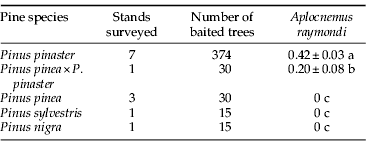
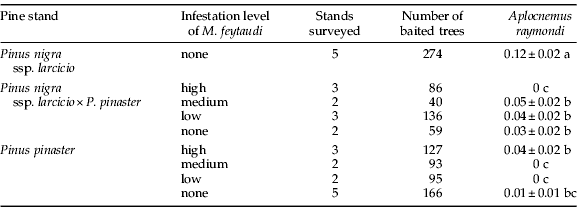
Using the same sampling procedure as described in 2.1, we sampled Aplocnemus spp. in stands with different pine species to see if the beetles showed a preference for certain tree species and consequently might prey on different pine bast scales. M. feytaudi only feeds on Pinus pinaster Ait. (Maritime pine), is native in the Iberian Peninsula and is invasive and expanding in Corsica (Jactel et al., Reference Jactel, Menassieu, Ceria, Burban, Regad, Normand and Carcreff1998). M. pini feeds on several pine species of the sylvestris section and is native in Corsica feeding on P. nigra subsp. laricio var. corsicana Ait. (Corsican pine) without any noticeable damage. Samplings were carried out in Portugal in 13 pine stands from four pine species: P. pinaster, P. pinea L., P. sylvestris L. and P. nigra Arnold (table 1). In Corsica, observations were done between 2006 and 2010 in twelve pure stands of P. pinaster, in ten mixed stands of P. pinaster and P. nigra subsp. laricio var. corsicana Ait. (Corsican pine) and five pure stands of Corsican pine (table 2). Further, P. pinaster stands in Corsica were chosen according to four infestation levels by M. feytaudi (high: tree mortality observed; medium: presence of M. feytaudi on many trees but no tree mortality; low: M. feytaudi has colonized the area recently; none: no M. feytaudi present in the area), whereas the Corsican pine stands were infested only by M. pini.
Mean number (±SE) of adult Aplocnemus brevis attracted by the sex pheromome of Matsucoccus feytaudi on pine trees in Portugal, from March to May, in 2004–2010. No Aplocnemus brevis were observed on control trees (n=54). Means followed by the same letters are not significantly different (LSD, α=0.05).

Mean number (±SE) of adult Aplocnemus raymondi attracted by the sex pheromome of Matsucoccus feytaudi on pine trees in Corsica, from April to June in 2006–2010. No Aplocnemus beetles were observed on control trees (n=32). Means followed by the same letters are not significantly different (LSD, α =0.05).

Seasonal activity of adult Aplocnemus
The seasonal activity of A. brevis was studied in two P. pinaster stands located in the Setubal Peninsula, in Portugal, in 2004, 2006 and 2007, based on monthly samples conducted from February to August, using the same sampling procedure as described before. All predator species attracted to tree arenas baited with M. feytaudi sex pheromone were recorded in order to compare phenology between species. In Corsica, the seasonal activity of A. raymondi was analyzed by sampling five stands, four mixed stands of maritime and Corsican pine and one pure stand of Corsican pine, from March to September 2007, at monthly intervals, except in May. Observations were carried out on ten trees per stand.
Time of predator arrival to pheromone lure in field trials
To compare the time of response of different predators to the M. feytaudi pheromone, as an indication of foraging time, the number of individuals, which arrived in the vicinity (10 cm distant) of the rubber septum within periods of 12 min after lure activation, was recorded during one hour. In this experiment, all individuals were collected with a suction device or brushed into a vial to avoid resampling. The proportion of individuals arriving within each time interval was then calculated for each sampled tree. Observations were carried out at three dates: 9 March 2004, 26 March 2004 and 1 April 2005, on 32, 32 and 12 trees, respectively, in one P. pinaster stand in Portugal.
Aplocnemus spp. food acceptance and performance in laboratory
Laboratory rearing trials were conducted in 2007 and 2008 in Portugal and in 2008 in France. Adults of A. brevis captured in the Setubal Peninsula, Portugal, using the M. feytaudi sex pheromone as attractant, were transported to the laboratory and reared on two different diets: (i) M. feytaudi egg masses (n=15); (ii) pollen of maritime pine (n=14). Egg masses of M. feytaudi were collected in France and kept in the refrigerator at 4°C until their use. All A. brevis individuals were maintained individually on each diet until death, under laboratory conditions (24.0±0.5°C, 60% r.h., 12L:12D photoperiod), in separate acrylic boxes (5 cm diameter, 5 cm high, bottom covered with paper), covered with a tissue to allow ventilation. Food supply was replaced every second day. The survival of beetles under each diet regime was determined in days.
Feeding behaviour and survival of A. raymondi was also studied in 2008 in France. In April 2008, five individuals of A. raymondi were captured in Corsica using the M. feytaudi sex pheromone as lure and transported to the laboratory in Bordeaux. They were placed individually in acrylic boxes and fed ad libitum with pollen, water honey solution and egg masses of M. feytaudi. Feeding behaviour was observed regularly for two weeks. Consecutively, three adults were fed only with M. feytaudi egg masses to allow hourly observations of food consumption. These adults were starved for 48 h prior to these observations. In May 2008, ten additional beetles were collected in Corsica. They were kept in the laboratory in two boxes and fed with a mixed diet of pollen, honey solution and egg masses of M. feytaudi in order to determine if they were able to reproduce on this diet.
In 2010 in Portugal, adult A. brevis preference for egg masses of M. feytaudi or pollen was assessed with two-choice tests. The two diets were exposed in diametrically opposed positions within Petri dish arenas (10 cm in diameter and 1.5 cm deep) with a sheet of paper at the bottom. The beetle was positioned in the centre of the Petri dish, and its feeding activity was monitored for the duration of one hour. Twenty trials were performed with a different specimen each time. To avoid possible visual or other extraneous effects, the position of each food item was changed between bioassays.
Data analysis
A generalized linear model (GLM) using a Poisson distribution, log-linear transformed, was used to test the hypothesis that the sex pheromone of M. feytaudi elicits attraction in Aplocnemus species. Only data from March until May (A. brevis) and from April until June (A. raymondi), corresponding to the peak of activity of the Aplocnemus sp. adults were used for this analysis. Pairwise comparisons of estimated marginal means by least significant differences (LSD) adjustment based on the original scale of dependent variable were used to compare differences between the number of Aplocnemus sp. collected in different pine habitats and M. feytaudi infestation zones in Corsica. A stand random term effect, nested within pine habitat, was included in the generalized model. One-way ANOVA was used to test for differences between predator species on the proportion of individuals arriving at each time interval in the response time trial, followed by a post-hoc Tukey HSD test. Data normality and equality of the variances was tested based on Shapiro-Wilk and Levene tests, respectively. Kaplan-Meyer survival estimates and log rank (Mantel Cox) test were used to compare beetles survival under different diets. One-sample binomial test was used for the two-choice test on food preference and to compare gender proportions of the beetles collected in Corsica (the null hypothesis is the categories occur with equal probabilities 0.5). Statistical analyses were performed using SPSS 18.0.
Results
Aplocnemus response to M. feytaudi sex pheromone
Considering the stands where Aplocnemus sp. was present, the mean number (±SE) of beetles per baited tree was 0.41±0.03 for A. brevis and 0.09±0.01 for A. raymondi. Both A. brevis adults in Portugal and A. raymondi adults in Corsica exhibited a significant response to the sex pheromone of M. feytaudi (GLM Wald Chi-Square=164.0, P<0.001 and 49.0, P<0.001, respectively). No specimens of Aplocnemus sp. were ever observed on control trees. No other species of Aplocnemus sp. or other Dasytidae were attracted to the lures. More than 200 A. brevis specimens were attracted to the M. feytaudi sex pheromone lures in Portugal and a total of 49 A. raymondi specimens were attracted in Corsica. For the 23 individuals of A. raymondi collected in Corsica and observed under binoculars, the estimated sex ratio between females and males was 7:1, differing significantly from equal probabilities (P<0.001). The 12 individuals of A. brevis collected in Portugal and observed for gender discrimination were all females.
Pine habitat
In Portugal, A. brevis beetles were mostly captured in pure stands of P. pinaster, where the beetles, in general, were found in high numbers (table 1). Further, the number of beetles attracted varied between stands which covered a range of about 400 km in latitude. A few specimens of A. brevis were also collected in one mixed P. pinea×P. pinaster stand. A. brevis was not found in P. sylvestris, P. nigra or three pure P. pinea stands surveyed in Portugal (table 1).
In Corsica, A. raymondi was captured in significantly higher numbers in pure Corsican pine stands Pinus nigra ssp. larcicio compared with other pine habitats (table 2). A. raymondi was further observed in significant numbers, in mixed stands as well as in P. pinaster stands highly infested with M. feytaudi. The beetle was practically nonexistent in P. pinaster stands medium, low or not infested by M. feytaudi (table 2). The occurrence of two beetles in one pure P. pinaster stand not infested by M. feytaudi (table 2) may be justified by the presence of a few Corsican pines within that specific surveyed stand. There was no significant difference in capture between stands within each pine habitat (Wald Chi-Square=3.9, P=0.413).
Time of predator response to pheromone sources
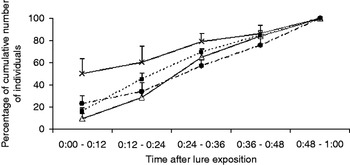
All predators were observed congregating on the sex pheromone-baited tree arenas soon after pheromone dispensers were placed on the tree trunk. In addition to the adults of A. brevis, two other predator species of M. feytaudi, as well as adult males of M. feytaudi, were recorded in the tree arenas in Portugal, namely larvae of the ladybeetle I. rondensis (Branco et al., Reference Branco, Franco, Dunlkelblum, Assael, Protasov, Ofer and Mendel2006a; Raimundo et al., Reference Raimundo, Canepari, Mendel, Branco and Franco2006) and adults and nymphs of the minute pirate bug E. crassicornis. About 23% of the total number of attracted A. brevis beetles arrived within the first 12 min after lure exposure, following a more or less linear trend through time (fig. 1). Similar patterns were also found for E. crassicornis adults and I. rondensis larvae. In contrast, the proportion of E. crassicornis nymphs occurring in the first 12 min (51%) was significantly higher than that observed for E. crassicornis adults (P=0.016) and I. rondensis larvae (P=0.033), but not significantly different from A. brevis adults (P=0.105) according to HSD post-hoc tests. No significant differences were registered between species for the proportion of individuals captured 24 min after lure exposure.
Mean cumulative percentage (+SE) of the number of predators attracted to the pheromone lure in function of time, for the duration of one hour after lure activation, in Setúbal Peninsula, Portugal (n=76 trees) (- -•- -, Aplocnemus brevis adults; –▪–, Iberorhyzobius rondensis larvae; ––∆––, Elatophilus crassicornis adults; –×–, Elatophilus crassicornis nymphs).

Seasonal activity
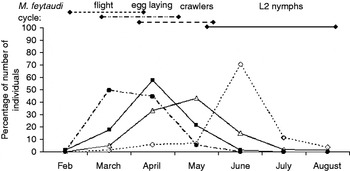
A. brevis was found to be attracted to the sex pheromone of M. feytaudi between February and May, with a peak in March/April in Portugal. No beetles were attracted to the lures between June and August (fig. 2). The larvae of I. rondensis displayed a similar seasonal activity, although slightly later; whereas E. crassicornis and H. stigma, two other predator species responding to the sex pheromone of M. feytaudi (Mendel et al., Reference Mendel, Assael and Dunkelblum2004; Branco et al., Reference Branco, Lettere, Franco, Binazzi and Jactel2006b), were found to extend their activity until summer.
Seasonal activity of several predators of Matsucoccus feytaudi based on captures in pine tree arenas baited with the sex pheromone of M. feytaudi in 2004, 2007 and 2009, Setubal Peninsula, Portugal. Data is expressed as the relative proportion of individuals per date for each species. Matsucocus feytaudi cycle in the studied site is based on previous personal observations (- -•- -, Aplocnemus brevis; ––▪––, Iberorhyzobius rondensis; ––∆––, Elatophilus crassicornis; - -◊- -, Hemerobius stigma).

In Corsica in the five stands surveyed from March to September 2007, except in May, four beetles were observed near the lures in April, in two stands, and only one beetle was observed in June, in another stand. No beetles were captured in March or between July and September.
Food acceptance of Aplocnemus spp
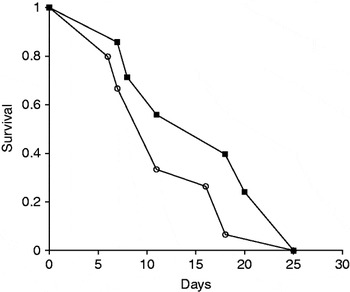
The adults of A. brevis fed on M. feytaudi egg masses, as well as on the pollen. Yet, the mean (±SE) number of days of survival for beetles fed on M. feytaudi egg masses (12.1 days±1.5, n=15) was significantly lower than for those fed on pollen (15.9 days±2.0, n=14) (P=0.045) (fig. 3). In two-choice tests between pollen and M. feytaudi egg masses, from 20 trials, eight A. brevis fed on M. feytaudi and two fed on pollen, the others did not feed. The results are not significantly different from random choice (P=0.109).
Kaplan-Meyer estimates of cumulative proportion survival of Aplocnemus brevis adults fed in laboratory conditions on two different diets, Matsucoccus feytaudi egg masses and pollen ad libitum (––▪––, pollen; –○–, Matsucoccus feytaudi).

The five individuals of A. raymondi collected in April 2008 in Corsica were not observed feeding on M. feytaudi egg masses during the two weeks kept in the laboratory. Yet, one out of three beetles observed every hour during daytime in two consecutive days was observed feeding on eggs of M. feytaudi. Two active larvae of A. raymondi were found on 1st August 2008 in a rearing box, meaning that at least one female Aplocnemus was able to reproduce and lay eggs with a mixed diet of pollen, honey solution and egg masses of M. feytaudi.
Discussion
Aplocnemus response to prey sex pheromone
Adult dasytids are frequently found in insect communities visiting flowers and exhibiting pollinating activity (Herrera, Reference Herrera1988; Petanidou & Ellis, Reference Petanidou and Ellis1993; Bosch et al., Reference Bosch, Retana and Cerdá1997; Bernhardt, Reference Bernhardt2000). The larvae are assumed to be generalist predators, although only a few occasional reports have been published on their preying activity. In fact, larvae of Dasytidae have been observed actively preying on immature stages of other insects, particularly under tree bark (Crowson, Reference Crowson1964). For example, larvae of Aplocnemus jejunus were found to prey on egg masses of Lymantria dispar (Prota, Reference Prota1966), larvae of Aplocnemus sp. were observed preying on larvae, and pupae of the olive tree bark beetle Phloeotribus scarabaeoides (Russo, Reference Russo1938) and non-identified stages of Dasytes flavipes were observed preying on Marchalina hellenica (Bodenheimer, Reference Bodenheimer1953).
Our findings show that the adults of two species of Aplocnemus respond to sex pheromone emitted by herbivore insects, which indicates that they most probably use it as a kairomone to locate their prey. Furthermore, attraction to specific semiochemicals suggests a specialized food regime, as predicted by the hypothesis of dietary specialization and infochemical use in natural enemies (Vet & Dicke, Reference Vet and Dicke1992; Steidle & van Loon, Reference Steidle and van Loon2003). In a study conducted on insects captured in traps baited with the aggregation pheromone of Trypodendron lineatum (Coleoptera, Scolytidae), Riba & Blas (Reference Riba and Blas1995) found, among other predators, a few specimens of Aplocnemus sp., which might be an indication that other Dasytidae species may also respond to prey pheromones.
A rapid response of Aplocnemus to Matsucoccus sex pheromone is suggested by the very short time in which they were able to locate pheromone lures. About one quarter of the individuals arrived in the arenas within the first minutes after exposing the pheromone dispensers. A similar pattern was observed for two other predator species, Iberorhyzobius rondensis and Elatophilus crassicornis, also attracted to the lures. A quick response further supports the hypothesis of prey specialization, as a reduced time needed for prey location is of selective advantage in terms of prey specialization according to the optimal foraging theory (e.g. Pyke et al., Reference Pyke, Pulliam and Charnov1977).
The adults of A. brevis selected and fed on M. feytaudi egg masses, but survived a few days more on pollen diet. Also, the adults of A. raymondi reproduced on a mixed diet, with eggs of M. feytaudi, pollen and honey. Preference choice-tests were not conclusive. These results indicate that the adults of the two Aplocnemus species probably forage on flowers to feed on pollen or nectar, but may have a mixed diet as reported for many other Dasytidae species (Crowson, Reference Crowson1964). Also, the discrepancy between adult predator attraction to the sex pheromone of M. feytaudi and the lack of adult feeding specialization on this prey lead us to hypothesize that the larvae of Aplocnemus are the life stage, which mostly prey on pine bast scales. Dasytid larvae are known to be predators (Crowson, Reference Crowson1964). Adult females might use the sex pheromone of the prey as a cue to select suitable habitat with breeding substrate for their offspring. This hypothesis is well supported by the fact that about 87% of the specimens of A. raymondi collected in sex pheromone traps were females. For specimens of A. brevis, only females were found among 12 adults observed for genitalia. Nevertheless, mating was also frequently observed in the vicinity of the lure, suggesting that the prey sex pheromone may further elicit its mating behaviour.
Matsucoccus-Aplocnemus association
The present work brings a new record to the long list of predators of pine bast scales that are known to positively respond to the sex pheromone of their prey, with two more species from a different genus and a different family. From now on, the community of Matsucoccus predators comprises nine species, namely four anthocorids, two hemerobiids, one coccinellid and two dasytids. To the best of our knowledge, these species are the only reported cases of predators to use prey sex pheromone in locating scale insects. The parasitoid free status of these scale insect species may originate a vacant ecological niche used by predators.
A. brevis is known only from the Iberian Peninsula and Morocco (Constantin, Reference Constantin2005), coinciding with the native range of M. feytaudi (Burban et al., Reference Burban, Petit, Carcreff and Jactel1999) and was observed only in the host pine habitat of M. feytaudi, i.e. in P. pinaster forests. In contrast, A. raymondi is an endemic species of Corsica (Liberti, Reference Liberti1995), where M. pini is the only native pine bast scale. Most of our captures of A. raymondi occurred in P. nigra ssp. laricio, which uniquely hosts M. pini as bast scale (Rieux, Reference Rieux1975). Therefore, present finding shows that A. brevis is associated with M. feytaudi, whereas A. raymondi is associated with M. pini.
The response of A. raymondi to the sex pheromone of M. feytaudi may be explained by its similar chemical structure to the sex pheromone of M. pini. In fact, all the three female sex pheromones of pine bast scales identified to date (M. josephi, M. feytaudi and M. matsumurae) share the same R-configured diene moiety, while the opposite parts of the molecules seem to determine their species specificity (Mendel et al., Reference Mendel, Assael, Dunkelblum, Branco, Franco, Kurosawa and Mori2003). It is, therefore, likely that the sex pheromone of M. pini, which has not yet been described, would have the same diene configuration. The attraction of pine bast scale predators, such as Elatophilus crassicornis, E. nigricornis and E. hebraicus, to the sex pheromones of allopatric Matsucoccus species was suggested to be based on the chemical similarity of these pheromones (Mendel et al., Reference Mendel, Assael, Dunkelblum, Branco, Franco, Kurosawa and Mori2003, Reference Mendel, Assael and Dunkelblum2004; Branco et al., Reference Branco, Franco, Dunlkelblum, Assael, Protasov, Ofer and Mendel2006a, Reference Branco, Lettere, Franco, Binazzi and Jactelb). Furthermore, the fact that the two studied Aplocnemus species respond to the same sex pheromone (of Matsucoccus sp.) indicates that probably a common ancestor would have had the same ability, evidencing an ancient relationship.
Nevertheless, in Corsica, A. raymondi also occurred in pure P. pinaster stands with high population levels of M. feytaudi. This is evidence that A. raymondi has already shifted from its native prey, M. pini, onto a new prey, M. feytaudi, as a result of the recent invasion of Corsica by this alien species (Jactel et al., Reference Jactel, Ménassieu and Burban1996).
The use of prey pheromone lures for detection and monitoring of predators
Traps baited with prey pheromones have been used to detect and monitor insect predators (e.g. Grégoire et al., Reference Grégoire, Coullien, Drumont, Meyer and Francke1992; Ribas & Blas, Reference Riba and Blas1995; Branco et al., Reference Branco, Lettere, Franco, Binazzi and Jactel2006b). However, some predators do not fly directly to the pheromone source, either because they are apterous, such as in immature stages, or they approach the pheromone source by walking rather than flying. On previous studies, using sticky traps baited with M. feytaudi sex pheromone, we were not able to detect either A. brevis or A. raymondi (personal observation). In the present study, we used direct observations in the vicinity of the lure placed directly on the tree trunk, a method which previously allowed detecting new predator species and stages (e.g. Branco et al., Reference Branco, Franco, Dunlkelblum, Assael, Protasov, Ofer and Mendel2006a). Thus, the use of different trap devices baited with prey pheromones may effectively uncover a wider number of species that, although being attracted by prey sex pheromones, do not approach the trap usually by flight.
Despite being considered a rare species (Liberti, Reference Liberti1995), A. raymondi was lured to pheromone dispensers installed in pine trees in many pine stands of both P. pinaster and Pinus nigra ssp. larcicio, thus suggesting that pheromone-based monitoring may be a valuable tool in the study of considered rare species, which would be otherwise untraceable, helping to detect and monitor its presence, as observed by Svensson et al. (Reference Svensson, Larsson and Hedin2004) for threatened click beetle species, being thus a helpful tool in insect conservation studies.
Acknowledgements
We want to thank Pierre Menassieu, Fabrice Vetillard and the French Forest Health Department for their help with the field work in Corsica, and Catarina Sousa, Maria Bernat, Filipa Martins, Cátia Figueiredo and Joana Fernandes for their help with the field work in Portugal. Gianfranco Liberti helped us by sending several papers on the ecology and biology of Aplocnemus species. We are grateful to Martine Lettéré, from the Unit of Phytopharmacy and Chemical Mediators, INRA, Versailles (France) for supplying M. feytaudi pheromone lures. This work was partially supported by FCT – Fundação para Ciência e Tecnologia (Portugal) through the Pluriannual Program. The study in Corsica was supported by the French Ministry of Agriculture and the Regional Community of Corsica.